DECEMBER -JANUARY
1942-43
THE AFS NEWS BULLETIN
Vol. 1. No. 5
Written, Edited and Published by Members
of
The American Field Service in the Middle East.
----------------------------------
 CASUALTIES
IN THE AFS CASUALTIES
IN THE AFS
RED
CROSS REPORTS STANLEY KULAK KILLED IN ACTION
CHARLES
E. PERKINS MISSING
LETTER
FROM POW
THE
AFS CLUB IN CAIRO
THE
GRASS IS ALWAYS GREENER
THANKSGIVING
IN THE DESERT (With subsection 3, 16 AFS ACC)
SECOND
UNIT COMPLETES PERIOD OF ENLISTMENT
THOUGHTS
OF OLD CAIRO ("Poem")
EDITORIAL
PAGE
WITH
THE FIGHTING FRENCH
A
LINK IN THE CHAIN
WESTERN
DESERT NEWS
OFFENSIVE
MANEUVERS
COY
HQ --- IN THE FIELD
THE
REMEMBRANCE OF SYRIA |
*********************************
CONTRIBUTORS: Dunbar Hinrichs, G.F.J. King, William Merrill,
Pat Fiero, William Brown, Kenneth Stevens.
------------------------------------------------------
Unfortunately this work has not been accomplished
without losses. May I extend my deepest sympathy and the sympathy
of the AFS to the families of those men who have given their
lives in relieving the suffering of others, and to the families
of those men who are wounded, missing, or captured."
Ralph S. Richmond
Colonel, AFS
------------------------------------------------------
American Field Service Middle Last Casualty Lists:--
| Captured |
Stuyvesant, Glenn, MacElwain, Mitchell,
Belshaw, Sanders |
| Missing: |
Foster, Perkins |
| Wounded: |
Stratton, MacElwain, Krusi, Sample,
Beatty |
| Dead |
Esten, Tichenor, McLarty, Kulak |
RED CROSS REPORT STANLEY KULAK
KILLED IN ACTION
THE INTERNATIONAL RED CROSS has reported Stanley Kulak killed
in action according to a cable from Stephen Galatti to AFS in
Cairo.
Kulak was stationed with the Fighting French forces last June
during the siege of Bir Hacheim. After the evacuation of Bir Hacheim,
Kulak was reported missing. In Vol. 1, No. 1 of THE AFS BULLETIN
an article by Lorenzo Semple 3rd, under the title "The American
Field Service at Bir Hacheim", told of the siege and subsequent
evacuation under devastating shellfire. Sample wrote that he was
probably the last to see Kulak on the night of June 10 as the
French and AFS were making their way to safety.
He says of the last two hours, "I realized I'd run into
a coil, of barbed wire. My frantic efforts to pull loose only
got us in deeper. About ten yards from me, across the passage,
I saw that the head of the GSD had had the same misfortune. .
.He abandoned it (his car), got in with Worden, and our private
little convoy moved on again ---leaving me behind. Tichenor disappeared,
following Worden, while a moment later Kulak and McElwain went
ahead and also disappeared. . . There is no way of knowing what
happened to Kulak and MacElwain. I believe I was the last to see
them, as they pulled past me while I was stuck in the wire."
It was in this same encounter that Alan Stuyvesant and Alexander
MacElwain were captured and George Tichenor was killed.
The official notification of Kulak's death received in the
Middle East follows:
(Cairo,January 12)
MAJOR DUNBAR HINRICHS AMERICAN FIELD
SERVICE GHQ MID
EAST FORCES CAIRO
PROVOST MARSHALL'S OFFICE REPORTS STANLEY KULAK KILLED 11
JUNE BURIED THIS REPORT RECEIVED FROM INTERNATIONAL RED CROSS....
STEPHEN GALATTI
CHARLES E. PERKINS MISSING
SINCE DECEMBER 15th
VOL. CHARLES E. PERKINS of Platoon 1 15 AFS ACC has been missing
since the morning of December 15. He is the first AFS casualty
since the night of September 23/4, when Arthur Foster was reported
missing.
Following is the complete official report regarding Perkins:-
(All times approximate to 15 minutes)
"The 10 AFS cars moved North with the Xth ADS to a point
a few miles South of the main road and West of Marble Arch on
the night of December 14, 1942.
"The following morning, December 15, evacuations took
place from the Xth ADS (with the Yth Brigade group) to the Xth
MDS (with Zth Brigade group) which was a distance of 12 miles
South.
"Charles E. Perkins driving car number ---- left the
ADS for the MDS at 1730 hours He was carrying three surgical
cases including Majors R---and W--- and orderly T. C--- He returned
to the ADS for further instructions at 0815 hours. He was directed
to the Div. track down which he proceeded. He has not been seen
since.
"Just before Perkins finally left the ADS Peabody and
McCandlish were dispatched on the same mission. Both arrived
at the MDS without encountering any difficulty. Perkins would
probably have been a half-hour behind them. Hobson was dispatched
to the MDS shortly after Perkins. He was turned back about halfway
by the appearance of a German column crossing his path perpendicularly
and going West. At about the same hour and same time McCandlish,
bound North to the ADS, was likewise turned back. Because of
Perkins' having arrived at this spot shortly before this column
was sighted by our men, there is strong possibility that his
car was taken by the enemy column. There appear to be no witnesses
to this action, however.
"In the afternoons it was reported that Perkins had not
yet arrived at the MDS; thereupon Colonel Furkert and three of
our cars traversed the track from MDS to ADS on a wide front,
finding no signs of the missing ambulance or personnel.
"The only information gleaned from this source was that
an ambulance was seen (censored) as part of this column and identified
by the eagle symbol on the door. Since there were no other ambulances
unaccounted for at this times it is probable that this car was
number ---. No information at all was ascertained about driver
or patients."
Signed D. Atwood 2/Lt. 15 Coy AFS
FROM AN AFS POW
-------------------------
J. W. CRUDGINTON and W. L. NICHOLS of AFS Unit 1 have recently
received a note from prisoner of war PETER GLENN, also of Unit
1. Glenn wrote them on 3 September:-
"Here we are again. Only 2 more months of 'sentence'
for you, lucky beggars. Or are you in the army? If so, whose?
For God's sake, men, pick a good regiment! New Zealanders tell
of AFS work at Matruh, El Alamein--greet work. Write the news!
Forward my mail (of course after Nic has read it all). Parmenter
and Corke (10th Corps) are here with me. Rumors of others captured
now in Benghazi in OR camp. Food stuff, books, desert shoes needed.
Love."
P.G.T.G.
Glenn's address is:--
Peter C. T. Glenn
Lt. AFS 25
Internment Campo 21
Posta Militaire 3300
Italie
THE AFS CLUB OF CAIRO
by
Dunbar Hinrichs
THE SLAP, SLAP of the painter's brush was music to my ears
Here, after long last, was something tangible. An AFS club of
Cairo was becoming a reality. Under the painter's hand the drab,
drear walls were taking on life and color to form the background
of the Club's living room.. In other rooms of the apartment more
work was being done. The whole place was astir.
Satisfied, I turned to the window. Beyond the gardens of the
English Cathedral flowed the chocolated Nile, and, beyond that,
in the distance, I could just spy the twin tips of the great Pyramids.
My thoughts slipped back and for a few moments I was lost in
memories. It did not seem so very long ago . . . April, 1917 .
. . Paris in Spring time . . . soft sunlight flooding the terrace
of 21 Rue Raynouard and from the garden below one sensed the smell
of freshly turned mold. At one side of the garden a group of AFS
men were pitching sous against the wall Beyond them was a foursome
at bridge. Here and there, under the newly leafing trees, other
groups wandered about the garden, lolled in chairs or on the grass,
enjoying the warmth of the sun. Beyond the garden and the Seine
the shaft of the famous Eiffel Tower reared its graceful form.
Yea; that was the setting of 21 Rue Raynouard, AFS HQ. The center
about which our lives revolved in World War I.
"Gardens, river, famous monuments, " I mused "Is
it a coincidence ---perhaps a good omen --- that again a famous
river laps at the doorstep of an AFS club, and world-famous monuments
lend themselves to our surroundings?"
Slap, slap went the paint brush.
The energetic painter brought me to the present I turned away
from the Pyramids, the Nile, and tropical gardens to face what
is to be our living room. Yours and mine.
The AFS club of Cairo is situated diagonally opposite the English
Cathedral (about ten minutes' walk from Shepheard's), on the third
floor in the same block of buildings in which the new baggage
over-night depot is located. It is quite a Club and worth all
that we have put into it
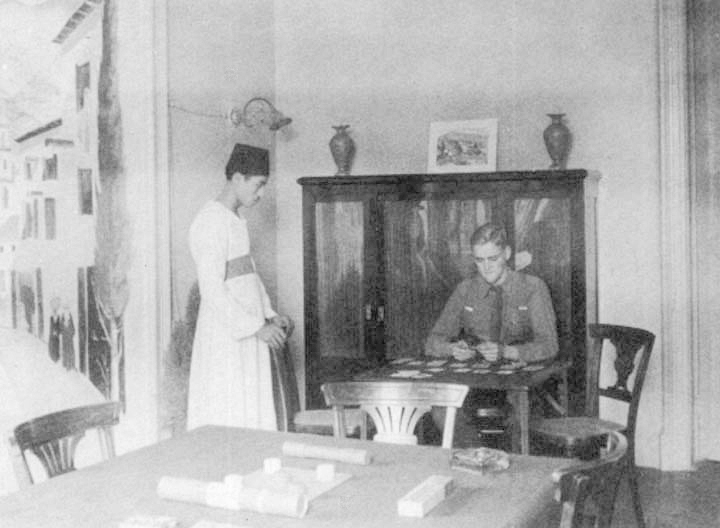
To the left as one enters, is the library, a small cosy room.
Adjoining it is a writing room. Passing along the hall, one comes
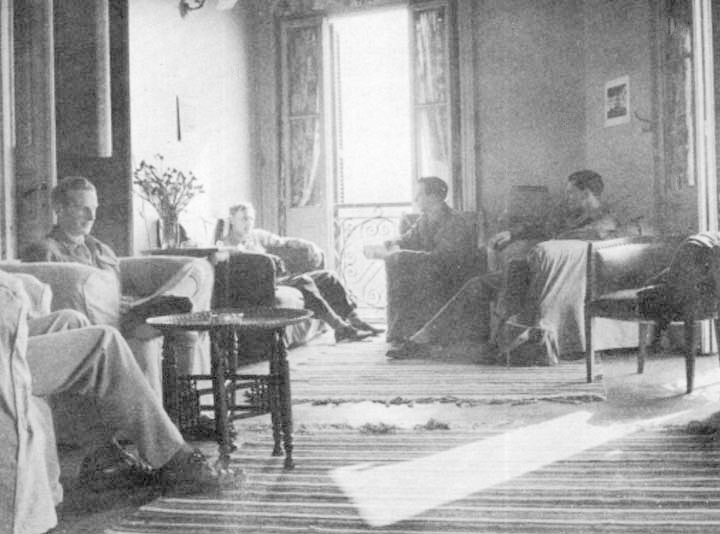
to the foyer, from which doors lead to the office, the living
room, the card room, and the living quarters are designed primarily
for our convalescents. There should be room for about ten or so
at a time. The charge for the night, with breakfast, will be nominal.
The kitchen and pantry exist for serving a light breakfast and
tea. It is not planned to provide other meals. The furnishings
are simple yet comfortable.
Much credit for this goes to Mr. Paine and Mr. Sloane, who
have worked extremely hard to produce an atmosphere of good taste
that has been achieved. Mr. Paine's mural of a Zahle street scene
is excellent, and extremely appropriate. Thank Harry Laiser for
locating our quarters. Apartments are not easy to find in Cairo
and are rare at the price we could afford.
Why an AFS club in Cairo? What is the obligation of the AFS
to its men? In the last war it was nothing, and therefore everything.
Times have changed, as I wrote Steve Galatti the. other day; and
I emphasize again here the point that this is a new AFS. So it
is. Cairo is not Paris; nor the Nile the Seine, the Pyramids,
though famous, are not the Eiffel Tower. And yet somehow that
makes sense, too, somehow, when you can walk up the steps of Shepheard's
and meet your old French Commanding officer, all of these things
seem to go together. And isn't it your dream and mine that someday,
instead of the terrace of Shepheard's, it be the Café de
la Paix and the sidewalks of Paris? As a relatively newcomer,
I sense the difference between the old AFS and the new one as
I have found it. Why an AFS club? Rather, why have we waited so
long for one?
It is not the furniture and fixtures that make a Club, but
people. Every AFS man past, present, or future is automatically
a member of the AFS club of Cairo, and shall continue to be so
long as his conduct makes him welcome there to his fellow members.
In brief, it is hoped that because of the generosity of friends
of the AFS at home you will find here a place to relax in congenial
surroundings. If so then the $2,400.00 a year which will be devoted
to maintaining this establishment will be indeed worth while.
The following simple rules for the management of the Club have
been instituted:-
Rules and Regulations.
1. Membership in the Club is extended to all past and present
AFS men, to their friends in the British, American, and Fighting
French forces, and to all other fighting forces of the United
Nations. Each member of the AFS is entitled to extend privileges
of the Club to one friend at a time. British and French officers
attached to the AFS will have full Club privileges.
2. Every AFS man on leave in Cairo should report to
the Club: this automatically registers him with the HQ Personnel
Department. Every AFS man on duty must report to HQ.
3. Every men is expected to do his part in seeing that the
Club privileges extended to him and his friends are not abused.
4. Over-night accommodations, including breakfast, are reserved
from noon to noon, on a day-to-day basis et 20 Pts. per day.
Special rates can not be made. Residence at the Club is limited
to two weeks. Preference in reservations will always be given
to the convalescents.
5. Hours: Breakfast, 8-9 a.m. Tea, 4-5 p.m. Doors close at
1 a.m.
6. Residents will he expected to police their quarters before
10 a.m.
7. The Club is not responsible for personal effects, valuables,
money, etc.
8. Tipping of Club servants is not permitted. The 10% system
is used and will be explained by the manager-in-charge. Members
are not permitted to enter the kitchen or pantry.
9. Books, stationary, and playing cards may be had upon application
to the manager. The library and writing-room are reserved for
their respective purposes so that they will not be used for visiting
and general conversation. Card playing in the morning is not
desirable, and will end by midnight, in order to secure quiet
nights for any convalescents in residence.
10. Liquor and beer will not be served by the Club, but men
may bring their own for private use to enjoy while playing cards
or visiting friends. Drinking will be permitted between 12-2
p.m. and 8-11 p.m., and confined to the foyer, dining-room, and
card room. The Club will provide glasses and water, but can not
supply other set-ups. Each man availing himself of this privilege
will deposit his bottle labeled with his name with the Club,
and will be served from it by the servants.
11. Disorderly conduct or drunkenness will bar a man from
use of the Club.
12. The AFS reserves the right to suspend membership for any
reason.
13. Realizing that Abbassis barracks are far removed from
the center of things and HQ, and also that there are a number
of us to whom even the nominal rentals of certain service clubs
are more than we can afford, the AFS is now able to offer free
lodging's (in one's own bedding rolls, but on a comfortable spring
cot) to a limit of thirty men at a time. Also at any time, a
hot shower and toilet and shaving facilities. The accommodations,
though in the raw, are still a step nearer civilization than
"in the Blue". With cots worth $10 each and even the
simple plumbing provided costing almost $1,500, we are sure you
will appreciate that even these modest accommodations are to
some extent a luxury. Just at the moment when it seemed hopeless
for us to find the money to install showers, generous friends
stepped into the breach and made it all a reality. In dignified
circles it is called an overnight station, among ourselves, the
"Flop House".
Later, mail and money and many facilities for servicing the
men will be concentrated in the Club area.
The Club opened officially on December 26. It will stay open
so long as its use and usefulness warrant. Those of us at HQ hope
through its medium to meet with you all under conditions less
harassing than are now possible in our limited quarters within
the Perimeter.
If, twenty-five years from now, you can look back over the
years to a memory which is centered about the AFS club in Cairo
then indeed it will have served its purpose well.
Au revoir. See you at the Club.
XXX
No.4...In the card and game room, Acmed
the Egyptian boy watches Wendel Nichols try to beat himself at
solitaire.
|
No.6...In the lounge from left to right
are: Roger Pierce, Charlie Miller, Mark Sloane and Charlie Hurd.
|
THE GRASS IS ALWAYS GREENER
by
G. F. J. King
---------------------------------------
"The undersigned members of the AFS, in the sincere belief
that they are expressing the opinion of the overwhelming majority
of their fellows, hereby place on record their disappointment
at the decision of the British Military authorities to limit
the activities of the AFS to those of a Motor Ambulance convoy.
They feel that such a limitation is not consistent either with
the past history of the AFS or with the understanding of the
present members who believed that they would participate in the
work of advanced medical units. While realizing that the present
heads of the AFS had no option but to accept the ruling of the
British authorities in the present operations of the 8th Army,
the undersigned members request that no further undertaking be
made with either the British or any other force which does not
give the AFS the right and privilege of serving in all branches
of the Field Ambulance work. They feel that any such undertaking
would be in fact a breach of trust between them and the AFS".
(Here followed thirteen signatures)
THE ABOVE PETITION was handed to Colonel Richmond on 13 December
1942. As I have been largely responsible for arranging the operations
in the Field in the Middle East and have acted in a liaison capacity
with the British Medical service, Colonel Richmond has suggested
that I reply.
The petition is based on an inaccurate statement. The British
Military authorities have made no decision at any time to "limit
activities of the AFS to those of an MAC". AFS units, ever
since they arrived in the Middle East, have served with all branches
of Army Ambulance work, including several advanced medical units;
they are still doing so; they will continue to do so. Therefore
I will not deal with the petition in a formal way.
The petition, however, does give the expression to a thought
which undoubtedly exists in the minds of many AFS men: that they
are not doing just the sort of work they expected to do when they
signed up for their war-work. This is by no means peculiar to
AFS men. Everywhere you can hear ack-ack crews complaining there
are no aircraft to shoot at, tank crews in England and America
wishing they were infantry in an active battle zone, infantry
in the battle zone wishing they were knitting socks at home, and
knitters at home wishing they were flying bombers over Berlin
Few persons seem to be entirely satisfied with their war-time
job, and maybe that's not altogether a bad thing.
I have been approached frequently by AFS men complaining that
the work they have been asked to do is insufficient, uninteresting,
too remote from the fighting. These complaints have usually come
from men new to war. Usually they have been motivated by curiosity
to get into the fighting to see what it's like; doubtless they've
had the feeling that only by being submitted to personal danger
will they be able to give the full service which they came out
here to gives This is a perfectly natural reaction and a good
one.
It is a fact, however, that of the First and Second Unit men,
who have served a year in the Middle East, all or very nearly
all, have had the opportunity to satisfy their curiosity; and,
more important, to feel the very sense of personal danger and
accomplishment which comes from doing the job under enemy fire.
Only a few still want to stick their necks out, but nearly all
of them are willing to do any work required of them --- whether
safe and boring, or dangerous and glorious.
In July, after the AFS had withdrawn from Tobruk to the El
Alamein line, I issued a report giving particulars of the number
of wounded carried and the miles driven. The report also showed
that 10% of the AFS men operating in the desert had been killed,
wounded, or captured, or damaged by enemy action. I repeat these
figures in order to impress on recently arrived AFS men that they
should not count on all battles in the future leaving the AFS
as unscathed as has the present October-December offensive.
I am well aware that this record of previous experience will
do little to relieve the minds of the signers of the petition
as regards their own future work. I will try therefore to explain
how the situation comes about that some men work in active positions
while others may have to do routine work in the rear, and how
this is not inconsistent with AFS tradition.
In France, 1914-18, there was an almost static front on which
often (though by no means always) there was action; from the action
a more or less continuous, though varying, number of casualties
had to be evacuated. AFS cars in sections of twenty were attached
to divisions. They collected wounded from the most forward postes
de secours, and carried them back along the usual lines of
evacuation to base hospitals. Then, as now, some of our men worked
in forward positions; some to the rear; and some attached to inactive
divisions, carried sick in the base areas. For AFS drivers eager
to prove themselves, the static front had the advantage of offering
a more or less permanent job. For men in the front-line trenches,
this advantage was no doubt obscurer.
In that war the AFS established a reputation of going anywhere
to pick up wounded whenever required by the army. In this way
it differed from other civilian ambulance services, whose activities
were confined to base areas. The tradition established then has
been maintained; the tactics of ambulance work however, have changed.
This change is perhaps the reason that present volunteers have
received impressions from last-war AFS men which are not completely
in line with the reality of today.
The present war, with the exception of some Russian sectors,
offers no such static front, which can be cordially hated by the
men on it while glamorized by those well away from it. The "front"
nowadays is everywhere; it is sometimes quiet for months on end,
sometimes deliriously active. There is no way of assuring that
the AFS will go to a front which is active, and it is a matter
of luck whether or not the active will come to it.
In France, in 1940, the AFS sometimes found itself many miles
from the front line (which, for the most part, existed only in
radio propaganda); yet it was no less in constant danger of being
attacked by enemy Panzer units and Stukas. In point of fact, some
AFS men were captured while evacuating wounded from hospitals
in areas abandoned two days before by Allied troops. They were
actually in front of the front. At the same time ambulance drivers
in the forward positions of the southern sectors had no work to
do.
In England, during the Blitz of '40-'41, the British armies
sitting on the coasts, which were the front lines, were sometimes
given leave; but London was out of bounds to certain of the best
regiments because of being "too dangerous." The British
armies are still sitting on the coasts, and American soldiers
are sitting with them; they are undoubtedly getting more and more
browned-off as one dreary day of inaction follows another. Yet
during this period ambulance drivers in London, often civilians,
get killed doing their base-area jobs. Think of Warsaw, Sedan,
Dunkirk, London, Crete, Tobruk, Pearl Harbor, Stalingrad, El Alamein;
and then think of the possible battles of the future.
There is one answer I ant trying to make to the petitioners'
objection to our cars being limited to work not in the forward
positions and hence unworthy of the AFS. Had the course of the
recent desert battle been different --- if large enemy elements
had been surrounded and had put up a determined resistance, supported
by the Luftwaffe ---- the MAC work might well have provided all
the excitement any one could desire. And we might have found our
reserve of ambulances hard put to it to keep our MAC to full strength.
When the Middle East expedition of the AFS was originally planned,
it was pointed out that in the British army ambulance cars functioned
in three capacities. First, there are those in a Fd Amb or LFA,
usually about eight cars to a unit. They come under the command
of the Fd Amb and form a permanent part (normally) of the unit,
for administrative purposes, the cars being charged to the unit
and the men being attached to the unit for all purposes. Since
it was desired to keep the AFS an entity --- and not have its
members absorbed individually into the British army --- some other
basis of organization was necessary. The second capacity in which
ambulances function is the MAC. This is a complete unit, but it
contains medical personnel. The possibility of obtaining trained
medical personnel was considered for a time; it had to be discarded.
The only unit remaining was the ACC. This is a more or less self-controlled
transport unit. Because of size and administrative organization,
the British considered it the most practical for us. The AFS drew
the attention of the British to the effect that the volunteers
did not wish to be confined to the rear areas, where ACCs usually
operate; and it was clearly stated in the contract that as and
when required the AFS cars might be used in forward areas.
When we first arrived, the British
knew about us only that we were an untrained group of volunteers
--- certainly not fit for an active front. We were given a short
basic training and sent to Syria to take over routine work being
done by an Australian transport company, to get ourselves properly
organized, to show what we could do. (By this I do not mean that
Syria was only a training ground: it is in a war zone, where many
troops were stationed, and it would be wrong to assume that it
will always remain inactive.) Two months later we had gained their
confidence sufficiently that, when a new AFS group arrived to
take over Syria, our first two units were moved to Tobruk to take
the ACC run back to Bardia. This entailed fairly hard, rather
dull, routine work. The work was enlivened with a few air raids,
some tank battles and gunning a few miles away, an occasional
dog-fight, and a parachute scare. During the period one section
was attached to a divisional Fd Amb; one driver and one ambulance
were lost from it. Late one night, I received orders that the
road was out and we should be prepared to save what cars we could
by filtering them through under cover of darkness. Following that,
the battle improved for us and we got out safely in convoy. We
got out safely because the British were able to maintain air superiority.
With its lines of communication shortened, 8th Army required
fewer ambulances. The DDMS, after consultation with Colonel Richmond
and myself, agreed to use our cars in small groups whenever they
could best be used that way. Thirty per cent were lent to the
NZ's to supplement their Fd Ambs; one section was lent to an armored
div; some were posted to supplement an MAC; and some went to assist
the French, who, at Bir Hacheim, had lost all of their ambulances
and most of their drivers. At this time, certainly, the AFS functioned
(as the petition suggests it should) in all branches of field
ambulance work. Later, the AFS cars were called out of 8th Army
in order to do all types of work, but during this period the AFS
men went through a dreary stretch of heat, mosquito-bites, flies,
dysentery, and frustration. Then later we were again attached
to 8th Army, and had more work on and behind the relatively static
Alamein line. The work varied from dull to exciting; in any event,
it had to be done. And it was well done. This led to our attachment
to 10th Corps to do MAC work during the push. In order to assure
that the full number of cars would always be available for Corps
MAC work, orders were issued that MAC cars would not be sent forward
of MDS's or back of CCC's, except in cases of emergency.
Before the push we had asked that some of our cars (25%) be
posted with Fd Ambs. The DDMS had pointed out that the MAC work
would require nearly all our cars, but he had assured us that
any surplus would be attached to Fd Ambs. This assurance was made
good, and, contrary to the petition's statement, several sections
of AFS cars have operated --- and at the time of writing are still
operating --- with Fd Ambs.
I have tried to show that up to date in the Middle East we
have had a fair share of all kinds of army ambulance work. I do
not believe that there is any way of assuring that in the future
we shall have more than that; nor do I believe that at present
we would be justified in demanding it.
The Directors of the British army medical services are well
aware of the character of the AFS. They know well the performance
of our drivers and of the Dodge ambulances. They know well that
if there is any difficult or dangerous work to be done, the AFS
will always be willing to do it and will do it well. They know
also that AFS volunteers dislike inactivity and that the morale
of the AFS depends largely on giving it the sort of work which
best suits it. They have been told these things by their own officers;
and they themselves have observed these things.
I do not think there is any reason to doubt that, with this
knowledge in their possession, they will use us how, when, and
where we will most usefully fit into the war scheme.
And so to AFS men who are worried because the work they may
be called upon to do is not exactly what they expect it to be,
I say this. The time will probably come when you will find yourself
looking into the barrel of a tommy-gun, or climbing out from the
debris of a Stuka raid, or driving over a mine, or just hugging
the ground while air-bursts scatter fragments around you; and
at those moments, as you cannot fight back, you will draw your
neck well in and promise yourself never to stick it out again.
Of course, if you have to stick it out again you will, and the
chances are if you stay around long enough you will have to many
times.
There have been other man who have complained to me that life
in the AFS is not what they expected it to be. Some of them maintain
that there is too much work, not enough wine, women, song, and
glamour. We have not yet received a petition about this, but if
we do we shall have to concede sadly that war is not all it's
sometimes cracked up to be.
------------------
Note
Since this was written an order has been issued which permits
the MO to use AFS men and equipment as the needs demand. The
AFS is, therefore, not limited to duty by location of MDS or
CCS from now on, and will be used wherever in the opinion of
the Medical officer its services can best be employed: from RAP
to Base hospital.
D.M. Hinrichs
XXX
A BRIGADIER ENCOUNTERS THE AFS
An unidentified AFS driver returning to his post was stopped
by a Brigadier after, according to the Brigadier, a 60 mile an
hour chase. He proceeded to take the driver to task for going
at such high speed. When the Brigadier had finished, the AFS man
replied in friendly fashions
"Okay, Brig," and started on.
The flabbergasted Brigadier continued ahead where he encountered
s traffic accident necessitating an ambulance. Soon the AFS man
appeared on the scene
"Hi ya, Brig, we meet again," he greeted the Brigadier.
What the Brigadier replied we cannot print.
Fred Meyers reported at an air field outside Cairo for much
demanded air passage. In making his request he said he was an
AFS man. The sergeant in charge told him he could leave the next
morning. To make sure, Fred checked up later.
"Sure, you're okay," he was told. "I know how
important it is for you Air Information Signals chaps to get back,
so I am holding back someone else".
Fred explained, to the consternation of the sergeant, but flew
anyway.
THANKSGIVING IN THE DESERT
with
Subsection 3, 16 AFS ACC
--------------
(This is a copy of the Program the
subsection typed for the occasion)
--------------
GRAND BANQUET AND BALL
in honor of
|
The Recent Glorious Victory of the Eighth Army
The Ancient American Custom of Thanksgiving
The Departure of our Friend, Comrade, and Sterling officer,
Evan Thomas
The Well-Deserved Promotions of Able Doug Atwood, Able Chuck
Larrowe and Able Dick Christian to Positions of High Trust and
Responsibility
The October Revolution and the Wide Reforms Advocated by Capable
John Day
The Final Attainment of an Ambulance by Worthy Alex Parker
The Terrific News Coverage Given the War by Far-seeing Correspondent
David Briggs
The Awesome Scrounging Ability of Competent Norm Pierce
The Tremendous Gastronimic Ability of Efficient William Pearmain
The Glorious Birthday of Knowing Jim Atkins
and
The Evacuation of Jack Carroll from the Field of Battle.
|
--------------
PROGRAM
Cocktails
Dinner
Speeches |
--------------
MENU
| Hors D'Oeuvres: |
Anchovy Canape a la Salum et Port
de
Tobruk sur pangrille |
| Soup: |
Potage Toheroa, a la Kiwi |
| Entrees: |
Macaroni avec fromage a la Goebbels
Mixed Grill: Goering Sausage, Meat
Cakes a la 88, Pineapple au Tripoli,
Sauce Cyrenaica |
| Legumes: |
Pommes de terre au Wilhelmstrasse,
Macedoine des legumes avec petits
pois et carrotes
Onions a la 91st Panzer |
| Entrements: |
Tartes Supreme avec Sauce Guilliaume
Pearmain V |
| |
Cafe Continental |
| |
Turkish Paste |
| |
**************** |
| |
Cigarettes Victoire (As especially
made for
Lord
Nuffield) |
| |
**************** |
| WINE LIST: |
(Cellars under the personal supervision
of
Maitre d'Hôtel, Norman, Compte de Pierce) |
| |
Victor Emmanuel III Cocktail |
| |
Vino Victorio, Chateau Bardia, 1942
Covee Capturee |
| |
Veinbrad, Schloss Berchesgarten
(This brandy has been graciously contributed by your friend and
mine, Marshall Rommel,
with the best wishes of the Afrika Korps) |
| |
**************** |
MESSAGES:
The inspiring work of Subsection Three, AFS, has more than
any other single factor, served as a tremendous source of inspiration
to the embattled Russian armies.
---Joseph Stalin
We in the Pacific area have watched with frank amazement the
work of SS3, AFS. The success of the democracies is assured as
such men serve them. By God, it was destiny that sent such men
there. They never break the soldier faith. Attack, attack, attack.
--- Douglas MacArthur
Never in my lifetime of soldiering have I led such men. Through
the shell-pocked cocktail lounge of Shepheard's and across the
machine-gun swept roads of Syria they have surged forward, always
forward, against all the devilish machinations of the Hun. Unfortunately,
none of these brave lads were killed during the recent battle.
But they should have been. I am confident they would have died
gloriously, murmuring, "For God, For Country, and my Sponsor"
Address all donations to Stephen Galatti, 60 Beaver Street, N.Y.
---Stuart Benson
Never have so many owed so much.
---Barclay's Bank
XXX
---------------------------
SECOND UNIT COMPLETES PERIOD
OF ENLISTMENT
ON DECEMBER 30, 1942, AFS Middle East Unit II completed its
period of enlistment. The following log of the unit is purposely
brief to avoid unnecessary repetition of material which has already
appeared in the NEWS BULLETIN:-
| December 30, 1941 |
The second AFS Middle East unit,
consisting of 62 men went on board the SS El Nil. |
January )
February) |
Those two months were filled with
Nursing Sisters, Calisthenics, Black-out patrols, Lifeboat drills,
Trinidad, First Aid lectures, Military drills. |
| March 1 |
This day included disembarking,
Colonel Richmond, Suez, third-class coaches on the ESR, and Tahag |
| March 2-11 |
The unit drew equipment and some
vehicles, attended lectures and classes, and was given one-day
leave to Shepheard's and the Pyramids. |
| March 12-14 |
Tahag to Beirut, in small convoy. |
| March 15-18 |
Transit Camp Flore de Pines, in
Beirut. |
| March 19 |
The unit was split: the men were sent to posts in various
parts of Syria-Lebanon.
During the last week in March a few men of the unit left for
the Western Desert, to serve with the FF Forces.
|
| April |
The majority of the unit continued
its work in Syria-Lebanon. |
| April 30 |
By this date all but a few men of
the unit had gathered at Beirut Transit camp. They, together
with the majority of men of Unit proceeded to Haifa on the following
day, May 1, and entrained for Egypt |
| May 2-16 |
At Tahag, these men of Units I and
II were formed into "X" (AFS) ACC. |
| May 17-20 |
Tahag to Tobruk. |
| June 15 |
"X" (AFS) ACC ordered to leave Tobruk.
During the remainder of the month and into July, "X"
(AFS) ACC continued to work with the 8th Army in the series of
withdrawals which ended at the El Alamein "Line".
|
| July |
RAP and MAC work in and behind the
El Alamein Line. |
| August |
Many men of Unit II returned from
Egypt to Syria in transfer of platoons, which brought Unit IV
and others to El Alamein. |
| September |
There were Unit II men in Syria,
in the Desert, and in Tahag. At Tahag, a new AFS ACC was being
formed; Unit II supplied the new company with a Platoon Leader,
a Company Sergeant, and with a few Subsection Leaders. |
| October 9 |
On this day General Catroux decorated
Lorenzo Semple (AFS Unit II) with the Médaille Militaire.
The citation was: "Au cours de la sortie de Bir Hacheim
le 11 juin 1942 conduisait une ambulance remplie de blessés
et immobilisée par la feu de l'ennemi.. A réussi
après deux heures d'attente à sauver ses blessés
en les transportant sur des camions." The citation also
carried the Croix de Guerre with palm. |
October)
November ) |
During these two months the men
of Unit II, as members of 11 AFS ACC and of 15 4FB ACC, were
working in Syria, Egypt, Cyrenaica, and Libya. |
| December |
With the unit nearing the end of
its period of enlistment, questionnaires were sent to the men,
asking about their plans for the immediate future. Of the original
62, there were 47 in the Middle East at the end of their year.
The names and plans (so far as the plans are definite) follow:-- |
| Barton, T. |
Reenlisting |
| Bragg, D. |
Returning to U.S. |
| Branch, A. |
Returning to U.S. |
| Clarkin, J.C. |
Reenlisting |
| Conover, C.F. |
Returning to the U.S. |
| Cooper, J.F. |
Eritrea--civilian work for U.S.
army |
| Countaway, J.A. |
Returning to the U.S. |
| Crue, D.M. |
Returning to the U.S. |
| Curry, R.W. |
Returning to the U.S. |
| Dean, R.G, |
Returning to the U.S. |
| Frank, J. |
Left in mid-December for the U.S. |
| Gilliam, N.M. |
Eritrea---civilian work for U.S.
army |
| Greenough, T. |
Reenlisting |
| Hammond, J.K. |
Reenlisting |
| Herschel, W. |
Returning to the U.S. |
| Hillman, E.H. |
Returning to the U.S. |
| Hirschberg, W. |
Returning to the U.S. |
| Hobbs, S. |
Working as civilian in the Middle
East |
| Howe, A. Jr. |
Reenlisting |
| Hyatt, D. |
Reenlisting |
| Jenkins, C.F. |
Reenlisting |
| Kahlo, W.C. |
Already en route to the U.S. working
way |
| Laiser, G.H. |
Returning to the U.S. |
| Libber, E.B. |
Eritrea---civilian work for the
U.S. army |
| Marsh, W. L. |
Job in Middle East |
| McGuire, W. C. |
Returning to the U.S. |
| McMeekan, W.J. |
Already en route to the U.S. working
way |
| Morley, C. Jr. |
Returning to the U.S. |
| Morris, T. |
Returning to the U.S. |
| Muller, R. Jr. |
Enlisted in the Indian army |
| Murray, C. |
Undecided |
| Pattullo, E. |
Enlisted in Indian army |
| Quale, F. B. |
Reenlisting |
| Randall, W. O. |
Returning to the U.S. |
| Reynolds, J.E. |
Returning to the U.S. |
| Royal, S. |
Eritrea---civilian work for U.S.
army |
| Schubert, C. |
Returning to the U.S. |
| Semple, L. III |
Already en route to the U.S. working
way |
| Taylor, F.C. |
Left for U.S. in mid-December |
| Terrell, H. |
Reenlisting temporarily |
| Torland, TC. |
Returning to the U.S. |
| Turk, R.H. |
Eritrea ---civilian work for U.S.
army |
| Vance, W.R. |
Returning to the U.S. |
| Warden, W.B. |
Reenlisting |
| Warren, C.R. |
Eritrea---civilian work for U.S.
army |
| Wiley, P.E. |
Eritrea---civilian work for U.S.
army |
XXX
-------------------------------
THOUGHTS OF OLD CAIRO
-------------------------------
The following is not supposed to be good poetry. But can you
do better? A prize has been offered for the best poem with the
idea expressed below, or for the best improvements on this "poem.
|
As I squat in my Dodge
Munching B-B hodge-podge
With thoughts of old Cairo in mind--
Of can beer and skittles,
Wine, women, and vittles,
And a raft of delights of like kind,
I remember that night,---
No, I wasn't tight,
And you lie if you say I got blotto
I was just out for fun
With a bit of a bun
In the terrible Battle of Cairo.
I don't envy one bit
Those guys who just sit
At "work" in HQ each day and night
On finance and misfits
O'er checks, or our chits,
And who just can't afford to get tight.
Not for me, I confess,
Is that headquarters mess;
Why it gripes my old bones to the marrow
And I'm grateful I'm not
Of the headquarters lot
When there's so much to do in old Cairo
Say, what was the name
Of that amorous dame
Who I finally picked up in gay Shepheard's?
She had hips, she had style,
And a glamorous smile
And lips that were red like two cherries---
Yes, she had what it took,
(You could tell at one look)
She was quite on a par with Gret Garbo.
And besides, a good scout
To go gadding about
In the terrible Battle of Cairo ---
On the Alamein line
Where the bullets do whines
The dust of the barrage leaves you choking
While the bombs from the air
Fill your soul with despair
And your voice sounds like a frog croaking.
True, its life in the raw;
To be sure and there's gore
But it's safer and cheaper, and also,
You can save up piastres
For future disasters
In the terrible Battle of Cairo
|
XXX
Associate Editor: Carl H. Adam
" . . . The AFS NEWS BULLETIN is dedicated to our families
and friends at home . . . "
---Vol. 1 No. 1
IN ASSUMING THE POSITION of editor of THE AFS NEWS BULLETIN
we fully realize the responsibilities of the task before us. It
is our hope, however, to continue bringing you news and information
on the same high scale as in the past.
Problems confront this regime which were not faced in past
issues. New men are arriving, veterans are leaving, and our field
of operations has extended to over 2,500 miles. So we must make
new contacts and go far afield for the news we present. As the
BULLETIN boasts no staff other than the editor, there will undoubtedly
be times when the foremost job of caring for the wounded will
necessitate delays in publication: for material comes from the
AFS drivers only when they find time to write. We would rather
wait for good material to bring you the true picture of the work
over here than to dash something together merely for the sake
of putting out an issue.
In Vol. 1, No. 4 of the BULLETIN was printed the intention
of having an editorial board to supervise publication. Upon reconsideration
it was felt that such a board would not be compatible with the
aim of having a news organ written, edited, and published by the
men of the AFS as a group. So the BULLETIN will carry on as before---as
a product of the .AFS in the Middle East and bearing the stamp
of no one part. Printed above is the statement " . . . The
AFS NEWS BULLETIN is dedicated to our families and friends at
home . . . " but we are not forgetting the fact that is also
a medium for the men over here to keep in contact with their colleagues
in the various units. Relative to that we invite all men to contribute
to the BULLETIN ---your BULLETIN---in the form of stories, poetry,
personal experiences, humor, criticisms, and suggestions.
* * * * * * * * *
BOB DEAN CEASES TO BE attached to the BULLETIN with this issue.
By the time you read these words he expects to be well on his
way home. We thank Bob for his diligent and faithful work in starting
the BULLETIN and paving the way for its future. We wish him the
best of luck and bon voyage.
XXX
WITH THE FIGHTING FRENCH
----------------------------
In a letter to HQ AFS, William Merrill of Unit IV writes,
"Enclosed is a factual account of myself and ambulance with
the FF artillery at the time of the October offensive. While
it is not webbed with excitement and anguish, it is nevertheless
a thread in the pattern of the whole front. I offer it on this
basis for present and future records".
A LINK IN THE CHAIN
by
William Merrill
SEVERAL DAYS BEFORE the big push commencing the night of October
23/4 the Dodge and I were detached from the main group at the
GSD and led out by our Colonel to the French artillery. Awaiting
us beside the doctor and his staff were one dead native and one
badly wounded in the thigh by shrapnel. A German plane was responsible.
It struck while they were digging the guns in. I evacuated the
blessé.
The next few days, each morning, I took the doctor on a tour
of the various battery emplacements. Work was light and casualties
nil. The guns were not within range on either side, and the enemy
air force was more interested in objects to the North.
Finally, after a days postponement, we were ordered and ready
to move at six p.m. the 23rd of October. The moon would be full
and rise about seven.
Into the Dodge, beside myself and the doctor, went two native
infirmiers, three paniers of medical supplies, personal
kit, 350 empty sandbags, and the kit belonging to the padre. The
terrain in the direction we were going was unknown, but where
the batteries were placed at this time the sand was very bad---a
heavy spongy top with light lower depths of several feet before
rock. This, as a matter of fact, was the reason for the Dodge
and my being where we were in preference to the Chevies and their
young fire-eating drivers.
At six we picked up the Commandant's peep as a guide and set
out at breakneck speed for the Dodge already weakened by 12,000
miles of previous hard work here and in Syria, plus a bent front
spring.
We arrived et the battery and were told to follow the fourth
unit.
Everything was in turmoil. The air full of the noise of churning
engines and staccato cries of men as they exhorted each other
to get the heavy equipment through the sand. We ourselves had
already been ensablé once. After that I redistributed
the weight by placing the two natives on the front fenders. It
helped the traction of the front wheels and provided a lookout
for bad areas and mine fields.
We had been in a southern sector of the El Alamein line.. Our
objective, we learned when we arrived, was only about three miles
directly East. The journey was not long in distance, but over
sand it could take a fantastically long time. As a matter of fact
we arrived, as I remember, sometime between midnight and one o'clock.
The adjoining British batteries were already firing when we arrived,
and farther to the North there was an incessant rumble and cr-u-m-p-p,
cr-u-m-p-p of tank fire, red against the horizon. Every one kept
muttering, "attaque générale" and
contributing their share to a ghostly tense atmosphere.
Somehow the doctor managed to find a place for our poste
de secours. There was a friendly rim of hills on the south
of our batteries, but it was too far from the third and fourth
emplacements. Therefore there was no choice but a very shallow
saucer. We must provide our own protection from the earth. And
we did by working until five, digging and filling sand bags. And
is that work! I don't know whether it is harder to dig and fill
than it is to hold and pile those heavy bags. Sleep is fitful.
The sound of our guns was still strange to me.
There we were and there we sat for several days. The Germans
had a marvelous advantage in situation. It was like looking from
well up the Empire State building down on Altman's. But their
record was not good. The first day they tried planes. Not many---a
brace, three or four times. But they didn't like the ack-ack from
the Fusiliers Marins. Although some tried to come in very
low, drop their stuff, and duck over the escarpment south. Because
they were so low the bombs usually landed on their sides and slithered
wildly along the ground without exploding. I, being a novice,
was sure they were time bombs and that we would be blown to bits
a bit at a time.
As the British further North were doing their work so effectively,
our air visitors became less and less. Then by that time the enemy
had our positions and response to our barrage became more insistent.
But they were wonderfully inaccurate. The whole was dotted with
guns and vehicles. Ammunition convoys were wandering all about,
leaving depots only partially dug in; yet we had no casualty serious
enough to evacuate. This was among the French and my concern.
The British had less luck.
At this location the only patient I carried was an Italian
prisoner. And how glad the doctor was to see him. He had been
ready so long to do his job with no customers that the Italian
got the full benefit of his pent-up energy. The slug had entered
the inside groin and penetrated outward and upward. Lacking complications
and with the prompt attention he got, he should be convalescing
now.
Lastly we ate with the Fourth Battery where the sergeant, a
former chemist with Coty, did the honors as chef du cuisine.
And what food he dished up over the open fire. The flare for good
living once engrained isn't easily restrained. There the guns
were about ten yards away and I wished I, too, had had cotton
for my ears.
Someday when the histories are written I would like to know
what we hit with our guns. Anyway they must have contributed to
the "attaque générale" because
the situation in the South was all clear.
XXX
-----------------------------------
WESTERN DESERT NEWS
In the long sweep into the desert in an attempt to cut off
the retreating German army at El Agheila, one platoon of AFS
ambulances was engaged in frontline work over territory unsuited
for regular ambulances. What happens when an ambulance convoy
moving over the unmarked desert misses connections is related
under the double meaning title:--
OFFENSIVE MANEUVERS
by
Kenneth Stevens
WE HAVE ALL BEEN IN A HURRY lately, and Jerry is definitely
inclined. He has been running so fast that everyone is having
a devil of a time keeping up with our own advanced forces. On
December 14, however, the picture changed. An LFA (light field
ambulance) and sections of Platoon II of the 15 AFS company caught
up with the enemy.
On the move for a week solid and moving fast we were naturally
in a state of confusion which may account for our little blunder.
The Colonel in command of our convoy left us at noon on the 14th
to go ahead and find a location to set up our dressing station.
The AFS was in tow to evacuate expected casualties. We continued
on the desert track all afternoon, still going westward somewhere
near Agheila.
The Major of our LFA decided that something was amiss around
4:30 p.m. and made enquiries et an armored-car camp. He was told
that if we turned and into the desert we would find our spot.
So we turned north and continued. The leading car finally stopped
on a ridge and to our surprise we found we had reached the coast,
and the bright blue of the Mediterranean was a tonic to our eyes
after weeks of drab and dusty desert. Lieut. Jim Ullman of our
group brought us the cheering news that we were lost, and that
after a light meal we would continue on. I parked my car next
to Jim's platoon truck and Sgt. "Chuck" O'Neil and I
piled out to look the situation over. Peter Brooks and Lee Ault
dispersed their ambulances on the ridge and "Babe" Lund,
Pieter Van der Vliet, Bill Schorger, Tom Smith, Charlie Bachman,
Howie Weisberg, Gene McVoy and the others, dispersed south of
the ridge around the platoon truck.
Chuck, Jim, Merrill Johnson, Carleton Richmond, and myself
stood around the platoon truck smoking and discussing the predicament
we were in. It was very peaceful day, and there wasn't a soul
in sight, nor a plane in the sky. We could make out the outlines
of a town on the coast approximately five miles west of us.
Suddenly the quiet of the afternoon man disturbed by an explosion
a few miles to the west. O'Neil stopped in the middle of a sentence
and for a moment it was a shrill whistle and we dropped like tall
grass under a scythe. The shell burst a mile or more south of
us near the heavily travelled road we had recently turned from.
We all felt rather foolish, but decided slit-trenches were in
order. Carleton took our only shovel and commenced, while the
remaining three kidded him about being nervous. The hole was almost
finished when we heard another explosion, then that eerie whistle.
I dove for the ground, Jim dove for the ground. Chuck dove for
Carleton's slit-trench, and Carleton under an ambulance. That
one was closer, but not near enough to give us the impression
that we were the target. We all laughed over O'Neil diving
into Carleton's slit-trench right under Carleton's nose; then
we went to supper at the cook truck.
We noticed that some of the "Tommies" from the LFA
were wearing tin hats and we were all a little jumpy, but not
seriously worried. After supper we dug slit-trenches near our
cars and sat down to await moving orders from our Major. I remarked
to Chuck that his slit-trench didn't look long enough, at which
he scoffed. Two seconds later we were all in our little holes
in the ground ---that is all but Chuck's feet.
The fun really began at this point. In patterns of three, 88
mm shells came over us with a whistle that caused you to feel
as if an icy hand had been placed on your back. They put one about
100 yards north of us toward the sea, then one about 100 yards
south. As we waited for the third, I sang the first line of "Give
my regards to Broadway" and Jim Ullman added "and say
hello to Herald Square". Then we heard the whistle. I ducked
and it went over my head. After it had exploded, I found that
my face was flat in the sand with a cigarette in my mouth. As
I was lighting another cigarette Jim got out of his trench, dusted
himself off and started for the Major's staff car. I heard another
one coming and yelled to Jim then ducked. That one had been the
closest yet. Shell fragments whistled past our heads and the concussion
of the shell hitting caused the sides of my trench to crumble
somewhat. I don't know how he made it, but Jim get back in his
own hole in the ground safely.
In this pattern, the second shell landed 15 yards from Lee
Ault's car, but he had dug his trench some distance away and was
all right. The third landed on the other side of us. By that time
we were beginning to realize that we were the target. Jim said,
"I've had enough of this," --dusted himself off for
the second time and started for the Major's car. Several seconds
later he made another swan dive into his trench as the salvo whined
over our heads. We then received orders to start our cars and
Jim walked on ahead of us. Chuck O'Neil was singing
"The shells whistle over by daylight
When Jerry starts to play;
We spend all our time in the slit-trench,
Oh please take those Jerries away,"
to the tune of "My Bonnie Lies Over the Ocean."
All of the British trucks had started to move at that moment
so Chuck jumped on my running board and we started a hasty retreat.
Jim jumped on the other aide and began throwing the various pieces
of my mess tin through the window as we bumped over the desert
at 30 m.p.h. It had been on the fender of the ambulance. I had
a hell of a time driving, ducking plates, and trying to keep my
head below the dashboard all at the same time. We must have looked
vaguely like a wild-west show; trucks, staff cars, radio car,
ambulances all tearing eastward across "The Blue", spread
out over half a mile or more.
We stopped after a mile and a half to count noses, and found
we were missing one ambulance. As all of us were trying to screw
up enough courage to volunteer to go back to look for it, it showed
up. It was Jack Lund. He had turned around half way through our
mad flight to take the Major back. One of the staff cars had broken
down. Jack and the Major went back into the shell-fire, chained
the car to Jack's ambulance and towed it out. The Major spoke
very highly of Jack later that night.
At this moment the Colonel in command arrived and we reformed
our convoy, with the AFS bringing up the rear.. We then moved
12 miles back to the spot where we should have been in the first
place. There was not one casualty out of the entire affair, and
the only vehicle damaged was the radio truck which had been hit
by a few shell fragments. We found out the next day that the town
we had seen was Agheila, and that the Eighth Army had by-passed
an enemy artillery pocket in its hurry to get at the main body
of Germans. Two days later one of our ambulances carried an officer
with a bad arm wound received in wiping out the pocket. He received
special attention---.
----------------------------
XXX
----------------------------
SAND--An Impression
by
Pat Fiero
FUNNY HOW YOU ALWAYS think of sand when you picture yourself
leisurely lolling around in the hot, summer sun at the seashore.
Sand, you say, is something soft in which to lie, wiggle your
toes, and let some little kid cover you up. Or something in which
to make forts and castles. In other words you PLAY in the sand
and enjoy it---unless you're like my brother. He hates sand. THE
DAMNED STUFF GETS IN HIS HAIR! Now in the short space of
two swift, sultry months you find yourself having been through
enough sand for the rest of your life and the lives of all your
great-great-grandchildren put together. Your conception of it
has changed. Whenever it's mentioned now, you recall terrific
heat in the desert, sand storms blowing the stuff into everything---your
food, clothes, eyes, lungs ---not to mention, like my brother,
your hair. You'll admit that there are times, few unfortunately,
when this desert has its attractions. If the night chances to
be quiet and there is a moon (a rare combination, indeed) you
see a beautiful picture. Dunes, silhouettes, stars, and all that.
But it is also dotted with the equipment of war. This is not the
picture you saw at the "shore" where shovels and pails
and a profusion of beach chairs cluttered up that sand. Nor is
it the same shovel that covers bodies out here. The pail has changed
into a water bottle to be carefully dealt out and not to be spilled.
Instead of play forts you dig slit-trenches into which you wriggle
your whole body ---not just your toes This is desert sand.
XXX
------------------------------
Having just returned from the Western Desert where we learned
the ins and outs of the work of the AFS through the eyes of 15
Company headquarters, we are passing on the story of the work
done in:--
COY HQ---IN THE FIELD
by
Carl H. Adam
UNDER THE CANOPY OF THE CANVAS cover of a three-ton
lorry, 15 AFS company headquarters, Coy HQ is the outpost and
nerve center for the men in the field with the Cairo office and
those at home. It is to Coy HQ that the orders come and mail comes;
it's in Coy HQ that news of the different sections is learned,
and in connection with Coy HQ is the company canteen where the
scarce and yearned-for cigarettes, chocolate, and liquor can be
obtained.
The personnel at the "office" of 15 Coy is Capt;
Art Howe, O.C., Lieut Charles Snead, adjutant, Coy Sgt. Pat Fiero
(who is also barber in his spare time), Coy Clerk Jake Vollrath,
and Canteen Manager Harry Blackwell. Each has his respective duties
to keep the company functioning and contributes generously to
the never-ending amount of paper work required for the records.
Lieut. Snead is adjutant, with his Willys "Peep", makes
frequent "recce" trips out into "The Blue"
to see how the boys are getting along and to take their mail to
them. Pat is more or less the spokesman for Capt. Howe on routine
matters necessary for keeping the company functioning smoothly.
And when there are sections moving up with HQ Pat is the traffic
cop who guides the ambulances into the proper dispersal areas.
He also supervises the routine work in the office.
With daily strength reports to be made out each morning, semi-
and monthly reports to do on patients carried and miles travelled
by each ambulance, and making changes when a man is transferred,
goes sick, or is promoted, Jake manages to keep his hands full.
Harry, operating from the back end of a 15-cwt truck loaded with
canteen supplies tries to keep the boys happy by anticipating
their wants and attempting to find the best bargains when and
if he is able to track down a bulk NAFFI supplying canteen goods.
As is so often the case, the boys in the office don't work
too hard. But their work has the sameness about it from day to
day that makes it difficult to refrain from chucking it and going
out in an ambulance where the action can be found. In the three
months I was with the company on only two occasions could I say
we really had any excitement around HQ. Once on the Alamein line
a single Jerry plane dropped a bomb over us intended for the railroad
a quarter of a mile away. We had to hit the dust. Again near Marble
Arch Jerry tried to bomb the airport five miles from us.He prompted
a noisy show from the ack-ack and drove us into slit-trenches,
but otherwise he didn't accomplish anything. You see HQ isn't
right up where the fighting is. As a general rule it's back about
15 miles from the nearest actual battles. Not infrequently, however,
it is located in the vicinity of some important objective. But
it is usually attached to some medical unit and thereby HQ is
under what protection the Red Cross affords so that it is comparatively
safe.
When we started into the desert we nearly
always had 20 ambulances with us because we were working with
a CCS that was evacuating patients farther down the line It wasn't
a bad life then. We were far enough back to escape serious water
rationing and once we were located, we were set for days and sometimes
several weeks. But when Jerry foiled the hard-pushing Eighth Army
at Agheila by not stopping to fight, we were left without an ambulance
except those in workshops. All the rest were out on the chase.
Ordinarily we had a battery of cooks to feed our men. When they
go off to work with outlying units they mess where they are so
we found ourselves with almost a cook per man. At meals it felt
like you had planned a big party---only no one had come. It was
a pretty lonely feeling sometimes when all the gang was out. You
didn't admit it openly, but you envied them with all the excitement
of being under fire and carrying those chaps who had been wounded
going against Jerry. The drivers, you felt, were really accomplishing
something. But on the other hand your work was necessary and it
had its bright moments.
At night you sat in the office and read books or wrote letters.
Sometimes you played cards or had a "brew-up" of cocoa.
Then you went to bed in your dug-in bivvy regretting your not
having a heater like the ambulances, but snug and permanent just
the same. Often you could look back on the day remembering that
George or Joe had been in---sometimes you hadn't seen them for
a week--- then there was always the little heart-flip you got
at opening the "secret" messages that came in by dispatch-rider.
Or you would have the satisfied feeling of superiority at being
able to send a "rocket" at the O.C.'s dictation to some
section or some HQ bawling the devil out of them for bawlicksing
up some detail. After a while the desert gets you that way. Knowing
that somebody is going to feel uncomfortable and that you are
having a hand in it lessens your uncomfortableness.
Speaking of those tedious days of sameness, the officers in
HQ get plenty fed up with censoring the mail. When time is on
their hands in the field the boys write millions of letters it
seems ---most of them to girl friends, probably, since their families
don't seem to hear from them. Then along comes a rush or a series
of moves and there is no chance to censor the mail. Eventually
Pat, who is also postal clerk (because he collects stamps) chucks
the mail on the table and caustically reminds those concerned
that the mail has to go out. Then come hours of reading the same
sort of letters.
The reports are the bane of the clerk's life. Especially on
the first and fifteenth of the month; it is then that most of
them are due. You know what has to he done, the figures that are
necessary and the information that must be obtained. But getting
the facts is something else. You remind the O.C. and he orders
the machinery set in motion. Vehicle numbers --four numbers for
70 vehicles each month, reports from sections twice a month, summary
reports and special reports, vehicle disposition reports--- and
all with three or more carbon copies .... How can you et it all
done? Some sections you don't hear from for days. Corps headquarters
doesn't know where the units are because they move faster than
communication. One of our drivers was out of touch with HQ for
three weeks before we could get through to him even by radio.
And then when you do get the information---"patients carried
and miles travelled during the last 15 days"---it is s week
or more after the report was due and the "rockets" begin
coming in asking where is the report due on the 15th? And so it
goes.
There is a war going on you are told and read. Sometimes you
wonder. Soon enough you are sure of it again. It seems so remote
from your seat at the typewriter. Then comes a movement order
and you are off to a new location. You are passing over the territory
the rest of the gang has been working the days gone by. You see
the wreckage of vehicles and planes, the graves, the mines piled
along the road. You say, "It must have been hell through
here," and then you get the feeling---what good am I doing
in all of this? Here I am snug in the back of the fighting riding
in a staff car when the others had to inch their way over desert
tracks with wounded; there's one chance in a hundred of getting
straffed, and as long as we're on the road we won't hit a mine
because they were taken out a week ago...we're safe because someone
else who is really fighting the war has made it safe.
Bitterness comes for a moment But somebody has to do the job
in Coy HQ; you've been assigned to it and it must count or you
wouldn't get "rockets" for late reports.
XXX
----------------------------
STRANGE HAPPENINGS IN THE WESTERN DESERT
WHEN THE AXIS FORCES were just a step ahead of the Eighth Army
it wasn't unusual for AFS drivers to go into towns with the first
advancing troops. Such was the case with John Carotenuto who was
one of the first into a coast town just evacuated by the Italians.
Many prisoners had been captured and one of them struck John's
attention. After exchanging a few words in Italian John discovered
the prisoner to be one of his cousins from Italy.
--------------------------------------
ISSUE CIGARETTES HAVE received some severe words for their
quality but they are smoked just the same. Kenneth Stevens nearly
gave up smoking, however, when upon opening a package a desert
lizard popped out.
It had been placed in the cigarette box for safe-keeping by
collector John Huntington.
XXX
--------------------------------------
THE REMEMBRANCE OF SYRIA
by
William Brown
|
I
From Children of Cain
of time's mirage beneath indifferent heaven's
blaze
this many-voiced chatter
and narrow-streeted rock.
The seething
bedlam, the howling marketplace.
City of the plain
built layer painfully upon layer of shattered
faiths,
your ways wrought in crooked
joints
are indifferent
too, brutish and diseased,
But
throbbing, as if to live forever
Sacking overhead yields these tattered streams of light,
and stirs above shadows,
and plays indifferently upon
a laughing greed of faces,
these
grasping-gestured old hands
and
threadbare arms
The faces shift, moulten in the crooked shadows,
and pass the tawdry heaped wares of endless
stalls:
leather carved and hammered,
and copper ringing,
melons
and unsweet wine, silver and brocades,
tapestry
for tourists, incense, baskets
II
"A wog is a wog!" (He was not a week off the troopship)
and he struck the Arab boy,
and squinted paled blue eyes
to the glaring white light,
angered
embarrassment,
annoyed,
elbowing his way with the throng
The Arab boy persisted, dismayed and wise:
"Yes, George ! Piastre! Thizway, George!"
Again the raised sunburned
arm,
and the
child fled with the throng,
grinning,
sly, quicklike gazelle,
Oh strong men from your West,
filled with strange oaths, armed,
endowed with the increment
of your ages
Built upon
these dirty mindless men of the East
their
shapeless lands shaped only by speech.
Your arm is raised., has struck its khakied strength.
"Lazy bastard wogs, bad as bloody flies,"
he cried,
walking on annoyed,
squinting
in the glaring white light
at
the Citadel mountain thrust above the town.
Meager feast for an ever-hungry Lion,
that is incorrigible and hungry for more hunger
still
The cohorts of empire too:
and now,
feasting grows thin.
Thinner,
perhaps, than hunger will stand..
Strong men from your West,
Empire's ferocity turned in upon itself
This grand incest now unleashed:
Spake Feysul
the land and the people of the land
heavy
in his heart
fired by
an idea and saddened by wisdom
"Does the ore admire the fire which transforms it?"
III
Beyond crumpled walls and seething crooked streets,
far from bedlam cries,
as slit, meandering rivers
pass through numbered fallen skies,,
Echoed
off the wind-torn empty desert,
down
from the mountain spine and hill.
Lost in echo on the rind of the wasteland
In cold wind under the black sweep of stars.
Over the slumbered earth,
a Prayer:
wailing
to the dome of night,
a cry unmarred
by doubt . . .
|
------------------------------
XXX
------------------------------
AFS News
Bulletin, No. 6
Index