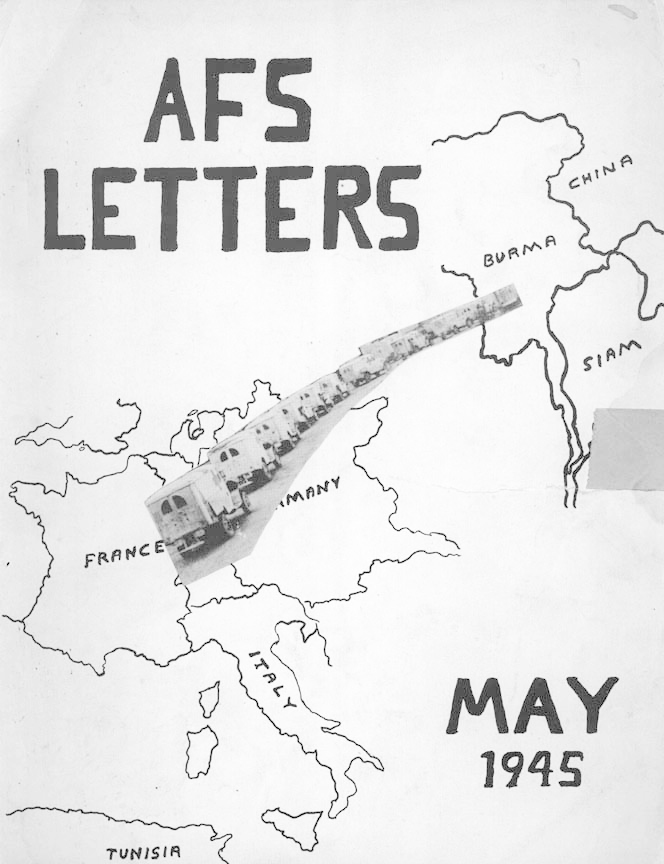
Edited and published at AFS Headquarters, 60 Beaver Street, New York 4, N.Y. under the sponsorship of the ambulanciers' relatives and friends, who contribute the excerpts from the letters.
With the end of hostilities in Europe the AFS ambulance units there conclude three and a half years of continuous service with British Forces. Although there have been units with French Forces for an even longer period, the misfortunes of war, the German occupation of France and the slow formation of a French Army from North Africa interrupted AFS' ability to render continuous aid to this ally. For most of the ambulance men, however, as for the majority of the men of the Allied Forces, VE day does not constitute an end, but rather a pause for breath before continuing down an even harder rougher road, to victory over the Japanese..
The volunteers and their ambulances have satisfactorily completed the mission which they began in Syria and the Western Desert. The wounded have been evacuated whenever and wherever it was possible. The shooting has stopped the fronts are quiet. . . . in Europe. The fight is still on in the far east where allied fighters are being wounded every minute. In the battles of Burma and China AFS is doing its bit to help. There are many long runs to be made before the volunteers can write "mission completed" on that chapter of their work. Many of the men now having a breather in Europe, will soon be joining the units already with the 14th British Army of SEAC.
The jungle and hill fighting against the Jap in that country is harder than most fighting because of the country itself. Evacuating the wounded is often nearly impossible. AFS' Yankee ingenuity has found plenty of problems there to work out. The wounded have been carried in almost every kind of a vehicle and contrivance possible, from ambulances, stretcher-bearing jeeps, motorcycles with a stretcher mounted on the sidecar, to a pulley system which hauls the patient down hillsides, from which no mechanized vehicle could reach him.
The Allied battle against the Jap will go on, Burma, China, Japan....the AFS men will go along doing their best to help, staying at their posts alongside our allies until final victory . . . . . VJ DAY.
J.B.
| Thomas Stretton Esten | Stoughton | Mass. |
| George Oscar Tichenor | Maplewood | N.J. |
| Stanley Blazei Kulak | Salem | Mass. |
| William Keith McLarty | Berkeley | Calif. |
| John Fletcher Watson | Larchmont | N.Y. |
| Randolph Clay Eaton | Ft. Lauderdale | Fla. |
| John Hopkins Denison, Jr. | Big Horn | Wy. |
| August Alexander Rubel | Piru | Calif. |
| Richard Sterling Stockton, Jr. | Bryn Mawr | Penn. |
| Curtis Charles Rodgers | Highland Park | Ill. |
| Caleb Jones Milne IV | Woodstock | N.Y. |
| Vernon William Preble | Lowell | Mass. |
| Charles James Andrews, Jr. | Norfolk | Va. |
| Arthur Paisley Foster | Warroad | Minn. |
| Charles Kendrick Adams, Jr. | Huntington | Va. |
| Henry Larner | Albany | N.Y. |
| Alexander Randall, Jr. | Baltimore | Md. |
| George Edward Brannan | Chicago | Ill. |
| Robert Carter Bryan | Richmond | Va. |
| Dawson Ellsworth | Milwaukee | Wis. |
| John Dale Cuningham | Brooklyn | N.Y. |
| Donald Joseph Harty | Buffalo | N.Y. |
| Thomas Lees Marshall | Winnetka | Ill. |
| George Alden Ladd | Burlington | Vt. |
| Paul Haynes Cagle | Owensboro | Ky. |
| James Bennett Wilton, Jr. | Peoria | Ill. |
| Ralph Evans Boaz | Omaha | Neb. |
| William Tuttle Orth | New York | N.Y. |
| Bruce Gilette Henderson | Kenmore | N.Y. |
| Albert Studley Miller | Cambridge | Mass. |
| Hilding Swensson | Manasquan | N.J. |
| Charles Butler Alexander, Jr. | Eccleston | Md. |
| Jack Wells Douthitt | Florence | Ala. |
CHARLES BUTLER ALEXANDER, JR, of Eccleston, Baltimore Country, Maryland, died on April 9th, shortly after he was wounded by machine-gun fire and captured by the Germans in the town of Niefern, near Pforzheim, Germany. "C.B.", as he was known to family and friends, had been a member of the AFS since 1943. He served with the British Eighth Army during the Desert Campaign and in Italy, and in August, 1944, transferred to the French AFS Unit, where he served until his death. His outstanding courage as leader of an AFS Section will long be remembered by the men who served with him.
JACK WELLS DOUTHITT, of Florence, Alabama, was killed on April 20th, while serving with the French Unit of the American Field Service. Jack was ordered to evacuate four seriously wounded men in the village of Boblingen, which was partly surrounded as the result of a German counter-attack. He did not report back to his post and on April 21st, he was found dead beside his ambulance, which had been blown up by a German bazooka. Jack had served with the British Eighth during the desert campaign, in Italy, and with the American Fifth on the Anzio Beach-head, later transferring to the French Section of the AFS. He was absolutely fearless and devoted to the Service in which he volunteered.
ARTHUR LESLIE WHEELER, of Ardmore, Pennsylvania, on April 20th, was slightly wounded in the head, while serving in the Italian campaign. His wound was dressed and he returned to duty immediately.
| PAUL M. MCKENNA | in India-Burma |
 |
 |
 |
 |
 |
 |
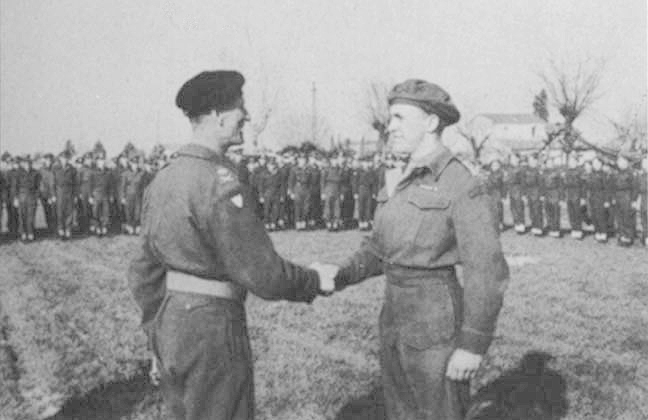 |
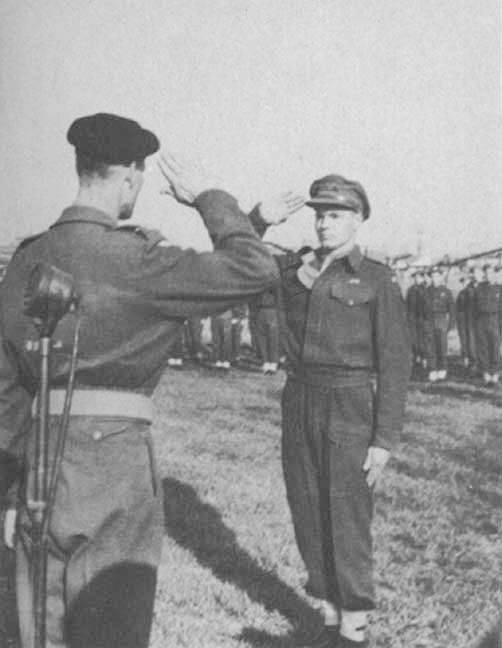
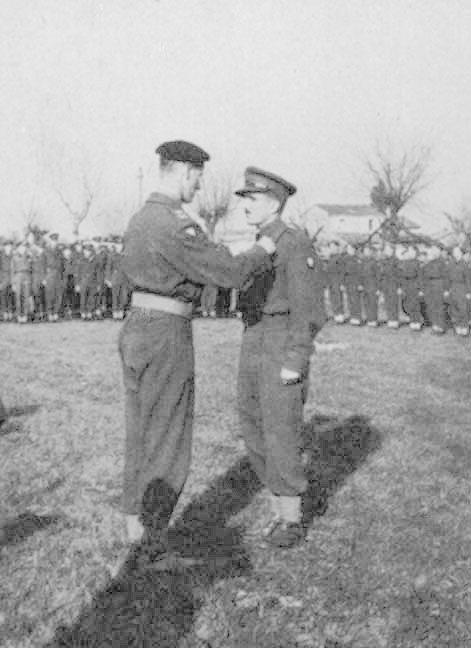
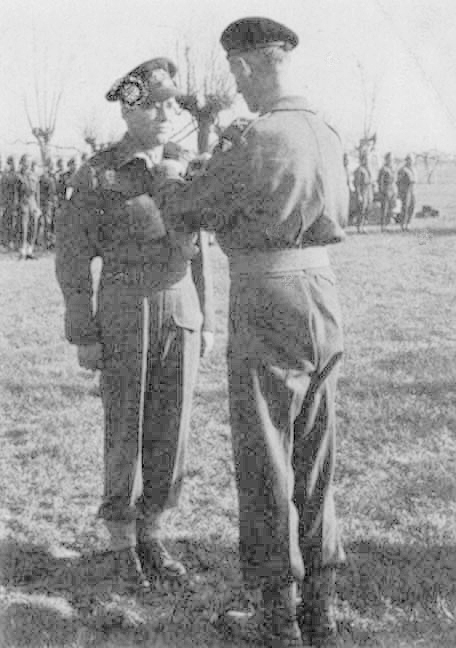
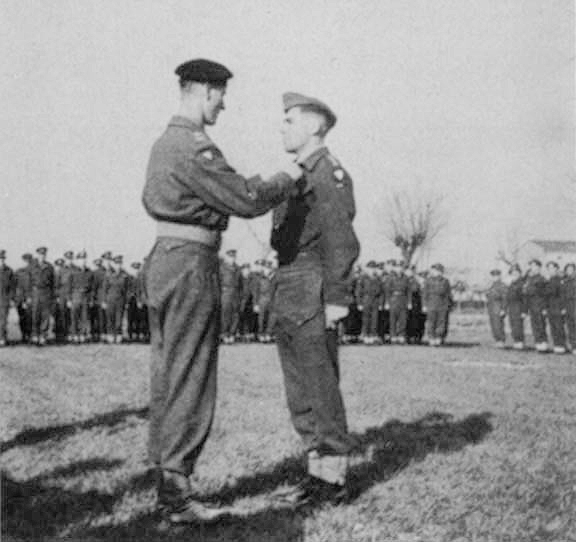
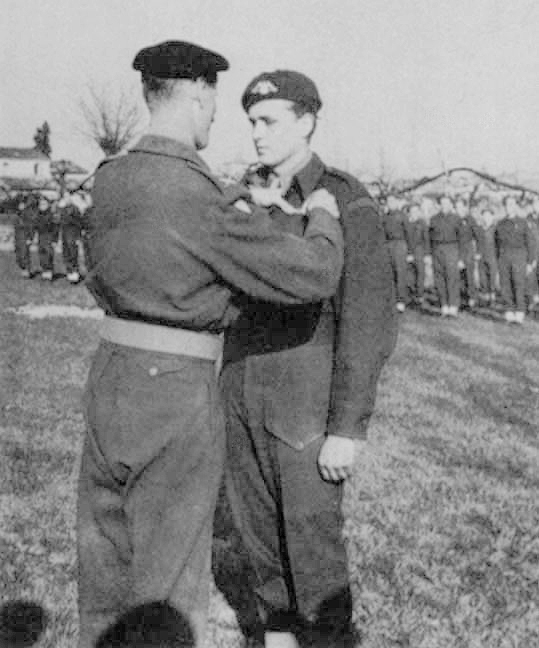
Lt. General McCreery, commander of the British 8th Army, awarded the British Empire Medal to six of the AFS ambulance drivers and an English officer who has long been in charge of maintaining the ambulances. The ceremony took place at the Army's headquarters in Italy. |
|

March 9, 1945.
"I am at present with the same five fellows at the same post. Things have been fairly hot around here lately as far as shelling goes, but it all seems to be over now as the past two days have been quiet. We stick very close to our room during the whole period and thus have very little chance of getting hurt. Two shells landed very close and blew the glass out of our window, but we were always careful to stay next to the safest wall in our room, so nobody was hurt. We have also found an entrance to the cellar thru our room and spent quite a bit of time in that while Jerry was stonking. We have all learned by this time not to make any false pretenses of unconcern and stay out doors when the shelling begins --- even a good distance away. This foolish attitude among some men in the town resulted in a goodly number of casualties in the past week here. One shell --- the fourth one to come in --- killed four and wounded ten. They all had plenty of time to get under cover but like damn fools just stood around in a large group till the shell got them. That incident kept us all pretty busy for a while. It was really a bloody mess. We carted everybody up to the A.D.S. in a great rush---corpses and all as we weren't sure who was dead and who wasn't. The A.D.S. regular ambulance wouldn't start, so we all made a good impression. They said it was just like a lot of fire engines zipping by. One guy had his head blown off (we were sure he was dead) and others had arms and legs missing, but the doctors' fast work here saved all that was possible. Such a sight would have probably got us all regurgitating at home, but it was all so impersonal that none of us were bothered. Though it probably sounds like the wrong thing to do in such a gruesome circumstance, it is usually best to joke about it. There have been several other casualties in the area, but that was by far the worst. It reminded us to be even more wary of shells anyway.
"Today we had some pitiful patients. Five little children were playing in a field and one of them set off a mine. Three were wounded quite badly and the other two only slightly. They were very good patients, but their crying seemed very pitiful and out of place in an Army dressing station where the wounded men rarely utter any sound except for occasional moans.
"The stretchers seemed very large for the tiny bodies lying quietly on them. Such incidents happen quite often, either by shells or mines, but whereas you get used to seeing wounded men --- some horribly mutilated---, the sight of a little child even slightly wounded affects you much more about the injustice of war. More people should see such things. Maybe this war would end a little sooner and would prevent another."
March 27, 1945.
"Italy continues to be colorful, beautiful, and truly interesting. I have seen many sights that I'll never forget, and I've been with outfits that I'll never forget. I've been with the 'Scots Guards', the 'Coldstream Guards', the 'Grenadiers', the 'Indians'. I worked with 'Joadies', 'Jocks', 'Paddys' and it's all been fun and most interesting. In Italy, I've seen both coasts, the mountains, the plains, and most of the big cities. Bologna is the next one I want to see. We have been fighting for that city for a long time, and it will be a relief to get it."
March 9, 1945.
"The weather here the last week has been like spring in America, unbelievably lovely --- except on days when it decides to rain.
"The people who used to occupy this house left two long, leather-covered benches which I now sleep on in my sleeping bag. It is much more comfortable than a stretcher.
"The house is 400 years old and includes a square tower. The Padrone lives downstairs fronting a stone terrace that looks out over a river valley. One of his tenant families used to live upstairs, another tenant family lives in a wing. Italy is still sort of feudal that way with many estates of this sort.
"The padrone only lived here in summer, but he comes up here every few days from his town house which is reputedly very sumptuous. He has an olive oil factory in town and another in the basement here, and drives up the tortuous hill in his shiny black little fiat. God knows where he gets the gas from. The furniture in the padrone's quarters is rather simple, but he has lovely ancestral paintings and a fine piano which unfortunately the German bombs rendered incapable of sound.
"The poor padrone is rather heartsick. He has had heavy tanks parked all over his orchards, and has shell holes in his walls. His beautiful formal garden and cypress trees, however, are undamaged and little fish are still swimming at the top of his large 25 ft. pool. It is fed by a spout of water that springs out of the lips of a marble face. Today one of our platoon ambulances carried 8000 liters of wine to town for him, and he gave us a ten year old bottle of vermouth."
March 24, 1945.
"The flowers grow up right under the soldiers' feet, and spring up again after the tanks have passed over them."
No date.
"I spoke out of turn and put my foot into it when we walked into a room where there was one of these 17th or 18th century museum-piece pianos. A Gurkha was standing there with a couple of strings, fastened at one end in the piano, which he appeared to be pulling out. The first thing that entered my head was that here was jungle boy fascinated with the music machine, and he was trying to see what made it work. I said, 'Is he tearing it apart, or tuning it?' He looked up, smiled rather grimly, and invited us in, in a very British accent. He turned out to be a captain, well-educated; and he was trying to put the piano back in shape, not pulling it apart. This reminds me of the one I heard about a boy from the American 92nd Division (they are the all-negro bunch over with the American 5th Army) who was driving his truck down the road and came to a bunch of Indians or Africans. As he paused he leaned out and shouted, 'Savage, where yo' spear?'...............
"The other man, was injured seriously at least from shock, and it was rather a close call. He had had a shell land near his feet, or something, which put holes in both legs and broke all the. bones in one leg just above the ankle. (It was twisted halfway around, but the skin was not badly broken) He was patched up as much as possible by a very kind-looking mild-mannered red-haired Italian doctor up there and we started off. I timed the trip down at an hour and ten minutes. The situation was not helped much by two excitable orderlies who were sent along, and who kept crying, 'Pronto, he die, Joe, he die.' We didn't know if they were just worrying or if he had died. I followed him into the hospital here and watched until they got plasma started into him. Presumably he was going to live. Then to bed at 5 a.m, and no action since then."
March 30, 1945.
"This post is something like home to me now, a large family. About 14 people altogether. Mother, father, 2 sons, 5 daughters, one married, a son-in-law and various other relatives, who lived behind Tedeschi. Yesterday they were all out working the garden. They were fairly well off and they have had practically all the army nationalities billeted here. They were trying to explain how beautiful the gardens and etc. were before. Have been very good to us. They have fairly good vino, but it really is something to see the way they enjoy beer. You'd think it was champagne. We have taken in three bottles and you can guess how far three would go. The girls are the same as you, though a little goes a long way.
"It's a scream to see what little things mean to them. They made me a new Red Cross banner, the one I had was a rag and I lost it on a run. They are used on the roads which are under observation by 'Ted'. So they insisted on making one for me on a Sunday, which you know is not supposed to be a day for sewing. They explained that I was doing good carrying wounded, so that it was O.K. Pretty good, what? All by hand too, no sewing machine. One of their red dresses which meant parting with something quite valuable.
"Have carried quite a few casualties considering the action in this sector. Very hilly and different than out on the plains. Carried several Teds, one in pretty bad shape. Everybody has a lot of respect for the Ted as a fighter, pretty tough and crafty, has the advantage of having been through this country and has the lay of the land. Certainly has raised a lot of H--- with mines. This post is not forward and most casualties are brought in by jeep. But occasionally, we have gone up, when they come too fast for the jeeps.
March 27, 1945.
"One of my pals and I were taking a walk up to one of the forward posts to see some of the boys. We went over the hills hoping to come across some enemy guns and ammunition that might be left behind. We had gotten about three hundred yards or so up the valley when we thought we heard some one yelling at us. Sure enough, there were two English soldiers coming after us, one covering us with his rifle. They told us their officer would like to speak to us. It made quite a scene with the two Limies behind us and heading towards the officers' quarters. He wanted to know who we were and what we were headed for and he seemed very much surprised. He took my Geneva card and tried to put a call through to my post, seeing whether there was any ambulance driver that fitted the description on the Geneva card. After about a half hour he dismissed us, but before we left he asked us if we knew the password. Our answer was no. He didn't think it would be a very good idea to continue onward but we didn't think his idea was any good so we went to our destination. When we reached back to our post the medical officer told me that a messenger had come while I was gone and inquired as to whether I. was posted there. The medical officer said he didn't know my full name but the description fits him well. I guess the officer that stopped us hadn't been able to get a call through so he sent a fellow over to our post to check us. It seems as though German patrols have been filtering through and we looked like pretty good suspects. Their mistake. Its a good thing the boys were not trigger-happy because the reason they had come running after us is that we didn't hear their first command to halt and had kept on going."
April 8, 1945.
"A most impressive occasion was the investiture with the O.B.E. by Lt. Gen. McCreery of the 8th Army honoring seven of our men---impressive in spite of the fact that while rehearsing the difficult role of standing at 'attention' and 'at ease' (the only two maneuvres the Field Service is capable of performing) two characters fell flat on their faces, luckily before the arrival of his Excellence.
"It was a fine clear day with a warm sun and we were far enough forward to hear distant guns and constant air activity, which gave the ceremony the proper atmosphere. There had been great activity for a few days before to get the outfit into some sort of uniformity of costume to be presentable. For instance, it was forbidden to wear fezes or Basuto hats, Spahi caps or Glingarys. It finally boiled down to garrison caps and berets for head gear. Those with caps wore black shoes and those with berets brown. The caps were in the front rank and the berets in the rear, on three sides of a square.
"After the presentation and address the O.C. inspected us, walking up and down each line and occasionally speaking to someone, especially to octogenarians, including even to little me, probably wondering more than ever what in hell the AFS is made up of anyway! Two men, who also show a bit of gray at the temples were so favored as well. The General is a fine distinguished looking old boy with a chest full of ribbons and, oddly enough for a British officer of his age, no mustache. His address was most flattering not only to those decorated, but to the whole AFS as well, and when it was over he complimented the AFS officer upon our fine appearance!!! I heard afterwards that there were no ribbons of the Order available in Italy and that in order to make them some, those attached to actual medals had to be chopped up! Casual, to say the least, what?"
January 22, 1945.
"We went to the dance at the AMG officers' mess held in the general section of the provincial prefecture. Lots of bright baroque gilding, ceiling festooned with angels and things. Orchestra played smooth jazz as well as Viennese waltzes. Lots of pretty, attractive girls, with space to dance and a good bar. Met a U.S. Capt. from Brocton, the British Capt. who runs the dances; all the girls danced very well. Got a big kick, while talking to a tipsy Yank officer over a sandwich. A British Lt. came up to the table, bowed slightly from the waist, said very seriously, 'You were at Alamein? I was in ----Corps. It was an honor having the Field service with us. Good evening.' He bowed slightly and disappeared."
March 9, 1945.
"The M.O. is a Captain, a very pleasant man, and very interesting to talk with. He spent quite a few years in India and is quite interested in anthropology ---in fact, it was his hobby there. So you can well imagine that we found a lot in common to talk about. He's a friendly sort of person, has little use for ceremony or formality, and is well-liked by every man in the regiment with whom I have talked. 'A Smashing Bloke', they call him, which is the highest compliment they can pay anyone. At any rate, we spent our time in the car comparing American Indians to the India Indians, discussing primitive religions, ceremonies, etc. It was quite enjoyable and I look forward to more of such trips.
"We arrived back at the post just in time for dinner at 1 o'clock. I few minutes later a jeep came tearing up the hill towards the R.A.P., and shortly after I got a call to bring the ambulance around. I backed it right up to the door. There were two stretcher cases, both flyers, and both Americans. They had made a crash landing in the valley and were pretty badly banged up. One was almost unconscious, his face badly cut up in addition to other bruises. The other hid a bruised leg, and his mouth and nose were injured. He limped out to the ambulance himself ---wouldn't be carried on a stretcher-- but was glad enough to stretch out on one after he got in. The M.O. came along with me and we took the two Yanks (the first time I had carried American soldiers) over the mountain to an American medical post on a main highway. There they would receive further treatment and be evacuated to the rear. We never found out exactly what happened, since neither of the men was in a condition to do much talking.
"On our way back the M.O. thought he'd like to take a look at the new position of a couple of our big guns. They had recently moved up to a rather forward position ---unusually far forward for such heavy guns. To get to these guns we had to go along a road that was under observation --a road marked periodically with signs readings 'Road Under shellfire! Keep 200 Yard Interval.' We also had to lower all windows and black out the windshield to prevent sun reflections. This was done by raising the windshield and tying a blanket over it The small rear door windows were so dusty they didn't need additional blacking out. Recently Jerry has made this rather a hot spot and has poured a lot of shells into the area. However, he must have been resting this time because there was no shelling while we were there.
"We finally found the guns, parked the ambulance on the far side (from Jerry) of a house, and walked across a little stream to the gun positions. Here we found that we were not the only visitors that afternoon ---the C.O. (Commanding Officer --- the Colonel) and the 2 i.c. (2nd in command --- a Major) were there, too. They were just getting ready to have a shoot, so we decided to stay and watch it.
"These guns, though not past the infantry, were located well up for artillery, especially heavy artillery. They were in a little valley or hollow, shooting over the top of one hill to another beyond where Jerry was. Each of the guns was well sand-bagged and covered by an elaborate camouflage net to make spotting from the air difficult. The men were none too easy about this because the most obvious thing about these guns cannot be camouflaged ---the flash when the gun is fired---a flash that is terrific. They all knew it wouldn't take Jerry long to spot them. Their hope was that by the time Jerry started to work on that position they would have finished their particular task and have pulled out. They don't leave these big guns forward for very long; ---push them in to do a job and then pull them back.
"They were busily engaged in doing this task at the time we were there. What that job was I don't know, and couldn't tell you if I did know---but it was obviously destruction on a large scale. The M.O. and I squatted behind one of the guns to watch the show. We could hear the O.P. sending down the readings on the target, and one of the gun crew repeating them to him over the phone system to make sure he had them right. The M.O. told me that if I looked above the gun I could see the shell as it left the muzzle --- the only place from which you can see it is directly behind the gun. The order 'Fire!' finally came through, and again the dazzling flash and thunderous crash as the gun went off. 'Did you see the shell'? the M.O, asked me, 'No', I replied, somewhat sheepishly as I removed my fingers from my ears, 'My eyes went shut'. I did see the next one, tho, managing to keep my eyes open. Out of the flame and smoke emerged a tiny black speck that climbed high into the sky, growing smaller and smaller until just as it began to arch for the descent it disappeared. Perhaps if you were at the other end and were watching for it, you could see it from there on as it approached you. I don't know and I can't say that I really have any desire to know!"
April 15, 1945.
"When we got up there the bombers were going over again ---wave after wave of them---not in as great force as the day before, but still in large numbers. We noticed a lot of ack-ack bursting in the air, and at first were somewhat puzzled to discover that it was from our own anti-aircraft guns. Then the solution dawned upon us; there was a pattern to these ack-ack bursts. They were being used to guide the planes over the front lines and to their targets. They were fixed to explode several thousand feet below the level at which the bombers were flying. Quite a clever sign-post system, but one not devoid of danger for us because the ack-ack was bursting directly overhead and the shrapnel fragments were dropping all around.
For the time being we all got into the back of one of the ambulances to wait until it was all over. If we did venture out we were careful to wear our helmets. Not a great deal fell in our immediate vicinity, but we did hear a piece ping off the side of a motor-bike parked next to the ambulance. We picked it up later --a jagged hunk of steel about the size of a fountain pen. A few others dropped in the yard, sending up little puffs of dust. These are not too dangerous since by the time they get down near the ground the only force behind them is that of gravity. As long as your head is protected you are quite safe.
"I have never, as yet, had any wounded man die while in my ambulance---and I hope I never do. Some of the other fellows have--- and it doesn't make them feel very good, even tho they know there was absolutely nothing they could have done about it. Yesterday I carried a patient with a badly mangled arm. My orderly sat in the back with him all the way, administering blood plasma from a bottle suspended from a hook on the ceiling of the ambulance. Fortunately I had found another road, much smoother, and was able to give this man a faster and more comfortable ride than if I had taken a regular road."
The American Field Service volunteers have received one of the finest recognitions of their history, in a recent directive issued by the War Department. This directive states that army men are eligible to count time formerly spent as an AFS driver on their point scores in applying for an army discharge. AFS service counts the identical number of points as does Army service.
A dreadful oversight has been called to our attention for which we belatedly apologize, and hasten to correct. At the time that Chan Ives returned from Burma, we neglected to tell the readers that Lawrence Marsh had taken over as CO. We hope Lt. Col. Marsh will forgive us long distance from Asia. He is an AFS veteran of the Western Desert and Syria where he served for two years before coming home and subsequently going to Burma.
David Briggs, at present serving with the First French Army has written a book of his AFS experiences in North Africa and Italy. This book, ACTION AMID RUINS, is illustrated by photographs that Dave took overseas. It will be lithoprinted and for sale at New York AFS Headquarters exclusively. We can not tell yet the exact price but the book will probably cost approximately $1.25.
In connection with the Seventh War Loan Drive a recording has been made telling the story of Neil Gilliam's work in Burma which won him the George Medal. This recording runs for fifteen minutes and has been distributed to 773 radio stations throughout the U.S. by the Treasury Department. It might be played at any time during the drive and is a grand tribute to Neil and AFS, well worth listening to if it should come over your local station.
The little man with the bow and arrow isn't doing a very large business with AFS this month. The romance news is that John Carotunuto was married in February to the former Miss Gertrude Moreay at Elkton, Maryland. Bill Tarvia is engaged to Miss Sidney Walker of Southport, Connecticut, David Hodgdon, now serving in Italy, is engaged to Miss Rosaria Guilia Flores of Naples; they will be married in June. The very best of luck to all of them.
The AFS veteran ambulance has acquired the affectionate name of Bambolina". There is no particularly valid reason for this except that the vehicle has a distinct personality all her own which is expressed in the name. In the two months since she has been home, Bambolina has worked very hard, nearly as hard as she did overseas. She has been punched, poked, peered at, rapped on, climbed over and under by thousands of incredulous civilians. She has taken part in an Army Day parade in New York, a War Bond Rally parade in Ithaca. She was proudly on display in Rockefeller Plaza in New York for three days. She drove to Rochester, N.Y. to be driven around and around in connection with the opening of the Community Chest Drive there. And she had the unusual experience of driving through a snow-storm on May 10th on her way back from Rochester.
John Patrick is acquiring a new career for himself to add to his laurels as a playwright. He is becoming a star speaker and under the auspices of the National War Fund will appear in several towns of Ohio, Iowa and Minnesota making speeches about AIS during June.
Something-new-under-the-sun Department: a recent issue of the Harvard Alumni Bulletin lists a former AFS man in the military intelligence department of the magazine as: "American Field Service volunteer ambulance corps, retired."
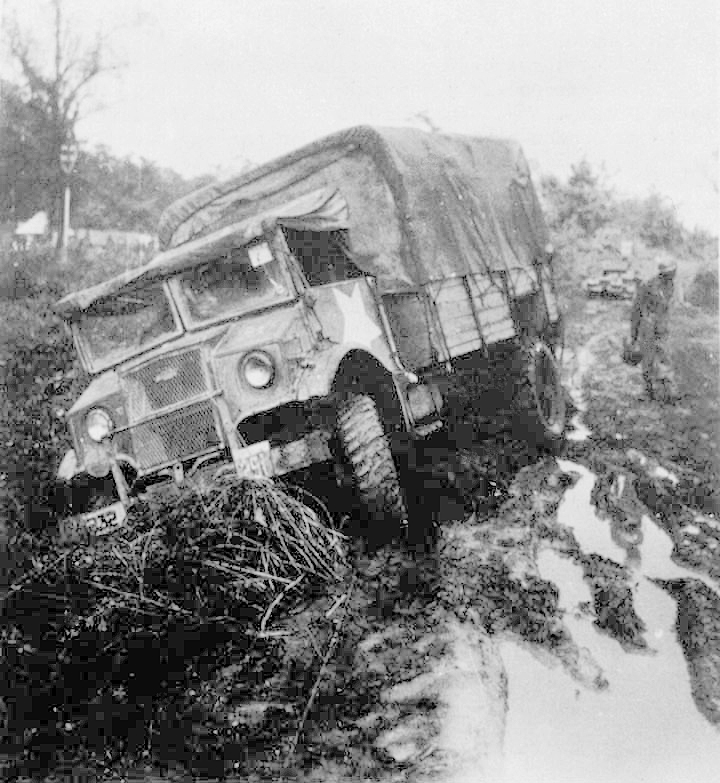
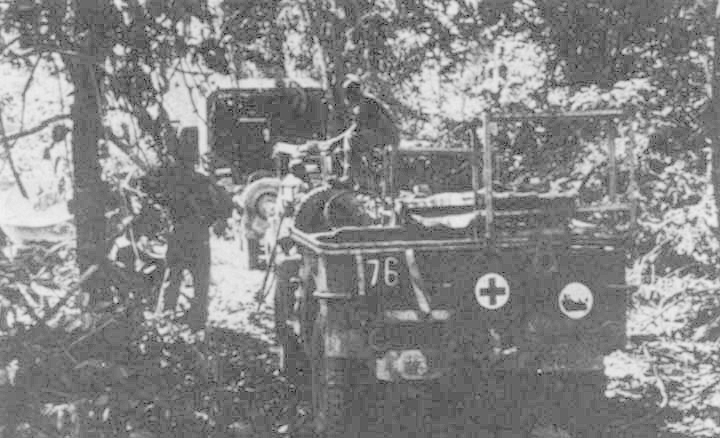 One of the stretcher-bearing jeeps used by AFS in the forward areas of Burma wherever the going is too treacherous for the heavier, more unwieldy ambulances. |
 |

February, 1945.
"I've finally caught on to the artillery fire now, and can judge just about how close it is coming. Yesterday the 'art' was blazing, away and I was down in my fox-hole. Was finally driven out by the heat. Guess what I saw? There was the Lt. sitting under a tree sketching pictures of the nearby landscape! He's been out here for 53 months. Evidently nothing bothers him now. He's pretty good, too.
"Boy, these British fellows are really swell eggs. They'd do most anything for you including giving you the shirt off their backs.
"Coming over I wondered if I'd be sorry for getting involved in this blessed war. I thought a great deal about it. I wondered if I would be like some of the fellows who enlisted in the Army and Marines whom I know are now plenty sorry and would give anything to get out. Well, I'm not the least bit sorry. Scared at times, yes, but I'm not sorry. I'm staying here until this bloody war is over if I have to stay twenty years! Then I'm going back to college and stay there until I get my degree."
March 20, 1945.
"I wont out with the Gurkhas this morning. Boy, are they fighters! They are short and very oriental looking. All they do is fight and do not know fear. One of them who was stationed behind their R.A.P. sneaked off to the front and came back later laughing and polishing his knife. They depend solely on their knives and often discard their guns. There is no doubt that they are the best infantry fighters in the world, but are no good for artillery, tanks, planes, etc.
"They refuse to have any Indian officer or Gurkha. He must be a British one.
"One night they planned a little party for the 'Jappies'. They stripped themselves to the waist and anyone that they felt in the darkness with a shirt on his back 'got it'. The Japs hate to fight them, in fact they avoid all battles with them and, boy! I can see why!"
No date.
"The weather forecast is for higher and higher temperatures this next 1 1/2 months, and right now it's hot enough to suit me just fine. I am once again sleeping on top of my bed roll with nothing but a thin sheet pulled over me for cover. Maximum temperatures around here for April are 110 degrees. I'm hoping that we reach some nice cool hills before the heat kills us all. It's hard right now to find time to write letters. The heat of the late mornings and afternoons till about 6 prohibits almost any kind of activity. It's dark by 6:30 and of course the rigid blackout stops you from writing then. And in the morning between the time you arise and the time it gets hot you are usually busy getting your chores done. So there you have it, 'My Day' by --------.
"My watch stopped and won't start, so I'm having it taken apart and cleaned by a Tommy in the signal corps who was a watch repair man before the war. That's one thing nice out the army, you can got just about anything done for you free of charge, just about every skilled and unskilled trade is represented in all units of any size, and much more so in a field hospital unit.
"The ADS moves from one village to another. When we get there the Burmese are just beginning to trickle back in. Very few. of them talk English so we don't got much out of them. This country we are in now has been Jap occupied since 1942 and since the Japs have apparently gotten along quite well with these Burmese, the British are more or less getting a very cold reception. In some instances Burmese have been openly helping and assisting retreating Jap forces, ferrying them across rivers, aiding them behind our lines, giving away our artillery and tank positions, etc. I do think, though, that the majority of them are pro-British, yet all of them are suspected and consequently the infantry are ordered to shoot all suspicious Burmese lurking in and around our front lines. The Burmese are a backward super-religious race and I rather think that they have been propagandized and anti-allied influenced by the Japs to a great extent. Actually they don't know what to think, wounded Burmese receive the best treatment in our hospitals, the same treatment as that given to the Tommies. Some of them come into our hospitals on bullock carts, traveling maybe 30 miles. They bring their families and all possessions with them, including cows.
"From a little incident that happened the other day you can judge for yourself how fast our advance has been. The O.P. on an advancing tank and infantry column spotted a bunch of Japs marching down a road ahead of them. The tanks went forward and cut the road about a mile below them, then just sat there waiting for them. Down they came marching three abreast in a regular route march not suspecting a thing. 20 Browning 50 caliber machine guns opened up on them and when the smoke cleared away there were 50 dead Japs lying about; not a one got away. Other parties of Japs have been similarly surprised. They actually don't know where the front here is. Small parties of them resist here and there in villages and pagodas. They burrow clear up into the top of solid brick pagodas and there they sit and wait until our infantry comes along. The only way you can get them out is to blow the whole pagoda down. It's flat country around here and the pagodas and villages are about the only shelter there is available to them. They don't stand a chance in open country; they know that as well as we do consequently they won't come out in the open and fight. They're sneaky, tricky, little yellow ..................."
No date.
"Haven't hardly had time to sit down these past few days. Everybody has been running, the Japs backwards and the British forward. The ADS has moved no less than 4 times in the past five days. First we move, then dig in --- a four-foot slit trench and a two-foot deep place to sleep in ---after we get dug in and everything set up just right, off we go again to another place. We have repeated this cycle four times already this week and probably will continue to do so every day from now on until the Japs stop running. Some information that I can now divulge is that I can now disclose that I'm with one of the few British Divs in SEAC. It is just about the cream of all British fighting outfits. The Division fought in France in 1940, after Dunkirk they were sent out to the Arakan in Burma. From there they were rushed up to Assam and completely shattered the Japs' invasion of India at the Battle of Kohima, where they completely routed 75,000 Japs.
"Have had quite an exciting time here lately. Been picking up lots of souvenirs and Jap equipment. The other day I got hold of some brand new Jap tropical shirts, have been wearing them every night. Also got new Jap boots, a new canvas back-pack and a Jap helmet. All this stuff when we found it hadn't even been unpacked yet. We broke open the boxes ourselves. In the line of souvenirs I now have a couple of silk flags with the rising sun on them, 6 or 7 of their different rank insignia, lots of photographs taken off of dead Japs along the way and many other things which are too numerous to mention. Picked up a brand new Eveready flashlight in a Burmese village and it is now working. Also have a few small wooden and marble Burmese Buddhas which I intend to bring home with me. A Burmese Bible is another little item I have. However, I'm still in the market for a Samurai sword (Jap officers carry them) pistol, compass or any of the other highly prized Jap souvenirs. A tank air corps man over here will pay up to 500 for a Samurai sword. Flags are worth about $15. It's a good way to make money if you're a good scrounger. Jap watches bring a good price also.
"For five days now our advancing troops have only run into small Jap suicide squads of about 10 or 15 men. They are fighting more or less of a rear guard action to delay our advance. These Japs squash, kill, or wound quite a few of our troops before they themselves are detected and killed. After they are spotted they've 'had it'. Artillery begin pounding them usually a squadron of planes dive bomb and straff them and the tanks are usually on band within a few minutes to pound hell out of them. They always get the first burst of fire in, but it's usually, their last. Up to ten miles' open country has been taken in one day, and for the past 47 days the advance was never less than five miles. So that gives you some idea of the rout that is taking place over here. We've been so busy moving the ADS, setting it up then tearing it down again that we've hardly had time for any casualties. It's quite clear now that the Jap army is finished in Burma; from now on our troops will just be mopping up."
March 14, 1945.
"I gave a pint of blood a few days ago and the chap I gave it to will be alright soon. I took pictures of the operation and hope they come out well. It was very interesting. The chap had a punctured intestine and had lost quite a bit of blood internally. Don't worry about me looking thin. It is just my face that is thinner, I weigh 160 pounds and that is alright for me.
"M. and I and a mad Scotsman are alone in the wilderness at a car post we set up this morning. It is about 10:30 a.m. and starting to get hot again. It will be like an oven in this 'wagon' after a while. There are plenty of Burmese around but you can't tell them from a Jap unless you speak the language, so we make them keep their distance. F. wants to shoot anything that's even the least bit brown, but that's no way to make friends with the people we have just 'liberated'. A lot of them don't like us too much, anyway.
"Yesterday, we saw two white girls in one of the villages we passed through. It was quite a shock to see them there. It develops their father is English and has lived out here for years and the mother is a very good looking Burmese. We would have liked getting acquainted but had to keep going."
No date.
"Warfare here is a ritual in which glory takes no part whatsoever (the same in any warfare, no doubt). It is a mixture of physical hardship and physical uncomfort. It is a blazing sun and a frigid moon; it's flies in your tea and bugs in your food; it's soaring temperatures and malarial shivers; it's narrow winding roads carpeted inches thick with dust; it's dust, caked on sweating faces; it's boiled, tepid water to drink, reeking with chlorine; it's bustling activity and incessant boredom; it's starvation one week and a festival the next; it's typhus and cholera, plague and jaundice. Yes, it's all that and more."
March 4, 1945.
"While I was on leave in Cairo I saw the funeral of Mher Pasha, Premier of Egypt. It was most interesting. About an hour and a half before the procession, all troops were driven out of the city, but we hid in a restaurant in the center of the city. I guess they expected trouble. We could see the whole procession from where we were, and it was very colorful. The royal guard, in bright colors marched to the mournful music of about five bands playing in unison. There were many, many horses and I estimate about 3000 were in the parade. The mosque was beautifully decorated on the outside, deep maroon carpets covered the sidewalk in front of the mosque. This represented an area about as big as the front of St. Patrick's cathedral and the square was about as big as Washington Circle but it was jammed with pushing humanity. There was a row of gold chairs with green plush seats along the outside of the mosque and beautiful multicolored tapestries were hung on the outside of it. The police were everywhere trying to keep the mob under control, and the best sight of all was the way the police attacked the people. They had no mercy on them at all. When they were too many to all be on the sidewalk they were pushed back and beaten over the head with sticks and whips and often they spurred their horses to rear up and charge into the people. I saw a couple of whips broken over someone's head. Their one thought was to get all the people on the sidewalks no matter how this was accomplished. I never saw such a crowd of seething people. It had Times Square on New Year's Eve beat all hollow.
"Some of the labor union groups which followed the coffin were trying to start trouble. One man was up on the shoulder of some others hollering to the people who shouted some response in unison. I couldn't understand them. After the crowd thinned a little, we came down from our hiding place still ducking into buildings when M.P.'s came along, until we saw other troops in the streets --- then we felt safe."
March 13, 1945.
"We saw the Parsee's burial place which was very interesting. The Parsees originally came from Persia and they were Fire worshippers. No one is ever converted to the Parsee religion, but must be born into it. Like the ancients, they believe that there are four main elements. Fire, Water, Earth and Sun. They believe that to burn the dead would pollute the sacred fire to and to bury the dead would pollute the sacred earth, so they get around this in a most interesting manner. They have five circular compounds on this hill which is covered with beautiful gardens and terraces. During the ceremonies none others but Parsees are allowed on this ground.
"There is one entrance to these circular cement compounds which is approached by a slanted earthen path leading up to it. You can't see inside the enclosures, but they had models of them and they look like an old Roman Circus inside, but on a much smaller scale. In the center is a pit and around this pit, sloping toward the center are three circular rows in which bodies are placed with their feet facing toward the center. The inside row is for children, the center row for women and the outer and higher row for men. The inside is arranged like spokes on a wheel with little hollow spots for the bodies. The two men who bring in the body walk on little raised paths which separate the cavities for the bodies. The whole thing is made of some sort of mortar. The oldest one of the five circular things is about 300 years old. The ceremony is very simple. Four pall bearers carry the body onto the grounds with the friends and family following behind. The women are left to sit on a terrace in the center while the men follow to the entrance of the compound. Two men, only, bring the body through a small black door, and put it in one of the cavities. At a whistle from one of the men all the men and women give one last prayer, and then the white sheet, which is the only covering of the body, is thrown into the pit in the center, and then the crowd immediately leaves. There are many vultures around which immediately eat the flesh from the bodies and after about three days a special keeper of the compound throws the dry bones into the pit in the center, where together with the tropical heat and the monsoons the bones are quickly turned to powder. From the pit in the center there are three radially running water drainage pipes. This water is filtered through charcoal and gravel and is therefore quite pure after it runs out.
"They only bury their dead from sunrise to sunset and they average about three burials per day, but no one is allowed there during burial periods. I say 'burial', but you can see that it is really not this. It seems to me to be a very sane and sanitary way to get rid of the dead, but there is a hitch. During epidemic periods the vultures are gorged and they have too much to eat. As a result they fly all over the city dropping pieces of diseased human flesh around making the epidemic worse. Aside from this it seems a wise method of disposing of bodies. There are only about 100,000 Parsees in the world of which 58,000 live in this city. No offerings are ever given to the dead, but when the friends come up for the funeral they bring wood which is donated to the temple on the grounds. This is used to keep the everlasting fire going which burns inside the temple."
December 9, 1944.
"Here I'm way out in the wilderness so far from civilization that it is impossible to even smell it. This is what they call jungle, pure and simple, completely unmolested by the destructive hand of man. The sights are strange and the noises stranger yet --eerie sounds, they are spine tingling, yet they go right with the jungle; in part they make it. There is a dank, musty odor about the jungle and a kind of depraved beauty. It's not uncommon to see pythons lying in the sun digesting a small cow and once we saw one which had just eaten a horned animal of some variety and it lay dead with the antlers sticking through its skin. I've learned how to guard against snakes at night by putting a prickly rope around the perimeter of the camp. The snakes won't crawl over it because it hurts their stomach. Also you can catch pythons by building a fence of briars around him while he is digesting his food and he'll never get out. By the way these pythons are small (they say here), only 15 to 20 feet long.
"It's really interesting to see how the natives here work. They haven't a tool made by machine and their houses are made entirely by lashing with whipped grass and strips of bark. In three hours, equipped with nothing but a knife, they can build the most comfortable little home and have it furnished with beds, chairs and tables. Bamboo is used almost exclusively.
No date.
"My health and fitness have been to me surprisingly good, in fact ---being pessimistic about it --- too good. That is, from the moment I reached this country I figured that two weeks out of every three months of my stay would be spent in sick bay. But since that last attack of malaria in October this has not proved to be true, thank the Lord. Mepacrine, when taken properly, practically wipes out malarious infection. It's either an excellent suppressive or a preventive. Which ever it is it remains to be a miracle drug in the opinion of all British Medical Officers in this theater.
"D.D.T. is being used extensively around here now. There are tons of the stuff in this area. Anti-malaria Units are posted with every field hospital and all vehicles, tents and other equipment are D.D.T.ed once a week regularly. As far as I can see, it doesn't kill insects, it merely holds them off. It does do a wonderful job of keeping them away though. However, I do not think that it has lived up to what the experts proclaimed it would accomplish."
March 20, 1945.
"All is the same, but we are all breathing a little easier now that we have Mandalay. It has been a terribly hard battle up to now and though it should go a bit faster the fighting is far from easing up, let alone being over with.
"It was exactly one year ago this evening that the five of us staggered into Imphal H.Q. after our little 'hike', and here I am none the worse for wear sitting in as much comfort as the heat will allow, sipping an ice-cold beer and listening to the Philharmonic! War is hell!!! In case you are wondering how we get the N.Y. Philharmonic over here I'll explain. The U.S. Army has put in their own radio stations all over India, China, and Burma. The programs are recorded (they use this new 'recording on the wire' system) at home and flown over. They may be a few weeks older than when you get them at home, but they follow almost exactly the same schedule as the programs at home. That is to say, Sunday we get the Symphonies, Kostelanetz, Jack Benny etc. It is a ridiculous feeling to sit and listen to those programs you associate with sitting in the living room at home, only to wake up and find yourself in India still.
"I will never cease to be amazed at the trouble and expense the U.S. goes to, to do all they can for the men. However, I am beginning to think that maybe the British have something in their terrific economy in things like that, I say this because I am one of the few guys that has had the realization that all these amazing luxuries a la U.S.A. are going to be paid for by none other than we fellows that are revelling in them now.
"I have finally realized one of the beauties of being an officer in the British Army. It is in the form of one very handsome bottle of Black and White Scotch sitting before me on my desk!"
January 18, 1945.
'We have moved again into Burma and are seeing some fabulous country. The jungles are very dense and enveloping. The desert country very similar to Tucson. The villages are made up of bamboo and reed huts set upon teak poles with lots of starving dogs lounging underneath them. We haven't seen many people as yet and presume they are off in the back country awaiting the return of peace and quiet. The people that are here are very oriental looking and not very interesting."
January 28, 1945.
"I can not tell you where I am, but if you follow the progress of the British Fourteenth Army you will have a general idea of my whereabouts. The way we work is to move up and take care of the casualties and then as the front moves on beyond a certain distance, another outfit will leapfrog and as it moves away from them, we go ahead. So don't worry, I won't be in too much danger. The worst thing to dread is disease, but I am taking every precaution for that."
February 4, 1945.
"This last week has finally given me the chance to do what I left home to do. It's really a great satisfaction to know that at last I am able to help ease the suffering and sometimes save the lives of these wonderful lads who are giving so much over here."
March 22, 1945.
"All the driving I've been doing has been hauling patients to a forward air-strip where they are taken by plane to larger medical units for operations or long convalescence. I have been doing considerable work in the reception department here at the unit. When the casualties are brought in, they are taken to this place for inspection, diagnosis and bandaging. If the wounds need immediate surgery, there is a medical surgical unit attached that goes to work at once. If, however, the wounds can wait a bit for treatment, we bandage and give shots for gangrene, tetanus, etc. We then take them where they can be flown to a larger and better equipped hospital. Those who are not as badly injured and can be returned to duty within a couple of weeks are kept here and sent back when they have recovered.
"I help bandage and carry stretchers besides driving. We get every kind of injury --- gun-shot, shell, mortar, burns, cuts, bruises, sickness of all kinds. It is interesting work and I like it very much. To keep busy is to make the time fly and it doesn't give me a chance to think too much about myself."
No date.
"Things are going along quite smoothly at this end, although we were shaken by the loss of two of our men within a fortnight's time. Once in a while the Japs find enough parts to build a plane and then they visit us. But all they succeed in doing is strengthening my belief in good old Mother Earth. I insist that the only reason for my landing in the trenches in nothing flat is not due to fear but to a complex I have against noises in the dark?"
April 13, 1945.
"There has been a little excitement around but not enough to write about, I like to talk, but when it comes to writing out long letters, it takes too much energy. I've never been shot at, because I never seen to be in the right place at the right time. Once we had bullets whiz over our heads, but I was asleep and never woke up. Another time the boys were machine-gunned five minutes after I left, and the place I should have been at was bombed, but I wasn't there. I'm enjoying life and mail and an education I could never get at home."
March 17, 1945.
"Am back on the jeeps and have been for the last couple of weeks. We are moving so fast that they don't have much time to clear out the Japs in the small villages that aren't right along our path. Nights are pretty grim at times, as the Japs carry on their jitter parties most of the night.
"You asked what we did when not driving. One is dig and the other is to try to catch a little sleep before nightfall. Am getting quite good at digging, so much so that a day in the garden wouldn't prove much of an effort. At least I say that now, but doubt if I will feel the same way about it once I get home. I might also add that the incentive to dig a nice deep slit trench la far greeter than to turn over the garden."
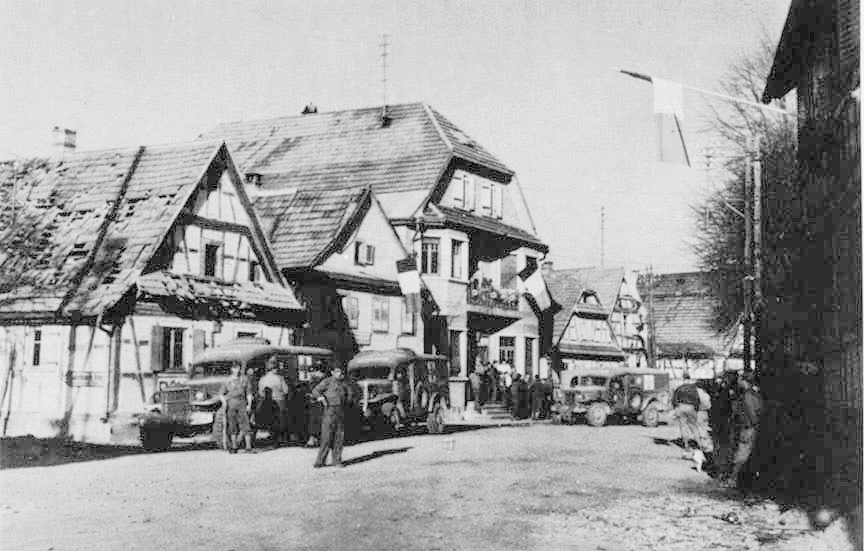 AFS ambulances waiting to evacuate casualties at a Casualty Collecting Station in Niederroedern. |
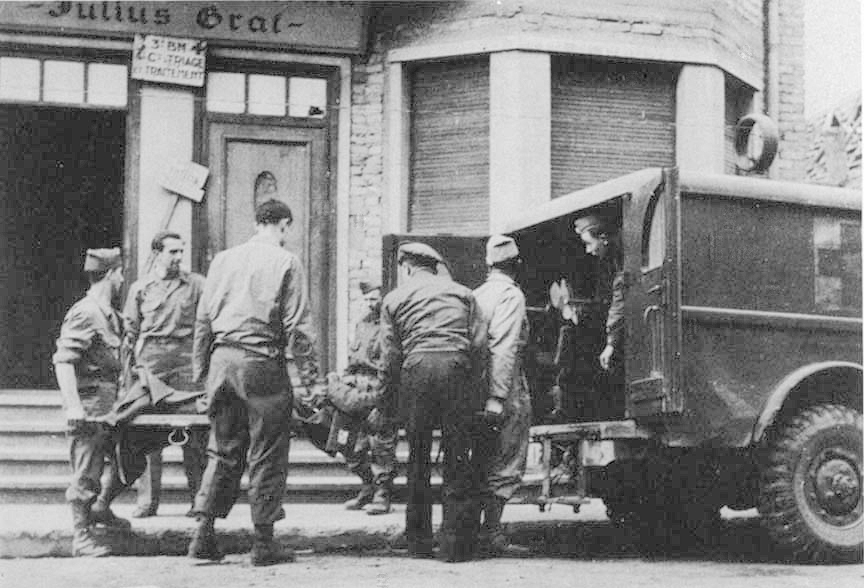 Some of the AFS men with the 1st. French Army assist stretcher bearers load a casualty at a medical post in Niederroedern. |

April 21, 1945.
"Also have been in Germany for some time now. It is a completely different country and I like country much better than France. I may have this impression because I am seeing it in good weather while I saw France in wet and cold weather. The Germans certainly know how to build roadways. There is one in particular that I have seen that would almost put the Pa. turnpike to shame. The towns certainly have been beaten up. They are mostly a pile of rubble with a path pushed through. These people seem very nice and are very cooperative so far. The reason for this I think is that they haven't quite gotten over the shock of being conquered. They certainly are the best fed people so far. All in all it is very interesting."
No date.
"This my third day in Germany and before the novelty of the experience wears off and possible prejudices appear, I'd like to pass along some immediate observations and impressions, spontaneous and perhaps inconsequential, but certainly confusingly inconsistent. Even frustration plays a minor role. Take it as you will.
"We pass through a fortified line of some kind; concrete anti-tank hedges supported by a ten-foot deep ditch stretch to the horizon on either side. The Siegfried Line? Are we now on German soil? I want to make sure before I spit on it. It is a beautiful green Spring day and everywhere farmers are at work on the rolling hills. Here is one standing near the road silhouetted against the blue skies, he stands, holding the handles of his plow, surveying the passing convoy as if reviewing a parade. There is an air of defiance about him, and as he fixes his scrutinizing gaze on me, I feel the impulse to get my spitting over with then and there. But I don't, I guess, because it's too much trouble to open the window. Besides, I still don't know whether this la France or Germany. Looks like Vermont, S. who is driving ventures.
"We pull into a slightly damaged village where there is a terrific jam-up and I ask a little girl whether this is 'Frankreich' or 'Deutschland'. 'Deutschland,' she answers curtly and turns away so that my glower goes unnoticed.
"My entry as the triumphant victor now thoroughly fouled up, I turn my attention to the civilians, the young and old farmers, women and children. Everyone seems in bouncing good health and well fed, especially the children. I notice the unusual number of cross-eyed women, the silk stockings, some hunchbacks, a veritable dwarf, some one-legged men and other discharged soldiers. The populace in general takes a detached interest in the passing convoy while some hausfraus stand in small groups chatting cheerfully.
"We turn the corner into the Adolf Hitler Strasse and come upon a middle-aged woman walking along pushing a baby carriage and weeping. My eye catches a solid wall of Chanel, in a shop window. A plump, well dressed German gentleman with a huge white moustache pauses to light a cigar. A young farmer appears in a doorway and from the shadow 'neath the vizar of his cap comes a look of distinct malice. The houses are clean and neat and the trees are in bloom. The road and countryside from here on are unmarked by war except for an occasional burnt-out vehicle; there are hardly any mine fields. The telegraph wires are up and everything seems in order.
"We pull into a Rhine-city for the night and park in a military barracks square. We cannot help but feel uneasy about the co-called werewolves who supposedly stalk in the night and kill at random. The next morning we play bridge and stick together; no one seems anxious to see what the town is like. We simply do not feel at all acclimated to our new environment; we feel insecure and strangely incapable. It is rumored that we will be armed, but as very few of us know the least thing about a gun, it would be far safer for all concerned not to arm us.
"In the afternoon our bridge game is interrupted by a spectacle on the parade ground. Four stalwart German youths are made to crawl on their stomachs, hop, skip, jump the length of the field. Frenchmen stand awkwardly about whooping and hollering and getting some sort of kick out of the procedure, I suppose. Soon about fifty Germans of all ages and standing are sent into the ring to clean up the grounds. They are kept working on the double for a good three hours; an old professor keeps limping by our ambulance, his arms laden with tin cans and rubbish, and as time wears on his limp gets worse (till finally he is told to go home. We don't know whether to feel sorry or not sorry for these people. We don't know our own minds, and feel more than bewildered. We understand the French attitude, although we recognize it as that of the repressed persecuting the repressed. It seems childish but vaguely just. That night we go to bed with nothing gained, restless and ill at ease.
"The next day we cross the Rhine via a pontoon bridge decorated with French flags. Soon we hit an autostrada and continue up it for about five miles. It is identical to the Merritt Parkway except that it doesn't have the fancy frills. After passing through miles of lush farmland and deer-infested forests, we arrive at our destination, a small village where we go about seeking living quarters. We don't know what to expect of these people. Will they be insolent? We figure that it will be far easier on us it they are.
"However, they are not. They are very obliging. Six of us find an excellent suite of rooms above a pharmacy. As H. plays with the piano and the rest sit around getting used to the deep chairs and ornate furniture, I wash my hands and the proprietress edges up to me.
"'Our troops did a lot of damage in France, didn't they?'
'She seems to want reassurances.
"'Yes,' I answer for want of a better answer. She comes closer, places herself almost between me and the basin.
"'Please,' she falters, 'Need I have fear of you?'
"This sort of takes me off my feet. 'No,' I manage to say, and before I can resume my washing she has scurried from the room.
"An hour later she reappears with a huge cherry pie. We are flabbergasted; we haven't seen such a thing since the States. It is freshly baked and we are advised not to eat it 'ere nightfall. There is some discussion as to whether we should eat it at all, but the thought of poison is soon dismissed. It looks so good.
"Meanwhile, in H.'s house the woman weeps and cries as she stalks about whisking away little treasures and other odds and ends. Her sister enters the room and immediately starts to bawl. Meanwhile H. is quite embarrassed and in an attempt to ignore the scene becomes preoccupied in his luggage. Then the husband, the man of the house and village baker, enters calm and collected and tersely informs his wife that 'This is your war, dear'. He is very nice and goes out and presently whips up two apple pies for H. who expresses his wonder at the sight of them.
"'That is nothing', says the baker, 'in peace and in war, no matter what the conditions, we Germans will always eat well.' Of our U.S. Army white bread which in France is regarded as a priceless dessert, the baker says, 'It is white, but see, it is baked too long. It is not healthful'. The man is being perfectly sincere.
"Other fellows, in the meantime, go about looking for rooms, refusing houses offering single bedrooms as we are strongly advised against being alone at night. It seems that B., in guarding our kitchen, will have to be by himself tonight, so we give him M.'s automatic and show him how to use it.
"About an hour before the village curfew, my gang is seated about the living room playing bridge and the victrola when, following a knocking, in walks a civilian without further ado. I guess we all sort of jump. Then he introduces himself as Mr. D---, an American citizen, and we offer him a seat and comment on the weather. He seems quite affable, and is so glad to talk to Americans again. Born in Germany, he lived in New Jersey for many years, became naturalized, and returned to Germany in '38. This is all the knowledge on that score that he wishes to impart to us, so we presume he had something to do with the Bund. However, because of his American citizenship he was never drafted into the German army, 'although I suppose I could have been'. We fire questions at him but gain little information that is surprising beside the fact that the bombings had been super-colossal, and that the Germans are very, very tired of war. Upon being asked how the American troops had behaved upon entering his town he simply answers a disquieting 'Nobly'.
In the street I am accosted by a hausfrau who goes into a long spiel about things in general, how the French, in passing through the town, had stolen firewood and turned the cellar upside down, thus mixing her laundry with that of her aunt's. I feel like telling her a thing or two, but for some reason I control my temper. She tells me how sorry she feels for herself now that there is no more gasoline, no more ammunition and the war is lost, I suddenly feel quite disgusted and leave her prattling by herself Has she no conception? Don't they know? Warped by misinformation and lies, has the resulting sheer ignorance and false standard of values wrought such havoc as to have produced an irreparable race of gibbering idiots? I shudder at the thought of a pretty village with crazy people, people who don't seem even to want to know the truth.
"I go to a house to get some kerosene. A man comes to the door, his face battered and his head in a bloody bandage. As he pours out the kerosene, he points to his head and mentions the French. I nod, and we pass some pleasant remarks, and then I leave.
"Walking alone in a dark street is no fun at all.
"The next day after breakfast about two hundred Jerry prisoners march through the village. Civilians come out of houses, appear at windows. Except for the marching feet on the dusty road, there is silence. The face of each prisoner bears an utterly blank expression. Men doff their hats. woman holds up her baby to the passing column, then breaks into torrent of tears. Children tag along at the end, teasing and distracting the French guard who in exasperation raises his rifle butt to shoo them away.
"In the afternoon, right outside our house, a child playing among some logs, happens upon an anti-tank shell, and plays with it. It explodes, takes both his legs off, and the child dies before first aid can be administered. A woman lies on the street, a severe wound in her back; she is carried off to the battalion aid station. H. arrives at the scene of the accident. The crazed mother has a knife in her hand and is straining toward him, but she is being held back by two other women. "In my ambulance I rush the wounded woman to the nearest military hospital where she arrives still alive, but the doctors seem pessimistic. It is too bad it is a woman, but, after all, she is a Boche."