
|
Mrs. Ogden Armour |
Mrs. John W. Cross |
|
Mrs. Robert W. Lovett Miss Maude K. Wetmore |
Miss Daisy Fiske Rogers Mrs. George A. Crocker |
| Mrs. Robert Woods Bliss Mrs. George A. Crocker Mrs. John W. Cross Mrs. Dwight Davis Miss Esther Dilworth Mrs. Homer Gage Mrs. Girard Van Barkeloo Hale Mrs. John Hughes Mrs. Henry James Mrs. Dean Jay Mrs. Robert Weeks Kelley Mrs. Robert W. Lovett |
Miss Margaret Mallory Mrs. Gilbert H. Montague Mrs. Victor Morawetz Miss Anne Morgan Mrs. Paul G. Pennoyer Miss Elizabeth Perkins Mrs. Campbell Pilcher Miss Daisy Fiske Rogers Mrs. Ethelbert Warfield Miss Maude K. Wetmore Mrs. Harry A. Woodruff Mrs. Arthur Woods |
| Miss Esther Dilworth Mrs. Lucette Hyde Mrs. Henry James Mrs. Robert Weeks Kelley Miss Edyth McCoon Miss Margaret Mallory |
Miss Anne Morgan Mrs. Campbell Pilcher Miss Daisy Fiske Rogers Miss Maude K. Wetmore Mrs. Harry A. Woodruff |
|
ARIZONA CALIFORNIA COLORADO CONNECTICUT DELAWARE DISTRICT OF COLUMBIA FLORIDA GEORGIA HAITI ILLINOIS LOUISIANA MAINE MASSACHUSETTS MINNESOTA MISSOURI NEW HAMPSHIRE NEW JERSEY NEW MEXICO |
NEW YORK OHIO PENNSYLVANIA RHODE ISLAND SOUTH CAROLINA TEXAS VIRGINIA WISCONSIN |
IT is proper that those who have contributed time, effort and money to the American Friends of France should receive, along with the interesting report of the work in France, a brief account of what was done in America. The story of the work done in this country naturally lacks the drama and poignancy of the French report; it will be told as briefly as possible and in a summary manner, but it is only just to point out that its significance is to be found not only in the money raised for transmission in one form or another to France, but in the large number of persons who engaged themselves in the work, and also in the interest which they obtained for the cause in a variety of ways. The reader will see even in a mere list of names and dates and places of meetings how widespread was the American sympathy, how readily it was rallying to the cause, how generous it was prepared to be. The French collapse on June 17, 1940, unavoidably checked this effort, and the subsequent restrictions on the shipment of relief goods have forced the organization to suspend temporarily its activity; but the record may stand as evidence of sympathy and goodwill which have not died and which it is hoped may have an opportunity to manifest themselves in some way that is practical.
The American Friends of France was incorporated under the laws of the State of New York on September 7, 1939, and immediately following the State Department issued Permit No. 54 which allowed money and material to be sent to the noncombatants of France. National Headquarters were opened in New York in Miss Morgan's house, 3 Sutton Place, with Miss Elizabeth Perkins as Chairman. Miss Perkins served in this capacity with energetic devotion until January, 1940, when Mrs. John W. Cross was appointed. New England Headquarters were opened in Boston by Mrs. Robert W. Lovett. The American Committee for the Devastated Regions of France contributed as an initial fund $1,306.00.
Purpose, Membership, Committees
The purpose of the New York Committee and all those formed in other states was to collect money and supplies to be sent to France. Members paid $1.00 registration fee and larger contributions ranged from $1.00 for a blanket to $2,000.00 for a social center; and some generous friends donated even more. Committees were established throughout the United States, and during Miss Morgan's visit in January, 1940, she made a short tour of the country to encourage the formation of new committees.
A tribute dinner to France was held at the Waldorf-Astoria, New York, in honor of the French Ambassador, Count de Saint-Quentin, and Miss Morgan, and was arranged with the aid of Miss Mary Vail Andress and Mrs. William K. Vanderbilt. Mr. Frederic R. Coudert, President of the Franco-American Society, presided and Colonel Ralph C. Tobin headed a color guard of the Seventh Regiment of the New York National Guard. This dinner was a memorable occasion, and sent Miss Morgan back to France full of confidence that the American Committees were back of her.
Shop, Workrooms
Through the kindness of the Robert W. Goelet Realty Company a shop was lent at 390 Park Avenue and occupied by the American Friends of France from February until December, 1940. This shop was under the direction of Mrs. Lucette Hyde and was staffed by volunteer workers. It served as an information center for the American Friends of France as well as for the sale and distribution of wool and novelties to the public and to the workroom committees formed by Mrs. Harry A. Woodruff. The Maintenance Unit Plan was adopted whereby anyone wishing to aid in money raising was named Chairman of a Maintenance Unit Committee and was responsible for securing fifty people, each of whom would give $2.50 monthly for six months. This plan was very successful. Later Miss Grace Parker was appointed as an organizer and lecturer and toured the country forming new committees and encouraging old ones.
National Conference Council
A National Conference Council, composed of each Local Chairman, was formed with Mrs. Arthur Woods, head of the Washington Committee, as Chairman. This Council was to meet at least once a year for the discussion of ideas. In May, 1940. the first meeting was held in New York with representatives from Arizona, Connecticut, Delaware, Florida, District of Columbia, Illinois, Massachusetts, New York, Ohio, Pennsylvania, Rhode Island and South Carolina.
Art Exhibitions, Statue, Cockade Pin, Garden Parties
The Durand-Ruel Galleries in New York, through Miss Mary Turlay Robinson, arranged an exhibition of Impressionists in March; and the next month Mr. Pierre Matisse had an exhibition at his Gallery of paintings by Derain, which were later shown in Cincinnati under the American Friends of France Committee there. Malvina Hoffman donated a bronze statue of St. Francis of Assisi to be raffled which was exhibited in New York and chances on it were sold throughout the country.
Mrs. Sturgis Finan suggested the sale of a pin which had been designed by Mr. John Goodwin. Miss Margaret Mallory arranged for the manufacture and sale of this pin. Through her efforts it was such a success that soon earrings, men's lapel pins, cigarette cases, compacts, and even lipsticks in the French colors were on sale; silk knitting bags having the name of the American Friends of France were also in great demand.
In the Spring gardens were opened to the public for the benefit of the American Friends of France and among these were Miss Morgan's at her place in Mt. Kisco, New York, and Miss Lily Pons' at Silvermine, Connecticut.
Shipments
Fourteen shipments of clothing, food and medical supplies, forwarded to New York by the branch and workroom Committees, with an insurance value of $26,256.75 were sent to France from November, 1939, to June, 1940. Shipments from the New England division were sent direct from Boston, but other Committees used New York as a shipping center. After July, with the consent of the State Department, two shipments, with an insurance value of $16,681.00, were sent to England for the relief of French refugees there.
 Mrs. Noel Murphy, one of Miss Morgan's assistants of the A. F. of F. trying to comfort this poor old woman. |
 |
All the activities herein reported demanded effort, energy and ingenuity, and to everyone who took part in them thanks are due. It is not possible to mention everyone by name. Thanks are also due to the Manhattan Storage & Warehouse which packed and prepared for shipment all the cases, without cost; and to the Allied Relief Fund through which all shipping was done without charge.
When word came of the fall of France work was temporarily suspended, and in September a letter was sent to the Chairmen of all Committees releasing them from further responsibility towards supporting the American Friends of France, but begging them to hold their officers together for the time when it would become possible to resume work
In September Mrs. Cross, after her untiring services, resigned as Chairman and Mrs. Paul G. Pennoyer was appointed in her place. The office was moved from 3 Sutton Place to 390 Park Avenue and later to 587 Fifth Avenue. On January 7, 1941, Miss Morgan returned to America leaving a small group of workers to carry on the work of her Committee in France, an account of which follows in the French report.
Before closing this brief summary of the American activities of our organization Miss Morgan and the Board wish to acknowledge with profound appreciation the splendid work of the Committees, and their loyal workers throughout the country who have proved themselves to be true friends of France.
| INDIVIDUAL CONTRIBUTIONS Received at New York Office . |
$96,757.64 |
|
| RECEIVED FROM A. F. F. Committees outside of New York City |
92,282.71 |
|
| SPECIAL COMMITTEES | ||
| American Woman's Association |
$395.30 |
|
| Colony Club |
11,655.00 |
|
| Ambulance Fund (through Mrs. Friedlander) |
1,959.00 |
|
| Golden Arrow (through Mr. Arthur Tuckerman) |
465.10 |
|
| Goodwill Delegation Committee |
89.50 |
|
| Westchester County Truck Fund (through Mrs. Lockwood) |
1,095.00 |
|
| Santa Barbara Ambulance Fund (through Mrs. Robert Woods Bliss) |
2,500.00 |
|
| Regency Club Ambulance Fund (through Mrs. C. H. Keep) |
1,844.00 |
|
| Dalton School Ambulance Fund |
906.81 |
|
|
20,909.71 |
||
| MAINTENANCE UNITS |
10,023.70 |
|
| APPEAL LETTER, June 14, 1940 |
3,196.30 |
|
| COIN CARDS |
1,583.21 |
|
| CONTRIBUTIONS RECEIVED FROM REGISTERED COMMITTEES other than A.F.F. | ||
| American Society for French Medical and Civilian Aid |
4,300.00 |
|
| American Women's Hospital 800.00 Allied Relief Fund |
100.00 |
|
| Committee of French-American Wives |
1,000.00 |
|
| A. F. F. Philadelphia Committee (through Emergency Aid of Penna.) |
4,150.37 |
|
| Smith College, Association of Former Juniors in France |
225.00 |
|
| Société Française de St. Louis |
373.49 |
|
| United Committee for French Relief |
1,100.00 |
|
|
12,048.89 |
||
| SPECIAL EVENTS | ||
| Allied Relief Party, Sterlington, New York |
1,203.29 |
|
| Allied Relief Party, Edgartown, Massachusetts |
400.95 |
|
| Art Exhibit, Durand Ruel Gallery (through Miss Mary T. Robinson) |
4,450.20 |
|
| Ballet Guild |
50.00 |
|
| Beckman Tower Party |
216.66 |
|
| Great Neck Party |
159.06 |
|
| Lily Pons Garden Party |
3,805.47 |
|
| Matisse Gallery Exhibit of Derain |
316.25 |
|
| Mt. Kisco Garden Party |
856.03 |
|
| Mrs. Pope's Lecture |
87.00 |
|
| Tribute Dinner |
4,000.00 |
|
|
15,544.91 |
||
| RAFFLE 1-Basket of Liquor |
302.50 |
|
| RAFFLE 2-Bronze Statue (donated by Malvina Hoffman) |
1,739.45 |
|
|
2,041.95 |
||
| SALES | ||
| Wool |
8,322.95 |
|
| New York Shop |
7,287.29 |
|
| Pins, Compacts, Cigarette Cases, etc |
35,207.83 |
|
| Cook Book |
1,509.18 |
|
|
52,327.25 |
||
| CONTRIBUTIONS FOR PUBLICITY, Lecture Trips, etc |
1,125.00 |
|
| REBATES-Insurance, etc |
1,231.44 |
|
|
$309,072.68 |
||
| DISBURSEMENTS | ||
| Cabled to France $155,933.71 | ||
| For purchase of food, clothing,
medical supplies and shipping expenses 17,503.10 |
||
| Total expended for relief |
173,436.81 |
|
| ADMINISTRATIVE AND PUBLICITY |
19,520.70 |
|
| ADVANCES for Returning Workers (to be refunded) |
5,106.84 |
|
| Total Disbursements |
198,064.35 |
|
| Balance on hand, December 31, 1940 |
$111,008.33 |
| HIS EXCELLENCY ANDR DE LABOULAYE, Honorary
President MISS ANNE MORGAN, President MRS. ROBERT AMES, Vice President MRS. DEAN JAY, Vice President MRS. ANDRÉ VAGLIANO, Vice President MR. BERNARD CARTER, Treasurer |
| M. PAUL CRESTIN MISS EVA DAHLGREN MISS ROSE DOLAN MLLE. DE JOANNIS |
M. DELOCHE DE NOYELLE MME. ROBERT MEYRAT MISS OPHELIA TILEY |
|
Miss Rose Dolan, Bellac, M. Grunelius, Mrs. John C. Hughes, Mme. Isabelle Houchet, |
Mrs. Henry Hutton, Bellac Mrs. A. W. Massey, Revin, Mme. Marie Meyrat, Blérancourt Mme. Novakova, Blérancourt Miss Ophelia A. Tiley, Mayenne, |
| Miss Elizabeth Adams, Chauffeur, Accredited Teacher Mrs. Theodore Beebe, Directrice of Stockroom, Paris Miss Bidda Blakeley, Chauffeur, Social Service Aid Miss Therese Bonney, Photographer, Evacuation Driver Mr. Charles L. Burwell, Chauffeur Miss Eva Drexel Dahlgren, Chauffeur, Chief of Transportation, Paris Miss Frances Eddy, Chauffeur, Accredited Teacher Mrs. G. Emmet, Stockroom Aid Miss Katherine Garrett, Chauffeur, Social Service Aid Miss Susan Hammond, Chauffeur, Social Service Aid Miss Mary Bainbridge Hayden, Chauffeur, Workroom Aid Miss Adelaide G. Johnson, Chauffeur, Workroom Aid Mr. Alfred Grima Johnson, Chauffeur Mr. Edward Condé Jones, Chief of Transportation, Bellac |
Mme. Louise Louis, Chauffeur, Social Service Aid Mr. Thomas Joseph McBride, Chauffeur Mrs. Carina Mortimer, Chauffeur, Publicity Mrs. Frederic Noel Murphy, Chauffeur, Foyer Miss Beatrice Phillips, Chauffeur, Social Service Aid Mr. Samuel Pierce, Chauffeur Mrs. Ellen Dudley Root, General Worker Miss Dorothy Russell, Publicity Miss Mary Rutherford, Chauffeur, Social Service Aid Mrs. Randolph Santini, General Worker Mr. Robert Schemer, Chauffeur, Publicity Mme. André M. Vagliano, Administration Miss Sonia Vagliano, Chauffeur Miss Mary Florence Wilson, Co-Directrice of Stockroom, Paris |
| Mrs. Blanche Ellsworth Davis | Mr. and Mrs. Girard Hale |
| Mr. Phil Cornelius Mr. William Davenport Mr. Jan Glowacki (taken prisoner) Mr. Frederic Loeffler |
Mr. Samuel Pierce Mr. Alfred Raymond (taken prisoner) Mr. Murray Shipley (taken prisoner) Mr. Louis Wehrle (taken prisoner) |
One hundred and twenty, including doctors, nurses, midwives, workers in canteens, foyers, stock and work rooms, motor service and office.
Of this number, Mlle. Anna Rogier and eight student nurses were loaned to the Comité for the evacuation, by the Amyot School. Chauffeurs with ambulances and cars were loaned at various times by a motor corps of the French Red Cross.
| Americans |
50 |
Czechoslovakian |
2 |
|
| French |
120 |
Swiss |
2 |
|
| English |
3 |
Belgian |
1 |
THE following report deals with the work done by the American Friends of France, in France, from September 1939 to January 1941. For the sake of brevity, no attempt has been made to give a full account either of the work done by the organization or of the personal experiences of those who participated in it.
The veteran members of the American Committee for Devastated France, at their bi-annual reunion in May, 1939, decided that an organization like theirs not only had memories, but a well-defined responsibility towards the impending conditions in France that their traditions would oblige them to maintain. Therefore, it was agreed that a skeleton organization should be formed which would be capable of developing relief for the civilian population whenever the emergency arose. In the meanwhile, Miss Morgan, who was going to Europe, was given the responsibility of seeing the French authorities and making whatever definite plans seemed wise under the circumstances.
In early July, on her arrival in Paris, Miss Morgan secured an interview with General Gamelin and explained her plan for forming mobile units to consist of graduate French personnel---nurses, social service workers, chauffeurs and doctors---under American direction, with as many American volunteers as possible. The units were to be entirely self-contained and capable of going wherever the need was. The end of August, learning in Norway of the Russo-German Pact, Miss Morgan returned to Paris immediately and started work under Colonel Dumas of General Gamelin's staff. The "Comité Américain de Secours Civil" was then formed, and the first center installed at Blérancourt (Aisne), where we had houses to lodge our personnel and where the American Committee had been known to the civilian authorities for a long time. This center had besides the advantage of permitting us to keep supplies in case there should be difficulty of replenishment from Paris.
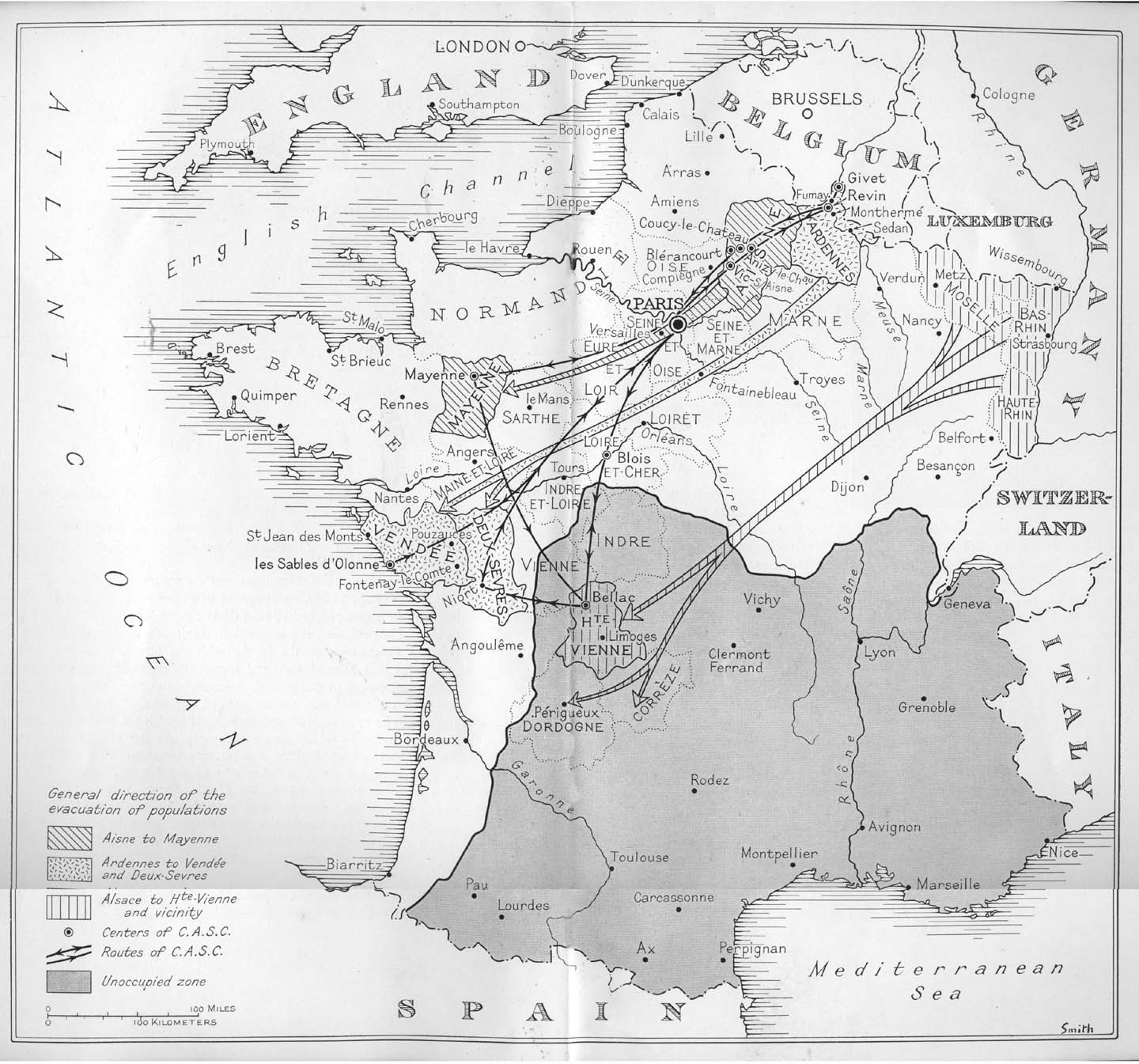
The following month we accepted the offer of the Minister of Public Health to work amongst the Alsatian "évacués" in Haute-Vienne. A mission under the direction of Mlle. de Joannis, directrice of the Amiot School for Nurses, accompanied by Doctor Thomas-Domela and Miss Rose Dolan, a member of our veteran committee, made a study on the ground, and on the basis of their report it was decided that a small unit should take charge of the Arrondissement of Bellac, near Limoges.

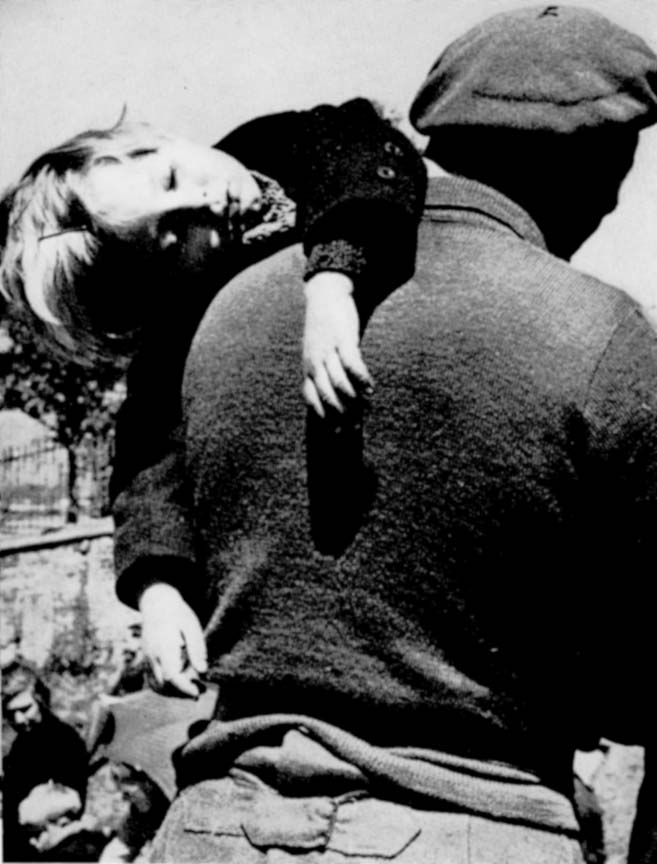
| Millions of French again driven from homes by Germans. Tiny children, exhausted, are carried by tired mothers who have trekked many miles before reaching a destination. |
Our experience in the Haute-Vienne convinced us that we could be useful also in the Ardennes, preparing the population for a possible evacuation. Six of our nurses were sent to convoy the train of voluntary évacués from Sedan to the Vendée.
The CASC also furnished food and medical supplies. At the request of the Prefect of the Ardennes, a unit was also established in the town of Revin to work with the local population toward the creation of a friendly contact which would be useful later if they had to evacuate.
A precarious situation was facing the civilian population in the North of the Department of the Ardennes. The "Pointe de Givet" runs into Belgium and is particularly vulnerable. One road through the narrow Meuse Valley and one railway line are the only means of evacuation. Many villages were in front of the French defense line, and the population must cross mined bridges to flee. This region should have been partially evacuated before any attack, but in spite of the army advice, the Prefect refused to authorize this, and the civilian population clung to their homes, remembering the pillage of 1914.
All during the cold and trying winter of 1939-40, our unit of Revin, headed by Mrs. Massey, cared for this poor population of factory workers, mostly wives and children of mobilized soldiers. They took care of the population of three Cantons: Givet, Fumay and Montherme, made up of 30 Communes and 62 school groups (7,134 children).
Our school "Cantines" were kept open for four months (at Revin alone 7,548 meals were served). Work rooms were opened in Givet, Revin and Montherme. Three French nurses took over health supervision in schools, and our ambulances carried the sick people from their homes to the hospitals.
In the meantime work continued at Blérancourt. The infirmary of the Society of Hygiene of the Aisne, which had been running for twelve years under the direction of Mlle. Talon, kept to its task; and more nurses, social service workers, and chauffeurs were called in to extend the work to the needy population of the Cantons of Coucy, Anizy-le-Château, and Vic-sur-Aisne in the region of Chauny. Work rooms were opened in Barisis, Blérancourt, Sinceny, Marizel-Bichancourt, Pierremande, Autreville. A large "Foyer du Soldat" (club, cantine, reading room) was opened in Autreville under the efficient direction of Miss Werleman.
Our difficulties in the beginning were considerably increased because we had no office other than Mrs. Ames' and Miss Morgan's personal quarters at the hotel in Paris. This situation was relieved when Mrs. Beebe and Miss Wilson gave us ideal quarters for storage and stockroom, which they paid for and which they equipped. It was at 2 Rue de Miromesnil. The office was moved there the early part of May.
UNDER an actual invasion the French Government had planned to evacuate the refugees at Argonne and the Aisne to the Mayenne and the Vendée, and the CASC was to accompany these refugees and re-establish their centers where the refugees were sent. Also to establish "postes de secours" and cantines en route. The conditions of attack, however, changed the lines which the évacués were to follow.
On the 10th of May, Belgium was invaded, and according to plans prepared in advance by Miss Morgan, Mme. Meyrat and Miss Dolan, all the CASC workers from Bellac and Paris joined up with those at Blérancourt at seven o'clock that evening. A telegraphic order for evacuation was awaiting their arrival.
Part of the personnel, under Mme. Meyrat, started for Landouzy, the central village of our "poste de secours," and part remained in Blérancourt as a reserve, under Mrs. Hughes. Miss Morgan and the rest went to Givet, where they joined Mrs. Massey and her group from Revin. At dawn, the next day, Miss Dolan started operations. A general alerte for evacuation was given in Givet and its surrounding villages. All the families who had cars were to leave as soon as possible. The sick and the helpless were to be called for. Those without cars, who were able-bodied, were to collect in the central square. The people began to herd there, creating an indescribable confusion.
The members of the Committee and the nurses aided these people in transportation and feeding. They were supposed to go out on trains, but the station had been bombed, so it was planned to take them by car. The Germans were pressing down through Holland, and the evacuation was made doubly difficult by the Belgium refugees streaming over the border with the Germans at their heels.
All day long Miss Morgan and Mrs. Ames organized and directed the crowds in the square, trying to bring some organization out of chaos and to give help. We had at our disposal only twenty cars of our own with six S.S.A. ambulances in addition. The chauffeurs started immediately with the loaded cars on their route to Fumay and back---21 kilometers each way. As the railway line from Givet had already been destroyed, there was no way for the refugees to be removed except by one road---a narrow, winding one of the Meuse Valley---which was jammed with troops and refugees from the North. Planes were constantly flying overhead and it was nothing short of a miracle that no one was caught by the machinegun fire and the few bombs that were dropped near the road. At Fumay, a first-aid station was immediately established, in charge of Doctor Leuba, our Swiss woman doctor, and several nurses, who remained on duty during the night and the next day, until we all drew out.
Late in the afternoon Capitaine Vacant, the officer in charge of the evacuation, at last turned up in Givet and promised the help of army trucks. By seven P.M. it was obvious we could not count on their arrival until morning. Therefore, since darkness had fallen, it was decided to send the population home for the night. As the cars returned from their trips, they were called in. The last car was requisitioned to bring back wounded soldiers who were victims of a heavy bombardment in a neighboring field.
 |
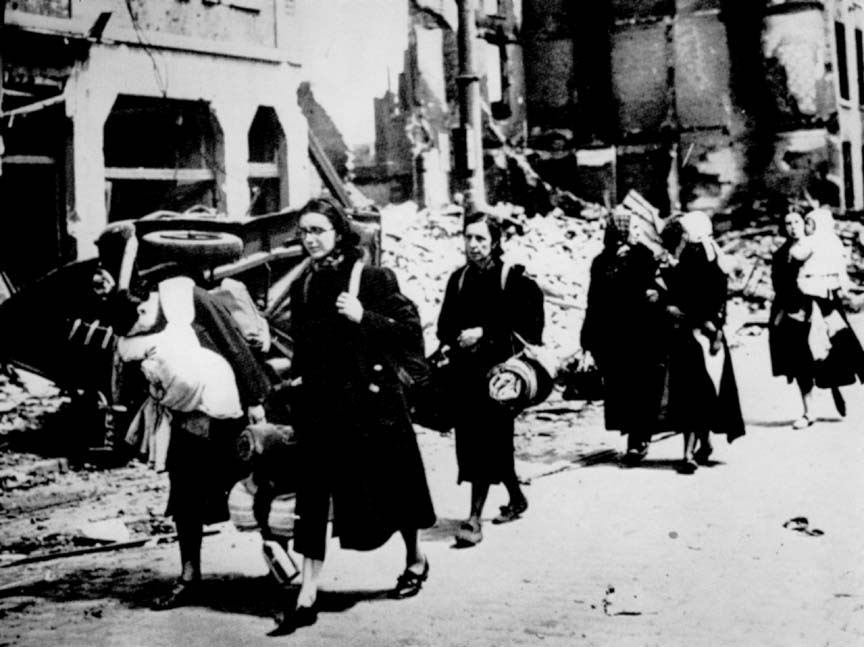
 the long tragic journey. |
At 1 A.M. the next morning, an officer aroused Miss Morgan and ordered the evacuation hastened, the advance of the Germans being appallingly swift. (We had expected at least two or three days to accomplish this task.) The army trucks had still not arrived, so again our chauffeurs went through the streets calling the population and telling them that speed was essential.
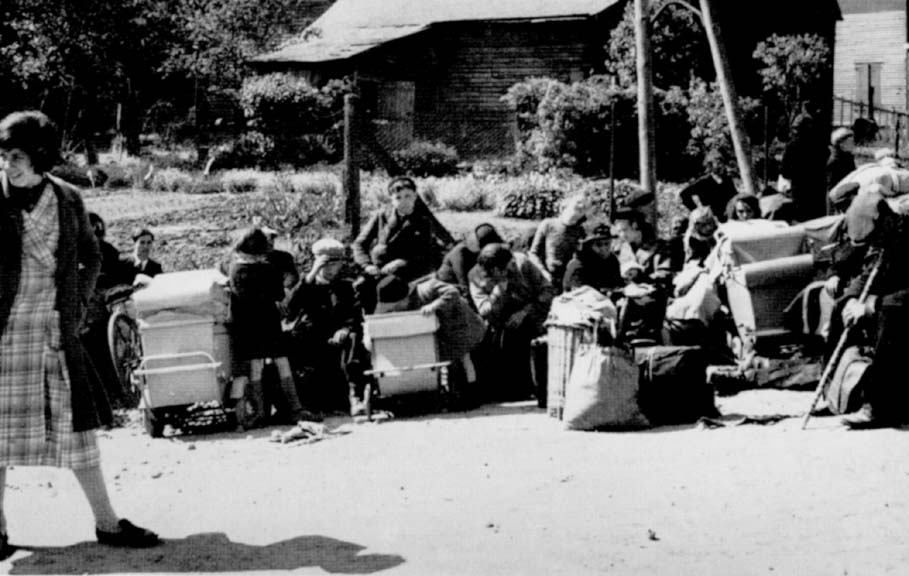
Our cars were loaded and started off on their first trip, going to Fumay, where they found the station had been bombed and trains were no longer running. Our workers returned to Givet with this word, which necessitated a change of objective to Mainbressy---a much longer run. Some of the Committee went down to Fumay to evacuate our workers there; the others continued to remove the helpless and the children from Givet. Again the order came to hasten, so the able-bodied were told to take to the road. They started the terrible trek by foot which, if they were fortunate, finally ended in the southern part of France, sometimes weeks later.
Half our personnel was left with Rose Dolan at Mainbressy---where there was a railroad station---and the rest went with Miss Morgan and Mrs. Ames to Rocquigny, the main center of the Committee.
Meanwhile Mme. Meyrat's group had been split up into three units, doing first aid and cantines at Aubenton, Amagne and Tagnon. The first aid station at Aubenton was in charge of two nurses, who had been caring for many hundreds of refugees passing through each day. As it was essential that we should re-establish communication with Mme. Meyrat's groups, Mrs. Ames went off with one of the chauffeurs, to make a tour of investigation. She found that the wires between Liart and Rethel had been cut. She asked for helmets for all our drivers---indispensable because of the numerous bombardments.
At Amagne an exhausted unit had been working in the midst of incessant bombardment, with remarkable energy and devotion. For three entire days four nurses and three drivers had served more than three thousand meals without sleeping. Seventeen bombardments were recorded in a single day.
Mrs. Ames reported to Miss Morgan and it was decided that the outlying posts should be called in, since they were in serious danger.
On Tuesday morning the evacuation of Mainbressy began and continued all day. Maggi milk trucks were requisitioned to help the Committee cars, and the American Volunteer ambulances, sent to us by Mr. George Washington Lopp, carried the sick and wounded to hospitals at Rheims and Soissons. Trains were still leaving and the cantines and first aid posts were being held dawn by our tireless workers.
On Wednesday, the 15th, at 4 A.M., there was a violent bombardment and a second one a few hours later. Two American Volunteer ambulances did not return from a trip to the Soissons Hospital. At 5 P.M. the CASC received military orders to leave Rocquigny. Additional refugees were coming into Rocquigny constantly, but the sick and the children were pretty well evacuated and those on the road picked up. Thanks to the supplies given to us by the army, we had enough food to leave behind for those still there, and the cantines were able to carry on. Miss Morgan, with Rose Dolan, was the last to leave the scene of the first fatal blow in Hitler's blitzkrieg.
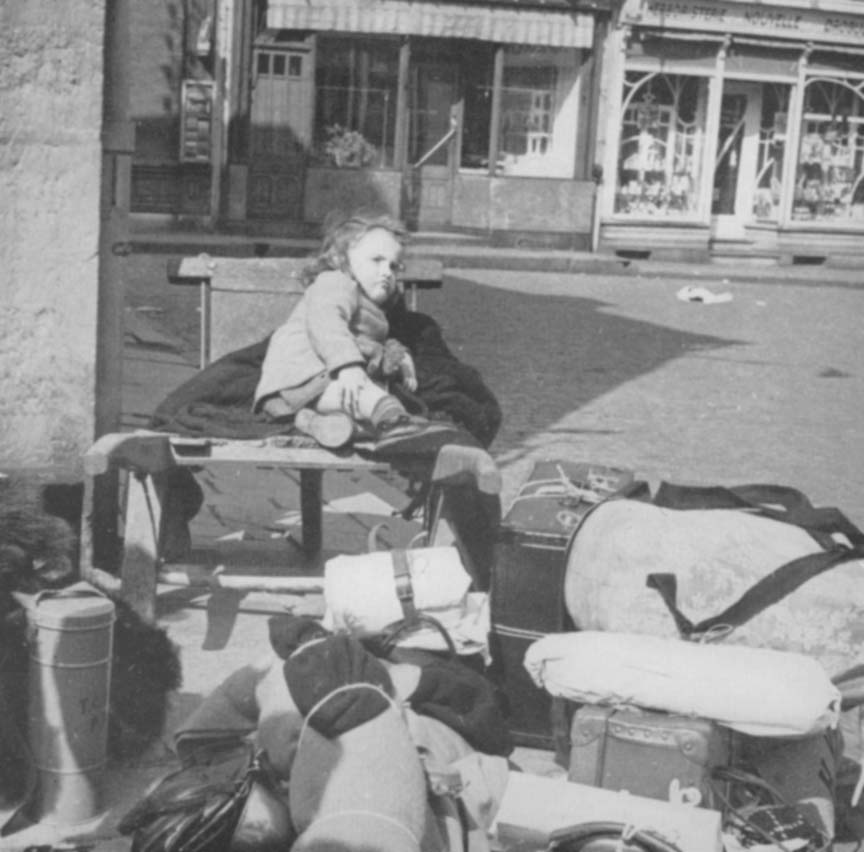
| This little one, lost during an air raid, was found by the A. F. of F. in her own shelter amid abandoned baggage. She climbed on a wheelbarrow and pulled a blanket over her head. |
Blérancourt
Meanwhile at Blérancourt Mrs. Hughes and Miss Werleman had turned the soldiers' foyer into a refugee center and were doing what they could to aid the refugees who had begun to arrive there.
When the exhausted unit arrived on Wednesday evening, they found beds and food waiting for them. Here all the outfit was reunited with the exception of the four volunteer American ambulance drivers, who had disappeared. The unit had scarcely gotten to bed, when it was aroused by military order to evacuate immediately, as the first motorized Germans had reached Laon.
The Committee convoy, accompanied by the French liaison officer, moved to Villers Cotteret, where it took refuge in the forest from bombardment and planes.
Miss Morgan and Miss Tiley drove to Paris to get into contact with the Colonel who had previously commanded our sector. He felt that the German army would take the direct road to Paris that day and that it would be unsafe for Miss Morgan's unit to return to Paris. Miss Morgan returned to the woods, but not having encountered any troops on the road, she decided to move the unit to Paris to re-organize.
Orders were given to start for Paris at once, and the unit reached the city unscathed. Throughout these trying days, individually and collectively the Committee showed that they had plenty of spirit and courage. In the process of evacuation our drivers were at their wheels hour after hour, and our nurses, six of them quite young and inexperienced, worked with unceasing devotion amongst the tragic procession of dust-covered sick and wounded human beings. German planes circled overhead; indiscriminate bombing and machine gunning created panic. But the CASC workers kept their canteens going, the first aid posts functioning.
Thirty-seven cars had been used in evacuation work. The four American ambulance drivers who disappeared were later learned to have been taken prisoner.
Paris
On May 17 Miss Morgan called a general meeting in the new Paris office to discuss the situation and to make plans for the immediate future. Two units were to be sent south as soon as possible to re-establish centers for our refugees. This entailed an enormous amount of buying quantities of necessities, which was much facilitated by the timely gift of one million francs from the Red Cross in Paris, to be spent within the week. There was also the problem of transportation of goods, both those bought in Paris and the cases of American goods stored in our Paris warehouse.
No one in America can realize the difficulties of shipping goods to new centers when the railway system is disrupted by warfare and when trucks and camions are almost impossible to procure. Suffice it to say that even under these difficult conditions, and by working fourteen and sometimes sixteen hours a day the work was accomplished.
On Sundays Miss Morgan and Mrs. Ames, in spite of the extreme danger, made several trips to the front as far as Amiens. They even managed to get to Blérancourt and found that all the inhabitants had gotten out in safety.
Mrs. Hughes and Miss Dolan organized a road canteen with French nurses and those who had not been sent south with the units. This canteen provided with food and first aid left Paris each morning and went as far towards the front as possible to aid the tragic stream of refugees coming down from the north. Frequently the work had to be carried on under bombardment. As the German advance continued towards Paris it became imperative that arrangements be made to move headquarters so that we could keep in touch with our centers, who were dependent on us for money and supplies. Consequently, on June 4, Mrs. Hughes was sent to locate temporary quarters near Blois.
Les Sables d'Olonne (Vendée)
As the population from the Ardennes had been told to reassemble in the Department of Vendée, the former Revin Center, with Mrs. Massey, was transferred to "Les Sables d'Olonne."
With a group varying in number from ten to seventeen, Les Sables d’Olonne unit started work, now to include inspection and amelioration of living conditions among the Ardennes refugees; a workshop, ravitaillement and a cantine and the distribution of clothing and other necessities. All aid rendered was in cooperation with the French authorities of the region. Social service and medical assistance was of primary importance. Outlying communities were daily visited and received attention.
As at Revin, "Les Sables" unit efficiently and systematically organized its work and continued to function until the refugees were ordered to return to their homes the end of June.
Mayenne
On May 20, Blérancourt unit reopened at Mayenne under the direction of Miss Tiley. Twelve cantons, including 122 communes, received the attention of the Committee. The scope of the work may be judged by the fact that there were 110,000 refugees quartered in Mayenne. Besides social and medical services, a cantine was maintained, which arranged the distribution of thousands of articles of clothing and other necessary items.
That the bureau at Paris was able to supply the tremendous needs of these centers attests to the efficiency of our main magasin and transportation department.
Paris-Evacuation
On Sunday, June 9, it became obvious that the Paris office must evacuate. Miss Morgan ordered the personnel, some forty in all including dependent relatives, to assemble at the office on June 10 ready to leave at once. All available cars, camions, and ambulances were summoned to 2 Rue de Miromesnil. Office files and supplies, records and equipment, storeroom supplies, clothing and other necessities, were loaded and began moving out of Paris. The last car to leave the city late that day carried the Chief.
Headquarters were established at the Château de Guerinet, outside of Blois. The entire Committee was lodged in the Château and its out-buildings, and a small inn in the village supplied our meals. But it soon became obvious that Blois, which is north of the Loire, was a dangerous and untenable position because of the squadrons of German planes which preceded the actual army that were flying overhead in great numbers. It was imperative, if the Committee was to keep in touch with its centers, that it should move south of the Loire.

| One of the ambulances of the Benjamin Franklin division of the American Volunteer Ambulance Corps with driver, who answered Miss Morgan's appeal for more ambulances to help the A. F. of F. units in the evacuation of the French Ardennes and Aisne. |
On June 14, accordingly, Miss Morgan gave the word to leave Guerinet. Mrs. Hughes, Miss Werleman, and Miss Eddy at their own request remained at Blois, to distribute the urgently needed food and clothing, working under bombardment. They only left Guerinet after the first German motorized units had entered, and joined up with the Committee at Niort.
In the meantime, the rest of the unit had gone to Bellac, before proceeding to Niort. Bellac was a scene of human despair, with hordes of refugees, wounded and retreating soldiers engulfing the local population. It was an utter rout. There was no gasoline, and the roadsides were cluttered with lines of stalled cars. Under Mrs. Hutton's splendid direction, the center at Bellac was able to take care of more than twice the number that was supposed normally to be accommodated, some eighty in all.
On the second day at Bellac, the Mayenne unit was sent for. In the midst of the general breakdown the dispensary and nursing services and the Foyer kept up their wonderful work. One especially memorable sight was the Foyer courtyard, where an outdoor cantine provided food for groups of children.
Sometime earlier in the summer, in case of the eventuality of an evacuation, the Committee had leased a château outside of Niort, because the bank had evacuated there and it was necessary to keep in touch with our funds. As Bellac was overcrowded, it was decided to move the Paris and Mayenne personnel to the Château Ste. Neomaye, as it seemed a strategic place for our headquarters, being located between the various centers. The Committee at once set to work. Visits by nurses to the surrounding countryside were organized, and a cantine opened to feed the destitute.
The first German troops arrived at Niort on Saturday, June 22. Armistice, a national day of mourning, was decreed for June 25, and the Committee attended mass in the village church. After the services, the population and the Committee assembled on the village green, where the Mayor paid tribute to Miss Morgan, and thanked her and the Committee on behalf of France. None of those present will ever forget the poignant scene.
AFTER the armistice the refugees' one idea was of course to return to their homes in the north, so the Committee decided to return to Paris, reopen our office there, and if possible to also reopen Blérancourt. Miss Morgan obtained the necessary permission from the German Kommandantur for our cars to travel on the highroads. The first cars left Niort for Paris on June 30.
It is impossible to describe the desolate, war devastated and deserted countryside around Paris and the tragic appearance of the city itself. Paris was completely empty, except for German soldiers. All the shops and smaller hotels were closed. The Germans had taken over the Ministry of the Marine, the Crillon, and all the hotels on the Rue de Rivoli, which were hung with Nazi flags and the roofs lined with machine guns. There were no taxis or buses, and it was almost impossible to obtain gasoline for our Committee cars; and one also had to obtain permission to drive one.
We may here mention that most of the other relief organizations, both French and foreign, had disbanded or become disorganized. But the CASC was still a going organization, and thanks to the generosity of America and the hard work of the Friends of France during May and June, there were sufficient funds to carry on.
One must understand that all activity in Paris was completely under German control. Miss Morgan obtained an interview with the new German Ambassador, Herr Abetz, to get permission to reopen our centers in the Aisne. In spite of difficulties due to the constantly changing German orders, we used our own initiative and returned with the refugees to our centers. Here we found our own mayors waiting our arrival and deeply in need of our help.
Blérancourt
The scene at Blérancourt when we arrived there was indescribable. Three armies had used the numerous buildings and extensive grounds---the French, the Germans, and the Moroccans, as well as refugees. To Miss Tiley, Miss Morgan entrusted the herculean task of getting Blérancourt in order again. Under her efficient direction miracles were accomplished.
Plans were in formation for the new program. The dispensary, the workshops and similar branches of Committee interests, as formerly, would continue, but new elements which entered the situation, required extended thought and planning. Essential to the population's welfare was, of course, food. France was already feeling the shortage. Equally essential was clothing, for the inhabitants, as they trickled back, having lost their belongings, found homes pillaged or destroyed. Following such conditions it was inevitable morale would grievously suffer. People were separated from their families, uncertain about their menfolk, whether prisoners or dead.
The system achieved by the Committee for the distribution of food was worked out by our members with suggestions from the mayors of Blérancourt and the neighboring towns and villages. It was as follows: Prices were established according to the cost to the Committee, tempered when necessary to the prices the merchants and buying public knew. Each family received a buying card stating the number of adults and children in the family and the maximum rations purchasable per week. In this way stocking up or unfair distribution was avoided.
A coupon system was instituted for the needy. Here the Committee's contribution not only included the providing of supplies-to-be-bought, but their gift. In each township the mayor decided who were the deserving of this service and gave them a signed coupon. This was then brought by the family to our dispensary and signed after a medical inspection by one of our nurses; or if in the rounds of the countryside a nurse discovered a needy family, a sick person or undernourished child, she would give them a valuable ticket. Those coupons were then presented at the grocery, and the allotted merchandise delivered.
Having completed a turnover from Committee money to supplies and back to money payed by the purchasers, or, where the indigent were concerned, in coupons, the Committee had a revolving fund with which to buy more provisions. The grocers chosen to handle the supplies were storekeepers who had no means of support, who had children, and whose husbands were either missing or prisoners. For handling and disposing of the goods, the Committee paid them from eight to ten per cent on their sales. An equitable plan had been established.
As one example of the many complications which arose, the local German commandant of Blérancourt changed frequently, and all arrangements made by the former man in charge were voided when his successor moved into town, with the consequence that our work had to be re-explained, sometimes a new set of rules temporarily put into operation, and numerous other details rearranged as to passes on the road, gasoline if available, and so forth.
Besides the provisioning activities, arrangements were made for the distribution of clothing. The dispensary and the continual visits by nurses to the homes, ever watchful lest disease become rampant, were of paramount importance. Hospitals at Soissons and other towns were investigated and given supplies. Ambulance transportation for the sick from our villages had frequently been needed.
Since the reopening of Blérancourt, the Committee's undertakings, which began in a small way, grew steadily in scope. By September the Center included seventeen communes, and the entire Committee are justifiably proud of the work done by Miss Tiley and her staff.
Vic-sur-Aisne
The bullet-pocked Center at Vic-sur-Aisne started its work on July 24 with Mrs. Massey as directrice. As at Blérancourt, the question of food and clothing had to be met and a similar regime was instituted, though instead of local grocers handling our supplies, the Center itself conducted their distribution. The nurses at Vic had to contend with a dysentery epidemic, and a great deal of sickness. Prisoners were helped as much as possible with the concurrence of the Germans. Children's classes were organized under Mrs. Eddy. The Vic unit ministered to some twenty-nine communities with its personnel of four.
Coucy-le-Château
Receiving its stocks for the main part from Blérancourt, the Coucy Center further spread the Committee's endeavors in the Aisne. This unit is across the line which separated territory open to the returning homesteaders and was strongly guarded by the German troops. Without interruption of its work, despite the difficulties of military regulations of all kinds, Miss Dolan supervised that canton. Three nurses attended to medical and social needs.
Anizy-le-Château
Our fourth Center under Mme. Houchet, was housed in an old Committee building which held associations from 1914-1918. When the Committee evacuated in May, the house was managed as a rest home for nurses and its former directrice, Mme. Houchet, returned to assist in the Committee's work.
Meaux
Mrs. Hughes, with the consent of the German authorities and aid from the American Hospital, took on the job of prison camp relief, and during the months of July and August worked at Meaux in a camp of 12,000 prisoners, trying to ameliorate their conditions, bringing them food and clothing, and endeavoring in whatever way possible to restore their morale.
It is fitting to call attention to the conditions under which our people lived in the four centers in the Aisne. Electricity was still not available in three centers; hot water, unless heated on the kitchen stove, was lacking. Many windows had only a coating of paper in lieu of panes. The days became colder but our workers bundled up and took it. Food, though added to by supplies from Paris, was meager.
Paris Headquarters
On the desk in the large front office overlooking Place Beauveau, were innumerable folders with headings: Aisne Reports, Aisne Correspondence, Vic Reports, Vic Correspondence, Official Letters, Coucy Ravitaillement, Transport Correspondence and Details, Automobile Purchases, Activities of the Committee, American Red Cross, Prisoners, French Red Cross, German Red Cross, Travelling Information (passports, etc.), N.S.V. (National Sozialistische Volkswohlfahrt) and many others. It was the Committee's nerve center.
During the first period (September 1939 to May 1940) the Committee functioned easily with the French Government and military authorities. Over the evacuation period that changed. The Committee carried on but without sure knowledge of finding the correct official or the quickest channel to facilitate our wants and needs. The third period, with our return to Paris, necessitated a new approach altogether for our organization.
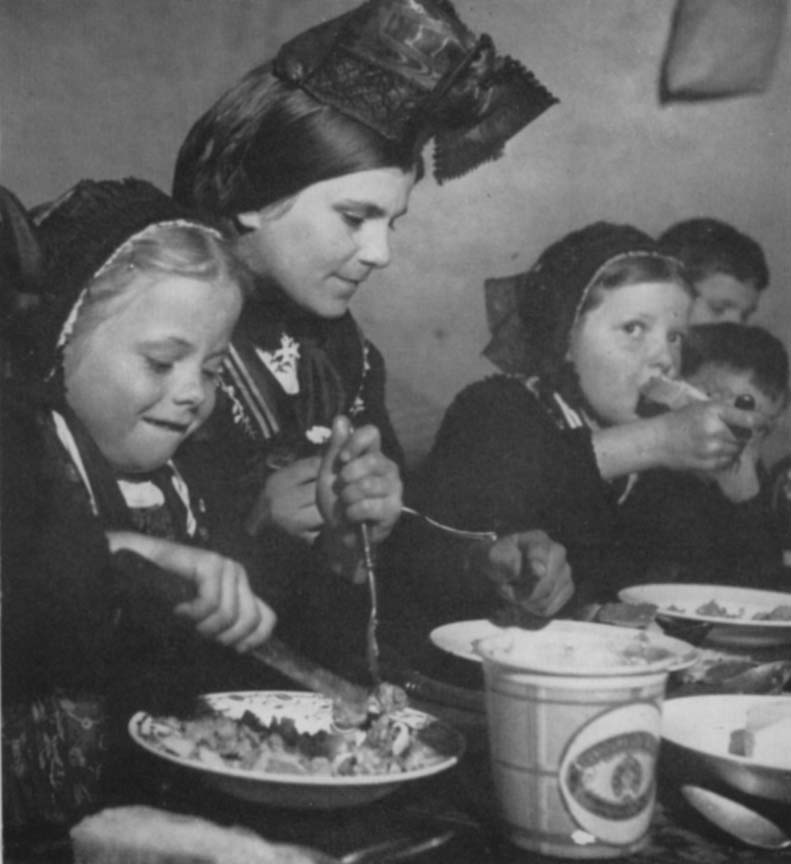
| Evening meal in Alsatian refugee home. Peasants from Oberseebach. Twelve in two tiny rooms. Near Limoges. |
Difficulties were met at every turn. The problem of gasoline surmounted all. Where to find it and how to get authorization for it and in sufficient quantities to carry the supplies to our centers whose work relies on the thrice-weekly stocking from Paris! Passes were needed at every step. In short, official documents from the French and Germans were required for almost everything but breathing! Where to find, in a maze of disorganized bureaucracy, the correct office and right person to secure these very necessary details? At this time Miss Dahlgren took over direction of the Transport Department. This work required hours and days of interviewing and pleading. In fact, our "chef de transport" was so efficient that she managed to get us favors that no one else in Paris could have obtained. Her work and untiring efforts made it possible to send supplies to our centers.
The storehouse under Mme. Ullern was responsible for the Paris buying, assorting and distributing of our stocks of food, clothing, medicine and the personal needs of the individual centers. This work demanded great ability, not to mention a talent for tracking down provisions and materials which had all but disappeared from the French markets. Mlle. Le Febvre attended the public markets at five in the morning and voyages to Brittany and Normandy were frequently made by Mme. Ullern in successful quest of all kinds of food materials.
Santa Barbara, our five-ton truck driven by Bob Schemer, our last American man volunteer, did yeoman service, leaving Paris for the Aisne at least three times per week, ladened with a precious load. In the period between July and October 1940, the truck rolled up a mileage of over eleven thousand kilometers.
The situation in America as the months passed seriously affected the Committee's work. Money and provisions could not reach us. The Germans had no inclination to ease our many problems and demanded all relief work should be under Red Cross direction. Therefore, in late September, the Committee joined hands with the American Red Cross. It was an arrangement whereby our autonomy was assured and our organization became their brightest and proudest "ward." The heads of the American Red Cross visited our centers several times and were greatly impressed to see a going organization, firmly established and doing remarkable work despite the circumstances and the times.
When war was declared on September 3, 1939, the French Government gave orders to evacuate the Lorraine and Alsace population living in the zone of military operations, and thus began the first vast exodus of the French population. Nearly a million people were moved south of the Loire. They went by train, by car, in their farmcarts (sometimes with their cattle). In the light of the dreadful flights of May and June, 1940, this peaceful evacuation paled. We who have seen the flight from Belgium and Paris, the bombed and machine-gunned convoys, the roads blocked with fleeing humanity in every imaginable conveyance, are hardened now to the tales of the comparatively orderly evacuation of Alsace.
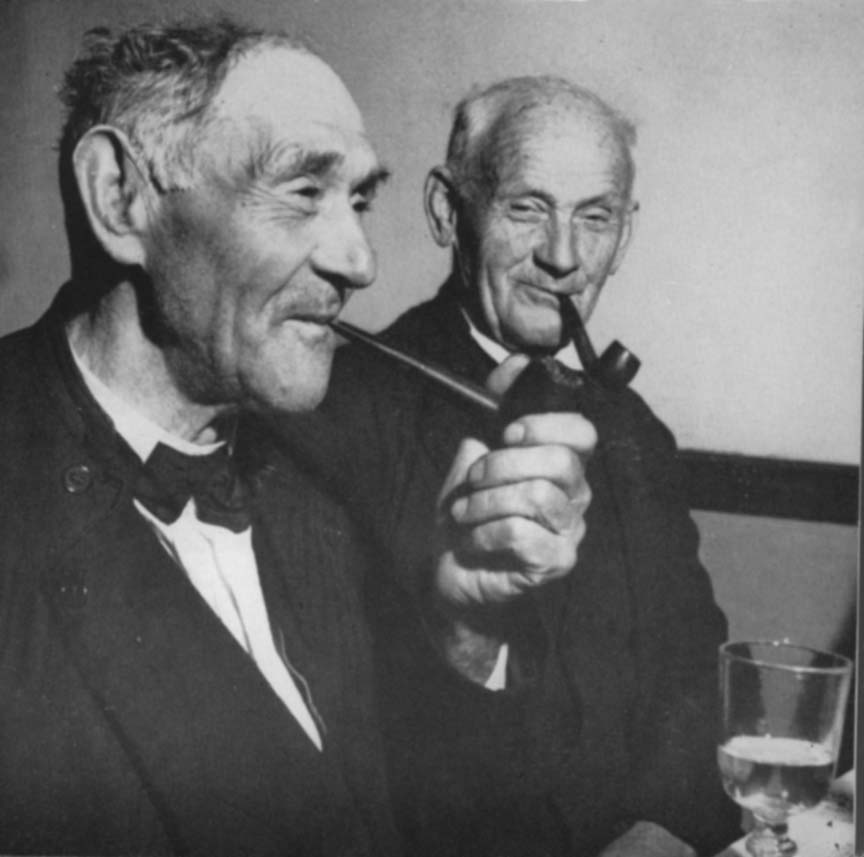
| Old cronies meet again in the Alsatian Center opened by the A. F. of F. near Limoges, donated by Charles Boyer. |
But in September 1939, this moving mass created vast and difficult problems. The Minister of Public Health, having asked the CASC to work amongst the Alsatian évacués in the Haute-Vienne, Mr. Ducombeau, Prefect of the Haute-Vienne, turned over to the Committee the arrondissement de Bellac, where 25,000 Alsatians had descended on a local population of 50,000 Limousins in a poor and unfertile part of France. For one year the American Friends of France worked patiently in Bellac; the nursing, the workrooms, the foyers (social clubs) were organized efficiently; the transportation of the sick to hospitals was assured by our "Regency Ambulance"; clothing, food, furniture were generously distributed. After that date Bellac became an emergency center---hundreds of thousands of French, Belgian and Dutch refugees poured through the town, and the whole aspect of this quiet little sous-prefecture changed.
The Blérancourt and Paris units, forty-eight strong, arrived at Bellac in June to spend three days before finding a home at Ste. Néomaye near Niort. For weeks every room became a dormitory where passing friends, or strangers, slept on mattresses or on the floor on blankets. The well-ordered foyers became canteens, the unit dispensaires became emergency posts for the sick, and sometimes wounded, refugees. Bellac itself received a visit from Italian bombers in those last dreadful days of the war.
This emergency work continued into August when Mrs. Hutton, the American directrice, began gradually closing down the unit, because of difficulty of communication with Miss Morgan in Paris. The canteen and the Foyer Boyer were kept open for another month, when they were turned over to the Sisters. The Dispensaire d'Hygiene Sociale was left in charge of Mlle. Hering, who will he paid by the CASC until May 1, 1941. Various charitable organizations in Bellac were given a generous amount of stock and other gifts, which were left with Mlle. Hering for distribution. The Regency ambulance was turned over as a permanent gift to the hospital of Magnac-Laval in Bellac. One year, day for day, after our first visit to Bellac, the American Committee drew out of the town as the first trains of returning Alsatians left for Alsace.
In November 1940, the American Red Cross in France was instructed by American Red Cross headquarters in Washington to cease activities in Paris, therefore it became necessary for our work in the field to be attached to local French authorities. Since then, our Committee in the North is known as the Entre Aide de l'Aisne.
Our nursing, social and physical education departments will continue as before. In addition we are increasing our help to Mlle. Feraud in the Ardennes where she is caring for her own region of Vouziere. She will divide her time supervising her own work and ours and acting as liaison officer with the CASC Paris office. The Paris office will move to smaller quarters, and consist of faithful Mlle. Richard as General Secretary, and the accounting department under M. Moeremans.
An advisory board of Mrs. Vagliano and Mlle. de Joannis will supervise all Committee action. Each center is budgeted and will have a local board of two or three prominent citizens to oversee the work and expenses in each sector. Each center was supplied with sufficient material, such as food stocks, medical supplies for distribution and use for the months of November and December. The financing for these centers has been taken care of until May 1941; further work will depend upon the possibility of transferring funds from America.
|
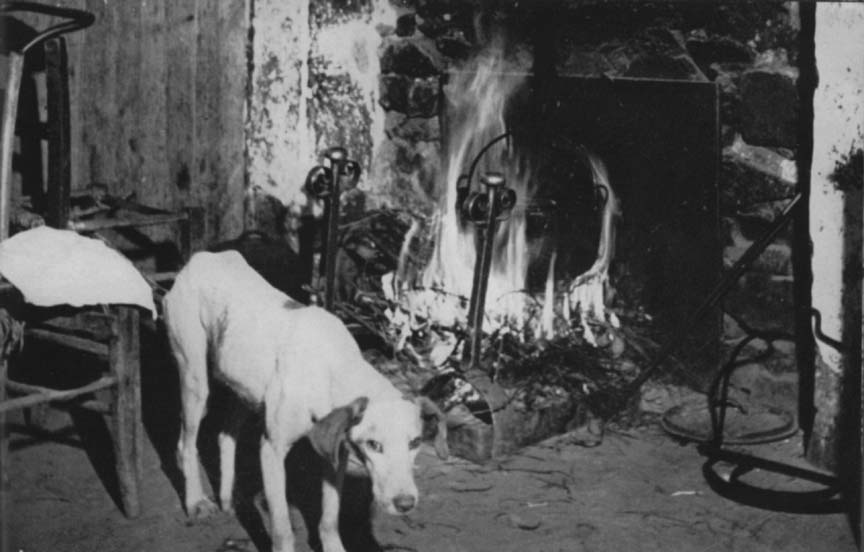
It was for such wretched animals, that the American Friends of France opened a cantine at Blérancourt. Every day the four-footed "breadline" formed at the back door. They were washed and fed and their mangy wounds bound up and treated. Each day the line grew longer, for every dog and cat brought back friends and relatives, puppies and kittens to be revived and cared for; arriving dejected but hopeful they trotted away wagging their tails and licking their chops to spread the good news to all their four-footed companions in misery. |
The American Red Cross has given the CASC generous supplies of condensed milk and cheese, sewing machines and medical supplies. The crowning gift, however, on liquidating their work in Paris, was that of 5000 litres of gasoline from their own priceless supply, which, combined with the stock of alcohol we had secured ourselves, solved the problem for the winter's work in the Aisne. Messrs. Richard Allen and Dean Jay of the American Red Cross, visited the civilian hospitals of Chauny and Soissons, which are in great need of help, and will re-stock them with supplies received from America.
Remaining on as long as circumstances permit, Miss Dolan, Miss Tiley and Miss Dahlgren will be our unofficial unit. No finer representatives than these three women could have volunteered to carry on the work of the CASC.
| RECEIPTS RECEIVED IN PARIS |
|
|
| From National Office, U. S. A |
6,762,212.30 |
|
| From Americans---Received Direct |
2,884,953.40 |
|
| From American Red Cross |
1,050,000.00 |
|
| From Other Sources |
50,780.00 |
|
|
10,747,945.70 |
||
| DESIGNATED | ||
| Relief. Dispensaries |
218,935.45 |
|
| Medical Supplies |
13,514.40 |
|
| Evacuation |
1,136,037.00 |
|
| Vendée |
108,108.00 |
|
| Blankets |
112,620.00 |
|
| Woolen Goods |
680.00 |
|
| Foyers for Refugées |
174,560.00 |
|
| Foyers for Soldiers |
87,000.00 |
|
| Showers and Disinfection |
218,200.00 |
|
| Children |
9,439.75 |
|
| Christmas |
43,500.00 |
|
| Milk |
3,697.50 |
|
| Prisoners |
27,010.00 |
|
| Motor Service-Cars and Service |
686,582.30 |
|
| EXPENSES FOR CENTERS | ||
| Special---Nurses |
11,378.85 |
|
| Salaries, Maintenance, Nurses |
89,538.15 |
|
| Salaries, Maintenance, Social Workers |
6,546.00 |
|
| EXPENSES OF ADMINISTRATION | ||
| Rent, lease of Paris Office |
99,750.00 |
|
|
3,047,097.40 |
||
| UNDESIGNATED |
7,70848.30 |
|
|
10,747,945.70 |
||
| OTHER RECEIPTS | ||
| Contributions from Municipalities |
162,146.00 |
|
| SALES | ||
| Foyers and Canteens |
140,023.25 |
|
| Liquidations |
6,150.40 |
|
| Stocks |
1,193,632.10 |
|
| Automobiles |
107,500.00 |
|
|
1,447,305.75 |
||
| TOTAL RECEIPTS |
12,357,397.45 |
|
| DISBURSEMENTS | ||
| Direct Relief |
3,319,517.13 |
|
| Indirect Relief |
1,116,710.45 |
|
| Donations |
132,167.95 |
|
| Stocks on Hand |
2,076,258.50 |
|
| TRANSPORTATION | ||
| Cars and Bicycles |
985,584.55 |
|
| Maintenance |
706,871.69 |
|
| Warehouse Expenses |
121,747.40 |
|
| Loss due to Evacuations |
175,578.25 |
|
|
8,634,435.92 |
||
| Administrative Expenses |
760,697.42 |
|
| TOTAL DISBURSEMENTS |
9,395,133.34 |
|
| CASH BALANCE as of November 16, 1940 |
2,962,264.11 |
|
| After this date the following gifts to 'l'Entr'Aide de l'Aisne" were made: | ||
| Funds to cover their budget from November 18, 1940 to May 15, 1941 |
1,231,500.00 |
|
| Materials and supplies, including gas and oil to the value of |
1,255,688.70 |
|
| Seventeen cars, spare parts, and nine bicycles. |

| Opening of the new building of the American Field Ambulance, September, 1938. General Gouraud and Miss Morgan in the foreground. |
