| CHESTER B. KAYES ("Doc") |
32 W. Elm Terrace, Brockton, Mass. |
"Doc" Kayes achieved much fame in France and although handicapped from the start by holding down a base job he "carried on." Doc was a soldier and mud and blood in the front line would have been his speed, or if he had achieved his fond ambition, a commission in the Sanitary Corps. Great things could have been expected, but a base walloper he was destined to remain. Doc could always deliver the goods, however, whether as a chauffeur, ward orderly or on the ground squad. He achieved his greatest success as a "surgical assistant" on the operating staff, where he showed rare form. Doc was a member of many clubs, "The Buckshee," "Mangee," "Salvage" and "Southern" clubs. He proved himself an all round good fellow, with a host of friends.
| WILLIAM H. KEATING ("Bill") |
Baker Street, Foxboro, Mass. |
Bill is a good mixer, he reads human nature quite readily, also the bulletin board around payday. He is not afraid to spend money nevertheless, and works hard for it; that is, he said he did before the war. I often wonder what he does for amusement. You never see him take a drink and of course he hates women. He must have had a monotonous life in this damp country of France. Cheer up, Bill, the States are dry and wifey waits for the return of the best Orderly of Base Hospital No. 5.
| MATTHEW J. KELLY ("Matt") |
112 Stewart Street, Fall River, Mass. |
A handsome young gentleman from Fall River with large honest blue eyes and hair that's getting a little thin on top. Yes, you are, "Matt." Your roof will be minus its thatch by the time you are forty. Good ole Matt. Your line of philosophical bull and that "gladhand" stuff of yours would get you by anywhere. We have no doubt but that you saw the whole of Belgium on that three days' leave of yours and we also believe your yarn about where you were on your regular leave. If you could see Cologne, Brussels, Metz, Coblenz, Luxembourg, St. Nazaire, Nantes, etc., in ten days we believe that if you had a month you might have visited the rest of the civilized world. And, Kel, we also believe the story of your interest in French children; in fact, we fall for your line in toto. We can't help it when you place one of your paws on our shoulder and holding us off at arm's length gaze at us with those frank open blue eyes of yours. We've no doubt but you'll make good, Matt, and we confess that we would enjoy living in a world of Matt Kelly's, providing that they would all have a little different line.
| IRVING KIMPTON ("Kimpy") |
1278 Salem Street, Malden, Mass. |
A youth who never should have left home, for foreign ideas and methods have ruined America for him. At least we gather as much from his lectures in F Hut. It is too bad that National Prohibition is imminent, "Kimpy," because now it is impossible to get your family to serve wine with meals as they do in France. Kimpy was a valuable addition to our unit orchestra and may be quite a man when he grows up.
| HENRY KING ("Hen") |
184 Hamilton Street, Dorchester, Mass. |
King and Shay---a strong combination when together, but somehow the authorities always seemed possessed to separate them for no apparent reason. Henry made an ideal ward orderly while he lasted, but that was only four hours. As janitor of F Hut he made a reputation that will live through several wars to come.
| RONALD MARTIN KING ("Roi") |
79 Lincoln Street, Laconia, N. H. |
If this war had never broken out Ronny might have stayed at home and become a respectable dentist. Now we fear the boy's career is forever shattered. For a young fellow like Ronny to pit himself against an old army man with fifteen years' service, and a Scotchman at that, was a great mistakes. And to think of going back to a country which is universally dry! The only hope we see for Brother King is to emigrate to Mexico or somewhere in South America where there is no William J. Bryan and no Prohibition Party to make life a bore for all good fellows. We like to hear Ronny tell a story, but we can't spare the time to hear more than one a day. Hasn't made any plans for the future and will probably end up as a country gentleman with Yvonne as his companion.
| JAMES D. LANGDON |
Y. M. C. A., Boston, Mass. |
Sergeant, first class. Enlisted with unit, Boston, May 7, 1917. On detached service with Mobile Hospital No. 6, A. E. F., September 9, 1918, to October 12, 1918. Transferred to Medical Detachment, 411th Tel. Battalion, S. C., October 12, 1918. Demobilized in France to become Y. M. C. A. Secretary.
| SEWARD S. LEATHER ("Gimme") |
Lawrence, Mass. |
A veritable "Charlie Chaplin" in the flesh, whose adventures would afford ample film material for that versatile comedian. A man whose head approaches nearer being a vacuum than anything science has yet discovered. Has developed borrowing into a fine art. Ordinary salutation is "Gimme a match" or "Gimme a cigarette." A great international social light, which light has now unfortunately been extinguished.
| PERCY N. LEATHER |
110 Waite Street, Malden, Mass. |
"Sh, don't wake him up!" But have no fear. Shot and shell have failed to rouse Percy from the calm tranquillity which he forever possesses. Hails from Malden with Ken Crowell and Kimpy. Not that this is any great credit to him, even if Crowell does say so.
| FRED C. LEMONT ("Monty") |
47 Burrill Avenue, Lynn, Mass. |
A poor youth who never should have left home. A chap with powers of intellect and a convincing power of argument, but after all nothing but a kid. Was known to argue on such foolish things as the question of writing home once every month. Was known to comb his hair once in Camiers, which fact was set down in the unit records.
| STEPHEN R. LESHER ("Steve") |
Rye, N. Y. |
Behold him as he ambles leisurely along the fortified ramparts of 1-B, hands in pockets, a walk as smooth as a flatterer's tongue, a pipe tucked in one corner of his mouth as casually as in a snow man's. His amazing coolness when patients to right of him, patients to left of him, patients in front of him volley and thunder, makes us think that he has the snow-man's heart too. But nay, not so. There is charity enough in Steve's breast to give each patient a lion's share, and still have plenty for his friends.
| ROY L. LIBBY ("Lib") |
318 Malden Street, Medford, Mass. |
| Men are known by the company they
keep, But "Lib" is ever in clover, He never speaks, not even in sleep, So naturally you'd think this over. |
But no such luck in a case like
this, For violins sure are his hobby, And speaking of ladies, now his little miss I'll say she's sure very "knobby." |
|
Why his should look like a kilt, So in and out, never mind the season, He wears it, till you'd think he'd wilt. |
|
| BYRON F. LIVINGSTON ("Livy") |
182 California Street, Newton, Mass. |
"Livy" reminds us of a monk---we mean those fellows who live in the desert and eat locusts and other fruit. This effect is produced by the complete absence of thatch on the roof of his dome. We might be inclined to think that this was caused by brain fever, but we are not sure that Livy ever owned one of those things. However, we would like to be present at the autopsy to see what is really inside that bean. Livy was one of the original sergeants and we will say that he has always been very original. There isn't another like him in the A. E. F. He was conscientious to a degree. If he gave a private an order and said private told him to go to Paterson or some other warm place, Livy did the job himself. When the detachment began drilling a place was found for him as right guide, the idea being for the boys to watch out and do everything just the opposite from Livy. Livy was a bosom friend of the Great Lover, Gimme Leather, and was no slouch himself as a knight-errant. If he only abjures vin blanc and keeps his hat on we predict he has a great future behind him.
| FRED G. LOFBERG ("Lof") |
Springdale, Pa. |
A long, lean Swede who has to make certain the plug is in the tub before he takes a bath. Willing, obliging and efficient. Patiently endured for four months the tiresome platitudes of our eminent Christian brother Langdon. The kind of a guy you don't hesitate to ask a favor of because you know it will be granted. An all-round good kid who, we believe, will get on in the world. "We ban tank so."
| JOSEPH LOGAN ("Joe") |
Hyde Park, Mass. |
One of the biggest mistakes made in our unit was that of not making "Joe" Logan a noncom. because he could give instruction so much better than he could service. If Joe follows the real estate and insurance business long enough we feel sure that he will make a success of it. He can sell anything under the sun to anybody who does not know him as well as we do, providing the buyer does not see what Joe is selling. Joe always reads the political news with so much enthusiasm it makes us think that his ambition is to be the political boss of Hyde Park.
| ELWYN C LONG ("Shorty") |
East Northfield, Mass |
Who will ever forget the fumigator with "Shorty" Long at the helm, usually with a bandage around his face? How well we remember his aversion to the hospital and how restless he used to be when confined there! Shorty was invalided home early in the winter of 1918.
| THOMAS LOUGHMAN ("Empty") |
103 Washington Street, Brookline, Mass. |
Nicknames are queer things, for to read his nickname, you would imagine lack of intelligence. Woe betide any one who attempts to prove his theory. "Empty" is the original come-back artist and generally leaves his opponent without a leg to stand on. A charter member of the Irish Brigade.
JOHN J. LYDON
Private, first class. Enlisted with unit, Boston, May 7, 1917. Invalided to U. S. March 11, 1918. Died at his home in Dorchester, Mass., September 23, 1918.
| FRANKLIN MADISON ("Maddy") |
Danvers, Mass. |
Another product from Danvers. A boon companion of Joe Hundley, who always tried to make life pleasant for "Maddy." Maddy spent several months in Paris and then in the latter part of the summer of 1918 he left with the "mud and blood" outfit, returning as a sergeant in January. He was transferred to No. 25 General Hospital and was sent home from there via Blighty.
| HENRY F. MAHONY ("Mac")' |
Waver1ey, Mass. |
Private. Enlisted with unit, Boston, May 7, 1917. On detached service with Mobile Hospital No. 6, A. E. F., August 21, 1918, to October, 1918. Transferred to Reconstruction Department, A. E. F., October, 1918.
| C. E. MANN |
Ridgley, Park, Philadelphia, Pa. |
Joined unit in Boulogne May 13, 1918, with rank of Private, first class. Commissioned Lieutenant, Dental Corps, October 12, 1918. November 8, 1918, detached for duty with A.E.F.
| ALLEN MASON ("Al") |
Vine Avenue, Winthrop, Mass. |
And thus did the spirit of "Al" Mason reply when challenged by St. Peter: "For almost two years I have striven both by word and deed to furnish an example of dignity and obedience to the members of Base Hospital No. 5. I have grown gray, worn large gold-rimmed spectacles, and have laughed inwardly instead of outwardly. Furthermore I have utilized my spare time in studying love as expounded in French paper-backs, even to reading between mouthfuls of maconochie, at the mess hall. And lastly, I have never suffered rebuke from the powers that were then on earth." With a clang, St. Peter flung open the Golden Gates, and, bowing low, said, "Enter, thou wilt make a welcome addition to our body of angel orderlies."
| ALEXANDER MATTHEWS ("Matty") |
Boston, Mass. |
Who says that small people grieve over their shortness? Not a merrier soul than our "Matty" is to be found in all France. His pleasant laugh, both loud and prolonged, is enough to make an octogenarian caper like a lamb or a love-sick damsel smile when "he" is dancing with her rival. In these war days, it is good to have such a man alive, and the Allied Governments should subsidize him---with prunes. He formerly possessed a large dome-like head as base and desolate as the storm-beaten peak of Mt. Blanc, but recently it has become with verdure clad. Thus inevitably does smiling spring succeed melancholy winter. Official entertainer to the nurses. How many a wan eye, how many a wrinkled brow, how many an even more wrinkled lobe of the brain has cleared when he has entered! The nurses could do without their maconochie pie, without their English officers, even without their little gossips, but, O ye heavens, not without their Matty.
| GEORGE MAXEY , |
Wheaton, Ill. |
A youth from the wild and woolly "West," but George used to conduct himself as though accustomed to associating with civilized people. Ernie Silva's running mate and together they have weathered many a heavy sea. George was at one time half owner of the swank shop, but money poured in so fast that they had to retire in order to count the proceeds. George was invalided home early in the winter of 1918 and at last accounts was in a hospital in Denver.
| EDWARD J. McCAFFREY |
128 Magdula Street, Dorchester, Mass. |
Joined unit with reinforcements July 30, 1917, in Camiers. On detached service with Mobile Hospital No. 6, A. E. F., September 9, 1918, to January 7, 1919. Transferred to St. Aignan-Noyers for reassignment January 16, 1919.
| GEORGE ZELL McCLELLAND ("Mac") |
808 Shelby Street, Seattle, Wash. |
Here's a prince among men, and an idol among women-judged by his popularity in the C. O.'s unit. "Mac's" closed doors could reveal many an interesting incident of our expedition, which some of the more curious would like to know, and, perhaps, which some of us would not like to have known; but Mac knows and understands "regulations."
We shall best remember him in the canteen, selling either Woodbines or Alaskan Gold bricks, and best of all he comes from "God's country,"---ask him. Mac has won everything from races to hearts between Juneau, Alaska, and Boulogne, France,---ask anybody.
| AUBREY S. McLEOD ("Indiana") |
Fitch Farm, Marlboro, Mass. |
"I say you don't expect any American to ride in one of those?" demanded Aubrey McLeod of the British R. T. O. at Rouen when shown a typical square wheeled "Hommes 40, Cheveaux 8." But this was only one of the many pitched battles fought by the detachment of 40 under the leadership of McLeod while trying to find Base Hospital No. 5, "Somewhere in France." McLeod had novel ideas on troop transportation in wartime and he was fearless in expressing them. His career in France, however, was cut short on September 4, 1917, when a "boche" out on a "Baby-Killing Expedition" decided to "strafe" an American hospital for a novelty and possibly get an Iron Cross. The boche certainly did get the Americans Cross and the "Victory Smile," inaugurated by McLeod while undergoing the most critical operations, is now worn by thousands of Yanks on both sides of the Rhine. While discussing the Allied Victories of 1918, Mac says, "I can't kick."
| JOHN D. McDONALD ("Mac") |
50 Summit St. Hyde Park, Mass. |
In order best to appreciate "Mac" one should see him about 10 P.M. on a cold rainy night, safely tucked away in the warmth of his cot, and begging Steve Lesher to make him some toast. With his quiet wit and ready smile Mac has made many friends. For over a year he worked in the operating room teaching non-coms what he knew, but his ability was at last recognized, and he was promoted to the awe-inspiring grade of Corporal.
| ROBERT S. McDONALD ("Mac") |
Montrose Avenue, Wakefield, Mass. |
"Mac" was much in evidence from the moment we left Boston, running through the train in his shirt sleeves, howling and yelling at every station through which we passed. Those who sized up Mac at that time got him all wrong. If ever there was a Get-Rich-Quick Wallingford in the flesh, "voila" McDonald. After making about a million francs at Camiers he came to Boulogne and went hunting for larger game. Besides selling chocolate he sold houses, automobiles, sugar, coffee, gramophones, etc. There are some that say that Mac actually bought the Casino, but we doubt it. When Mac takes a leave he doesn't blow in his coin like most of the boys, instead he comes back after a week with 5,000 francs or so that he has corralled on the trip. We bet if Pop Bryant was ever put on Mac's trail he would unearth some startling facts. It makes Mac smile to hear about trying for a commission when he is making more money than a colonel.
| JOHN J. McGANN ("Mac") |
708 Parker Street, Parker Hill, Roxbury, Mass. |
According to "Mac" he has trod the boards of every music hall from Maine to 'Frisco, but there are others who declare that these are only pipe dreams that he indulged in when driving a brewery wagon in Roxbury. Be that as it may, Mac is a natural comedian and he can get a laugh from us any time he opens his yap. It is said that Mac sprung one of his funny ones on a wounded Yank when he was with the Mobile Unit and that the poor fellow laughed himself to death. John is a good-hearted, witty young man who has always performed his duties faithfully and well. A much better personality to keep the troops in good humor than the average Y. M. C. A. secretary. Among other things, famed for his perfect rendering of "reveille," as erstwhile bugler of the outfit.
| HARRY McGRATH ("Chappy") |
4 Grant Street, Cambridge, Mass. |
"Chappy" McGrath, better known in he Mangee Club as "Lieut" for his lightning-like changes from a "buck" to a shavetail when he has an engagement to tea or a dance with his Canadian queen, is another product of Kerry Corner. His main objective is that "darling, lil' ole bed," from which he derives very little benefit, especially those mornings he rolls in at 3 o'clock and wakes us up in F Hut with his cheery, "Do you know I got the funniest feeling in my stomach; why, it's awful, doncherknow." You may walk around any night and hear his prominent, "Cheerio, old China," to some Waac or "Bon centimes" to some French dame, when he ought to be entertaining his Canadian queen. He sees the club right every night with a lot of French bread and sometimes he brings us home a whole chicken. (Wonder how he gets them without getting caught.) He is also a shrewd gambler; he will shoot "ha'pennies" till he gets a franc and then go south with all the silver in the game. He smokes good issue cigarettes (Woodbine) and claims his greatest sport is eating.
| KENNETH McNICHOL |
Bay State Road, Boston, Mass. |
When the reinforcements arrived one of them immediately announced that he intended to systematize the hospital. He began with the office, but he lasted there only a couple of days when he was transferred to the ground squad. He had several senators and congressmen out West whom he had elected to office and in consequence we were not surprised when influential parties arranged his transfer to the A. E. F.
| JOSEPH A. McOWEN ("Joe") |
260 Elliott Street, Newton Upper Falls, Mass. |
"Joe" is better associated with the "Cliff" Burgess Gloom Club than most of us, but his natural inclination to shine before the public in the capacity of actor or cheer leader more than offsets his failing to find fault with the administration of this command. His ability to escape the difficult assignments of duty should have enabled him to wear stripes, but when vacancies occurred his anxiousness to work was too evident. However, his devotion to duty during air raids was an inspiration to others, though it was never recognized. A good fellow, generous to a fault, we wish him good luck.
| WILSON R. McNEIL |
c/o Adjutant General's Office, Washington, D. C. |
Sergeant, first class. Medical Department, U. S. Army. Assigned to unit, Fort Totten, May 11, 1917. Detached September 24, 1917.
| JOHN A. McNIFF |
25 Rawlins Street, Salem, Mass. |
Private, first class. Enlisted with unit, Boston, May 7, 1917. Returned with unit.
| SIMON B. MILLER ("Aby") |
35 Deering Road, Mattapan, Mass. |
If arguments gained anything the whole of Base Hospital No. 5 would have been pro-Jewish, for "Aby" Miller did his best to convert us. A good-natured chap who worked hard both on a ward and at Red Dog. However, if we are to believe reports, ward work was the more profitable, so he forsook the green-covered table.
| ALBERT E. MINER ("Al") |
99 Grant Street, Somerville, Mass. |
The kind of a guy who meets you with the invitation, "Come on over to your house and have dinner with me." A grand entertainer who always finds himself occupied when the waiter comes round with the check. Invited a friend to the Sergeants' banquet and bade him partake of the best in the house. "Al" should worry; there was plenty of money in the mess fund. Made a mistake at the Gare Centrale one day and removed the wrong box. Was in good spirits for some time afterwards, but the reaction was awful. Went cuff to the front with the Mobile Unit and came back a much more humanized sergeant. An efficient N. C. O. who employs rather rough methods but who gets the work done.
| ALBERT J. MOLL ("Dublin") |
830 Somerville Avenue, Cambridge, Mass. |
A late member of the Mangee Club and beloved by all nurses (peut-être). One of the volunteers to come over with the original unit. Has served faithfully and well. Noted for his ability to go without sleep longer than any other known soldier.
| WILFRED J. MONTGOMERY |
19 Elder Street, Dorchester, Mass. |
Private. Enlisted with unit, Boston, May 7, 1917. Detached July 27, 1918.
| SIDNEY H. MONROE ("Sid") |
366 Market Street, Rockland, Mass. |
A gentleman of melancholy visage and rather bored with life's fitful fever, but in spite of the army, I repeat, a gentleman. A valiant trencherman quailing not even before the flighty terrors of army biscuits and the dubious depths of a pot of maconochie. In his varied activities with us, he has given proof of a variety of talent, and equal faithfulness, in all. Beginning with a good record on the Camp Board of Health, he soon rose to the salaried office class, where he thumbed records and 100 franc notes, much to the envy of his drudging friends. It was only when the war clouds lowered upon him and bits of flying shrapnel peppered every square millimeter of the ground (it must be thus, for all the members of the Mobile Unit say so) that Fortune, seized with a womanish terror, fled panic-stricken and left her beloved to become a ward orderly.
| DOUGLASS P. MORRILL ("Doug") |
52 Evelyn Street, Mattapan, Mass. |
"Doug" is small in stature, but wonderfully able to take care of himself---and others. He says that Congress has hit members of the "Vin Blink" Club pretty hard, but better times are coming.
| JOHN MULVIHILL ("Johnny") |
52 Plympton Street, Cambridge, Mass. |
A model ward orderly and also one of the charter members of Miner's Ground Squad, where he was more contented. A product of Cambridge, Mass., which will not be used against him. John liked working for the government so well that he joined the mail service on discharge . . . .
| FRANK NESS |
95 West Street, Braintree, Mass. |
For almost two years Frank tried to tell us about his wonderful position here in Boston. How the boss wanted him to come back as the business was dead without him, etc. We endured these letters with fortitude and while Frank has not been seen lately we judge he is making good. He was the idol of the nurses and one of the best-built men in the outfit. A friend of Bill Keating and has weathered many a wild night on C-3 when they were both patients there.
| ABNER J. NESTOR ("Ness") |
c/o E. J. Cross Co., 82 Foster Street, Worcester, Mass. |
A rosy-cheeked, good-looking young man; that is, when he is shaved, which is seldom. Has spent many an hilarious evening seated on the beach or on the hill back of the Casino with his lady fair reading a book while she talked to herself. The big advantage of this method of entertainment is it doesn't cost you anything. Has a scientific mind, an argumentative nature and finds it impossible to pronounce the letter "y." With his trusty saw and hammer he has fixed about everything in the Casino; many of them beyond repair.
| HOWARD DOUGLAS NEWHALL ("Howdy") |
Reading, Mass. |
"Howdy," the man with the perpetual cigar and the omnipresent pencil, is controller of the Casino grounds and at least one khaki girl. He is M. O. to all cases of fires, floods, leaks, crossed wires and burned-out fuses and frequently his profession takes him to the nurses' quarters. When he isn't reclining in luxurious ease on the divan in his palatial rolling residence in the circle, he is somewhere else.
| KARL NEWHALL ("Newy") |
Townsend Harbor, Mass. |
When is a harbor not a harbor? When it is Townsend Harbor. This little "Damariscotta" of Northern Middlesex County received the name back in the days of the Revolution on account of its loyalty to the British and because the settlement harbored so many Tories. Karl Newhall, judging from his fondness for tea, jam and macaroni, must be a descendant of the old "Tory stock." Anyhow---when the first call for volunteers came in 1917, Karl emerged from his dug out and joined Base Hospital No. 5 to serve "Under Two Flags," the American and British. Loyal in all tasks and faithful in every general, special and hospital order, Karl returned after 22 months' service, with a record to be proud of. What are you going to do in the next war, Karl?
| WILLIAM E. NICKERSON |
Private. Enlisted with unit, Boston, May 7, 1917. Deserted January 26, 1919.
| FREDERICK W. OCHS ("Rebel") |
15 Paul Gove Street, Jamaica Plain, Mass. |
| Cutest little fellow, Whom everybody knows, They used to call him "Germany," But now that never goes. |
Instead they call him "Rebel," A monicker which shows, The things he says, the way he acts, Defying N. C. O.'s. |
|
So the old saying goes, And that's the truth of Ochsie, He's always on his toes. |
|
| EDWIN OEHMIG ("Bishop") |
63-1/2 Ceylon Street, Dorchester, Mass. |
My Lord Bishop appears to be rather bored with this transitory world. Even orderly work with all its running and being screamed at is insufficient to excite him. Nevertheless he played his part faithfully until a recent infatuation with gardening has made him an enthusiastic and persistent exponent of the outdoor life. When you know him better, however, you find numerous interests, for instance, the hopeless friend who mentions the money market is swamped with bulls, bears, dollars, signs and such nefarious creatures. He has, too, measured every square inch of ground about Boulogne. Above all, his soul soars aloft in iridescent clouds of fragrant flowers, sparkling tinsel and delicately tinted tissue paper toward the eternally beautiful.
| CHARLES OPPENHEIM ("Oppy") |
702 Tremont Street, Boston, Mass. |
Our idea of what a soldier ain't. Tried to shake him when the Mobile Unit left, but the old proverb about the egg held true. Couldn't dig a hole until he ascertained whether a square or a round hold was desired. Dissipated a fortune shaking the bones. Tried hard to get to England to see if he could locate another aunt who was in feeble health but failed. On learning that Italy was opened as a leave center, figured that he might be able to get to Palestine. "Oppy's" great ambition is to show Joe Foley up when they both get back again selling shoes.
| JOHN OWEN ("Jack") |
11 Wellington Street, Boston, Mass. |
Some day in the future we are going to get a pleasant surprise by seeing "Jack" Owen, that paragon of waiters, in his natural environment, a dress suit on his back and a towel on his arm. And to think that for seven months we had this garçon who had spilled soup in the lap of many a millionaire handing out hash to us. Good old John. Jack was lucky in meeting an old lady with a child on the beach one day along with Sergeant Hank Bartlett. Bart played with the child while Jack talked with the old lady. As a result these two courteous young gentlemen found a permanent home in this city. John has nobly acquitted himself in the great war. Was it not Milton who said, "They also serve who only stand and wait"?
| NICHOLAS PAPPAS ("Nick") |
4 Mount Vernon Street, Peabody, Mass. |
Peabody, Mass., is well represented at Base Hospital No. 5 by its esteemed citizen, Nicholas Pappas, a personal friend of Ex-King Constantine of Greece. When Constantine, popularly known in political circles as "Tina," was having difficulties with his neighbors, Bulgaria and Turkey in 1913, it was to "Nick" Pappas that the Athenian king appealed for assistance. Nick promptly responded, but the Bulgarian and Turkish monarchs, having received advanced information, quickly settled their difficulties with Greece before Nick could reach Salonica. In 1917 Nick plunged himself into the Great War. He came to Europe for two reasons. The first was to serve his country; the second was to study the European methods of "the pony express." In the latter quest he was disappointed, for he found European pony express systems extremely antiquated; in fact, not much better than that of Salem, Danvers and Peabody before the organization of the Inter-State Express Co. It is hoped that Nick will be able to offer some valuable assistance to the French Government on this business which is so vital to the life of the French Republic.
| WADE H. PAUL |
c/o Adjutant General's Office, Washington, D. C. |
Sergeant. Medical Department, U. S. Army. Assigned to unit, Fort Totten, May 11, 1917. Returned with unit.
| EARL PICKETT ("Pic") |
Georgetown, Mass. |
A Tech man who took the exam for a sergeant and made a hit by his response to the question, "How much air does a man use per hour?" Was chief foreman in E Hut for a while and then transferred to the office. Departed with the wild-men for the American Army and liked "mud and blood" so much that he wouldn't stay with the Mother Unit any more.
| HENRY PINKERTON |
12 Blackwood Street, Boston, Mass. |
"Henry Rare Couchez" Pinkerton he used to insist on being called in F Hut. A French linguist par excellence and one of the best ward orderlies the hospital produced. Was in the second year at Tech, but by his experience in the laboratory under the able instruction of Captain Stoddard, the bug specialist, he was able to finish his thesis two years ahead of time.
| FREDERICK A. PRISLEY ("Sunny") |
Hyde Park, Vt. |
| P--Is for Prisley who works hard all day, R--Is for reason, he likes to "kooshay." I --Is for instance, when he was upset. S- -Is for "Sunny," "Tip 'em over," and "Tet." L--Is for Little Jack Homer, forever to be. E----Is for English, I mean, "Waacs" and tea. Y--Is for youth, may it keep him alive, To remember the boys of Base Hospital 5. |
| WILLIAM PRINA , |
c/o Adjutant General's Office, Washington, D.C. |
Private. Medical Department, U. S. Army. Assigned to unit, Fort Totten, May 11, 1917. Detached June 10, 1918.
| MONTGOMERY C. REED ("Jack") |
41 Egremont Road, Brookline, Mass. |
A young banker not over fond of exertion. Drove the hospital ambulance for some time until McDonald's influence lost him the job. Then he blossomed out one of the best orderlies ever seen on 1-B, which statement can only be appreciated by those who have watched Miss Ramsey's orderlies drink coffee and take Buckshee P. M.'s. Then "Chuck" Whidden's influence made him one of the Quartermaster's Staff, in which position his infatuation for coffee at 10 A.M. did not decrease. Jack acted as interpreter at Wimereux and in this capacity arranged many delightful Yank-Waac dances. A permanent fixture at the Villa Paulet and man about town.
| FOSTER W. RICE ("Boils") |
172 Church Street, New Haven, Conn. |
A round-headed, owl-like gentleman from New Haven who acquired a reputation for boils and gullibility. Our first recollection of Foster is seeing him running excitedly up and down the platform at New Haven, searching in vain for the Reception Committee who were to see the young hero off for France. Our next recollection is watching him gravely preparing himself for swimming practice off a raft in the middle of the Atlantic. We could write a whole book on Foster and his many activities. As an N. C. O. he had an exceptional facility for starting trouble in any job he tackled. The nurses found him a regular martinet at Camiers when he was ward master and several of them nearly had nervous prostration. As Supt. of the Morgue at Boulogne he made the place so attractive that it really was a pleasure to die and have Foster pickle one's intimate parts in alcohol. He astounded the camp by his fearless belligerency, offering at different times to lick every sergeant, not excepting Bill Kenefick. When he couldn't get a man to volunteer to get wiped up, he found some pretext for jumping on poor, inoffensive McCaffrey, bruising his hand against Mac's jaw. Foster expected confidently to be a Sergeant, first class. He partly succeeded; i.e., he got the first class all right. Rice's principal recreation was writing letters to girls and getting boils. Every doctor in the outfit experimented with those boils without success. It's an ill-wind, etc., and Foster's boils finally managed to get him home before the rest of us, and at this writing he is posing as a war-worn hero in a Boston hospital. Is that invitation to your wedding still good, Foster?
| JOHN RICHARDSON, JR. ("Rich") |
149 Columbia Avenue, Pawtucket, R. I. |
Desiring to show the British that "Young America" is "there," "Rich" took two paths to prove it. The first was to instill the spirit of Americanism into the W. A. A. C. The second was to teach five evening classes of the poor benighted Tommy. When Rich dons civie clothes, he means to show that Expert Accountancy is more profitable than three stripes.
| GLEN A. ROBERTSON ("Bobby") |
3 Dayton Street, Dorchester Center, Mass. |
A red-cheeked, vivacious young gentleman with a line of infantile witticisms which most of us discarded when we ceased reading the "Youth's Companion." Keeps faithfully a diary in which he enters all the important events which occur during the day such as meeting a new Waac or remembering some old joke to spring on his defenseless comrades. The kind of a guy who meets you at a time when you feel like committing murder, with a "Say, did you ever hear this one?" And then he tells you a yarn that was hoary with age when Noah commenced building the ark. A graduate of the N. C. O.'s Training School, where he learned lots of things not set down in the Army Manual besides acquiring three stripes. Was obliged to spend several months working alongside of Robinson, and having a similar name was often confused with that gentleman, which we admit was pretty tough on him. Discovered a Waac with a sense of humor and spent many a happy afternoon with her explaining his jokes. A talented musician and a clever imitator. A bright, witty, energetic, capable young man who makes friends wherever he goes. A personality that is going to be a great help to him and to others. We'll say you're there, Glen.
| CHARLES P. ROBINSON ("Robbie") |
279 Lawrence Street, Lawrence, Mass. |
When Charlie speaks, he means it. That square jaw, that bull-dog bite on his pipe, the energy in his voice, all denote a developed firmness of character that has proved his salvation in France. But unlike a similar quality in the bull dog, Charlie's determination is the product of that comprehensive reason hidden behind the broad brow. There is but one thing that we hold against Charlie---he proudly avows that he comes from Lawrence, whereas he ought to confess it with reluctance. We can explain this seeming paradox only by thinking that he is one of the redeeming features of his city.
| FREDERICK ROBINSON, JR. . |
Marblehead, Mass. |
One of the bright lights of the North Shore social life---and occasionally lit up on this side of the pond as well. He's a Harvard man, too, and lives up to the old university traditions by parting his hair in the middle. A fellow of great intellect and learning, but like the girl with a homely ankle, he rarely shows it. Spends most of his time reading such light literature as "Sartor Resartus" and "Nelson's History of the War" in 20 volumes at 1/6 per. All he needs to make a good business man out of him is a job in civil life---something he never had yet.
| FRANK ROCCHI |
Everett, Mass. |
Frank used to favor us quite often with vocal concerts on the Camiers front, and it must be admitted that they were more than appreciated at that time. As a ward orderly he was a shining light, but always seemed to prefer Miners' Ground Squad.
| ARTHUR C. ROWLEY |
Westville Center, N. Y. |
Private, first class. Enlisted with unit, Boston, May 7, 1917. Detached March 22, 1919, to attend French University.
| RUDOLPH RUBINO, JR. |
Private, first class. Medical Department, U. S. Army. Assigned to unit, Fort Totten, May 11, 1917. Killed in hospital air raid September 4, 1917.
| GEORGE RUSSELL, JR. ("Gig") |
Summit Street, Roslindale, Mass. |
During his sojourn with the unit we found "Gig" to be a quiet, conservative chap, and one that could hold his own with the best of philosophers. Having the distinction of being one of the first 500 his many friends regretted his leaving the unit with Colonel Patterson. Unable to resist the call of "mud and blood," Gig was destined to become a fighting man with the aid of a Sam Browne belt, but the day he passed his exams in the Art. O. T. S. the armistice was signed, and Gig was returned to the Chief Surgeon's office out of luck, like many other aspirants of the sword. Far be it for Gig to worry, for, being a firm believer in preparedness, he is looking forward to the next scrimmage. Then watch his sparks.
| JOSEPH SALMON |
Boston, Mass. |
"Bring on those four hundred blankets." How often that war cry has echoed down the company streets in Camiers. It was Joe Salmon who made the E lines famous and he bid fair to do the same with the huts in Camiers until Miss Gregg interfered. Joe left us in the fall of 1918 to be invalided home.
| BENJAMIN SEWARD ("Ben") |
162 Walnut Street, Brookline, Mass. |
A fellow older than most of us, who spent his time either in the hospital or the clink was finally traded to a camp hospital at Le Havre. Wrote out his own discharge which we are informed reads like a fairy tale.
| JOHN F. SEKEVITCH |
c/o Adjutant General's Office, Washington, D. C. |
Private, first class. Medical Department, U. S. Army. Assigned to unit May 11, 1917. Returned with unit.
| JAMES J. SHEA |
32 Waterhouse Street, Somerville, Mass. |
Private. Enlisted with unit, Boston, May 7, 1917. Transferred to Le Havre October 12, 1918.
| JAMES E. SILVA ("Ernie") |
Cambridge, Mass. |
The comedian of the outfit---a youth from Cambridge who kept us all convulsed with laughter from the moment he enlisted until he left with the Mobile Unit. Originator of "The Whizzbang" daily newspaper, the Ward Orderlies Union and Strutters' Ball, which was so popular with the enlisted men. Also instrumental in organizing the Whizzbang Concert party, in which he was the leading figure. Always in trouble with "Hep," but as that was the case with every one, whether they lived according to King's regulations or not, we cannot hold this against "Ernie." He was finally invalided home after being wounded.
| ALBERT E. SIMPSON |
18 Sanborn Avenue, Somerville, Mass. |
Until recently but few fellows of the unit knew Albert, so successfully did he hide his light under the bushel of the officers' mess. Since joining the landscape architects' club, however, and, more lately, the sergeants' mess, he has become a well-known and welcome figure in our midst. Though quiet and unobtrusive, Albert is by no means slow. Was it not he who first set the pace of carrying off one of Boulogne's fairest daughters? And everybody's doing it now.
| ELMER C. SLOAN |
c/o I. A. Jarrett, Route No. 2, Alexandria, Ind. |
Private, first class. Medical Department, U. S. Army. Assigned to unit, Fort Totten, May 11, 1917. Wounded in hospital air raid September 4, 1917. Returned with unit.
| J. J. SPILLANE |
529 E. Sixth Street, South Boston, Mass. |
This young man is a well-known authority on the Terpsichorean art. Also a specialist in poudre de talc. In the summer he is to be found in Maine waters, where he is a great favorite with the natives. In the winter months he devotes his idle moments in chasing the movies. At other times he is engaged in discussing learnedly on matters musical. Since coming to France he has added to his list of accomplishments the culinary art.
| HAROLD RUPERT SMITH ("Smithy") |
Brookline, Mass. |
"Smithy" was in a class by himself. He challenges any one in the unit to produce a record for continuous service on one job to equal his. Almost from the moment we hit the bright lights of Camiers to the day we shook the mud of Boulogne from our feet, Rupert whiled away the hours in the dark seclusion of the Steward's Stores.
Thus the difficulty of setting down his story. Smithy was one of a small cabalistic clan that held its secret meetings we know not where. His was indeed a life of mystery which only few know---perhaps but two---the "Staff" and the old lady next door. How we shall ever obtain the facts from them is a problem. "Staff" Douglas is doubtless studying King's Regulations and making out indents in Egypt or India. As for the old lady we haven't had a word from her since that fateful day when we kissed her good-by, and it is safe to assume that by now she has passed on to "l'heureuse chasse." Latest reports state that Smithy has abandoned the grocery-store game and is now selling shirts. But the mysteries all remain unsolved and until somebody draws back the veil we'll all remain in the dark.
| JOHN F. STANTON |
1455 Hyde Park Avenue, Hyde Park Mass. |
Private. Joined unit with reinforcements July 30, 1917, in Camiers. Wounded in hospital air raid September 4, 1917, Detached May 21, 1918.
| HENRY M. STANLEY ("Stan") | Walter Reed Hospital, Washington, D. C. |
"Stan" comes from a race of good-looking men and he has lived up to the family reputation. Like many beautiful women, we know he is a creature of moods. "When he is good, he is very, very good, but when he is bad, he is horrid." He has imbibed an erroneous idea that the proper way to get men to work is to growl at them. When he gets rid of this impression he will make a pretty good fellow. At the present time he thinks he is in love and goes about with that faraway look in his eyes indicative of this malady. He has helped Ronny King to punish many a good bottle, but, since the great change came into his young life, he has foresworn the cup that cheers. He has an ambition to get married and settle down to a quiet, domestic existence in some army post, where the work is not too strenuous, so he can have his afternoons and evenings to himself.
| FREDERICK F. STEFFENS ("Pa") |
4 Concord Square, Boston, Mass. |
"Pa" Steffens, or "Pop," is the grand old man of the unit. He served his country bravely in the Spanish-American War and, when the call came again, could not stay behind, but joined the first unit to sail for France. Because of his previous service and good record, he was given the post of honor as color bearer. One of the proudest moments of his life was in May, 1917, when we entered Blackpool, England, and marched up the street with colors flying,-the first American colors to be carried by American troops on foreign soil. Pop is always looking out for the interests of the "boys," and especially when there is an extra feed to prepare does he sacrifice his time and work hard to make it a success. He has managed banquets for the Spanish War Veterans for several years and is well qualified for the position. Our first reunion will be incomplete unless we have Pop Steffens on the banquet committee.
| THOMAS F. SULLIVAN ("Sully") |
33 Ash Street, Cambridge, Mass. |
One of our small fellows, very fond of tea and lime juice; also known as the "King of Kerry Corner." It is a pretty well-known fact that "Sully" busted in all of F Hut's windows and terrorized the place more or less from time to time. He has plenty of musical talent, especially singing at night. He has been a great help in giving surgeons work in the district when there were no drives on and things looked dull. Very good as a waiter. (Let's gip him, Doug.) He also gives you to understand that Cambridge is the center of the world and by not living there you are only half-civilized. Has a few bad habits, such as not smoking, drinking tea and muttering to himself at times. Never misses a Waac dance, where he has learned lot of new steps. Sees the club right at all times. Last but not least, he is the leader of the Irish Brigade, which had us buffaloed from time to time.
| WALTER H. SULLIVAN |
Private. Enlisted with unit, Boston, May 7, 1917. Transferred to Q. M. C. G. H. Q., A. E. F. Transferred to 18th Infantry. Engaged Meuse-Argonne offensive. Died of wounds October 6, 1918, at Villers Dancourt, Marne.
| RAYMOND TEAL |
Villa Paulet Rex Napoleon, Wimereux, Pas-de-Calais, France |
A chocolate soldier whose paramount ambition in life is to play the dandy. One of the biggest lead swingers the army has produced, his total efforts since joining the organization being to stand two hours a day admiring himself in the glass and spend the rest of the day letting others admire him. Finding an opportunity for even a bigger graft than the army Teal signed a life contract for his bed and board, in which arrangement the other party has our sincere sympathy. A good-looking, neat, soft-spoken young man who admires himself a great deal more than we do. Would make an ideal chorus man in a second-rate musical company.
| HAROLD I. THOMPSON ("Confucius") |
Fitchburg, Mass. |
Go into the Boston Museum of Fine Arts any day and you will see a gentleman (evidently a veteran of the Great War, for his forehead still bears the old scars of the battle of November 11) bending over a collection of Chinese idols. He is separating the carvings into three groups, muttering abstractedly to himself the while these mystic words, "Goodelah. No Goodelah. No Damn Goodelah." Now and then the look of abstraction vanishes and a glint of malice is seen in his eye, as he fiercely demands of one idol, "Are you a miner?" Then the bored expression returns and he goes on muttering, "Goodelah. No Goodelah," as he places the idols in the different groups.
| WARREN TOBEY ("Tobey") |
A grand good sergeant who was popular with every one, but not much of a success as a private. "Tobey" was one of the best sergeants the unit produced and there was never a kick on the way his department was run, but as a ward orderly he was a washout and, at his own request, he was traded to the 14th Engineers. We lost by the bargain and, moreover, we missed Tobey's line. He had been in every battle since the Civil War. Warren was seriously wounded at Fismes and subsequently lost one eye from the wound. He was waiting for us when we reached Camp Devens.
| OSCAR TUGO |
Oscar was taken from us just as we began to appreciate him. A true friend and royal good fellow, whose memory will forever hold a warm spot in the hearts of the unit. He made the supreme sacrifice in the air raid of September 4, 1917.
| ARNOLD W. URLASS ("Bunkie" ; "Pop") |
317 Lamartine Street, |
"Pop" Urlass, ofttimes called "Bunkie" of C-13 and linen store fame. A model youth when he joined the unit, but close association with the gang of crooks that infest the linen store has transformed him into a desperate character. Nobody ever knew what went on behind the closed doors of the linen stores, and it is feared that many a rainy, lonesome evening one could find a quiet game there. Bunkie was often pried loose from his linen store graft, but Phil Hatch always managed to get him back after a conference with Major Lyman. During the summer of 1918 he made his regular appearance on the sands in multi-colored bath robes. However, those were good old times. A good-natured chap who would go to the limit for his friends. A coming young wool merchant and at the present time on the verge of committing a great mistake, for he is seriously considering matrimony.
| ARTHUR WARD ("Hap") |
57 Pinckney Street, Boston, Mass. |
A genius who has been hiding his light under a bushel for thirty years. A man with an encyclopedic knowledge of everything which has occurred on this earth since Noah's ark alighted on the mount. Likes to discuss such things as religion, chemistry, gas engines, radiology, pathology, golf, horses and dogs, textile manufacture, spiritualism, archeology, etc. One subject in which he is extremely proficient he doesn't like to have mentioned and out of deference to his wishes neither will we. Guiding principle of life is to keep the fear of God in his heart and vote the Republican ticket. Blames every evil that has befallen the world on the Democrats and longs for the return to power of the Grand Old Party. He is a finished bridge player, that is to say, he will be finished if he keeps on playing it.
| EDWARD A. WELCH ("Gus") |
23 Myrtle Street, Quincy, Mass. |
"Gus" will be noted for the following failings: To awaken on time for reveille; to miss his morning's toast; to work too hard; to allow the "guerre" to interfere with his social obligations.
| CHARLES D. WHIDDEN ("Chuck") |
15 Ellery Street, Cambridge, Mass. |
A portly gentleman from Lowell, Mass., and Cabinet No. 120, The Plage, Boulogne, France; a dealer in francs; a bridge enthusiast; a friend of the Army Nurse Corps; fond of French girls, jam and dainty underwear. Who could it be but Charles Dwinell Whidden? Although only one of the recruits, Charlie soon proved to be the backbone of the quartermaster's staff. His voice was always one of the best things in the unit. He passed exams for a commission, but was unlucky enough to be shut out when the armistice was signed.
| OSCAR F. WHITE ("Chaplain") |
55 Homes Avenue, Dorchester, Mass. |
It is said that war develops a man spiritually and this statement is proven by the army career of Oscar F. White. Oscar was well on his way to be a deacon in the church, having sung for some time in the village choir. Naturally, under the circumstances, he was a bit narrow in his views, looking upon wine, women and song as the veritable agents of Old Nick. But after White was in the army a year he began to get romantic, going so far as to write poetry. There are some who say that Oscar once took a mouthful of vin blanc and smoked a vile cigarette, but we can never bring ourselves to believe this. Oscar at one time was ambitious and because of his conscientious work on the guard he was made Acting Temporary Lance Corporal. He bore this honor with all due dignity, but when it was taken from him he lost all military ambition and turned his attention to social pursuits, in which he has been very successful. Oscar would have made a good chaplain---in a Waac seminary.
| WILLIAM F. WHITLEY |
328 Columbia Street, Cambridge, Mass. |
Sergeant, first class. Enlisted with unit, Boston, May 7, 1917. Demobilized in France.
| JOSEPH WILSON ("Joe") |
52 Murray Hill Road, Roslindale, Mass. |
Chief at the officers' mess and the cleverest man in the unit at getting buckshee stuff to please the palates of our officials. Knew every sergeant in the Bassin Loubet and obtained a lot of stores by this means. A human being when once you knew him, but awfully hard to get acquainted with. Thanks to him, we occasionally got a square meal from the officers' mess. .
| GEORGE D. WOOD ("Red") |
Box 504, Baltic, Conn. |
"Red" always said, "They can't make me mad." (This refers to Army Rules and Regulations and the interpretation thereof in this unit.) Red was one of the members of our concert party and full of jazz to his finger tips. Can he sing? Ask Red! He'll tell you. Red left our peaceful home for a few months and did his bit as a front-line soldier and returned more "fed up" than ever with this place. He is extremely sensitive and loyal to his friends.
| LESLIE G. WOODS |
Private, first class. Medical Department, U. S. Army. Assigned to unit, Fort Totten, May 11, 1917. Killed in hospital air raid September 4, 1917.
| ODE H. YOUNG ("O. D.") |
"O. D." hails from Old Kaintuck and has many of the idiosyncrasies of the proverbial denizen of the Blue Grass, such as a pronounced aversion to water for drinking purposes. He has a store of metaphorical expressions which are sometimes more expressive than elegant. O. D. has traveled extensively in the States and can mix any drink from a Bronx cocktail to a mint julep, and it makes him sad to contemplate the advent of prohibition. "Who ever heard of a Kentuckian drinking grape-juice?" says O. D., with tears in his eyes.
| WILLIE T. CAMPBELL ("Texas") |
Franklin, Texas |
"Texas," better known around our "corral" as Willie, is a quiet, unassuming little chap, who claims this is the best war he was ever in, and differs slightly from the rest of us, inasmuch as he claims that his branch of the service, the Quartermaster's Department, will do him in the next war (probably because he is a late riser any way)---his favorite expression being, "She'll do me." Said Willie was a very attractive little fellow when he first came to our ranch, and joined our Mangee Club and associated with some of his gentle Northern brethren. He was here, I daresay, two weeks, when he blew in one night minus his front upper molars.
| JAMES F. FITZGERALD ("Fitzie") |
38 Galpin Street, Naugatuck, Conn. |
"Fitzie," the quartermaster guy, second broom to our old friend Miner, sleeps late mornings, associates with W. A. A. C.'s (when they have cigarettes), gives us a lot of impertinence, but he is one of our stanchest members of the Mangee Club, and owes less than a year's dues (probably due to the fact that he has been with us only six months). Outside of these and a few more bad habits too numerous to mention, he is "not 'alf" in our estimation. The height of his ambition is to have it understood in a person's mind that "Old Fitzie" and not the "New Haven" made Naugatuck, Conn., a famous cow pasture.
| LYMAN E. ROBB ("Beano" ; "Robbie") |
608 Wellington Avenue, Waterloo, Ia. |
"Robbie," a very boisterous young gentleman at times, especially when there are stove chimneys around to knock down, and for his short period with us, has the bed-breaking record of F Hut. He claims that "wars may come and wars may go, but where they come from he don't know." Robbie is also one of the guys who gips us on the pay-roll (maybe he is keeping what we don't get for us when we get home). He has a pleasing personality, and is seen at his best on a night when some big celebration comes off, such as armistice or Labor Day, and has been known to ask "When is the Kaiser's birthday?" He also wears a black dirt ring around his neck, signifying that he is a member of the Mangee Club.
| WENZEL A. VAVRA , |
Cadott, Wis. |
Private. Attached to Quartermaster Reserve Corps of unit September 28, 1918. Detached March 8, 1919.
WALTER B. CANNON. Awarded Companion of the Bath by British Government, June 7, 1919.
HARVEY CUSHING. Mentioned in despatches by Sir Douglas Haig, December, 1917. Citation by General Pershing, April 9, 1919. Awarded Companion of the Bath by British Government, June 7, 1919.
REV. ARTHUR MOULTON. Received Souvenir de France from French Government, January 15, 1919.
OSWALD H. ROBERTSON. Awarded D. S. O. by British Government.
RICHARD P. STRONG. Awarded D. S. M. and Companion of the Bath by British Government. Awarded Officer of the Legion of Honor by French Government.
ALLEN MASON. Mentioned in despatches by Sir Douglas Haig, December 29, 1917.
MARY W. ARVIN. Personal commendation from General Pershing for conduct on night of June 30, 1919. '
ROSE BUTLER. Mentioned in despatches by Sir Douglas Haig, December 31, 1919. Awarded Royal Red Cross by British Government.
HELEN J. EBBS. Awarded Royal Red Cross by British Government.
GERTRUDE M. GERRARD. Mentioned in despatches by Sir Douglas Haig, December 29, 1917. Awarded Royal Red Cross by British Government.
CARRIE M. HALL. Mentioned in despatches by Sir Douglas Haig, December 29, 1917. Awarded Royal Red Cross by British Government.
EVA J. PARMELEE. Awarded Military Medal by British Government for conduct on night of September 4, 1917.
HANNAH S. PETERSEN. Mentioned in despatches by Sir Douglas Haig, December 31, 1918. Awarded Royal Red Cross by British Government.
GOLDA G. PRICE. Awarded Royal Red Cross by British Government.
TYLDESLEY L. SANDS. Personal commendation by General Pershing for conduct on night of June 30, 1918.
MARY L. WRIGHT. Awarded Royal Red Cross by British Government.
MARJORIE E. HULSIZER. Awarded Royal Red Cross by British Government.
STATISTICS, generally speaking, are tiresome and uninteresting, yet this book would be incomplete without a few. Of course the great difficulty is this: those statistics which would be by far the most interesting we are unable to obtain. For instance, who would not like to know how much "Shoot-the-Pot" Allen lost at Red-Dog in the course of his sojourn in France? Imagine how interesting would be a diagram showing, by days, the number of "fags" borrowed by "Gimme" Leather. It would have required a sleuth---with an adding machine---at Hep's heels, to have computed Hep's capacity for certain commodities.
How interesting, too, would be a few pages covering the military careers of Warren Tobey and Charlie Edwards. Imagine if you can the surprises that would result if we sprung a list giving the ages of everybody in the unit from Bryant down to Hersey---and included the nurses!
It is evident that there might be scores of such lists or groups of facts and figures brought together for our mutual enlightenment, but such a task is far beyond the ability or capacity of any one of us, so we must pass them up.
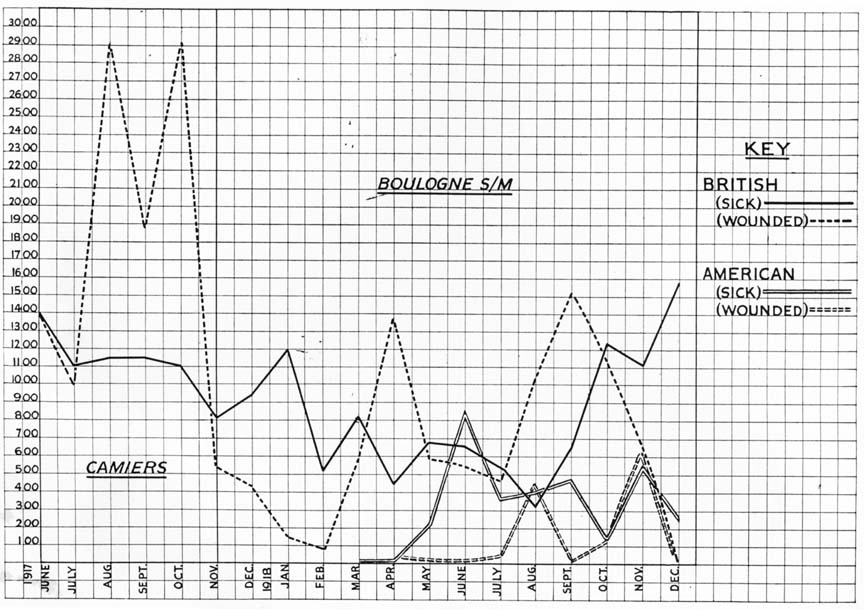
Perhaps the most interesting figures we have are those showing the number of patients cared for by our unit during its period of operation. The accompanying chart presents these figures in a clear way so that one can readily see the fluctuations in cases passing through our hospital. Note the high percentage of British wounded during our first few months in France, and the reduction in these cases during the winter months, when sickness predominated. Wounded cases again rise immediately after the big enemy drive in March and continue to remain at a high figure until the month of September, 1918, when we handled the greatest number of wounded men for any one month in Boulogne, or about 2,000. From that time on the number rapidly declined until December, when we had evacuated practically all such cases.
The drop in the number of wounded British patients during the months of June and July, 1918, is accounted for by the fact that our hospital was practically filled with casuals from the 77th Division, which was at that time arriving in France. The peak shows over 800 such cases during the month of June. We all remember those patients well; flat feet by the score, chronic rheumatism, general debility, epileptic fits, glass eyes, fractured spines, and one "I don' wanna fight." It was a conglomeration of patients, and how they ever were inducted into the army in the first place was always beyond us. A glance at the chart will show how the necessity of our caring for these men cut down our capacity for wounded men who, at just that time, were coming down from the front in great numbers.
This chart is filled with interesting information for one who will take the time to study it carefully. Note the rise in the number of American wounded cases during the period that our divisions were fighting side by side with the British and the Belgians in Flanders. Note the rise in the number of sick patients during the "flu" epidemic in the latter months of 1918.
It must be borne in mind that the great drop in the number of cases after November, 1917, is due to the fact that our hospital in Boulogne accommodated only about one-third the number we were able to care for in Camiers. Proportionately, we were just as busy in one place as in the other.
While the figures for this period are all available, it has been deemed useless to print them, for their significance is more readily grasped in graphical form. However, some of the more striking facts are given as follows:
| Greatest number of patients cared for in any one month, August, 1917 |
4,074 |
| Greatest number of wounded in any one month, August, 1917. . |
2,909 |
| Greatest number of sick in any one month, December, 1918. |
1,827 |
Totals for the entire period from June 1, 1917, to December 31, 1918, are as follows:
|
Camiers |
Boulogne |
||
| British Patients (sick) |
5,950 |
11,608 |
17,558 |
| (wounded) |
10,099 |
9,183 |
19,282 |
| Total British |
16,049 |
20,791 |
36,840 |
| American Patients (sick) |
- |
3,235 |
3,235 |
| (wounded) |
- |
1,328 |
1,328 |
| (sick-command) |
147 |
267 |
414 |
| Total American |
147 |
4,830 |
4,977 |
| Total Regular Patients (entire period) |
41,817 |
||
| Detained Cases |
4,020 |
||
| Total of all patients passing through hospital (entire period) |
45,837 |
||
Figures for the last month that we were engaged in operating the hospital are not available, but it is fair to say that the number of patients cared for was less than 500, so that the total for our entire stay in France was slightly over 46,000.
To feed these patients required over 400,000 daily diets. These were furnished at an average cost of about 1 shilling 6 pence a day, or about 36 cents. The total cost for all food consumed by patients only during the period from June, 1917, to January, 1919, was over £30,000, or about $150,000. This seems like an enormous sum, but consider the great amounts of some articles which were consumed. For instance:
| Fresh Beef |
|
100 |
tons |
| Rabbits and Fowl |
|
5 |
" |
| Potatoes |
|
75 |
" |
| Other Vegetables |
|
33 |
" |
| Bread |
|
200 |
" |
| Fresh Butter and Oleomargarine |
|
18 |
" |
| jam |
|
18 |
" |
| Sugar |
|
30 |
" |
| Fresh Milk |
|
55,000 |
quarts |
| Condensed and Dried Milk . . . . |
|
150,000 |
" |
| Stout and Ale |
|
29,000 |
bottles |
| Brandy |
|
650 |
" |
| Port Wine |
|
640 |
" |
| Soda Water |
|
38,500 |
" |
| Fresh Eggs (gift of the British people and not considered in the cost of rations) |
|
500,000 |
Cigarettes were issued as a part of the ration, and more than 3 tons were given out to patients.
Inasmuch as our hospital handled no officer patients, it is interesting to note the comparison between the amount of food consumed by our patients and that consumed by patients in officers' hospitals. A tabulation showing food used per 100 patients at every hospital at the Boulogne Base presents some striking contrasts. Perhaps the most interesting is that of No. 8 Stationary Hospital, which handled both officers and other ranks as patients. The figures shown are for the month of April, 1918.
|
|
||||||
|
|
|
|
|
|
|
|
|
|
|
|
|
|
|
|
| Officers (No. 8 Stationary) |
|
|
|
|
|
|
| Enlisted Men (No. 8 Stationary) |
|
|
|
|
|
|
| Enlisted Men (our hospital) |
|
|
|
|
|
|
|
|
|
|
|||||
|
|
|
|
|
|
|
|
|
|
|
|
|
|
|
|
|
|
| Officers (No. 8 Stationary) |
|
|
|
|
|
|
|
| Enlisted Men (No. 8 Stationary) |
|
|
|
|
|
|
|
| Enlisted Men (our hospital) |
|
|
|
|
|
|
|
In not one instance did the amount consumed by the enlisted men even reach that consumed by the officers. No figures for cheese were available in that instance, but we note from the report for the same month that at No. 14 Stationary Hospital the officers consumed 1 pound per 100, while the enlisted men consumed 7 pounds! Evidently the officers were off the cheese diet in France!