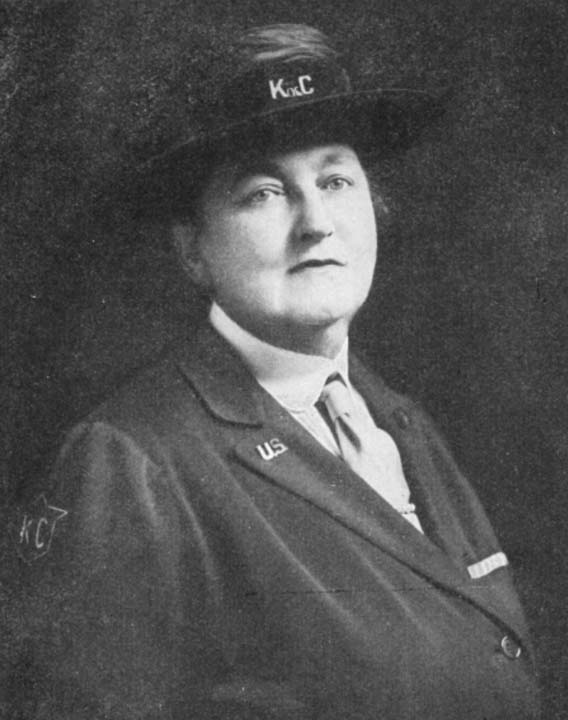
IT was in October 1918 that I was introduced into the arena of politics about which until then I had been practically ignorant. My interest had been spasmodic and divorced from party affiliations. I had supported men and their individual motives. I was a careless mugwump, espousing each cause as it developed, while remaining indifferent to the body politic from which it had gathered its impetus.
My connection with the Administration of the City of Greater New York had sprung from my belief in its human opportunities and in its humane intentions. Party organization at that time meant little to me, but as I became more and more familiar with the ways and means of politics I realized that this was as essential as is the foundation of a fifty story building, for it is in the local district club or meeting place where one can get a real angle of comprehension.
Therefore, the advice I offer every woman who is "thinking" about taking an interest in politics is that once she has determined upon being a Republican, a Democrat or a Socialist that then she should ask the first policeman she meets to direct her to the district where she is to vote and to the headquarters of the party she has selected.
Be careful, however, if he is an Irishman that he knows where the Republicans and the Socialists are located, otherwise, with a twinkle in his eye, he might start you off as a Democrat.
Progressive Republicans and Independent Democrats are generally absorbed sooner or later by one of the three parties I have mentioned. They are each individual until beaten at the polls, after which they generally become docile and amenable to reason.
I was surprised when I was asked to head the Woman's Committee of the Citizen's Committee to campaign for Alfred E. Smith who had been nominated for the first time as the Democratic Candidate for Governor of the State of New York although he had always held minor offices.
I evidently seemed promising timber in the minds of the leaders. I had met "Al" Smith many years before together with our present State Senator "Jimmy" Walker. I thought them both fine fellows. The war had made me a staunch Democrat.
I took to my new associates and to my new environment with real delight. I entered into this unexpected job with enthusiasm. I became a good campaigner for I could talk so as to hold attention and could write copy which the crowd would read.
I studied my political catechism day and night until I had mastered enough data to serve in the emergency of platform heckling.
To get a ticket over was an intensive preoccupation. It had to be quick work in limited time. There is an excitement in a campaign which only those who have been participants in it can really understand.
It is the one experience which to my mind is as full of thrills as is the taking of a three pound black bass with an eight ounce trout rod.
Both produce a tingling effect.
I soon became acquainted with the so-called "bosses," which word is as little understood as is any other in the dictionary. After five years of intimate acquaintance with these men who presumably command our political destinies, let me state that I am still looking for "Bosses" in the ordinary conception of the word.
I have found on the contrary that persuasion and not coercion is the influence which produces the actual leadership.
Heart rule and not head rule is the real asset of the Democratic party.
Occasionally the two are combined, as in the cases of Charles F. Murphy, the Executive Chairman of Tammany Hall, and of Alfred E. Smith, present Governor of the State of New York. The latter's personal magnetism can hardly be over-estimated. It was this same equation which stood back of Roosevelt.
A candidate who possesses this quality is already half elected. Without it, his constituents must work four times as hard for every vote in sight.
With Alfred E. Smith it is an easy proposition. No one really elects him to office but himself.
Given half a chance he makes good, for even in the great Republican landslide in 192 his vote loomed up as an extraordinary tribute to the man, although it could not carry the party which that year was buried under an avalanche of after-war influences.
Those who have had the pleasure and the privilege of working for Governor Smith during his campaigns, need not flatter themselves that he owes his victories to them for if he ever does make a political blunder this is generally due to the advice of someone disqualified to advise. His own intuitions are rarely at fault.
His technical knowledge of state craft and his memory of administrative incidents are amazing.
I cannot pass from my subject without allowing Charles F. Murphy to enjoy a gentle amble across my crystal ball.
No man has been more grossly misrepresented. He is portrayed in inimical cartoons as either wielding a bludgeon or in performing the lock step. Only those who have come in friendly contact with him can accurately estimate his gifts of leadership.
His loyalty to his associates, his sense of justice to his party, his bulldog courage, his clear mind, his willingness to help, his power to fight, his reserve of force, his masterly grasp of the unexpected, all of these qualities are the basic ones upon which his claim can rest. He would control no patronage had he not earned the right to yield it.
Tammany Hall with its many subsidiaries believes in him. Every man and woman in it knows how much they owe collectively and individually to their chairman.
This great organization of Greater New York does not rule through its efficiency but through its humanity. That is the secret of its power. Money spent in the investigation of its possible corruption is money wasted, for to the unemployed whose rent has been paid, to the mother whose child has been cared for, to the district worker who has been rewarded, to the laborer who has been found worthy of his hire, nothing is really remembered of their leader but his kind thought, his unfailing recognition, his genial welcome and his sympathetic understanding. The shabby old headquarters is the goal towards which the weary feet of the sorrowful and the disappointed have often turned f or comfort.
To be a real Democrat one must first grasp the underlying forces which are the very life of this party. He must be a Democrat at heart. He must learn to know from within the people which this party represents, and his knowledge must be picked up at first hand. The platforms must be prepared in the interests of the people and they must be carried out in the protection of the people.
The men and women who are merely seeking office without any realization of the moral responsibility which the office entails will sooner or later be detected in the fraud they would promulgate.
When after election the public recovers from the deception which at the moment may have been practiced, it lays low until it has its next opportunity, sweeping into victory with an overwhelming majority the friend who has been tried and not found wanting as was the case in the last election of John F. Hylan, Mayor of the City of New York.
During the winter of 1918 and 1919 I became more and more affiliated with politics. I was threatened with chronic indigestion owing to the public banquets I attended, and with a permanent paralysis of my vocal chords due to the eternal speech making for which I was slated.
However, all this was to be cut short temporarily.
IN June 1919 I sailed for Europe in a dual capacity.
Secretary Franklin K. Lane selected me to go abroad in the interests of the Department of the Interior, there to present his farm scheme to the soldiers who were slowly returning and to show them that they could take up land either in small or large acreage which would enable them to build homes and to earn livings. The plan as then worked out by Secretary Lane was practical and convincing. During the three months I was working at the proposition I succeeded in turning into the Department some fifteen thousand applications. Unfortunately, however, Mr. Lane was never able to secure the appropriation he required in order to make his project operative, thus these applications were doubtless thrown into the scrap basket.
At this time the Knights of Columbus, who during the war had sternly refused to introduce women into their overseas' service, suddenly decided, as I have always insisted, that as I was neither young nor beautiful they could safely ask me to go over in their interests to travel about through their still existing centres, to make suggestions as to their peace needs and to tie up any loose ends of their work which I might happen to find.
Thus I sailed away to serve both our government and this great organization to the best of my ability.
Of all my experiences in life I think that this reached the climax of my enjoyment.
I was in splendid physical condition and the word "tired" was never in my vocabulary, although I had just celebrated my sixty-third birthday.
On reaching France I revelled for the first time in the luxury of going about in a car which was militarized.
The U. S. A. on the door was a magic sign. We never had to stop at an octroi, our papers were never examined, gasoline could be had in every barrack yard by merely showing our passbook. Privileges such as I had never dreamed of were ours for the asking. No speed laws were imposed, no restrictions were in evidence. In fact of all spoiling habits easily acquired and never to be forgotten this was the most agreeable.
I was told that discouraging as it might seem my errand so far as the plan of addressing audiences was concerned was hopeless.
The men had been practically talked to death by representatives of every welfare organization then operating abroad.
Crossing on the ship I had made the acquaintance of a Y. M. C. A. secretary who hailed from one of our middlewest states. He explained that he and his wife had found themselves hard up so that this job seemed as good to them as any in sight. This fact had decided his vocation. I inquired how his duties functioned. He said nothing was easier, that on the transport ships he generally "expounded" the Scriptures during the voyage. I asked the size of his audiences. He replied, "Oh, about thirty! " This on ships which were carrying about four thousand, but he didn't seem in the least discouraged by the small percentage of attendance.
"Then what do you do after landing?"
"I just go to our headquarters, and tell the boss I need a big tent. A notice is put out that there will be a revival meeting, after which I get busy and round up every man in sight."
"How large are the audiences then?"
"Oh, we get about fifteen hundred at a clip."
"What do you say to them? "
"I tell them what they are missing by not being Christians, that they are a godless crew and that this is perhaps their last chance to save their souls."
"But," persisted I, "how do you know that their souls are not already saved?"
"Say," looking at me with a certain contempt, "don't you know that I never take any chances with them roughnecks?"
The way of the transgressor seemed at the moment indeed hard.
But this taught me my lesson. Whatever happened, I determined not to "round up" my audiences. If the unprotected lads didn't want to listen to me, they should go scot free.
My first experience was at Le Mans, where in the K. of C. club house about two hundred had crowded in. I was asked to repeat this talk to some three hundred more on the following morning.
Then I went on to Bordeaux and to St. Nazaire with the audiences ever increasing. The K. of C. secretaries were called "Casey." In the minds of the boys this didn't seem to be quite the proper trade mark for me, so suddenly I found myself referred to as "Mother Casey" by which name I was known during my entire trip. At the end of a fortnight I was surprised to receive a wire from the General Headquarters in Paris, to report there at once.
I responded as quickly as possible and thus had my first audience with General Pershing. He looked at me quizzically and I know wanted to address me as "young woman." He had the habit of gallantry, but he couldn't quite get to this.
"What hypnotic influence have you been using, Miss Marbury? My officers report that you are playing to full houses."
I laughed and answered:
"For thirty years, General, I've been learning the secret."
"I want you," he continued, "to take your itinerary hereafter from me---beginning to-morrow at the Stadium, just outside of Paris. We have three thousand men stationed there and Colonel Roberts who is in charge has assured me that at eleven o'clock you will have a big crowd to listen to you."
"Very well, sir, that suits me all right if I can make my voice carry."
"No fear of that. I am glad that we agree."
This interview was short and to the point, so under these conditions I began my obedience to army orders.
On reaching the Stadium next day I was faced with the fact that I was to stand in the open in front of the grand stand which acted as a huge sounding board and which held about four thousand. When I looked at the towering rows and rows of men, I could readily believe that this was no over-estimate of its capacity. However, General Pershing to the contrary, I was not sure that I could pitch my voice so that it really would be heard. Throwing back my head, I tried the effect by directing the tone toward the top rows.
"Say, fellows, can you bear me up there?" I cried.
Judge of my relief when the answer came back,
"Sure we can hear you, you're all right, go to the mat!"
I FOUND our troops everywhere in a very restless and disgruntled frame of mind. They resented the delays which still kept them in France. Their one idea was to get home. They had played the game. Hanging around in semi-idleness was boring. Nothing amused them any more. The novelty had worn off. I sensed this psychology at once. I never talked about the War but about actualities and the future. America, not France, was my theme. Even when I was with men who were minus arms and legs they wanted diversion not sympathy.
Thus a good laugh went far to help the situation and many a one we had together.
I was speaking one night at Romorantin in a very large balloon tent. The place was packed to overflowing. The young Jews seemed my strong patrons, and as usual were on hand early so as to be assured of the best seats. Suddenly an Irishman appeared, steering toward the front middle section only to find every place taken. He was evidently not for Prohibition and his temper did not seem of the best. Standing and shouting, he exclaimed: "Things have come to a pretty pass in this bum crowd, when the O'Briens have no chance to hear Mother Casey because them dirty Kikes have grabbed every decent seat."
Realizing that in another minute we were in for a scrap, with a tone of clarion authority, I cried: "Sit down O'Brien! Behave yourself. If you hadn't come in so late you would have known that I have just opened a Jewish Chapter of the Knights of Columbus."
He accepted my statement, rushed over to his presumably new associates, grasping each and every one of them fraternally by the hand.
On another occasion I was sitting outside of a big Red Cross building with some twenty lads gathered about me. I had noticed a long lank oldish fellow who was uninterruptedly chewing gum and whose personality was not unlike that of Will Rogers. Two youngsters were discussing the ever popular theme, just "girls." One expressed his preference for a blonde whereas the other favored a brunette. At last they decided that the matrimonial choice didn't make much difference after all because in case of need the divorce court was always a solution.
The elderly gentleman, whom I discovered hailed from Nebraska and who until that moment had never broken his silence, drawled out:
"You fellers seem to think deevorce is easy!"
"Listen to Pop! What do you know about that?"
"Oh, enough I reckon. It's a pretty costly business. If you go into it, you'll have to dig down pretty deep into your jeans! "
"Say, you're a wise guy all right, but this is somethin' I bet you know nuthin' about!"
"I don't, don't I? Wal, I reckon I must know sumthin' considerin' I'm payin' alimony now to three dames in the States! "
Our boys' sense of humor rarely failed and it was comparatively easy to turn away their wrath.
Reason also went a long way with them. In one place there were a lot of German prisoners directly opposite a contingent of three hundred of our negroes. I found the latter surly and resentful because they had discovered that the same rations were being served to them as to the prisoners.
They kept jumping up to investigate the latter's chow while their own grew cold and unappetizing.
When I realized the situation I called their attention to the folly of their conduct, saying that if I were in their places I would never allow the Boches to ruin my meals, that if I found my soup cold on their account I would kick myself for being so many kinds of a fool. My logic was unanswerable and there were no more grouchy faces. Soon the jazz jingled on the old piano and the feet twinkled. The sun had broken out.
It was difficult for me to contemplate with complacency the increasing marriages between our negroes and the white girls. There was no federal law to stop this and no moral suasion seemed to produce much effect. One day at St. Nazaire I dropped into a church and there saw four such couples waiting for the nuptial ceremony to be performed.
In this same place, walking along the ocean esplanade it was not an uncommon sight to find a white mother nursing a black baby.
One day the Colonel of a regiment sent for me to see whether I could convince a certain local shopkeeper that he should not permit the contemplated alliance of his very young sister with a swarthy buddy who was unusually typical of his race.
As I spoke French fluently the Colonel thought that I might explain the situation as we saw it.
I found the Frenchman polite but wholly indifferent to my arguments.
I drew a picture of the social discomfiture of the young woman once she found herself in America. I emphasized the unpleasantness of her prospective environment, but all to no purpose.
The brother, shrugging his shoulders, merely replied that he could do nothing, that he could not interfere with love's young dream.
Finally as my last card, I said, "But you wouldn't allow your sister to marry one of your colonials."
"They are different," he answered. "They are savages."
"And our darkies, what do you think of them?" I asked.
"Why, they are perfect gentlemen," he replied.
I saw that there was nothing to be done. The marriage took place the following week. It was afterwards explained to me by a friend of his that the brother in question was the guardian of the girl as both parents were dead, that he had to support her, that he could not afford to make her any settlement, or "dot" as it is called. That to find a man so disinterested as to not ask for any was indeed wonderful, and that once she was at such a distance as America, that even if she should be in any financial difficulty that he, the brother, would not then be called upon to help her out or to take care of her children as they came along.
This reasoning was certainly very un-American and another proof of what I have always maintained, namely that the Latins and Anglo-Saxons rarely speak the same language. It seemed as though our swarthy soldier was the better fellow of the two, and how often when I saw our negroes staggering back from the front, literally shot to pieces, I realized that their blood which had flowed was the same color as that of their white brothers and that the women who wept for them shed tears which were identical.
I was soon sent to Brest where we still had over one hundred thousand men in camp. Pontarnesin, two miles out, was like a great city. The road was always very crowded and very dusty. I was booked to speak twice a day on an average and the camp was so vast that the audience was sectional and varied. Occasionally I was loaned to the Navy.
One night at the peril of life and limb I was taken out to the flagship "Bridgeport" which seemed a frightening distance from the pier. The launch was dancing so merrily that I dreaded to leave the solid ground. As we neared the ship my heart sank, for there hanging on the side was a wretched little rope ladder swaying in the wind. Turning to the young officer in charge of our boat I asked him whether for one moment he thought I would risk my life attempting such a feat as to climb on board. He said the crew would make our boat secure. Two youths then proceeded to hook us up to a little platform which was bobbing about like a cork. Two others were looking on as ornaments.
Entirely regardless of discipline, I said: "Let those other two get busy. I need the whole crew to get me up that scaling ladder."
With the utmost difficulty the "stunt" was accomplished.
Half way up I saw an officer waiting on the deck to formally receive me.
"Come down and help me," I exclaimed. "You're no good to me there!"
Having thus demoralized the Navy I spent rather a nice evening. I found a large audience easy to amuse. To my surprise no one knew why sailors were called "Gobs." I was as ignorant as the others, but suddenly had a luminous idea which inspired me to say:
"I know why you are 'Gobs.' G. O. B. stands for God's Own Boys."
This seemed to carry over so that subsequently the explanation went the rounds.
One of my many experiences showing how thoroughly we were detested by the French at that time concerned a conversation I overheard while crossing the large public square in Brest, which had always been known as the Place d'Armes, but which a few months before had been changed to the "Place du President Wilson." Two ladies were gazing at the recently erected sign and were volubly denouncing the President as the cause of all their country's misery. No epithet of abuse remained in their vocabulary.
When they paused for breath I stepped up to them and said:
"Ladies, your conversation has been most edifying to me, an American, but I must remind you that only a few months ago you had to choose whether this Square was to be the Place du President Wilson or the Place du Kaiser."
Having shot my '75 1 turned on my heel leaving the objectors to their own reflections.
The war brides who were waiting an opportunity to sail were a queer lot. In a group of four hundred there were not a dozen who seemed to me really good looking or attractive. Never have I seen such a collection. They had come from all over, most of them apparently delighted to have wedding rings on their fingers for with his pay and the low rate of exchange every doughboy was rated as a millionaire. Many of our men must have been ornamental liars judging from the description of their home towns as given to these baby-brides. I asked one of the girls where her husband lived. She answered: "O-ee-o." I inquired the name of the town. She replied that it was a place as large as Paris, that there were many theatres there, wonderful shops, all the fashions, that gayety was continuous and wealth abundant.
"But the name," I insisted. "Tell me the name."
"Ah, Madame, it is hard to pronounce. I will write it for Madame."
She scribbled it on a bit of paper. It was Xenia, Ohio, opposite Dayton. No further comment is necessary. How often I have thought of that young woman's frame of mind when she faced the reality.
Occasionally we had an excitement when some husband would try to slip away on the transport, leaving his wife in Brest. Then the services of an M. P. would be employed to drag him off the boat by the leg and to restore him to the waiting lady who had been abandoned on the pier. However, these connubial misunderstandings were usually straightened out by the officer in charge and by a few days of short rations dealt out to the culprit.
I found the best spirit prevailing everywhere in the huts of the Knights of Columbus. The magic words: "Everyone Welcome. Everything Free," did the trick. Jam, biscuits, cigarettes, chocolates were words with which to conjure, but behind these creature comforts stood sympathy, an entire absence of any sectarian spirit and a human understanding which was unfailing. The work done by this organization overseas needs no endorsement. It has become a matter of history due to the reports brought back by our two million men. As administrators the commissioners in Paris, Edward L. Hearn and Lawrence Murray, were beyond criticism. Their popularity was only equalled by their efficiency. Splendid team work was done between the head office here, over which that very able gentleman, William P. Larkin, presided, and the active forces which were overseas.
I was proud to be working under the auspices of such an organization, and never once did I experience anything at its hands, but the greatest courtesy and consideration.
There was never any friction between the K. of C. and the General Staff for whereas my itinerary was military, my personal comfort was always the responsibility of those representing the Knights of Columbus. Everything was foreseen and every accommodation was provided. I was always accompanied by one of their secretaries who saw to it that I was well looked after.
During the entire three months I was spared both hardships and discomforts. I was never in a train as a K. of C. militarized motor took me over all the ground. It would have been impossible for me to have traveled under more agreeable conditions.
A fine understanding existed with the Jewish Welfare Board, and with the Salvation Army, but somehow the Y. M. C. A. in their treatment of the various problems, while very commendable, and in many ways admirable, operated from such a different standpoint that it was difficult for our organization to assimilate the same views. However, there was plenty of work for everybody.
I CANNOT turn my back upon Brest, where I had been stationed for many weeks without referring to the outlying segregation camp which numbered as its patients and prisoners some five thousand men. One could imagine the words blazoned at the entrance of Dante's Hell, "leave all hope behind," for the utter dreadful dreariness of the place was one's first impression.
It seemed isolated from human intercourse. There were no visitors allowed. The nursing was chiefly in the hands of men. My introduction to it happened in this fashion.
I was surprised one morning to receive a message from the officer there in command, asking whether he might call at my hotel. I received him and learned that the object of his visit was to ask whether I would be willing to give my talks within the segregation camp as well as without. The major said that of course I would never be ordered there, but that it would be an act of mercy if I would go as a volunteer. I felt no hesitancy of any kind so cheerfully consented, the only difficulty being to squeeze in the time.
However, this was ultimately arranged so that I could undertake the additional engagements.
I soon became absorbed in this work for my heart ached when I found myself facing those hundreds of mere lads, as were most of them, who might have exclaimed with immortal Frou-Frou "an instant of folly and this is where I have been brought."
Many of them were just "Mother's Boys." Many of them had young sweethearts in America who were waiting for their return. Few of them were vicious. Few of them were degenerate. Few of them were hardened. Their misguided drifting had been along the line of the least resistance in which ignorance played no small a part.
I soon established a genuine confidence between them and myself. My visits were always welcome. My simple talks seemed to strike a cord of sympathy. Across my crystal ball I can even now see groups of these lads sitting around me in the twilight upon the grass. To them I was indeed their Mother Casey. I was able, thank God, to dwell upon the happy years ahead which would blot out even the memory of the shadow by which for the time being they were encompassed.
Little by little they grew to realize that the sun had set only to rise again. Each day as it was checked off would bring them nearer to their coveted freedom and to their restored health. Youth was on their side with its natural optimism and buoyancy. Above all they were once more looking up and not down. From them I drew a deeper inspiration than it was possible for me to give, and when finally my work among them was over, I seemed to have learned more of God's tenderness in dealing with his little children than I had ever known before.
As I journeyed over the wide area where our troops had passed I began to realize the enormity of our undertaking and the miracle of our accomplishment. From the coast where our forces had landed to the very edge of the last trench I saw nothing but reminders of the fact that we had sent overseas five million tons of raw material and this with only a loss of seventy-five thousand tons due to the submarine attacks.
At Bordeaux stood the great wharf and storehouse which had cost us one million dollars. From there a road had been built which was a feat in engineering, and which wound like a wriggling serpent until it reached the upper city. Endless lines of telegraph poles stretched along miles of highway. Sheds in which bakeries were operating and great refrigerating plants in which meat was kept, so that its freshness was a certainty, machine shops, repair centres, electric power houses and all the rest studded the landscape as far as the eye could reach.
Thrown into scrap heaps were cars and trucks of every description, machine guns, tanks, motor cycles, engines. Everything in fact which could possibly be needed or anticipated for the conveyance, the care and the feeding of an army which each incoming transport only served to increase.
At the moment of the Armistice a steady stream of fighting forces was pouring in. A continuous supply of iron and steel, of beef and provisions, of clothing and equipment, of arms and of munitions was being received at the docks and distributed throughout that portion of France, which had been especially allotted to our occupation. We built our own railways, we constructed our own bridges, we used our own cars and our own locomotives. We were providing for a long war. Too little has been said of our industrial army which was always active and alert. Our men could never have fought at the front had it not been for those who were working at the rear. The latter were given no opportunity for bravery, there was no Croix de Guerre or Distinguished Service Medal dangling before their eyes in honorable brilliancy, yet they were all part and parcel of the great mosaic which was then paving the fields of Europe. The pattern required myriads of tiny stones, providing the colors upon which the vast design depended.
How many of these silent workers dreamed of those battlefields where they might in turn emerge from the grayness of the tasks which had been their fate, and yet the war had ended without their ever having been given their chance to share in the absolute struggle and in the intoxicating victory. The shrapnel of disappointment had entered their souls and the knife of discouragement had severed their very heart strings.
This was the frame of mind into which many had fallen, for while their faces were turning homeward , they knew that they were to tramp through their village streets as bakers, and butchers, as ice men and plumbers, as carpenters and painters, as machinists and chauffeurs, as electricians and as day laborers, but not as heroes who could boast of Cantigny, of Château Thierry, of Belleau Woods, of Montfaucon and of the Argonne. My heart used to ache for these lads as I read in their faces their thoughts which were so rarely expressed and which accounted in no small degree for their restlessness and for their sadness. It was part of my task to help them to a greater satisfaction in the duties which they had so uncomplainingly and so faithfully performed, duties which neglected for a day or even for an hour would have threatened the collapse of our entire military system. The liquidation of our material was already well under way in the Summer of 1919. To transport it back to America was out of the question. It had to be sold on the spot and for what it would bring. The result was that it was practically given away. The trading in these things became a source of profit to thousands of foreign speculators.
The cash charges which stood against our Government were fantastic. We paid for everything, almost for the air we breathed. Nothing was free. Had the war continued another six months we would have found ourselves in debt to France which we had helped to save.
The scales would have balanced heavily against us.
I was told of one incident when our officers in charge were making a price for a quantity of motor cycles in excellent condition. The representative of the French government refused, it was said, to accept the figure claiming that the cycles were worthless and should be liquidated merely as scrap iron.
Our representative finally agreed to this provided that in the bill of sale these perfectly good cycles were so described. The price as settled was about ten dollars for each machine. As soon as the deal had gone through, the doughboys, who knew the terms of the transaction, proceeded to reduce the material to the veritable scrap iron as set forth. Every motor was demolished with yells of derision.
One of my most interesting experiences was a visit paid to Maréchal and Madame Foch in their manor in Northern Brittany. I had already met them in Paris on several occasions, but rejoiced in seeing them in their home and in finding the Maréchal in civilian clothes for the first time in five years. Once more he was revelling in the luxury of private life. The house was simple and unpretentious yet just the kind of place where one would have expected to find him. A small chapel stood at the left of the approach, and I was especially touched when Madame asked me to step inside, there to join in the daily prayers which they offered for the repose of the soul of their only son who had been killed in the war. As I knelt by them reverently, the spirit of peace which passeth all understanding seemed to descend in our midst. A great grief had become a shrine.