 |  |
|
|
|
THE great artists of the footlights came over more frequently in those early years than now. The fact remains that as our theatre was in the process of its development we welcomed these foreign visitors as we felt we had much to learn from them.
Henry Irving and fascinating Ellen Terry were here at various times. She captivated the hearts of our people.
Her magnetism was infinite. No one analyzed her performances. They were accepted because she gave them. Her very defects possessed qualities which endeared her. And how piquantly pretty she was in her youth! There was much beauty in the whole Terry family which through the Neilson Terrys has descended to the present generation.
Beerbohm Tree was here repeatedly and during one tour I acted as his personal representative. His wife did not make the trip that year so entrusted him to me. I always maintained that I must have been amazingly unattractive when these married ladies turned over to me the care of their husbands with so little apprehension of any sentimental danger.
There have been few men so witty and so inconsequent as Tree, yet who possessed such a knowledge of human nature, such a wealth of experience and such a shrewd sense of business.
He was mercurial on the one hand and phlegmatic on the other. His superficial moods were often misleading, for within, reason was hard at work planning and plotting for the end in view.
When he was apparently the most indifferent and careless his mind was struggling with some problem which as a rule was one of finance. Tree's monetary ups and downs were common property, but his luck was at the same time proverbially good. I remember that on one occasion when at a meeting of his directors and share-holders, things were looking very black, and when everyone was depressed but Tree, that after indulging in some witticism he said, "Gentlemen. This is not our lucky day. We must separate until the morrow for I see our sun rising in the eastern sky." The following morning when they assembled, Tree announced that he had just taken a delightful walk in the city, and that there fifty thousand pounds had been given him to do with as he pleased.
He made lavish productions both at the Haymarket and at His Majesty's Theatre. My friend, dear Percy Anderson, provided the designs for the costumes and gave the indications for his scenery. Anderson was a wonderful artist, and possessed an erudition which was unassailable. His taste was never questioned and in his particular line of work he was preëminent.
He lived in a most attractive house where one was sure of meeting people of talent and accomplishment. A feature of it was his conservatory in the rear where a fig tree perforated the roof. The lower branches extended over the guests while sipping their coffee and liqueurs. The effect was most picturesque and unusual.
But to return to Tree. His leading ladies were rarely permanent. His admiration of women was spontaneous and boyish, frank in its expression and ingenuous in its avowal. He was never so happy as when plunged into one of these genial intrigues.
For the time being they became his breath of life. He danced through each experience, yet there was never a moment when his sense of humor deserted him.
I was dining one night with friends at the Bath Club when suddenly at eight o'clock, with our meal just begun, Tree dashed into the room demanding that I should go at once with him to his theatre. I refused with decision. He pleaded with my hostess whom he knew, described with distressing emphasis an urgent matter of business which required my presence; finally Tree scored a victory, and I was carried off. Once in the hansom which awaited outside, I turned to him and inquired eagerly as to the nature of this disrupting urgency. He began to laugh and admitted that there was one reason only which made him throw himself upon my good nature as a friend. He confessed to having been philandering. the entire afternoon with an attractive lady for whom his admiration was outspoken. He had just left her at her door. The hour was late. What explanation could he give Mrs. Tree at the theatre? She would accept the excuse of any diversion shared with me for we were good friends. Thus there seemed no alternative. I must be the scapegoat and drive to the stage door with him. No other explanation of his tardiness would be necessary.
When he had finished his brazen explanation I waxed indignant. I stopped the cab, threatened to get out; but Tree was matchless in his own inimitable method of. cajolery. His very effrontery was disarming. I yielded and played the rôle assigned to me in this domestic comedy of innocuous trifling.
Another incident connected with Tree concerns an engagement in repertoire at the Knickerbocker Theatre in this city.
Business was not very good. "Hamlet" had been announced for the Thanksgiving Day matinée much against my advice and the advice of others who were financially interested in the tour.
Tree and I were standing at the back of the box office when a lady appeared at the window and purchased ten seats for this matinée. After paying for them, as she turned away, she said:
"Trilby's the play, is it not?"
"No," said the treasurer, "Mr. Tree will play 'Hamlet'."
"Oh my," exclaimed the lady, "please return my money. Nothing would induce me to take my party to see 'Hamlet'."
Realizing the situation and that "good money" was stalking out of the theatre, Tree, from behind the door, whispered to the young man in the box office:
"Call her back! Do not let her get away. Tell her I will change the bill to 'Trilby' or to anything she likes!"
It was "Trilby" and not "Hamlet" which was presented at that memorable matinée.
He was proverbially late at rehearsals, and the fact that stage hands and mechanics who were paid by the hour were kept sitting about in idleness meant nothing to him. Such sordid details never entered his mind. He rose above them and cheerfully faced deficits which could in many instances have been avoided.
He persuaded his brilliant young brother, Max Beerbohm, to travel with him as his secretary, but the latter's understanding of his employment never suggested that he need report officially until well on in the afternoon.
The actual working staff regarded Max Beerbohm as a luxury, until I insisted that he was doubtless Tree's confidential secretary, and that his duties were so very private that none of us were ever made aware of them.
After his production of "The Seats of the Mighty," by Sir Gilbert Parker, which Tree facetiously referred to as the "Seats of the Mighty Few," the press criticisms were very adverse, especially from the pen of Alan Dale who wrote a slashing review to which Tree took great exception. He insisted that Dale should be excluded from the theatre thereafter as he, Tree, would not risk another such personal attack.
Ignoring these instructions no order was given by me which would debar this able writer from the use of his regular press seats.
"Trilby" followed the Parker play. Its success was overwhelming.
On, the second night when I went to Tree's dressing room, I found him in a state of natural elation.
Pinned over his mirror was a newspaper clipping. It .expressed unstinted praise of Tree's Svengali. Upon examining it I discovered that the author was Alan Dale, and pointed out the fact to Tree who laughingly said: "He must be a remarkable man, and a most astute critic. Please arrange so that I may meet him."
I cannot mention that delightful play of "Trilby," so skilfully dramatized from du Maurier's novel by Paul Potter, without telling a little story which proclaims the author's very sincere admiration of the talent of Charles Dana Gibson. It seems that when the latter was beginning his career that he wished above everything to meet George du Maurier, who was then a master in that form of art which Gibson most desired to emulate.
While in London, unheralded and unknown, he called upon du Maurier, and timidly showed him some of his drawings while seeking his advice.
No one could have been kinder or more encouraging to this young artist than du Maurier. When they parted he told Gibson how proud he would be to have him as a pupil.
Years passed before they ever met again. Gibson in the meanwhile had risen rapidly to eminence. His name was known in every American household, and his fame had become international.
Remembering his first visit I thought a portfolio of his drawings in reproduction would interest du Maurier, so in reaching London I called upon him taking the sketches with me.
As du Maurier turned them over he said, "When you see Gibson tell him that our rôles have changed because he has now become the master while I shall be proud to be his pupil."
WHEN Mounet Sully came to this country to play in "Oedipus," "Hamlet" and other dramas in the repertoire of the Théâtre Français, he was so upset by the noise and ugliness of New York that he refused even to go out during the day. He used to remain in his hotel bed-room with the shades drawn down, and the artificial light turned on. He insisted that otherwise he suffered too much. Nevertheless he gave some splendid performances which were inspiring and educational.
Réjane was another French artist who visited us. A fact worthy of comment is that "Madame Sans Gêne" was played in French by Réjane, and at the same time in English by Kathryn Kidder.
The receipts were twice as large from the latter's performances so that Réjane had to revert to those modern comedies which were unknown to our audiences, and which were purely Gallic in their conception. She was a great comedian and unequaled in our day.
Jane Hading and Coquelin were here together one season, but the tour was not financially successful despite the fact that Hading was a rarely beautiful woman. She enjoyed the advantage of having a provident mother and in addition, her friends were wisely chosen so that in her maturity she enjoys a large fortune, and can look with satisfaction upon her intelligently selected investments. Charles Wyndham, Mary Moore, Marie Tempest and Cyril Maude soon became favorites with the American public. They brought their charming English productions which always received patronage and commendation. They gave infinite attention to detail. Their stage interiors were attractive and like human homes. Their diction was better, their distinction more assured. But a great deal of water has flowed under the American theatrical bridge since those days. We no longer need musical comedies from Daly's or the Gaiety. We have the Ziegfeld Follies, the Harris-Berlin Music Box, the Winter Garden, and the Greenwich Village Reviews under skilled manipulation. Our actors and actresses have learned the value of proper elocution, they having passed the Rubicon, both in their art, and in their bearing. Nowhere in the world to-day are plays produced better than I here. We have dozens of young and talented men and women who can be safely cast in the most difficult rôles. Our stage is as rich in talent as it is in beauty.
The same progress can be found in the playwrights. The majority of our great dramatic successes are home brewed. We no longer depend upon material from abroad. We have graduated in the school of playmaking. Instead of buying, we are selling. To-day nearly every successful American play is eagerly sought for by the English producers. This is a very healthy sign and clearly indicates that we have developed a theatre of our own. We are no longer anaemic imitators. We are giving the world what we best understand. We are promulgating material which is indigenous to our soil.
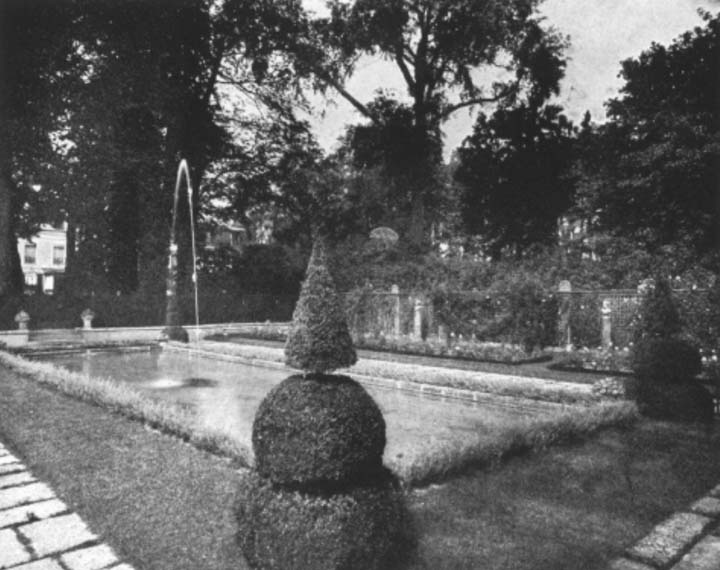
ONCE more I turn my crystal ball to see reflected therein a French villa set in the midst of green, shaded by venerable trees, dropped between park and plain, silent and enclosed. It is the Villa Trianon in Versailles as Elsie de Wolfe and I first peered at it between iron grilles. This place has a history. The land was given originally to the daughters of Louis the Fifteenth, known in their day as Mesdames de France. There they rested, descending from their heavy carriages as they covered the rough road between Versailles and Marly.
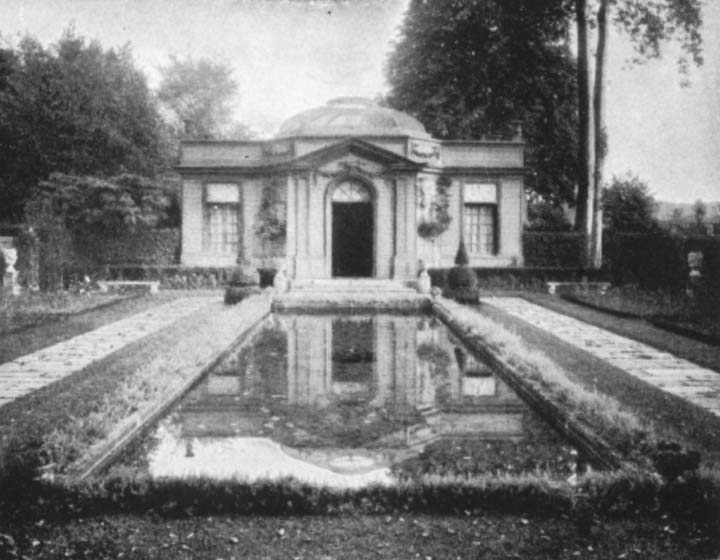
There they built a little pavilion in the corner after the style of a "rendez-vous de chasse," where they partook of such refreshments as were at that time considered palatable. They called it "goûter." It was equivalent to our five o'clock tea.
Later when the next sovereign mounted the throne , the present house was built for the surgeon of Marie Antoinette, and still another pavilion added, which was modelled in every detail after the farm buildings in the park of the Trianon composing the hameau of Marie Antoinette when she played at rusticity, and milked her cows with gilded horns into pails designed and made at the Royal factory of Sèvres. One can find all these landmarks clearly indicated on the old maps of the period.
At the time when Miss de Wolfe and I lived in the English cottage previously described, we were practically next door to this property. We looked at it admiringly and wondered why it remained neglected and deserted
Suddenly one day we noticed great yellow placards announcing its forthcoming sale at public auction.
It had been the home for years of the Duc de Nemours and his children. There were twenty-five people all told forming his household and who were lodged, heaven knows how, in the limited space of the Villa Trianon for it was never a very commodious dwelling.
There was then only one bath-room and toilet combined, which served generally, but which at the time was doubtless regarded as the last note of modern luxury.
After the disintegration of this royal family the property passed through several hands until it was thrown into the market by one of the victims of the famous Madame Humbert. He was a jeweler who had speculated heavily under her guidance until he was ruined.
As we gazed at this beautiful place we began to crave its possession. We had decided that Versailles was the one spot on earth where we desired to locate. We had lived there so long in rented houses, that if we bought anywhere, it would naturally be in this paradise of our choosing. Our fortunes, however, were only mounting slowly. We were far from being in affluent circumstances. I was doing fairly well in my business, and Miss de Wolfe was earning a good salary in the theatre, yet to have a sufficient total enabling us to purchase a house and land was a serious matter. Sardou, our friend and neighbor (this corner of Versailles was only four miles from his estate at Marly), came over at our request to inspect the place. He studied it carefully, then thumping his heavy walking stick upon the stone terrace said: "My children, I advise you to buy this property if you can get it for a reasonable sum. It will prove a good investment." How little our old friend realized that in the years ahead it was to bring us a happiness which no investment could equal.
At last came the a auction when the place was bought in for eighty-three thousand francs. Several months passed, and we learned that the owner who lived in Troyes, and who had accepted this property in part payment of the jeweler's bad debts, was thoroughly disgusted and determined to resell at almost any price.
We discussed this opportunity from every angle until we mustered enough courage to make an offer of sixty thousand francs. Our proposition was spurned as ridiculous. We could do nothing more. We thought of our loss, and bemoaned our fate until one day a letter reached us of an encouraging nature. We were told by the real estate agent that if we would add five thousand francs to our first offer that he thought the sale might go through. We acted upon his advice, and became the proud purchasers of the Villa Trianon, of its two pavilions, the outbuildings and the ten thousand square yards of land, all this for less than twelve thousand American dollars.
The whole of the repairing and reconstruction were left in Miss de Wolfe's hands. This was in the year 1903. From the hour of the original purchase until the present time, this place which has become famous for its beauty, and for its wealth of luxury, is due entirely to the taste and knowledge of Elsie de Wolfe. It is she who created this home of loveliness, it is she who inspired and executed its every addition, it is she who planned and planted the wonderful garden, and who built the pavilion of music, surrounded by its avenues of roses. It is she who furnished every room, and who breathed her soul and taste into every corner of the house. The Villa Trianon, probably the most perfect small country place in the world, will always remain as a monument to the artistic gifts with which Miss de Wolfe is so richly endowed.
| | |
|
|
|
It stands upon a fairy carpet midway between park and plain. The tree tops as they sway, murmur a message of peace and as one senses this beauty, God's eternal green touches and heals one's inmost soul.
Our French neighbors, especially the Curator of the Musée de Versailles, Pierre de Nolhac, were fearful of the changes we proposed. They connected the trend of modernism with American enterprise, and could not imagine us capable of reverence and of reserve. Their surprise was very great therefore, when they found us restoring the past while recognizing the importance of hygiene, and the necessity of present day convenience. The work moved slowly and we counted the months until at last the place was turned over to us as our future habitation.
ONE of our first visitors was Anne Morgan, the daughter of the late J. Pierpont Morgan. I had grown to know her fairly well. She was many years my junior, and young for her age. She had often come to our little house in New York. There was something pathetic about this splendid girl, full of vitality and eagerness, yet who, as the youngest of a large family, had never been allowed to grow up. Her environment had always been conservative. Those with whom she had been thrown were respected members of that society in which they moved, but the great army of individualists was practically unknown to Anne Morgan when first I met her. The people about whom she had read and also wanted to meet were wholly off of her line of match.
Her mind was ready for the spark plugs to be adjusted. Her moment of mental expansion had dawned. The power of her personality was to be set in motion. In other words she was about to discover herself, to earn through successive experiences her own potentialities.
Probably no two people were ever more alike in fundamentals of character than were Anne Morgan and her father, as described by those who knew him best. He was a man of marvelous energy, of infinite courage, and of concentrated opinions. Once he believed in anyone or in any cause, no outside influence would have the slightest effect upon him. He could not be side-tracked. While these qualities drove him into leadership, as he grew older it was evident that he suffered from their very defects.
To acknowledge defeat was foreign to his temperament. He was always loyal to his mistakes.
Brilliant in vision, dauntless in self-confidence there was probably no figure of his century who was more meteoric than J. Pierpont Morgan in his journey across the world of finance in which for years his ability to reign was uncontested. It was not until the men whom he despised had on gotten together, determined upon the undoing of his prestige, not until the old order of property rights had been challenged by the new order of human rights, not until the question of how a man had accomplished took precedence over what he had accomplished, that Mr. Morgan and the associates who were affiliated with him were forced to answer for their stewardship to those who, until then, had seemed mere soldiers in the ranks. President Theodore Roosevelt was threatened with impeachment by the Capitalists of Wall Street because he would neither bend his knee nor choke the truths which he felt and uttered. It was Roosevelt who dared to come out in the open and call "halt." It was Roosevelt who in the days of his forcefulness took the helm, and directed the fate of our country upon the high seas where until then the power of privilege had dominated the power of labor.
I doubt whether the significance of this conflict has ever been fully realized. Roosevelt won the victory, but later through political defeat, paid the price of his triumph.
Mr. Morgan was patriarchal in his views. The emancipated woman enjoyed no favor in his eyes, therefore as his daughter grew up she determined that she must think for herself.
She has in later years amply justified her early independence of spirit, for there is no woman in our country of finer fiber, of higher vision, of more disinterested conduct or of more persistent achievement than herself. She has an unusually accurate as well as an executive mind. And yet despite her forceful quality of brain her heart has retained the simplicity and the sincerity of a child.
After that first visit to Versailles she began to draw her own conclusions, to develop her own opinions, to select her own interests, in other words, to stand on her own feet.
To watch this expanding of her mentality was a privilege. A friendship was thus established as her visits each summer grew in length. The Villa Trianon became her playground, and her pastime. Miss de Wolfe and I were obliged to combine our respective businesses with our pleasures, but it all seemed to dovetail.
Miss Morgan and I were fond of purposeless motoring, so we gadded about sightseeing over a very large area and under conditions of self-indulgent comfort. Our last motor trip together of any consequence was in 1914 at the breaking out of the War, when we drove from Savoie to Biarritz, where we joined Miss de Wolfe who had been in Spain. We traveled through a line of barrier bayonets and past hundreds of buoyant poilus preparing for the unknown conflict.
Between Chambéry and Bayonne, we were forced to show our papers of identity, and our passports some seventy times. it was the beginning of the reign of terror which made everyone a suspect, but which in its confusion, frequently harbored an enemy as a cherished friend.
Miss de Wolfe only cares for motoring when there is something objective at the other end. She never shared my sheer joy of settling myself in a car, of riding along aimlessly feeling a symphony in its whirr of looking through green branches at a background of blue sky, of watching valley and mountain with the indolence of a vagrant mind, of taking a vast sensuous pleasure out of the vibrations of the engine, and of experiencing a sense of relaxation such as nothing else in the world can give. It is this and more which an automobile has always meant to me.
In 1912 it was decided that a new addition to the Villa should be made so that we could have further guest rooms. We laughingly called this "the Morgan Wing," for its construction was her contribution to the general investment. Architecturally it stands against the original house frankly inspired by utility and not as a pretentious effort to any furtherance of beauty.
Towards the close of the War I realized that my time must be more and more devoted to interests in my own country, that my work here must be made paramount, and that I could no longer be free to absent myself for so many months in every year. My legitimate business had been ruthlessly disrupted as was the case with so many. Therefore, due to the aftermath, I gradually drifted away from my trans-Atlantic moorings. Miss de Wolfe and Miss Morgan generously relieved me of my share of the Villa Trianon, and assumed it between themselves so that my financial responsibilities in France were lifted from my shoulders. From time to time I have returned to this land of enchantment for I shall never cease to regard it as my first love.
I gave up France as a residence, but never as the most alluring playground of the whole world. During the years following 1914, there were, however, many causes productive of internal friction for nothing is a more unlovely spectacle than to find one's compatriots in a foreign land so disloyal to their own country as to throw the balance of their influence against it. The traitors to the United States were not only to be found in the enemy's camps, but in the most luxurious drawing rooms of the American colony in Paris.
At the moment when our soldiers were shedding their blood upon the battlefields, sent over by the Administration then in control, when our Chief Executive was struggling with problems even greater than those of military strategy, when, whether right or wrong, we should have stood for solidarity in the eyes of the world, our home government was too often made the target of American criticism, and its short-comings were noisily described and derided by our compatriots who were the loudest in proclaiming their allegiance to the Allies.
It was a sorry spectacle to say the least, and one which forced upon one's mind the tragedy of that man or of that woman who stands literally without a country.
MANY were the civic movements promoted by Anne Morgan during the early years of her activity. The list of them would be too long to enumerate. Her absorption in French interests since the War has consequently been a source of regret to those who had previously been her co-workers here.
We had, together with Mrs. J. Borden Harriman, and others, established the first social club for our sex in this City. Our efforts met with success, and the Colony Club, at 122 Madison Avenue, designed by Stanford White, and decorated and furnished by Elsie de Wolfe, became the forerunner of similar centres throughout the country.
Clubs for women with restaurant, lounge, swimming pool and gymnasium have now become so common that they cease to arouse even passing surprise. Personally I belong to four such organizations in New York alone, although I have lived to realize that no club can ever replace a home.
Not only were Anne Morgan and I officers of the Colony Club but for seven years, and even after its removal to its more spacious but less attractive building at 564 Park Avenue, I was the Chairman of the House Committee, no easy task, especially as every system in the running had to be established. We had to build our machinery in advance hoping that when put in place it would function. To a great extent we were not disappointed, and many of the original ideas as to the operation of the Colony Club still obtain.
It was little wonder that our friends enjoyed to the utmost the atmosphere of the Villa Trianon for its popularity was always increasing. The Sunday afternoon receptions drew the most interesting people together from all corners of the globe. Incongruities of acquaintance seemed there to fall into proper pigeon holes. Racial and religious prejudices became extinct. The lions and the lambs were thrown into each other's society with every external evidence of mutual enjoyment.
Kings and potentates walked hand in hand.
I remember receiving on one occasion the powerful French Cardinal Mathé, whose coming had been officially announced. Suddenly we saw him crossing the lawn in animated conversation with Jean Richepin and the popular writer, "Gyp," whose real name was the Comtesse de Martel. She was a direct descendant of the Comte de Mirabeau, that famous citizen of revolutionary days.
I also recall a very extraordinary visit I once paid to this brilliant woman whose books "Nos bons Normands," and "Petit Bob," had made such a sensation. Her house was well situated in Auteuil. Her love of animals was widely known, but I was wholly unprepared for the species which at that time absorbed her attention.
She had become a passionate lover of monkeys and had surrounded herself with them.
As I sat in her drawing room I suddenly became conscious that I was not alone. I was made aware of other living occupants. In an instant something had dropped upon my shoulder. I raised my eyes and discovered crawling down from the ceiling on silken cords half a dozen little animated beings, chattering and confusing, tiny creatures of every color and variety, and all as friendly as they were garrulous.
When "Gyp" entered the room she exclaimed, "Ah, Mademoiselle, I see that you have made friends with my family!"
WE were all deeply interested at Versailles in the stories which were exchanged through the sales of objects of art, when transferred to the great collectors. There were many purchasers in the field in those days, and the rivalry in acquisition was very keen. Prices soared accordingly, and it took even a man like Sardou a long while to realize "other times, other habits."
When that series of decorative panels by Fragonard became familiar in two continents, Sardou was amazed beyond expression, especially because he was one of the few who was really familiar with the history of these lovely eighteenth century pictures.
What is generally known is that they were originally a royal command given by King Louis the Fifteenth, and destined to adorn the walls of Madame du Barry's pavilion at Louveciennes. When Fragonard, who was then a young and struggling artist, had completed the order the canvasses were taken there and set in place, as their respective sizes corresponded with the mural spaces which had been left empty to receive them.
When Madame du Barry saw the pictures, however, she imagined that the subjects were in illustration of her relations with the King and it was the fifth panel, representing the heroine leaning disconsolate and deserted against the marble column which came as a hideous warning of her approaching abandonment by her royal lover. She was so incensed that she had the pictures torn down. They were removed instantly from her sight. Fragonard rolled them up, disgusted with his fair patron, but still more disgusted with the ignorance and caprice of that world upon which his fortune and his reputation so largely depended. He decided that he would turn his back on it all, return to the south of France near Grasse where he was born, paint merely as a pastime, and earn his bread literally by the sweat of his brow while tilling the soil.
He lived thereafter happily, although frugally, amassed a considerable competence, married and became the father of several children and finally died in the first quarter of the nineteenth century, leaving quite an estate which was then administered by a cousin of Victorien Sardou's, one Blaize Sardou, notary, who was many years his senior.
What everyone does not know is that in the settlement of this estate these decorative panels played a very conspicuous part. They had been thrown into an attic by the artist, together with dozens of his other drawings while Fragonard became more and more absorbed with the raising of cows and pigs. In the living rooms were the usual pieces of simple furniture and in the kitchen hung the familiar array of shining copper pots and pans so dear to the hearts of French housewives.
It was decided that justice demanded an equal division of these articles amongst the three heirs, one a girl and the other two, boys. All went smoothly under the tactful administration of Blaize Sardou until it came to the division of the culinary utensils. Then the trouble really began. The sister, who was about to marry, insisted that the brothers should resign all claim to these precious treasures as it was more appropriate for her to inherit them. She would even give up the farm implements if only she might keep the pots and pans.
After many sessions, when feeling ran. high, the notary suddenly remembered the paintings in the attic. He asked what about them? They were at once carefully examined and appraised with the result that the two young men said that they would allow the kitchen utensils to become their sister's sole property provided that she on her side would relinquish all rights to the paintings.
She looked these over, agreed to the bargain and for many months told the story to her neighbors, chuckling with glee over the ignorance and stupidity of her brothers.
Years passed until one day some tourist reported to the Princess Mathilde in Paris that he had discovered in the old French homestead this series of panels. The Eighteenth Century School of Artists was then rapidly coming into vogue. Emissaries were at once sent to Grasse to investigate the truth of the traveler's statement which was amply verified. An offer to purchase was immediately made, the sum proposed being forty thousand francs. Young Fragonard, who was the grandson of the painter, felt that if anyone wanted his pictures enough to pay this amount for them, that by holding them a while the value would increase. His reasoning proved correct or eventually these famous Fragonards of Grasse were sold to a dealer in Paris for one hundred thousand francs, which at the time represented approximately nineteen thousand dollars.
They passed subsequently through several hands until purchased in England by J. P. Morgan. They were for a long while in his house in London where they were seen at an unfortunate disadvantage owing to the crowded wall space of the room where they hung.
The panels were afterwards brought to this country and exhibited for many months in the Metropolitan Museum where they attracted much attention and publicity. Ultimately the executors of Mr. Morgan's estate in turn sold them to the late H. C. Frick who had a gallery especially prepared for their reception. There they hang now after having traveled many miles through many years, from the Pavillon of Madame du Barry at Louveciennes to rest in a modern New York residence.
One of the gems in the collection of the Musée de Chantilly is an exquisite statuette in bronze of the sixteenth century which stands in a case in the centre of the rotunda. Every connoisseur who has visited Chantilly will doubtless recall it. The circumstances under which it came into the possession of the Duc d'Aumale are interesting
Early in the nineteenth century there was one Baron de Pourtalés who was a great collector in his day. He amassed many beautiful and rare objects of art, paying for them prices which now would hardly seem to us credible, yet for the bronze in question even de Pourtalés admitted having secured a bargain.
He was posting through the department of the Meuse. when one of the ropes of the harness broke. Fortunately this accident happened in front of a farm house so that assistance could be promptly procured. The accommodating farmer soon produced a new rope, the repair was made and the Baron was about to proceed, when the good man informed de Pourtalés that very recently he had dug something up in his barley field which might interest him.
He returned to the house and soon reappeared with a little statue in bronze rolled up in a bit of newspaper. When he showed the contents of the package to the Baron, the latter's heart nearly ceased to beat, so great was his emotion in beholding this wonderful treasure. Concealing his joy with a practical restraint, however, he asked the farmer, with a semblance of indifference, what price he wanted for the bronze.
"Would your Excellency think five francs too much?" said the farmer.
"No," replied de Pourtalés, "in fact I shall add fifteen francs to this amount on account of the services you have rendered my driver."
Later the Duc d'Aumale paid de Pourtalés sixty thousand francs for this same statuette, and prior to his death received an offer for it of one hundred thousand francs from the Musée du Louvre.
In connection with Chantilly I cannot but recall the only time when I saw the Duc d'Aumale. It was at a reception of the French Academy when he occupied his chair as one of the forty immortals. He looked every inch a king, tall, stately, a soldier and a prince. Race was indicated in his slightest movement. It was no wonder that in his last will and testament he bequeathed his royal domain of Chantilly with all its treasures to his country from which, at one period, he had been exiled. France was so written across his heart that his final gesture in life was to assure her of his loyalty, and of his love even after death. He is not now remembered by his countrymen as an heir to the throne, but as, a fellow-citizen who understood the full significance of the word brotherhood at a moment when the memory of liberty was to him a cruel jest.
I recall his funeral in the ancient church of Ste. Geneviève in Paris. I was honored with a card of invitation to attend. Even as a stranger I realized that this solemn event marked the passing of a great man. I was deeply impressed at the sight of a tall, slim lady of mature age who as she was escorted to a seat struck me as a woman of unusual distinction. She was dressed, however, with a simplicity I shall never forget. A plain serge gown, such as is worn by nuns, with a simple black camel's hair shawl across her shoulders and her bonnet almost of the style of 1830. 1 discovered that this lady who could afford to dress so simply was none other than the Comtesse de Paris, who had come forth from her seclusion to pay the tribute of her presence at the obsequies of her royal relative.
There was long ago in Paris a very great collector named Baron Pichon, whose house was in the Isle St. Louis. He was a curious and interesting figure living amidst priceless treasures, in the midst of crumbling glory. His surroundings were the triumph of disorder. On the occasion of our visit when we were shown trays of historical rings, cases full of miniatures, drawers bulging with rare stuffs, closets crowded with signed pictures, I asked whether I might see his catalogue to which he replied, tapping his forehead:
"Here is my catalogue. I have none other."
I can well believe his statement for on his toilet table I observed that his tooth powder was kept in an enamelled box whose lid was the work of Petitot, and beside his bed, serving as an ash tray, was a small dish by Palissy.
I can see this little old man in a figured silk dressing gown welcoming us with the courtesy of royalty and dismissing us with the dignity of kings.
I once asked Sardou why he did not employ a secretary to which he replied that he had never found anyone but his gardener who could always trace a paper or who could accurately put his hand on a book.
Miss de Wolfe and I still have in our possession a very rare and exquisite group in wax, known as Pandora's Box.
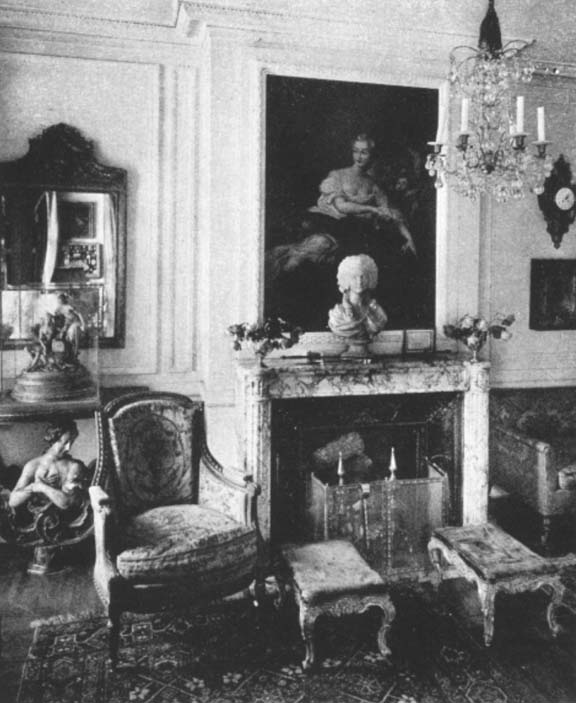
We had wandered into a little side street in Paris many years ago. We went into the rear of a dusty shop, and there in a half light saw this object. The owner of the establishment said that he had just purchased it with a lot of furniture from a Château in Auvergne. Attracted by its intrinsic beauty, without the smallest inkling of the identity of the artist who had molded it, we struck a bargain, carrying off our precious acquisition.
Set in place at Versailles it was always admired. Frequently our friends who were experts insisted that it was by the famous sculptor Falconet. One day while walking through the collection at Hereford House in Manchester Square, London, we were thrilled when we discovered a clock catalogued as by this artist, which exactly resembled our group in wax. The mystery was thus suddenly explained. Our wax was indeed by Falconet having served as the original model for the clock we had seen. As was very common, some few discrepancies were found between the model and the final execution of it. For this very reason the artists of those days worked first in wax as this substance was so easy to mold and to alter.
Afterwards when we had our group appraised, we were told that at a conservative estimate it was worth five thousand dollars.
The day has gone by, I fancy, when such bargains are to be picked up in the little shops of Paris or in the French provinces. Even the peasants have become cultivated with the passing of wooden sabots, with the adoption of silk stockings, with the interment of local costume and with the restricted hours of labor; a cunning born of sophisticated intelligence has crept in, and a pride taken in proving themselves sharper at a bargain than the most wary dealer who ever plied his trade.
If a collector, for his own protection, wishes to find genuine treasures at fair prices, let him go to the recognized and established antiquaries who sell with a guarantee. The making of false objects of art is a thriving industry all over the world, and nowhere in the universe are they planted more successfully than in the small town or in the isolated dwelling.
Even the best judges are occasionally deceived. I remember the description of such a tragedy which was given me by one of the most important dealers in Paris who lived in an historical and beautiful private hotel.
His brother had returned from a great sale in Belgium, bringing back with him a vase for which he had paid a fabulous sum. My narrator told me that when he first saw this he shared all his brother's enthusiasm. He examined it under the electric light with a strong magnifying glass, he turned it on all sides, he looked at it from every angle. No doubt of its authenticity ever crossed his mind. He set it in place temporarily and retired for the night. On the following morning at five o'clock he crept out of bed and went down to the room where he had left the vase. It stood bathed in sunlight. One look, possessed of the flare which had proved the foundation of his fortune, he felt that the vase was modern, that it was not genuine, that its fate was the rubbish heap. His morning impression was found to be correct, and the vase for which his brother had paid fifty thousand dollars was proved to be actually worthless.
No wonder that these great merchants of antiques always wear a troubled and anxious expression.
WHILE selling objects of art had become such a prevalent industry in Europe, our country had been busy producing the men who could buy them. Great fortunes had been accumulated, but wealth was still undigested. The process of assimilation had just begun.
In those days each new and pretentious household selected some indigent youth whose business capacity had never been demonstrated, but who possessed a large social acquaintance, whose personality was pleasing, and who knew how to direct with success the kitchen and the wine cellar. The ranks of the little brothers of the rich thrived and increased. Newport, R. I., became their happy hunting ground.
Possibly things were better done and society was more agreeable under these conditions than at present. The all-sufficient and aggressive type of millionaire now so familiar was not then so conspicuous. The fortunes were more modestly disbursed. The mere building of palatial residences, the acquiring of museum pieces, the employment of many servants elaborately liveried, the highly paid services of an able press agent, the Lorenzo di Medici rôle of patron of art, and the drama, does not seem after all to have produced a very finished article. Blunder after blunder is made and the sublime part of it is that the sinners remain ignorant of their sins.
I remember a luncheon given to the wife of one of these newcomers by an amiable young man who had made considerable money through the wise advice of the lady's husband. On this occasion, in order to show a proper appreciation of the latter's kind interest, he had invited some very well-bred and socially prominent women to meet her.
This was to be her début in the world of fashion. She evidently thought that if she came on time her eagerness would seem too apparent, hence she was so late that the luncheon began without her. Arriving finally, the host, after making the proper introductions, upbraided her jocosely for her tardiness, to which she replied:
"Well, there is certainly no excuse for my being so late because I have seven automobiles in the garage."
This same woman, when her daughter was married, was most successful in eliminating every blood relation she had in issuing the wedding invitations, yet she had thus despised the best reason for her own existence as she had really sprung from a stock of good citizens.
There is probably no desolation in the world to be compared to that of an enormous house of architectural beauty, decorated and furnished with exquisite taste, filled with priceless objects of art, and yet occupied by two people who socially are thoroughly inadequate, or, if they have children, are bringing them up as little vulgar, purse-proud prigs.
To see them living in spacious splendor is certainly an unedifying sight. It has always seemed a marvel to me why decent and intelligent folk should be bored with them. Often the excuse is made that one meets such interesting personalities at their table, yet the pall which usually hangs over such establishments casts its shadow upon the brilliant guests and it would be infinitely more sympathetic as a rule to run across the latter amid less pretentious surroundings, in simple homes, for instance, where the owners themselves contribute to the pleasurable sense of well being as well as do the furniture, the pictures and the food.
One thing I observed in my vast passing acquaintance with millionaires, was that they inevitably played solitaire as a pastime. It seemed a hall mark, and in traveling, the moment I found some fellow passenger absorbed day after day with this very unsociable game, I knew to a certainty that his fortune ran high in the millions, but whether he played solitaire because of his fortune or whether he had acquired his fortune through playing solitaire, I was never able to determine. As the game is one of contemplation, concentration and combination, who knows but that many a big deal in Wall Street has been projected while indulging in this apparently innocuous form of enjoyment.
Another striking feature so far as millionaires is concerned is their inborn suspicion of the motives of all who approach them. The magnitude of their wealth has assumed such preposterous proportions in their eyes that life is out of focus.
They are always looking for trouble. They are in a vicious circle for the men and women who surround them are as a rule polite grafters, hence their suspicions are justified. On the other hand this vulgar attitude of mistrust keeps away all really worth while people. The millionaire becomes literally hoisted by his own petard. Furthermore he rarely hears the truth, and so his self-inflation proceeds without check. His trained secretary sorts out the press clippings before he sees them. Only those of a flattering nature come under his eye. His underlings keep their jobs by removing all thorns from his path.
He is fed upon adulation. He hears nothing but praise. The power of wealth is preached to him by the sycophants who travel with him to Palm Beach or to Cannes. In his own line of business they are his inferiors, but he is physically incapable of forming an estimate of people as wholly apart from their material surroundings, of realizing that the doors which are closed to him and to his family are swung on hinges of intellectual value, of high purpose, and of self respect; that there are still thousands of men and women who are supreme masters of their minds and of their souls, who refuse to bow to a Calf of Gold, and whose hands, upstretched to Heaven, pluck from it stars which, unsurpassed in beauty, shine on and on refulgent and immortal.
Fortunately, however, for the world there are hundreds of men of large fortunes whose intelligent generosity has proved of inestimable benefit to mankind. The unostentation of their mode of life, their constant effort to alleviate the conditions of others who are less fortunate, the support of our hospitals, the gifts to our public museums, the eternal response to the eternal appeal merely emphasizes that there are two kinds of millionaires as opposed to each other in precept, and in principle as are the antipodes. In every town in ever state, men like the above can be found, faithful and just stewards of that wealth which has either been inherited or acquired.
The day when millions can be accumulated through privilege is over. The public is alert. Franchises are no longer granted behind closed doors. The tax payers become volunteer investigators.
From the hour when human needs took precedence in questions of legislation, the death knell of the old methods was struck. A man can earn the limit of his energy and of his brain, but he can no longer ignore the righteous claims of those less richly endowed.
What was once the dawn of the to-morrow is now the noonday sun of the day in which we live.