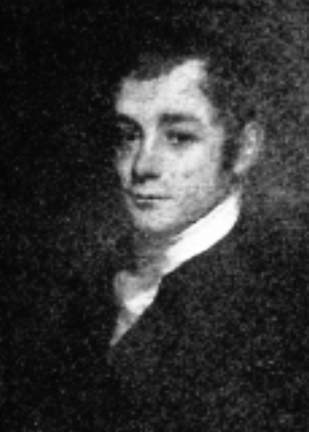
 | 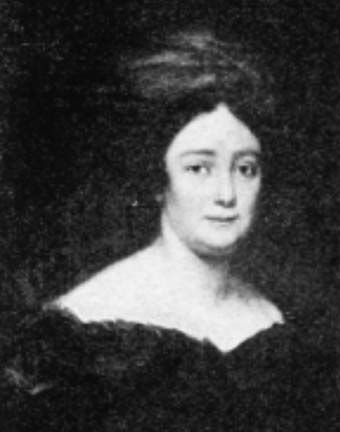 |
|
(Maternal grandfather) | (Maternal grandmother) |
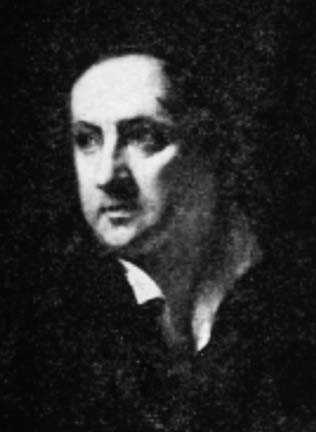 | 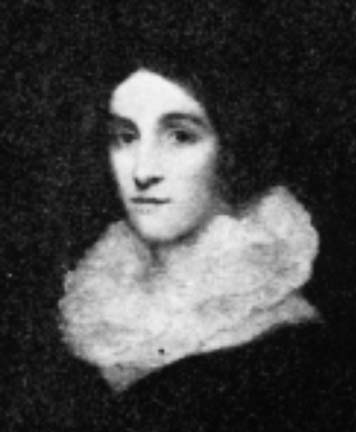 |
|
(Great-uncle) | (Great-aunt) |
WORLD Fairs always aroused my enthusiasm. I have personally enjoyed four of these official amusement parks, beginning with that of the Philadelphia Centennial, opened by President Grant in the year 1876. My father was then encouraging the attentions of a very substantial and serious young man from Boston who was altogether a correct and desirable suitor. Therefore this admirer was invited to go to Philadelphia with us. I was reasoning with myself that I ought to respond to his wooing, as I was quite sensible enough to appreciate the assets he had to offer. He was extremely well off. Two trivial incidents, however, proved fatal to his courtship. We were passing an exhibit of heating appliances, and I was especially attracted by some Franklin stoves, built after the old models. My admiration of them was abruptly checked by my escort, who remarked that they didn't begin to heat the room as did the ugly, modern stove which stood well out; in fact, he asserted that when he married he would allow no other kind than the latter in his house.
The second set-back had to do with furniture. I was particularly pleased with some that was upholstered in attractive material, when my friend insisted that horsehair covering was the only kind he would use, as it could be kept clean with little effort.
This finished him, and so I promptly informed my father that any further persuasion was useless.
I do not recall anything of memorable interest in the Philadelphia Exposition, unless it is a phrase that decorated the Egyptian exhibit and which read: "The oldest nation in the world sends its morning greeting to the youngest."
The large and superlatively beautiful construction of Chicago in 1893, and of San Francisco in 1915, obliterated even the impressions of this, my first, experience of world fairs. The White City in Chicago will always be remembered and the names of Daniel Burnham and of Stanford White are immortal in this connection.
In point of beauty and of inspiration the Exhibition at San Francisco effaced anything of the kind in history. It would be difficult even now to surpass it. So much was accomplished there with the aid of prodigal expenditure and of artistic direction. It was a perfect creation of its kind.
In Paris in 1900, so far as the gathering of priceless treasures was concerned, that Exposition stands forth as preeminent. Its educational opportunities were infinite. The retrospective collections offered unique facilities for comparison and for research. The royal palaces of Europe had poured out their possessions. The local museums had disgorged their objects of the greatest value. Private citizens had generously loaned their pictures and tapestries for the success of the vast undertaking.
France, at the beginning of the new century, intended that the world should be brought to her feet. Her trumpet of art tradition and of art leadership was blown to the four corners of the earth. Every nation was urged to bring her in adoration its sweetest incense and its finest myrrh.
Like a gesture of hands across the sea, the gilded bridge of Alexander III. was thrown over the Seine, and Russia, the unknown and the unconquered, was bidden to be the guest of honor among the nations to partake in splendor of the bounty of France.
It mattered little whether England sulked and whether Queen Victoria stayed away. The Grand Dukes formed a never-to-be-forgotten cortège and an alliance between France and Russia was consummated in a Treaty which at that time seemed invulnerable and eternal.
Yet the rumble of revolution could be detected, even while the military bands played loudly and the fireworks illumined the new bridge of beauty. It is little wonder that national archives become the waste-baskets of history.
My second trip abroad was with my father in 1880. We went directly to London and there took lodgings in Jermyn Street. James Russell Lowell was our ambassador at the time and William Hoppin the senior secretary. Both of these gentlemen were intimate friends of my father's, sharing with him, while smoking their after-dinner cigars, memories of Brook Farm, that experiment in fraternity, and of its habitués, such as Nathaniel Hawthorne and George William Curtis, about whom I heard many a story. Thanks to Mr. Lowell, we were invited to various agreeable functions. It was even proposed that I should be presented at court, but oddly enough this held no attraction for me. Then, as all through my life, I escaped the lure of titles. I felt with Emerson that the only real aristocracy in the world was the aristocracy of brains; it was the opportunity of penetrating into the circle of such men as Charles Robert Darwin, John Tyndall, Thomas Henry Huxley and Herbert Spencer of which I eagerly availed myself. They were my father's associates during this London visit. I absorbed from them.
A little anecdote in connection with Professor Huxley seems worth the telling.
We were at a large Sunday evening high tea at his house. Nearly everyone present enjoyed some distinction. After supper in the long twilight the young folks adjourned to the lawn to play croquet, the then popular game.
There was a non-conformist church nearby. The singing was distinctly heard, as was the clicking of our croquet balls. In the midst of the fun a stern-looking individual appeared, stalked up to Professor Huxley and said: "Sir, the rector and our congregation beg, that during the hours of service, you will refrain from disturbing us by making this most objectionable noise with the croquet balls."
To which Huxley loftily replied: "Sir, I and my guests beg, that during our enjoyment of my garden, that your rector and his congregation will refrain from disturbing us by making the very distressing noise caused by your singing."
Another anecdote is in order which relates to Herbert Spencer. One morning he came early to our lodgings and found me just leaving to visit the National Gallery---I was eager, full of enthusiasm and tireless in my energy. Spencer, looking at me with a certain amount of weariness, asked why I devoted so much time to the old Masters. In retort I said that "it was doubtless because I realized that I was so young that age could teach me much." "That is all very well," answered Mr. Spencer, "but if you had ever studied anatomy, nothing in the world would seem to you more grotesque than the majority of these old paintings which we prize as national treasures; for instance, look at any one of the Holy Families and therein study the eyes of the Christ Child. You will note that those early painters invariably put eyes of adults into the heads of children, and that they were never accurate in their portrayal of anything which required a knowledge of anatomy."
| | |
|
(Maternal grandfather) | (Maternal grandmother) |
| | |
|
(Great-uncle) | (Great-aunt) |
For years afterward these observations of Herbert Spencer disturbed me not a little. It was only when I grew to understand the souls of these old Masters that I realized how much he had missed in merely dwelling upon those technical defects of which they had been guilty. His scientific mind had failed ,to grasp that "little more and how much it is," and "the little less" which, as Browning wrote, is "worlds away."
Spencer, like all that group of thinkers who were then considered unorthodox, rarely wandered into the byways of imagination. They had little sympathy with loose thinking in any direction. Herbert Spencer always impressed me as a highly nervous man. I believe be was a victim of insomnia which could readily account for this. In those days there was as no Coué to teach people bow to sleep, and auto-suggestion was still in its infancy.
John Tyndall, the physicist, was then sixty years of age. He was an Irishman, very gentle and very lovable. Possibly his constant visits to the high Alps, where he lived for months at a time, away from the incessant bustle of the world, may have contributed to his balance and poise. Charles Darwin was seventy-one years of age when I saw him. He was surrounded by those who worshiped at his feet. His theory of evolution had enlisted hundreds of followers. People who believed at all in Darwin regarded him as the Columbus of the scientific world. Those whose intelligence failed to grasp the social economics of Spencer felt responsive to the teachings of Darwin which carried them in an unbroken ascent from an atom upward. There was something especially fascinating to the imaginative mind in his "Descent of Man." To trace one's scientific ancestry through centuries was educational and flattering, especially as humanity was thereby proven to be the best creation of a perfected system,
George Eliot I met but once. My father and I were taken to her house on one of her intimate afternoons. Her personality to me was rather austere and frightening. Her face was unattractive and angular, but redeemed in a great measure by her wonderful eyes.
Her book of essays, "The Impressions of Theophrastus Such," had just been published. Of course I had read with infinite delight and a surprising appreciation for my age, everything from her pen. I was also familiar with "The Life of Goethe" by George Henry Lewes. Prior to the time of which I write there was a very large element in English society which refused either to visit or to receive George Eliot. Her liberal views were never entirely endorsed nor generally tolerated. The circumstances which determined her to live with Lewes as his wife, without the marriage ceremony would seem less startling to-day than they were at that time. Her marriage to John Cross in May, 1880, while it brought her many new friends and gave her a security of position which she had never previously enjoyed, cost her many of her old admirers. To them, George Eliot strong and independent of view, George Eliot who through her sheer intellectual forcefulness had reached the pinnacle of literary fame, reigned supreme in their minds and far above the necessity of an alliance which seemed at best but a commonplace concession to public opinion; a sort of social aftermath which to them was colorless and unconvincing.
Thanks to our friend Mr. Hoppin, my father and I were taken to visit the wonderful collection at Grosvenor House, the residence of the Duke of Westminster.
It was there that I saw Gainsborough's Blue Boy for the first time. It seemed so completely in its proper setting that I confess to a regret that it was ultimately, sold, even though our own country has thereby benefited, as its home hereafter will be on the Pacific slope.
Another visit which I shall always remember was to the beautiful and impressive studio of Alma Tadema, then at the zenith of his popularity as a painter.
Upon entering his house., which was classical in conception and decoration, two willowy young girls. clad in clinging draperies which might have come from the looms of William Morris, rose to greet the visitors. They were the daughters of Tadema and it would not have been surprising to run across them in one's travels, reclining upon marble benches or loitering in the Acropolis with baskets of luscious fruit upon their heads,
Over the wide doorway which led into the studio were these words: "As the Sun is to Flowers, so is Art to Life." This phrase savored of such good symbolism that I have never forgotten it. It was in this same year of 1880 that the "professional beauty" became a recognized factor in London society. Conspicuous amongst these young conquerors were the lovely Georgiana, Countess of Dudley; Lady Lonsdale, who afterward became the Marchioness of Ripon; Mrs. Cornwallis West, who had a distinction which was all her own, and the fragile and lovely Marchioness of Anglesey, an American girl who was Minna King of Georgia. However, the sensation of the London season was a young woman who had crept quietly into town from the Island of Jersey, protected by a husband, but having neither influential connections nor a substantial bank account. Her name was Lillie Langtry, referred to in the society column of the day as the Jersey Lily. I saw her for the first time at the opera. She came in rather late, when immediately all eyes were turned in her direction. The stage was forgotten.
She stood for a moment wondrously fair and symmetrically slim. Her gown was of black net with tulle sleeves, There was neither paint nor powder on her face. Her complexion was literally like roses, the softest shade of pink and white. Her arms were very beautiful, in fact as she stood there, the target of concentrated admiration, it seemed to me that I had never seen anyone before who was quite so lovely.
This impression lasted for several seasons, even when I became more accustomed to seeing her. She was the social star. No function of any importance was complete without her. She took precedence everywhere and, whether within the royal enclosure at Ascot or on the royal yacht at Cowes, it was Mrs. Langtry upon whom all eyes were turned; and it was Mrs. Langtry who was the rain and the sunshine of London drawing rooms.
It was she who had Jersey cloth made into sports costumes, and I remember now how smart and trim she looked in them.
I first saw Henry Irving in 1880. My father took me to a performance of the "Lyons Mail." I enjoyed it vastly, but father, who admired good diction above all else, insisted that Irving's was beneath contempt, that, his mannerism was unpardonable and his speech unintelligible. I was never, even in later years, able to change his opinion so far as Henry Irving was concerned.
Having tired of London we crossed to the continent where we spent several months.
One story regarding that great patriot Gambetta deserves mention. We were walking along under the arcades of the Rue de Rivoli when suddenly a smart little brougham dashed up to the curb. The man who alighted from it was Gambetta. I was moved by curiosity to step to the side of the carriage and to look in. Judge of my surprise to see on the seat three articles: a new novel, a box of chocolates and a bunch of violets. No paper of state, no ministerial portfolio, no political review. Were these three presents for three women or were they three presents for one woman?
The above reminds me of the very witty remark attributed to the wife of Lieutenant Hobson, the hero of the Spanish-American War. After addressing a meeting in Chicago, so great was the enthusiasm that the lieutenant was forthwith kissed by three thousand women. When Mrs. Hobson was asked whether she objected to this, she replied: "Not in the very least! I infinitely prefer to have my husband kissed by three thousand women than that he should be kissed three thousand times by one woman."
This indeed was a case of Mrs. Hobson's choice. How many, by the way, know the origin of this expression? It seems that, in the eighteenth century, there was a livery stable keeper in Surrey named Hobson. His horses all stood in line. When a teamster or a traveler called for a post horse, Hobson's rule was that he should take the horse standing nearest to the stable door, hence the expression "Hobson's choice."
AFTER my return from abroad in 1885 I became actively interested in the theatre. The Lyceum was the playhouse to which all fashionable New York flocked. Daniel Frohman, formerly associated with the Madison Square Theatre, had decided to be at the head of his own company and in independent management.
His many years of subsequent success justified this self-confidence. He produced one good play after another, and it was wholly due to his encouragement that I became identified with plays and playwrights. I first met him in connection with a benefit performance I had arranged and was directing for a popular charity. This entertainment was so successful financially that we cleared nearly five thousand dollars from it. It was this result which influenced Mr. Frohman to believe that I possessed business qualities which might be developed. I listened eagerly to his advice, and not only listened, but had sense enough to follow it. Mrs. Francis Hodgson Burnett had placed her play, "Little Lord Fauntleroy," with Henry French, who was to produce it in the Broadway Theatre. I heard indirectly that Mrs. Burnett knew little about the stage, so it occurred to me that I might perhaps act as her business representative. A mutual friend gave me a letter of introduction to her, which I promptly presented.
I must have made a favorable impression, because Mrs. Burnett invited me then and there to attend a rehearsal. For a fortnight I never left her side. I was sincere in my enthusiasm for the play and in my admiration of its author. "Little Lord Fauntleroy" was produced and made an instantaneous hit. There was a prospect of other companies being immediately organized, to cover the country, as in those days piracy was facilitated by our very lax interstate laws. However, by this time Mrs. Burnett felt enough confidence in my intelligence and energy to give me the position I had craved.
She lived in Washington with her husband, who was a well-known oculist, and her two sons, Lionel and Vivian. Every week I spent Saturday and Sunday in her charming home, and rarely allowed anything to interfere with my making my report to her with regularity. I remember on one occasion, while suffering from an attack of tonsilitis, and with a temperature of one hundred and one, that I still persisted in keeping to my schedule.
For several years I was in the closest relations with Mrs. Burnett, making all of her play contracts, collecting her royalties and looking after her dramatic interests generally. I knew every line of "Fauntleroy." All the children who were considered for the leading part were first approved by me. I then realized that they are natural born actors and that it is rarely that a youngster cannot easily memorize lines and master stage business. How many Little Lord Fauntleroys there were, beginning with Elsie Leslie and Wallace Eddinger! The latter had, even as a tiny boy unusual personality. He was excellent in the part, although nothing could have been more unlike his own character than was that of the hero of the play.
Mrs. Burnett always adored children and still does. She wanted to know each boy and girl who were her interpreters, so insisted that "Wallie" Eddinger, as he was then called, should be brought to see her at the Clarendon Hotel. Elsie Leslie had often visited her, as she had already been featured in "Editha's Burglar," with E. H. Sothern.
I had been thrown in contact with Wallie and knew that he was a one-hundred-per-cent real boy. There was nothing sentimental nor angelic about him. He was a child of nature, used language which was at times more forcible than polite, and invariably spoke in a vernacular which was his very own. Thus I had some little misgivings as to the effect of his visit, especially when he always seemed so very gentle upon the stage.
I discovered that the prospect of this interview bored him considerably. It seemed to him a waste of his play time. However, we reached Mrs. Burnett's door, knocked and were instantly admitted.
At once he was surrounded with every toy that could possibly delight his heart and with an added generous supply of cake and candy.
The boy said very little at first, but looked fixedly at his benefactress, then suddenly exclaimed: "Who are you, anyway?" "Why, I am the author of the play in which you are acting," said Mrs. Burnett. Wallie, not at all convinced, insisted: "Say, you didn't write it all alone, did you?" "Certainly, my little man," replied Mrs. Burnett, "I wrote the story first, and then I wrote the play, and I mean to write ever so many more stories for dear little children like you."
Apparently unaffected by her kind interest in him, Wallie still remained skeptical, for finally, after a moment's pause, he said: "Gee! You may be all right, only I didn't think you looked as though you could do it."
Mrs. Burnett was enchanted with his ingenuous frankness, and I believe in consequence that she has always had a very large place in her heart for Wallace Eddinger. She has watched his career with more than a passing interest, so that when he carried the public by storm as the roystering bully, Captain Applejack, I doubt whether anyone was more pleased with his success than the dear little lady who had created his first part.
Personally I shall always feel very grateful to Mrs. Burnett for the opportunity she gave me. Through my association with her interests, I learned the practical side of the theatre. I began to understand the relative positions of playwrights and producers. The experience was invaluable to me, and laid the foundation of my subsequent business career.
Mrs. Burnett and I worked out many a problem together, so that at the end of our agreement, when I could no longer render her any further service professionally, our friendship grew and became cemented during the years which followed. Who knows but that some day we may again become associated in a play?
My last business connection with "Little Lord Fauntleroy" revolved around the company which sailed to produce it in Australia.
I was offered a twenty-five per cent interest in this tour for the sum of three thousand dollars, money I had saved through hard work. Like all who have anything to do with the theatre, the spirit of speculation entered into my veins. Sooner or later, this happens inevitably. The manager of the company had leased the rights of production for this territory. He was a slick and persuasive individual. I handed over my three thousand dollars to him without hesitation.
It looked as though "Little Lord Fauntleroy" could not fail.
The play made good in Australia, as it had done elsewhere. Each week showed a healthy profit on paper, but never a cent of my investment nor a cent of the earnings did I ever see. In any other business this fellow would have been arrested as a crook, but such procedure is not considered etiquette in the theatrical world.
All we say, as a rule, is that a man has had hard luck, and another chance to rob is given him. Not only did I never receive any money from Australia, but my slippery friend deceived me so successfully that he persuaded me to sail for France, to produce the play there. I was promised a deposit of five hundred dollars to await my arrival in Paris, plus fifty dollars a week for expenses, plus fifty per cent of the profit.
There were far too many "pluses," as I afterwards learned.
Throughout my life, I have always found that events which seemed at the time disastrous, ultimately developed into positive blessings. In fact, I have never known of one instance when this has not proved to be the case.
Had my first theatrical venture been a success, I doubtless would have become a manager, rather than an author's representative; and I am satisfied that I could never have stood the physical strain of such an uncertain and nerve-racking occupation.
The perils of Wall Street are nothing as compared to the pitfalls of Upper Broadway.
In this connection let me state that one of the peculiarities of this business is that when a manager makes six productions, four of which are successes and two of which are failures, the two failures more than consume the profits of the four successes.
Profits are negligible when compared with losses.
However, believing in the proposition which the manager of our Fauntleroy company had made to me, I sailed for France in March of that year, taking with me three hundred dollars, practically all that was left after paying my steamship fare above my investment to which I have already referred. We had a most tempestuous voyage, cold and dreary. When we landed at Havre, it was in the midst of a French imitation of an American blizzard.
I went to the Hotel Frascati, then only a summer resort. In winter it was dismal. The fire in my room, for which I paid extra, consisted of a few wretched faggots burning in a very small fireplace. I felt depressed and lonely. Suddenly a cable was brought to me. I opened it, hoping for good news, instead of which it informed me that our manager had absconded, and that he had only sent me abroad in order to give himself more time in which to transfer the funds beyond legal reach.
There I was, stranded three thousand miles away from home and friends, all of my savings lost, and with the paltry sum of three hundred dollars as my sole asset.
I kept warm that night by pacing up and down the floor, wondering whether I had better use my meagre cash to pay for a return ticket to New York or whether I had better push on to Paris, in an effort to build up a business, for I reasoned that the same brain which was able to earn my first three thousand dollars might still prove its value by serving other authors as it had served Mrs. Burnett.
To return to America was to confess that my career so far had ended in lamentable failure. To go back to my family to be supported was an admission of weakness. My pride was involved.
The next morning the weather had changed. The sun was shining brightly. The temperature had gone up some twenty degrees. The glistening sand was beneath my window, the blue sea was calm and beautiful. I felt inspired. My optimism had returned. I abandoned all idea of going back---Paris and life were ahead of me. I knew with everything in me that I would succeed. No other course was possible. Our surest capital lies in ourselves. To husband one's own resources from within prevents a run on the bank from without. Ideas may be stolen. They can never be taxed. I backed myself to win, which is the keynote of success in any undertaking. Exhilarated by these reflections, I paid my bill at the hotel, proceeded to the railway station, bought a second-class ticket and took the eight o'clock express to Paris. I felt with Monte Cristo that the world and all its treasures were mine.
I MUST now retrogress somewhat, in order to introduce certain friendships and interests which have played such a conspicuous part in my life.
Amateur theatricals were then very much in vogue. We had fewer theatres and no movies. Diversions were rarer. Dancing was confined to private evening entertainments. Cabarets were unknown. Jazz was undiscovered.
The first country club had come into existence owing a the vision and enterprise of Pierre Lorillard. Tuxedo Park was projected and in due time, it became an actuality.
I was visiting some friends there, when I met with an unfortunate accident. I sprained my ankle while dancing. The pain was for the moment intense, but suddenly there was a buzz of excitement, when a slim and graceful young girl passed through the ballroom. I asked her name and was informed that she was Elsie de Wolfe, a newcomer from abroad, who had considerable talent as an amateur actress, and who was there to take part in the club entertainment. I remember that my remark was far from flattering, as I was not in the least impressed by her appearance. Her foreign type and her French distinction elicited no admiration so far as I was concerned. She was exotic, but in looking back I must confess that I was then rather crude. I have always attributed my critical attitude on this occasion to the severe pain I was suffering in my injured ankle.
It was soon after my visit to Tuxedo, and through my interest in the amateur stage, that I met Elsie de Wolfe. My friends, the Hewitts, asked us to luncheon. Caroline Duer, who had written some quite lovely sonnets, was also present. She had given me copies of them. After leaving the dining-room, I took Miss de Wolfe aside, showed her these verses and asked her to read them aloud, which she did, with a very pleasurable appreciation of their quality.
I found her so extremely intelligent that she quite altered the first unfavorable impression which she had made upon me that night at Tuxedo. Thereafter we met frequently, so that before many months had elapsed a friendship between us was established, which from that time until the present has remained unbroken and inviolate.
This was in the year 1884.
Miss de Wolfe's father was a physician, born in Halifax, N. S. Her mother was Scotch, although her family had removed to Canada when she was comparatively young. At sixteen years of age, Elsie had been sent: to visit her Scotch relations, who held distinguished positions in Aberdeen, belonging as they did to the well-known family of Charteris, which had furnished a long line of Deans and Professors to the Universities and pulpits of Scotland.
The austerity and simplicity of this environment were unsympathetic to a girl of her temperament, for from her baby days she had been indulged in her artistic sense and in her love of beauty, both of which qualities, by the way, being her dominant expression, even at a very early age.
Throughout her life, her chief articulation has invariably been through some form of art. Her color sense was her first sense. Never could she spend fifteen minutes amid new surroundings, without longing to move the furniture, to rearrange the ornaments, and to pull about the draperies, thus visualizing all the while what she might do if only she were given a free hand in the room.
She knew intuitively where a few flowers would produce the best effect, and where the angle of a chair would improve the general appearance. She felt furniture and decoration through every fiber of her being, and waved a magic wand while creating a lovely interior.
This clearly indicates the very beginning of the career which has since made Elsie de Wolfe internationally famous.
When she adopted the stage temporarily as a profession, it was a road leading to her final fulfillment. She never in reality deviated from her natural bent. Her talents, wherever they might find expression, were always focussing toward the objective. Slowly but surely she was coming into her own. She traveled, she studied, she acquired knowledge. Her flair in detecting the real from the imitation was extraordinary. Her sense of proportion was unerring. She might make a mistake in many things, but she was physically incapable of making a mistake in the matter of taste.
For this reason, and without any apparent effort, she was always perfectly dressed. A simple cotton frock upon Elsie de Wolfe became a poem, and a shawl thrown across her shoulder an inspiration. Probably her proverbial generosity to other women has protected her from much jealousy so far as clothes are concerned, for no matter how novel or unique may be a model in her possession, I. have never known her to refuse lending it to a friend who desired to copy it.
The misconception which obtains in the mind of the amateur actor or actress regarding the professional is often very amusing. I remember once hearing a young woman who aspired to become a real actress, say: "Just wait until I am on the stage---no more ginger ale and ham sandwiches for me at night, only champagne and paté de foie gras.
In after years, when I would be supping with some of the greatest stars, I used to wish my little friend were with us, to drink beer and to eat bacon and fried eggs.
Speaking of "stars," Elsie de Wolfe enjoyed this proud distinction amidst the amateurs for several seasons. I was duly impressed by her importance, so that on one occasion, when I beard her mother reproaching her in no gentle terms for some line of conduct, I remonstrated, saying: "Oh, remember, dear Mrs. de Wolfe, that the star must be handled carefully."
"She is no star to me," answered Mrs. de Wolfe, which remark gave Elsie and myself a hearty laugh, for we both had a keen sense of humor, which has never deserted us in all the years of our intimacy. Many a domestic storm has thereby been averted.
Perhaps if husbands and wives exerted it occasionally, there might be fewer divorces. When two people can laugh together, there is less room for tears, and when they can see a joke at the same moment, catastrophe is often prevented A sense of humor is probably the one saving grace in the world. It can save nations as well as individuals.
With the exception of an occasional visit, I knew little of the so-called fashionable resorts. Therefore when it was proposed that we should rent a house together in Lenox, Mass., for the season, I gladly agreed to the suggestion.
We found just what we wanted, a little cottage, not too impractical nor uncomfortable. There was a certain "picnic" atmosphere about it all which being young we really enjoyed. We had hosts of friends in Lenox who welcomed us so cordially that the weeks of relaxation flew by. The experiment was so successful that it was not very long before we decided we would cast in our lots together. We had both determined not to become lotus-eaters, but to be bread earners, hence independent. We could see our families daily and we could, through freedom of action and protection from unproductive demands upon our time, better qualify to be of practical assistance to those who might ultimately depend upon us if ever the rainy day came; and it did come with a vengeance. When Miss de Wolfe's father died, he left nothing. He had lived from year to year upon his earnings as a physician without setting anything aside.
When my father died, we found that he had speculated so disadvantageously that there was little to fall back upon. But long before these cyclones struck, both Miss de Wolfe and I were respectively hard at work. From that time on business and pleasure went hand in hand. It was this which determined my friend to adopt the stage professionally. She had had so much training as an amateur that she made the common mistake of believing that this would equip her for the broader field.
Like many others she soon discovered this error. Personally I am convinced that experience in amateur theatricals is a detriment rather than an advantage to anyone aspiring to the stage. Most that has been learned has to be unlearned. The very self-confidence which this experience engenders produces oftentimes an undesirable result.
The praise of injudicious friends frequently fosters bad mannerisms. Glaring faults are glossed over and indications of talent are generally exaggerated.
A young man or woman (with very few exceptions) who has never been on the amateur stage is a more docile and plastic pupil than one who has.
The stage is a hard profession. Work and constant work, humility, perseverance and great physical strength are all essentials to success. The road is long and bleak. Each step forward must be with bleeding feet. I have felt more heart throbs through sympathy with the disappointed and discouraged members of the profession than I have ever experienced by contact with the victims of material poverty. The latter may starve with their bodies; the former with their souls, although I might add both at times go hand in hand.
The uncertainty of enduring engagements, the long lapses of weeks with nothing to do, the wearing rehearsals which only lead to the brief run of a failure, the jealousies, the injustices, the disappointments are all heart breaking. The salary when received may seem large but how quickly it melts during the periods of enforced idleness.
And what shall I say of the traveling which even the greatest stars cannot escape! Life in a train is a wretched existence under the most favorable conditions; a three room modest apartment in a side street of a small town is preferable in my opinion. How many of our actors and actresses when they do establish homes for themselves live in them only in retrospection. The doors are locked and the keys are with them as they travel from one dreary city to another.
In the case of Miss de Wolfe and myself, when she was on the road, I always lived in our little home save when I joined her which I did as often as was feasible. Many a time she felt like giving up the whole thing, but stuck to it with a pluck which carried her through thirteen years. She finally left the stage after reaching the position of being starred with a salary which in those days was considered very large, namely four hundred dollars a week.
While she was never a great actress she had a distinction and a diction which were admirably suited to the parts which she played. She was a very hard worker and an extremely apt student. Her talent was indisputable though she gave no evidence of genius. When she abandoned her histrionic career and adopted her present profession it was then that she came into her own, and the success which she has made as a decorator effaces even the memory of her dramatic experience. The moment Elsie de Wolfe turned her back upon the theatre the golden gates were flung open and the angels who had stood at the cradle of her birth, but who for a while seemed to be standing aloof, came forward waving their magic wands.
The triumph denied her on the stage became hers in the field of art. Fame and fortune were at last actualities, and I who had stood by her in the former struggle rejoiced beyond expression at her drastic determination and gloried with delight at the results of her decision.
Her début was in "Thermidor," by Victorien Sardou under the management of Charles Frohman. The success of this drama was nil, but Miss de Wolfe became a member of Frohman's stock company with which she was identified for many seasons, and until she decided to become her own producer. In this last venture she practically lost most of the money which she had saved through hard work and stringent economy.
Her story has been duplicated hundreds of times. Rich actors in their maturity are few and far between and the slogan of professionals is usually "I am stony broke."
I cannot leave this portion of my recital without a reference to the dear little house on the southwest corner of Seventeenth Street and Irving Place in which we lived for many years.
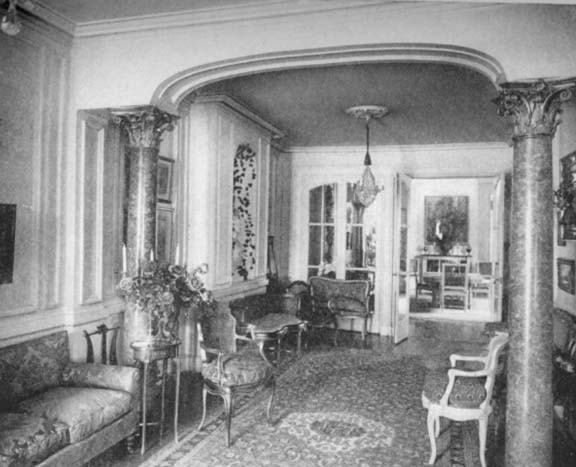
This originally belonged to Washington Irving, and when it was first built there were no other dwellings between it and the East River. In one of his letters he referred to the long stretch of meadow before his windows.
It was quaint and inconvenient, yet charming withal. It had atmosphere and became the meeting place of people of artistic, literary and social distinction. Our Sunday teas developed into considerable popularity, and when there was a dearth of chairs, the stairs would serve even to our attic floor. We were joyous and young, and able to earn enough for our needs and incidentally for our pleasures. How often we quoted Béranger who said, "How happy one is in a garret when one is twenty."
Many an amusing anecdote can be told about the little 17th Street house. During the campaign of Wm. Jennings Bryan and William Howard Taft in 1908 we had one afternoon as visitors Charles Bryan who was then our minister to Portugal, and Henry Taft, the eminent lawyer, the latter a brother of the opposing Presidential candidates.
A slight fire broke out in one of the servants' rooms which was quickly extinguished. The Fire Inspector presented himself to make the habitual inquiries. After jotting down my answers to his questions, he, hearing voices in the drawing room, said, "Who are your callers?" I promptly replied "Mr. Taft and Mr. Bryan." He looked at me indignantly and exclaimed: "Say, lady, I ain't here to be kidded. I want to know the real parties." I again repeated the names of our visitors. This further irritated the inspector, and he demanded that I should produce the two gentlemen at once. I asked them to step into the hall, and when they confirmed my statement as to their identity the man cried out angrily, "You guys can't put anything over on me like that. Don't I know how Taft and Bryan look? Ain't I seen their pictures?" With this he slammed out of the door and we all had a good laugh at his expense.
It was in this house that I met the young and brilliant journalist, Arthur Brisbane. He was brought by Mrs. Chatfield-Taylor, of Chicago, to take a simple supper with us after the play. His personality then was as marked as it is to-day. At that time we had heard little of W. R. Hearst. It was Brisbane who was the high light of the new school of journalism. I had known all of his seniors and can recall hours spent at Dosoris, personally conducted over the estate by the owner, Charles Dana; the able and feared proprietor of the New York Sun, who delighted in oriental porcelain, and who spent a fortune on exotic shrubs. I could write chapters about the celebrities who frequented our little drawing room, in the old Washington Irving house, and could recall many associations connected with the distinguished men and women from abroad who passed our way.
It was a glorified Ellis Island, and to many of our good friends it became the real Port of New York.
AT the time of my fateful decision. in Havre, which I have already described, Elsie de Wolfe was in Paris. She had gone there to study and was living modestly at a small hotel. It was natural that I should join her, and I doubt whether I was ever before so glad to see anyone at the end of a journey, for as I neared the city, I confess to feeling rather awed at my temerity. How could I impose myself in this strange land? How was I to plead my cause with French authors, alone and unaided? My knowledge of the language was meagre, and only connected with a classroom. However, after a few weeks of persistent effort, I acquired a certain facility of expression so that I soon earned the reputation of making myself always clearly understood which is an essential in business.
There was a rather conspicuous actress on the American stage, whom I had met. Her name was Kate Forsythe. She had played lead with John McCullough for several seasons. I had been taken to see her in her apartment in New York so that I might inspect her wonderful bedstead made entirely of repoussée silver. It stood upon a platform eight inches high. I remember that she explained its existence by saying that she had invested in some silver mines which had developed so wonderfully that the directors had presented her with this bedstead, as they regarded her their mascot.
She was an amiable person, and so when I ran across her in Paris, I found her only too willing to furnish me with the information for which I was sorely in need; it seemed she had had some dealings with the French Society of Authors which afterwards I learned was the close corporation of the dramatists I was so anxious to reach.
Its president was Victorien Sardou, with whose plays I was more or less familiar. His "Fedora" and "Dora" had already been very successfully produced in America.
As I learned more of the men who were then writing for the stage, I decided that unless I could enlist Sardou's interest in my undertaking that it would be a sheer waste of time, for he was not only the president of the Authors' Society, but its ruling spirit. His word there was law. It soon became evident that in order to accomplish anything I must have his support and his endorsement.
I knew that up to that time selling plays in America upon a royalty basis was an unknown system, so far as the French authors were concerned. They had never found anyone they could trust to look after their interests at such a distance.
While this was the method followed in their own country, to adopt such a hazardous system abroad was quite another matter, as it involved the author receiving a percentage of all the gross receipts at each and every performance of his play, which gross receipts should be duly checked up.
The other system was to sell the dramatic rights for a fixed sum, according to the territory to be covered.
It was the latter method which had always been followed by Sardou and his associates in our country until I appeared on the scene with my project.
Of course there was a certain risk attached to it, for if the play should fail, the percentages or royalties would be very small, whereas the fixed sum even though not large might prove to be the proverbial bird in the bush.
On the other hand if the play scored, the amount earned in royalties would be infinitely larger. That no argument was necessary was due to the fact that this was the accepted procedure in France.
But how was I to reach Sardou? That was the burning question. Who could give me a line of introduction to him? I cast about, but the situation only grew more hopeless.
I found that he lived in the Rue du General Foy, but how to get an interview with him was my haunting and hopeless preoccupation. I again put on my thinking cap. The atmosphere was cleared. Why wait for any intermediary? It was up to me to write him a letter which would compel his attention. I must interest him enough to see me and this in as few words as possible.
It is pertinent here for me to interrupt my narrative by urging all those who seek a hearing from strangers to realize that nothing exerts such a prejudice against them as do long winded epistles. Such appeals are usually thrown into the waste basket to remain unanswered and even unread.
Hundreds of such communications have been destroyed by me. Busy people must economize their time, and when one faces fifty letters in a morning, pages of family or personal history written by someone unknown provoke irritation rather than attention.
I sent my letter to Victorien Sardou asking him to accord me a little of his valuable time. This was posted on a Friday. On Monday morning I received his reply saying that if I would call upon him at nine o'clock on the following day, he would see me for fifteen minutes. He had taken my request literally. I was there ahead of time. Sharp on the tick of the hour, his study door opened and I saw this great man. He greeted me affably. I felt then, as I felt during the many years of our subsequent friendship, that Sardou's personality was one of the most vibrant I had ever encountered. His face suggested a Voltaire touched by human sympathy. It was mobile beyond description. His eyes were illuminated with intelligence. His glance was direct. He was incapable of evasion. His smile was most magnetic although those same features could at times seem cold and severe. He spoke with decision and invariably in short staccato sentences.
The one quality which he demanded from all those with whom he came in contact was honesty. His patience was inexhaustible once he had confidence in the individual who taxed it for advice and for help. He could be sympathetic and tender as a woman, on the other hand I have seen him unforgiving and relentless. If he made up his mind as to the integrity of a cause nothing could prevent him from throwing himself into it with a zeal and an intensity that carried his enemies before him. He was a splendid fighter and a good loser.
I may in this summing up of Sardou's chief characteristics have amplified somewhat the initial impression I had of him , but as I found him that morning, I found him through the years of our long friendship. The man was revealed in that first flash of acquaintance.
It was a rare thing to see him without the little black velvet biretta or cap which he always wore for fear of draughts. A loose coat, baggy trousers, felt slippers, soft shirt and bow tie completed his working costume. His desk was long, covered with pamphlets and papers, neatly sorted and in piles. Disorder with Sardou was unknown. He had a precise mind.
He asked me to be seated and swiftly demanded the object of my visit. I plunged into my subject; told him that I wished his aid in revolutionizing the method of selling French plays in the United States. I pointed out convincingly that he himself would have reaped an infinitely greater harvest had he been paid royalties. All the while I was conscious of one thing; namely, that I had to make good with Sardou in these fifteen minutes and that unless I captured his interest then, all opportunity of my doing so would be lost. This recognition of the situation did not produce nervousness, on the contrary, it clarified any haze which was in my mind. I was perfectly cool and collected. My mental machinery was working with regularity and at top speed. At the end of the time allotted to my visit, I arose promptly to the minute, thanked the great man for his attention and proceeded toward the door. He called me back, saying that he had fifteen minutes more at my disposal if I would sit down again.
I knew then that my battle was won. At the end of the half hour, I was urged to return the following morning, which I did. This was followed by several other conferences.
I purchased and brought with me a map of the United States. I showed my listener the relative position and population of each of our big cities. I described the method of touring four companies in a successful play at the same time, I proved conclusively what the gross receipts from this aggregate of companies might be.
My victory was complete. Soon Sardou introduced me to the leading dramatists of the day. I was taken to the Society of Authors and was there endorsed before the general agents, Georges Pellerin and Gustave Roger who were at the head of this organization.
At the end of three weeks it was evident that I would be appointed the sole representative of the majority of the French dramatists. One after another either sought me out or wrote for an interview. Messrs. Pellerin and Roger were ready to give me their official coöperation. Oddly enough it was I who insisted upon presenting credentials, as no one, not even Sardou, had asked for them. I was taken on faith. However, our Minister to France at the time, was Mr. Whitelaw Reid a friend of my father's.
I think he must have been most generous in his recommendation, for when Miss de Wolfe and I dined with Mrs. Reid and himself in their imposing residence in the Avenue Hoche, our host told me with some amusement, that he had been happy to give me a "character."
Thus was the last obstacle removed, so that for sixteen years I was the official agent for the French dramatists in all English speaking countries.
During this long period practically every French play which appeared in English form passed through my hands. I knew personally all of the leading authors and many a happy and congenial hour was spent in their gay, illuminating and instructive society.