
ONE of the first agencies of American aid to the sufferers from the European War was the American Ambulance Hospital in Paris. Its flying ambulance corps of motor ambulances was in active service by the autumn of 1914. Harvard graduates---including R. H. Post, '91, J. S. Cochran, '00, Richard Lawrence, '02, C. T. Lovering, Jr., '02, O. D. Filley, '06, E. C. Cowdin, 2d, '09, and Lovering Hill, '10 ---were among the first volunteer drivers of these ambulances. Still another was Francis T. Colby, '05, commanding a section of the American Hospital Ambulance Corps, from whose letters to his family the following passages illustrate conditions in Belgium while the German invasion was still in its earlier stages.
Later in the War Colby was made a lieutenant in the Belgian Army, replaced the American volunteers in the motor service under his direction by soldiers, and maintained this service on an individual basis.
WE left Paris on December 7, loaded with every pound we could carry in relief gifts to the Belgian refugees, given by Mrs. H. P. Whitney. We carried two carloads of sweaters, one carload of underclothes, one carload of chocolate and socks, and one car loaded with all the fixings and necessaries for an operating room, given by Mr. Bacon. Altogether it was a splendid freight of American gifts, and I never felt like so real a Santa Claus before.
I have six cars all told.
One 20-horsepower Daimler, and supply car for this; food and spare tires.
One 30-horsepower Daimler ambulance, i. e., the big one you have a picture of, carrying six litters or ten sitting cases.
Four 15-horsepower Daimlers, taking four litters or six sitting cases.
We went to Beauvais the first night, and Samer, near Boulogne, the second, in heavy rain and with a good deal of tire trouble because of our heavy loads. We reached Dunkirk on Tuesday, the 9th, and gave our cargo to the Belgian authorities, who were very much pleased indeed. The operating room was, I believe, put to immediate use.
I tendered the services of myself and my ambulance detachment and was accepted and ordered to report to the première division of cavalry. This I at once did. The 1ère Division is made up of the very flower of the Belgian army, largely officered by noblemen. We have been received with the greatest courtesy, and have been assured that the ambulance detachment was a thing of which they were in the greatest need, and that it should have a large number of men who would otherwise have to be left on the field of battle. This, unfortunately, has often happened in the past.
For several days we have been carrying French wounded for a neighboring hospital, and find that our cars are in every way fitted for the work on these northern roads, which are worse than anything we have met before. It rains every day --- just like Southern Alaska --- and everywhere except the centre of the road, which is apt to be of cobble-stones, is a foot deep in mud. Of course you have got to get off the cobblestones when you meet artillery or big motor trucks, and it takes a good driver not to stall his car. . .
FURNES, BELGE, December 25, 1914.(2)
THIS is Christmas night, or rather was, for it is now after midnight, and strangely enough I've had a Christmas dinner. The town is filled with soldiers of many regiments, some marching in from the trenches and others going out. All very quiet but very determined. The main square is a delightful place, with old churches of 1562 and a charming old Hôtel de Ville of the best Flemish architecture. I am "billetted" at the house of the leading lawyer. That is to say, the officer in charge of quartering troops has given me a small document which forces this good gentleman to provide me with a bed and lodging as an officer of the Belgian army. In fact, I am a guest and have just left my host, whose brother has many African trophies here. My room is large, with many paintings of the Dutch and Flemish School, inlaid tables, and best of all, a huge bed, for it is a long time since I have slept in a bed of any kind.
This morning I waked to the distant rumble of guns, but they sounded a long way off, and are so in fact --largely the British ships shelling the German trenches. The battalion to which I am attached, namely cyclists, made up of our cavalrymen whose horses have been killed, left for the trenches this afternoon. We did not go with them because their pace is too slow to be economical for motors, but shall follow tomorrow.
Just before lunch I motored to La Panne, where there is a large hospital in which the Queen herself is interested. I took the surgical shirts which you have sent me as a Christmas gift, and had the satisfaction of giving them and knowing that they were of immediate use, without delay or red tape. I also offered to give a large part of the anaesthetics which you are sending me, but which have not yet reached me.
I went out this morning with Sir Bartle Frere to see a young English doctor who has been with an ambulance attached to the first Belgian artillery division, as we are to the cavalry. He was very glad to see us and it seemed to be quite a part of his Christmas. He told me many interesting things about the work and gave me much valuable information. Unfortunately he has been wounded three times, the last time so seriously that he will not be able to take the field again, if he recovers. I lunched with a company of English ambulance people who are connected with the British Red Cross. They are very pleasant and gave me a lot of chocolate, marmalade, and English cigarettes.
This afternoon we were just putting the cars in the courtyard of the British hospital, when the Germans took it into their heads to give us a taste of their big guns. The first shot was a beauty, range and deflection perfect, but luckily for us the height of burst a little too great. The report sounded louder than usual and after it we heard the scream of the projectile, then the sharp blast as the shrapnel burst about one hundred and fifty yards short. The bullets struck the building and in the courtyard all around us, but the cars were not hit. A woman in a house about one hundred yards short had her arm taken off by the case.
After that the Germans fired for about an hour. I thought it best to see that the cars would start, in case they wanted us to move the wounded, and imagine our disgust when Gardy's [Gardiner F. Hubbard, '00] car, usually a most docile beast, refused to give even a cough. We had to take down the whole of the gasoline supply system in the dark and found that water from the cursed French "essence" had collected and frozen solid in the pipes. All the while the Germans were shooting. The reports reached us about two or three seconds before we could hear the scream of the shell, so we would flatten up against the wall when we heard a shot and then go to work again. The Germans stopped shooting at about 8.30, and we sat down to our dinner at a little before nine. I was the guest of the small (English) gathering of medical officers and nurses in Furnes. All were in uniform and just from work. As I was going to wash the grease off my hands before dinner I passed the woman who had been hit by the shrapnel which so nearly got us. She had had her arm amputated, and was just coming out of the ether.
The dinner was much like ours at home ---a big U-shaped table for sixty people, with the flags of the Allies draped among the Christmas things of all kinds --- bonbons and "crackers" on the table, champagne in the glasses, and best of all, turkey and plum pudding. The man on my right was a real one"; he owned his own ambulance and has been in it from the beginning. Six weeks ago he was wounded by a bomb from an aeroplane while taking wounded out of Nieuport and he is just back in service again. We drank the health of the Belgian and English kings, and of absent ones, and sang "For he's a jolly good fellow" to several people.
All told, it was a good dinner, and if any one had feelings other than those usual at Christmas, he kept them to himself. The German guns might just as well have been across the Rhine, as across the Yser, as far as our dinner was concerned. That is like the English; the more I see of them, and the Belgians also, the better I like them. It is very late and I cannot write again for some days, for I am busy from early morning to late evening. Just now that big bed in the corner is too attractive and too unusual to this kind of life to be put aside any longer, and so good night.
Happy New Year.
FURNES, December 31, 1914.(3)
THE last long letter I wrote was Christmas night, and I told you about being shelled and about our Christmas dinner. Well, the next morning I went down to the courtyard of the hospital to do some work on the cars before taking two of them out to the trenches to our battalion, which had just gone in. We were soon interested in an aeroplane which came over us from the north. Just as it reached our zenith there was a zigging sound not unlike a shell, followed by a sharp explosion, and a house about two hundred yards away flew into pieces. The aeroplane had hardly dropped its first bomb when the soldiers came swarming from their houses, and the cracking of rifles sounded on every side, and soon a machine gun got into action, and Furnes was a lively little town. The German did not seem to care, and dropped three more bombs, and then seemed to find it too hot for him and got out --- not until, however, he had dipped to give his gunners our range and deflection.
That morning I went out to join our battalion just back of the trenches. The roads were pavés in the middle and then a drop of anywhere from six inches to a foot and a half in the soft mud. I got forced off by a big motor truck, and laid my best car up with a broken clutch bearing. I was towed home, and in the afternoon again went out with two cars. Placed one with our battalion, and with the other went to a French battery which was in action. The captain had been wounded, and we also picked up two wounded men and took them all straight through to Dunkirk at the request of the medical authorities.
That is why my letter is mailed from Dunkirk. My cars are all now working either with the battalion to which I am attached, or for the Dr. Depage Hospital at La Panne, or the British Hospital here.
Yesterday we had a most interesting, but fatal, exhibition of the combination of gunners and artillery. A Taube came over in the morning, and dropped a bomb, which caused great loss of life. In the afternoon two Taubes came over, and just as one of them got over a certain point it dipped. Hunter and I were on our way up in a motor, and speeded up to get away before the bomb fell. None were thrown, however; instead, the enemy's artillery opened fire. They did not hit this certain place, but the shells did great damage, and killed a lot of people. Soldiers were en route to the trenches.
FURNES, January 24, 1915.
THE morning of the 22d was clear, and, as usual on clear mornings, the German aeroplanes visited us. It was a very wonderful scene --- the aeroplanes above, the boom of anti-aircraft guns all about, and the air filled in the neighborhood of the planes with little white puffs of smoke and the bursting of shrapnel. I went down in a motor to Gyzelt to report to my commanding officer, and on the way back saw another aeroplane fight, and shrapnel, and a British biplane to help. One of the Germans dropped a bullet through the petrol tank, and had to come down about two kilometres from Adinkerke. We motored up across the canal in a boat and had a look at the machine --- a beauty, and quite uninjured, with a crowd of delighted French and Belgians about it.
That night Carroll left for Paris, and had scarcely gone when the bombardment here began. The operating room was soon filled with wounded --- all soldiers this time. Five ambulances, luckily not mine, were smashed, and much damage done. The shooting stopped, and I went to bed and read a novel for a time, but it was not long before I heard the scream of another shell, and turned out to search for wounded.
We spent the night in cellars, but personally I slept pretty well.
Yesterday morning all was quiet until about ten o'clock when the Germans opened fire. I took Vanderaa, a Belgian soldier in my command, and went out into the town. It was the real thing, and plenty of it. I reported for duty to the commanding officer. The staff and most of the motors had gone, and the streets were deserted. I found plenty to do, for the houses were filled with soldiers, and each shell got its quota. We soon filled the cars and returned for more. I took only the wounded, and left the dead where they lay. There was satisfaction in feeling that one was tending to the wounded under fire, and I think I was right in staying here. After the shelling stopped, we took all the nurses from the hospital and large numbers of old and crippled civilians to places of safety. One of the nurses, however, was seriously wounded, and will lose her leg.
EARLY in the War, André Chéronet Champollion, '02, a naturalized American citizen of French descent, enlisted in the French Army. He was a grandson of the late Austin Corbin and a great-grandson of Jean François Champollion, the eminent Egyptologist who deciphered the Rosetta Stone. A painter by profession, he was also a hunter of big game and had lived much in the open. Yet without military training, he began his army life as a private in a platoon of candidates at Sens. There his hope was to be "sent to the front to fill the gaps left by other petty officers, who have been 'knocked in the block.' If I behave myself at the front, I may get promoted to adjutant or second lieutenant." On March 1, 1915, he went to the front, and wrote the first of the two following letters to his friend, Anton Schefer, '03, of New York. The second letter, dated March 20, was written only three days before he fell at Bois-le-Prêtre, in France, killed by a bullet in the forehead.
AT THE FRONT, March 1, 1915.(4)
IT may interest you to know that this letter is written in the trench, thirty yards away from the enemy's lines, with the continual crashing of artillery all around and the shells whizzing directly over our heads. I have indicated by cross every time a shell passes over us during the composition of this note. If I punctuated the explosions, I should have to stop between each letter. It is astonishing how quickly one gets used to the racket. The first two or three times you lower your head involuntarily, and then you take the noise as a matter of course. We are in a forest in a regular labyrinth of trenches, some entirely underground, and we are plastered with mud from head to foot. It is a life of filth and misery beyond description, but so extraordinarily novel and interesting that, strange as it may seem, I am in good spirits. I have only been here twenty-four hours, and I dare say when the novelty wears off that I shall get damned sick of it. This morning it snowed and rained, but this afternoon a cold wind is blowing and the sun is out.
Before leaving Sens, I passed the medical examination and was given my outfit. The uniform consists of light blue cap and coat, with dark blue trousers. We have to carry, besides gun, knapsack and cartridge belt, a canvas tent with pegs (cracking of German rifles at our trench) our rug and rubber sleeping-bag, a gourd full of fire-water of some kind; and two small canvas bags filled with odds and ends, most of which cannot be used, soon get lost or get caked with mud. The whole weighs about thirty-five or forty pounds, and at first you feel as if you had another man on your back. We left Sens at night, and spent twenty-four hours huddled in third-class carriages. The next night we spent in rather clean barracks, where they actually supplied us with cots instead of straw bedding. The next morning another trip by rail. At about ten o'clock we were landed at an unattractive village, where we were made to stack arms in the mud of a vegetable garden.
Here we saw some of the wounded on their way to the rear. Some were merely sick, others minus a leg or arm. We also began hearing the roar of distant artillery and saw some aeroplanes and observation balloons.
That night we spent on the straw, and the next day, after a march through the rain, we got to the last settlement before getting to the trenches. This place was full of soldiers who had been to the front, judging from the dilapidated and filthy condition of their uniforms. They looked at us with curiosity, in our new outfits, and seemed to consider us like tenderfeet, especially those of us who were going under fire for the first time. At about three o'clock we (about three hundred men) halted in a wood and were given our final instructions. We then marched along a muddy road (nothing unusual by the way) and soon entered the long communication-trench, single file, which was to lead us to the second and first line of trenches. During this time the roar of guns were quite perceptible, to say the least, and now the first shells went whizzing over our heads above the trees.
The trenches are lines, one behind the other of course, but joined together in all directions by every kind of communication-trench, like the streets of a city, for a man never shows his head above ground. There are all kinds of subterranean cells and passages; also one has to sleep under ground, wallow in the mud, eat in the mud. Our hands and faces, our uniforms, above all our feet, are caked with it all day. The sleeping quarters are fairly well protected from the rain, but the greatest hardships are the mud, the wet, the inability to wash the slightest bit, as water --- except rain --- is very rare and for me who am tall, the continual necessity of stooping down so as not to get my head knocked off by the enemy's snipers. We are given plenty to eat. The men's spirits are pretty good. It is marvellous what you can stand when you are obliged to. Gosh, think of kicking in a New York restaurant because the service is not up to the mark!
Last night we slept in the sleeping cells of the second line trenches (not so bad) but today we are nose to nose with the enemy on the frontiest of fronts. We live the lives of woodchucks whose holes are within forty yards of Kimton's [a New Hampshire hunter's] front door. We are not troubled by bomb or shell explosions because we are so near the enemy. Their artillery fire might damage their own men along with ours. It is the damnedest life imaginable. In some ways it is better than Sens . . . for you really feel as if you were in the game. All the petty annoyances of Sens are over. You are no longer treated like an irresponsible ass, but like a man, though you live the life of a beast or of a savage.
I forgot to mention the fact that we are also protected by rapid fire guns, completely under cover, in cells like those in which we sleep. The cannonading goes in wave motions. For an hour, like 11 to 12 this morning, it may be very violent, then calm down and then begin again.
AT THE FRONT, March 20, 1915.(5)
SIX days ago we left the village of "Dunghurst" at two in the morning and got back to the trenches at about eight, that is, six hours later. When we first entered the long communication-trench, things seemed pretty quiet. Only a shot and an explosion at long intervals could be heard. We had travelled along the communication-trench about half an hour, and were about to enter our shelters in the second line trenches when not far away came two fairly loud bomb explosions in quick succession. Then the earth seemed all of a sudden to reel. There was a commotion like the bursting asunder of a volcano. Two hundred yards off, above the trees, a column of huge rocks, lumps of earth, tree-trunks, and probably numerous human limbs, rose slowly and majestically. The upper fragments, as they rose, seemed to advance menacingly in our direction, as if they must surely hit us when they returned to earth. They seemed suspended in the air for an indefinite space of time, as if there was no hurry at all about their falling back. They seemed to cross and criss-cross in all directions, now obscuring half the sky. Gradually the mass assumed the shape of the upper portion of an elm tree, and then began to subside. Then could be heard the smashing sound of the tree branches as this mass of rock and earth fell back with the crushing force of an avalanche. Everybody ducked and plunged head first into the shelters.
Almost immediately there came the sound of thousands of heavy rain drops on a stiff canvass or the snapping of innumerable small whips; all this punctuated by a peculiar bizz, bizz, whizz sound like someone whistling in surprise. I could not help making the inward remark, "I knew war was tough, but look here, boys, isn't this a bit too rough?" It seemed that the Germans had exploded a mine under one of our trenches, then opened a violent fusillade to capture what remained of it. Being second line troops just arrived from resting up, we were not required to fight. We consequently were huddled together in a bombproof shelter, packed all day like sardines, but quite satisfied to remain where we were, while above our heads shot and shell seemed to pass for several hours with unexampled violence. That night also was "stormy," but since then, that is for the last five days, there has been little else but sniping and desultory firing by the artillery. In the above action we lost sixty men killed and two hundred wounded, but the enemy failed to capture the trench and lost a few yards of one they had held the day before.
The day after the explosion I saw many dead and wounded men carried out of the trenches on stretchers. Some of the wounded seemed more mauled than some of the dead. Behind a hedge at the end of the communication-trench, which hedge is erected to conceal our movements, I counted twenty-five dead men lined up for burial. Their faces were usually concealed by part of their uniforms, but their arms assumed every imaginable attitude, gestures of prayer, attitudes of men pleading, some even seemed threatening. Here and there big red gashes and splotches indicated where they had been hit. A few men are hit every day by the desultory artillery fire and the sniping.
All the trees in this wood show signs of the punishment they have received. Whole acres are shaved down, trees two feet in diameter have been broken in two like matches by 210 mm. shells. Almost all have lost branches. Their trunks are all scarred by bullet holes and scratches.
In the second line trenches we live the lives of convicts at hard labor. Either we have to dig more trenches or carry heavy logs, iron bars, bales of hay, etc., from the outside, along the communication-trench to where we are "lodged," a distance of about half a mile. As the communication-trenches are always congested with men coming and going, this work is all the more irksome.
We live like swine. There is no water, so we never wash or even brush our teeth. We are not allowed to drink water. We simply live in filth. At night we are huddled together in a small bomb-proof or covered trench. Though we are pretty well protected from the weather and bullets, we have hardly room enough to turn around in. We use candles to light up this terries, but nevertheless everything gets lost or hopelessly dirty. We eat from the pail, and can get or send for all the red or white wine we want. In the morning, besides tepid coffee, we are given a swig of rum which warms our stomach and starts the blood going. This small pleasure and continued pipe smoking are about our only joys but hold --- there is also our mail, which we get fairly regularly.
There is no longer a ghost of a chance for me to be made interpreter. Write often, old top.
Your faithful friend,
"CHAMPY."
ANOTHER letter from the trenches should be added to these of Champollion. It was written to Professor C. T. Copeland, by a young Englishman, Harry Gustav Byng, a graduate of Harvard in 1913, who enlisted as a private in the London Artists' Rifles early in the War, and, at the date borne by his letter, was on the point of receiving a commission in the 2d Border Regiment. On March 22, 1915, he was married in London to an American. On May 16, he was killed near Festubert in France. In the light of Byng's brief career as a private and officer, his letter carries with it more than its manifest simplicity.
March 5, 1915.
I HAVE been over here since last October. I enlisted in a regiment which is composed entirely of University men-named "the Artists "---but I am now going to take a commission. Life is much more simple and pleasant as a private amongst friends; but they need officers who have had a certain amount of experience, so there is no help for it.
Trench life, of which luckily I have not had so much as a good many others, is at times monotonous and at times exciting. Last week when out scouting in a mist, I ran into a German patrol--- then it was exciting. At the present moment I am sitting in a "dug out," while our gunners and the Germans are having some practice --- this is monotonous. At first you worry about the landing places of the shells, but there are so many different noises, that not being able to keep track of them all, it is simpler to ignore them. "Yer never 'ears the bullet wet cops yer " is the Tommies' philosophy and it is the best one.
Do not believe the stories you hear about the apathy of England. Racing may continue, and probably our respectable cricket will commence at the regular date --- that I suppose is our nature, but we are in earnest about this war. Whenever peace may be, you may be sure it will only be after our job is finished. Personally 1 hope to be in Boston again this year.
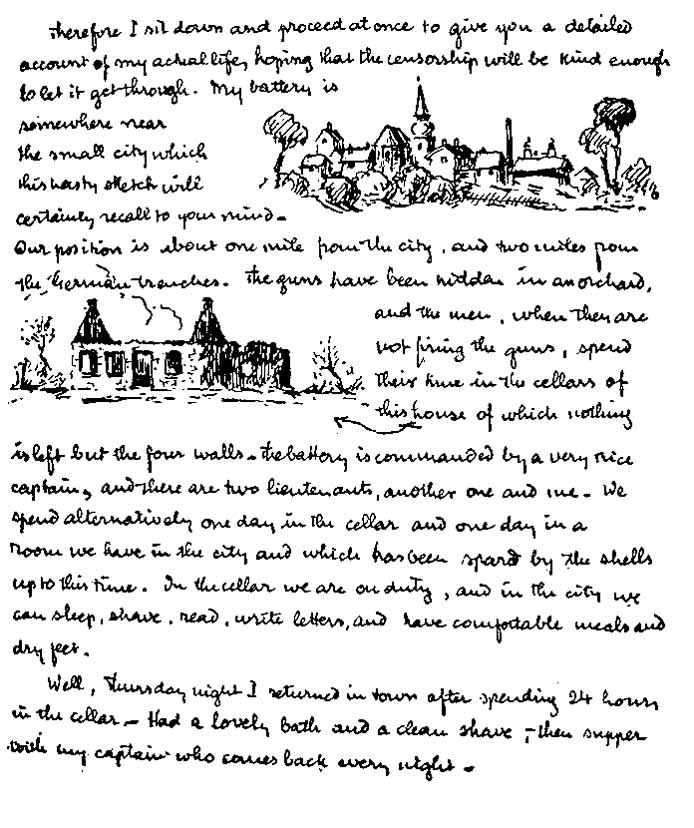
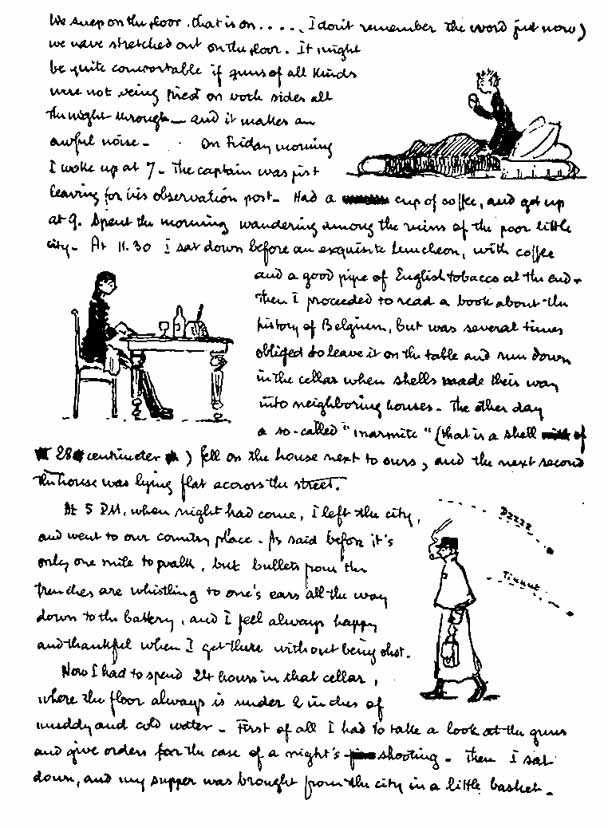
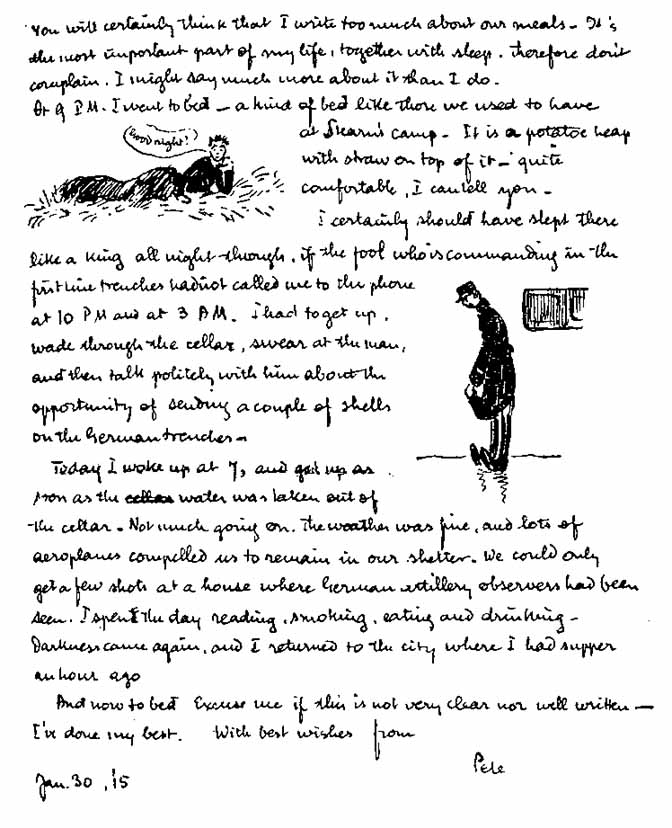
THE scenes at the front are for the most part illustrated by graphic words. In a letter from Pierre Alexandre Gouvy, recently of the Business School. the pen was put to this double use:
 |
 |
 |
FROM the front it is not a far cry to Paris, where, two days after Champollion wrote the letter just given, Francis Jaques, '03, then associated for more than two months with the "American Distribution Service" of the American Clearing House in Paris, gave, in a letter to his family, the following description of a stirring spectacle.
PARIS, March 22, 1915.(6)
SATURDAY night, or rather early Sunday morning, the Germans treated us to the long-expected spectacle of a Zeppelin raid on Paris. They hoped without doubt to strike terror to the hearts of the population of Paris.
They only succeeded in treating the city to a most interesting spectacle, and in making everyone feel that one had not been waked for nothing.
Four Zeppelins started for Paris; two were headed off, and two flew over the northwestern part of the city. I was sleeping peacefully at 10 rue Chapini, in my small apartment near the Étoile, when I was awakened by the firing of cannon, about 2 AM. I stumbled out of bed, trying to make out whether I was in Dunkerque, or Calais; and finally waked up enough to realize that I was in Paris, and that the Zeppelins must be coming at last. I went out on my balcony, which commands a view over the house-tops in every direction, except the southeast, and saw the shells from the French guns describing great arcs across the sky, passing over my house. I could see nothing in the way of Zeppelins, and so went in again and dressed, and then took up my position at the corner of my balcony, where I could see the whole sky. It was a wonderful, starry, cold, clear night. Search-lights were playing about the heavens in every direction searching the skies, and below in the streets I could hear the "pompiers " in their automobiles, rushing through the city, warning people by their "honk-honk," and their bugle calls of "garde à vous " to seek refuge in the cellars. It was good advice; but Paris was out to see a Zeppelin, and the balconies had as many people as the cellars.
As I was watching a great beam of light to the northwest playing up and down, I suddenly saw something bright, like a white moth, shine out in the path of light; the search-light swept up again, and there it was like a long, white cigar in the sky. At last I was looking at a Zeppelin ---Paris had not been waked up in vain. I could not have been better placed to see it. On it came towards the Étoile, always followed by the great search-light. It looked like a white Japanese lantern, lighted up inside, with the light shining through the paper. Of course it carried no lights; but the search-light gave it that effect. The light seemed to play along its sides in ripples as on the water. When about one thousand yards from where I was, it gradually swung round broadside and started off to the east over the northern part of the city.
In the meantime the French cannon were firing away at it. Some shells were coming from my left near the Bois, others passing over my head from behind, and others from the Arc de Triomphe to my right. It was a wonderful sight, as the shells --- like great round red balls of fire --- described their arcs against the starry sky. I could follow each shell, and involuntarily, I found myself saying "Pas assez loin," "Trop à gauche," as though I were at some kind of a tremendous big game-hunt. At all the balconies, I could hear the same remarks, as each one followed the course of each shell with passionate interest. I could distinctly see the two passenger-baskets under the balloon part of the Zeppelin. Suddenly, just as the shells began to fall near the Zeppelin, it disappeared out of the beam of light, and that was the last I saw of it, while over the city we could distinctly hear the roar of the motors, like a train of cars in the distance.
About 5 A.M. the "pompiers " went about to let people know that all the Zeppelins had gone off. I am sorry that they did not bring at least one of them down to earth to put with the other trophies at the Invalides. Of course, the shots fired at them while there over the city were more to drive them off, than to bring them down, as it would have been dangerous to have brought down a "160 mètres" Zeppelin on the roofs.
IN the spring of 1915 an opportunity was presented to the Harvard Medical School to provide a Surgical Unit for a three months' term of service at the American Ambulance Hospital in Paris. One American medical school, that of the Western Reserve University in Cleveland, was represented there by such a unit, from January to April, under Dr. George W. Crile. Units from other schools were to follow. The University had no free funds available for a purpose so remote from the usual objects of expenditure. Through the generosity of Mr. William Lindsey, of Boston, not a graduate of Harvard, who placed the sum of $10,000 at the disposal of the Corporation for the cost of this humane service, the University was enabled to undertake it. In March a well-equipped Unit of surgeons and nurses, with Dr. Harvey Cushing, Moseley Professor of Surgery, as surgeon-in-chief, and Dr. Robert B. Greenough, Assistant Professor of Surgery, as executive officer, set sail for France. Two letters from Dr. Greenough, some passages from the diary kept by Dr. Cushing during his term of service, and a passage from a letter of Dr. George Benet, reveal something of the circumstances and value of the work in which this Unit was engaged.
PARIS, April 8, 1915(7)
I HAVE been waiting until we should get a little organized to write to you and report on our journey and arrival here. We came through with very little difficulty, and reached Paris on the morning of the 1st of April. The only misfortune we had at all was that some of our personal baggage was left behind in Spain and has not yet reached us, but we are still hopeful. The crossing was comfortable and interesting, but we saw nothing exciting until we were held up by a torpedo boat off Gibraltar.
We came at once to the Hospital on reaching Paris and took over the University Service of one hundred and sixty-two beds, which at that time contained one hundred and sixty patients.
The Cleveland people had all gone but one, as they had to get a steamer at Liverpool on the 31st. We have four nurses and five house officers living in the Hospital; the rest of us are in a pension in Passy, about twenty minutes' walk. We are very comfortably installed in what under ordinary conditions is a girls' school. We have the house to ourselves, an American lady and her French husband take very good care of us, and we feel that we have fallen on our feet.
I am in charge of the General Service, and Dr. Cushing is taking on the nerve cases which are quite numerous, I should say thirty or thirty-five at present, although not many of them are immediately operable. Dr. Osgood, who, as you know, specializes in orthopedics, has found a great many cases which he is interested to work over, and the rest of us have our hands full with the regular work.
The shipment of supplies which left Boston the week of March began to arrive in Paris yesterday, so that we expect to receive dressings regularly from now on. We had to buy a certain number of instruments and special apparatus, white hospital clothes, and laboratory outfit. We have not yet got our anaesthesia apparatus working, but things are progressing. Everyone has been very cordial to us, and they seem ready to do anything we ask to make us comfortable.
The experience is extraordinarily interesting, and I feel that it has been worth while to come over for what we have already had.
Strong leaves us Saturday or Monday and we shall miss him sorely. He has helped us to get the laboratory equipped, and Benet and Rogers will carry on the work under his general outline; but I wish we could have kept him longer, although the work he goes to in Serbia is of infinitely greater importance; he is apparently to have charge of the whole commission which includes a large group of English and French medical men, in addition to the men from home.
Sincerely yours,
ROBERT B. GREENOUGH.
Saturday, April 24, 1915.(8)
SOME time since, I followed for you as well as I could, the blessés from the Poste de Secours to the Gare Régulatrice, and this afternoon in response to a call to the Ambulance for all of our many cars, I went with them to La Chapelle, the present Paris distributing station.
It was very funny---our start. We had been at work all the morning, and about 1.30 I learned by mere chance from Dr. Gros that there was such a call, and expressed a desire to go down with the Ambulance drivers, and he said I might go in his motor, which would be better, but that we must leave about 2.00---the train was due at 2.30---and, moreover, that I had better stop at our lodgings and put on my uniform, for most of us have provided ourselves with the Hospital khaki uniforms which they like to have us wear more than we do. There was room for another, so B---'s eager face left no question as to who should go. We had lunch, learning there that Gros had been detained so that we were to go in a militarized car with a Mr. Lemoyn instead.
Well, by this time B---- had secured an excited permission from O--- to borrow his uniform, and we left for 163 bis Ave. V. H. B---- dashed in, unlocking the gate and front door as though the house were afire --found Mrs. O---- and Miss H---- quietly playing duets on the piano, breathlessly commandeered Dr. O----'s uniform, for they were waiting for us in a motor and we were due at the station at 2.30, and were going to Neuve Chapelle, and there was no time to lose. Well, there was much scurrying, for the ladies thought at the very least that we had been summoned to the line to operate upon some generalissimo, and B---- himself, at this stage, had a very confused idea of what and where La Chapelle was. He got into O----'s uniform by magic, over-large and over-long as it was, and was ready by the time I could get on my ambulance overcoat and put on some heavy boots, for it's still raw and wet hereabouts. And so we sallied out, but before we had gone a block, off flew B-----'s cap, which, after its rescue, was strapped under his chin, and without further incident we reached the station, way across Paris at the northeast edge of the city.
Red Cross ambulances of every pattern, and from a great many hospitals, were being picked up from all sides as we neared our destination --- a rather unusual sight here at mid-day, as the authorities do not like to have the recent wounded going through the street by day even though it be in closed cars, and the larger number of our admissions as a matter of fact occur in the late hours or at night.
It was a very impressive sight. A large, high building, once a freight-shed, I presume, possibly two hundred and fifty feet long, has been transformed for the present purpose, and the train runs in on a single track behind a curtained-off side of the building --- curtained off by a heavy black, huge canvas curtain, which opens at one place through which the wounded successively come --- first the petits blessés, on foot, then the men in chairs, then the grands blessés, on stretchers.
The impressive thing about it is that it is all so quiet ---people talk in low voices ---there is no hurry, no shouting, no gesticulating, no giving of directions---nothing Latin about it whatsoever. And the line of men, tired, grimy, muddy, stolid, uncomplaining, bloody; it would make you weep. Through the opening in the curtain through which you could see one of the cars of the train, they slowly emerged, one by one, cast a dull look around, saw where they were to go---and then doggedly went, one after the other, each hanging on to his little bundle of possessions; many of them Arabs, though for the most part downright French types. Those with legs to walk on had heads or bodies or arms in bandages or slings, to hurriedly apply which day before yesterday uniforms and sleeves had been ruthlessly slit open. Not a murmur not a grunt --- limping, shuffling, hobbling --- in all kinds of bedraggled uniforms --- whether the new grey-blue ones, or the old dark blue and red-trowsered ones---home troops or African Zouaves, and occasionally a marine; for they too have been in the trenches of late.
The procession wound directly by us, for the American Ambulance drivers are privileged to go into this part of the shed, owing to their known willingness to lend a hand. They were sitting in a quiet group, evidently moved, though many of them had been through the Marne days when cattle trains would come in with wounded on straw, without food or water for two or more days --- stinking and gangrenous. Things of course are very different now, and here at La Chapelle where Dr. Quenu, of Hôpital Cochin reputation, has finally gotten a very perfect system arranged, out of the demoralization of those days when any system would have broken down.
It has been only two days since these fellows were hit, and many of them, regarded as sitting cases, have stuck it out and thought they could walk off the train; but not all could. One poor boy collapsed before us, and they put him on a stretcher and took him to the emergency booth. Others had to be helped, as they walked on between the two rows of booths to the farther end of the building, where were two large squares of benches, arranged in a double row about an open perforated iron brazier in which a warm charcoal fire was glowing; for as I've said, it's a cold, raw, and drizzly afternoon. There was a separate table for the slightly wounded officers, of whom there were some six or eight.
The wounded all have their tags dangling from a button somewhere --- a tag from the Poste de secours, another from the Ambulance de première ligne, and possibly one or two more, indicating where they have been stopped for a dressing --- and in addition, on the train, to save trouble, each has been chalked somewhere on his coat with a big B (blessé) or M (malade) so that they can be sorted readily. The booths of which I have spoken and into which the stretcher cases are distributed are merely little frame ---perhaps cardboard --- houses, five or seven in all, occupying the farther half of the building. Each has a different color --- red, green, yellow, grey, brown.
It was soon whispered about that this lot had come from Ypres, and that they had all suffered greatly from some German gaz asphyxiant, but I hardly believed the tale, or thought I had misunderstood, until this evening's communiqué bears it out. Many of them were coughing, but then most of the wounded still come in with a bronchitis. We have heard rumors for some days of a movement of German troops in the direction of Ypres, and this attack is apparently the result --- an attack against a weak spot at the junction of the English left and the Franco-Belgian lines, as I understood it --- hence these French wounded from the English section. But this will clear up tomorrow.
The little houses of varied colors were all very neat in appearance, and were surrounded by palms and green things, so that the place was quite attractive, and by the time the wounded were all out, many Red Cross nurses were giving them hot soup and other things, ending up with the inevitable cigarette. The men were quiet, immovable, sitting where and how they first slumped down on their benches. No conversation --just a stunned acceptance of the kindly efforts to comfort them.
Meanwhile Quenu and his assistants were going about listing the men and distributing them as they saw fit among the hospitals which had indicated the space at their disposal. Our drivers had handed in the number of their cars and the number of patients the Ambulance Hospital could take ---possibly fifty, I'm not quite sure---and we finally went away with perhaps twenty --- a large proportion of the two hundred and fifty who came in, as a matter of fact.
I looked over the list of hospitals posted on the wall with some amazement --- they were grouped under the following heads:
1. Hôpitaux Militaires, e. g., Val de Grace, etc.; 4 in all, with their dependencies.
2. Hôpitaux Complémentaires for each of above 4, as at the Grand Palais, etc.
3. Hôpitaux Auxiliaires de la Croix Rouge; 105 in all, de la Société de Secours aux blessés militaires.
4. Hôpitaux de l'Union des Femmes de France; 86 in all.
5. Hôpitaux de l'Association des Dames Françaises; 99 in all.
6. Hôpitaux Indépendants; The English Hospital, Rue de Villiers, L'Ambulance Américaine at Neuilly.
7. Hôpitaux et Hospices Civils; 25 of the Assistance Publique, i. e., the Civic hospitals and 30 of the environmental towns.
8. Convalescents; 10 as at the École Militaire, etc.
9. Établissements de l'oeuvre d'assistance aux convalescents militaires, etc.
10. A new list of 25 additional hospitals recently added.
The numbers ran up to one thousand and fourteen, though this is really more than they represent, as the individual groups begin their enumeration with one hundreds. But there must be at least four hundred to five hundred.
Quenu, though busy, was very polite --- they all are --- and pretended he knew me, and asked if I would like to see the room where the petits pansements were being made --- which I did and found a chance not only to lend a hand myself, but to call on B----- and some of the Ambulance drivers. Among the several who had been singled out as needing immediate dressings, because of pain or dislodged bandages, or recent bleeding, was the poor boy we had seen collapse as he walked out of the train. He had a high fever and a trifling bandage on his badly fractured arm. This was enough, but when the young doctor cut off his six layers of clothing, there was an undressed chest wound in his right pectoral region, and we sat him up and found the wound of exit near the scapula in his back--- at which the boy said, "C'est bon; je guérirai." He was in our lot, and I saw him landed later at Neuilly spitting blood.
The evacuation was very orderly and quiet --- the drivers got their slips at the bureau, and the color of the houses where they would find their man, and each answered to his name when it was called out, and was carried away to the waiting ambulance and slid in ---three in each Ford car for the couché patients --- men on their faces or their backs, some propped up on pillows and knapsacks --- any position to find a spot to lie on that didn't hurt ---but not a complaint or a groan.
When we got back to the Ambulance the air was full of tales of the asphyxiating gas which the Germans turned loose on the men Thursday --- but it was difficult to get a straight story. A huge, rolling, low-lying greenish cloud of smoke with yellowish top, began to roll down on them from the German trenches, fanned by a steady easterly wind. At the same time there was a terrific, heavy bombardment. The smoke was suffocating and smelled to one like ether and sulphur, to another like a sulphur match times one thousand ---to still another like burning rosin. One man said that there were about one thousand Zouaves of the Bataillon d'Afrique in the lines, and only sixty got back ---either suffocated or shot as they clambered out of the trenches to escape. Another of the men was "au repos" 5 km. away, and he says he could smell the gas there. He, with his fellows, was among those of the reserves who were called on to support the line, but by the time they got up, the Germans were across the canal, having effectively blown up their smudge. They seem to have been driven out later, or at least these men thought they had been. We'll have to await the official communiqués, and perhaps not know even then. In any event, there's the devil's work going on around Ypres, and the heralded "spring drive "seems to have been initiated by the Germans.
We got back in time to see the men brought in, and when I finally got up to our operating room --- lo and behold --- there was B-----, getting his photograph taken, his cap still strapped down, and filling O----'s uniform as best he could.
THE AMERICAN HOSPITAL OF PARIS,
SECTION FOR THE WOUNDED,
May 22, 1915.
ON reaching Paris, April 1st, the Harvard Unit took over a service of one hundred and sixty-two beds in the American Ambulance. Since that time, other beds have been added to the service until we now have something over one hundred and ninety beds. For a week or so after we first came, not all the beds were filled, but for the last three weeks we have had practically no empty beds. Thirty-three cases in twenty-four hours is the largest number of admissions we have had, and sixteen major operative cases has been our heaviest operative day.
The virulent infections with gas-producing organisms, of which there were a number of cases early in April, have become less common as the season advanced and warm and dryer weather followed the cold and rainy period of the early spring. Most of our cases reach us on the second or third day after injury. The wounds are usually infected when we get them. In April almost every wound showed gas-bacilli, on culture. In May the proportion of such cases has fallen off materially. At present the ordinary pus-producing organisms are the ones most commonly found in cultures of fresh wounds. Almost every wound contains more or less of the clothing of the soldier, carried in by the missile, but the wounds produced by shell fragments are more frequently contaminated in this way than the bullet wounds. The bullet wounds are the most common injuries, followed closely by wounds from shell fragments. Shrapnel injuries are much less common.
Soldiers severely wounded in head, spine, or abdomen, are not easily transportable, and therefore do not reach the base hospitals like this one. Most of our cases are penetrating or perforating wounds of the soft parts, with or without bone injuries. The bone cases are among the worst with which we have to deal. A septic compound fracture of such long bones as the humerus or the femur is a very difficult case to handle. In almost every case the bone is shattered into many little pieces, and these bone fragments are driven into the tissues in every direction and act like foreign bodies, to prevent healing until they are removed. We have been greatly helped in our work on these cases by plaster and metal splints devised for each individual case by Dr. Osgood.
Up to May 20th, including the cases we took over when we first came, we have had three hundred and seventy cases on our service. We have had three deaths, (1) brain abscess and meningitis, (2) perforations of the lung and hemorrhage, and (3) diffuse perforative peritonitis; the last case died ten minutes after entrance to the hospital.
Among the most interesting operations have been cerebral cases upon which Dr. Cushing operated. In two of these cases he was able to remove shell fragments from the brain, by use of the electro-magnet. Dr. Cushing had also two cases of peripheral nerve injury, one a plastic upon the facial nerve, and another upon the musculo-spiral.
Dr. Vincent has had one case for transfusion at this hospital, and demonstrated his method of performing this operation; also at Dr. Carrel's Hospital in Compiègne. There have been other cases in this hospital on other services where Dr. Vincent's apparatus has been used. Dr. Osgood has had a number of orthopedic cases for operation, lengthening tendons, and so on, and has contributed very materially to the success of the general service by devising and applying apparatus for retaining the position of difficult compound fractures. On the general service, we have had a number of bone cases for operation, plating fractures of the femur, tibia and jaw, and a plastic on a jaw with the insertion of a bone graft from a rib. We have been very fortunate so far in that we have had no cases that required amputation on our service, and no cases of secondary hemorrhage have occurred, although both conditions are ordinarily to be expected in a service such as this.
The moral and physical condition of the French soldiers has made a very favorable impression upon all of us. Some of the wounded reach us in a state of very great physical and mental depression. This is not unnatural under the circumstances, in spite of the very excellent system of hospital trains which has been established by the French Government for the transport of wounded from the evacuation hospitals to the base hospitals. These trains are well equipped for ambulatory and stretcher cases, and are used exclusively for this service; they arrive k Paris at the freight station at La Chapelle, as a rule, sometime in the night. The station has been equipped with portable houses erected on the platform, and a competent staff of orderlies, surgeons and nurses is on hand to take the wounded from the train, feed them, do emergency dressings, and attend to their distribution among the many military hospitals in and about Paris. The distribution of these cases is accomplished in a very orderly manner, and the whole system of handling the wounded even under stress is working well. We were told that two thousand wounded were brought to Paris by these trains in one twenty-four hour period after the fighting at Ypres.
There are many Red Cross Hospitals in operation in Paris, beside the American Ambulance, although that is the largest one outside of the regular French Military Hospitals. The Russians and the Japanese have each a hospital in Paris, and the English have a large hospital at Versailles. Most of the English wounded, however, are now evacuated to the Channel ports and carried immediately to England. We have about eight English in the American Ambulance, and almost all are cases that have been in the hospital for a long time. An American from the Foreign Legion was brought to the hospital the other day. The vast majority of our cases, however, are French, with a few Turcos and Sengalese.
The attitude of the French Medical Officers, and of the Government, toward the American Ambulance is most cordial, and its work is held in high esteem by the soldiers as well as by the public.
ANOTHER letter from a member of the Harvard Unit at the American Ambulance Hospital, George Benet, M.D. '13 (Univ. of Va. '06), illustrates points not touched upon by Dr. Greenough and Dr. Cushing. A portion of it follows:
THE wards are beautifully kept and clean: there are, for instance, "The New York Ward," "The Boston Ward," "The Philadelphia Ward," "The Dartmouth College Ward," etc. The nursing is very well done. Each ward is presided over by a graduate nurse, and I found many old friends, viz.: Miss Jean Balsilly, who was my senior nurse at Roosevelt, in New York, and Miss Cotter from Boston, etc. Working under these heads are the "auxiliaries," and they are as interesting a lot as I know of, made up of actresses, teachers, mothers of "enfants " at the front, society girls from London, Paris, New York, Washington, Boston, etc. For instance, Secretary McAdoo's daughter is one of the lot. There are several titles here as well. They have to do the most menial, and to be frank, disgusting things, but they do it cheerfully and willingly, and are very largely responsible for the success and splendid spirit of the place. Imagine a well-known actress scrubbing a floor! They are terribly distracting, I am free to state.
As to the surgeons, they are, with one exception, Americans who have volunteered. Dr. Crile and party have just left. Each has his own staff. The orderlies are school boys, lawyers, teachers, etc. In one ward we have a well-known Parisian artist and a genuine Russian count, who salaams to us like a true Eli. Quite embarrassing! I don't ask him to run down to the laboratory for this and that --- not with a beard like that! Not me. We have over one hundred ambulances, and some thirty cars for work around the city. Each car is a gift and only accepted if "endowed " --- gasoline, repairs, etc. These are manned by youngsters and adventurers picked up from anywhere. A good many Harvard and Yale students are in the lot. Very natty in their khaki and puttees. The field ambulances are as follows---80 Fords, 8 Sunbeams (English), a Pierce-Arrow (gift of George Denny's father-in-law, and said to be the finest ambulance on the continent. His brother-in-law runs it). There are a dozen nondescript things --- converted taxis, etc. Of the lot, the Fords are by far the best. For field work they leave the Pierce-Arrow floundering like a whale ashore. They are the wonder of the French. Each Ford carries three wounded men besides the driver and a helper. The Pierce-Arrow carries the same number, and costs ten times as much.
Before I forget, I want to put in a word for the Boy Scouts. Without them, I think the war would stop. You see them everywhere. Running elevators, acting as orderlies, telephone exchanges---and they also carry despatches at the front. One young Belgian of twelve was decorated with the coveted Military Cross by King Albert for having on four occasions slipped through the German lines with despatches. He also took part in every battle during the invasion of Belgium. I saw his photo --- just a spindle-legged little fellow. I'll never laugh at Boy Scouts again. Of course, they would rather do it than go to school, but at the same time I don't want to tackle the German lines.
Now as to the wounded, or blessés. I hardly know where to begin. They are the most amazing patients I have ever seen, accepting everything as a matter of course. They go into their fourth or fifth operation with nothing more than the inevitable salute, and "Oui, Monsieur, merci." Never a grumble or complaint --- always ready for whatever is coming to them. And God knows they have had their share before the scalpel starts. For the most part the wounds are head and face and foot wounds, as most of our men come from the trenches. Of course there are dozens of frightful compound fractures, due to falling buildings and Lord knows what, but I was surprised at the frequency of face wounds. These are explained by the fact that one can't help peeping out now and then, and also the head is more exposed to shrapnel. The foot wounds are due to frost bite (and infection following) and to the hand grenades thrown into the trenches. These cause frightful wounds too rotten to write about---but imagine a lump of lyddite, or whatever it is, the size of a tennis ball going off between your feet. As usual, there is a funny side to it, for it seems the Germans have never learned to use the grenades properly, being afraid to cut their fuses short enough, so the French pick 'em up and throw them back! (Ticklish work!) At least this is our side of the story. Some of them were cut short enough. I can testify to that!
The shrapnel wounds simply defy description. Here you see a boy of eighteen with his lower jaw, floor of mouth, and half his tongue blown away. He lives, but for what? Another young man of twenty-four with both legs gone at the thighs, and his right arm crippled for life. And of course the pitiful blind! They, to me, are the worst. And the frightful and almost inevitable infections. You see, the common history is this: "Shot at A.M., March 28. Very cold night. Raining. Fell in mud and not found until 2 P.M. the next day. No bath for three months. Underwear changed seven weeks ago." For you can't be fastidious in the trenches; but if you are a Frenchman you are a fighting man that the world can't beat. When asked what he did until found, the aforementioned chap said: "Smoked my peep." He had the bone of his thigh sticking out in the mud and smoked his" peep." One chap told a nurse today that he saw his captain killed (by shell) and his head blown off. When he ran to him his "trachea said squeak squeak." I have no doubt it did; but imagine scenes like that to think about the rest of your life.
DR. BENET'S service at the American Ambulance Hospital in Paris continued through the three months' term of the Harvard Unit. Again he served in France, with the rank of Captain, in the Second Harvard Unit, at the 22d General Hospital of the British Expeditionary Force. But after his first term of service in Paris he spent much of July and August, 1915, with Captain Stanley, of the Royal Army Medical Corps in a French Hospital, three miles from the firing line, at Longueuil Annel, in a château belonging to Mrs. Chauncey M. Depew of New York. The following letter, written in July, 1915, deals with his experiences there.
THIS letter will probably take some time to reach you, as the mail goes into Paris from here only when a car is sent in for supplies. I never know when it is going, but will write this and wait patiently. I came out just a week ago, and will never regret having done so, as I think I will have a better chance here than any place I have seen. As I wrote you, the hospital is in the château of Mrs. C. M. Depew of New York, and incidentally, she is a very delightful person. The château is very old, dating back to before Louis XIV, and was at one time a favorite spot of Napoleon's. It is situated in a very large and beautiful park with acres of lawn, and immediately behind the house proper is one of the most wonderful bits of forest I ever saw. The house is built around three sides of a square, facing the stables and garage, where the ambulances are now kept---in addition to two Fords---of course, the "inevitable Ford" --- and the machinery for lighting, etc. My own quarters are excellent, with even American plumbing in the bathroom. A private bath in France is a seven days' wonder
We have fifty-six beds, for blessés, and an excellently equipped operating room, under the charge of a Presbyterian Hospital graduate of New York, whom I remember quite well when working therein 1912. Also we have a small, but practical X-ray apparatus, which is indispensable in localizing bits of shell. There are two wards for the wounded, and three rooms for officers. One of these wards is the old music room, and I am glad to say I found a large and very fine pipe-organ still in place, which adds quite a bit to the evenings.
The "staff " consists of Dr. Stanley and myself. He is a very young English surgeon (F.R.C.S., incidentally), and an exceptionally good man. He has been here for eight months, and has accomplished a great deal, I think, when you consider the difficulties of working without adequate assistance and facilities. Our operating room "team " now consists of Miss Balen, the Presbyterian Hospital nurse, who gives the anaesthetics, Dr. Stanley and myself at the table, and "Pierre," a soldier detailed from the ranks to help us here. Owing to our position here nearer the lines, we get a type of case never seen in Paris, or in any of the larger Base Hospitals. Also our cases are in almost every instance "clean," which is the exception in the larger hospitals farther back. For instance, the last two men admitted had been wounded only one hour and a half. This makes the work far more satisfactory and the results better. Lately we have been comparatively quiet, as activities along the sector of the lines we drain here have slowed down for some reason. We have heard very little firing for the last twenty-four hours. In consequence of this "let-up," we have had a deluge of officers for dinner --- and what-not --- for several days. Yesterday Lieutenant Bardet, son of General Bardet, and Lieutenant Naxon rode over for a game of tennis, and defeated Stanley and myself hopelessly. They have been on active service in this region for ten months, and are not complaining of the recent inactivities. They returned to the lines at ten o'clock.
As to our position here: We are just across the Oise from Ribecourt, and some three miles from the lines. If you were here this afternoon, you would never suspect it, as everything is as quiet as Walhalla on a Sunday. The only ripple today was the appearance of a German monoplane that passed over us at seven o'clock this morning. Two days ago there was a pretty steady fight going on a few kilometres up the river, to judge from the guns, and in the night I heard a furious fusillade of rifle fire over beyond Ribecourt. This lasted a half hour, but as we received no call I don't think much damage was done. Yesterday afternoon, while playing tennis we heard the French "75's" going for twenty minutes, but today all is as peaceful as the aforementioned Walhalla. However, we manage to keep busy, as in addition to the wounded we have had to assume the care of the village and of Compiègne, as of course every available surgeon is away "somewhere in France." As examples of this type of "war surgery," we have a little girl with a bad mastoid that Stanley operated on, just before I came up here; and an appendix or two. We are expecting an old lady in tomorrow, with what promises to be gall stones, so we have work anyhow.
I think I wrote you of Maxim Gorky's son, who was a patient at the American Ambulance in Paris, and had his right arm amputated some six weeks ago. I am enclosing a letter I received from him last week, which I received with his photograph. I am going to ask you to keep it for me, as I want it. He wrote this, mind you, with his left hand, and only a few weeks after his operation. He tried to return to the front, but was refused because of his amputation. I often wonder if I am half as good a man as these soldiers one comes in contact with here. I doubt it.
Tell A- E- that this château where I am living was used by his friend von Kluck as headquarters, on his advance into France, and, race out, of France, and that but for a picture of Chauncey Depew on the table in the hail, he would have burned the place down. .
I have not written anything for a day, since the last paragraph, and since then I had occasion to witness a very interesting sight. Late yesterday afternoon a French biplane passed over us going toward the German lines to reconnoitre. About a mile below here, and at a height of about a mile, the Germans began to shell the machine. Apparently it made no difference whatsoever to the observer, as he kept right on his course. While looking at him, I counted eighteen shells, all breaking either directly above him or directly beneath---but missing by a wide margin. First I could hear the deep rumble of the gun, and then in an instant see the black or light gray puff of smoke, followed in a few seconds by the sound of the explosion. I lay on my back on the lawn with a pair of binoculars watching the performance, until the biplane passed out of sight. They seem quite used to such sights here, as I was the entire audience. An old man cutting the lawn, paid no attention whatever. It was very interesting to a neophyte like myself.
ONE of the Harvard physicians attached to the American Ambulance Hospital Unit when it left Boston was Dr. Richard P. Strong, Professor of Tropical Medicine in the Harvard Medical School. The Unit had not been long in Paris when he was detached from service there to direct the work of combatting the plague of typhus in Serbia. Other Harvard physicians joined him in this all-important enterprise. One of the them was Dr. George C. Shattuck, '01 (M.D. '05), a grandson of Dr. George C. Shattuck, '31, a pioneer investigator of typhus in Europe as long ago as 1838. A letter from the younger Shattuck, written from Serbia in May of 1915, is supplemented here by an article he contributed to the Harvard Graduates' Magazine. Dr. Strong's written and spoken words have informed many Americans regarding the work he accomplished. The reports of a younger colleague, written on the spot and soon after his return from the scene of the Commission's work, contribute towards a completion of the inspiring record.
SKOPLJE (USKUB), SERBIA, May 1.
I WANT you to know that I am very well and am enjoying myself greatly here. The hospital is about a mile and a half from the town, in the midst of a green, unfenced valley, with low mountains to the north and south, and a chain of snow peaks behind the hills to the southwest. The hills are many-colored, partly cultivated, partly grazing land. The weather is beautiful, with bright sunshine and a soft mist on the hills. When I look out in the morning, I see the Austrian prisoners in their blue-gray uniforms doing the morning's work outside. Sometimes a clear, loud song rings out and stops abruptly. It is the marching song of a company of Serbians out for a hike across the rolling downs. There is no other word, because we have no country like it. At the edge of the slope where the land falls off sharply to the river, a herd of cattle are grazing, watched by a shaggy leader.
We are living in the end of one of the hospital buildings, of which there are two, structures of three stories each, built for barracks by the Turks. Two hundred yards to the north, facing them, is a long row of one-story buildings, used now for storage and other purposes. They were cavalry barracks. In the centre of these are the offices and the laboratories, and behind them, forming a quadrangle, are four long buildings with single story and basement. Prisoners who act as orderlies, etc., live in the basement, and above them, in each building, are two wards of forty-five beds each. Sellards [Associate in Tropical Medicine at the Harvard Medical School] and I have charge of two such wards. There are two good graduate nurses, or sisters, on duty in each of them, and they are helped by some of the prisoners. The wards are clean, the care of the patients all that can be expected with the small staff, and we are beginning to collect data.
Typhus is one of the most interesting diseases I have ever seen, and there are many problems. Most of the patients have it, but a few have relapsing fever or other things.
I put on a louse-proof suit every morning, take it off before lunch, work in the laboratory until tea time, and then dress in another suit and return to the wards.
Smith, who has charge here now, is a very competent London consultant of about my age, I should think. He does an enormous amount of work very quietly and easily, has charge of two hundred and twenty, or two hundred and thirty, beds, and directs the management of the hospital.
I hope you realize that this is a very safe place to work, because the patients are clean before we see them.
I HAVE been asked to write about the work of the American Red Cross Sanitary Commission in Serbia, and, in particular, to tell something of what was done by the Harvard men connected with this Commission. It should be understood that no member of the Commission, except Dr. Strong, knows exactly what was done by other members of the Commission, or can form a comprehensive idea of the work as a whole. Therefore, I shall make a few general statements about the work, and then proceed to describe some of the things which I saw myself.
Dr. Strong was the first member of the Commission to arrive in Serbia. In April, a few days after his arrival, he organized an International Health Commission, the orders of which could be promptly enforced in all parts of Serbia. The formation of such a Commission was extremely important for many reasons, and particularly to co-ordinate the work of the Serbian authorities, and of the British, the French, the Russians, and the Americans, all of whom were represented on the Board. Dr. Strong, as director, travelled constantly in order that he might have personal knowledge of the situation in all parts of Serbia; and he instituted sanitary work in Montenegro as well as in Serbia.
The American Red Cross Sanitary Commission was financed jointly by the Red Cross and by the Rockefeller Foundation. A group of ten men, including Drs. F. B. Grinnell and A. W. Sellards, of the Harvard Medical School, and myself, sailed from New York on April 3 and met Dr. Strong in Skoplje, or Uskub, as the town was called by the Turks, early in May. Meanwhile, Dr. Strong had gathered up several American doctors in Serbia, and had taken with him Mr. C. R. Cross from Paris. Mr. Cross was a member of the Class of 1903, and later graduated from the Law School. He offered to help in any way that he could. He travelled for a time with Dr. Strong, then went to Montenegro with Dr. Grinnell, and afterwards returned to Paris, where he was killed in an automobile accident.(12) For nearly a year before his death Mr. Cross was in Europe working constantly with energy and devotion to duty.
The first contingent of members of the Commission was followed by a second group of twenty or more which arrived toward the end of June, and several of these were Harvard graduates. The Commission included men of various attainments. There were sanitary engineers, public health physicians, sanitary inspectors, many of whom had been trained under General Gorgas at Panama, and there were practising physicians, and laboratory experts, a bacteriologist, and a water examiner.
Dr. Grinnell was soon sent by Dr. Strong to take charge of the work in Montenegro. Dr. Zinsser, of Columbia, was to study typhus from the bacteriological point of view, Dr. Sellards was to undertake other laboratory work, and it was my privilege to study typhus fever from the clinical standpoint. We agreed to work together so far as possible, and having found in the Paget Hospital in Skoplje a favorable opportunity for beginning work without delay, accepted the invitation of the British physician in charge to join the staff of that hospital.
The buildings known as the Paget Hospital, or "Shesta Reserma Bolnitza" (6th Reserve Hospital), were used formerly for the Military Academy, and for barracks. They are situated on elevated, rolling ground, about a mile from the town of Skoplje, in the midst of a most beautiful and fertile valley, bounded to north and south by rugged hills, and dominated on the west by snow-capped mountains.
I had charge of two wards of forty-five beds each, most of them occupied by typhus patients in various stages of the disease. Near the hospital were some large stables, used as a prison-camp for Austrian soldiers. Nearly all the prisoners had had typhus, and a very large proportion had died of it. They were allowed to go freely about the hospital grounds, and many of them served as orderlies in the wards. Being immune to typhus from having had the disease, it was not necessary to take precautions to protect them.
There was a considerable nursing staff of English sisters, and a few Serbian women worked in the wards. In order to protect themselves from the body louse which commonly transmits typhus, the sisters wore a one-piece garment of white linen, which buttoned across the shoulders, and over this a blouse of the same material hanging to the knees. The hair was carefully covered, the sleeves were held close to the arms by elastic bands, and, in order that there should be no opening at the ankle, the legs of the garments were prolonged into coverings for the feet. Over these the sisters wore Turkish slippers or high leather boots, according to the weather. I urged the sisters in my wards to wear rubber gloves in order to protect their wrists more completely, and to wear a strip of gauze across the nose and mouth as a mask, because I thought there was danger of contracting typhus through the air as a result of the coughing of patients; but the gloves were soon discarded as being difficult to work in, and the mask as being too hot and uncomfortable. One of the sisters contracted typhus toward the end of the epidemic, and I think that she got her infection from a very sick patient who coughed a great deal, and whose life, I think, she saved by unremitting care. She recovered from the typhus, but suffered afterwards from distressing nervous symptoms from which it is probable that she has not yet fully recovered. We physicians wore cotton trousers with feet attached, and rubber boots. The trousers were tied around the waist, and the upper part of the body was covered with a short tunic, tied below the top of the neck. Rubber gloves were then pulled over the sleeves of the tunic and fastened in place with elastic bands or adhesive plaster. I used a gauze mask for a time, but gave it up because the weather was hot and the mask slipped into my mouth when I talked. I was very careful not to let a patient cough in my face.
The appointments of the wards were of the simplest character. The toilets were managed by the bucket system, there being no plumbing. Water for bathing and other purposes was heated in sheet-iron wood-burning stoves standing outside. When one or two patients at a time came for admission to a ward, they were stripped, clipped, and bathed by the orderlies behind a screen on the steps of the pavilion. When large numbers of patients had to be admitted, they were sent to a wash-house where clipping and bathing could be done wholesale.
Before I had been long at the hospital a trainload of patients arrived in Skoplje. Eighty of these were assigned to the Paget Hospital and sent out in carriages, each vehicle taking four or five patients. They were laid on the grass outside the wash-house, and many, exhausted by the journey, required brandy or other stimulants before being moved. Many others, thin and haggard, but stronger, straggled across the grounds to the wards, attired in night-shirt and slippers. On that day, forty patients entered my wards ---a number impossible for me to examine with care. I went around the ward feeling the pulses, listening to the hearts, and picking out the sicker patients for more particular attention. The rest received routine treatment.
This particular group of patients showed a peculiar cast of countenance which I attributed to the fact that they had been for several days on a train, probably almost uncared-for, with little food, and insufficient water. The features were pinched, the skin was dry, the brows knitted, and the eyes staring. Like most of the inhabitants of Serbia, they were bronzed by the sun, but, in spite of this, there was a bright flush over the cheek-bones, a common thing in typhus fever. These men showed no emotion and little interest. The predominant expression was not that of resignation, but of courageous endurance, the most characteristic quality in the Serbian when ill, as I have seen him. He shows neither fear nor despair, and seldom indulges in lamentation. During convalescence he early takes an interest in food, and begs to be sent home for "bolivani," that is, furlough. With return of strength he shows merriment, geniality, and humor.
The Serbians have been called the Irish of the Balkans, and one of them had such a genial smile that he reminded me of the song about Kelley. In one of the other wards there were two patients with relapsing fever who were taken sick at the same time, who entered together, and who ran an exactly similar course of fever. A rivalry sprang up between them, and when one had a sudden rise of temperature so high that it went off the chart, far from viewing this with alarm, he pointed to it with delight.
After about two months' work at the Paget Hospital, Dr. Sellards went to Belgrade to continue his studies there, and a few weeks later, there being very little typhus at Skoplje, I finished my clinical work, and went to Belgrade with Dr. Strong. I stayed there for a few days at the American Hospital where Dr. Ryan is still in charge.
The hospital stands on a hill at the outskirts of the town, and was respected by the Germans who were entrenched across the river. The town showed comparatively little damage, except along the river front, where all buildings, including the barracks, had been reduced to ruins. The bridge across the river had been wrecked, but at that time the batteries were exchanging only occasional shots, none of which fell in the town. A German aeroplane made almost daily flights in the morning over Belgrade, and was always greeted by a fusillade of shrapnel which, when it burst, looked like powder puffs in the sky. The shots were nearly always wide of the mark.
One morning, however, the German made three trips, each time dropping bombs in the town. The third time he was met by a French plane which opened fire upon him. Almost immediately the German began to descend in wide circles, and presently disappeared from my sight behind the roof of one of the hospital buildings. He must have been wounded, for he subsequently lost control of his machine, and fell from a considerable height into the mud on the bank of the river.
After leaving Belgrade I went with Dr. Strong to Vallievo to inspect the graveyard. There had been many Austrian prisoners in Vallievo, and the deathrate from typhus among them is said to have reached seventy per cent. The dead had been buried in great square pits, and insufficiently covered with earth, so that the graveyard became offensive to the neighborhood. The French, who were working in Vallievo, had already carried out the necessary measures.
Dr. Strong then asked me to go to Pristina to supervise sanitary work which was being conducted there by members of our Commission. They were living in tents in the military reservation, and running a mess of their own.
The hotels in Serbia are so infested with bed-bugs that we avoided them whenever possible, and when obliged to spend any length of time in a place we fumigated and cleaned our quarters or else went into camp. The work at Pristina consisted in cleaning and disinfection of hospitals, the jail, some large barracks and stables used for quartering the soldiers, disinfection of clothing, bathing of soldiers and prisoners, building sanitary privies, and vaccinating against typhus fever and cholera.
Bathing and disinfection of clothing were carried out by means of converted refrigerator cars, into one of which steam could be turned to sterilize the clothing while the men were bathing under shower baths in the other. This system was first used in Manchuria by Dr. Strong.
Pristina is not far from Mitravitza, now the temporary capital. The latter is situated at the end of a branch railway near the border of Montenegro. The railway leaves the main line at Skoplje and follows a branch of the Vardar River through narrow mountain passes to the great plain of Cosova, upon which the Serbians made their last stand against the Turks in a great battle five hundred years ago. Pristina lies at the foot of the hills on the northern side of the plain, near where the battle took place. The Serbians have a very strong sentiment about this region, where every hill and piece of ground has for them historic meaning. They say that not to have seen Cosovo and the old church called Grachanitza, in which every soldier of the Serbian army took communion before the great battle with the Turks, is not to have seen Serbia at all.
After finishing the work at Pristina arrangements were made for some of our men to go to Mitravitza, where Dr. Osborn, who had recently received a degree in public health at the Harvard Medical School, took charge. Other men went with me to Prisren, situated to the south and east near the border of Albania, and fifty kilometres from the railway. There we set up our cots in a large, vacant room in the barracks near the town, and took our meals at a restaurant, where, by special arrangement, we obtained an abundance of fruit and vegetables, a welcome change after the restricted fare of the springtime.
The work in Prisren was similar to that in Pristina, and the authorities, with one exception, gave every assistance. The mayor of the town was well educated and refined. He had been a professor somewhere before entering on official life, and was now working enthusiastically to institute modern improvements in this old town with its narrow, crooked streets, and its jumble of primitive buildings. Before the outbreak of the present war he had had profiles drawn of all the streets and had made plans for straightening and widening the principal thoroughfares. He showed us chemical analyses of the water, which came from springs on a hill above the town, and wished to know which of the several supplies was the best. One of our engineers visited the sources, inspected visible conduits, and made arrangements to have maps drawn of the distribution of the water from each source. It was also arranged that bacteriological tests should be made at different points along the distributing lines, and at the street-fountains where the water was delivered, in order to detect pollution. The mayor expressed himself as delighted with these arrangements but owing to delays, almost impossible to avoid in Serbia, this part of the work was still unfinished when the fumigating and vaccinating had been completed.
Toward the end of August I left Prisren to start for home. I shall not soon forget that beautiful morning of late August, the soft, fragrant air, the misty plain, the wooded hillside, the rugged mountain-range, whitened by the first snow of the autumn, and the quaint old town with the tall poplar trees around it, the white minarets among the red-tiled roofs, and the old, gray Turkish citadel above.
Dr. Strong and Dr. Sellards left Serbia a few days after I did, and Dr. Grinnell a month before. Twelve members of the Commission remained in Serbia to prevent the spread of any outbreak of contagious disease that might occur in the coming winter, and to complete some of the more extensive engineering work. Mr. Stuart, a Harvard engineer, was left in charge by Dr. Strong. Most of the others went to Russia under the leadership of Dr. Caldwell, to work among the German prisoners there.
Dr. Grinnell had a severe illness on his way home, and Dr. Strong narrowly escaped death from a most dangerous form of malaria, which rendered him unconscious in Saloniki just before sailing. It seems likely that he got the malaria in Durazzo, where he had gone, at the request of Essad Pasha, to advise about its prevention. At any rate, he was exposed to it there from having lent his mosquito netting to a woman in the hotel who hadn't any. No other members of the Commission, so far as I know, incurred any serious illness, and most of them were not sick at all.