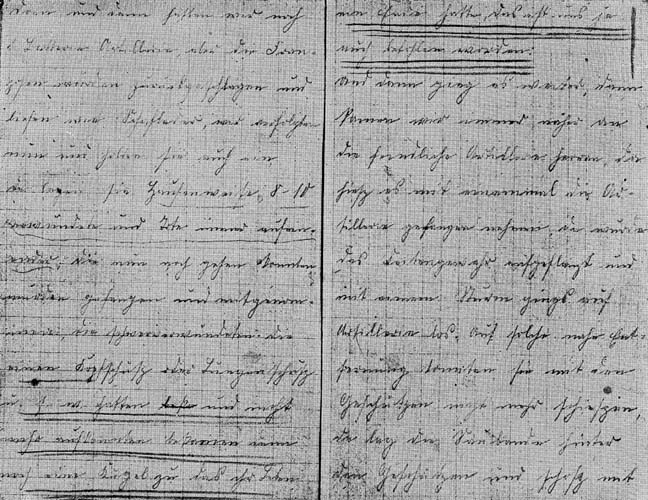
A FAMOUS American president once said to a distinguished ambassador:
"We make them into Americans. They come in immigrants of all nationalities, but they rapidly turn into Americans and make one nation."
And the ambassador thought within himself and later said to me:
"But a nation is a people with a long experience, who have lived and suffered together. There is a bell in a great church, which if you lightly flick it with the fingernail, gives out one single tone which goes echoing through the Cathedral. If you stand at the far end, you can hear that tone. So it is with a nation. If it is struck, it responds as one man to its furthest border. At the stroke of crisis it answers with one tone."
No. We are not a nation. We are a bundle of nationalities, and some day we shall be a Commonwealth if we deal wisely with these nations who dwell among us.
We cannot "make" Americans. We can make "imitation Americans," as Alfred Zimmern calls them. The Jew, spiritually sensitive and intellectually acute, becomes an "amateur Gentile." The imaginative Calabrian, of rich social impulse, becomes a flashily dressed Padrone. The poetic, religious Irishman, whose instinct has been communal for many centuries, becomes a district leader. These individuals have come to us with rare and charming gifts, fruit of their nationality. Instead of frankly accepting them in their inheritance, we have applied a hasty conversion which denied their life of inherited impulses and desires. Instead of bringing out the good in them, we have Americanized them into commercial types.
Where does our future lie!
It lies in developing and making use of men like the great Jews, Abram Jacobi, Charles Proteus Steinmetz and Louis Brandeis, who are true to their own nature, and who respond to the American environment. These men are not amateur Gentiles. They are Jews and they are Americans. It lies in Italians like Dr. Stella, who love those elements in Italy which are liberal, and who further every effort in America to create free institutions. We need the help of every man of them to save our country from commercialism.
Recently I asked one of the most brilliant of living scholars, of German descent, to give me his views on the future in America. He wrote:
"What is America to do? I should answer: preach hyphenation. Make the common man realize that nationality is a spiritual force which has in essence as little to do with government as religion has. When government interferes with freedom of worship, religion comes into politics and stays there till its course is unimpeded. The same is true of nationality---in Ireland, in East Europe and elsewhere. But that is only an accident. To allow governments to exploit for political ends the huge inarticulate emotional driving force of either religion or nationality is to open the floodgates. Hence the wars of religion in the Seventeenth Century and the nationalist hatreds of the present war."
Alfred Zimmern says:
"It seems strange that there should be Americans who still hold firmly to the old-fashioned view of what I can only call instantaneous conversion, of the desirability and possibility of the immigrant shedding his whole ancestral inheritance and flinging himself into the melting-pot of transatlantic life to emerge into a clean white American soul of the brand approved by the Pilgrim Fathers. Now the only way to teach immigrants how to become good Americans, that is to say, how to be good in America, is by appealing to that in them which made them good in Croatia, or Bohemia, or Poland, or wherever they came from. And by far the best and the most useful leverage for this purpose is the appeal to nationality: because nationality is more than a creed or a doctrine or a code of conduct, it is an instinctive attachment."
The road to sound Internationalism, to an understanding between States, lies "through Nationalism, not through leveling men down to a gray, indistinctive Cosmopolitanism but by appealing to the best elements in the corporate inheritance of each nation." True democracy wishes to use the best that is in men in all their infinite diversity, not to melt away their difference into one economic man. The American passion for uniformity, for creating a "snappy," efficient, undifferentiated type, is merely the local and recent form of the rigid aristocratic desire to "Christianize" the Jew, to Anglicize Ireland, to modernize the Hindu. It is the wish to make man in our own image. It is the last bad relic of the missionary zeal which conducted the Inquisition. It is only subtler and more dangerous, because persecution called out hidden powers of resistance, but triumphant Commercialism, as engineered by our industrial oligarchy, calls out imitation.
I have a collection of photographs made at Ellis Island by Julian Dimock. They are subjects chosen almost at random from the stream of newcomers on the morning of ship-arrival. There is often something very touching in the expression of these faces: a trust in the goodness of life, in the goodness of human nature. Man and woman and youth, they seem to carry something that has been won by long generations of rooted life and passed on to them for safe-keeping. And suddenly at the landing in the new world the tradition is touched to a dream of hope. But that light never lasts for long. Watch those same newcomers as they are disgorged from our city factories. How soon the light goes out of their faces, the inhabiting spirit withdrawn to its own inaccessible home. Something brisk and natty and pert replaces that unconscious dignity. Something tired from unceasing surface stimulus takes possession of what was fresh and innocent in open peasant life and the friendly intercourse of neighbors.
These races, in their weakness and poverty, have been unable to swing back to their own deep center of consciousness. Unaided, it is doubtful if they will ever raise their buried life from its sleep. The Jewish nation is the only dispersion among us which has gathered its will and recovered its self-consciousness enough to give us any promising movement. They are slowly recognizing what is being done to their young. They begin to see that their nation is losing its one priceless jewel, the possession of spiritual insight. In the movement which is spreading through the day schools for teaching young Jews the great ethical tradition of their people, in their educational alliances, in the Menorah Association, in the Zionist Movement, in the writings of Brandeis, and Ho race Allen, they are showing the first glimmerings of statesmanship and making the first application of intelligence to our commercialized cosmopolitan materialistic country which we have had since we passed on from "Anglo-Saxon" Protestant civilization. May their grip on their nationality never grow less. May the clear program which they have constructed against the drift and rush of our careless life seize the imagination of Italian and Serb and Bohemian. So and no otherwise, we shall at last have a spiritual basis for our civilization.
Frank acceptance of the fact of dual nationality leads to such clear statement as Randolph Bourne has given us in The Menorah Journal for December, 1916. He shows the fallacy of the "melting pot" idea, which attempts to knead the whole population into an undefined colorless mass, labeled American. In place of that undesirable and absurd consummation, he offers a coöperation of cultures. "America has become a vast reservoir of dispersions," and Coöperative Americanism will meet "the demands of the foreign immigré who wishes freedom to preserve his heritage at the same time that he coöperates loyally with all other nationals in the building up of America."
What is Coöperative Americanism? Mr. Bourne answers that it is "an ideal of a freely mingling society of peoples of very different racial and cultural antecedents, with a common political allegiance and common social ends, but with free and distinctive cultural allegiances which may be placed anywhere in the world that they like. If the Jews have been the first international race, I look to America to be the first international nation."
Now, there is no unpopularity to-day in lauding a Jew or a Greek or an Irishman. May I go a step further, and say that the same freedom to express the tradition within them must be extended to the Americans of the old stock, even those who hold a grateful love for France (some of them recently have died for that), even those who love England for her long struggle for political liberty. I cannot feel that Agnes Repplier, Lyman Abbott, George Haven Putnam and the American Rights League are deserving of a certain fine intellectual scorn which Randolph Bourne and Max Eastman have applied to them. The American Rights League is entitled to the same open field and the same respect which the Menorah Society should receive. Why does Mr. Bourne(3) applaud the one and lash the other? I trust he will welcome both. What I think Bourne, James Oppenheim, Walter Lippmann and Max Eastman have failed to see is that the old American stock (of diverse race but common tradition) had a right to respond vigorously to this war, where their inheritance of social, legal and political ideas were battling with hostile ideas. Somewhere, at some point, the new American tradition must plant itself. In some issue it must take root. We of the old stock sought to make this war the issue. We failed. All right. It is now your turn. In the open arena of discussion the ideas of all of us must collide into harmony. I can make clear the difficulty one has in reaffirming the old American idea by quoting from the letter of an American editor in response to what the chapters of this book are stating:
"It seems so curiously out of focus in its estimation of the Old, the vanishing, America. Do you really believe that Old America should be raised from the dead:---The America of convenient transcendentalism where religion allowed a whole race to devote its body and spirit to material aggrandizement? If you blame America for Christian Science optimism, you must remember that Emerson and Whitman were our teachers. If you blame America for not taking part in the European war, you must remember that Washington told us to keep out of 'entangling alliances.' It is historic America that was grossly material, out of which our vast industrialism sprang with its importation of cheap labor. But the Garden of Eden always lies behind us, and nothing is commoner than finding Paradise in the past."
What I have tried to say is that the tradition of a nation is not a dead thing, locked in the past. It is a living thing, operating on the present. A tradition is a shared experience, governing present life. The State needs to cohere and find itself and establish a cultural consciousness, blended from manifold contributions. It is destructive to have new swirling elements ceaselessly driving through the mass. So I have protested against the too ready and ruthless discarding of the cultural consciousness bequeathed us by the older American stock. While the ideas imbedded in that consciousness will never again be in sole command, I believe that they should be more potent than they are to-day. I believe that politically they have a living value for us, and that we persistently underestimate the English contribution to freedom and justice. I deny that my desire that these ideas shall prevail is an attempt to locate the Garden of Eden and Paradise in the smoky past. It is, instead, the wish to see our country appropriate a particular political contribution from the English stock, exactly as it needs to appropriate certain social values from the Italians and the Greeks, and many very definite spiritual ideas from the culture of the Jews.
What is the solution of these diverse elements? What blend can we obtain from a score of mixtures? How fashion a civilization that shall absorb and assimilate those blood-strains and traditional beliefs ? I think the one clear answer lies in the creation of free institutions, which shall answer a common need, and which shall violate the instinctive life and traditions of none. Those free institutions will be the product of education, legislation, Cooperation, Trades Unionism and Syndicalism, municipal and State ownership, and widely spread private ownership and enterprise. The organized State under democratic control will be the thing aimed at. But these free institutions must gradually extend over areas far wider than vocational training and economic well-being. They should seek to offer free expression to the fully-functioning mind in art, science, ethics and religion. In this way they will give a good life. We have the shadowy beginnings of such institutions in the public school and library. But we have nothing like the Danish or English coöperative movement. Our institution of property affords us nothing like the peasant proprietorship of Ireland.
No apter illustration of how little we have tackled our job can be found than in American Socialism. There is no American Socialism. Orthodox socialism in America is dead doctrine, brought across by German and Russian revolutionaries, reacting on their peculiar environment, and then exhumed in a new country. Meanwhile a great vital movement toward democratic control goes on in Europe, in Trades Unionism, Coöperation and municipal and State ownership. Our socialist locals repeat formulæ which Shaw, the Webbs, Rowntree, Wallas, Kautsky, Vandervelde and Hervé outgrew a generation ago. It is here I hold that the old American stock can do a service in interpreting American conditions to our recent arrivals.
But if we continue to leave the door open we shall continue to be swamped, and we shall employ our little hasty ready-made devices for turning peasants with a thousand years of inherited characteristics into citizens. We shatter them against our environment, and then are astonished that their thwarted instincts, trained to another world, revenge themselves in political corruption, abnormal vices, and murderous "gunman" activities. Psychologists like Ross warn us in vain.
These overlapping hordes of "aliens" destroy the economic basis on which alone free institutions can be reared. People, to whom we cannot afford to pay a living wage, or for whom we do not care to arrange a living wage, will not help us in creating free institutions. Instead, they are manipulated by the industrial oligarchy into a force for breaking down the standard of living of all workers. A resolute restriction of immigration is not a discrimination against any race. It is the first step toward unlocking the capacities of the races already among us. The reason for stopping immigration, then, is economic. It rests in the fact that our wage-scale and standard of living are being shot to pieces by the newcomers. As the result our existent institutions are not developing in liberal directions, and we are failing to create new free institutions. It requires a somewhat stable population, and a fairly uniform economic basis to create a Coöperative movement, like that in Ireland, or a Trade Union movement, like that in Australia.
Slowly the new order is coming, the day of the Commonwealth of nationalities, where men from many lands, drawing their spiritual reserves from the home that nourished their line through the long generations, will yet render loyal citizenship to the new State which harbors them and gives them a good life. The task of America is to create that Commonwealth, that entity which men gladly serve, and for which at need they willingly die. Our politics have not yet held that appeal. Not yet can an American of these recent years stand off from the stream of his experience, saying, "What does it mean that I am an American?" and answer it in the high terms which a Frenchman can use. Fifty years ago the American could answer in fairly definite terms. But does our recent history mean much to Czech or Russian Jew or Calabrian who has settled among us? It does not. The stirring of their blood responds to another history than ours. Shall we take away their tradition from them? We cannot if we would. What we can do with their help is to create free institutions which will win them to a new allegiance, and this will slowly root itself in the fiber of their line.
For a few generations they will continue at time of stress to hear the call of their old home, as a bird in the autumn takes the call of the South. The Serb will return to his mountains when the battleline is drawn, as he returned five years ago. The German will go back to his barracks when Russia begins to spread toward the West. And over those that do not go back a great restlessness will come, and they will torment themselves, like a caged bird in the month of flight. But with each generation the call will grow fainter, till finally the old tradition is subdued and the citizen is domesticated. In this way only can the new allegiance and instinctive sense of nationality be created, growing very gradually out of free institutions.
Out of free institutions in State, property, religion and marriage, ever-developing to fit a developing people; out of the unfolding process of law, escaping from legalism and applying psychology to human relationship; out of an education, sanctioned by human interest, and devoted not only to vocational training but to the sense of beauty and wonder; out of vast movements of the mass-people toward democratic control; there will some day grow the new American tradition, which in the fullness of time will take possession of the heart of these diverse races and clashing nationalities. It will not root itself and grow in the years of "naturalization," nor yet in one or two generations. But in a hundred or two hundred years it will coalesce infinitely repellant particles and gently conquer antagonisms, and in that day, which not even our children's children will see, there will at last emerge the American Commonwealth.
I HAVE made out the best case I can for our people. These chapters have listed every excuse that can reasonably be given for our failure to declare ourselves on the moral issue of this war. They have said that a careless, busy folk, like those of the Middle West, need many facts to enable them to see where the truth lies. They have pointed out how short-sighted is the foreign policy of the Allies which gives few facts to the American public. They have shown how the best of our radicals have. failed to think clearly because they have been befuddled by a vague pseudo-inter nationalism. I have stated what I believe to be the falsity in our present-day conception of Europe, the self-complacency in our monopoly of freedom and justice; and I have tried to reveal how that assumption of merit blinded our eyes to the struggles of other peoples for the same causes. I have blamed our failure on Germany and on England. But after every explanation has been made, it is still true that our people ought to have been sensitive. At a great moment of history we failed of greatness. There remains a shame to us that we held aloof. There was no organized campaign of facts needed to convince France that we were fighting for human rights in our Revolution. Three thousand miles of water did not drown the appeal of our extremity. But to-day our leaders are so bewildered by dreams of universal brotherhood that they overlook our blood-brother on the Marne. Our common people have their eyes to their work, and do not look up, as the workers of Lancashire looked up with cheer and sympathy when we rocked in the balance of 1863.
This war has shown to us that we are not at the level of earlier days. We have lost our national unity, our sense of direction. The war has revealed in us an unpreparedness in foreign and domestic policy. It is a curse to know one's weakness unless one cures it. So this war will not leave us blessed until we take a program of action. It is a waste of time to write a book on the war except to convince and move to action.
The steps are clear.
Our first step is to set our house in order. We need to recover our self-consciousness, to restate what we mean by America. A half million newcomers each year will not help us to find ourselves.
We shall be the better friends of freedom if we digest our present welter. Let us fearlessly and at once advocate a stringent restriction of immigration. Our citizenship has become somewhat cheap. Our ideals have become somewhat mixed. Let us take time to locate the direction in which we wish to go, and decide on the goal at which we aim. "Thou, Oh! my country, must forever endure," said a famous patriot; but in a few years his country had been melted down into an autocracy. We cannot rely for all time on luck and happy drift. Size, numbers, the physical economic conquest of a continent ---these are not a final good. They are at best only means toward worthy living. It is easier to rush in fresh masses of cheap labor than it is to deal with the workers already here as members of a free community, aid them in winning a high standard of living, and establish with them an industrial democracy. The cheapest way of digging our ditches and working our factories, and sewing our shirts, is of course to continue holding open our flood gates and letting the deluge come. It is the clever policy of our exploiters, and the sentimental policy of the rest of us who love to be let alone, if only we can cover our unconcern with a humanitarian varnish. But the result of it is the America of today with its oligarchy of industrial captains and bankers, with its aristocracy of labor, made up of powerful trades unions and restricted "Brotherhoods," and with its unskilled alien masses of mine and factory labor, unorganized, exploited. Let us begin to build the better America by sacrificing the easy immediate benefits of unrestricted immigration.
Our second step is to teach our tradition to the hundred million already here. It is a large enough classroom. We can advertise for new pupils when our present group matriculates. When it has matriculated, there will be no popularity for phrases like "He kept us out of war," nor for songs of "I didn't raise my boy to be a soldier." The teaching of that tradition will reveal the interweaving of the American and the French Revolutions as products of a single impulse toward world liberation. If we had known our history, we should have answered the need of France, as Hall, Chapman, Thaw, Seeger, and many more answered it who have laid down their lives for their friend, France. The teaching of the American tradition will reveal to our awakened astonished minds that our policy has not been that of neutrality toward oppressed peoples like the Belgians. It will reveal that the British fleet has served us well from the time of Canning down to Manila Bay. It will stir in us loyalties that have long been asleep. It will show what a phrase like "Government for the people" has meant in terms of social legislation. It will point to the long road we must tread before we reach that ideal goal. We cannot leave the teaching of our tradition to the public schools alone. Courses of evening lectures for the people, the newspapers and periodicals, clergymen and economists and social workers, all must help.
Our third step is a deep understanding sympathy with the forces in the world making for righteousness. We should have been sensitive enough to see the right and the wrong of the present war. But that chance has gone by. Let us now make ready to contribute to the future. The fundamental question is this: Are the democracies of the world to stand together, or is the world-fight for freedom to be made, with our nation on the side-lines? The whole emphasis of the world's emotion has shifted from war to peace. When thought follows this emotion and rationalizes it, we can begin constructive work. The test of our desire for peace will be found in this: Do we mean business? Pacifism is valueless, because it is a vague emotion. Peace is a thing won by thought and effort. It is not alone a "state of mind." If we are willing to give guarantees by army and navy, and to back up protest by force, we can serve the cause of peace. But if we continue our "internationalism" of recent years, we shall not be admitted to any such effective league of peace as France and England will form. We must take our place by the side of the nations who mean to, make freedom and justice prevail throughout the world.
Our fourth step will be that measure of preparedness which will render us effective in playing our part in world history. We cannot go on forever asking the English fleet to supply the missing members in our Monroe Doctrine. We cannot go on forever developing a rich ripeness, trusting that no hand will pluck us. In a competitive world, which builds Krupp guns, we cannot place our sole reliance in a good-nature which will be touched to friendliness because we are a special people. That preparedness will not stop with enriching munition makers, and playing into the hands of Eastern bankers. It will be a preparedness which enlists labor, by safeguarding wages and hours. It is the preparedness of an ever-encroaching equality: a democracy of free citizens, prosperous not in spots but in a wide commonalty, disciplined not only by national service of arms, but by the fundamental discipline of an active effective citizenship. It is a preparedness which will call on the women to share the burden of citizenship. It is a preparedness which mobilizes all the inner forces of a nation by clearing the ground for equality. It will be a preparedness not against an evil day, but for the furtherance of the great hopes of the race.
IN presenting the facts that follow of the behavior of the German Army, I am fortunate in being able to introduce them with a statement written for me by Lord Bryce. The words of Lord Bryce carry more weight with the American people than those of any other man in Europe, and his analysis of the methods of the German Staff is authoritative, because he was the Chairman of what is known as the "Bryce Committee," which issued the famous report on German "frightfulness." When I told him that our country would respond to a statement from him, he asked me to submit questions, and to these questions he has written answers.
The first question submitted to Viscount Bryce was this:
"America has been startled by Cardinal Mercier's statement concerning the deportation of Belgian men. Our people will appreciate a statement from you as to the meaning of this latest German move."
Lord Bryce replied to me:
"Nothing could be more shocking than this wholesale carrying away of men from Belgium. I know of no case in European history to surpass it. Not even in the Thirty Years War were there such things as the German Government has done, first and last in Belgium. This last case is virtual slavery. The act is like that of those Arab slave raiders in Africa who carried off negroes to the coast to sell. And the severity is enhanced because these Belgians and the work forcibly extracted from them are going to be used against their own people. Having invaded Belgium, and murdered many hundreds, indeed even thousands, among them women and children, who could not be accused of 'sniping,' the German military government dislocated the industrial system of the community. They carried off all the raw materials of industry and most of the machinery in factories, and then having thus deprived the inhabitants of work, the invaders used this unemployment as the pretext for deporting them in very large numbers to places where nothing will be known of their fate. They were not even allowed to take leave of their wives and children. Many of them may never be heard of again. And von Bissing calls this 'a humanitarian measure.' Actually, it is all a part of the invasion policy. They defend it as being 'war,' as they justify everything, however inhuman, done because the military needs of Germany are alleged to call for it. It shows how hard pressed the military power is beginning to find itself at this latest stage of the war. It is said that Attila, when he was bringing his hosts of Huns out of Asia for his great assault on Western Europe, forced the conquered tribes into his army, and made them a part of his invasion. I can hardly think of a like case since then. In principle it resembles the Turkish plan when they formed the Janissaries. The Turks used their Christian subjects, taken quite young and made Moslems, and enrolled them as soldiers (to fight against Christians) to fill their armies, of which they were the most efficient part. These Belgians are not indeed actually made to fight, but they are being forced to do the labor of war, some of them probably digging trenches, or making shells, or working in quarries to extract chalk to make cement for war purposes. The carrying off of young girls from Lille was terrible enough, and it seemed to us at the time that nothing could be worse. But the taking away of many thousand of the Belgian population from their homes to work against their own countrymen, with all the mental torture that separation from one's family brings---this is the most shocking thing we have yet heard of. I have been shown in confidence the reports received from Belgium of what has happened there. The details given and the sources they come from satisfied me of their substantial truth. The very excuses the German authorities are putting forward admit the facts. In Belgian Luxemburg I hear that they have been trying to stop the existing employment in order to have an excuse for taking off the men."
The second question read:
"How are such acts of German severity to be accounted for?"
Lord Bryce replied:
"When the early accounts of the atrocious conduct of the German Government in Belgium were laid before the Committee over which I presided they seemed hardly credible. But when we sifted them, going carefully through every case, and rejecting all those that seemed doubtful, we found such a mass of concurrent testimony coming from different sources, and carefully tested by the lawyers who examined the witnesses, that we could not doubt that the facts which remained were beyond question. You ask how German officers came to give such orders. The Committee tried to answer that question in a passage of their report. They point out that for the German officer caste morality and right stop when war begins. The German Chancellor admitted that they had done wrong in invading Belgium, but they would go on and hack their way through. The German military class had brooded so long on war that their minds had become morbid. To Prussian officers war has become, when the interests of the State require it, a sort of sacred mission: everything may be done by and for the omnipotent State. Pity and morality vanish, and are superseded by the new standard justifying every means that conduces to success. 'This,' said the Committee, 'is a specifically military doctrine, the outcome of a theory held by a ruling caste who have brooded and thought, written and talked and dreamed about war until they have fallen under its obsession and been hypnotized by its spirit.' You will find these doctrines set forth in 'Kriegsbrauch im Landkriege,' the German Official Monograph on the usages of war on land, issued under the direction of the German Staff. What military needs suggest becomes lawful. You will find in that book a justification for everything the German Army has done, for seizing hostages, i. e., innocent inhabitants of an invaded area, and shooting them if necessary. You will find what amounts to a justification even of assassination. The German soldiers' diaries captured on prisoners offer the proof that the German officers acted upon this principle. 'This is not the only case that history records in which a false theory, disguising itself as loyalty to a State or a Church, has perverted the conception of Duty, and become a source of danger to the world.' This doctrine spread outside military circles. I do not venture to say that it has infected anything like the whole people. I hope that it did not. But national pride and national vanity were enlisted, and it became a widespread doctrine accepted by the military and even by many civilians. The Prussians are far more penetrated by the military spirit than the Americans or English or French, and such a doctrine ministered to the greatness of the power of Prussia. It was part of Prussian military theory and sometimes of practice a century ago. But in the rest of Germany it is a new thing. There was nothing of the kind in southern Germany when I knew it fifty years ago.
"In an army there will be individual cases of horrible brutality---plunder, rape, ill-treatment of civilians. There will always be men of criminal instinct whose passion is loosed by the immunities of war conditions. Drunkenness, moreover, may turn a decent soldier into a wild beast. But most of the crimes committed in Belgium were not committed by drunken troops. The German peasant, the 'Hans' whom we know, is a good, simple, kindly sort of fellow, as are the rural folk in every country. But remember in the German army there is a habit of implicit obedience. The officers are extremely severe in military discipline. They will shoot readily for a minor infraction. It is the officers more than the private soldiers that were to blame. And some of the officers were shocked by what they were forced to do. 'I am merely executing orders and I should be punished if I did not execute them,' said more than one officer whose words were recorded. How can an officer in war time disobey the orders of the supreme military command? He would be shot, and if he were to say he could not remain in an army where he was expected to commit crimes, to retire in war time, if he were permitted to retire, would mean disgrace to his name. It is the spirit of the Higher German Army Command that is to blame. The authority that issued the orders is guilty. The German people as a whole are not cruel, but many of them have been infected by this war spirit.
"And we little realize how strict is the German censorship. The German people have been fed with falsehoods. So far are they from believing in the record of their own army's cruelties, that they have been made to believe in cruelties alleged to have been committed by French and English troops. They have been fed on stories of soldiers with their eyes put out by Belgians. The Chancellor of the German Empire in a press communication said:
"Belgian girls gouged out the eyes of the German wounded. Officials of Belgian cities have invited our officers to dinner and shot and killed them across the table. Contrary to all international law, the whole civilian population of Belgium was called out, and after having at first shown friendliness, carried on in the rear of our troops terrible warfare with concealed weapons. Belgian women cut the throats of soldiers whom they had quartered in their homes while they were sleeping."
"There was no truth at all in these stories."
The next question was submitted as follows:
"Has the German Government made any effort to prove their general charges and to disprove the detailed charges of your report and the report made by the French Government!"
Lord Bryce writes in reply:
"The diaries of German soldiers referred to have been published throughout the world, and no question has been raised of their authenticity. They contain testimony to outrages committed in Belgium and France that is overwhelming. No answer is possible. The German Government have never made a reply to the Report of the British Committee. They attempted to answer some of the reports made by the Belgian Government. But their answer was really an admission to the facts, for it consisted in allegations that Belgian civilians had given provocation. They endeavored to prove that Belgian civilians had shot at them. It would not have been strange if some civilians had shot at those who suddenly burst into their country, but no proof has ever been given of more than a few of such cases, nor of the stories of outrages committed by Belgian priests, women and children on German soldiers. Even if such occasional shooting by civilians had taken place, as very likely it did, that did not justify the wholesale slaughter of innocent persons and the burning of whole villages. In the burning of the 26 houses at Melle, which you tell me you witnessed, no allegations were made of shooting by civilians. The little girl murdered at Alost, to whom you refer, had not shot at the Germans. The woman, eighty years old, had not shot at them. These severities were committed as a method to achieve an end. That end was to terrorize the civilian population, and destroy the spiritual resources of the nation."
The final question was this:
"As the result of this war, what hope have we of reconstruction and an altered policy in Germany?"
Viscount Bryce answered:
"It is to be hoped and expected that the Allies will so completely defeat Germany as to discredit the whole military system and the ideas out of which the horrors of German war practice have developed. It is essential to inflict a defeat sufficiently decisive in the eyes of the German people that they will have done with their military caste and its nefarious doctrine, and it is essential to discredit the methods themselves---discredit them by their failure---in so thorough a manner that no nation will ever use them again. The way, then, of ending what is called 'frightfulness' is by a complete victory over it. It is our task to show that shocking military practices and total disregard of right do not succeed. We must bring to pass the judgment of facts to the effect that such methods do not avail. In this determination our British people are unanimous as they have never been before. The invasion of Belgium, the atrocities committed there, and the sinking of the Lusitania---these three series of acts united the whole British people in its firm resolve to prosecute the war to a complete victory. Now on the top of these things and of isolated crimes of the German Government, like the shooting of Miss Cavell and Captain Fryatt, come these abominable deportations of Belgians into a sort of slavery."
In all communication with Lord Bryce, one feels the accurate fair-minded scholar. He is without heat and partisanship. He added in a note:
"We know that our British soldiers fight hard, but they fight fair, and they have no personal hatred to their enemies. I have been at the British front and have seen their spirit. I was told that our men when they take a prisoner often clap him on the back and give him a cigarette. There is no personal hatred among our officers or men. Efforts are properly made here at home to keep bitterness against the German people as a whole from the minds of our people, but it is right that they should detest and do their utmost to overthrow the system that as produced this war and has made it so horrible."
I HAVE seen the original diaries of the German soldiers in the army which devastated Belgium and Northern France. Things tumble out just as they happened, hideous acts, unedited thoughts. Phillips Brooke once spoke of the sensation there would be if the contents of our minds were dumped on Boston Common for people to see. Here is the soul of the German people spilled out into writing. This is what Germany was in the year 1914. This record left by dead men and by captured men is a very living thing to me, because I saw these German soldiers at their work of burning and torture. Here they have themselves told of doing the very thing I saw them do. We must not miss the point of their proof, written and signed by the perpetrators themselves. It is the proof of systematic massacre, systematic pillage, systematic arson.
These diaries found on the field of battle were brought to the French General Staff along with the arms and equipments of the dead and the prisoners.
They are written by the soldiers because of Article 75 of the German Instruction for Campaign Service (Felddienst-Ordnung), which states that "these journals of war serve for information on the general operations, and, by bringing together the various reports of active fighting, they are the basis for the later definitive histories of the campaigns. They should be kept daily." No words could be more exactly prophetic. Those diaries will be the basis of all future histories of the war. The keeping of them is obligatory for the officers, and seems to be voluntary on the part of the men, but with a measure of implied requirement. So stern did some of the soldiers feel the military requirement to be that they kept on with their record up to the point of death. Here is the diary of a soldier of the Fourth Company of the Tenth Battalion of Light Infantry Reserves, which he was writing at the moment he was fatally wounded.
"Ich bin verwundet. Behüte dich Gott. Küsse das Kind. Es soll fromm sein." And then the pencil stops forever. The writing on that final page of all is regular and firm up to the "Ich bin verwundet." Those last four sentences are each just a line long, as if each was a cry. He wrote the word "Küsse" and could hardly rally himself. His pencil slips into three marks without meaning, then he writes "das Kind." I trust my German readers will not deny me the use of this diary. It is the only one of which I have not seen the original. The photographic reproduction is my only evidence of this flash of tenderness among a thousand acts of infamy.
The diaries are little black-covered pocket copybooks: the sort that women in our country use for the family accounts. They contain about 100 pages. They average five inches in length and three in width. A few of the diaries, and those mostly belonging to officers, are written in ink. But most of them are in pencil, occasionally in black, but the large majority in purple.
Many of the diaries are curt records of daily marches and military operations. The man is too tired to write anything but distances, names of places, engagements. That was what the Great German General Staff had in mind in ordering the practice. They could not foresee what would slip through into the record, because in all their calculations they have always forgotten the human spirit. Once again we are indebted to German thoroughness. The causes, the objects, the methods of this war, will not be in doubt, as in other wars of the past. History will be clear in dealing its judgments. Like the surgeon's ray on a fester, German light has played on the sore spots. So the soldiers have gone on making their naked records of crimes committed and their naive mental reactions on what they did, till all too late the German machine forbade further exposure of the national soul. But the faithful peasant fingers had written what all eternity cannot annul.
"These booklets, stained, bruised, sometimes perforated by bayonet or torn by splinters of shell, the pencilings in haste, day by day, in spite of fatigue, in spite even of wounds"---they are the most human documents of the war.
This privilege of working with the originals themselves was extended by the Ministry of War. The General Staff issued a Laissez-Passer, and gave me an introduction to the fine white-haired old Lieutenant, who is a Russian and German scholar. Together we went word by word over the booklets. I was impressed by the fair-minded attitude of my coworker. "An honest man," he said, when we came to Harlak's record. "Un brave soldat," he declared of the old reservist, who protested against murder. He was not trying to make a case. He had no need to make a case. The pity of it is that the case has been so thoroughly made by German hands. These diaries have not been doctored in the smallest detail. There they are, as they were taken from the body of the dead man and the pocket of the prisoners. The room where we worked is stuffed with the booklets of German soldiers. Shelves are lined with the black-bound diaries and the little red books of identification carried by each soldier. They overflow upon tables. In this room and a suite adjoining sit the official translators of the French General Staff. I have purposely selected certain of my examples from the official reports of the French Government. I wanted to verify for American "neutrals" that no slightest word had been altered, that no insertions had been made.
My first diary was that of a Saxon officer of the Eighth Company, of the 178th Regiment, of the XII Army Corps. He makes his entry for 26 August, 1914:
"The lovely village of Gue-d'Hossus, apparently entirely innocent, has been given to the flames. A cyclist is said to have fallen from his machine, and in so doing his rifle was discharged, so they fired at him. Accordingly the male inhabitants were cast into the flames. Such atrocities are not to happen again, one hopes."
The German phrases carry the writer's sense of outrage: "Das wunderschöne Dorf Gué-d'Hossus soll ganz unschuldig in Flammen gegangen sein. . . . Man hat männliche Einwohner einfach in die Flammen geworfen. Solche Scheusslichkeiten kommen hoffentlich nich wieder vor."
He adds: "At Läffe, about 200 men have been shot. There it was an example for the place; it was inevitable for the innocent to suffer. Even so there ought to be a verification of mere suspicions of guilt before aiming a fusillade at everybody."
In the village of Bouvignes on August 23, 1914, he and his men entered a private home.
"There on the floor was the body of the owner. In the interior our men had destroyed everything exactly like vandals. . . . The sight of the inhabitants of the village who had been shot beggars any descriptions. The volley had nearly decapitated certain of them. Every house to the last corner had been searched and so the inhabitants brought out from their hiding-places. The men were shot. The women and children put in the convent. From this convent shooting has come, so the convent will be burned. Only through the giving up of the guilty and the paying of 15,000 francs can it save itself."
The German phrases of frightfulness have a sound that matches their meaning:
"Hatten unsere Leute bereits wie die Vandalen gehaust." "Männer erschossen."
I opened the diary of Private Hassemer of the VIII Corps, and in the entry at Sommepy (in the district of the Marne) for September 3, 1914, I read:
"3/9 1914. Ein schreckliches Blutbad, Dorf abgebrannt, die Franzosen in die brennenden Häuser geworfen, Zivilpersonen alles mitverbrandt."
("A hideous bloodbath (massacre), the village totally burned, the French hurled into the burning houses, civilians, everybody, burned together.")
An unsuspected brutality is here revealed. To these men a peasant of another race is not a father and husband and man. He is as a dog. He is "Ausländer," beyond the pale---a thing to be chased with bayonets and burned with fire, to the rollicking amusement of brave soldiers. Back of the slaughter lies the basic idea of a biological superiority in the German people, a belief that their duty calls them to a sacred war to dominate other races, and create a greater Germany. They think they are a higher order of beings, who can kill creatures of a lesser breed, as one slays the lower order of animals in the march of progress. Other races have had dreams of grandeur, but never so mad a dream, so colossal in its designs on world dominion, so cruel in its methods of achieving that supremacy.
Soldat Wilhelm Schellenberg, of 106 Reserve Infantry of the XII Reserve Army Corps, gives his home as Groitzsch bei Leipzig, "am Bahnhof," first floor, number 8. "Frau Martha Schellenberg" is to be notified. His diary is innocent.
I held in my hands the diary of Erich Harlak of the II Company, 38 Fusilier Regiment of the Sixth Army Corps. There is a cut through the cover and pages of the pamphlet---probably the stab of a bayonet. Harlak is a Silesian. On the first page he writes in German "Bitte dieses Buch gütigst meinen Eltern zusenden zu wollen." Then in French "Je prie aussi Les Français de rendre, s'il vous plait, cet livre à mes parents. Addresse Lehrer Harlak." "Meinen lieben Eltern gewidmet in Grune bei Lisser in Posen."
He writes, "I noticed how our cavalry had plundered here." He gives an instance of how the men broke to pieces what they could not carry away. "La Guerre est la Guerre." He writes that in French. He runs his table of values.
1 kleiner sous = 4 pfennig.
1 grosser sous; = 8 "
1/2 sous = 2 "
He has a vocabulary of French words in his own handwriting. His record is one of honest distress at the pillage done by his comrades.
When the French soldiers say "C'est la Guerre"---"that's the way it is with war"---they refer to the monotony of it, or the long duration, or some curious ironic contrast between a peaceful farmyard scene and a Taube dropping bombs. The Germans say it again and again in their diaries, sometimes in the French phrase, sometimes "Das ist der Krieg," and almost always they use it in speaking of a village they have burned or peasants they have shot. To them that phrase is an absolution for any abomination. It is the blood-brother of "military necessity."
Carl Zimmer, Lieutenant of the 57th Infantry of the VII Corps, has a diary that runs from August 2 to October 17, 1914. On August 29 he tells of marching through a village of Belgium.
"Very many houses burned whose inhabitants had shot at our soldiers. 250 Civilians shot."
At the head of his diary he writes: "Mit Gott fur König und Vaterland." His record is in ink. Bielefeld in Westphalia is his home town.
Prussia has Prussianized Germany. These diaries cover the Empire. The writers are Rhenish Pomeranian and Brandenburgian, Saxon and Bavarian. And the very people, such as the Bavarians and Saxons, whom we had hoped were of a merciful tradition, have bettered the instruction of the military hierarchy at Berlin. What Prussia preached they have practiced with the zeal of a recent convert eager to please his master.
Fahlenstein, a reservist of the 34 Fusiliers, II Army Corps, writes on August 28th:
"They (the French troops) lay heaped up 8 to 10 in a heap, wounded and dead, always one on top of the other. Those who could still walk were made prisoners I and brought with us. The severely wounded, with a shot in the head or lungs and so forth, who could not make further effort, received one more bullet, which ended their life. That is indeed what we were ordered to do."
("Die schwer verwundeten . . . bekamen dennoch eine Kugel zu, dass ihr Leben ein Ende hatte. Das ist uns ja auch befohlen worden.")
His unwillingness to do the wicked thing must be subordinated to the will of the officer.
Corporal Menge of the Eighth Company of the 74th Reserve Infantry, 10 Reserve Corps, writes in his diary for August 15:
"Wir passieren unter dreimaligen Hurra auf unsern Kaiser u. unter den Klängen d. Liedes Deutschland über alles die Belgische Grenze. Alle Bäume ungefällt als Sperre. Pfarrer u. dessen Schwester aufgehängt, Häuser abgebrannt."
("We passed over the Belgian border under a three times given Hurrah for our Kaiser, and under the Strain of the song Deutschland über alles. All the trees were felled as barricades. A curé and his sister hanged, houses burned.")
This is a neatly written diary, which he wishes to be sent to Fraulein F. Winkel of Hanover.
Penitential days are coming for the German Empire and for the German people. For these acts of horror are the acts of the people: man by man, regiment by regiment, half a million average Germans, peasants and clerks, stamped down through Belgium and Northern France, using the incendiary pellet and the bayonet. In the words of the manifesto, signed by the 93 Wise Men of Germany, referring to the German army, "Sie kennt keine zuchtlose Grausamkeit": it doesn't know such a thing as undisciplined cruelty. No, these are the acts of orderly procedure, planned in advance, carried out systematically. Never for an instant did the beautiful disciplined efficiency of the regiment relax in crushing a child and burning an inhabited house. The people of Germany have bowed their will to the implacable machine. They have lost their soul in its grinding.
Private Sebastian Weishaupt of the Third Bavarian Infantry, First Bavarian Corps:
"10.8.914---Parie das erste Dorf verbrannt, dann gings los; Dorf nach dem andern in Flammen; über Feld und Acker mit Rad bis wir dann an Strassengraben kamen, wo wir dann Kirschen assen."
("Octobre 8, 1914. Parux is the first village burned, then things break loose: 1 village after another to the flames; over field and meadow with cycle we then come to the roadside ditches, where we ate cherries.")
It is all in the day's work: the burning of villages, the murder of peasants, the eating of cherries. Travelers among savage tribes have told of living among them for years, and then suddenly in a flash the inmost soul of the tribe has revealed itself in some sudden mystical debauch of blood. There is an immense unbridled cruelty in certain of these German soldiers expressing itself in strange, abnormal ways. This is the explanation of some of the outrages, some of the mutilations. But, for the most part, the cruelty is not perversion, nor a fierce, jealous hate. It is merely the blind, brutal expression of imperfectly developed natures, acting under orders.
Göttsche, now commissioned officer of the 85 Infantry Regiment, 9 Army Corps, writes:
"The captain summoned us together and said: 'In the fort which is to be taken there are apparently Englishmen. I wish to see no Englishmen taken prisoner by the company.' A universal Bravo of agreement was the answer."
(" 'Ich wünsche aber Keinen gefangenen Engländer bei: der Kompagnie zu. sehen.' Ein allgemeines Bravo der Zustimmung war die Antwort.")
Forty-three years of preparedness on every detail of treachery and manslaughter, but not one hour of thought on what responses organized murder would call out from the conscience of the world, nor what resistances such cruelty would create. It is curious the way they set down their own infamy. There is all the naïveté of a primitive people. Once a black man from an African colony came to where a friend of mine was sitting. He was happily chopping away with his knife at a human skull which he wore suspended from his neck. He was as innocent in the act as a child jabbing a pumpkin with his jack-knife. So it has been with the Germans. They burn, plunder, murder, with a light heart.
There are noble souls among them who look on with sad and wondering eyes. What manner of men are these, they ask themselves in that intimacy of the diary, which is like the talk of a soul with its maker. These men, our fellow-countrymen, who behave obscenely, who pour out foulness---what a race is this of ours! That is the burden of the self-communion, which high-minded Germans have written down, unconscious that their sadness would be the one light in the dark affair, unaware that only in such revolt as their own is there any hope at all of a future for their race.
The most important diary of all is that of an officer whose name I have before me as I write, but I shall imitate the chivalry of the French government and not publish that name. It would only subject his family to reprisal by the German military power. He belongs to the 46th Reserve Infantry Regiment, 5 Reserve Corps. He has a knack at homely details. He enters a deserted house where the pendulum of the clock still swings and ticks and sounds the hours. He believes himself under the direct protection and guidance of God. He sees it when a shell explodes, killing his comrades. He speaks of the beauty of the dead French officers, as he sees them lying in a railway station. He is skeptical about the lies told against French and Belgians. He realizes that the officers are whipping up a fury in the men, so that they will obey orders to kill and burn. In his pages you can see the mighty machine at work, manufacturing the hate which will lead to murder. The hand on the lever at Berlin sets grinding the wheels, and each little cog vibrates and moves in unison. He is a simple, pious man, shocked by the wickedness of his soldiers, offended by the cruelty of the officers, hating war, longing for its end. He plans to publish his memoirs of the campaign, with photographs, which he will return to France to make after the war. He is a natural philosopher. Most of all, he loves his quiet smoke, which keeps him good-humored. He has written a page in his diary in praise of tobacco.
"I smoke about ten cigars a day. And if it hadn't been for these cigars my good-humor in these dangers and fatigues would be much less. Smoking gives me to a degree calm and content. With it I have something to occupy my thoughts. It is necessary for one to see these things in order to understand."
Later he writes:
"October 15, 1914. It had been planned at first that we should go into quarters at Billy (Billy sous-Nangiennes), where the whole civil population had been already forced out, and whatever was movable had been taken away or made useless. This method of conducting war is directly barbarous. I am astonished how we can make any complaint over the behavior of the Russians. We conduct ourselves in France much worse, and on every occasion and on every small pretext we have burned and plundered. But God is just and sees everything. His mills grind slowly, but exceedingly small."
("Diese Art kriegführung ist direkt barbarisch . . . bei jeder Gelegenheit wird unter irgend einem Vorwande gebrannt und geplündert. Aber Gott ist gerecht und sieht alles: seine Mühlen mahlen langsam aber schrecklich klein.")
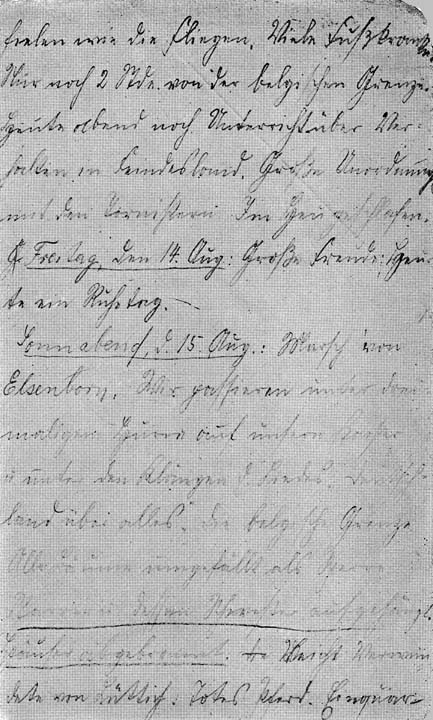
| Photograph of the German Diary, examined by the writer of this book. It was written by Corporal Menge ,of the 8th. Company of the 74th. Reserve Infantry. He reports: "A curé and his sister hanged, houses burned." |
These extracts which I have given are from diaries of which I have examined the originals, and gone word by word over the German, in the penciling of the writer. The revelation of these diaries is that the Germans have not yet built their moral foundations. They have shot up to some heights. But it is not a deep-centered structure they have reared. It is scaffolding and fresco. We shall send them back home to begin again. Sebastian Weishaupt and Private Hassemer and Corporal Menge must stay at home. They must not come to other countries to try to rule them, nor to any other peoples, to try to teach them. Their hand is somewhat bloody. That is my feeling in reading these diaries of German soldiers---poor lost children of the human race, back in the twilight of time, so far to climb before you will reach civilization. We must be very patient with you through the long years it will take to cast away the slime and winnow out the simple goodness, which is also there.