
DECEMBER 26, 1917 HENRY D. SLEEPER, ESQ.,
AMERICAN REPRESENTATIVE,
AMERICAN FIELD SERVICE, BOSTON, MASS.SIR:
In accordance with your instructions, we have attended at the Boston Offices of the American Field Service for the purpose of auditing its accounts from the inception of its Fund (September 18, 1915) , to September 18, 1917, and inaugurating any methods of procedure that might be helpful in the administration of the Fund. With the same purpose in view, we have also attended at the several American Field Service Offices in New York City.
Reviewing the history of the American Field Service, it would appear that although it was inaugurated as early as the battle of the Marne, in the fall of 1914, under the auspices of the American Ambulance Hospital at Neuilly, no Fund was opened for subscriptions for the special maintenance of this Service until September 18, 1915, at about which time the worthiness of its purpose became generally understood by the public, and subscriptions towards the cost of carrying on its work were received by Messrs. Lee, Higginson & Company, acting as depositories.
Four subdivisions of the Fund have been opened and maintained, viz.:
General Fund:
Subscriptions received for the General Fund are expended in purchasing ambulances to be sent to France and to the French Army in Saloniki in providing for the adequate manning of those ambulances, and for their maintenance, and in providing for the maintenance of the Service incidental thereto.
Drivers' Fund:
An auxiliary fund described as the "Drivers' Fund" was opened on October 9, 1916, to receive subscriptions to be used in giving financial aid to the drivers not possessing personally means necessary to purchase their equipment, or to pay their passages and expenses abroad.
Moving Picture Fund:
This fund was opened on September 8, 1916, for the receipts derived from a series of educational moving-picture entertainments given in different cities and towns in the United States. The incidental expenses of such entertainments have been paid from this Fund, and the surplus receipts have been set aside to be used where most needed in the interests of American Field Service work.
Ward Fund:
This Fund was opened to receive subscriptions for the support of a Ward in the American Hospital at Neuilly-sur-Seine, France, to be donated in memory of members of the Field Service who had died for France, and to be used by members who could be brought there to recover from wounds or illness.
The American Field Service Fund was officially opened as stated, in September, 1915, when the first subscriptions were deposited with Messrs, Lee, Higginson & Company, and thereafter the subscription lists steadily grew in volume.
In the fall of 1916, in response to appeals from France, presented through A. Piatt Andrew, Inspector General of the American Field Service in France, it was decided to conduct a campaign in order to obtain subscriptions and enlist volunteers on a much larger scale than had hitherto been contemplated. To this end divers means were used to inform the public as to the need and value of ambulance work in France. Illustrated lectures were given by returned drivers, describing conditions at the Allied fronts, and a moving-picture committee was empowered to open offices, to procure suitable reels depicting conditions in France and showing the American Field Service at work, to make bookings and give entertainments. One hundred and sixty showings, in many instances accompanied by lectures given by returned drivers, were arranged in thirty-four States in various sections of the country. Another of the many means used in arousing public interest was the circulation of books referring to the history of the Field Service and presenting highly interesting letters describing the experiences of the drivers at the front.
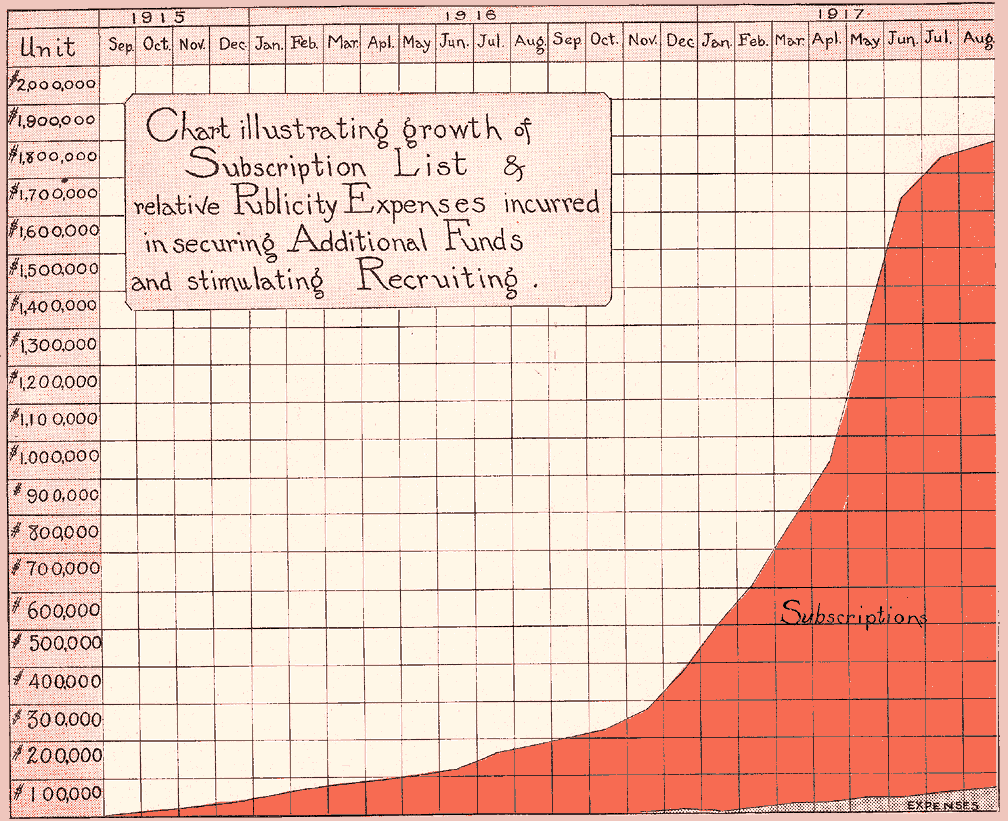
The appeal for funds presented in such a practical and efficient manner met with a marked response from the public, the moving-picture entertainments alone, after paying all expenses, showing a net profit of $235,117.56, while the growth of voluntary contributions received from donors residing in localities where entertainments were given can be attributed directly to the excellent publicity secured in the manner described. The progress shown by the entire Fund up to September, 1916, and the impetus it subsequently gained---after the publicity campaign was launched, and the relative expense incurred in accomplishing such results---are clearly set forth in the accompanying graphic chart.
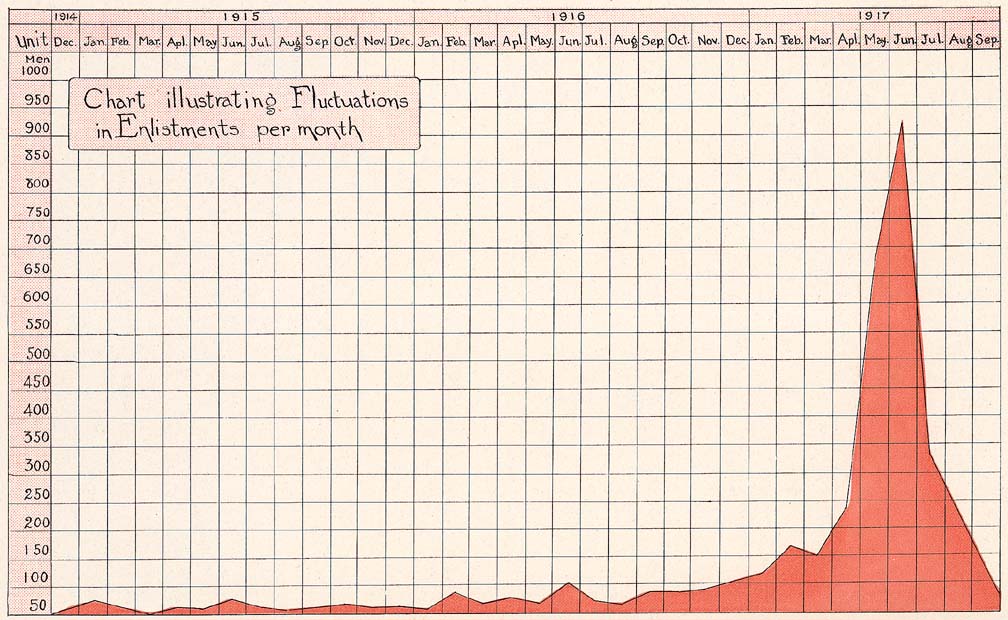
The publicity methods used in securing subscriptions to the Funds appear to have been very helpful in stimulating enlistments, but the need for men became so great that in the Spring of 1917 a recruiting campaign was planned and undertaken, George R. Young, Recruiting Officer of the Field Service, personally visiting a large number of colleges in different parts of the United States to secure men of the desired type. As an immediate result, sufficient men were enlisted to form over thirty units averaging twenty-five men each, and in addition to the formation of such units a great momentum was also given to individual enlistments. Recruiting booths were opened at the National Allied Bazaar at Boston, and at bazaars held in Buffalo, St. Louis, Chicago and elsewhere, as another means of securing enlistments. The comparative growth in the monthly totals of enlistments from December, 1914, to August 31, 1917, is illustrated in the following chart appended to this report.
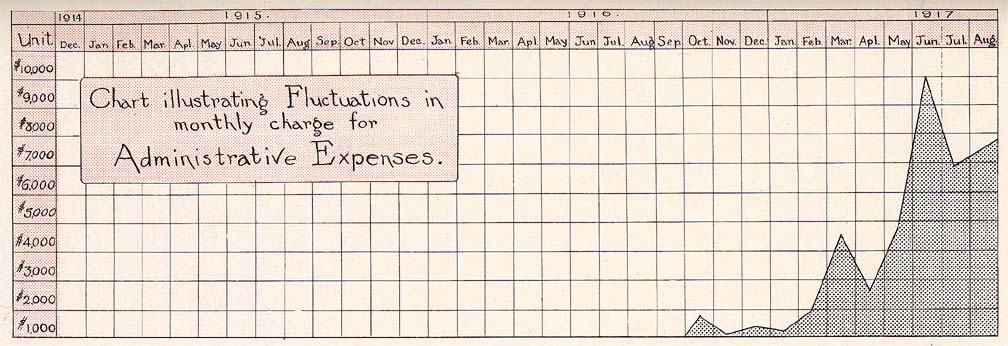
A graphic chart illustrating the comparative monthly totals of administrative expenses incurred in caring for the routine work incidental to the enlistments secured, is shown below.
After the opening of German-American hostilities an opportunity arose for the Service to broaden its scope (which, up to that time had been confined to Sanitary Sections), by undertaking a share of the Transport work. Upon the assumption of this additional responsibility, the organization took title to its present name, the "American Field Service"; prior to that time it had operated as the "American Ambulance Field Service." The invitation extended by the French military authorities to the American Field Service to enlarge the latter's activities in this manner is very significant of the French appreciation of the Service's usefulness. The militarization of the Service by the United States Government, which will be in process during the next few months, also points to a realization of the practical field efficiency that has been attained by the American Field Service volunteers.
Office Facilities:
From the inception of the American Field Service, the administration of the Fund was carried on entirely free from expense, thanks to the generous application of voluntary work (see Chart, page 33), until October, 1916, when with the growth of the Service, the burden of administration increased to such proportions that it became necessary to seek further assistance in coping with the multiplying details and complexities incidental to sending the men to France. The need for increased office accommodation was met through the generosity of Messrs. Lee, Higginson & Company, who kindly gave the use of adequate headquarters at No. 40 State Street, Boston, Mass. In June, 1917, the use of office premises was also donated at No. 14 Wall Street, New York, by Mr. J. P. Morgan, in order that the development of the enterprise in that territory might be properly cared for and that the embarkation there of the men enlisted from all parts of the country might be carried out efficiently. Up to this time, such duties had been discharged through the offices of the American Ambulance Hospital at No. 14 Wall Street, New York, until the increasing volume of the work entailed necessitated a large working staff and quarters. Offices were also maintained in Chicago to care for the Western interests, and offices were opened at different times in twenty of the larger American cities to care for local enlistments. To facilitate the securing of passports, a representative of the American Field Service has been stationed at Washington, as the complications in this division of the organization have considerably increased since the entry of the United States into the War.
Equipment:
To ensure the proper equipment of drivers, the American Field Service purchased for redistribution to its men suitable uniforms, blankets, ulsters, etc. This equipment was originally held in Boston, but with the Service's development it appeared that New York, as the port of embarkation, was a better center of distribution. The Field Service was again fortunate in securing premises without assuming the burden of rental charges, and the Field Service Store was inaugurated in July, 1917, at 29 West 36th Street, New York City.
Office Details:
In addition to the indispensable routine business herein mentioned, the American Field Service has deemed it necessary to assume some responsibility for the personal interests of the drivers sent abroad, and it has been its aim as far as practicable to keep in touch with the welfare of each volunteer. For example, in order to allay the anxiety of parents during a period when the activity of the German U-boats was at its height, upon receipt of cable advices from France of the safe arrival of boats carrying volunteers, telegrams were sent to all parents, or relatives---as the case might be,---notifying them of each man's safe arrival.
Assistance to Drivers:
The forwarding of parcels and the remitting of funds from friends to the men abroad became a task of considerable proportions, but these and other favors for the men appear to have been no less than they could reasonably expect if it be borne in mind that the services which the volunteers rendered were given in every instance without recompense, aside from a comparatively insignificant allowance for spending money, and that in many cases the drivers bore all expenses themselves and refused any remuneration. The maintenance of the drivers after their arrival in France has been another division of responsibility requiring close attention. It was originally estimated that $350.00 would pay all the expenses of sending a driver abroad for six months' service, accounted for approximately as follows:
| Fare from New York to Paris and return | $170.00 |
| Equipment | 90.00 |
| Six months' incidental expenses | 90.00 |
| Total | $350.00 |
While many of the volunteers were able to entirely finance themselves, others needed assistance, and this assistance has been furnished through the Drivers' Fund referred to on page 21. Unforeseen contingencies, however, have frequently occurred, and letters from drivers at different times have contained pleas for financial assistance, because of extra expenses incurred in New York through the postponement of sailings, or money lost, or additional equipment needed, or unexpected expenses incurred abroad owing to a lack of knowledge of the usages of a foreign country. All such communications necessitated, and appear to have received, careful examination and sympathetic and practical treatment.
From the foregoing review of conditions, it can readily be seen that while the administration of the American Field Service Fund at the outset may have been a comparatively simple matter, it developed later into a large and complex undertaking calling for painstaking attention, judgment and vigilance.
A summary of the Total Receipts of the American Field Service Funds from their inauguration to September 18, 1917, classified in chronological order so as to show separately subscriptions, proceeds of entertainments, and interest earned on monies upon deposit (as shown by the books of the organization), is as follows:
|
| DESIGNATED FUND. | |
| |
| 1915 1 mo. ending Sept. 30. | General | $ 3,069.32 | | $ 3,069.32 |
| | $ 3,069.32 | | $ 3,069.32 | |
| 3 mos. ending Dec. | General | $ 29,418.50 | $ 108.84 | $ 29,527.34 |
|
| $ 29,418.50 | $ 108.84 | $ 29,527.34 | |
| 1916 3 mos. ending March. | General | $ 45,200.36 | $ 265.89 | $ 45,466.25 |
| | $ 45,200.36 | $ 265.89 | $ 45,466.25 | |
| 3 mos. ending June. | General | $ 38,249.95 | $ 354.62 | $ 38,604.57 |
| | $ 38,249.95 | $ 354.62 | $ 38,604.57 | |
| 3 mos. ending Sept. | General | $ 81,885.62 |
$ 543.00 | $ 82,428.62 |
| | $ 81,885.62 | $ 543.00 | $ 82,428.62 | |
| 3 mos. ending Dec. | General | $ 124,665.05 |
$ 876.63 | $ 125,541.68 |
| Drivers | 13,796.65 | 44.90 | 13,841.55 | |
| Moving Picture | 34,358.21 | 69.06 | 34,427.27 | |
| | $ 172,819.91 | $ 990.59 | $ 173,810.50 | |
| 1917 3 mos. ending March. | General | $ 341,969.03 | $1,621.37 | $ 343,590.40 |
| Drivers | 19,364.00 |
83.61 | 19,447.61 | |
| Moving Picture | 53,156.30 | 376.60 | 53,532.90 | |
| Ward | 1,840.00 | 18.27 | 1,858.27 | |
| | $ 416,329.33 | $2,099.85 | $ 418,429.18 | |
| 3 mos. ending June. | General | $ 694,670.17 | $2,146.93 | $ 696,817.10 |
| Drivers | 10,015.00 | 39.66 | 10,054.66 | |
| Moving Picture | 148,074.78 | 1,018.71 | 149,093.49 | |
| Ward | 1,284.00 | 38.05 | 1,322.05 | |
| | $ 854,043.95 | $3,243.35 | $ 857,287.30 | |
| 2 mos. & 19 ds. ending Sept. 18. | General | $ 103,807.12 | $ 26.14 | $ 103,833.26 |
| Drivers | 5,577.00 |
| 5,577.00 | |
| Moving Picture | 35,198.70 | | 35,198.70 | |
| $ 144,582.82 | $ 26.14 | $ 144,608.96 | ||
| NAMES OF FUNDS | |
| |
| General . | $1,462,935.12 | $5,943.42 | $1,468,878.54 |
| Drivers. | 48,752.65 | 168.17 | 48,920.82 |
| Moving Picture | 270,787.99 | 1,464.37 | 272,252.36, |
| Ward | 3,124.00 | 56.32 |
3,180.32 |
| | $1,785,599.76 |
$7,632.28 | $1,793,232.04 |
|
| | | | | |
| | | |
| |
| 1915 | 1 mo. ending Sept. 30 | |
| |
| |
| |
| |
|
| mos. ending Dec. 31 | | $ 5,997.00 |
| | | |
| $ 3.00 |
| $ 6,000.00 | |
| 1916 | 3 mos. ending March 31 |
| 24,650.00 |
| |
| |
| 20.50 |
| 24,670.50 |
| 3 mos. ending June 30 |
| 42,030.00 |
| |
| |
| 24.95 |
| 42,054.95 | |
| 3 mos. ending Sept. 30 |
| 22,250.00 |
| |
| |
| 12.90 |
| 22,262.90 | |
| 3 mos. ending Dec. 31 | $ 33,484.06 | 17,167.38 |
| | $ 9,540.62 | $ 5,650.45 | $ 1,158.86 | 44.58 |
| 67,045.95 | |
| 1917 | 3 mos. ending March 31 | 121,733.12 | 51,552.39 | $149.90 | $776.05 | 29,204.89 | 18,997.02 | 4,991.25 | 495.39 | $6,000.00 | 233,900.01 |
| 3 mos. ending June 30 | 193,843.61 | 175,746.93 | 3,211.90 | 3,599.57 | 57,434.12 | 23,208.82 | 13,079.23 | 2,373.76 | 100.00 | 472,597.94 | |
| 2 mos. and 18 ds. ending Sept. 18 | 143,442.43 | 265,568.51 | 1,955.47 | 82,256.56 |
44,226.62 | 17,471.50 | 14,619.06 | 2,557.49 |
|
572,097.64 | |
| $492,503.22 | $604,962.21 | $5,317.27 | $86,632.18 | $140,406.25 | $65,327.79 | $33,849.40 | $5,532.57 | $6,100.00 | $1,440,629.89 | ||
| Field Equipment Purchased and Shipped Abroad. | The disbursements made under this heading represent Ford Chassis and White Trucks, and spare automobile parts and accessories shipped to France. |
| Field Equipment Purchased in Europe and cost of maintenance of Service Abroad. | Funds have been periodically remitted to Paris for the purposes named in this caption. The Paris branch of the organization has undertaken the building of ambulance bodies for the chassis shipped from the United States, and has maintained repair shops. The cost of paying mechanics, boarding the newly-arrived men, and men on furloughs, has been borne out of these funds. We are in correspondence with A. Piatt Andrew, Inspector General of the Field Service, in regard to these expenses, and are to receive detailed analyses of them for incorporation in our next report. |
| Food Purchased and Shipped to France. | The disbursements made on this account are for miscellaneous food supplies shipped to France for the headquarters in Paris, where the men not on duty are boarded. |
| Drivers' Equipment Purchased. | These disbursements cover uniforms, blankets, etc., purchased for redistribution to the drivers, as referred to on page 21 of this report. A considerable quantity of this equipment has been and is being sold at the time of making this report, for which the equipment account will duly receive credit, and to that extent this item of expense will be reduced. |
| Financial Aid Given to Drivers. | Disbursements made on this account represent money paid to desirable men not possessing sufficient means to buy equipment or undertake the expenses of going to France. Sums varying from $50.00 to $350.00 have been given to drivers, according to the merits of each case. A special "Drivers' Fund" has been opened in connection with such cases, as referred to on page 21 of this report. |
| Recruiting and Publicity Expenses. | Disbursements made on this account represent expenses paid in connection with the purchase and production of moving pictures, the giving of moving-picture entertainments, the travelling expenses of lecturers and managers, commissions allowed to managers ( 1 per cent), the publishing and distribution of books and literature, the printing of posters, and other incidental expenses as described on page 22. |
| General Administration and Office Expenses in various US Centers. | These disbursements cover the office expenses incurred at the Boston, New York and Chicago Offices, and some temporary offices; printing, stationery, and salaries of non-volunteer workers employed in handling the routine work and office details. They also cover the cost of maintaining an office in Washington, and miscellaneous travelling expenses incurred in the administration of the Field Service interests. |
| Telegrams and Cables. | The payments made under this heading represent various telegrams, cable messages, and the cost of cable remittances. The nature of the enterprise under review, and the rapidity with which the constantly increasing obligations of the Service had to be considered and adjusted, and the critical conditions under which it has operated have necessitated a lavish use of the cable as a means of communication between the offices in the United States and Paris, speed and certainty of communication obviously being essential factors in the efficient management of the Service. |
A recapitulation of Receipts and Disbursements, showing the Cash Balance on hand with the depositories, Messrs. Lee, Higginson & Company, Boston, J. P. Morgan & Company, New York, and at the New York Office (14 Wall Street), on September 18, 1917, is as follows:
| |
| | |
| 1915 | 1 Month ending Sept. 30 | 3,069.32 |
|
| 3 Months ending Dec. 31 | 29,527.34 | 6,000.00 | |
| 1916 | 3 Months ending Mar. 31 | 45,466.25 | 24,670.50 |
| 3 Months ending June 30 | 38,604.57 | 42,054.95 | |
| 3 Months ending Sept. 30 | 82,428.62 | 22,262.90 | |
| 3 Months ending Dec. 31 | 173,810.50 | 67,045.95 | |
| 1917 | 3 Months ending Mar. 31 | 418,429.18 | 233,900.01 |
| 3 Months ending June 30 | 857,287.30 | 472,597.94 | |
| 2 Months and 18 days ending Sept. 18 | 144,608.96 | 572,097.64 | |
| Balance on hand Sept. 18, 1917 | | 352,602.15 | |
| $1,793,232.04 | $1,793,232.04 |
| On deposit with Lee, Higginson & Company, Boston | General Fund Drivers' Fund Moving-Picture Fund Ward Fund | $ 61,780.79 |
| On deposit with J. P. Morgan & Company, New York | 18,606.00 | |
| American Field Service, New York Office | 11,945.32 | |
| Total | $352,602.15 |
A Cash Book recording the summarized receipts and disbursements of the Funds has been kept by Mr. G. Noyes Stanley. Disbursements made from the General Fund maintained with Lee, Higginson & Company, Boston, have been authorized by your written requisitions (which we have seen), and paid cheques are on file with them covering such withdrawals. Receipted bills are on file in the American Field Service offices covering substantially all disbursements made for merchandise and sundry purchases. In other cases, we exercised reasonable diligence in investigating the same, and finding no reason to question the propriety of the transactions involved, we passed the recorded entries. Signed receipts were inspected by us for all currency disbursements made through the General Fund on account of salaries paid to non-volunteer workers, and for miscellaneous travelling expenses and petty expenses. Disbursements made from the General Fund for remittances to be sent to New York for the purchase of chassis and other field equipment were traced by us and agreed with sums deposited to the credit of the American Field Service Fund with Messrs. J. P. Morgan & Company; and disbursements from the same Fund covering remittances sent to the Fund's New York Office for carrying on business there were traced to the New York records.
Upon your written requisition, various sums have been cabled to the Fund's Paris headquarters by Messrs. Lee, Higginson & Company, and upon similar requisition, Messrs. Lee, Higginson & Company have also issued drafts on Paris, to be sent forward by you, and have charged same to this Fund. On October 24th, we wrote to A. Piatt Andrew, Inspector General of the Field Service, at Paris, in order that such sums might be clearly traced and reported in analytical form in our final report
Disbursements made from the Drivers' Fund, covering financial aid given to drivers, have been made by means of cheques signed by yourself as American Representative of the American Field Service, and we have seen duly endorsed cheques for all such charges against that Fund .
Disbursements made from the Moving Picture Funds have been made by Messrs. Lee, Higginson & Company upon written requisition by you. Such disbursements represent remittances sent to the Moving Picture Office in New York to cover expenses of that branch of the business, and these remittances have been traced by us to the records maintained in that office. Other disbursements made from the Moving Picture Fund represent accounts incurred in connection with the moving picture entertainments paid for through the Boston Office, for which proper vouchers have been seen by us.
Photographic detailed copies of monthly accounts issued by Messrs. J. P. Morgan & Company, New York, have been produced to us as a voucher for the accounts of the Field Service with them. The deposits with them, as previously stated, have been traced and found in agreement with sums remitted from the General Fund maintained in Boston, and the disbursements reported in the photographic statements, representing sums paid to the Ford Company, White Motor Company and others, appear to be for chassis, trucks and equipment, and some food supplies, all of which, we understand, have been shipped to France. Disbursements have been made from the Morgan account upon the written requisition of Mr. William R. Hereford. Endorsed cheques are on file with Messrs. J. P. Morgan & Company covering these disbursements, and we have seen duplicate vouchers covering the majority of them, and where vouchers have not been available, we have seen letters signed by Mr. Hereford explaining the nature of and the reason for such disbursements. All disbursements made through the J. P. Morgan account have now been recorded on the Boston books in appropriate accounts.
We carefully examined the accounts of the Moving Picture Office conducted at 432 Fourth Avenue, New York, and saw receipted bills or endorsed cheques covering all disbursements originating from that office.
Acknowledgments were seen by us for payments made to lecturers and others for fees and travelling expenses incurred in connection with entertainments given in the interests of the Field Service, and we have satisfied ourselves that the expense charges were consistent with the undertaking involved. The Moving Picture office has now been closed, and the cash balance on hand at the time of closing has been redeposited to the credit of the Moving Picture Fund in account with Messrs. Lee, Higginson & Company.
At the time of our attendance at the New York Office of the Service, the books there were incomplete, and a full audit of those accounts was not possible, owing to the limited time at our disposal, but we made a general survey of the accounts and saw receipted bills or endorsed cheques covering all disbursements. We arranged with Messrs. Hecht and Satorious, then in charge of the New York Office, that they should forward to the Boston Office monthly cash statements, and the several statements seen by us thereafter indicate that the accounts at the New York Office are being kept accordingly.
With regard to Income, we found that all subscriptions have been recorded upon lists and have been acknowledged to donors by Messrs. Lee, Higginson & Company, and also in many cases by the Field Service, since and including those made on October 30, 1915, although a few subscriptions were received and deposited with Lee, Higginson & Company (the first deposit was made September 18, 1915), before the subscription lists were opened by them. Some minor clerical errors were discovered by us in our examination of the lists. In two cases, cheques had been received, acknowledged, and listed, and then for some reason (possibly endorsement), had been returned to the donor, and when sent forward a second time, such amounts had been recorded as additional subscriptions. Our examination also disclosed a case where a subscription had been entered on the list twice. The explanation for these slight discrepancies undoubtedly lies in the fact that the task of caring for the lists was temporarily out of the hands of the person to whom that work was assigned, on account of absence due to an accident, as the person substituting was unfamiliar with the duties.
Owing to the inability of the Field Service to obtain satisfactory delivery of ambulances for which funds had been donated during July and August of the current year, some of such subscriptions, at the request of the donors were turned over to the American Hospital Fund, and these subscriptions have not as yet been eliminated from the lists of the Field Service. In a few instances, also, donations were received by the American Hospital Fund, and in one instance the proceeds of an entertainment were taken into the accounts of the Moving Picture Office. These sums, as yet, have not been recorded on the lists of the Field Service, although they have been credited to the Subscription Account in the books of the Fund, and the cash has been duly accounted for. Now that the pressure of office work has abated, we have instructed your Mr. Thompson and your bookkeeper, Miss McArdle, to enlist the assistance of Miss McDonald (who is familiar with the history of these cases), and Miss Ross, whenever necessary, in order that they may devote their attention to the preparation of a complete subscription list, and may bring to your attention any promised donations not received, so that they may be followed up.
In the course of our examination, we checked all cash book footings, petty cash transactions, and all ledger postings. We reconciled with Messrs. Lee, Higginson & Company's statements the cash balances standing to the credit of the four separate Funds, and the balance standing to the credit of the American Field Service with Messrs. J. P. Morgan & Company, New York, by means of a certified photographic copy of the account furnished by them. As stated earlier in this report, owing to the limited time at our disposal during our attendance at the New York Office, the accounts of that office have not been completely audited, and the cash balance standing to its credit has not been verified by us. We verified the cash and bank accounts maintained by the Field Service Store in New York on October 2nd, but the accounts relative to that branch of the organization have not been incorporated in the figures herein presented.
For the purpose of analysis, we found it necessary to open ledger accounts, and the receipts and disbursements have been classified therein in accordance with the classification given in this Report. During our attendance at the New York Office, books and accounts were installed there under our direction upon the lines introduced at the Boston Office. We inaugurated methods of caring for the financial records of drivers given monetary assistance, so that details of the same might be more readily available in the future.
Respectfully submitted,
[seal] PATTERSON, TEELE & DENNIS,
Accountants and Auditors.