| Aim of the Government --- Relation of the Department of Military Relief to the Army --- Service at Railroad Stations --Numbers of Canteens --- New Work for Women --- Death to a Libel --- Canteen Functions Defined by Army Orders --- Canteen Records --- Washington Union Station Canteen --- Many-sided Service --- One Month's Statistics --- Sanitary Branch of the Service --- Camp Service --- Red Cross Field Director. |
THE United States Government started out with the definite intent that the American soldier should be the best conditioned, the best fed, and the best cared-for soldier in the world; the verdict of a proud and grateful people is that the Government, taking everything into consideration, came very near to realizing its purpose. In truth, the fitness and fighting qualities of these men --- men who a year before had been shuffling along in a thousand-and-one different trades --- proved to be the happiest as well as the biggest surprise of the war to tired and disheartened Europe.
In lending a hand to the Army, coöperation between the Red Cross and the Government was necessarily close but, oddly enough, no phase of our work is less known than the almost herculean labor undertaken on behalf of the soldier.
To a large number of people the military work of the Red Cross is personified in the figure of a girl in khaki passing out coffee and sandwiches to grinning soldiers who, already, look a hundred per cent nourished. This trite picture does not begin to tell the story. The soldier himself, unless he be a very thoughtful and observant man, does not know how strongly and at bow many points and angles the Red Cross has influenced his mental attitude, his moral conduct, and his physical condition.
Reference has been made to the departmental organization of the Red Cross and the distribution of its duties incident to war. Moreover, it may be unnecessary to add that the men and women engaged in all these various departments were, every one, convinced that their own department was the biggest and most vital; but it was this conviction, nevertheless, that inspired their work and actuated the whole machine. It is also true that as we follow the soldier on his long journey to the battleground, and back again, each stage as it is passed seems to yield in importance to the next.
In all the formative stage of the soldier's development and, for that matter, at every step of his service, of all the departments of the Red Cross that of Military Relief was closest to him. In his cosmos that department and no other comprised the Red Cross.
A large part of the work of the department of Military Relief was merged in the Medical Service of the Army. The base hospitals with their personnel, which were organized and equipped by the Red Cross as part of its official business, became automatically a part of the Army organization when they were sent into service overseas. There remained under Red Cross administration, for the purpose of utility and to simplify the Army mechanism, the bureaus whose sphere was broader and more elastic and whose functions were not an actual part of the warmaking business. They were, in a way, the left hand of the service. Under this head may be grouped the Bureau of Canteens, the Bureau of Camp Service, the Bureau of Motor Service, and the Bureau of Sanitary Service.
The American boy --- up to forty-five --- bumped into the Red Cross at the very moment almost of leaving his home door for the training camp. The last thing he saw from the train as the old town faded behind him was the Red Cross girl he had known from babyhood, waving good-by; and at the first station were a group of Red Cross girls to let him know that the folks back home were not the only ones who cared.
Here is where the illustrative instances began, showing how this Red Cross factor pervading every stage in the work of soldier-building made for a general cleaning-up. It is related that in the early days of the war the mayor of a western town in the exuberance of his feelings presented each man of the town's draft quota with a bottle of whisky for "deoch an' doris." The next station was a canteen town where Red Cross women waited to welcome the troop train. When the Red Cross report of that visitation reached the War Department the instant reaction was the brassard on the sleeve of every drafted man, and thenceforth it was a penitentiary offense to give or sell him intoxicants.
During the early period of mobilization it was not realized that the services of the Red Cross would be needed at railroad stations. But when the railroads began to feel the strain of moving hundreds of thousands of troops, and trains began to be late, the inevitable emergencies arose: it was not enough to have Army dining-rooms at regular intervals along the route, but the Red Cross must be ready to feed and take care of the men at all stations. Secretary Baker's request that the Red Cross take over this work acted like magic on the women of America. The whole nation was mobilized overnight.
And so it was that when the armistice was signed there were in the United States 781 canteens where 70,000 women with military organizations were doing yeoman service. They not only gave the soldier a lift when he needed it, but they themselves discovered a new meaning in service and came to the knowledge that life is real and that there is beauty in its reality. There were women scrubbing floors in Red Cross canteens who had never done a day's work before in their lives. But the thought that they were helping made them happy.
When the canteen women at one of our debarkation ports were first called upon to take care of the wounded men, who had now begun to come back from war, they said they couldn't stand the awfulness of it. But they did. The cheerfulness of these poor fellows shamed them into self-sacrifice. Forgetfulness of self strengthened these women's characters and illumined their souls. In the change that war service has brought to the women of America, many an old fetish has gone by the board.
The incident described in the following letter from a canteen worker in Charlotte, N. C., and of which there were many similar occurrences all through the Southern States after America went to war, shows that the Red Cross is not a thing of race or color and should be the last word of proof of this growth in patriotism: --
"To-day we had a fine example of discipline and its value. Thirty colored sailors stopped at the Canteen hut. When we went to serve them they were drawn up in two lines and stood at attention. As if with one voice, they said, 'To the Red Cross,' and saluted. As we passed down the line, each man as he was served removed his hat and bowed, but did not speak. After all were served they sang all sorts of songs, gave a rousing cheer for our Country, the Red Cross and Charlotte Canteen. It was one of the most affecting experiences we have had and our Chairman went back to the hut and cried. These men had crossed the ocean eleven times."
The war and the canteen sounded the knell of one ancient fallacy that should long ago have been laid to rest. In order to insure prompt supply of needed food or special service that the canteen could furnish, the troop train commander wired his requisition to the commanding officer of the next canteen ahead. This involved imparting a knowledge of the movement of troops, which had been religiously guarded to forestall the ubiquitous alien enemy and his secret wireless. The service oath of the canteen worker bound her not to disclose this knowledge to "a living soul." For centuries fathers have inculcated in their sons the belief that a woman cannot keep a secret.
It is a matter of record that seventy thousand women dispelled this fallacy. In war time loyalty becomes a religion.
The vital importance of the Canteen Service of the Red Cross can be realized from the reliance of the War Department upon it for all sorts of emergency work essential to the rapid transportation of troops. The soldier's need of food and drink was reason enough for the canteen; but the Army orders to troop-train commanders and canteen officers, defining the canteen functions and outlining its use, confirmed its value as a wheel in the great mechanism. This, like every other department of the Red Cross, did the things which the Army could not do without slowing down the business of war. The Red Cross could be depended upon to find a short cut, if there was one, to the furtherance of its ends. Its service was not confined to the maintenance of good spirit by providing soldiers with food, tobacco, newspapers, postal cards to keep in touch with home, shower baths, recreation grounds, medical supplies, and other aids to comfort; on telegraphic order from the troop-train commander the canteen provided supplies of all kinds, whether commissary or medical, and lodging and meals where needed. It is not treason to say that Army stores sometimes go wrong---in fact, it would be strange indeed if such were not the case. There have been instances where detachments of soldiers have rolled into canteen stations without having had a bite to eat or a sup to drink through a long, weary, empty day.
But there are other untoward things that happened. The Army called further on the canteens to arrange for surgeon, dentist, or physician to meet trains on wired request; it authorized them to accept sick or even dead men for transfer, and to give receipt for them to the officer in command. There were military books of instruction covering all this service and every train commander had. one. They listed all the canteen stations along their route on every railroad, indicating the equipment of each in detail and the service it was able to provide. There were voluminous Army orders covering in minute particular the procedure for the soldier who was left behind or missed his troop train while on furlough or in transit, and for the Red Cross in giving help to him. These orders also provided for the disposition of all sick or injured soldiers who might be turned over to the Red Cross at canteen stations; the contingency of a soldier's death, the care of his remains and the notification of his family were likewise prescribed in detail. Here entered the Red Cross Bureau of Home Service, which is another important story.
These things were not mere possibilities, but actually came to pass. Forty-five canteens in the Southern States during the month of August furnished medical treatment to 1180 men and 22 were removed to hospitals, either military or civil. For record of all removals of men from trains, whether living or dead, there were transfer slips in duplicate with all details regarding the soldier, his service record, his malady, and the hospital to which he was dispatched. By these records the train commander accounted to the War Department for his missing. Simultaneously, cards were sent to the Communications and Home Service officers who, forthwith, established relations with the soldier's family and summoned them, if he happened to be dangerously ill.
There was a wide range of facilities offered by the more important canteens in various parts of the country. In large towns where there were big chapter organizations and war enthusiasm ran high, elaborate equipment was installed for bathing and, in some places, for swimming, and the menu of refreshments sent back home on the Red Cross postal cards made the home folk think that soldiering was an easy life after all. In many ways, the most noteworthy canteen in the country was that in the Washington Union Station. It was formerly the presidential suite, but was given over by President Wilson at the beginning of the war. Its spacious reception room, conference rooms, and offices were filled daily with way-bound soldiers. There were refectory-rooms, reading-rooms, lounging-rooms, and all sorts of rooms for the doughboy, who was wont to idle in the station at night waiting for the early train to bear him away. There were baths and sleeping places near at hand where he could go if he wished.
This service of the canteens was many sided: it not only made the soldier comfortable but it kept him from the station-saloon and other temptations of the night, and went further than most people know towards keeping him clean and straight and ready for his big job. In the great inland stations like Chicago, this service had almost no boundaries. Through the confusion, incident to war preparations, it happened, frequently, that the men traveling from the Atlantic coast to far western posts found that their tickets read to Chicago only and money for the remainder of the journey was, likewise, lacking. Here again the Red Cross stepped in to feed and send the men on their way.
In almost every canteen of consequence there was a surgical ward --- a neat little hospital equipped for as many as ten or twelve men and a doctor who, without a summons, was patriotic enough to meet the troop trains on the chance that some soldier might need him.
The intimate stories of canteens that are "different," in all parts of the country, would make a huge volume. There were college girls who set up extraordinary canteens in university boathouses that were equipped with everything under the sun; there were canteens that were famous all over France for certain articles of food, and were a pleasant memory through trying days. The Staten Island canteen at Tompkinsville Naval Station was known, probably, in every port for "pie like mother used to make." Little branches and auxiliaries off the main lines of travel which never saw the passing show but were none the less eager to help along, baked, canned, and pickled all manner of things, and the Motor Corps girls came and toted the output to the railroad. The whole business was developed in an astonishingly brief space of time. Who, in pre-war days, would have thought of classes in the art of "handing out lunches on the fly"?
Speed, indeed, was the order of the day. When the detachment of fifty men tumbled into a canteen without notice and empty as drums they were fed nights, days, and Sundays; and when the Sergeant with a dozen sick men asked for invalid food the Motor Corps "hustled it up." And then there was the newly married man from the hill country and his weeping girl-wife who had just learned that she could not follow her man to war and who lacked the wherewithal to purchase a ticket back home; needless to say the ticket was placed in her hands and everything done to send her more cheerfully on her way. On the Hoboken docks, one rainy night, the Canteen Chief found a hundred or more soldiers who had come from the war to train new troops. They had no food, no money, and nowhere to go --- not even the solace of a smoke. When that company got up from a large hot meal and a long cigar, and had slept and breakfasted and had a ticket for their destination, there were a hundred odd more men who knew something of what the Red Cross meant.
In the station at Goldsboro, K. O., was a soldier on crutches who had finished with war and was making his slow way home. When the canteener learned that he had come through the fighting of Château-Thierry, she gathered the men, five hundred of them, from the next troop train, and got him to make them a speech. That voice, straight from the front, sent them away cheering madly and vowing to square him with the Kaiser.
Altogether it is a wonderful record of service. There is no way of telling half its story. Statistics, which are more or less unconvincing, have only recently reached the stage of compilation, but one month's figures from only about forty odd per cent of the canteens of the United States, tell this interesting tale: --
| Men served |
|
| Sick aided |
|
| Removed to hospital |
|
| Value of supplies requisitioned |
|
| Value of supplies furnished free |
|
| Postals distributed |
|
| Cigarettes distributed |
|
| Canteen workers |
|
| Canteens reporting |
|
| Canteens not reporting |
|
The Sanitary branch of the service was efficacious in meeting emergencies, and the things it did, while they do not appear outwardly as service to the soldier, none the less reacted upon him in the largest way possible. An illustrative one was the work which was done at one of the Army Camps. Camps, it may be well to admit, were not always located in ideal places, not always where the Army would have put them if it alone had had the choosing. This particular camp had a swamp beside it --- a swamp where the highly armored mosquito made merry on his rounds, delivering malaria to any unlucky human whom fortune might send his way. To the Army Staff it was plain enough that the swamp spelled trouble in capital letters, unless it were promptly drained. Yet in the statutes there was a stubborn little law, born no doubt of the iniquitous land juggling of early days in the West, which forbade the improvement of private property at public expense. But there was no law to keep the Red Cross from doing the job, which it proceeded promptly to do, the cost of which was $7000. In the opinion of the Surgeon General's Office, this work forestalled an epidemic which was positively scheduled to appear in the spring and which would have laid on the Army a continual tax in man power and expense.
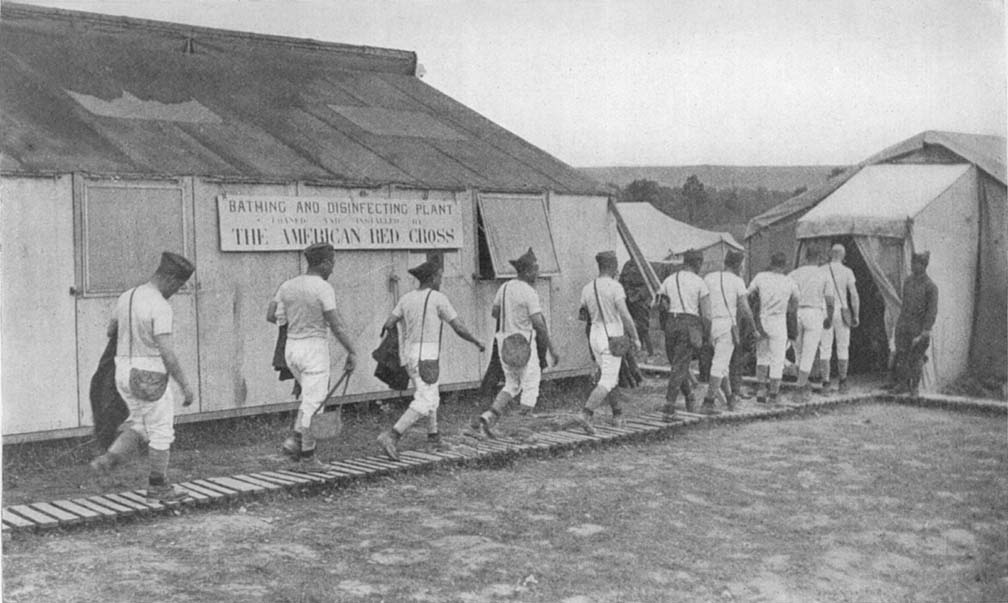
This Sanitary Service, which was conducted as an adjunct to the Federal Department of Public Health and in coöperation with the state and local health boards, and which shared their powers under state law, was indeed one of the most fundamental and omnipresent of all Red Cross activities for the preservation of Army health. It did not doctor sick soldiers; the Army did that. But Sanitary Service went further back: it doctored the country for five miles around the camps; it diagnosed the fields and streams and ferreted out behind the camouflage of landscape the hidden machine guns of disease, which in one summer can shoot an Army cantonment full of holes; it ditched the sinkholes and swamps that breed and harbor the carriers; it sprayed with fatal oils the streams and ponds and ditches on thousands of ancient and diseaseful well-curbs and sounded the death knell of the "Old Oaken Bucket." It put old vaults where they could no longer spread sickness; it combed the stables of near-by farmers with a rigorous hand and drove them into at least the "B" grade, or else out of business. Dirty or tuberculous milk simply could not be sold to soldiers. Nor were unsanitary conditions allowed to prevail where food was served: A restaurant keeper who had a military policeman before his door for a week warning soldiers away was a poor bookkeeper in not discerning the business wisdom of cleaning house.
To-day, the Sanitary Service maintains medical inspectors of schools and homes and even churches. It vaccinates everybody who needs it. The Public Health Department's nurses --- all graduates --- are promptly available for combating epidemics. For bacteriological purposes there are laboratories, sometimes newly established for the emergency. And to safeguard against a crying need the Red Cross has furnished at substantial cost four laboratory cars which, the English sanitarians and car builders agree, are the last word in point of convenience and equipment. These can be hooked on to fast trains and delivered on the front of an epidemic's advance, civil or military, with amazing alacrity.
Thus, on every aide the soldier was guarded against all that had in it any potential possibility of injury to his health, and the sanitary forces which were combined for the physical protection of the army camps built up health organizations of the highest order all over the United States. In many lines, standards were established and methods of purification set up which will outlast all wars.
In our supersensitive land we have a fashion of sidestepping reference to what we term social disease. If the Army had been as squeamish there would have been a different story told in the Saint Mihiel salient. The Public Health authorities and the Red Cross Bureau of Sanitation, as well as the War Department itself, recognizing in this thing a peril greater, even, than tuberculosis, laid hold on it barehanded. There are thirty-seven states now that have made venereal ailments reportable; whereas at the beginning of the war there were but five. The program was to stamp out this thing at its source. The arm of military law is long: It reached into far villages that sent soldiers to the Army, and the Army lever to pry the truth from men is strong. The day is here when the distributors of sex poison, professional or otherwise, will be put where they can no longer foul the nation's life.
In the more wholesome field of Red Cross work for the soldier in camp, there was an activity that knew almost no rest and no limit. Keeping in close touch with the man from the time he landed within the reservation until he finished his training, it tried to make him bear in mind that it was there to help him get rid of his worries and to smooth his road. An unsung genius who saw how the thing worked out crystallized it in this stanza: --
"Don't pack your troubles in your old kit bag,
Tell 'em to the Red Cross man."
That is the story in a very few words. The Red Cross built houses in all the thirty-nine camps at first established. When the war closed it had nurses' houses in connection with base hospitals in more than forty-two different camps, posts, and Army hospitals; it had convalescent houses in sixty-three military and naval establishments and rooms in others furnished for convalescent purposes. There were nearly six hundred men and women in the Camp Service offices, and fifty-nine directors doing communication service at base, general, naval, and embarkation hospitals. There were no large camps, posts, or stations for the training of soldiers, sailors, or marines not covered by the Bureau of Camp Service, and when peace came the small places were being added to the list as quickly as possible.
It is difficult for the person who has never seen one of the great Army camps, with its miles of barracks and hospital buildings and warehouses, the far-reaching avenues and endless company streets, the brand-new drainage system, the garages and fire houses, commissary stores and officers' quarters, rest houses, mess quarters and remount buildings and all its innumerable housings of soldiery, to form a mental picture of the setting in which the Red Cross Headquarters was located. Through all the hours of daylight the movement never ceased. It was an endless reel of motion filled with the burly, brown figures of a man population, and the air vibrated with their clatter. There was the rhythmic beat of tramping recruits, going through the everlasting evolutions of drill, and the murmur of many voices. There were individual figures "hay footing" to and fro on a thousand errands, working detachments whose blue "rompers" were almost a foreign note in the khaki symphony, mule-teams, trucks, and commissary-wagons, loads of hay and loads of drain pipes, tents, and supplies --- everybody going somewhere and doing some one thing. Scattered everywhere, singly or in groups, were soldiers, soldiers, soldiers. The thought that every, soldier lazing down the road, every disconsolate mule browsing on the scanty herbage, every single thing, animate or inanimate, was a duly recognized and numbered item in either the personnel or the furnishing of an Army summoned up a vision of bookkeeping which staggered the imagination.
Let no one imagine that the day of the Red Cross Field Director at any busy Army camp was a day of rest. He was the officer in command of Red Cross activities at every camp and cantonment. There was no busier man on the premises, and the fact that he worked for nothing never seemed to slow him down. Moreover, the qualification test that he had to pass to get the job was not an easy one: tact, caution, initiative, calmness, firmness, and persistency were a part of his necessary equipment --- he need be many types of men all in one.
There were no bankers' hours in the Camp Service. The camp turned out at six when the Red Cross man was on his job mapping out the day's work, examining and preparing to fulfill orders from the camp commandant or the chief surgeon, going through a mail that was full of Home Service problems, a hundred individual cases, official communications, and "axes to grind." There might be requests for help in securing discharges, for the Red Cross --- with its facilities for investigation and its standing with the War Department --- could present the story of a man who had a just claim for release as well as for the man who had no claim and had yet to learn the hopelessness of asking to be released. There were always a lot of private messes that were coming up for settlement, domestic complications, legitimate and otherwise. The draft brought to light more bigamy than the law could ever punish. It brought one soldier face to face in many a camp with two wives and often with more. There were reunions in Red Cross camp headquarters of several families with only one head. It would take Solomon and Haroun-al-Raschid rolled into one to adjust in these cases the questions of insurance and allotment. The Red Cross Director was not a judge, but he was asked more than once to sentence a foolish soldier to matrimony.
In forty-four of the camps throughout the country the Red Cross built big cruciform convalescent houses to give the sick or wounded soldier, who was on the mend, a lift up the hill --- a cheerful place to flee to in his daytime hours to escape the sight of sick men and medicine bottles, of temperature charts, the paraphernalia of surgery, and the smell of ether and iodoform. It was a great thing for a man who, with the help of nurses and doctors, had won a long uphill fight against death, to be transferred into a big cheerful place with couches and steamer chairs and sunshine, with cards and checkers, with curtains and flowering things, where the Library Association furnished him with the latest best-seller, where the magazines and newspapers were handy to restore his touch with American life, where he could smoke and swap yarns, and where his mother or his sister, his wife or his best girl could have a pleasant reception when she came to see him. It cost money to build these houses, but they were worth it.
Then there was the warehousing in connection with Red Cross administration in a big camp. There was all the trucking and handling and requisitioning. Sweaters? A big packing case held a great many. A mathematical genius at Camp Cody, away down in Texas, figured up in his idle moments that if the cases of sweaters that had come in were ranged in a row they would make a fine barricade nearly half a mile long.
Then there were the pitiful things in the base hospital ---the things that laid bare the quick of life and drew forever on the reserve fund of nerve and heart. There was the drawing of wills, the adjustment of allotments, and the constant touch that must be kept with all the teeming and changing life of that city which was called a camp. It certainly was a variegated industry, this Camp Service! A man of unsteady nerves or inflammable temper or lacking in resourcefulness would not have kept his sanity in it longer than twenty-four hours. It did not require continual searching to find the "gaps"; other people found them for you; the Red Cross mission was to fill them. To get soap, brooms, medicine-glasses, and hot water bottles for a hospital whose supplies were held up on a railroad siding somewhere; to provide a heater for heating liquids; to get screens to give the ward patients a certain amount of necessary privacy; to rig up a building where junior officers could study nights; to provide entertainment for a delegation of Civil War veterans; to get a Ford car for the Division Surgeon to go his rounds in when an epidemic was overhanging the camp; to hurry in a consignment of horse medicine out of the blue sky in time to save the whole herd of sick and dying remounts from being sent to the horse cemetery; to find laundry tubs on twenty-four hours' notice for a quarantined regiment; to skirmish up quarters for a staff of nurses; and, finally, to get a flag to put on the coffin of a dead soldier on his last journey home, represent a few of the requirements and not even a decimal part of the work accomplished.
| Red Cross Cooperation with the Navy --- The Naval Reserve Force---Medical and Surgical Service Hospital Ships Equipped through the Red Cross ---Lack of Coast Hospitals---Personnel for Base Hospitals Supplied by Red Cross---Naval Shore Hospitals Abroad---Organization of Naval Auxiliaries --- Letter of Secretary Daniels --- Rush Order for Surgical Dressings --- Camp Service in Naval Stations ---Convalescent Houses at Naval Stations --- Relief for Survivors of the San Diego ---Admiral Sims' Encomiums. |
THE mass of the American people are wholly unaware, I am sure, of the close coöperation that existed all through the war between our organization and the Navy. Nor is it at all surprising when one considers the strictness of the departmental censorship. These strange fighting ships, the lean, trim cruisers, the lithe sea wasps that they call destroyers, the undersea boats, all are members of our family, but we are permitted to have little more than a speaking acquaintance with them. They come; they go. They swing in the river at evening and with the last somnolent note of their bugles yet echoing across the waters, they are still with the stillness of sleeping villages. When the sun comes they are gone, and the young ebb tide, which tells no secrets, silently follows on their track. Every now and then, it is true, some fortunate individuals catch a glimpse of these great, gray ghosts of war moving in purposeful majesty down the harbor outward bound, and fading into the murk and mystery of the sea. But the horizon's rim is the end of their knowledge.
Now and again, however, there comes the inevitable leak --- the human equation is always to be reckoned with---and word finds its way into the public prints of some brisk bit of business that the Navy has been doing. But that is all. The highest tribute that a loyal people can possibly pay to the Navy is that of unquestioning and abiding faith which, certainly, is the evidence of things not seen.
Public interest and popular enthusiasm turned ever, perforce, to the soldier whom we had always with us. Sturdy, clean, competent, and happy, he was forever tramping up and down the thoroughfares, a welcome visitor at the Red Cross Canteens. Yet, during these anxious years, our ships together with those of our Allies held watch over the German Navy, netted the harbors, mined the runways, keeping up night and day a sleepless vigil while it safely convoyed 2,000,000 soldiers and many more millions of supplies across the Atlantic.
Almost at the start the Red Cross had one of its opportunities to coöperate with, or better, to help the Navy. It was at a time when newly fledged naval recruits were being hurried into the great formation and four hundred of them were rushed east from the Great Lakes station to Washington. They were forced to depart so hurriedly that their account books were left behind. They arrived in the capital with practically no money and there was no prospect that the governmental machine could provide them with funds. A request was made to the Red Cross to finance them over the period of delay, which was cheerfully granted.
But to go back a little: In August, 1916, Congress had created the Naval Reserve, unlimited as to number for the duration of war; the old naval militia became Class Two of the Reserves. By this measure the Navy, later on, was able to reach out and gather in men who had seen service, as well as thousands of recruits. The regular establishment increased in numbers from 55,000 to 88,000 in a few months and, ultimately, reached nearly 600,000 men. The Marines jumped from 10,000 to 75,000.
We come now to what might be called the first move in the naval game which followed our entrance into the. conflict: the spectacular arrival of the first flotilla of our destroyers in British waters long before they were expected. For many uneventful years the Navy had been waiting for a chance to make just such a dash as that and the order, needless to say, was carried out in accordance with the best traditions of the service. Within six weeks, also, after war was declared, the personnel of the Navy had more than doubled. Not only was the Atlantic Fleet growing in an amazing rate, but the Navy was called upon to furnish guards for American merchantmen, and it had already been suggested that the training of the new merchant crews, soon to be launched, should be under naval auspices.
Meanwhile, the Medical and Surgical Service of the Navy had been organized with great care and thoroughness. In the naval training schools there was established at the opening of the war, as part of the general preparation for a great emergency, an elaborate system of instruction and training for pharmacists and hospital corps men. The training of these new forces was intensive and involved practice as well as theory. There was instruction in clerical work, microscopy, urinalysis, pharmacy, dentistry, pathology, bacteriology, chemical nursing, X-ray examination and development of plates, the making of splints and surgical dressings, and all the chemical laboratory and field work incident to the care of the sick and wounded. The Army, numerically so great, stripped the field of medical men and hospital attendants. The Navy, especially for sea service,---where women cannot or do not go,---was forced to rely upon itself. To realize the urgency of this need, it is necessary to consider the special character of naval service, its environment and its difficulties.
The Army can evacuate its wounded from one hospital to another by prompt and, in the case of hospital trains, highly equipped conveyances. Aboard a warship it is different. In an engagement between modern vessels the space available for the wounded is limited, and the intensity of battle permits of little or no work with them until an engagement is over.
The most that can be done for a wounded man is to apply the dressing that every one carries and to remove him, if he cannot remove himself, to the unexposed side of the ship to await attention until the battle is over. Then, if the ship stays above water and there are surgeons enough left, the wounded may be transferred to an ambulance ship, hospital ship, or other transport, if there be one nearer than the nearest land.
This matter of hospital ships was one of vital moment to naval establishments and one in which the United States Navy had long labored under serious embarrassment. The lack of facilities in this service had been obvious for a long time prior to our entrance into the war, and by persistent effort Congress had been prevailed upon to make appropriations for its extension. Two passenger vessels --- sister ships of about 10,000 tons --- were taken over by the Government and adapted to hospital uses. They were commissioned under the names of Comfort and Mercy. Through the Red Cross, the Society of Colonial Dames provided money to equip them, which was done in the most thorough manner.
In addition to these there was the Solace, a small ship, also converted and which, prior to the war, was the only vessel maintained for this purpose by the Navy. Mention, however, should be made of the yacht Surf, whose owner offered through the Red Cross to turn her over as an ambulance ship to attend the fleet in Atlantic waters. She was altered to meet the requirements of the service, equipped with all the necessary appliances and placed in commission on May 27, 1917, in New England waters, thus releasing the Solace for purely hospital service. Later she was transferred to Chesapeake Bay, and in August to the New York base. When the Red Cross flags and markings were removed, and she was turned back by the Government, she had transported in the neighborhood of a thousand sick men from ships of war. But save for the Surf there was no distinctive ambulance ship available for the naval service. In this connection the following will be of interest: --
"A hospital ship," says a writer on naval matters, "does not in any sense replace a base hospital in a coast town. The hospital ship acts as a hospital transport to which ineffectives are transferred to fixed base hospitals. The hospital ship is, in a way, a fleet base hospital moving from place to place as the fleet position changes on the sea."
At the beginning of the war there was a decided lack of coast hospitals, notwithstanding that the Medical Bureau of the Navy, had long tried to secure them. However, there was great activity in expansion of hospital facilities based upon the nucleus of the old established naval hospitals, which had undergone material improvement and enlargement. Civilian hospitals in larger cities were specified as collateral naval institutions, and prominent civilian physicians were enrolled in the Navy Aid.
Apropos of this last statement, I have the assurance of an authority that within a year after the United States entered the war nearly five hundred medical officers were added to the present Medical Corps of the Navy, and a thousand medical officers of the Naval Reserve Corps were assigned to active duty. Every sort of specialist was listed in the Navy service.
Nor was the Red Cross at all backward in the way of assistance: it supplied the personnel for five base hospitals. In itself this may not seem, perhaps, to be of much importance, but in the intense work which characterized the naval medical service, it was distinctly an advantage to secure staffs of medical men and nurses who had worked together in civil practice and were familiar with each other's methods. Thus, our Red Cross system of recruiting as many as possible of its hospital units from large cities was the means of providing the peculiar teamwork that is so essential.
On August 22, 1917, the Red Cross had provided eight base hospitals and thirty station units of the Navy with medical officers and nurses. Hospital corps men and expert workmen in various lines coincident to hospital operation were provided by the Navy from its trained personnel. For example, in addition to doctors and nurses, each unit included diagnosticians, X-ray specialists, pay-clerk, commissary steward, yeomen, carpenters, electricians, plumbers, mechanics, cooks, and mess attendants. In perfecting the base hospital system, the Public Health Service collaborated with us in attending to sanitation.
Moreover, at that time the Red Cross stood ready to equip more base hospital units for the Navy, but no further call was made. In addition to permanent equipment it provided articles of invalid diet, which were a boon to the sailor in convalescence.
After activity started in foreign waters, Red Cross efforts bore fruit in increased efficiency of naval shore hospitals abroad. There were two base hospitals in Brest, each of which accommodated 500 patients; one in Queenstown, which held 300; one at Lieth, with an expanding capacity of 800; one at Strathpepper, rated at 500; and a small hospital of 50 beds near London, which was purely a Red Cross establishment.
In the effort to organize its system of service at the beginning of hostilities, in order to supply every possible lack of sailor and soldier and to render instant aid in any direction to all branches of the service, the Red Cross began in September, 1917, the formation of Naval Auxiliaries throughout the country. This was done in compliance with the wishes of the Secretary of the Navy, who addressed a letter to the Chairman of the War Council in which he successfully endeavored to impress upon me the necessity of centralizing all of America's war relief agencies under the Red Cross. It read: :----
DEAR MR. DAVISON:
For some months a large number of patriotic women of the country, animated by a desire to add to the comfort of the fine body of youths who have enlisted in the Navy, have been sending useful gifts of their own make. Some of these good women have done this work through the Red Cross and others through different organizations. It has been suggested that it would be wise if the Red Cross, the only National relief organization having official recognition, be asked to extend its large sphere of usefulness by taking over entirely the direction of this laudable work of sending tokens of good will from willing workers to the men in the Navy by creating a Naval Auxiliary of the Red Cross.
I am sure the country fully approves the statement of the President, that "recent experience has made it more clear than ever that a multiplicity of relief agencies tends to bring about confusion, duplication, delay, and waste." In every European country volunteer aid has been rendered "under a well-organized central body." The Red Cross is a body to which the whole country looks. To its appeals the people are ready to respond generously because, as President Wilson recently said: "With its catholicity and its democracy the Red Cross is broad enough to embrace all efforts for the relief of our soldiers and sailors, the care of their families, and for the assistance of any other non-combatants who may require aid." With this broad foundation, with a record of efficiency, I feel sure that the workers of the country who are particularly interested in the men who wear the Naval uniform will be glad if the Red Cross will increase its benefactions by this natural and proper addition to its noble service.
If your organization can do this, the Navy Department and the Navy in all its units and the one hundred million Americans who are proud of their Navy will give cordial aid and hearty coöperation.
Trusting that this suggestion will meet your favorable consideration, I am,
Sincerely yours,
JOSEPHUS DANIELS.
And again, at a meeting on November 26, 1917, the Secretary said:--
"The women are in the War because war cannot be conducted without them. Across the water in the early days of the War there were mobilized organizations of patriotic women and patriotic men. They organized in the cities and states to serve and help, but they largely failed of their purpose because of their division of interest. They lacked a uniform and coördinating head.
"I think it time everybody in America should be a member of an organization and helping the Army and Navy.
"In getting the coördination we must not lose the spontaneity and the enthusiasm and the zeal of individuals, but it must be harnessed to organization.
"Since the Geneva Convention the Red Cross has been the chief organization to which people looked for succor, for help, and for wise administration. It has demanded the best thought of the country. They are trying to coördinate all the agencies of America, and we are here this morning to work with them. I shall assure you for myself and for the Navy, we will coöperate with you in every way possible.
"Some time ago, a very patriotic organization announced that unless a certain number of sweaters were sent within a certain time, the Marines would freeze. Now the spirit back of that was to stimulate good feeling and help, but it did more harm than good, because the men in charge of that service had not neglected their duty. The impression got out somehow or another that the Secretary of the Navy, the Secretary of War, and the head of the Marine Service did not appreciate the splendid service women rendered. Of course it was a mistake.
"You know that this Navy is made up of boys. The average age is twenty-one, perhaps nineteen. Sixteen year old boys rushed into the Navy and they said they were eighteen in order to get in, and I have no doubt that if they made a false statement the Recording Angel blotted it out.
"So you are working for boys, and that is the appeal to mothers of this country, you are working for boys, and I come over to thank you and to join with you and with the heads of the Red Cross, who are charged with a great work."
As the ships, large and small, came hurrying to the Atlantic bases and the work of final preparation went forward, many things were found lacking, among which was a supply of surgical dressings. This was essentially a Red Cross emergency. Dressings were called for to supply 133 destroyers and small vessels and 56 battleships and cruisers. The Navy supplied the gauze, but the Red Cross had the willing workers at hand for immediate action. So far as possible, the Red Cross placed the order for these dressings in the home towns of the ships, but as haste was most essential the demand, for the most part, was distributed among the ten nearest large Chapters --Chicago, Cleveland, Pittsburgh, Washington, Baltimore, Philadelphia, New York, Boston, and the Atlantic and New England Divisions. The Chapters turned the order out, packed and marked, in record time. It was all forwarded to the Supply Department at the Brooklyn Navy Yard for distribution to the ships wherever they might be.
The making of this supply of dressings, on Navy specifications, lifted a load from the Navy shoulders and enabled their surgical staff to attend to other pressing business; and, in addition to the dressings, a large number of knitted articles were supplied to these same destroyers and battleships by the Red Cross knitting women, who had now begun to work for the Navy. Sweaters and socks and helmets went out in great bundles to ships and training stations.
In the first outburst of excitement, however, there were a number of people who thought little of knitting needles as instruments of war, but who now sat in the revealing brightness of a great light as the letters began to come from the North Sea in Arctic weather telling of the comfort of Red Cross sweaters and snug woolen helmets. Indeed, many a tar blessed the Red Cross knitter long before his ship poked her nose into the Atlantic for the journey overseas.
One bitter night in the early winter, a battleship came bowling into Norfolk from Guantanamo Station with several hundred very blue noses aboard. Out of the dark they picked up a tug light. The harbor boat swung alongside and Red Cross men from the Norfolk Station swarmed aboard with bundles of Chapter knit goods. That sturdy ship crossed the Atlantic many times afterwards, taking the Army across. To its Commander the Red Cross sweater was the best thing of the war.
Parallel in every respect of organization and work with that carried on in the Army camps and cantonments, the Red Cross maintained a thoroughly organized camp service in camps and training stations and hospitals in fourteen naval districts.
At Pelham Bay, Newport, Portsmouth, Quantico (Marines), Chelsea, Great Lakes, and Norfolk it established convalescent houses similar to those at Army camps; and other similar work at Philadelphia, Paris Island (Marines), and Balboa Park, near San Diego, California, was just begun, or partially completed, when hostilities ceased.
In divers ways, some large and important, others small but still important, the Red Cross was able to assist the Navy. The consensus of opinion in the Navy, however, is that the best thing the organization did for the sailor was to provide these recreation places where the convalescent men, away from the unhappy monotony of hospital surroundings and the propinquity of suffering, could for a time forget their own woes and make strides toward health and a return to their homes or to duty.
To facilitate the work of the Navy on shore, it has been the privilege of the Red Cross to assist by provision of motor equipment and service. A very considerable number of ambulances, motor trucks, and touring cars were provided for the use of the naval establishment. Where civilian hospitals are utilized for the accommodation of Navy patients they are often widely scattered and the naval doctor, in order to visit them, is compelled to travel long distances. Congress does not provide quick transportation for these emergencies, but this was provided by the Red Cross.
A very good example of Red Cross service for the naval stations is found in the New York or Third Naval District: the service here was under the Atlantic Division, with headquarters at New York City. There were eighteen stations in this district in which Red Cross work for the sailor was conducted. In and out of New York thousands upon thousands of sailors passed; and we contributed in every way possible to the comfort and content of the multitude.
The same thing is true in other great naval centers, such as Newport News, Boston, Newport, Philadelphia, Norfolk, Charleston, New Orleans, Galveston, at the Great Lakes Naval Training Station, at Chicago, Seattle, San Francisco, and San Diego, as well as in the navy yards where men were at work on the ships which were in process of construction or tied up for repairs.
Among the incidents connected with Red Cross coöperation with the Navy, the strangest, perhaps, was the action of a woman who, by the way, for a year and a half afterwards was the busiest person about the Hoboken Embarkation Station (the old North German Lloyd and Hamburg-American piers'). I am positive it will be written in personal if not official Navy records as a remarkable instance of intuition. One day there came a woman all the way from western New Jersey to the Red Cross Station who said that she had an unexplainable feeling that something was wrong. That there was something wrong was demonstrated in less than a half hour from the time of her arrival by a message from the Navy Yard which said that the survivors of the cruiser San Diego were coming in. There was fast work in Hoboken getting out warm clothing from the Red Cross stores and commandeering of trucks and tugs for its delivery. The boat to which the woman was assigned took off seventy-eight men from the incoming collier. When she went back for the next load she took the things the men needed for their immediate comfort. And so it happened that half the next day men were running around the docks in Red Cross pajamas, looking for all the world like escaped hospital patients, while they waited for the Government to find them uniforms. That woman surely left the Red Cross engraved on the memories of many sea-faring men!
The same thing happened on the other side of the Atlantic. Out of the busy life which the Navy led over there, there came through various channels thrilling narratives of rescue. It was tolerably well known, in spite of naval modesty and secretiveness, that United States vessels, both small and large, gave a very good account of themselves in the disposition of submarines. On one occasion an American torpedo boat, having rescued crew and passengers from a steamer which had been sunk in the English Channel, brought them into a French port in cold weather almost destitute of clothing. It would have been a very serious matter for the victims of this outrage to have waited the action of the United States Congress for an appropriation for clothing and its delivery to France on contract. Application was made to the Red Cross, which furnished outfits for the entire company.
In summing up the joint work of the Red Cross and the Navy it is not too much to say that our organization wholeheartedly endorses the sense of satisfaction that all our people have for the accomplishments of the Navy. Conversely, the Navy has ever shown itself most appreciative of the efforts of the Red Cross to do their part, and nowhere is this spirit of enthusiastic fairness more happily reflected than in the words of the Commander of the American Naval Forces in British waters: :--
"When our men are sick or wounded we need quick action," declared Admiral Sims in an address in London, "and it must be free and unhampered. That is where the Red Cross comes to the front. Disasters like the Otranto show how valuable is its work." And, later, in replying to a question that can easily be imagined, he said: "All government activity is governed by rules with a view to what is likely to happen, but all needs cannot be foreseen. When an emergency turns up, we sometimes have not the facilities, sometimes not the legal authority to do all that we ought to do. The Red Cross man can make a law as quick as you can write a check. The Red Cross is ever present to help in time of trouble."
| An Inspiration --- Number of Families Assisted --- Home Service Worker, a Silent Agent --- The Picture of the Woman Left Behind --- The Range of Home Service --- The Peculiar Fitness of the Red Cross for Home Service --- Representatives in All Camps and Cantonments --- The Machinery for the Work --- United States Government Sanctions Home Service in Camps and Naval Stations-How Home Service is Administered --- The Character of the "Cases "- Complications after the Signing of the Armistice -Home Service Institutes and Training Courses -Number of Trained Workers Lasting Force for the Betterment of Social Conditions. |
WHEN a man goes out to fight his country's battles he and all who belong to him are of paramount moment to the Government. The day has gone by wherein his dependents are abandoned to whatever fortune might befall them Indeed, few things connected with the fighting man are more impressive than the increasing solicitude extended to those whose welfare is imperiled by his absence or death.
Almost at the start of this new conception of duty,---an acknowledgment at last of the importance of every individual,--- the Red Cross recognized that here indeed was a long step forward. And since it has ever been its mission to consolidate public effort on behalf of the soldiers and sailors, to concentrate the prevalent good-will towards sufferers in other countries into an organized system of relief, it, therefore, proceeded to formulate a plan for the far more delicate and difficult work of giving to the families of the American fighting men the hand and help that they needed when the need was most pressing.
It is hardly necessary to say that this was an undertaking that required the exercise of tact in no small degree. When the call came for hundreds of thousands of our fighting men, many of them left behind them the tangled affairs of life, some of which it was well-nigh impossible to straighten out.
To enter into these innumerable homes in the capacity of guide, counselor, and friend, to do so many diverse things for so many widely variant people was in the nicety of its requirement no less exacting than the planning of a military campaign, and amounted to far more than the simple duty of giving people a hand to help them over a rough spot.
Home Service was an inspiration. Organized for the purpose just mentioned, there was a human note as well as an assurance of sincerity in it which were keys to confidence. It had no echo of condescension or patronage; on the contrary, it took people back to the time when the scattered and imperiled colonists were all things to one another; in other words, it brought into the foreground of thought the picture of friendliness, of neighborliness, and it won prompt and grateful recognition.
As the work developed the scope of its possibilities became more and more patent. Home Service did not go about its business preceded by a brass band, so to speak; to have done so would have ended its usefulness automatically. It had its very root in the sanctity of confidence, and the people whom it was privileged to serve knew that if it gave assistance it would also keep the faith.
Who of you know of the things that Home Service has done in your community---perhaps even next door? Not many, probably. And yet within a little more than a year it took into its keeping approximately 300,000 families. If one will consider the number of perplexing problems the affairs of one family can present, it is not difficult to understand what it signified in service rendered to straighten out the tangled affairs of a large number of families scattered all over the United States; nor must we forget that it is that very confidence which has made of Home Service the big brother of many a troubled household, the lawyer for counsel in times of stress, the banker in a pinch of circumstances, the doctor in sickness, the nurse, the teacher, the bearer of burdens, and the friend in need that is responsible for its being relatively unknown. The things it did were not on the surface.
Every one knows that the canteens were a picturesque and lively addition to any railway station. That there was glory in hurling a Red Cross motor-ambulance through the lanes of traffic on a crowded city street, and that Red Cross service in France had a glamour and a thrill all its own are, also, well-known truths. But the Home Service worker was a silent agent who, in a way, did good by stealth; so that if by any chance one of his countless deeds did creep into print it was by the very nature of the case utterly depersonalized. As for the glory of the service, it was ever unhonored and unsung.
It follows, therefore, that the narrative of what Home Service did since it entered upon its mission consists in the main of a blind succession of "cases." They are told in skeleton with a studious lack of detail. But it is certain that in these reports, flowing from every corner of the country, from homes and camps, from the embarkation piers, and from the turbulent zones of soldier life behind the lines, that there was more melodrama, more of the plain, plaintive comedy of human life and of tragedy, even, than would suffice to fill the endless reels of half the world.
No one who has traveled country roads, either by foot or by motor, could have missed the home side of the war. In all the thinly populated places, in the little white cottages of the New England hills, in the farmhouses of the Dakotas, far scattered over their rolling expanses of wheat fields, one saw the war symbolized by strangely muted homes. There was a hush over things, a sense of finality about it all. The smoke rose only from a necessary chimney, the barn was shut up tight, even the "stock" stood around in a solemn sort of expectancy. Rural industry, simple as it was, had lost in such places its emphasis. The fading service flag and Mr. Hoover's mark in the parlor window told the passing stranger what had happened. For the old farm, battling against pests and bad seasons, taxes, and the hungry and long-lived mortgage, was not like a mercantile or manufacturing business in which diversified labor is distributed through many channels; and, besides, war and munition factories had stripped the farm. More than likely, too, the next-door neighbor was a lone woman whose mainstay was somewhere between the farmstead gates and Vladivostok. And, to make matters harder, even if a woman could manage a farm --and there are some who could --- there was not a farmhand to be had for love or money.
In nine cases out of ten the farm woman took over as much of the farm work as she could handle single-handed. Such a situation, of course, was a trouble-breeder. All that anybody on earth could do in such cases was to be a good neighbor. It does not require much imagination, therefore, to surmise what the war did to country homes, how still the nights were, or how far the bare fields stretched to the horizon!
The monotony in the cities may not have been so intense, but in cities a family on the floor above might as well be in Manchuria for all they know of you or all the heed they give you. It is an old saying that there is no place so lonely as the city street. And the war brought pathetic changes here. Behind the same old service flag and the food pledge, which in so many cases was a superfluity in the face of soaring prices, the same old misery was doing its work. From the proud habitation uptown to the crowded tenements downtown, where English, Greek, Italian, Yiddish, and even German made the fire escape a babel on hot summer nights, men of the A. E. F. had gone forth, leaving behind them lonely women and still homes.
As will be easily seen, therefore, all the variation of town and country life came within the range of Home Service. In planning the work it was to do it enlisted a wide and a detailed knowledge of life as it is lived everywhere. It was essential to have shrewd consciousness of how people's minds work as well as an almost inspired intuition of things that were apt to happen. It had all been measured in terms of morale to begin with, and the threads of this multitudinous life traced on a chart of inference and theory, which proved phenomenally accurate from first to last in the great drama of war.
It has been said of certain important tasks in this war that there was no agency that could handle them except the Red Cross. This is, of course, an overstatement. It is, nevertheless, doubtful if any other existing instrument could have fulfilled the peculiar purpose of Home Service, for there was no other agency which had ready and equipped an organization so far-reaching, so instantly and so incessantly active and available, and so closely in touch with the homes and the needs they were apt to have. Moreover, in the thousands of Chapters driving away night and day for the soldiers and sailors, there was a perfect line of communication to every home which had sent a man to war.
Ever since the war began the outstanding thing in all Red Cross work was the alacrity with which its wide-branching plan of organization enabled it to meet demands on the minute. The actual accomplishment was noteworthy, but the sentimental unity of the machine enabled it to perform many more delicate functions --- functions which in their nature required a high pressure of personal tact and sane judgment, not to speak of the necessity of a businesslike faculty of execution. Foremost among these was Home Service. The framers of Red Cross plans knew the American man. They know --what a great many narrow-gauge people had never suspected---that he was domestic to a degree never imagined, and that while he was perfectly willing to throw up his job and put his life to the hazard, if his country asked it, the only virtually important thing was that his family should be free from trouble.
"My time in the service," wrote a Texan, early in the war, "is the happiest time of my life. It is great! But you pack up your home affairs when you go in, and you can't help wondering all the time about the folks at home."
Home Service proved the most effective possible agent for establishing in numberless homes a new view of life and a new schedule of values, which was seed for future growth and betterment; it created new ideals where they would do the most good; it was, without doubt, the most effectual kind of shock absorber for the Government, and by its good offices a silencer of the note of resentment and discontent which echoed far in war time.
There are women, as we all know, who are natural-born dependents and whose training has added to their native tendency; on the other hand, there are those who have inherent resources of courage and self-help and will fight their way through any obstacle. So, naturally, it was the former class who needed the ministrations, for the most part, of Home Service. A man who left a strictly dependent wife at home with a few little dependents looking to her as acting manager could do very well for about three days. Then he began to realize, as he never did before, how helpless she was. One wailing letter has made all the wondrous new life of the training camp a gray and dismal thing. The mental picture of an empty pocket-book, with a weasel-faced landlord in the background insisting that "leases are leases," summoned in its train visions of misery that made a man deaf to the brisk accents of a drill sergeant and replaced martial ardor with a longing to be back home for just half an hour. It is a corollary of modern war that you can't manufacture a first-class soldier out of a man who is thinking all the time that his personal responsibilities are going to the dogs, and whose barrack pillow is hardened by nightmares of trouble in the home.
I have been told that there was practically only two kinds of desertion from the American Army: one of men who deserted in France from their regiments in the rear in order to join regiments at the front; the other of men who deserted because of unhappy letters from home. When we went into war it was established beyond any shadow of doubt that there must be intimate and direct connection between the family and the trenches, that the home fires as well as the flames of patriotism were essential to proper military temperature.
There had to be a way to send soldiers and sailors 3000 miles or more across the sea and yet assure them that their families alike deserved and would enjoy the good faith and watchful kindness of the nation. The roots of the thing stuck deep. The easiest way to keep the service man from being worried by unhappy letters was to make the letters happy. The only way to accomplish this in so many homes was to establish a neighborhood feeling that would embrace all. And the chapter organization,--- a growth whose roots ran into millions of homes in every section of the country--- was there for the spreading of the Home Service gospel and the doing of the Home Service work.
Three months after the declaration of war, Home Service had already begun to send representatives to all the camps and cantonments in order that Home Service workers in the Chapters might always be sure of a good attorney, whose duty it was to locate the soldier in camp when his family wanted news of him, and vice versa. There were camps, notably in the vicinity of New York, with its strangely diversified population, where for three weeks the major part of the Red Cross field director's time was taken up with the home problems of men in the new levies. All the Red Cross machinery, all its resources were called into use in the prosecution of Home Service business: it enlisted trained men and women of every sort, some skilled in the care of the sick, others whose trade was to unravel legal and business tangles and who knew the resources of a community. These could minister to people caught in war's complications far better than an untrained individual, no matter how well meaning, could ever hope to do. To solve properly any problem, even the failure of an allotment check to arrive, required a system, with agents both in the Chapters at home and in Washington; it required some means of access to the War Department where the mystery of soldiers' money could be elucidated. True, the troubles of some lonely woman could be settled, but it required machinery, brains, telephone, telegraph, cable, letters, railway journeys, and professional assistance, all working together. Home Service could set a thousand forces at work, thousands of miles apart, to find the. right answer to any question.
At first it was hard to make this purpose clear. The Red Cross pursued no one. It did not intrude into people's business. This would have been the first step to failure. But wherever its lantern shone on the darkness of a camp street, wherever the chapter centered its war activities, the latchstring was always out for the man and his kinsfolk to enter.
Now, like every one else, the American soldier, or sailor, has his traits, and it required thorough knowledge of his mental processes to introduce the business to him and tell him that he was entitled and welcome to all that the Red Cross could do for him. So in the training camps, in the railway terminals, and in every place where sailors and soldiers congregated big signs were displayed at points where no eye could miss them. Some of these signs asked pointed questions --- they were never impertinent, however direct, for a question is pertinent or impertinent according to what is behind it. Here are some examples: --
"Have your allowance and allotment failed to come through satisfactorily?"
"Are you worried about the home folks? If so tell your troubles to the Red Cross man."
"We keep your home safe while you fight to keep the world safe."
All this was reassuring news to the fighting man who had just learned from a letter that everything was going wrong.
It is eloquent of the sagacity with which the Army was constructed and managed that these placards, in curious contrast with the purely military atmosphere of the camp, where every conceivable thing has been bent to martial purpose, were placed at the request of the United States Government in the interest of military efficiencies, a governmental recognition of the fact that a worried fighter is a poor fighter. At most of the stations the men in trouble --- and there were a multitude of them --- had the same everlasting problem of the bread-winner. But where a civilian, if he had any gumption, could get out and administer "Civilian Relief" to himself, the service man was tied hand and foot. He knew that if his checks did not come through there would be no groceries in the house, and he was plainly between the devil and the deep sea.
It was just because Home Service was equipped to step in and save this situation that it found its greatest field of endeavor in the camps. But all the promotion work was not done by the signboards; there were other ways by which the Home Service representative found out who needed his assistance. He got it from the chaplains, from patriotic and relief organizations, from camp paymasters, and in other ways known only to these earnest practitioners. What Home Service did when the much needed moneys lagged was to file the claims again for preferred consideration at the Bureau of War Risk Insurance or the War and Navy Department, as the case might be. It got into immediate touch with the Red Cross Chapter in the man's home town, which sent some one around to see the family, advance the necessary money, adjust their legal tangles, get the doctor, get the nurse, and reconstruct the housekeeping schedules so as to lessen the anxiety incidental to the high cost of living. When the mother was able and of a mind to work and help out the family income, the Home Service --- through its wide connection --- got her a job. If she was about to do foolish things to banish loneliness, well, there were cures for loneliness, too. These are things that do not go by formula and never can be standardized.
It may be said, therefore, that Home Service was pretty nearly all things to all men and women. But it is an interesting human fact that much of the work that it did for service men's families has been in response to demand from the service man himself. Many of the applications were made by men in camp who, in desperation, had been driven into seeking a way out of the dreary letters and who leaned on the Red Cross as it was meant to be leaned on. As for the women, some of them --- perhaps because of their pride---did not go to the Red Cross to tell their trouble but wrote instead to their husband or son about it; and he, not knowing how simple a matter this was for the machine to handle, immediately hated the sight of a rifle and began to think in the back of his head that the Kaiser might just as well have the earth since it was no longer fit to live in,---which was a perilous state of mind for a man who was headed for France with the country's fate in his hands.
Confronted with a situation like this, Home Service stepped in and checked it; and when it had once taken a family under its protective and advisory wing, it "carried on" with them, kept tab on them, and mothered them properly. After that the letters that went to camp or overseas had a new color and Uncle Sam had a new soldier.
If Home Service in Italy was reflected in the victory at the Piave, Home Service in America gave an account of itself at Château-Thierry and along the stubbornly contested reaches of the Meuse.
The "cases " which constitute the Home Service record were multi-colored. In the main they pivoted on money, and the tough old question of subsistence, but their details varied as people do. There was every conceivable sort of plot. It was to the credit of the system that most of these had a happy ending. Where it was merely money or business complication that caused the trouble, it was easy of adjustment.
Still further complications arose after the signing of the armistice, because then began the real test of the fighting man's morale. The fighting was over and the fighters wanted to return home. Their families were insistent that their boys should be returned to them. Home Service workers now had the additional task of explaining why their boys could not be returned immediately and of dissuading them from sending their boys morale-destroying letters, of investigating family conditions of men who applied for discharge and, at the same time, not allow their sympathies to warp their judgment. Instead of decreasing, the work of Home Service kept increasing for many months after November, 1918. Who can estimate, therefore, the effect of Home Service before and after the signing of the armistice, on the mental attitude of the millions of people who either fought or gave fighters in the Great War?
There was hardly a department in the work of the Red Cross in which Home Service aid was not invoked or in which the home principle was not involved. The prompt acceptance of this service and this principle by the people whom it was meant to aid, and the realization of its meaning in the new life of America, demanded an extension of its scope, which meant a greatly increased number of workers. In order that there might be at hand a force to meet the growing need, the Red Cross established Home Service institutes,- a six weeks' training course planned to fit students not only for war work among soldiers' and sailors' families, but to serve in equally specific ways returned fighters themselves, who have been crippled in action and for whom definite programs of reeducation and industrial adjustment will be necessary.
The syllabus of instruction prepared for these institutes, which were started in the fall of 1917, was wide and comprehensive. It included not only the fundamental principles and procedure of Home Service,---health, employment of women and children in reeducation,---but went into all these departments with thoroughness in order that certificates of the institute should imply a knowledge of the ethics of family and community living. Manuals of instruction were carefully prepared, covering the whole ground of Home Service activity. In this way the emergency was soon met.
In the end it took 30,000 mature and tactful people to carry it on and at a cost approximately of three million dollars. But it did more than help win the war; it raised the standards of health, efficiency, and happiness in the homes that had sent men to France, so that the man returning should find small reason to reproach his country for the way his family had been treated in his absence.
At the time that this is written we are about to enter upon wider fields of international activity and these, obviously, necessitate new development in industry and thrift. But it has been part of the work of Home Service to teach these lessons with everyday application. It has shown in a practical fashion the effect of intensified effort, intelligent management, the worthlessness of outworn formulas. And precisely as the Red Cross labor in France was directed to the conservation of child life as insurance for the imperiled future of the republic, so in America we have made an effort to improve living conditions for soldiers' and sailors' families, always aiming at a steadily progressive and wider betterment for the time that is ahead.
The work that Home Service has done is merely a sowing of good seed; future generations will reap the harvest. In spite of what was ostensibly an emergency origin, the whole undertaking was constructive in its inward purpose for the long future of our national life. Throughout the war Home Service taught English to women of foreign birth who had husbands in the war. Every instance of this kind meant one more family on the road to Americanization. Again, a multitude of soldiers' and sailors' wives found it hard to resist the temptation to sot their children at wage earning in order to increase the family income. But Home Service, mindful of the future and recognizing in this recourse a net loss in which the whole country shares, set itself persistently against it. Not only did it labor by every possible means to keep the children in the schools, but in many cases it contributed money outright to tide the family over. In others, expert assistance in the adjustment of household expenditure averted the necessity of turning soldiers' children into the factory.
Lastly, it was in such things as solving imperative problems and performing, at the same time, an educational office which looks to future widening of horizons, improvement of living conditions, maintenance of higher ambitions in the young, that Home Service assumed its highest position and that through it the Red Cross attained to a greater plane of usefulness.