 George Crile. 1910, at the time of the first European trip of the Society of Clinical Surgery. |
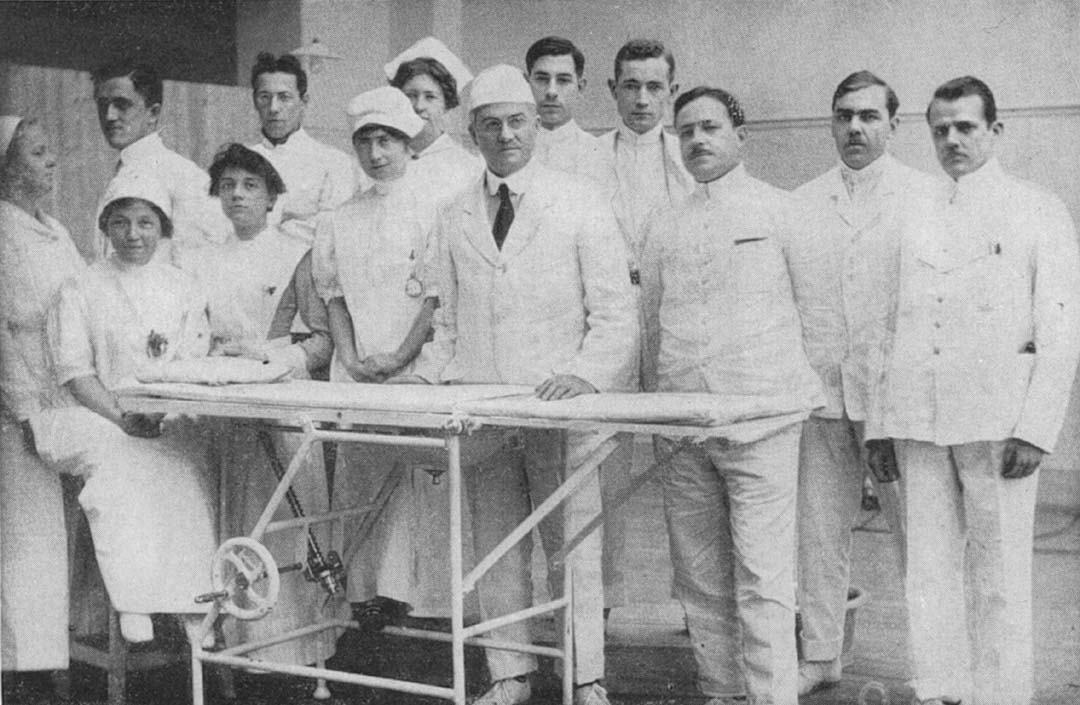 Dr. Crile and his staff-The Lakeside Unit, American Ambulance, January 13, 1915. "Today we are on duty!" |
THE RESEARCHES OF Pasteur and anesthetics were the foundations upon which the ingenuity of the surgeons of this generation based the development of a remarkably efficient surgical practice.
The good results were due largely to the achievement of asepsis and the control of shock and hemorrhage. But there still remained a great task, viz., the reclamation of a large group of handicapped patients that constituted the tables of mortality if operated upon, and if unoperated they remained unrelieved or died.
My researches had shown me that the central nervous system was a tissue of primary importance, that the vital force is dependent upon the state of the ganglion cells, and that impairment of these cells constitutes a serious handicap.
In our later research upon the pathologic physiology and cytology in surgical anemia, shock and anesthesia, Dr. Dolley and I had established a definite relation between the changes due to the trauma, anemia, and depth of anesthesia and the consequent physiologic alterations in the ganglion cells.
The chromatin-staining substance of the cells of the brain and the central nervous system apparently represented the objective evidence of the functional power of the cell, therefore the reduction of the chromatin-staining substance I believed represented overaction in response to overstimulation. In fatal cases there was in some instances total disappearance of the chromatin stain.
It was of course, not safe to infer modified function from modified form, but I was convinced that if a correlation could be shown to exist, there might be opened an objective method in the working out of a physical basis for altered function. In brief, I believed there should be a pathology for such states as anemia, shock, traumatic neurosis, etc., just as there was a pathology for fractures and tumors. This conviction naturally led to the belief that if, brain cells are handicapped prior to an operation, such cells must be given every protection during an operation.
In the entire domain of medicine no subject was at that time so neglected, so badly done and with such needless distress, not to mention direct and indirect disaster for its victims, as the administration of anesthetics. It seemed to me that we should expend at least as much care and skill on our patients as we did on the animals in the laboratory where we had employed an anesthetist for years. Furthermore, I was convinced that a nurse of ability would, because of her natural intuition, make a better anesthetist than a man. So I looked over the nurses on our Lakeside staff and decided that Miss Agatha Hodgins, the head nurse of the private pavilion, possessed the qualities necessary for such a responsibility.
One morning in 1908 while making rounds I drew Miss Hodgins aside and presented to her what amounted to an annunciation. She had received no warning whatever about the plan to make her my special anesthetist, but she told me promptly that she would undertake it if I would remember always that she was giving her best. This was the beginning of the first school of anesthesia in the world. Before we actually started it however, Miss Hodgins and I had our own experimental school. In order that she might become familiar with the symptoms of death, I started her to work administering anesthetics to rabbits and dogs. From anesthetizing rabbits she learned to anesthetize young babies. Her skill in amusing them with toys or my watch while she allowed the gas to play gently near the child's face until the sandman closed his eyes and he slipped back on the pillow was extraordinary.
In my early experiments in shock, I had observed the deleterious effects of ether and chloroform anesthesia. Ether, if deep or prolonged, produced a condition identical with that of surgical shock. When chloroform was used the animal usually died from respiratory failure. These experiments indicated to me that the poor condition of many patients after surgical operations, especially if they were prolonged, was attributable in large part at least to the harmful effects of the anesthetic.
My first attention clinically was called to nitrous oxide by the work of Dr. John Stephan and Dr. C. K. Teter. Dr. Teter had acquired a splendid empirical knowledge of the administration of nitrous oxide in his dental work and had invented an excellent apparatus bearing his name. A few administrations of this anesthetic by him for patients of mine were sufficient to indicate to me its clinical possibilities in my field, so I undertook a research in 1906 to ascertain if nitrous oxide gave better protection to the central nervous system than ether or chloroform.
In the laboratory I subjected animals in parallel series to the same shock-producing experiments of varying severity, anesthetizing one series with ether, the other with nitrous oxide. The changes in the ganglion cells of the central nervous system from the cortex to the cord showed a distinct difference between the cells in the ether and the nitrous oxide animals. The cells of the animals anesthetized by nitrous oxide showed much less change than the cells of the animals anesthetized by ether. This convinced me that nitrous oxide anesthesia in the hands of a skilled anesthetist might be the anesthetic of choice for major operations. So, in 1908, we began experiments to see whether or not, by the addition of oxygen to prevent the asphyxiating effects of too prolonged administration of this anesthetic agent, it could be used safely in major operations.
We found that by judicious mixture of oxygen with nitrous oxide, dogs would live for four hours or more and come out from the anesthetic with no evidence of shock. There was no increased respiration, and the blood pressure was but slightly altered. It remained for later experiments to show that the temperature of the brain was but slightly altered under the continuous administration of nitrous oxide-oxygen anesthesia, while it fell continuously under ether anesthesia.
About this time I had a revealing but embarrassing experience. I believed that nitrous oxide-oxygen anesthesia put the patient completely to sleep. While making rounds with my staff and some visiting doctors I asked an extremely intelligent woman who had had an abdominal operation under complete nitrous oxide-oxygen anesthesia what her memory of the event was.
She asked, "Shall I report everything?" Thereupon she began: "This is a white female, aged fifty-eight," and continued to give an exact repetition of the notes read by the intern while she was supposedly under full anesthesia.
I was so completely mystified as to how much one can remember in an unconscious state that when my dentist, Dr. John F. Stephan had occasion to do dental work for me we prepared a plan for testing the sequence of events going under and in coming out of gas oxygen anesthesia. I was to write the events on a pad of paper. At times Dr. Stephan would test my sight and hearing by tests known to me in advance, and I would either write the answers to his questions as long as I could, or I would write whatever sequence of thoughts came to me as a mere act of thinking.
Finally, I conceived the idea of endeavoring to divorce myself from all special sense or common sensation and maintain the process of thinking alone as long as I could, on the ground that by sustaining the continuous act of thinking I might the more accurately test the real activity of the thinking brain under anesthesia. I was the more encouraged to follow this line because dreams and mental processes are thought to proceed during sleep.
I found that pain and emotion disappeared at about the same level, and that beyond the pain and emotion level my mind continued in activity. My mind apparently did not leave my original train of thought which developed its trend and scope as the varying depth of the anesthesia identified former experiences. It was as if I were at last alone with my intellect and that I had identified the mind as purely mechanistic. There arose a feeling that it would be important if I could come out of the anesthetic and tell Barney that every anesthetized mind is mechanistic. It cannot create a new thing but it can reveal the laws that govern it. I considered the misfortune of losing the opportunity to tell this to Barney, for this truth might never be revealed to his mind; but if I could tell him he would hand it on to others.
This experience suggested to me that the mind is operated by higher potentials than the senses and that it continues active through life, whether awake or asleep.
But it also suggested to me the need to devise a method that would rob the day of operation of all disagreeable memory.
A method was worked out whereby small doses of scopolamine and morphine and atropine given one and one half to two hours prior to operation, together with nitrous oxide-oxygen analgesia formed so effective a combination that the edge of both the physical and mental distress was so dulled that no nocuous influence could register, yet the patient maintained his intellectual control.
Although I cannot recall the exact date that I first used nitrous oxide alone or supplemented with ether, I find, in looking over my case histories, I used it as early as August 21, 1900 at Lakeside Hospital for a urethrotomy, and two months later for a cholecystectomy. By 1903 I was using it in many of the hazardous risks in which ether was contraindicated---acute appendicitis, prostatectomy, operations for cancer and sarcoma, the anesthetic in each case being administered by Dr. C. K. Teter.
In 1909 I was able to report before the Southern Surgical and Gynecological Association that Miss Hodgins had administered nitrous oxide in 575 major operations, and in August 1911, I reported before the American Surgical Association, 10,787 surgical operations performed by me under either ether, or nitrous oxide supplemented by ether with no anesthetic death. I reported also the use of morphine and scopolamine as adjuncts to ether or nitrous oxide anesthesia in over three thousand operations.
At this time I stated, "could there be discovered a method of spinal anesthesia that one could use without reservation in the Trendelenburg posture, the entire question of shockless operations upon the abdominal viscera would be solved."
I have lived to see that day and not lone since, as I stood by our own Tommie Jones (Dr. Thomas E. Jones) while he performed under spinal anesthesia the difficult technic of the operation for cancer of the colon, in which he is master, I could not but experience a thrill of satisfaction that Ed Lower and I, so many years before in my dingy laboratory, had played a part in blazing the trail to spinal anesthesia.
The administering of an anesthetic is not only an art but a gift. In my mind it ranks close to the work of the operating surgeon. The nitrous oxide expert, for instance, must develop an anesthetic intuition. Oxygen is a pilot light to keep the flame of life burning safely. If the light burns too high, the patient immediately comes out from the anesthesia, if too low, the patient is too deeply submerged; if it is turned out, the patient dies. Yet with a steady flow of gas under constant pressure, the patient is carried easily through the narrow zone of anesthesia. Miss Hodgins made an outstanding anesthetist for she had to a marked degree both the intelligence and the gift.
From the very first day that I stole her from the private pavilion, the work developed rapidly. In the beginning the interns were none too willing to relinquish the work to a nurse. One day I came upon an intern putting a big, six-foot patient under an anesthetic while Miss Hodgins struggled to hold the patient down. On my suggestion he reversed the order of the procedure.
That was one of Miss Hodgins' earliest anesthesias. That first year both Dr. George Brewer and Dr. Charles Frazier sent a nurse to Miss Hodgins to be trained. Visiting surgeons impressed by our method of anesthesia asked to have their anesthetists trained by us or to have a nurse-anesthetist whom we had trained. Before we knew it, Lakeside had inaugurated its School of Anesthesia.
Then came the First World War and the service of the Lakeside Unit at the American Ambulance at Neuilly in 1914. The implication of that was enormous. We literally introduced gas-oxygen anesthesia into war surgery and into England and France. I recall the gratification felt when wounded soldiers asked for gas anesthesia. We used it in all painful dressings. Moynihan sent his anesthetist to Miss Hodgins to be trained and she trained several Frenchmen in the use of it.
One day a wounded Australian asked, "Are you goin to put me to sleep, Sister?" Miss Hodgins, who was training a young French doctor at the time replied, "No, the French doctor will." "My God," said the Aussie. "Then make it quick."
AMONG THE GREAT group of handicapped patients, none derived greater benefit from the newer methods of anesthesia, local, nerve block, and nitrous oxide than patients with goiter.
For many years the development of surgery of the thyroid gland was in the hands of a few surgeons. Of these, Professor Theodor Kocher of Berne was the greatest authority.
Dr. David Marine of Cleveland showed that the Great Lakes Basin and the Columbia River Valley form the two greatest goiter districts in the United States. In his researches, normal thyroid glands were so rare that Marine was obliged to obtain from the sea coast zones a number of specimens to form a normal standard.
But it was not until early in the twentieth century that active interest in the surgery of Graves' disease or exophthalmic (toxic) goiter was aroused by the results of Kocher, Mayo and myself. But Kocher's statistics did not include the toxic cases which at this time were considered practically inoperable.
The nonoperative treatment of Graves' disease had been greatly advanced by the brilliant researches of Beebe, constituting the most important therapeutic contribution in the history of the disease but up to 1905 when I attempted transfusion in a case of Graves' disease, no specific had been found and there still remained to be conquered the group of acute toxic cases which did not respond to medication and management, and when brought to the surgeon were no longer safe surgical risks. The thyroid crisis which follows in this class of case seemed to be the rock upon which our surgical craft had often been stranded. If the normal individual's psychical state is taxed heavily to face a surgical operation, what about a patient whose disease itself seems to be morbid fear?
Under excitation the phenomena of this disease are an exaggeration of all the symptoms of the disease, and the symptoms of the disease are a counterpart of the emotion of fear, viz., rapid pulse and heart tremors, breathlessness, sweating, crying. Patients suffering from exophthalmic goiter seem to be enveloped in an overwhelming nervousness, accompanied by an increase in basal metabolism. Associated with this increase in basal metabolism is an increase in the thyroid cells and a great increase in the vascularity of the thyroid gland. Significantly, the victim of exophthalmic goiter is hypersensitive to adrenalin, and adrenalin plays a major rôle in all of the strong emotions.
I had operated upon goiters from my early days as assistant in Dr. Weed's clinic. My first operative case for goiter was performed June 25, 1897. The thyroid had so enlarged that breathing was difficult. Under cocaine and morphine the enormous right lobe was removed. The patient made an uneventful recovery.
My second operative case of goiter was performed on April 5, 1898. The patient, a man twenty-five years of age had an enormous growth which extended from the jaw to the clavicle, pushing the trachea to the left. The internal jugular was thrombosed and the mass extended down and in under the carotid artery. The voice was hoarse and gutteral and the patient considered himself a monstrosity. He made a perfect recovery and his voice returned to normal.
As my own researches developed better methods of neck surgery, I removed many simple goiters and performed thyroidectomies on early cases of exophthalmic goiter under cocaine and morphine or under nitrous oxide anesthesia supplemented with ether anesthesia. As early as 1899 in a case of acute appendicitis in a patient suffering from mild Graves' disease, I had encountered my first thyroid crisis. When a thyroidectomy is successfully performed on a patient suffering from hyperthyroidism, all of the symptoms of the increased "drive" of the adrenal sympathetic system disappear and the patient returns to normal health.
In practical experience with these volatile patients I had found that conditions which aggravate the symptoms in this disease were such as are known to cause increased output of adrenalin; such as pain, emotional excitation, infection, asphyxia, inhalation anesthetics, and hemorrhage. Even the most minute injection of adrenalin into this volatile mechanism might cause so violent a reaction as to kill the patient, in an explosive outburst of activity.
Typical of those days, when surgery was being haltingly introduced as a treatment of Graves' disease was one of my early cases. At this time surgery had not glimpsed that in these desperate cases, too long treated medically, the ship had gone upon the rocks and it was only the wreckage with which the surgeon was dealing.
In 1905, I was called into consultation with Dr. C. F. Hoover, Professor of Medicine at Western Reserve University, by the father of a young doctor who had just returned from Leipzig. The father himself was a general practitioner, and the young man was a brilliant medical student. Due to his personal qualities and his high scholarship he had won honors beyond those of many other high-grade graduates from Harvard Medical School and, after graduating, had gone to Germany for advanced work. While in Leipzig he had contracted diphtheria followed by exophthalmic goiter which developed with startling rapidity.
This young physician had read all the meager literature on his disease and knew his plight. He knew that medical treatment offered little and that not infrequently disaster attended surgical approach.
The four of us discussed this problem in detail and concluded that for one month the patient should be kept at complete rest and under medical treatment. If no improvement resulted, operative measures would be considered. But this brilliant, emotionally driven, highly energized patient could neither rest nor sleep. From the moment we discussed the case with him, the disease increased. So rapid was its progress that within a week the psychologic drive of fear and uncertainty had made his condition grave.
Operation seemed to offer the only hope, and he, as well as his father, insisted that the chance be taken. In the light of subsequent developments and of what we learned later about the fundamental nature of this protean disease, the discussion of the case with this patient was a mistake.
In spite of sedatives he slept little the night before the operation. When he was brought to the operating room his pulse was 120. He was in a frenzy of excitement, and as he began to go under the ether anesthesia, he sang German student songs with almost violent enthusiasm. When he took the anesthetic his pulse rose to 218, so I decided to wait until he was well under full anesthesia before we risked the operation. The pulse fell to 180. Although fearful that the operation would be too great a risk we all agreed that in view of the great urgency we should proceed.
The gland was a mass of blood vessels, so soft and compressible that it felt more like an arterio-venous aneurism than a gland. The utmost care was exercised in its removal. The patient was in the inclined posture, feet down. There was little or no loss of blood. He passed through the operation entirely satisfactorily! The pulse remained between 175 and 185. The blood pressure fell from 150 to 135. Before returning him to his room we administered 700 cc. infusion of I-25000 adrenalin solution. He slept for four hours during which the pulse fell to 140 and the temperature rose to 105-1/2°. That night he died with a temperature of 109.6° without regaining consciousness since the inauguration of the delirium while going under the anesthesia.
Stunned by the overwhelming effect of this kinetic disease, I determined that should another patient suffering from exophthalmic goiter exhibit comparable emotionalism on being brought to the operating room, I would not attempt anesthesia but would return the patient at once to his room. Within ten days such an instance occurred.
A young woman, somewhat the counterpart of this young medical student in brilliance of mind, consulted me. She too had exophthalmic goiter. When brought to the operating room she was under such a storm of excitation, with such an extremely rapid pulse, that we returned her to her room without even an attempt at anesthesia and awaited a better opportunity. That opportunity never came. Her course followed the pattern of the young physician.
By the time this patient reached her room she was delirious and a crisis of hyperthyroidism was developing. She showed an outburst of activity of the disease unlike anything I had ever seen. It was like a detonation. The toxicity was progressive. The delirium soon faded into unconsciousness. Within eight hours the temperature reached 109° and rose one degree after death. This patient was chemically destroyed. We had not the slightest control over her destiny.
These two cases convinced me that exophthalmic goiter is a pathologic physiology of the mechanism by which the emotions are expressed. In the case of the young physician, I thought the misjudgment of continuing the anesthetic in the midst of such an outburst of emotionalism as occurred while he was taking the anesthetic, was probably the cause of the death, but in the case of the young woman I realized that in this disease the fear stimulus alone can cause death.
However, there was nothing in medical literature that elucidated this point. Kocher, evidently, had not attempted operation on such late cases. Other surgeons who had specialized in this field were operating with splendid success on subacute cases of Graves' disease (old adenomatous goiters with superimposed hyperthyroidism) but they too seemed to have not the slightest control ever the destiny of the acute toxic cases of the severest types---the seriously handicapped cases that most urgently needed relief.
As for myself, my ignorance as to what mysterious forces destroyed these two brilliant patients was complete, but written indelibly on my mind was the terrifying fact that the disease operated the identical mechanism that is operated in the expression of the emotions, and that the specific excitant of the exophthalmic goiter is the emotion of fear.
In order to study more closely the expression of the emotions as seen in men and animals and to evolve a method by which these handicapped patients, beset by fear might be helped, I turned back to Darwin and Huxley. It was reading that illuminating book The Expression of the Emotions in Man and Animals by Darwin that gave me not only a realization of the role that phylogeny plays in ontogeny and that disease as well as health is a part of the web of life, but also the suggestion to eliminate fear in my next case of hyperthyroidism.
The patient was a young woman of the acute toxic type who had been under observation for three weeks in Lakeside Hospital. The circulation was in an extremely unstable equilibrium; even slight exercise or psychic excitation caused dilation of the heart. The case seemed unpromising and from my former experience, hopeless, unless we could operate without her knowledge.
Having the consent of the patient for possible surgical treatment, her physician, Dr. J. C. Darby, and I decided to wait for a favorable opportunity to remove the thyroid without her knowledge, on the ground that hyperthyroidism may be psychically produced. We planned that there should be no mention whatsoever of an operation. On the day prior to it there should be as great elimination as possible, and on the preceding evening, a hypodermic of 1/4 grain morphine and atropine was to be given; the shades were to be kept drawn, and on the morning of the operation the moment she awoke she was to be given 1/6 grain of morphine with atropine. A little later when she became quiet, we planned to create a negative phase as nearly as possible by instilling homatropine into her eyes to interfere with vision and filling her ears with moist cotton to lessen hearing. When she was oblivious to her surroundings, I was to see her. If her condition was favorable, I was to tell her that we had arranged to give her an inhalation treatment in her room.
In reality this inhalation treatment was to be an ether anesthesia. When she was under partial anesthesia, we were to take her to the operating room where, if her condition were satisfactory, the operation would proceed in the ordinary manner.
The plan after operation was to administer large quantities of water to favor elimination and to continue to maintain psychic quiet by giving morphine.
This program was carried out on December 16, 1907 exactly as planned. The patient went to sleep peacefully. She neither remonstrated nor struggled. Although she was an extremely bad risk she came to the operating table and went through the operation with little change in her pulse rate, and she made an excellent recovery.
This experience convinced me that to conquer exophthalmic goiter, fear itself must be eliminated. The greatest factor in the mortality in these cases is not the operation, if well done, but what has occurred before the operation. I was certain that at the time the surgeon makes his first incision, the fate of the patient is sealed. Therefore, as we had proved in one case, the only safe method would be to "steal the gland."
We then proceeded to develop a plan of so protecting these handicapped patients from all nocuous influences that under the guise of an inhalation treatment and a dose of morphine, we could not only anesthetize them in their own beds without their knowledge, but we could also operate upon them in their beds. After this first operation we stole the glands of hundreds of patients and almost eliminated the mortality of this dread disease. In some instances the patients were discharged from the hospital without even the knowledge that a portion of their thyroid glands had been removed.
The importance of the emotions in this disease was impressed upon me over and over again. It explains one death which seemed inexplicable at the time. We had followed the usual procedure with this patient but from the moment that we began the anesthetic---under the guise of an inhalation treatment---we were utterly helpless in stemming the tide of hyperthyroidism that consumed her.
We learned later that a friend had told the patient she would know the morning she was to be operated on as the nurse would begin her "inhalation treatment" before she had eaten her breakfast. The gossip of that friend sealed the fate of that patient.
Already we had shown experimentally that death occurs whenever the brain cells are impaired to a certain degree, therefore it was not a surprise in an autopsy of a patient suffering from exophthalmic goiter who died without operation to find the same characteristic changes in the brain cells that were seen in the experimental animals that had died of infection, anemia, poisons, shock and fear.
Thus at last the brain cell studies plus our research in methods of anesthesia had established the principle of the shockless operation. But how describe the beneficent state of the patient who experiences no harmful association? I needed a word and saw that I must coin one.
Sherrington, the masterly physiologist, in The Integration of the Nervous System states that the individual responds to the stimulation of his motor mechanism through associative memory. If a given stimulus causes an association that harms the individual, it is a noci-association.
Now I knew that by blocking off the field of operation by a local anesthetic we were able to prevent the occurrence of physical changes of exhaustion in the nerve cells and hence to prevent the discharge of nervous energy which would otherwise be caused by the trauma. In other words, there would be no noci-association.
"Noci-association"---"anonoci-association"---here was the word for which I had been looking, so I adopted it in spite of the objections of Jim Mumford who was visiting me at the time. Mumford was a purist, he believed in the king's English and did not approve of coining words. But I was rather proud of "anoci-association" later contracted to anociation and now in medical dictionaries---because this was the only use I have ever made of the Latin that I learned from old Professor Houghton as we jogged along on accident calls through the streets of Irishtown on Whiskey Island.
Much fun was poked at anoci-association. Surgeons old in routine ways said I hypnotized my patients; others said I was a skillful operator and did not know it; but the critics sent their inoperable cases of exophthalmic goiter to me, and the men I trained attained in their own practice results equal to mine.
WHEN I WAS overseas in France in 1917, I often walked among the towering pines of Rouen. This forest was so thick that when I reached an étoile or resting place from which the tall pines had been cleared, I had difficulty in choosing which trail to take, as paths led from each point of the étoile to others that, in turn, led farther and farther on.
Thus has it ever been with my research. There has never been a resting place. The unknown is always beyond. The brain cell and anesthesia studies led to the establishment of the principle of anoci-association, which led to the consideration of the principal reason for the variations in the discharge of energy when different parts of the body are injured; which led to an investigation of man's phylogeny, his evolution as a species, in its relation to medical problems; and that catapulted me into a study of the emotions which, in turn led to the Kinetic Theory.
My first public discussion of man's phylogeny in relation to his ontogeny (his evolution as an individual) was before the Inquisitive Club and resulted in such a heated controversy that I knew I must have landed something. The members of this club were a number of the faculty of the Medical School of Western Reserve University, all of whom were interested in research problems. As the name suggests, the purpose of the club was to give the laboratory and clinical men equally, an opportunity to discuss informally problems under investigation. The plan was that each member should at some time take over a meeting and present his thesis, after which the meeting would be open to discussion.
Everyone was hopeful and enthusiastic. At the first meeting, the Professor of Physiology was head of the round table; at the second, the Professor of Pathology. It was then the turn of the Professor of Anatomy and, finally, my turn as Professor of Surgery. My thesis was that fear is a phylogenetic flight; anger, a phylogenetic fight; love, a phylogenetic embrace; and trout fishing and hunting, a phylogenetic procuring of food.
The spectacle of a captain of industry becoming emotionally excited over landing or losing a half-pound speckled trout which he has no interest in eating as he has no real hunger, could be accounted for, I maintained, only on the basis of his ancestral recall when a fish was the difference between starving and living. So commonplace is the eating of good food with this man that, instead of buying a steak, he travels a thousand miles to catch a trout that is inferior in food value to a steak. Stalking and struggling along the tangled banks of a rushing stream, wading in cold water, searching new pools, changing flies under the broiling sun or in the rain, becoming dirty, exhausted, he fishes on, tingling with disappointment when he loses a fish and triumphant when he lands one. In spite of the labor and the fatigue, the day is one of pleasure and rejuvenation, one in which the lingering wild man awakens the memories of the ancient days when life depended upon success in capturing food.
|
George Crile. 1910, at the time of the first European trip of the Society of Clinical Surgery. |
Dr. Crile and his staff-The Lakeside Unit, American Ambulance, January 13, 1915. "Today we are on duty!" |
I postulated that the speckled trout, living in a tangle of water cress, in a cold, swift stream or in foaming water splashing down a mountainside where it catches much of the twenty per cent rich concentration of oxygen in the air, as compared with the one per cent rich concentration in the quiet waters, is equipped with larger energy organs than the fish of the still waters. Hence, the speckled trout, like the salmon, puts up a hard fight, thereby sharpening the necessitous instinct for the procuring of food that still lingers in the wild inheritance of this fisherman.
At the meeting of the Inquisitive Club, I also presented the early results of my long research on anger and fear and traced these emotions to the phylogenetic stimulation of actual fight with, and flight from enemies. I compared the histologic results in emotional stimulation with the results in such physical injury as biting and crushing, and showed that, according to the findings of our researches, the mechanism by which motor acts are performed and the mechanism by which emotions are expressed, are the same. I stated that I believed the emotions to be primitive, instinctive reactions which represent ancestral acts, and the influence of phylogenetic experience to be so great that, although we may not meet an enemy today by actual physical attack, we clear the decks for action just as though there were to be a physical combat.
I enlarged upon the fact that when our progenitors came in contact with exciting elements in their environment, immediate action followed. Civilized man, I stated, is in autocaptivity. He is constantly subjected to innumerable stimulations and inhibitions and---although he is frequently prevented from physical action by custom and convention---his inhibited actions or emotions produce changes in the brain cells that are identical with those produced from exhaustion, physical injury and fighting.
I told how in our researches on animals and observations of patients in the clinic, we had found that under ether anesthesia stimulation, whether from emotion or actual physical injury, such a degree of excitation or stimulation of the brain results that the outburst of activity is followed by exhaustion of the brain cells which, carried to extreme, ends in death.
This long line of experiments was, of course, new. None of the professors of physiology, anatomy, or pathology had followed them or had realized that the applications of these observations to human beings had led me to establish the principle of the shockless operation. The session began quietly. After my presentation I showed lantern slides of the photomicrographs of the studies of the cells of the brain and various organs in shock, in fight, in fear, in fatigue; and clinical charts of some of the raging mechanisms in exophthalmic goiter. The discussion quickly developed an atmosphere of tension which reached a climax when I related the emotions to the long past---to the wild man within us. Finally the session became so bitter that at two in the morning the chairman adjourned the meeting. Oddly enough, this meeting itself produced a phylogenetic recall. It left such a deep feeling that the Inquisitive Club could never meet again. On every other ground my critics and I were the best of friends, but the idea that emotion is a phylogenetic recall was tabu with all save a small group of clinical men. The intense feeling in this intellectual group of scientific men, supposedly trained to look at life biologically, had in its reaction proved my theory.
After this experience I was eager to present my conclusions to the medical profession so when I was invited to give the Ether Day address at the Massachusetts General Hospital in Boston on November fifteenth of that same year (1910), I chose as my subject "Phylogenetic Association in Relation to Certain Medical Problems."
As a tryout I submitted the title to Jim Mumford who answered, "I have not read the manuscript but I have read the title upon which listen to the following reflections. The title is a mighty lever, George, as well as a big stick. It should fall firmly, quietly, gently, cogently upon the heads of one's listeners. What, think you, will be the sensations of your audience in Boston when they receive, full in the face, 'The Discharge of Nervous Energy on the Law of Phylogenetic Association in Relation to Certain Problems in Medicine'? I have shown this title to three or four men who have fled, disconsolate."
So spoke my friend. As it was too late to change, I decided to do what I could in spite of the title. In part I said:
"When a barefoot boy steps on a sharp stone there is an immediate discharge of nervous energy in his effort to escape from the wounding stone. This is not a voluntary act. It is not due to his own personal experience---his ontogeny---but to his phylogeny, the experience of his progenitors during the vast periods of time required for the evolution of the species to which he belongs. The wounding stone made an impression upon the nerve receptors in the foot similar to the innumerable injuries which gave origin to this nerve mechanism itself during the boy's vast phylogenetic experience. The stone supplied the phylogenetic association and was followed automatically by the appropriate discharge of nervous energy. If the sole of the foot is bruised or crushed repeatedly by the stone, shock may be produced. If the stone is only lightly applied there is a discharge of nervous energy from the sensation of tickling. The body has implanted within it in a similar manner other mechanisms of ancestral origin whose purpose is the discharge of nervous energy for the good of the individual."
After discussing the effect of trauma under surgical anesthesia, upon the medulla, and recapitulating the results of my experiments with anesthetics which showed that ether offers to the brain cells little or no protection from trauma and is, so to speak, but a veneer; and that with equal trauma there is approximately only one fourth the exhaustion under nitrous oxide as under ether, I discussed the causes of the exhaustion of the various cells under trauma and concluded that whether the nerve energy of the brain is discharged by injury under anesthesia or whether by ordinary muscular exertion, identical morphologic changes are seen in the nerve cells. In shock from injury, in exhaustion from overwork and in exhaustion from pure fear, the general functional weakness is similar---in each a certain length of time is required to effect recovery, and in each there are morphologic changes in the brain cells. It is quite clear that in each of these cases the altered function and form of the brain cells are caused by an excessive discharge of nervous energy.
This brought me to the question: What determines the discharge of energy from trauma with or without inhalation anesthesia? Through our experiments with animals we had established that in ether anesthesia without trauma there were neither the characteristic physiologic exhaustion after the anesthesia had worn off nor characteristic changes in the brain cells. Turning to trauma, in a study of the behavior of patients under deep and light anesthesia, we found the cue to the discharge of energy, the consequent physiologic exhaustion and morphologic changes in the brain cells.
"If, in the course of abdominal operations, rough manipulation of the parietal peritoneum is made," I continued, "there is frequently observed a marked increase in the respiratory rate and an increase in the expiratory force, even to the extent of an audible expiratory groan. Under light ether anesthesia severe manipulation of the peritoneum often causes such vigorous contractions of abdominal muscles that the operator may be greatly hindered in his work.
"Among the unconscious responses to trauma under ether anesthesia are purposeless moving, withdrawing of the injured part, and if the anesthesia is sufficiently light and the trauma sufficiently strong, there may be an effort directed toward escape from the injury. In injury under ether anesthesia every grade of response may be seen from the slightest change in the respiration or in the blood pressure to a vigorous defensive struggle. As to the purpose of these subconscious movements in response to injury, there can be no doubt. They are efforts at escape from the injury.
"Can anyone picture the actual result of a formidable abdominal operation extending over a period of half an hour or more in an unanesthetized human patient if extensive adhesions are broken up or if a large tumor is dislodged from its bed? In such a case would not the nervous system discharge its energy to the utmost in efforts to escape from the injury, and would not the patient suffer complete exhaustion? If the traumata under inhalation anesthesia are sufficiently strong and repeated in sufficient numbers, the brain cells will finally be deprived of their dischargeable nervous energy and become exhausted just as they are exhausted following a strenuous and too prolonged muscular exertion.
"According to the doctrine of evolution, every function owes it origin to natural selection in the struggle for existence. The mechanisms for self-defense which we now possess were developed in the course of vast periods of time from the lowest forms through all the intermediary stages to our present estate. One would expect, therefore, that we are now in possession of mechanisms which still may discharge energy on adequate stimulation but are not suited to our present needs.
"On the basis of natural selection, only the regions of the body that have been exposed to injury during long periods of time could have developed noci-ceptors (receptors for pain). On this ground the finger, because it is exposed, should have many noci-ceptors while the brain, though the most important organ of the body, because for a long period of time it has been protected by a skull, should have no noci-ceptors. Dr. Sloan and I verified this in my laboratory. The cerebral hemispheres of dogs were exposed by removal of the skull and dura under ether anesthesia and under local anesthesia. Then various portions of the hemispheres were slowly but completely destroyed by rubbing with a piece of gauze. In some instances the hemisphere was destroyed by burning. In no instance was there more than a slight response of the centers governing circulation and respiration, and there was no morphologic change noted in a histologic study of the brain cells of the uninjured hemisphere.
"Clinically I have confirmed the experimental findings in the course of exploration for brain tumor with a probe in conscious patients. Such explorations elicited neither pain nor evidence of altered physiologic functions. The brain, therefore, contains no mechanisms, no noci-ceptors---the direct stimulation of which could cause a discharge of nervous energy in a self-defensive action.
"The various tissues and organs of the body are differently endowed with injury receptors. The abdomen and chest, when traumatized, stand first in their facility for causing the discharge of nervous energy, i.e., they stand first in shock production. Then follow the extremities, the neck and the back. It is an interesting fact that this physical type or that physical type of trauma elicits different responses as to the discharge of energy. Because it is such a commonplace, one scarcely realizes the importance of the fact that clean-cut wounds made with a razorlike knife cause the least reaction, while a tearing, crushing trauma causes the greatest response. It is a suggestive fact that the technic of the carnivora in fighting each other and in killing their prey makes probably the most efficient shock-producing trauma known. In the course of evolution this may well have been the predominating type of trauma to which our progenitors were subjected.
"The discharge of energy caused by an adequate mechanical stimulation of the noci-ceptors is best explained in accordance with the law of phylogeny and association. That is to say, injuries awaken such reflex actions as have been developed by natural selection for the purpose of self-protection.
"Adequate stimulation of noci-ceptors for pain is not, however, the only means of causing a discharge of nervous energy; it may be discharged also by adequate stimulation of the various ticklish regions of the body. The entire skin surface of the body contains delicate ticklish receptors which are closely related to the noci-ceptors for pain. Their adequate stimulation by an insectlike touch causes a discharge of energy---a nerve muscular reaction-resembling that of brushing off insects. This reflex is similar to the scratch reflex elicited in the dog; it is almost wholly independent of the will and is a self-protective action in the same sense as is the response to pain stimuli.
"The ear in man and animals is acutely ticklish, and so also is the nasal chamber. The discharge of nervous energy in horses and in cattle on adequate stimulation of the ticklish receptors of the ear is so extraordinary that in the course of evolution it must have been of great importance to the safety of the animal. The other ticklish points which are capable of discharging vast amounts of energy are the lateral chest wall, the abdomen, the loins, the neck and the soles of the feet. The type of adequate stimuli of the soles of the feet, the distribution of the ticklish points upon them, and the associated response leave no doubt that these ticklish points were long ago established as a means of protection from injury. Under present conditions they are of little value to man.
"The adequate stimulus for the ticklish points of the ribs, the loins, the abdomen and the neck is deep isolated pressure, probably the most adequate being that of a tooth-shaped body. The response to tickling in these regions is actively and obviously self-defensive. The horse discharges energy in the form of a kick, the dog wriggles and makes a counterbite; the man makes efforts at defense and escape.
"There is strong evidence that the deep ticklish points of the body were acquired through long periods of fighting with teeth and claws. Even puppies at play bite each other in their ticklish points and thus give a recapitulation of their ancestral battles and of the real battles to come. The mere fact that animals fight effectively in the dark and always according to the habit of their species, supports the belief that this is not an intellectual but a reflex process.
"A close analogy to this reflex process in the fighting of animals is that of the sexual receptors in conjugation. Adequate stimulation of these two distinct groups of receptors, the foci and the sexual, cause specific behavior, the one toward embrace, the other toward repulsion.
"According to Sherrington's law, the individual as a whole responds to but one stimulus at a time: only one stimulus occupies the nerve paths which perform acts, that is, the final common path. As soon as a stronger stimulus reaches the brain it dispossesses whatever other stimulus is then occupying the final common path, the path of action. The stimulus of a fly on the nose, for instance, would be superseded at once by the crushing of a finger. In quick succession the various receptors occupy the final common path, but each stimulus is for the time always the sole possessor, hence the nervous system is integrated to act as a whole. Each individual at every moment of his life has a limited amount of dischargeable nervous energy. This energy is at the disposal of any stimulus that obtains possession of the final common path. Each discharge of energy is subtracted from the sum total. If it is large enough, it produces exhaustion. Apparently there is no distinction between the state of exhaustion which is caused by the discharge of nervous energy in response to trauma and that caused by other stimuli. On this conception traumatic shock takes place as a natural phenomenon and is divested of mystery. . .
"In regard to the discharge of nervous energy through mental perception we find evidence in experimental research. that the physiologic phenomena of fear have a physical basis. This evidence is morphologic alterations in the brain cells similar to certain stages of surgical shock and of fatigue from muscular exertion.
"An analysis of the phenomena of fear shows that, so far as can be determined, all of the functions of the body requiring the expenditure of energy and which are of no direct assistance in the effort toward self-preservation, are suspended. In voluntary expenditure of muscular energy, such as in the chase, the suspension of other functions is by no means so complete. Fear, hence trauma, may, therefore, drain to the last dreg the dischargeable nervous energy; therefore, the greatest possible exhaustion may be produced by fear and trauma. This is a distinction between fear and desire.
"There is also another factor that influences the discharge of energy. I refer to summation. This is attained by the repetition of stimuli at such a rate that each succeeding stimulus is applied before the nerve cells have returned to the resting stage from the preceding stimulus. 1f drops of water fall upon the skin from a sufficient height to cause the slightest unpleasant sensation and at such a rate that before the effect of the stimulus of one drop had passed, another drop falls in precisely the same spot, there will be felt a gradually increasing painful sensation until it becomes unbearable. This is summation. When a patient requires for a long time frequent painful wound dressings, there is a gradual increase in the acuteness of the pain receptors. This also is summation."
Having thus summarized the evidence in support of the hypothesis that the discharge of nervous energy is accomplished by the law of phylogenetic association, I pointed out that anoci-association which excludes fear, pain, shock and postoperative neurosis, is a new principle in operative surgery. I showed its application to certain diseases such as Graves' disease, sexual neurasthenia, infections and certain diseases of the abdomen, possibly of hay fever and the common cold.
In conclusion I said of anoci-association, "It places on a physical basis certain of the phenomena of fear; it explains to us the physical basis for the impairment of the entire individual under worry or misfortune and it explains the power of therapeutic suggestion and other influences which serve for the time to change the physical basis for the difference between hope and despair. It should teach us to view our patients as a whole; and especially it should teach the surgeon gentleness. It should teach us that there is something more in surgery than mechanics, and something more in medicine than physical diagnosis and drugs."
THE FIRST YEARS of my married life revealed many interesting characteristics of the Chief. One was that every phase of life had to be organized.
When he returned home from a day's work nothing interrupted his beeline to a hot bath and he always put on a tuxedo for dinner. But, when he removed them at night, if by chance he left his evening clothes hanging on his clothes tree, absent-mindedly he would put them on again in the morning. Sam Ledbetter, one of his Lakeside "boys" once said, "I can always tell when Mrs. Crile is ill or out of town as the Chief arrives at the hospital in evening trousers and a light coat."
When we were in the Orient on our wedding trip, the Chief fancied the heavy pongee suitings used by the English throughout the tropics and ordered three suits. From then on, although most men wore dark suits all summer, he affected the lighter shades, believing that the dull drabs so often worn by physicians are depressing in the sickroom.
I soon learned that color meant much to the Chief, and tie, handkerchief and socks had to match, a result impossible to achieve, however, unless everything was laid out for him. Soon after returning from our wedding trip, I asked: "Did Ed Lower organize your dressing before you were married? I recall when I first saw you in business clothes you were wearing a wine-colored tie, with socks, handkerchief and even a carnation to match! How did you do it?"
"Oh! God no!" he replied. "The club had a fine housekeeper and I trained her, just as I'm training you!"
But although I was being trained, it was fun. I was always a free lance and he was never wanting in appreciation.
One hot summer day when wearing a white suit and a blue pinstriped shirt he came in quite seriously and said, "Grace, are you dressing me up like a dude?" I laughed aloud and said, "Why no! Why?" "Well," said he, "a nice-looking man stopped me on the street today and, begging my pardon, asked me where I bought my shirt." "What did you tell him," I asked. "I told him he would have to ask my wife and I gave him your telephone number," he replied.
The Chief could remember that he was wearing a gray overcoat, but any gray overcoat, so long as it fitted him, served the purpose. We had so many amusing experiences that I felt much cheered over an incident that occurred when Dr. E. A. Codman, of Boston, visited us. After he left we could not find the Chief's raincoat which had been hanging in the coatroom. Inquiry disclosed the fact that Dr. Codman had a coat when he left, but no one could recall that he had had one when he arrived.
I wrote Dr. Codman, but there was no strange overcoat in his possession. The next spring when his wife was shaking out the mothballs she found a coat bearing the Chief's name plate!
So perhaps the quality of seeming dependence in a surgeon is a characteristic of a profession habituated to extending a hand and having an instrument placed in it.
I recall once when Dr. Robert Coffey, of Portland, visited us and, fumbling in his pocket before dinner, said to his wife, "Ellen, you didn't give me a handkerchief." "I laid it on the bed, Bob," she replied. "But you didn't put it in my hand," he observed.
But it was pajamas when travelling that eluded the Chief. He finally organized his shortcoming by saying he would wear only pink ones and all were to be made from the same material.
Those pink pajamas became notorious. I have known him to oversleep on the train and with an overcoat over them, come home in the morning, or with riding boots drawn over them canter through the meadows glistening with dew.
It was in his pink pajamas while sitting in a canoe at Algonquin Park that he wrote his Ether Day Address; and in Africa, in the early dawn I would often miss him, to see him in his armchair on the veldt---in his pink pajamas---writing.
But on these occasions he always wore a tie: A tie to the Chief was the hallmark of a gentleman. An open-neck shirt was unthinkable. With a dressing gown he wore a scarf. When ill, if he was to sit up to see visitors, he insisted upon wearing a tie and a bed jacket.
In many ways the Chief belonged to the old school. Courtesy and certain formalities were innate with him. No matter how warm the weather, to sit down in shirt sleeves was tabu: whether at the Knob, the Shooting Club, Castalia, Paradise Island or on safari---the Chief always reached for his coat!
The razors, I confess, flabbergasted me. There was a box of them, one for each day in the week, and when "Tuesday" was dull, I had to take it to the instrument makers to be sharpened.
Then his purse---it was an old-fashioned one which opened two ways and was worn in the hip pocket. Each side had five compartments to hold twenty-, ten-, five-, two- and one-dollar bills, and the Chief insisted that each bill be folded separately.
Once a police officer came to the Clinic and said, "Dr. Crile, I have a strange request: May I see your purse?" When the Chief handed it to him he opened it and remarked, "That is exactly as it was described." It seems a noted criminal had been apprehended in another city and in the course of the investigation he had spoken of Dr. Crile as if he knew him, stating, as an ultimatum, "I can even describe the unique way he carries his money"---then he described his old-fashioned pigskin purse and tightly folded bills of various denominations.
But I soon learned that criminals and lunatics go and come in a surgeon's life. I recall the fear everyone felt at Lakeside when one of Blinky Morgan's gang was a patient of the Chief's and the surprise we all felt that he was docile and, mild, just like everyone else, when down and out.
In 1901 the Chief, who was serving as Surgeon to Troop A Battery, Ohio National Guard, participated in the inaugural ceremony of President McKinley. In a letter to me he wrote: "We were in the saddles at nine in the morning and were not relieved until half after four. The cold rain made it uncomfortable but Troop A did itself proud.
"To me the entire inaugural ceremony has been more of an American character study than anything else. As a people we cannot do public ceremonies, and should either make them simple or absolutely formal, in which case they should be in the hands of some permanent official department, such as the Army or Navy. The inaugural ball reminded me of a trip to a downtown fire or an ambulance call in a crowded district."
During this trip he also wrote to me: "Your letter yesterday gave me a world of pleasure, surpassing even those after our engagement, when everything was opening to us. But now, newer fields, so greatly surpassing the old, are ours. It seems almost too sacred to mention, as if something might lessen it, if the gods knew!
"But dearest 'Brickie,' the year has told its story and has given assurance of the future. I would not dare to wish it to bring more."
In early 1906 the Chief, my brother Donald, and I sailed to Jamaica for a short holiday, Dr. Milliken, then Dean of Western Reserve Medical School, and Dr. George Stewart, the well-known physiologist, joining us.
Instead of enjoying balmy breezes we were caught in one of the worst hurricanes experienced on the eastern coast and were blown far out of our course. When the storm abated, Dr. Stewart, a dyed-in-the-wool old bachelor, sat day after day at the stern of the ship in deep contemplation, mulling over some great physiological problem we supposed, although occasionally he would ask a ship's officer how long it took for a letter to reach Jamaica from England.
When we reached Port Antonio and found no mail, Dr. Stewart, moody and preoccupied remained at the hotel, the rest of us visited interesting points on the island. Dr. Milliken and the Chief were worried, lest Dr. Stewart might be undergoing a nervous breakdown.
Upon our arrival in New York he rushed to inquire for mail, then before we had even located our luggage, announced he had arranged for accommodations and was leaving immediately for England.
When he returned to America, he brought with him a bride!
In congratulating him the Chief said, "Remembering my own restive days in Russia when I left the girl I loved behind me, I had great understanding of your predicament, Stewart, but what I think you should do as a physiologist is to interpret the physiologic effect of such a predicament upon the nervous system in the next edition of your textbook on Physiology."
The Chief took great delight in the development of his children. The story hour was always when "Daddy comes home," and the vicissitudes that befell Peter Rabbit, Molly Cottontail, Brer Rabbit and Alice in Wonderland became quite as much his concern as Margaret's and Elisabeth's.
In the early spring of 1907 my mother not being very well, I accompanied my father and mother to Lakewood, New Jersey. In a letter to me the Chief described some of the difficulties and joys of this period:
Margaret and Elisabeth are undoubtedly in good health, but just how the house or furniture will survive, I can't as yet predict.
I have now evolved a system of discipline, but find it difficult.
I do enjoy those blessed babies and am just impatient for our third, now on "his" way.
The other night I overheard the following conversation, while Helen was urging Margaret to hurry with her bath---Helen---"I don't think you really care for me Margaret, because if you did, you would hurry when I tell you that Lulla has a hard headache."
Margaret---stopping utterly, to discuss the matter---"Yes I really do Lulla. Don't you remember what I told you one day?"
Helen---"No, I don't. What was it?"
Margaret---"Why don't you remember I told you I'd take care of you when you are old?"
Helen---"Well! I'd rather you do what I ask you to do, than take care of me when I'm old. I may never live to be old."
Margaret---"Oh well, if you don't, I'll build you a monument because you have no mother to make you one."
Helen---"I'm not sure that I care for a monument, Margaret. I only want you to hurry."
Margaret---"But Lulla, you must have a monument. Everybody has a monument. I'll make you one anyway and do you know what I'll put on it?"
Lulla---"No what?"
Margaret---"I'll write---No one can take her place."
How can one discipline such a child? Every night the children and I exchange stories. Yesterday Margaret was telling me one, with Elisabeth in the audience. It ran thus---"Once upon a time there was a fire, that burned up all the cities in the world, then it burned up the world and--and---then it burned up the sky" (Elisabeth meanwhile looking more and more astonished) "and finally-it burned up heaven"; whereupon Elisabeth inquired, "Did Jesus climb out of the window?"
The Chief and my father used often to go fishing or duck hunting together. On one of these occasions the Chief wrote:
"In memory I shall always like best to place the Governor on the banks of the Castalia Trout Stream which we have so often whipped together and fish or no fish, for others his creel is always filled; or in a blind in the marshes at Winous Point, near Sandusky Bay, waiting for a flight of mallards and after the day's sport enjoying a cocktail of rare mixing in his adept hands with oysters that he fried in the hot coals at the bungalow. He is a rare comrade, a master fisherman and hunter, and a great pal of mine."
Of the Castalia Trout Club the Chief once wrote:
"The geological formation of northern Ohio is such that a stratum of limestone lies under the surface allowing subterranean streams to form. Such a subterranean stream comes to the surface at Castalia, near Sandusky, in a large, even flow of cold water and is ideal for speckled and brook trout.
"The Castalia Fishing Club consisted of about twenty fishermen and philosophers who commuted from Cleveland, Pittsburgh, Toledo and even Chicago for their favorite pastime. The main preoccupation of the membership was the theory and art of fishing, the indoor discussions of which continued diurnally the fifteen years during which I was a member. After discussions lasting four years, it was decided to introduce the brown trout. But the brown trout soon became a bottom-feeder. It grew so large and took so many brook trout in its stride, that the members of the Club became so anti-brown trout that they determined that they would destroy their spawning beds. After fifteen years of constant effort, the brown trout continued to thrive.
"Then, these fishermen-philosophers decided to introduce water cress into the stream, because the water cress would form a shady shelter for the small fish.
"But the richly oxygenated cool water caused the water cress to grow with unexpected vigor. It filled the bottom and sides of the stream, in places choking the flow of the water. It also became the home of millions of snails and small crabs, that yielded such a luscious and unexpected biologic table that all the trout became bottom-feeders, neglecting the flies of the fishermen.
"After hearings from the Stream Committee it was decided to put in a hatchery as there was evidence of a falling off of trout in the stream. Although millions of small fry were turned into the stream, these captains of industry---bankers, lawyers, doctors, found that the census of mature fish remained at a very low level. The judgment was that the big fish ate the little fry, so the little fry were no longer turned into the big stream, but instead were tenderly cared for in nurseries, where they were given vitamins, shade, shelter, an even temperature, in fact, every attention except a health examination.
"When the proper time came, these young adolescents were introduced as at a debutante ball, into the main stream. But the fish census remained the same.
"Could the fish live in the vast ramifications and dark recesses of the water cress or did the water cress exert some adverse influence on the trout's desire for food?
"These two influences, it was argued, were the only ones that could interfere with a natural increase in the fish census, so it was decided to rid the stream of water cress, and the membership was heavily taxed in order to provide for a two-year program of exterminating it by raking the bottom and the sides of the stream.
"One day, to the fisherman's surprise, a snake took his fly. Noting a tumor-like deformity, the snake was submitted to a post mortem examination. Three young fish were found in its stomach. This ugly fact rocked the club. A bounty was at once put upon water snakes. The next season's toll of water snakes was 1,329-far greater than the catch of fish, either in numbers or in weight.
"What caused the excitement was not so much that a water snake had swallowed three small trout, but that the Club had been suddenly introduced into the very most fundamental problem in life, the principle of natural selection.
"With utmost diligence on the part of the bounty-seekers, it required several years before the snake catch fell below the trout catch. Meanwhile, a member called attention at a hearing to the fact that the kingfishers seemed to be more numerous than before along the carefully guarded trout stream, more numerous than in any other part of the Great Lakes territory. A bounty, therefore, was put upon the head of a kingfisher and the weight of the kingfishers for that season was greater than the weight of trout taken by members and guests of the Club.
"In the following March a flock of merganser ducks---over four hundred of them---swooped down on the trout stream. Since the members of the Club through heavy dues had by this time become natural-selection wise, they found that the many floats along the stream, which they had built to serve as retreats and shelters for the trout, were apparently made for the merganser ducks, who dived under them and took toll of vast numbers of the larger trout. These events lowered the suspicion against neighboring farmers and village people, as these natural poachers---the snakes, the kingfishers, the ducks caught far more than all the members of the Club, and their guests.
"Overcome with the power of truth and disillusionment, the Club settled down to the purchase of tank loads of trout from western New York State.
"Thus the once unique speckled trout stream was denatured on account of the necessity of having vigilantes against fellow enemies---the brown trout, water cress, water snakes, kingfishers, merganser ducks, and the Stream Committee."
The Governor was also a great cook. His results with a chafing dish so intrigued the Chief that he wasn't content until he too could produce Welsh rarebit, chicken à la king, pigs in blanket and lobster Newburgh.
Then Sunday evenings with such friends about the table as Dr. and Mrs. Edward Cushing, Dr. and Mrs. William Howard, Dr. and Mrs. Charles Hoover, Dr. and Mrs. Hunter Robb and Dr. and Mrs. George Stewart became memorable evenings of good talk and inimitable stories---while the Chief glowed with pride over his chefs-d'oeuvres.
Barney was nearly seven when my father died. Barney was the first grandson and he and his grandfather had been great pals and had often fished together at Castalia.
The Chief was anxious that his death should not leave a mystery in Barney's mind, so he called his attention to the death of the leaves in the autumn and how they fall from the trees and disappear into dust.
Barney replied, "That's what happened to Grandfather. He just went into his chemicals."
When telling me of it the Chief said, "I left it that way---realizing once again the natural logic of a child's mind."
One of the ways in which the Chief appealed to this natural logic was in the weasel stories that he used to tell the children at the breakfast table. Whether this was a means of getting them all down in the morning and off to school on time, or whether it was a spontaneous expression of his extraordinary imagination I have often wondered, but in any case, none of them missed the morning story.
In these stories a family of weasels bearing the names of the individual members of the family and symbolically representing them passed through the most amazing adventures. Each morning one or all of them would be left in a precarious situation, from which there seemed to be no possible escape. Their adventures included contact with every known animal, set in a background of Jules Verne science.
They fell into a crater and were left whirling about the Magnetic Pole. They took trips to the moon, where they slid down the tense whiskers of the man in the moon so fast that each whisker emitted a musical note pitched in accordance with the size of the weasel, the whole constituting a musical chord---the music of the spheres, as the Chief called it!
At this time the Chief was writing on phylogeny and adaptation. Floating idly on the lake, during a camping trip in Canada, he wrote incessantly. To have time to write was his conception of a perfect holiday.
But perhaps the most vivid among the children's memories were the biological problems which the Chief gave them to solve.
These problems were presented to the family as a whole, and a quarter was given to the child who gave the correct answer. Among them I recall the following: Why does a cow chew its cud? Why in deer and antelope do the males usually have the horns? Why does a man shrug his shoulders? Why does man pout? Why is your chest high when you fight? Why does a robin pretend to have a broken wing? Why does a salmon have a white belly? Why do birch trees outstrip the pines in growth? Why is the growth of trees stunted in the North? Why does it rain more often in the mountains than in the valleys? Why do wild flowers bloom before the leaves are out?
To impress the children that there was no need for superstition or fear he would sometimes go to great lengths. Once I recall we were sitting in a little summerhouse at the Knob---open to the elements on all sides---in the midst of a terrific electrical storm. We were at the top of the highest hill in the neighborhood and commanded a magnificent view of the forest below. The lightning was striking all about us and the children were uneasy. After a close thunderclap the Chief laughing said, "Why I just defy that lighting to strike us." We laughed and felt reassured, but just then a bolt of lightning made matchwood of a tree not ten feet from where we sat. "You see," he said, "it missed us." But we all went inside.
The Chief drove the boys to school every morning. He trained them either to be in the car when he was, or run for it. He had many amusing near-accidents with his cars. Once while travelling along Euclid Avenue at a good clip, the steering knuckle on his Stearns broke and he found himself mounting the curb, just making it through a gate and across a grassy lawn, the car finally coming to rest on its side halfway down an abandoned well. He crawled out of the window, walked to the street and thumbed a ride to the Knob, while the owners of the property looked on in amazement from the front porch.
Another time when a traffic jam kept him from getting to the hospital for an emergency operation he left his car in the middle of the crowded thoroughfare and walked, and once when hit and partially overturned by a streetcar, he managed to jump out so quickly that when the crowd gathered he wondered with them who the owner was.
He was always being nearly arrested but when the policemen saw who it was they always forgave him as he had operated on so many of their families.
Barney's pony when he was a small lad, then Bob's, and Sam the police dog, were the ones to take the dust from the heels of the Chief's hunter. Sometimes there were twenty or more of us on those Sunday morning rides at the Knob-the Chief in the lead, the family and the children of the neighborhood in between, and I at the rear, to pick up those who fell off----all of us galloping pell-mell, up and down deep ravines, splashing through clear brooks and across wide meadows. Then back to the Knob for a swim and one of Mary Belle's and Jack Kilmurray's chicken dinners. Such were our week ends at the Knob, and when the grandchildren came along, they too had their mounts.
The Chief's greatest hobby next to research was horses. He had been used to horses all of his life. His ideal horse was one which he could never quite control and the children all learned to ride, by following his uncontrollable flights over Lake County. For a number of years he had a horse named "Iron Duke," a beautiful animal with the muscles of a Percheron and a hard mouth. All Duke wanted was to take the bit in his mouth and run in a straight line, over, through, or under all obstacles. The Chief loved to tussle with him. One day he pulled up in a field that was surrounded by three solid walls of underbrush and announced that he was going to test Duke to see just how far he would go, the test being based on the premise that he would stop at the woods. We watched them fly across the field straight for the thickest part of the underbrush through which they both disappeared. For years we used that path as a trail---the Chief calling it "Duke's Pass."
All men who are busy are absent-minded to a degree. The Chief's mind was so occupied with problems that his everyday actions were often automatic. He always wore exactly what was put out for him and the children all had to watch him when I was away to see that he was properly dressed. He was never able to salvage his pajamas from a train and sometimes forgot his suitcase. He never bought anything for himself. I always arranged for everything.
Names he didn't attempt to remember---but he could recall the number of the room a patient was in, years after he had operated upon her and every angle of her problem. Often when there was a group of visiting doctors at the Clinic at the end of a morning's operations he would invite them to the house to dinner and ask them to tell his secretary whether or not he might expect them. Invariably when he came home he'd say to Gertrude, as she opened the door, "I don't know what has happened. I have two more than I expected. Please ask Mrs. Crile to come down and introduce herself, so we'll know the names!"