Letters of
CASPAR HENRY BURTON, JR.

The War, continued

Duchess of Westminster's Hospital.
No. 1 Red Cross,        
Le Touquet, May
29th, 1917.

JUST a line to tell you that I will be in England about the end of this week. Have been X-rayed and have many small splinters and two medium-sized ones scattered pretty well all over my left lung. My spine is uninjured and I am sitting up and turning about by myself and really feeling fine. In fact I am very much better than I have any right to be. Go to the Ritz and I will let you know where I am as soon as I arrive in England. Don't get wind up; there are several hundred thousand men in France sighing for a wound just like mine. More later.

Love,               
CAP.


Duchess of Westminster's Hospital,
May
30th, 1917.

DEAR MOTHER,

I AM still doing splendidly. I must tell you at length of this amazing Hospital. It is the dernier cri in fanciness. There are more good-looking and thoroughly incompetent V.A.D. creations floating about here than ever were gathered under one roof before. Talk about what Alberta calls "atmosphere"! Well, it's so thick here that I think I should put on my gas helmet if I hadn't lost it. Most of these officers try to flirt all day long and seem to enjoy it. Personally five (that is the latest total according to the X-ray) bits of shrapnel in my lung rather dampen my ardor for this form of sport. I am as rude as I can be towards these sweet young things, but for some reason or other I seem to have developed a charm which has been conspicuous for its absence for nearly thirty years. It's pretty bad when you have to get shot in the lung before young ladies show any interest in you. I suspect the fact that I am a Yank has something to do with this. As the Ticker says, "Americans are booming," and I seem to be the first here. At any rate I shall go clean off my head if many more of these sweet things tuck my bedclothes in and mess about with my pillows. I sigh for Astin and the old bivouac sheet and peace. But finally my sense of humor has won out and I am really getting a lot of amusement out of the whole show. Honestly I couldn't stick it if I took the War as seriously as these Red Cross people.

My doctor is the kind who has never been called Doc in his life. I am sure he is the most fashionable minor surgeon in Harley Street. But he's not going to open me up. He is the kind who would pick away for hours with all the latest instruments. No, if I have to have an operation I want some red-blooded fellow with the courage of his convictions to do it. But I don't think there will ever be an operation. The food, etc., is perfect. There is a regular barrage of Padres here.

Just got your wire and have replied. A Field Cashier appeared yesterday with a special form for officers who have lost Advanced Pay Books!


Paris Plage.

BURTON, Ritz Hotel, London.

WIRE received. Operation not necessary. Arrive England four five days time. Will wire Ritz on arrival final destination. Doing magnificently. Spine uninjured. Have money.

Love.                   
BURTON.


A note from Lt. Col. Beall, King's Regt. to Father:

United Service Club.
June
3, 1917.

I UNDERSTAND your boy is going on quite well. He was not very badly hit. He was doing very good work at the time and I can tell you in confidence that I have recommended him for the Military Cross, which I think he stands a good chance of getting.

I am over on a few days' leave.

I have just heard that he is arriving this eve, so you can tell him.


Mother's account of Caspar reaching them.

The Ritz, June 4, 1917.

DEAR SPENCE,

I CAN'T go back of the emotions of yesterday, but that you must have. We went to Mass and then your Father felt so sure Caspar was on the way that he would not leave the house, so I went back to Grosvenor Chapel where I could be picked up at a moment's notice. John and Daisy came to lunch. Daisy in the same state of knowing Caspar was near (we had had a telegram Saturday saying, "Expect me tomorrow") so she and your Father bombarded the War Office with telephones. At four o'clock Lady Agneta(37) 1 arrived in a flutter to say Princess Christian had sent her to say she would like Caspar sent to her hospital where there was a bed. We had no time for Royal messages, as a telegram was handed us from Caspar saying, "Arrive Charing Cross about five. Try see me." We dashed off. Crowds always for a hospital train. No chance of getting near. Your father went to telephone (I am sure I don't know where) and I walked up to an old guard and said, "I am an American who doesn't know the War Office orders. Can I see my wounded son?" "I'm afraid not, Madam. W.O. orders." "Who is the officer in command?" That beloved man said, "I will nod to you when he passes." So when he did, your father and I went up to him with our telegram, and he was most courteous and cordial and said he would try and stop the ambulance that he was in so we might look in --- could promise nothing, etc., but would tell us to what hospital he was to be sent ----- probably London. I said, "We have just had a message from Princess Christian hoping he could be sent to her hospital." He bowed and said, "I will see what can be done. Wait here." The motors began to come out, cheering crowds throwing flowers and cigarettes into them, the marvellous British Red Cross men and nurses moving as though by clock work and yet with love to help in every place. As each ambulance passed your father said to the nurse in' charge, "2nd Lieut. Burton?" "Not here." Presently the C.O. returned and said, "Please follow me," threw back the great platform gate, ushered us through, closed the gate, and Caspar lay on a stretcher at our feet. We just knelt down there by him and thanked God. He was as gay as possible. Looks worn, but truly not ill, and he had been travelling from 2 A.M. to 5 P.M. We had fifteen minutes there and he said they had been convoyed across by one British and one American ship. He saw his own flag for the first time as his protector. His escape was a miracle. The grenade hit his steel helmet. Broke through the rim and peppered his back entering the left lung in many places, but missing his spine by a quarter of an inch. Part of the bits of the helmet driven into the lung. The X-ray today will prove all that and see what can be done. No doubt he will recover. He is covered with a tetanus serum rash and practically nothing else!! Like Caspar, he turned up with nothing!! His clothes all torn off him and thrown away, his kit probably all lost. Bless him! He says Astin was superb. He had to kick him out of the fight after Astin was wounded. Then they lifted Caspar up and he said, "Follow me to the London Hospital." I must tell you, when they landed, an orderly shouted "2nd Lieut. C. Burton to be sent to Oxford by order of Sir William Osler"; but there was no train to Oxford. The surgeon in charge said, "You must not be moved again. You go to London"; and here he is!

We dashed off to the London Hospital (across the world!) and saw him there for half an hour in an Officers’ Ward. He told us of his fight --- You must hear it from him!! They took that trench. Solid concrete tunnel. When he reached the Casualty Clearing Station it was full and he had to be driven thirty-five kilometers. You see the battle was so tremendous and it was there he had the orchard and beloved old matron for seven days. We then went to see Mrs. Starr and to Agneta to send our (whatever you do send to Royalty!!) and tell our joy. When we got back here at eight o’clock Caspar’s Colonel had been here and left a most kind note praising Caspar’s work.

It was the final touch and we were just the happiest people on earth. We cabled you somewhere en route. Now we have been to Church and your father is out buying pajamas, etc., and having the time of his life providing for his family again! Life will be too short to repay our gratitude to God.

Caspar is simply beloved and too witty for words.

Dearest love,                   
MOTHER.


June 4. Later.

HAVE spent two hours with Caspar. He seems well. The house surgeon says two weeks have done wonders. I never knew any one in my life so interesting. He talks of being up any day. Mrs. Lewis blew in. We all had tea as gaily as possible.

By this time cablegrams, letters and newspaper clippings from America began to inundate Caspar and our parents. One of these tributes to Caspar really adds to the picture of him.

[Editorial from The Cincinnati Times Star, May 29, 1917.]

HE WENT BEFORE

CASPAR BURTON of Cincinnati possessed prophetic vision. When this Government was engaged in writing diplomatic notes, to which it received now and then unsatisfactory responses that would be violated a few days later by submarine warfare which seemed contemptuous of the word of Wilhelmstrasse, young Mr. Burton decided to go to war. He wished to be prepared when his country called him after its diplomatic resources had been exhausted, and he knew no better way of becoming prepared than by fighting with our future allies against the Kaiser. His first offensive against Germany was with a Harvard ambulance unit. That service being useful, but not sufficiently belligerent, Mr. Burton entered training in the British officers' reserve. During the recent battle of Arras he received a wound from a hand grenade which pierced a lung.

Mr. Burton is not the first Cincinnatian to be wounded in battle in France. Nor, of course, will he be the last. But he serves to remind us of the men who went before. They knew that eventually the die would be cast between junkerdom and this country. They saw distinctly the issue this world war involved. And their passion for the great principles that underlie free government was sufficient to cause them to throw themselves into the breach before time and many words had fashioned a definite issue between the United States and Germany.

The men who went before! Worthy harbingers of the men who will follow them! It is an axiom that trade follows the flag. But the flag follows those who, like Caspar Burton, recognized Armageddon and sought the great sacrifice in the very forefront of battle.


The London Hospital,
June
14th, 1917.

DEAR SPENCE,

JUST a line to let you know how I am getting on. I am doing splendidly. I am really out of all danger and am not of the least interest to anybody medically. So kindly cease praying for my physical well-being until I issue a further communiqué. It is just a question of time before l am fit to go out again, but I am offering odds that I get out again before October and I want gently but firmly to heave a grenade into the midst of at least one little Teutonic gathering before it is all over.

It has been a great pleasure watching Mother and Father blossom out, as they sure had "wind up" about me. But they look like two different human beings already.

I can't seem to get up any interest in the War here in hospital, and wounded people bore me to tears; in fact we all bore each other, and the War is scarcely mentioned.

I shall certainly transfer to the American Army at the first opportunity, but oh, how I hate deliberately running into miles of red-tape. I think the great trouble is going to be to get the U.S.A. Medical Corps to pass me as fit even after I am passed for General Service here, but by means of a barrage of lies and wholesale destruction of X-ray plates I may be able to pull it off.

"Say, feller!" With you I say, Vive la France, etc., but for goodness sake give us credit for doing some of the things that every Frenchman gives us credit for. In the words of the poet Bud Fisher, "Be reasonable, Mutt, be reasonable." As to your remarks about the late Mr. Casement, I would like to refer you to the rank and file of a certain famous Irish Catholic Regiment I know; but I would advise you before repeating any of your remarks about said gentleman to dig yourself well in and put up plenty of wire unless you were particularly keen on doing a "little Eva" tableau. Few Irishmen like England, but all the best Irishmen have more or less pigeonholed this matter until the Hun is settled with, and believe me, when the real lads get back, black eyes are going to be the fashion in Sinn Fein circles.

If you would like my advice on the chaplain question let me know and I will promise you a sixteen-page essay on the subject.(38)

Would like to meet your household.

Love,                      
CAP.


The barrage of lies, to which he refers, was successfully pulled off by him; as for the X-ray plates of his lung they were smashed on the trip from the London Hospital to the Princess Christian's Hospital. There he improved so quickly that further photographs were not taken. Had those first plates not been broken he would probably never have been accepted for active service in the American Army and so have been alive today. Caspar never regretted that they were smashed or that his barrage of lies was effective. He was determined to "get on with the War."

The following letters from Mother tell of Caspar in hospital:

12 Bruton Street, London,
June
16, 1917.

DEAR MARY,(39)

I HAVEN'T the vaguest idea what I have written you or other people, but I have given, I know, no idea of all Caspar went through. He loved it at the London Hospital, it was so perfectly professional. Even in the fearful air raid everything went on as usual, although one bomb fell 170 yards from Caspar. When we got there the dead and wounded were being carried in, but no excitement there. The King and several million other people all rushed to the East End as we did. It looked like a public fête day. Children hunting for bits of shrapnel. No one is afraid, but every one angry that the poorest part of London should have to suffer like that.

Through Lady Agneta Montagu, George's mother, Princess Christian heard of Caspar's bombing attack and said a bed in her hospital would wait for him until he wanted it. I think she wanted to show that honor because he is an American. Caspar knew he wouldn't stay long at the London, but was surprised when they told him that by Royal Command an ambulance was at the door to take him to her hospital.

It is a huge palace some one has loaned her for the war, and Caspar says simply perfect. He has a bed in a room with five other officers and sits up every day. The rules are rather strict as to visitors, but he will soon be out and then in a moment be any place he wants to be. The doctors can form no guess as to how long it will take to get well, but that is a detail when you hear he will get well. All the small splinters they say the lung will take care of in a very short time. It is the two big, sharp pieces that will take time. . . .

I wonder if I have written you a dozen times that his Colonel had six days' leave and gave one evening to us. He took knives and forks at dinner, explained the attack and said, "Your son did conspicuously good work." . . .

There was a bit of the Hindenburg Line that they had to take, a concrete tunnel running under the trench. The British and German troops were in the same trench, the Germans having built a barricade in this trench. This the British blew up and Caspar led the attack down the trench. Many officers volunteered, as he did, and he was chosen and allowed to ask for twenty-one volunteers. Forty volunteered to serve under him, from whom he picked his twenty-one men. Other platoons were directly behind them. Twenty out of Caspar's lot were killed or wounded. Men who came after them had it hard. Lieut. Robinson, who took Caspar's place, was killed and has been recommended for the V.C. Every hour this goes on. Some one's time comes, but Caspar says the spirit of the Allied troops --- he had been all winter next the French troops --- is superb and the Germans are either fighting like devils or giving up in crowds. He talks to us by the hour and I wish I had the sense to take it all down, for he is so intelligent and amusing and seldom speaks of the horror of it all.


Caspar was allowed to go out for the first time on June the twenty-second.

June 24, 1917.
Almond's Hotel,
Clifford Street,
Bond Street, W.

DEAR SPENCE,

SUNDAY afternoon and Dr. and Mrs. Starr, your father and Caspar, are playing bridge ....

He looks perfectly well: and says if it wasn't for X-rays no one would know he wasn't well. In fact the verdict of the doctors is, "far better than you have any right to be." We walked for an hour this morning. Your father, Emily and I had been to Mass when Caspar walked in. He has been moved from 6 Grosvenor Place to an annex of Princess Christian's Hospital at Queen's Gate where he will have more liberty and only be under observation. He says this is a beautiful house run by a charming lady, all the officers taking their meals in mess, a beautiful library, one head nurse, a few V.A.D.'s who do the work and the doctors visiting twice a week. I hope he may have several weeks there, but there is no knowing, they move him so often.

Today Caspar was with Berta for luncheon. Poor Faith had arrived all enthusiasm to see him bloody and heroic. Instead he was dressed and well. He says she lost all interest at once. We talk by the hour. Caspar begged me to find a Mass where he can go, not too early, so I will and we can all go together this week. The joy of it!


On July 3 Caspar was discharged from the Princess Christian's Convalescent Home and given three weeks' leave.

Ritz Hotel,
Piccadilly, London W.
July
18th, 1917.

DEAR SPENCE,

AFTER worrying myself nearly to death for some time, I have finally come to a definite conclusion. I feel very strongly that now my own country is in the war, my real place is with her, but I do not want to procure my discharge from the British Army until I am sure there is a commission in the American Army waiting for me. You see, did I do this, I would simply be a civilian looking for work in the States, and at a time like this, I do not fancy the prospect. Can you by any possible chance either assure me of a definite job in the United States Army (that is, a commission) or would it be possible for me, while still holding my British commission, to be attached to some unit over there?

The British are most courteous; the trouble is at home. Anybody who wants me over there can have me. The British are willing to do anything for an American in their Army these days. I leave the ways and means entirely to your discretion. I am reporting for duty on the 24th of July, and fully expect to be whipped out to France again in six weeks to two months. I shall carry on with this programme unless I hear to the contrary, but I must say my heart is not in the work as it once was.

I would suggest seeing President Roosevelt about this, but you know best. These are the facts of the case. Do your best, as I know you will, but I shall not be in the least broken-hearted if I finish the war where I am, only I feel that I really must make some effort to get under my own flag.

Lovingly,                
CASPAR.


His hospital leave was over and he was ordered to Regimental Headquarters.

Pembroke Dock,
3rd Batt. The King's Regt.
Sunday,
July 29, 1917.

DEAR MOTHER,

I KNOW nothing more than when I left London. I have not been boarded(40) yet. I may be boarded any day and I may not be boarded for weeks. All I can say is that all the signs point to my being here in this spot for the next fifty years.

I combed out P.D. There is nothing here. Absolutely nothing. As a learned inhabitant said to me, "You might say, sir, as how there's several families living in every house here already."

I went to Pembroke and had better luck. The Lion Hotel there is not impossible and I believe there may be a chance of your getting a really charming little house there. At any rate, I advise your going there and having a look round.

Read the words of "All dressed up and nowhere to go" and you get my mental attitude.

There is absolutely no work for me to do.


Pembroke Dock,
3rd. Batt. The King's Regt.
August
2, 1917.

JUST when things seemed darkest and I was very blue indeed the "fairy godmother" Department got busy. I have just been told that I have been selected to go on a "Pioneer Course" at Reading, which lasts eight weeks. It seems like being a traitor to the Infantry to be even temporarily connected with the R.E. Also I shall be more or less a dud at it, I fear, but still Reading is not P.D.; I can get well there better than here and I suppose I am bound to pick up a lot of useful stuff. The only other fellow going from here is a young Lamont, a cousin of Lord Guthrie's, and just about the most attractive lad I know anywhere. Curiously enough he got hit just the way I did and has bits of tin hat in the back of his neck. So really the sun shines on P.D. this evening.

I am on a bombing course here, but would not have been able to go to the Western Command school of bombing at Prees Heath (which would have been the natural sequence of things) because I find that I can't let myself out throwing. I can just lob them over easily. I find I can do practically anything unless there is a sudden jerk of any sort; if there is it "brings me up standing" every time. Well, many a time and oft have I watched our noble R.E.'s at play and I never saw them do anything sudden yet. Oh, so prettily and easily they gambol about.

So make your own plans irrespective of me until I get fixed at Reading.

I have cancelled the order for rooms at The Lion. My kit has turned up.

I won't have a Medical Board until I get back here.


Pembroke Dock,
Llanion Barracks, 3rd King's,
Aug.
12, 1917.

I JUST got your wire and have answered it. As far as I know I am still going to Reading on the 15th. In other words, I have come out in orders and unless I should fall down and break my leg or something I will be there on that date. If you want to see me for anything come down there on Wednesday or Thursday and I will dine with you. I would rather not have you settle down there for four or five days until I shake down.

I have been touring the provinces. I took a draft of crocks to Oswestry, got back here two days' travelling, grabbed a few hours' sleep, and off I went again to Heaton Park in the suburbs of Manchester and brought a draft here. All night, and for that matter all day, railway journeys in Great Britain at the present time are hardly "joy rides," but they beat doing nothing here.

I am told that this course is very good, but that it is very difficult to get to London at all. We shall see.

Don't see how I can see Campbell much as I should love to. Do you know Sonning, just a couple of miles from Reading, where there is a delightful little inn? Also an excellent golf course and quite an American colony.


Father and Mother took a house at Sonning, The Little Deanery, for two months. Caspar arrived at five o'clock each day and stayed until ten. He seemed very tired. On September 19 Caspar was operated upon at the Reading Military Hospital. Lead and copper were taken out of his back. The "junk" had moved in his back and some of it was taken out nine or ten inches from where it went in. Caspar had great difficulty in breathing all this time.

He was discharged from the hospital October 4, with seven days' hospital leave, and went that day to London.

Ritz Hotel,
Piccadilly, London W.
October
8th, 1917.

DEAR SPENCE,

I HAVE been thinking about writing you several days since reading your letter to Mother. I want you to understand that I do not feel in the least critical of your attitude, but I do feel very very strongly that you are making a big blunder.

As you know, it is not my usual policy to meddle in something which I suppose is really none of my business. I quite realize all of your arguments about tradition and so forth, but this is where I think you are making your mistake. This war is not in the least like any former war, and consequently I don't think that the opinion of learned and saintly men of past generations applies at all at the present time. I understand that the Bishop of London has always given permission to enlist. It is not that I feel in the least that the few people under you at the present time are in the least needed, but I do think you will be doing your work a lot of harm in the long run if you don't do all in your power to encourage them to get into active service.

When I was in the Red Cross, attached to the French Army in France, I saw what wonderful work the priests were doing there. Had you seen the contrast between them and our own chaplains, you would feel as I do. Mind you, I don't blame our Church in the least. I think they do all they are allowed to do; but they have lost a great opportunity. If your men are medically fit, send them into a combatant force, but not in the Red Cross or any similar organization. I feel that this sort of thing can be done by the unfit quite well.

You have been so remarkable in never criticising me, that I hate to say anything that you might take to be criticising you. It is simply that I think you can't realize at such a distance what this war is like in the least, and if possible I would like to prevent your making such a great mistake.

I can't tell you how grateful I am for all you have done for me at this time. I now think that I shall get permission from the War Office to go to France and see Pershing, backed up by several very good letters. I hope I shall be able to transfer to the American Expeditionary Force, but if I can't, I will at least have done all I could, and I shan't worry about things if I fail.

Give my love to everybody in Boston, and keep much for yourself.

CAP.


Before receiving this letter the novices of the American Province of the Society of St. John the Evangelist who had entered the Army were in the Medical Corps. After this those who were medically fit went into the Artillery and the Infantry.

Before Caspar left London for Pembroke Dock on October 12 he wrote to Col. Beau, asking to be returned to the 4th King's at the Front.

Pembroke Dock,
Cocheton, Oct.
18, 1917.

DEAR MOTHER,

OF course go to Alberta. I am quite happy here. We are way off in the country three miles from P.D. and two from Pembroke. It is lovely country and the mess is very small and the chaps are very nice; all of them wounded. We have about three hundred men here, all of the wounded, etc., and it is really a place just to get the crocks fit again. I may tell you that I delivered a speech about America to them which was greeted with cheers.

Lashmar is here and it is good fun seeing him again. He had a map of the Ypres district, and long before the 33rd were in he spotted Polygon Wood and said, "That looks like the place Pinney will volunteer to take." And sure enough after three divisions had failed we got and held the whole place.

Lash told me a priceless tale which he has just heard about Astin. The whole Division was on the move. Astin was left behind. They marched all day and, everybody, including Beau, thought they were going to another part of the line. Astin didn't turn up and Bangham was very nervous about him. In the morning they went back to exactly their old billets and found that Astin was there and had breakfast ready for them. He said, "Oh, I heard you was a-comin' back again so I didn't trouble to follow on"!!!.

We have a big show on here Monday night; sorry you can't be here. I had dinner at The Lion. The food is really good, but it is very dreary and doesn't look clean.


Pembroke Dock, Oct. 18, 1917.

BURTON,
     Hinchingbrooke, Huntingdon.

ORDERED go Fermoy Ireland tomorrow. No details yet. Will wire.

CASPAR.


Fermoy, Oct. 20, 1917.

BURTON,
     Hinchingbrooke, Huntingdon.

ROYAL HOTEL. Good. Address 217 Infantry Battn. Place delightful.

CASPAR.


217th Infantry Battalion,
Fermoy, Sunday, Oct.
1917.

DEAR MOTHER,

I HAVE no more idea why I was sent here than you have except that they needed a few officers and three of us came over. We are in Barracks; it is a Battalion for training lads who are called out when they reach eighteen and without exception they are the smartest soldiers I have seen in the New Army. It is like a breath of fresh air to get amongst a lot of men who are not war-worn. The officers come from pretty well every regiment. It is, of course, not a permanent thing for me, as I will go out from here as soon as I am marked G.S. The C.O. is delightful.

This is more Irish than I thought anything could ever be. To me it is fascinating and I think you would enjoy it. It seems queer to be living in a free country again; and as near as I can make out there are no restrictions of any sort.

The Royal Hotel, I believe, is perfectly possible. If not you could get lodgings, I am sure. Tell Dad it is a great fishing place. Yesterday was market day; every woman looked like Ellen!(41)

This is all I can tell you now.

Love,                  
CAP.


Father and Mother arrived at Fermoy, County Cork, October 27, and left there November 27, to go to London to attend to the matter of his transfer to the American Army.

New Barracks, Fermoy, Co. Cork,
Saturday, Nov.
30, 1917.

DEAR MOTHER,

You certainly had a close shave!(42) I wonder did you know about it while crossing. Get somebody's opinion about it who knows, but a night crossing certainly seems safer to me.

I couldn't get off in time to hunt Wednesday. I played cards with the three McDonald(43) children. They are a joy. Mrs. McDonald asked me to stay on for dinner, which I did. All your letters have been forwarded on.

I rode a bit yesterday and shall hunt tomorrow if a bad storm now on lets up.

Give my love to everybody.


Royal Hotel, Fermoy,
Dec.
1 1917, Sunday.

I GOT yours and Father's letters, also one from Ned Bell .... There was no hunt today, but I have just come in from a glorious ride. I came a beautiful cropper over a nasty bank; both horse and I went down in a bunch, but neither of us was touched. On Wednesday the meet is at Castle Hyde, so I will be able to go. In fact the C.O. has already given me permission. I have a Medical Board tomorrow and will wire you the result of it.


Fermoy, Dec. 3, 1917.

BURTON,
     Ritz Hotel, London.

Passed general service.


Royal Hotel, Fermoy, Dec. 4, 1917.

I AM hunting tomorrow, riding a little chestnut that Father saw me on one day. The meet is at Paddy's Crossroad, not at Castle Hyde. I believe two ladies are riding.

I went before the Adjutant and asked what were my chances of being sent to France now that I am G.S. He told me the C.O. had powers to keep G.S. officers for eight months, and in my case he did not think that even if I made a written application to go to France it would be accepted unless another wiring officer(44) turned up.

I am very depressed at the War news.


Fermoy, Dec. 5, 1917.

JUST back from a most glorious run. We killed after about a ten-mile run over by Ballyhooly. Broderick was M.F.H. and I should think did his job excellently. Matty took a jump that I would have sworn was an impossibility for anything. There was a very pretty girl out, who I think is the finest rider I have ever seen on a side-saddle, but I didn't manage to meet her. A few more runs and I shall be able to ride with these people. But really at present I think I am the worst of the lot. I got pretty well out in front at one stage of the game and was so excited that I tackled something which was a bit over my depth and I landed bang on the horse's neck. Only luck kept me from coming a beastly cropper. The Duhallows are meeting Sunday at Castletown Roche and I am trying to get permission to go with them.

There is a great rumor afloat that we are going to Cambridge. It is much hotter than the last time and I really think there may be something in it.

Last evening in the Royal the Recruiting Sergeant brought in one James Cooney and I stood there in the billiard room and read out the oath of allegiance to King George the Fifth. Some War this! I gave the poor lad, who was in rags, five bob, and I thought he was going to embrace me on the spot.

Give my love to all the Montagus.

Love,            
CAP.

I overdid it with the McDonald children; they think they own me.


Royal Hotel, Fermoy,
Tuesday, Dec.
11, 1917.

NOTHING very new here. The C.O. still away. The ground is all frozen, so there will be no hunt tomorrow.

I went on Sunday with Gibbons to a party at a farmer's at Conna about nine miles from here and had a glorious time. The charm of these people is that they have never stopped to think what class they belong to nor do they stop to think where you belong. I am going to take you out to the Cronins' farm when you get back. Three officers have just gone from Moore Park to America to instruct. I couldn't get away on Sunday to hunt.


The following letter from Mother to me tells of meeting Caspar in Dublin on December 18 and of Caspar signing his application papers before the American Consul to transfer to the American Army.

On December 19 Father, Mother and he all returned to Fermoy.

The Royal Hotel,
Fermoy, Co. Cork, Ireland,
Christmas Eve,
1917.

DEAR SPENCE,

CASPAR arrived in Dublin with three other officers. They had brought a big draft of men to the steamer. Then we heard the clever way in which Caspar had reached us by a note. The telegraph and telephone wires were all down. He found a travelling salesman who was going to Mallow. The Dublin train passed that way and he got the man to fee the guard to take it to Dublin and give it to a messenger. He left the note open, knowing the Irish mind, and told your Father in the note to pay the bearer five bob. A cabman delivered the note at A.M, and demanded five bob before he would give up the note, so he must have read the note. We got it and he his money. As one of the officers said, "If Burton was Lieutenant Governor he could govern Ireland." . . .

The next day Caspar took all his solemn oaths before our Consul and sent his papers off.

Father and Mother left Fermoy on January 7 and returned to London to work for Caspar's transfer to our Army.


Fermoy, Sunday,
(Early Jan.
1918.)

DEAR FATHER,

THANKS! I will do nothing until I get orders. I don't really see how I could. I had a rotten time in Cork, as they worked us pretty hard; made us sit one hour in a gas chamber, etc. I bought a Kerry blue bitch there from Father Cronin that is the most attractive dog I have ever seen. You will fall in love with her. I am also getting a dog(45) from Lewis(46) tomorrow, so I will be able to breed. If George's keeper can't look after them for me I will get Mr. Leigh to.

Here is the best yet. Father Cronin said to me yesterday night, "Faith, I'm a priest, a damned bad one, but still I try to do my work, but to tell you the honest truth at heart I'm a horse-dealer." He has got a little mare that is the finest horse I have ever seen or ridden.

I saw the Adjutant of the 3rd King's, and today I fixed it up with our M.O. about papers saying I am G.S.

I was just coming down that brute of a hill in Cork when I met Miss O'Conner(47) almost carrying an old lady up the hill. The old lady, who was a total stranger, had fainted.

As a result of my becoming a dog-fancier I shall need some more money soon. Please put twenty pounds in Cox's.

The Duhallow are meeting at Lord Listowel's Saturday and the C.O. has given me permission to go.

The other day the General inspected E. Coy. at work. When he came up to my squad he said, "Well, I understand you don't know what Army you belong to." After he had watched my squad at work he said to the Colonel, "You might tell Burton to get his hair cut before he goes to the American Army." He also handed in a very good report of the work.


Caspar joined Father and Mother in London on January 26. He had been given "leave until gazetted out of the British Army." The following letter from Mother tells of Cap's arrival at the Ritz with a game hip and a fighting terrier.

Ritz Hotel, London, W.
January
29, 1918.

DEAREST SPENCE,

SUNDAY morning Caspar arrived, his face gray with pain. He has broken, or rather torn, a muscle in his hip. How he took that trip I don't know, but he did and brought a dog with him! Mick, a "Kerry blue" sporting dog. Such a delightful Irish country dog at the Ritz! We don't always have what we need to eat and now a dog! However, we behaved like trumps and welcomed them both. Even with his bad hip Caspar looks splendidly and I do remember he left one dog in Ireland, so I can count my blessings. He is in bed and must just lie low until he is well. It is provoking and very painful. Such a time to be thrown! It happened a week ago. His horse turned a somersault instead of jumping a bank. Caspar had to ride back nine miles in this condition.

When he left Fermoy half the inhabitants came to see him off. The priest from Mitchelstown, ten miles off, rode over. His Colonel had given him permission to hunt, so they were all fond of him. But isn't it provoking? Will the U.S.A. wait or pass him? He can't go into a military hospital because then it would take weeks to get "boarded," etc. I am at least having the fun of his being here, and it is fun, for in spite of his pain and annoyance at spending his leave in bed he is delightful.

We had a terrible air raid, but they are so impersonal I can't get up any fear. We heard all the guns at close quarters. What a curious sensation to be in a luxurious room and have a battle raging outside! Caspar couldn't get up, or didn't think it necessary. He was interesting, for he could tell all the different guns, our machine guns and Lewis guns on our aeroplanes, our big guns and the thud of the German bombs. None dropped very near here .... At 10.30 we thought it was over so I went to bed, but at 12 the guns began. Caspar and I stayed where we were and talked from our adjoining rooms. The reports have just come and it was bad.

On February 15, 1918, Caspar was gazetted out of the British Army.


IV

THE A.E.F.
LONDON, FRANCE, U.S.A.

ON February 16, 1918, Caspar took his examinations for the American Army, and on March 6 he received notice that he was commissioned 1st lieutenant. On March 17 he went to France to report to American Military Headquarters.

Paris, March 28th, 1918.

DEAR MOTHER,

I AM in Paris only for twenty-four hours on my way to a new job. I had a most interesting time at my last place . ... My mind is so full of the big scrap that I cannot think of anything else.

I told the authorities that I knew the ground around the Somme very well, but they are sending me in another direction .... Don't let Mick be a nuisance. Get rid of him if you must, although I hate to lose him.

Saw Hoyte,(1) looking beautiful.

Love, CAP.


April 5th, 1918.

I JUST got back from a long motor trip and had a most interesting day. I would love to be able to tell you what I saw, but can't even hint.

I had a long talk with Col. Bacon.(2) He is a wonder, and I hope I have somebody who is interested in me.

I heard a good tale about two negro soldiers. An old soldier was explaining to a new recruit about officers. He said, "Well, look y'hear, it's this a-way; a Lootenant he knows nufin and does eberything, a Captain he knows eberything and does nufin; a Major he knows nufin and does nufin."

I think I can answer a few questions now.

(1) I think it will be just as easy to get leave to go to London as to Paris.

(2) I don't think there is any chance of leave for a great many months --- say six.

(3) I see no chance of getting wounded.

(4) If I were wounded I wouldn't get anywhere near Paris.

(5) Anything which Americans in London may tell you about the A.E.F. does not apply to me at present.

No time for more, very tired.


April 7th, 1918.

I AM finally in a place where I can write you and will now get a letter off every day if possible. I cannot tell you where I have been, but I have really made a pretty complete tour of France through mistaken orders. When I left Paris for my present billet everything pointed to the fact that I was to get right into the scrap, but I will say that if I hold my present job I shall probably live to be ninety-two at least. I can't apparently tell you anything-about it and there is no use asking any question, as I could not answer it and it might even cause trouble. My work promises to be hard, valuable, interesting and peculiarly safe; but things in the American Army are changing so rapidly that what is true today may not be true tomorrow.

Who do you think I had to report to? Major Queckemeyer, Ned Bell's friend, who got me my transfer from the British Army, and his Chief, Col. Robert Bacon!! I am not actually with them now, but my Chief is in pretty close touch with them.

I never had so much I really wanted to write about in my life, but upon my word, they have got me bluffed. As near as I can make out I really can say nothing at all. I apparently can't express any opinion about the war, or our Army or any other army, or in fact anything at all.

We are in the nicest French town I have ever been in, and I have a perfectly splendid billet and an office!!! You may see breakers ahead there, and probably there are, but I have a splendid Sergeant, a telephone and a Field Clerk with filing (I don't even know how to spell it) systems. Do you know, I believe this office stuff isn't so appallingly difficult after all, if you don't have to file things, and keep little books, records, etc., yourself. Besides I can dictate letters with great gusto. Already I enjoy saying, "Let me see the correspondence on this matter." And in some mysterious way the correspondence appears. After this it isn't so difficult to do the rest.

There is only one trouble with our Army. ----- -----(3) apparently has about 50,000 brothers and they are all well up in our Army. The men, N.C.O.'s and junior officers, are simply gorgeous. Both spirit and discipline are splendid.

We have got a splendid mess here and we certainly live like kings, although these poor boobs don't seem to know it.


April 9th, 1918.

THERE is a young fellow named Ewen MacVeagh(4) here who knows the Montagus .... He got here by a curious mistake. He was in the same battery with Jack.(5) They meant to send Jack here for the same reason they sent me, but got them mixed up and sent him instead, at which he is very sore. He is really delightful; very young, but very competent. I am really getting to like everybody here very much.

I do hope Campbell is back. That man I feel has really got to live through this show somehow or other.

I am curious to get the latest communiqués from the Cassington front. I expect Mick has by now killed all the dogs in Cassington. I wish I had him here. . . .

I am very optimistic over the war situation.
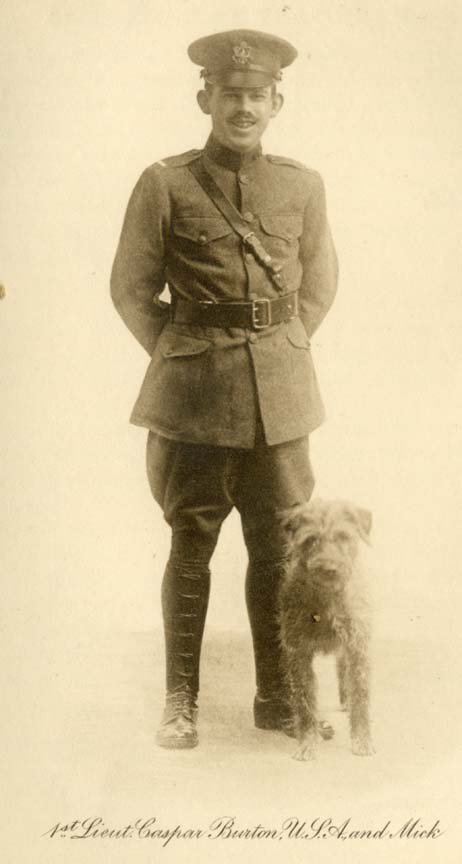
1st Lieut. Caspar Burton, U.S.A. and Mick


April 10th, 1918.

IT is hard to write about matters of no importance with such big things going on, especially when the continual noise of the guns goes on. It is a great crisis, but I am supremely confident. That is all I can say.

One thing I can vouch for, the American troops get on marvellously with both the French and British. And the way the men are studying and really learning to speak French is wonderful. Even if the brains of France and England are disappointed with us the common soldier is going to make a real alliance. Gertrude(6) started at the wrong end; it doesn't do any good for the politicians of two nations to "get on." My greatest hope, which seems every day nearer, is that if only we can polish off the Hun, a real alliance, built on the solid foundation of a real understanding and appreciation of each other by the people of the Allies, will be a reality.


April 11th, 1918.

NOTHING new except things which I may not write about. I feel such an ass writing such stupid notes, but really it is impossible to write about trifles with such big things going on.

With all the different jobs I had in the British Army I always had to deal primarily with the human factor. Here that is of secondary importance, comparatively speaking. I miss it.

I don't see that I will ever get promotion here, as with two or three exceptions all the officers here are Regulars and the distinction between Army men and new Army is far greater than it was with the British. Still I am not losing much sleep over that.

Our mess is really excellent and very good fun. Fortunately we are so situated that I don't think the Y.M.C.A. crowd can get at us. The worst of it is they have real power in our Army. There was a guy at ------ who went everywhere. He gave lectures, being billed as "The Montana Sky Pilot." And they are killing good men by the thousands and the likes of him are writing and lecturing about their experiences at the "Front."


April 12th, 1918.

.      .      .      .      .      .      .      .      .      .

IF I was allowed to tell you what my job was I don't know where I would begin. Do you remember some cartoons which always ended up, "Let George do it"? Well, I'm George. Every old odds and ends that turns up I get handed on to me, so that I never do the same thing twice.


April 14th, 1918.

I AM still so busy that I don't get time to write much. I hear that some new officers are due and in that case things will ease up a bit.

We had the gentle Hun over last night, but he didn't do very much damage.

I have been off all day in a side-car and have seen about "umpteen" personages about very trivial matters. Rather a disgusting way of spending one's time at a crisis like this, but I have volunteered for really active service and got turned down, so there you are.

I am very anxious to hear whether Campbell is back. I do hope he is, but I "hae me doots."

By this time you should surely be getting my letters, but when I will get any, goodness knows. Lots of people have got no mail for three or four months. Really the times are a bit too grim even to try to write an amusing letter. But I am still confident.

I wish I had Mick here, but I would never have been able to manage it.


April 15th, 1918.

I AM off(7) tomorrow on a job which may take me anywhere from five days to five months. All I can tell you is that it is "umpteen" miles from here in the safest spot in the world, I should think. This job fell like a bolt from the blue. It may be interesting, but I doubt it. I will have a motor of my own, at any rate, and will be at the head of the show, such as it is.

I think you will be able to get my letters easily, but I don't see that I will ever hear from you.


April 19th, 1918.

WELL, I have settled down to my new job after an all-day motor trip. I am the only American in a large French city, and consequently am considerable of a curiosity. I am working with the British Staff here and have a desk in their-Headquarters. Never have I met more delightful people and never have I met with more courtesy. There are also some extremely nice both British and French Naval people here. In fact I think I have "clicked" for about the best job in the whole Allied Army, and I certainly didn't hunt for it. It looks as if I would live to a ripe old age and die of senility, for Headquarters II American Corps have evidently decided that I am to be the handy man of their Hdqs. I gathered all this from a long talk I had with our Chief of Staff. I told him that I was fit and ready to do some real active service. He absolutely turned me down. He told me he could use right now twenty-five officers who understood British methods and that he had no intentions of letting me get away. So there you are.

I am living in a very nice hotel, and the food is as good and as plentiful as in peace times; a bit more expensive, but that is the only difference. Everybody drinks cider in this part of France; you never see vin ordinaire at all.

I am just going now with the British Base Commandant to call on the Prefect Maritime, an old French Admiral who I hear is a great character. I went yesterday to a French "at home." Talk about stiffness, it would have made an early Victorian reception look like Mardi-Gras.

Awfully anxious about Campbell and Mick.


April 20th, 1918.

THE more I see of this job the more I like it. I have a nasty sort of feeling that I ought to be in the scrap, but as there is nothing I can do about it I try to convince myself that I am doing what I really should be doing.

I am considering leaving the hotel and going to live en pension with some nice French family. It would be much cheaper and would be an interesting experience. On the other hand, I am very comfortable where I am and the food is really wonderful. Besides, we have a small dining-room to ourselves, about twelve British officers, Naval and Military, and four or five French. It is really a sort of mess and is very good fun. One wounded French officer is a wonderful musician. He sometimes conducts the orchestra at the Opera here. When he does he takes off his officer's tunic and puts on a private's, as a French officer cannot appear in public in uniform.


April 21st, 1918.

I AM finding a lot more office work than I expected, but am wading through it and should have it fairly well cleared up in a day or so.

My French officer friends always call me "L'Armée Américaine à ------." A Captain de Ferrier says that I should issue a communiqué every day from the American front at ------. I am going to the opera tonight with a lot of French officers to hear "Mignon."

I don't think I ever ate better food than I am getting here. And there seems to be any amount of it. Too much in fact.

Really the British are wonderful. They are jumping over themselves trying to help me and be agreeable.


April 22, 1918.

STILL no news from you, but I don't suppose I can grouse when thousands of Americans with wives and children haven't heard in months. I saw by the paper that Congress has appointed a Committee to examine into the delay. Let's hope they get some results ....

This certainly is a one-man show. If I can make a success of this job I don't see how anybody else can get the credit for it. On the other hand, if I don't do a good job, Well!!!


April 23rd, 1918.

IT is tantalizing to be having interesting experiences all the time and not be able to write a word about them. But you see my position. I am attached to a British Staff and am only using their Postal and Censorship systems through courtesy; so that I have to be far more careful than I would be did I still hold my British Commission. Besides all this I have been in a position where I have known a great deal more what was going on than when I used to be in the line. Still it is tantalizing all the same. Yesterday afternoon, for instance, I saw things which thrilled me, and later on I heard a genius who is an inventor talk about how some of the inventions of this war are going to revolutionize economic and social life after the war. It was thrilling and not a word about it may I say.

Well, I am glad I am not in Ireland just now, although I have an idea I could fight Sinn Feiners and still be friendly with them.


April 26th, 1918.

.      .      .      .      .      .      .      .      .      .

You write that you hear U.S. troops are to be brigaded with the British, so I don't mind telling you that that is the job I am on. And a very splendid thing it is too. . .


Apri1 27th, 1918.

.      .      .      .      .      .      .      .      .      .

I HAVE been laid up for two days. A bit of tin hat has worked out of my back. The M.O. here took it out and I don't think made a very good job of it. But I am O.K. now. Apparently they left quite a bit of stuff in at Reading and an X-ray still shows a good deal.

I have written Father Cronin, Father Nolan and Father Grady masterly letters on the Irish situation. They can do more than anybody to stop trouble. They are all good sports and I think possibly they may listen to me. They are the three priests who used to hunt ---you, I think, heard Father Nolan preach a wonderful sermon.


May 3rd, 1918.

NATURALLY nothing interests me but Campbell.(8) I have kept thinking of other people who might know about him and have written them. In a few days' time I won't be very busy and am going to apply for leave for two days. I think I could find the 4th King's in that time and then I could really get to the bottom of the matter.

It all makes me terribly ashamed of myself. Father ought to be doing my work and I ought to be in the Line. It seems a parody to write O.A.S. on my letters. In fact I have written the Chief of Staff asking to be relieved and posted to an infantry battalion. Not much of a thing to do because I shall be turned down, but it eased my conscience.

A bit of tin hat has just been taken out of my back. It was just under the skin and I didn't even have to go into the hospital. They simply sprayed ethyl chloride (the freezing stuff) on the spot and whisked it out. Doctor Watson(9) once said, "Excellent stuff, ethyl chloride, the surgeon doesn't feel the pain nearly as much."

But I have been through a really terrible experience. I had to go to a meeting at the Opera House. It was a lecture by the Prefect Maritime, Admiral Jaurès, to the new French class which has just been called up. I had to sit on the stage with the British Base C.O., a French General, a Belgian Colonel, an Italian, etc. He finally turned to me and said with many gestures, "Et nous avons avec nous, mes enfants, Le Lieut. Burton de L'Armée Américaine, etc." Well, I was in for it. Fortunately most of the boys were asleep; for, believe me, it was some speech, but they probably wouldn't have understood me, at any rate ....


May 6th, 1918.

I JUST got your letter and Father's about Campbell. Pack and Warburton and Kendall(10) are three of the people I wrote to. I have heard no news from the 4th at all. I only fear that all of the people I have written to are not there any more. I have written one or two more letters, but there must be so few left that I know.

If f can ever get leave, which is doubtful, I shall bring Mick back with me, as I should travel both ways by trawler in all probability and I know all the skippers here. He would be a great pleasure to me and could fight dogs here to his heart's content and nobody would mind. . . .


France, May 8th, 1918.

DEAR SPENCE,

IT is a long time since I have written you. I gather from bits you write that you are blue about your lot. There is only one thing worse than fighting in this war and that is not being able to fight. That I am afraid is your lot. I quite understand your feelings.

When I used to be in the front line I used to dream of a job like my present one, and now that I have it I long to get back. I have been always and still am a coward. I know this, and it always troubles what is left of my conscience. Yet when I used to be in the front line I can truthfully say I wasn't ever really afraid. It was only when a stray shell burst somewhere near, when I was back a bit, that I minded. My whole life seems like that; I can buck myself up for a big thing, but I tumble over a small thing.

To think that you don't know the South of Ireland! You and I could run that country. You could straighten out the religious troubles and I could fix up the rest. When I left Fermoy there were about one hundred people at the station to see me off. Most of them wouldn't speak to each other, but they all came to see me off and sang, "For he's a Jolly Good Fellow." Never was I so well liked as in Ireland and the reason was very simple. I didn't want to reform anybody or change anybody; I just liked them. For instance, a Father McConnel with whom I used to hunt was a terrible Sinn Feiner. On one occasion I was sent with troops to guard a bridge in his parish. And mind you, it was no child's play. Well, I went up to him, bought him a drink, and said, "Father, please be kind enough not to have your shows on hunting days." Well, that man rode ten miles to see me off. An Englishman would have called on him officially and would probably have had a brick dropped on his head later on. The great charm of them is that none of them ever considered whether they are gentlemen or not, or gives a damn. Well, when you get a person like that you get a gentleman or something very close to it.

And the hunting! If you must be a priest why not an Irish one? You used to ride better than I, but believe me, you would have trouble riding that country. The jumps are not really jumps at all. They are huge stone walls. You go like the devil across fields and then slow up as you come to one; then your horse "leps" on top, changes feet and "leps" off, and you never know what is on the other side. Well, the hounds were fed on dead horses which were all killed hunting. And nobody hunts because it is the smart thing to do. You don't have to belong to any club or anything like that. After we had killed, Father McGuire used to pass around his hat. Oh, you must come with me sometime to Ireland. I would never go to England again if I had a chance of getting to Ireland. Poor Ireland, she is always supremely right and supremely wrong.

CAP.


May 18th, 1918.

DEAR MOTHER,

I STILL have very little to do. Just buzz about a bit and write a few letters. I wish there was more to do, as I am all ready for troops now if they would only come.

I just saw a good joke in a French paper. There was the picture of an old Frenchman in his nighties in a most uncomfortable-looking cellar, during an air raid. He was saying, "And to think that I once gave two francs to erect a statue to Wilbur Wright!"

We have just started three meatless days a week, but honestly I think we have more and better food on those days than on others. All sorts of odds and ends picked up on the beach and little tiny fish which other nations would throw away! And twice a day as good Camembert as I have ever had.

I am playing bridge tonight with a French Staff Officer, just come back from Roumania via Archangel.

I am afraid there is practically no one left who was in the 4th when I was there.


May 23rd, 1918.

AM getting very fed up with my job. I have done a lot of work, getting everything ready for troops who don't seem to be arriving. They seem to be going to every other place, but they give us a very wide berth. Still I don't see how they can have gone to all the trouble and expense they have and then do nothing. We shall see.

I am seeing more of the French. I have always met them around in cafés, etc., but now there are two families where I go. They are always charming, but in their own homes they are doubly so. At a Captain de Gagnier's house we have some of the best bridge I have ever had. I also get some great chess with a Captain de Fournier.

There are also some very interesting British Naval men here.

Let me know about Helen.


May 24th, 1918.

HELEN can't have received my letter yet or she would know that Kendall is missing.

I see Balcombe-Brown is also missing, but then I have seen so many names in the casualty lists that it sometimes seems as if there can be nobody left that I know.

The food here is wonderful. Here's what we had for lunch today: Oysters, artichokes, Coques St. Jacques, new potatoes and some of the best Camembert I ever ate. The meatless days you get by far the best meals, as a French chef looks on a meatless day as a sort of a challenge.


May 26th, 1918.

IT certainly is a comfort having a good English batman. The Doctor's man looks after the two of us and he certainly is a good man. He is old, stupid and slow, but he spends the whole day keeping your possessions in shape and he certainly turns me out well.

I would like a picture of me with Mick. Send me the one which is the best of Mick. I wonder how he is getting on with Lily.(11) Does she really like him or is she just so good that she pretends she does?


May 25th, 1918.

WHAT do you think I have got to do now? I received a wire telling me to decorate graves, Union and Confederate alike, of sailors of the Alabama and the Kearsarge. I couldn't make head or tails of it. I have finally found out that during the Civil War these boats actually did fight off here and the dead are buried here. So I am going to hold a Decoration Day all on my own, and I intend doing it up to the hilt. I don't think I shall make a speech to myself, but I certainly shall march out alone, doff my cap, etc. I am even betting that it rains to add to the realism of things.

I went out mine-sweeping again yesterday on one of the trawlers. What wonderful sea boats they are, and what splendid chaps are on them!


May 31st, 1918.

I FINALLY got one letter from you from the Mitre. Tell Helen that I hear that there seems to be no rule about hearing from prisoners of war. Several people have told me that sometimes you hear in a few days and sometimes for no apparent reason it is months. . . .

There is only one thing to do with Mick. Buy a muzzle and keep it on him when he is out. He may be such a fool that he will still try to fight, but if he is he must take his medicine.

Decoration Day was a howling success! "Everybody who is anybody" was there. Some day I will show you the photograph which I had taken. Later on I entertained at the Grand Café de Balcon, and if I do say it, it was one huge success. Major Leake, the Brigade Major, made a speech (as did everybody) asking me if I couldn't get Congress to pass a law to have Decoration Day once a month.

The French here seem confident, but certainly things are serious.


June 8th, 1918.

DEAR DAD,

I AM very enthusiastic about our Army at present. They are doing wonderful things everywhere. For the first time I really feel that we are eventually going to be the people who will be the deciding factor in crushing the Hun.


June 10th, 1918.

DEAR MOTHER,

THERE have been two American destroyers in here. It was good to see them. The officers, all surprisingly young, I saw a lot of and they certainly were good fun. Did I or did I not hear that our Navy was dry? There certainly were no signs of it here, but there wasn't the least bit of trouble. In fact everybody was sorry to see them go.

One officer said to me, "Say, Burton, why don't you get yourself made Mayor of this Burg, you seem to be everything else."

My British naval friends tell me that their ships were as shipshape as a British destroyer, which is high praise indeed.

The picture of Mick is splendid. Will you send me a picture of you, Father and Spence and a few of the house, garden, etc., if you have them? I am not getting sentimental in my old age, but if I am going to live here forever, I am going to try to make my room look like something. It is a splendid, airy, clean room, but oh the pictures!


June 14th, 1918.

I HAD an interesting day yesterday. Some French friends asked me to go to Church for the First Communion of their Kid and afterwards to their home for a fête. It was all very lovely and I was very flattered by being asked. I love France and the French, except in one thing. I do get awfully tired of the continual fuss. You can never have a meal or even a drink without the head waiter cussing out somebody. In fact you can hardly buy anything in a shop without a brawl. It does get on my nerves. Still it doesn't mean anything, and it just happens to be their way of getting things done.

Still no work to do. I’ll hold this job I shall be, as Port Officer, the last American to leave France after the War. Pleasant thought!

My landlady is in love with Mick. I am trying to get Captain Scott, R.A.F., to fly him over. That is the only way I could get him across. But he is afraid of getting caught.


June 25th, 1918.

WELL, they weren't such fools as I thought they were. The long expected work has sure come. I think Father at least can realize that it is some job to get 2,000 Americans and tons of belongings off a boat and eventually to see that nobody misses the train. This can be accomplished just about the time the next lot are appearing. Still I can't grouse. I wanted work and am much happier.


July 1st, 1918.

A BIT of time to take my breath today, as there were no troops and, by George, I am glad of it .... If I get work at the rate I have been getting it you can't expect to hear very often, but I will try to get off at least two letters per week. I literally have been days without getting my clothes off, but I have got things working a bit smoother now. Our men are simply splendid and have splendid discipline. I wish I could say as much for the officers. Of course a lot of them are fine, but a lot are terribly, terribly crude and cocky. But on the whole they look very, very good to me and a good many thousand have already gone through.

My job principally seems to be the official peacemaker.


July 13th, 1918.

THE more I see of our troops the more enthusiastic I am. They really are splendid and their discipline is far better than I ever thought possible.

No time for more now.


Aug. 17th, 1918.

BETWEEN you and me the news about Campbell(12) did not come as a terrible shock to me, as I have had all along a hunch that he was not a prisoner.

As to leave! I thought I had it, but for the present at any rate it won't be granted. In my position, however, it is almost as easy to get English leave as French, so one day I shall blow in.

I have had the privilege of working with a great many thousand American troops. As you know I have not been a great optimist. That is all changed now. They are far, far better than I ever dreamt they would be. And their discipline is up to that of the best British troops I have seen. Next spring they are going to come very close to winning this war, or I am greatly mistaken.

I wish I could have a long talk with you all about them; but I am sure it won't be long now before I get to England.


Cherbourg, Aug. 18, '18.

Ordered report former Headquarters. Another job.

BURTON.


Flanders, Sept. 2nd, 1918.

DEAR MON,

WELL, I am really back in the War. When I got up here I saw the long line of observation balloons, the bursting Archies, the long lines of transport, the ruined villages, and heard the noise and all, it seemed as if the whole of my life between May 20, 1917, and now was but a sort of dream, and the wonderful thing is that almost instantaneously I have become keen again. I wouldn't have thought it possible, but it is true. It is American enthusiasm which has done it, and whatever we do or don't do I firmly believe that both the French and the British, tired of the war as they are, have caught it also. I am so keen that I went to see if I couldn't get posted to some infantry battalion, not because I felt it my duty, but because I really want to fight with our American boys; but no chance. The Corps has every intention of hanging on to me, as near as I can make out. They have no intention of giving me a really good job, but have made up their mind (or rather his mind) that I am a sort of handy man to have sitting around to do any old job that turns up. I wish I could write my views on the victory here. I know too much about it to say a word. Suffice it to say, that in my opinion there is no possible way for the Boche to be anything but decisively beaten in the end. I don't think he will give in for a long time yet, but I think there is a good sporting chance that he may collapse sooner than anybody expects. I tried to look for Campbell's grave, if such a thing exists, but it was too hot there today. Shall have another go tomorrow.

Love,               
CAP.


September 3, 1918.

DEAR HELEN,

I AM at present very near indeed to where Campbell was killed. I have tried on two days to search the neighborhood in the vague hope that I might find his grave, or at any rate the graves of some of the King's. I am sorry to tell you that I have had no luck; on both occasions it was too hot for me. The first time the shelling was too strenuous for me to get there and today I got there, but got shelled out. It is an awful mess. If by some strange chance I should be able to find his grave, of course it would prove everything, but not finding it would prove nothing. If the Hun goes back a bit farther it will of course be possible to go over it with a fine-tooth comb. I wonder if you know the terrific strategical value of that particular bit of land. Also how very near the Hun came to breaking clean through; also that there was very little left behind to stop him going right on. It certainly was a supreme moment and by a sad chance for you, a happy chance for England, a supremely fine man and a gallant soldier was on the spot. I shan't comment on what Campbell did other than to say it was just what I always knew he would do in a crisis. I have met many brave men, but I never yet met a man whom I considered you could depend upon to be brave always as much as he. Most people have their good days, and their off days, but not so he. I, do not know that it is the right thing to say, but it is true, I am so selfish and was so fond of him, that side by side with my sympathy for you is a horrid feeling that I have had a loss as well. I think we were really more intimate than you imagine.

Helen, I hope to get leave to try and tell you how sorry (not the right word at all) I was. In fact, really to talk to you, if you cared to, about Campbell.

I nearly got it, but I got turned down finally, and now I don't see any chance of ever getting leave.

Helen, I just put off writing you from day to day, but it really wasn't at all callousness. If there was anything I could do to help, Helen, I would do it.

Love,                         
CAP.


Sept. 6, 1918.

DEAR MOTHER,

I AM now far, far away from where I was when I wrote you last and for the time being well back of the line in billet.

This is mainly for Helen. The 4th King's are very near here and I had lunch with Col. Beall, who is, to everybody's joy, back with the Battalion, Maj. Browne and Capt. Boumphrey. I also saw Ager and Boardman. They are all that is left of the officers. I saw, however, a lot of N.C.O.'s and men who I knew and I don't mind telling you that I was touched at how glad they all seemed to be to see me. Col. Beau was simply charming and very amusing. He wanted to know when I intended going into the Italian Army. It was very refreshing. I shall never mention it again, but among a very large class of American officers an officer who has served with another Army is looked on distinctly with suspicion. This is the attitude, "What the hell are you, anyway, an American or an Englishman?" If my skin was not so thick this would be hard to bear; as it is it does no harm except that it will seriously hinder any chance of promotion for me. But what of that?

This is for: Helen. One and all were terribly surprised to hear that Campbell was killed. They were all firmly convinced that he was a prisoner. I must say they couldn't give any very definite reasons for this belief except that his body was not found. There were, however, other cases of bodies not found of men who have not been reported prisoners.

Capt. cut loose to me and said that allowing him to go back was nothing less than a disgrace both to the Battalion and to the Brigade. Every one was really affected to hear that he was done in.

The other interesting experience I have had was to visit all the part of the line where I was hit.(13) No wonder it was a tough nut to crack; there were things there we never dreamt of. I will tell you all about them some day. It is comparatively safe there now, thanks to this marvellous push; only a few long-range shells dropping about and no particular method about these.

Give up the idea of my ever getting any English or other leave for a long time at any rate. It might be possible in the winter if the fighting slows up.


Sept. 7th, 1918.

HARRY LAUDER turned up today and gave in a barn just about the best performance I have ever attended. Really he is an artist. He finished it off with a speech about the War, its causes, what we were fighting for and why we must win. During the last few years I have heard many such speeches, a few from rather well-known people, but nothing to touch his little talk. The truthfulness of it, the simplicity of it, the deepness of it and the fire of it were stirring.

You can see by this that I am at present well back of the line and will probably be here for a short time. Davie Hayward,(14) a fellow in The Fly who I like very much, is here. Also Ralph Bradley;(15) you know his mother in Boston.

I have been up where I spent the winter of 16-17. In spite of all this year's fighting it isn't nearly so desolate as it was then, for there is grass.

Am very tired.

Good night,              
CAP.


Sept. 10th, 1918.

JUST a line tonight, as I am very tired.

I had tea today at my old Brigade Hdqs., where I saw some of the old crowd. There is one good feature about being here, I can always get either a car or a horse when I get time off. The best description of my job is that of Corps handyman. Well, it isn't what I would like. I would like to get in some regular outfit where I could try to make a place for myself, or at least try to, but c'est la guerre, and these guys don't seem to want to let me go.

By the way, Scho is a Major and is at present in a Staff College.. It would be funny if he stuck to the Army after the War. I hear he likes it.

Too tired for more tonight.

CAP.


Sept. 12th, 1918.

I HAVE had a couple of very interesting days; have really practically seen the whole of the great advance. I am afraid to say a word about it, for I have seen a bit too much to trust myself to say anything. Tell Helen I have been lately with a Texas outfit. One huge man, a sergeant, knows her father. He says, "He is a mighty fine man, but he sure can get peeved at times."

Here's a tale of a negro regiment. They had been taught all about bombs. Finally the day came when they were to throw a live one apiece. They were waiting their turn in a trench when one fellow threw his out of the trench, out of turn, without even taking out the pin. When the officer asked why he had done this he said, "Boss, I could feel her swellin' in mah han!" But really to watch a nigger battalion is the most amusing experience in the world. If you ask a sergeant a question he salutes you after each sentence and never by any chance knows what you want to know. It's curious, but the French like us better than they like the English, and the English like us better than they like the French. ----- said to me that the Americans find the French and the French customs interesting, and the English find them curious. It about hits the nail on the head.


Sept. 15th, 1918.

I GOT your letter about Helen's news. I shall try to get to the 4th as soon as possible. I will there try to find any officer, N.C.O., or man who was actually on "the burying party." I will then find out whether this same farmhouse was blown to bits or not. In other words, if this farmhouse was not blown to bits and if other bodies were found there it seems to me that there is still a vague chance that he may still be alive. At any rate I will find out all I can and let Helen know.

I consider that the American success south is of great importance, for (I) It will encourage both the French and British. (II) It will have a very bad effect on German morale. (III) Our troops will learn a lot in it and will be just ripe for something bigger when it comes off.

When I see our army doing things that seem a mistake to me, I console myself by thinking of the things they are really doing well. Foremost of these is the way they scrap officers who don't make good. They are just plain sent home and their commissions taken from them. It is really appalling, but I believe absolutely the thing to do.

You keep saying how anxious you are to see me. Well, I don't really see how there is a possible chance. As far as I know nobody from this Corps has ever got leave and nobody ever even talks about it or really wants it, and even if I ever did get it, it is doubtful if I could get to England.


Sept. 20th, 1918.

HAVE been sitting on Court Martials all day and am on duty tonight, but for some reason or another am very tired.

Dad said he wished I could be "where the Americans are fighting." Tell him it wouldn't be good for his health to repeat that to any of the II Corps Infantry in these parts.

One Alliance at any rate is a finished article. The Americans and the Australians, I venture to remark, hit it off better than any two forces in this whole war. They just simply love each other both in the line and out. They never by any chance disagree on any subject, and all they ask is to be stuck in the line together, and when they have been I fancy nothing very gentle has occurred. On the other hand, this combination, while a tough nut for the Hun to crack, is a still more difficult nut for the military police to crack. The discipline here is really on the whole very good (very different from the British, but good), but to an American a military policeman is just a cop.

Am very interested in censoring letters to find out how much better educated the American soldier is than the British. There is just no comparison, but then they ought to write better letters, for they write so few. The average soldier has a girl or a wife (fairly regular), mother spasmodically, but apparently no American soldier has either a brother, sister or male friend.


Part IV: The War, continued

Table of Contents