|
|
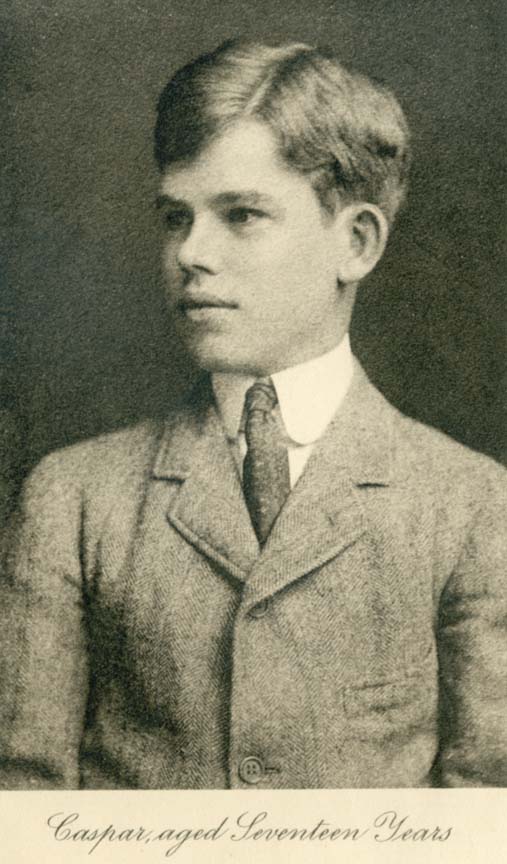
CASPAR passed his preliminary examinations for Harvard with flying colors, decided that all examinations were easy; consequently did no work during his last year in school and failed his final examinations. His surprise was acute. He felt Harvard had made a mistake, but soon learned that Harvard was immovably convinced that he, rather than his examiners, had made the mistake.
At that time I was in Italy and remember well the letters about this family tragedy. They could not join me in Europe because Caspar had "flunked his exams." Caspar could not go to Camp because he had to be tutored. This domestic catastrophe Caspar merely used as an opportunity to make new friends.
He spent that summer of 1905 in Cambridge with the famous tutor, "The Widow" Nolen. In Mr. Nolen Caspar discovered not only a real friend, but also a royal road to passing examinations.
In more senses than one Mr. Nolen prepared him for college. In his "select establishment" Caspar met the hand-picked blossoms of the expensive schools that say they prepare boys for Harvard. He found these irresponsible youths entirely congenial. Some of them were like Caspar, clever and care-free; some of them were stupid and sporty; all of them were generous and delightful companions. With them as his intimate friends, Caspar romped into Harvard.
Just before college opened he wrote this letter. It is characteristic of his summer with "The Widow" and of his joyous attitude of mind on entering Harvard.
Cambridge, Sept. 21, 1905.
DEAR MOTHER,
AFTER dinner I went to "The Widow's" and tutored. A man named Brown, his Chemistry man, tutored me. He should be made President of the United States or some other high position. He literally rained facts on me; he stupefied me. It was like reading a dictionary. However, he had a bad cold and would have to stop to "spit." When he stopped I felt like a prize-fighter when the umpire yells "time." However, some of his remarks stuck, I think, but from the faces of the boys who were there I don't think they learned much. He told me that he thought I would surely pass. But I am afraid I will explode something and kill a professor or two. However, I have decided that I shall wound myself too so that they will pity me .... I went down to the field with Bruce(1) to watch the football practice. It was fine.
Yours lovingly,
CAP.
Caspar and Bruce (or "Lamb") were together at school in Cincinnati and were intimate friends always. It seems significant that the first classmate Caspar mentions in his college letters is the devoted friend who came to see Caspar every day during the fourteen weeks of his last illness.
Friends, fun and humorous comments on studies and teachers make up most of Caspar's letters written in college. He always said he loathed writing letters. Probably he did, for even some of his best friends say they never received a letter from him. His letters were about them. He enjoyed his friends when he was with them and did not bother about them when he was away from them, or rather when he was with other friends.
This frame of mind and real dislike for writing letters makes it the more surprising and praiseworthy that whenever he was away from Mother he wrote to her frequently, at times almost daily. Had he written to his friends this volume could give a truer picture of him. It does, however, reveal Caspar. He wrote to his family about his friends. It is with that fact in mind that we have made the following selections and excerpts from among his college letters.
The men he chose as his friends even in those jolly, careless years were men who, like himself, had the vision and generosity to offer their lives for us in sacrifice. In indicating their service in the War we have had to rely on the Harvard War Records.
Claverly Hall, Oct. 4, 1905.
DEAR DAD,
MOTHER got away all right, and did not break down. She finished everything here, so that the room is really beautiful . . . . I went to Slavic today. I think it will be O.K., for all of the Varsity team are in it. It is one of Bill Reid's prescribed courses for football candidates. There is only one textbook, and the man who is giving the course wrote that himself. . .
Sincerely,
CAP.
Mother had been on to Cambridge to furnish his room and to see him settled (?). That she left him without letting him see a tear he appreciated. He always dreaded Mother or me being too demonstrative. It is with solid comfort that he turns to his congenially undemonstrative father and signs himself, "Sincerely." That was rather warming up, for as a child he ended a letter to Father, "Yours truly, Cap."
He is not conscious of futility or shame in choosing to begin college with a course on the History of Russian Literature, in translation. It was notorious as a "snap." He hoped it would not consume too much of his time. It didn't.
Most of Caspar's letters were written to his mother.
Oct. 6, 1905.
DEAR MOM,
IT is a great mistake ever to have good food here, for you realize how poor the food out here really is. I have only had one meal in town and then I only had 75 cents to spend at the Touraine.
The bill(2) is O.K. I had to be recuperated with smelling-salts when it fell out of your letter just now. It was a terrible shock. It is "perfectly lovely" of Dad to pay it.
Oct. 6, 1905.
I HAVE just returned to-day from Medfield, where James Roosevelt(3) took me to spend Saturday and Sunday. We left here Friday afternoon, and arrived at the Norfolk Hunt Club about four o'clock, when we had a ride. Saturday morning we came back to Cambridge for lectures. James insisted that I go back with him and I did.
We had a ride to the hounds. It is just fifty per cent better than any other game I ever tackled. The run consists of two halves with a check in between. Each half was about five miles long.
The first half was very new to me, of course, but great fun. However, I was purely an "also ran," as I waited at barways for ladies and older men to pass, etc.
James told me that the stunt was to get off next to the master and stay there. I did this in the second half and finished first along with James. He gave me a little thoroughbred to ride, by Imp July---April Showers; very ugly, but jumped like a bird and went faster every minute.
But I am afraid that this has spoiled me for just plain riding. There seems to be no object in it. James is going to Virginia for the American vs. English fox-hound trials. I will continue this in my next .... Send list of misspelled words.
Caspar did not restrict himself to the friends he had made at "The Widow's" or to his classmates. He began at once seeing friends of the family and friends I had made in Cambridge and in Boston.
This letter reminds me of a day in 1902 Caspar and I had on Exmoor with the Devon and Somerset Stag Hounds. We were staying at Lynton with Father and Mother late in the summer. The hounds were to meet for the first time that season. The Cottage Hotel was full of hunting people. Cap and I longed to ride. The proprietor of the hotel and stables promised us horses. When the morning came he brought up a shaggy little pony for Cap. He was only fifteen then and tiny, but he had long ago graduated from shaggy ponies to thoroughbreds. His lip quivered and he had a hard fight not to weep by being thus humiliated before all the men and women who were mounting hunters. He was too good a sport to quit. How he did it I don't know, but he kept up with all of us that day, even on that round pony, and was in at the death.
We did not kill until well on in the afternoon. Cap and I had no sandwiches and were ravenously hungry. We made our way to Porlock. There, in a picture-book inn with a thatched roof, we could get only a cottage loaf, grey as putty, cheese and beer. I told him he was too young to drink beer. His eyes snapped and then twinkled. I knew he would get even with me. He had ginger beer, the kind in stone bottles. I stuffed myself with stoggy bread and cheese, and washed it down with much heavy beer. As soon as we reached the bottom of Porlock Hill on our long ride back to Lynton, Cap said: "We've got to walk. Your horse and my apple-dumpling here are all in."
By that time I was tired and sleepy, but it was so obviously the thing to do that I could not dispute his advice. Then his fun began. I began to sweat beer while Cap danced circles around me and made merry remarks about me being too young to drink beer.
He scored also on the owner of the stables, for by walking home we brought in his pony and my horse in so much better condition than the others that the proprietor publicly declared that he wished he had let his best hunter to Caspar instead of to the cavalry officer who had brought her in lathered and splashed with bloody foam.
Oct. 12, 1905.
DEAR DAD,
I GOT back from my trip with James Monday. As I did not go to football practice Friday or Saturday I got kicked off the squad. About half the squad was fired.
I am going out for coxswain; in fact, I went out yesterday. It is pretty good fun and you meet lots of nice fellows, both freshmen and upper classmen. I have met so many nice, "white-looking" fellows that I am utterly unable to tell one from another.
I went to see John(4) and Fay(5) this evening. They were very nice, and John invited me to play golf with him tomorrow.
I went to Slavic today. It is very interesting. There is not a grind among the hundred fellows in the course, and nobody can be found who wants to be a monitor. The football players form a group, discuss plays and use coins to represent men. Others talk on different subjects, and some study their lessons. Lots will flunk the course, I am sure.
I am going to start in eating at the St. Mark's table tomorrow. Henry McCall(6) pulled the wires for me.
I wanted to go to New York to see the automobile race and baseball game on Saturday, but after a look at my accounts I changed my mind.
CAP.
Tell Mother that I appreciated her not breaking down in her letter to me.
Oct. 19, 1905.
TUESDAY I studied all afternoon and went to a freshman reception at Fred's(7). You can picture Walter(8) spending the evening by going from the bathtub, in which a keg of beer was, to the sitting-room, carrying two white pitchers and never cracking a smile.
I see lots of George Wagstaff.(9) He is very amusing. I asked him what Anthropology was about, and he replied that "it was just about things in general." He was the first man taken in the Polo Club.
Oct. 25, 1905.
DEAN BRIGGS is a wonder. He is worth all the snippy little brainless imps of instructors put together. I am rotten on daily themes as a rule, but every now and then I rip off a corker. I got B+ on one the other day. The subject was "The Nuisance of Writing Daily Themes."
My instructor, an ass, says that, on the whole, my work is "very childish" and that he finds it "difficult to read it at all," but that at rare intervals I rip off a "rather amusing one." I will choke the little ass some day.
Mother must have asked him to write her just what he was doing day by day. The following bit is characteristic of many letters. He enjoyed writing comments, rather than narratives.
Oct. 30, 1905.
SATURDAY I went to the football game with Dabney(10) and Huidekoper.(11) In the evening I played bridge with John Suydam(12) and George Roosevelt.(13) Sunday I went to church and played tennis.
George Roosevelt says that when he and Teddy(14) were going to start in, his cousin, the President, said to them, "Well, boys, there are two ways of starting in at Harvard. One way is to have a good time and stay in if you can, and the other is to stay in, and have a good time if you can."
It is grand that I belong to the Oakley Country Club. It is really fun playing golf on that course. . . .
This is the first letter in which Caspar mentions belonging to a club. His biography could be written under the names of his clubs. They made the background he liked. He liked people, sport and games. He refused to make plans and he disliked the responsibility both of host and of guest. At clubs he could meet friends without planning to do so and there enjoy them without any social responsibility.
In Cincinnati he could usually be found at the Riding Club, the Golf Club, the Country Club or the Queen City Club. While in college and even after graduation the Fly Club was his home when he was around Cambridge or Boston. In New York the Harvard Club was headquarters. Of all his clubs I think he liked best to be at the Pontiac Game Club in the wilderness of the Province of Quebec.
Nov. 4, 1905.
As regards the Russian crisis! What I don't know about it is not worth knowing. Wiener is very excited and talks about the crisis instead of regular lectures. It is very amusing. Everybody pretends to get excited. Wiener told a story. He said that a friend of his was imprisoned by the Government awhile ago. Another friend sent Wiener a petition to the Czar, after having had it signed by Harvard Professors. Wiener replied: "The Czar is a coward; he does not dare to keep Mendeleff in prison, and besides the Czar is not worthy that an American citizen should send him a petition." The class stamped their feet, whistled and somebody in the back of the room yelled "A bas Nicolas." If the Czar is deposed next Wednesday we think there will be no hour exam.
I played tennis with Sam Bush(15) yesterday. He is the nicest fellow I have ever known, the best athlete St. Mark's ever had, president of their last year's class, and as simple and unaffected a fellow as I have ever seen. He turned down the Polo Club.
Fritz(16) has been appointed Captain of the Freshman team. He has been playing wonderful football and is without doubt the best man on the team.
Nov. 12, 1905.
I PLAYED golf, tennis, and took hour exams. all last week. I killed Slavic. I enclose the paper. Useful for a business man to know, isn't it?
I got a letter from one of my "brothers" at school, telling me all the news. He said that they had only four dollars in the treasury, and that the secretary had spent it to have an in-growing toe-nail cut out.
Too bad about the football game, isn't it? But we have a good chance with Yale.
CAP.
Knowing Dad's sporting qualities, tell him not to take that prophecy seriously.
Nov. 15, 1905.
LIFE at Claverly has become exciting, to say the least. Everybody has pass-keys. My friends have all found out how I love to be fondled. They turn up at all hours of the night, in groups of two or three, and pull me out of bed. I am having two huge bolts made for my door.
There is now a golf course laid out on my floor which causes much amusement and more noise.
Dan Forchheimer,(17) I hear, was taken into the Fencing Club. Fritz turned it down. It rather amuses me, for the Fencing Club is composed mostly of dropped Freshmen and fellows about nineteen, who are anything but the Doctor's(18) ideal. It won't hurt Dan any, I don't think.
I was amused by an invitation from the Wiborgs.(19) On it was their coat of arms with the motto: "Conquer Death by Virtue." If you will kindly tell me what it means I will be much obliged.
How about my spelling?
Nov. 20, 1905.
. . . . . . . . . . LAST Saturday the Freshmen got beaten by Yale. I went with Bill Wendell,(20) a fellow named Biddle,(21) and Dacre Bush to have dinner with Sam Vaughan.(22) Bill told me that he lived on the right-hand side of Beacon Street. For a while I was horrified that such a nice fellow should live on the wrong side, but, as I rather liked the boy, I accepted. Imagine my relief to find that he really did live on the right side in a very grand house. We had a wonderful dinner. I have got it doped out so that I can get about one or two meals a week in Boston, and it is nice. You know what my ideas on dressing(23) for dinner used to be. Well, they have changed. When I first started in I used never to wash for meals. Now I always wash and the other night changed my collar. By the way you can wear a collar (24) until it wears out unless you fall down or something in order to get mud on it.
Nov. 21, 1905.
. . . . . . . . . . TALK about a social blunder! I committed one, worse than being seen by a Bostonian reading a Hearst's Boston American, which by the way I always read. A fellow here, who I know quite well, is named Wendell. He eats at the table, and lives with Sam Vaughan on my floor. It never entered my mind that his father was Barrett. I went in to dinner with him at Sam Vaughan's house last Saturday. I can remember of talking to him on several occasions on the subject of English instructors and professors in general.
All my friends are on probation. I was pretty fortunate to escape.
CAP.
Nov. 27, 1905.
WELL, it is all over. It was one of the greatest games that there has ever been. Of course it is too bad that we lost, but we did much better than we expected to. It was the most wonderful sight that I have ever seen; 43,000 people all excited and crowded, but perfectly good-natured..
Mark(25) was with the Glee Club. We had a wonderful time. Such a sight as that big Boston Theatre I have never seen. All Harvard men. The show absolutely a farce. Everybody threw confetti and streamers.
After the show there were hundreds of people all wanting to get on the same cars. When they did get one, they never paid any fares, threw the conductor and motorman off and ran the cars themselves. No brutality at all! I did not see a single man get into a fight. I can't describe it all, but it was really wonderful.
Mission House of the Society of St. John the Evangelist
33 Bowdoin Street, Boston,
Nov. 30, 1905.DEAR MOTHER,
SPENCE arrived last evening at six. We had a fine talk and turned in early. We are to have dinner here and are going to see Nat Goodwin tonight. . . .
We have decided to buy an Irish terrier for Dad if we can get a good one. What do you want?
I want a bath-wrapper (a smooth one without an "itch"), one cuff button to match my gold one, socks (serviceable ones), neckties, underclothes and money. I don't want any fountain pens, books, pen-knives, Gibson girls, or any little fool luxuries. I should also like a mershaum pipe (one with a flat bottom, called a poker pipe). I want no pictures or anything for my room. It is perfect. This is a concise and full list.
Lovingly,
CAP.If I must have things I don't need I prefer things for the woods. I pity the dog who I take care of for three weeks.
Claverly Hall, Cambridge,
Dec. 2, 1905.LAST evening I got a letter from Dean Wells(26) putting me on probation. To say that I was surprised hardly expresses it, although I knew that I did not do well. Spence and I went to see him this morning, but could do nothing. I got two "C's" and four "D's," but the "C's" were in half courses. I naturally feel very badly about it, and blame nobody but myself. I think, however, that it will do me no harm, and I feel perfectly sure that I can get off at the midyears. But I realize how much hard work I have to do and intend to do it, without the aid of a tutor.
What makes me feel so badly about it is the fact that I did not get such high marks so that I would not have been on the boundary line. I did do some work and I also worked regularly, but I did not do enough and did very poorly in the exams.
I hope that you won't take it too seriously, for it will do no good. I must suffer for not working enough and not you. My one object now is to get my marks up to "C's" with a chance for "B's," instead of "D's" with a chance for "C's," and what's more it has got to be done.
I realize that the work must begin at once and have already been studying about two or three times as much as I did. The results have shown in my last conferences and I know they will show even more.
Spence will tell you just what probation means, technically, so there is no use of my repeating it.
Don't get an idea into your head that I am going to get dropped, for the chances of that are infinitely less than if I had just skinned through, or don't think that I have any idea of leaning on the Widow, for I haven't.
Tell Dad that I got his check.
Lovingly,
CAP.There is lots more news, but it is insignificant.
Caspar's friends thought it a good joke on him that I should arrive to visit him just in time to get the news of his probation. He thought it fortunate that I should be there to "explain" to the family and so save him the discomfort of doing it. Such a division of labor was not unique or uncharacteristic. He refused to let his peace or happiness be disturbed by such a detail, but he did study enough to get off probation.
Dec. 12, 1905.
. . . . . . . . . . FIRST questions! In regard to bath-wrapper; it may be fuzzy, but not sharp and itchy like Father's.
I got a B+ in History last week. As George Wagstaff said, when he killed his hour exams., "You can't keep a good man down."
It has been so cold here that I feel as if I would snap right in two if I were shaken. I have been wearing both my suits of underclothes. I am praying for warm weather soon so that I can have them washed and wear summer ones. That was no joke about my wanting underclothes and money.(27). . .
In spite of the weather, the Office and nine o'clocks, I am getting to like it better every day. Even the studying is not so bad as any other I have ever done. Don't think from this that I am not working, for never in my life have I worked so regularly.
I have just finished a nine page biographical portrait of Father Powell.(28) It is a literary gem. I hope I can convince --------(29) of it.
I thought that I knew most of the nice fellows in our class, but I was mistaken, they spring up from everywhere. There are hundreds of them. We have undoubtedly the best class that ever entered college.
I am getting anxious to get home. I ought to have a wonderful time. I enclose the letter of my friend(30) Dean Wells. He is very nice; it is Hurlbut(31) that causes all the trouble.
The following letter suggests that while he was at home for the Christmas holidays there were conversations on the subject of study.
Jan. 14, 1906.
. . . . . . . . . . LAST week I worked along in "John-horse"(32) style until Friday, a day which will long remain in my memory. Then I worked from 6.45 in the evening until three in the morning and have been "stale" ever since. I read most of the Old Testament, two French plays and James Roosevelt's notes in Eng. 28. There is only one thing which describes such an act. It is hell! Saturday I recuperated. I slept until lunch time and played bridge with Ted Roosevelt, Shaun Kelly(33) and "Skein" Hadden(34) in the afternoon. In the evening I did a little work in a gentlemanly fashion and went to bed. This morning I got out of bed, with a great effort, and went to Church. There you have me up to date.
For the next three weeks each day will be worse than the preceding one. Bright prospect, isn't it? But "Cheer up.
I must tell you an amusing thing Mr. Nolen said to me --- I met him on the street just as I was mailing a letter. He said as he passed, "I am working hard. Your loving son Caspar."(35)
. . . . . . . . . . My English A man said in regard to my long theme "The man(36) you write about may be interesting, but you conceal it well." That is discouraging, but works of art are never appreciated while the author is alive.
Jan. 17, 1906.
DEAR DAD,
I RECEIVED your letter and check yesterday. When I read Mr. Nolen's letter I confess I was red hot, but on consideration I decided to say nothing. Talk does little good now. It is results we want; nevertheless in order to make you feel a little easier let me say that I think he is wrong both when he says, "I am inclined to think that even now he is a little over-confident," and when he says, "He might put forward even more endeavor than he does with advantage."
The first of these statements is the result of the fact that he does not know that I was scared when I was put on probation and that I have been doing my work regularly ever since.
Let me say in regard to his second statement that I fail to see how I could do very much more work than I am doing right now, although there is no limit, and your letter will make me open the throttle wider still.
But as I said all this is of very little value. I hope to show you by results that what I say is true, and if I don't it will be because I am a fool.
Lovingly,
CAP.It just occurs to me on reading the "Widow's," my, and your letters through, that he has just about accomplished what he aimed at!!!
Jan. 21, 1906.
DEAR MON,
. . . . . . . . . . I WORKED part of this evening and loafed the rest. I have just one week more in which to prepare.(37) I have gone over my work pretty well, but have only hit the high places. Next week I polish.
Don't let Dr. F.(38) bother you.
Jan. 25, 1906.
. . . . . . . . . . I STRONGLY advise you go to bed and rest up and do not run up and down stairs.(39)
I finished lectures yesterday so now there is plenty of time for study. Last night I went to the Widow's and covered the Constitution of the United States in one hour. Going some, isn't it?
Father Tovey(40) came to see me yesterday. He is very amusing, and about the best man I have ever seen. He is so good that it is a shame. It sticks out all over him. He seems so out of place with people shouting across to Randolph, "Jim, for God's sake bring back those printed notes." These, by the way, are wonderful in going over lectures.
I have made so many outlines that I dream of skeletons. Everybody says make an outline and work after its pattern.
Feb. 2, 1906.
I GOT Dad's telegram this morning. It is too bad you are sick. The thing to do is to rest up and not worry.
Now a proposition. If you have no objections I am going to room with Francis Biddle in Dunster next year.
Francis is a dandy, awfully bright and attractive, and doesn't get on my nerves at all. I think it ought to be an ideal arrangement. We would both rather get the double room if we can, but this is doubtful.
Francis is a cousin of Edmund Coxe(41) and went to Groton. As George Wagstaff says, "Pretty high life, I guess!" His sister is the one you read about in Town Topics who is always "raffling off Persian kittens.". . .
Feb. 20, 1906.
I SPENT last evening holding the hand of a great friend of mine who has just been dropped. I never felt sorrier for anybody in my life. The poor fellow knows he is a fool, and yet feels that there is nothing to be done about it and that he isn't worth anything, etc. I left him and played bridge for a time. I went to get something to eat at about twelve, and was surprised to find this fellow, whom I pictured weeping his eyes out, surrounded by a crowd of fellows saying, "When I was in college," etc., and having a fine time.
Feb. 21, 1906.
I AM SO sorry to hear that you are sick, but if you calm yourself I think all will go well.
Went to Boston with Hal McCall in the evening. He is a wonder. It's too bad he is in love. John Suydam, who is a second edition of Madame,(42) says the girl doesn't like it. She is a fool.
Feb. 22, 1906.
I AM off probation. I got a C in English A and the Dean took me off himself. If I should get all C's at the end of the year I would be on the Dean's list next fall. That would be wonderful, but I fear it could never be.
Feb. 28, 1906.
FATHER'S check arrived this morning. It arrived at a most opportune moment, as we are having a big dinner tonight for "those who are going to leave us," and I was in sore need of money.
Sunday morning I went to Church, ate breakfast at that hotel near the Church, returned to Cambridge, and talked until three o'clock. At three I went to Oakley and played squash with John Stet, had tea and returned to Cambridge, where I spent the evening "among my books."
Monday I went to lectures, all of them, talked awhile, coxswained awhile, and spent most of the evening reading "Tom Jones," which I like very much.
Yesterday I went to lectures, read, coxswained and played bridge with Hugo(43) and the two Roosevelts. We played all evening and stung the Roosies good and hard.
I am having great sport coxswaining. I know everybody on the crew, which is the rottenest on the river, and so have great sport cussing them out. I heard the coach say the other day, "Robinson,(44) get more bevel on your oar."
So I, remembering that, yell out at the top of my voice, "Number 3, you have got to get more bevel on," at which Mose falls to laughing and puts the whole crew out, for he knows that I haven't the vaguest idea what bevel means. The stroke, Eggie Denny,(45) tells me what to say and I proceed to say it in very harsh terms to somebody. I had them fooled for a couple of days, but they are on to me now.
The rooming business is getting more complicated every day. John Suydam is back in the running again, as Nick's(46) mother doesn't want to sign his lease. Hugo has to have a very cheap room and we seem to be unable to find one, but are still hunting. I shall get a good single if I can in Claverly and hold on to it until the sky clears. Then if it does so, I will give up my single, after which I will sign the double lease, but will let you know before I act.
Lovingly,
CAP.Mose brought the hat back, or what was left of it. I know Secretary Taft sat on it at the wedding.(47)
I am going over to Randolph to live with John for a while, and if I like it may stay all year.
Mar. 9, 1906.
I AM so sorry to hear that you are still sick. What is the matter? Tell Dr. Forchheimer that I want you to be well.
Everything goes on just the same here. Tuesday I heard the most interesting lecture I have had solar. Barrett Wendell said, "Richardson's ideal was to be superintendent of a Sunday School; Richardson had not a spark of genius; gentlemen! I think you will agree with me that genius in a Sunday School superintendent is a contradiction in terms." He has a way of summing up the characteristics of a man in a few sentences that remain with you always.
I just saw Francis Biddle. He has been on what is called here a "God-helping" expedition to Nashville, Tenn. He had a wonderful time. He and Skein Hadden lived in a Southern family, where Francis fell in love with the daughter and went riding every day. As far as I can find out he never heard of any convention or speeches.
I should like very much to go to New York and visit Spence, but I can see no hope. Ahead of me is a region of utter financial darkness. I could get together enough to go, but it would be like a candle going out with a flicker. I owe nobody anything, however, and could not even if I wanted to, which I don't. Everybody here who has been given money by the year is simply floored.
Mar. 17, 1906.
I GOT your letter about half an hour ago. For goodness' sake, don't think that I meant to criticize your letters. Far from it! They are wonders. I simply said that a particular one was slushy, and I don't mind slush.
April 29, 1906.
. . . . . . . . . . LET me know whether you are coming on or not. I do hope you will, for you will have a much better time than before, I am sure.
Father would love it here now. On the 26th, I think, there are track athletics and a boat race. He could also play golf.
I have ordered a dress-suit, which I think will keep me in debt for life. It is going to take me most of this summer in the woods(48) to come out even on the year at any rate.
May 6, 1906.
ONE reason I have not written you for so long is that I have been up at St. Paul's(49) since Friday morning and have not had a second free.
What I did in the first part of the week I do not remember, but I think I worked. I also worried a bit about money matters. Talk about "frenzied finance"!
Never have I had a better time than I had at St. Paul's. "Mose," "Lamb," Du Pont Irving, Jack Harrison, Victor Oñativia and Elliot Cowdin(50) all went up.
Friday afternoon we spent canoeing, playing ball and shaking hands, which seems to be the national sport up there. Friday evening we were all dead, and after making remarks about what rotten condition one gets in after a winter in Boston, etc., we went to bed.
Saturday we took a long canoe trip. I find that my beautiful nature has become spoiled. Little things annoy me. This is not a pose, but a sad fact. I find that when I get on a bum horse and saddle or when the stern man in a canoe insists on turning his paddle the wrong way and wasting all my valuable energy I grow peevish. There is one good thing, I am so small that nobody will take much "sass" from me. I am going to try stopping coffee.
Saturday night we went to Communicants' meeting where Father Huntington,(51) Spence's friend, talked. He is O.K.
Sunday we slept over most everything until 11.30 Church. It is just like the services in England. "Jack," who used to sing at Eton, sang in the choir and said they sang wonderfully. Father Huntington preached wonderfully. He is a great favorite here. In the middle of the sermon "Mose," who was fast asleep, fell out of his stall with a dull, sickening thud.
Today we spent calling on the different Masters. I will have a talk with you about St. Paul's when you get here.
[Here follow suggestions for improving the school! Editor.]
I think I must be in love, for I wrote a description of a small rapids in springtime for English A. Maybe that's what makes me peevish.
Harvard Polo Club,
May 11, 1906.I HAD an eye-opener the other evening. I went with Morgan(52) to collect money for the class fund. We went up to Walter Hastings Hall and then along some streets way north of there, where I never had the slightest idea that any men lived. Why, there are any number of fellows who live up there and some in Somerville, I find.
But most surprising of all were the fellows themselves. All of them were pretty generous and gave all they could, and some of them were charming. We stayed and smoked a cigarette with one fellow, who was as much of a gentleman as anybody I have ever known. What I can't understand is why such a fellow will come to college. Why he wants to give up an opportunity to make some money simply to learn that the Battle of Adrianople occurred in 1376 and other equally valuable pieces of information, I can't understand.
When we came to Claverly and Randolph we heard tales of selling dress-suits, watches, guitars, banjoes, etc., and did not get much money except from a few rich fools who are stung by everybody.
I have been studying all week, not from any sense of duty, but because of the ever present fact that I have $13.50 to last out the month with. When you come I shall have three meals a day with you. I saw Father Powell(53) Monday. . . .
A few days' fishing wouldn't be half bad now.
CAP.
My peevishness was due to coffee, not love.
"Overlook," Orange, N.J.,
June 12, 1906.MANY things have happened since I last wrote you. I have taken all of my exams., except Government, which comes next Monday. I feel pretty sure that I am a Sophomore, and I hope I have and will do myself proud.
I came down here with "Mose" on the midnight. He also has Government and we brought along a fine line of books, notes, etc.
Last night in the Touraine I saw Merlo,(54) who has been sick for four months. He said, "When is your brother ever going to work?" I replied that he was in New York now. Merlo then said, "He was only joking about being a minister, wasn't he?"
We had breakfast with Elliot Cowdin. He lives in Gramercy Park, and has, I think, the most beautiful house I have ever seen.
Directly after breakfast we came out here. This house is right on the top of a very heavily wooded mountain, from which you can see all the way to New York. The house is, I think, the prettiest I have ever seen. They have one huge living room with a billiard table in the middle, which is undoubtedly the most interesting, comfortable and attractive room I have ever seen. And to see old, unshaven, lumbering Mose giving directions to "Perkins" the butler, is the most amusing sight I have ever seen. George Wag calls Mose the Patrician Vulgarian, and it is a good name for him.
But the stables! His father's hobby is horse-flesh. There are sixteen horses in their stables, and four grooms. It sounds like a circus ad, but it is true. There are three Texas Polo ponies, two thoroughbred ponies, numerous "hacks," carriage horses, etc.
His family are simply lovely, and all laugh at, with, and like Mose, whom they adore. His sister is really beautiful, and "lovely brought up."
I have no plans or money for after the eighteenth and may come home. I will let you know.
Mose's father rides every morning at seven, goes to town at nine, plays polo at five, and, as far as I can make out, seems to make a "nice living." That is a wonderful combination, isn't it?
Mose said a little while ago, "Let's study." He took a bath and then said, "I feel better, let's not study." But we are going to do wonders!
Claverly Hall, June 23, 1906.
. . . . . . . . . . PLANS I LEAVE Sunday evening on the cruise,(55) as they have finally hired a boat. There are about sixteen going and bedding for eight; but the Captain, who has made the trip before, says that nobody ever wants to sleep at the same time.
I can only take a dress-suit-case along, so I am going to freight my trunk and gun to Father. I will surely be home by the first.
As to going abroad! Nothing ever surprised me more. I should like to go very much and know how you would love it. But why Italy? Why not Norway, Ireland, England, Châteaux Country, Holland, Russia, or, if all these don't attract you, Germany? Why not take one of your cheap houses in Country Life, with "fourteen bed and one bath room"? That would be great sport.
But don't worry. Please do not wear yourself out thinking about it and nothing else. It won't hurt you to talk about it, but don't think. Why not say, some evening at seven-thirty, we'll give each other until twelve tonight to fight this out and after that we will have no more discussion. Or better yet, toss up a coin. I bet you are all getting peeved and cross talking it over. Tell Dad I got his check. It saved my life.
Caspar did not have a high regard for our ability to make summer plans easily. They turned out well, however, and we four had a happy summer together in Europe. It was his only visit to Italy. Whenever he was hot or bitten by a flea he blamed me for taking the family to Italy in summer; but, in spite of heat and fleas, he was keenly sensitive to the beauty and the charm of Italy. When we got to France and to England he was at home. How impossible it would have been then to imagine that in a few years he would be fighting for England in France! Even then, and at the time of the Passion Play at Oberammergau in 1910, he would not go to Germany. His chief objection to Switzerland was that it was full of Germans.
He first went to Europe in 1900, when he was thirteen. Then he had his first glimpse of Ireland, which he was later to enjoy, his first visit to England, which he was later to serve, and his first real stay in France, where he was to suffer. We spent most of that summer in Paris. I had just completed my freshman year at Harvard and was feeling too much "a man of the world" to associate in Paris with my little brother. Therefore I do not know what were his first impressions. Almost every morning he went with Father to the Exhibition. Afternoons I imagine he spent with some of our cousins, either at their house or driving in the Bois. Certainly from this time on he was devoted to them all, Mrs. Leggett, her sister Miss MacLeod, Alberta and Hollister Sturges, her children by a former marriage, and France Leggett. At his Cousin Betty's magnificent house in the Place des Etats-Unis, he saw for the first time prominent people of every nationality and listened to their interesting talk. He woke up to cosmopolitan life and international problems. From that time he never contracted his horizon. He was determined to live all over the world. Also he never again thought provincially. America came first, but she was part of a larger whole. If she was not fighting for Right he must enlist under any flag that was.
This wider outlook than he had at home was renewed by subsequent trips abroad. The long vacations of 1902 and 1904, when he was still a school-boy, he spent in England, Scotland and France. He became more and more intimate with the same group of Mother's cousins, by paying them long visits in England and meeting their English friends. He developed a taste for English country life and a feeling of being at home in both London and Paris.
He was never again condemned to a summer resort. From the time he was thirteen he spent his long vacations in Europe or in the Canadian woods. After his graduation from Harvard he spent every summer but one abroad until he went North. From Newfoundland he went to Europe again, "to get in the war." One wishes there were letters written during his early trips to Europe. I believe they would reveal seeds that flowered in his sacrifice. But during those early trips abroad he was with "the family," and that meant for him a holiday from writing letters.
Sept. 24, 1906.
. . . . . . . . . . DEAR DAD,
Now about the room!
I went this morning to Thurston(56) and received a little encouragement. I was just going out when Templeton Briggs(57) came along. He asked me what I was doing, and, when I told him that I was hunting a room, he said that he was doing the same thing. We then met Norman Prince.(58) He had just gotten a room in the new Ridgely Annex. This is a new building which has been put up in the Court between Claverly and Apley. There are only four suites in it. So Tempy and I took the only remaining double suite.
Tempy is quite a hard worker and in every way a good room-mate; so all ought to go well, and we can both save money at the same time.
Sept. 26, 1906.
DEAR MON,
. . . . . . . . . . WASN'T meeting Tempy Briggs a lucky accident? The room is really fine and the arrangement seems perfect. Tempy says he can put up with me easily to save $300. Monday evening I talked to Bruce and went to bed early.
Tuesday I spent just shaking hands and having a good time generally. I have also been getting a line on courses and will see Barrett(59) tomorrow.
Fritz is back as a special on probation and the Doctor has been seen prowling about. . . .
Sept. 30, 1906.
THESE are the answers to your questions:
(a) There are two bedrooms and one study in our suite.
(b) The suite is on the ground floor.
(c) Allowance is gratefully received.
(d) Tempy lives in Boston, played on the Harvard Golf team, Freshman Hockey team, and was Captain of the Freshman Baseball team. He was in the Polo Club. Besides all these he is really awfully nice.
Friday I saw Barrett. I am going to try for a Degree with Distinction in the History and Literature of England. I shall take English D, English 8a and 8b, History 12a and 12b, Economics 1 (all terribly hard), Fine Arts 3 (fairly easy), and German 25 (reputed to be easy). I am sending a catalogue .... Yesterday evening Tempy and I worked for three hours on this room and finished everything up except putting in a piano. Everybody thinks we have the bargain of the year, and it does look nice.
I must tell you about Mose. He went off and bought a big picture of Nancy Hanks for his room, as he thought the walls looked bare. I am bound for St. John's.
CAP.
I have just asked Tempy to let me see his teeth, and they look like a hound's.
Professor Wendell seems to have accomplished by this talk with Caspar what no other teacher had ever done. He effected a connection between Caspar's mind and studies. From this date Caspar's letters are full of what he was reading. Even as a small boy he had read widely, provided the book had nothing to do with school. Scott, Dumas, and Kipling he had swallowed whole. While he was reading "Les Trois Mousquetaires" nothing could divert him. I remember him reading it even while driving to a picnic.
Oct. 16, 1906.
DEAR DAD,
LAST night I went into town with Pren Willetts,(60) had dinner at the Victoria and walked back again talking all the time. We played the Sophomore game good and hard, and it is O.K. I did not think it was going to be, but it is all right. We seemed to run into loud-talking freshmen making fools of themselves at every corner and we both went to bed with Sophomore swell heads.
Oct. 23, 1906.
DEAR MON,
You speak as if you did not intend to come on. That is an idle fancy. Of course you will. We will have a wonderful time watching football games, etc. I want no excuses. Just pack up and come. This is final!
Spence and I have been enjoying ourselves thoroughly. We had dinner alone at the Victoria. It was good fun.
Caspar's peremptory invitation to Mother is characteristic. No parents were ever more cordially and forcefully urged by a son to be with him. Such appeals recur frequently throughout his college letters. By the time he got into the Medical School nothing would satisfy him short of their going to Boston to live.
Nov. 13, 1906.
EVERYTHING has been going on about the same since you left ....
It is too bad Father missed the moose. Tell him to write me about it if he can bear it.
Ridgely Hall, Cambridge,
Nov. 14, 1906.I HAVE just been elected into the Institute of 1770 and the Dickey on the Fourth Ten. I was the tenth man! Did ever fellow have such luck? The others were Ned Currier,(61) Arthur Newbold,(62) Bartow Crocker,(63) Harold Edgell,(64) Bertie Hoffman,(65) Louis Shaw,(66) Frank Reece,(67) Sam Hoar(68) and Ted Roosevelt in order named. Our own class elected this ten. The first three were elected by the upper-classmen, and that was the only way I got in so soon. I assure you I and everybody else were so surprised that we almost collapsed. Nobody thinks I "deserved" it, and everybody apparently thought they were the only person who voted for me.
I must now keep from getting a swelled head, and from some of the terrible examples loose here, I ought to have learned to do it.
Caspar's classmates by electing him a member of these two most desired sophomore clubs showed that they recognized his charm. His talent for making friends won as much undergraduate recognition as if he had "made" athletic teams or been a conspicuous success in any form of college activity.
Ridgely Hall, Nov. 25, 1906.
SINCE Thursday when I wrote you last more big events have occurred. On Friday morning Clarence Pell(69) came to tell me that I had been elected into The Fly. I am to be taken in with Pren, Monk Jones,(70) Henry Wilder,(71) John Suydam and probably two other fellows on the sixteenth of December. It is all over now, and it surely does make one feel happy. I am so glad I did not go into some poorer Club, that I can fairly jump with joy over it, and I guess it was a very close shave too, for I know of two men in The Fly who literally hate me.
This next week I am going to do a larger amount of work than any undergraduate has probably ever done.
The Fly, or the Alpha Delta Phi Club as it was then also called, is a small "final" club for upper-classmen. It became in Caspar's mind a second home. Its members were the group of friends from which he chose his intimates. Wherever he was in after life he always thought and spoke of returning to The Fly. In it was focussed his love for Harvard. When, on the night before he went out to France as an officer in The King's, Father and Mother asked him what memorial he wished if he were killed, he told them he would like to have a scholarship founded in his memory at Harvard. He wanted it controlled, if possible, by William G. Wendell and me. He wanted Wendell to represent The Fly and me to represent The Society of St. John the Evangelist. An unusual combination of organizations, but not incongruous in Caspar's mind! He wished the scholarship to be available primarily for members of my monastic order and for members of The Fly. Wendell and I were to arrange that, and I suppose to appoint our successors from members of The Fly and The Society of St. John the Evangelist. Caspar wanted his memorial to be at Harvard, and he said that what he valued most at Harvard were "Spence's work and The Fly."
Hotel Somerset, Boston,
Nov. 29, 1906.I HAVE just finished a most wonderful Thanksgiving dinner with Mrs. Willetts and Marion Willetts(72) who are here seeing Pren. It was a wonder. Pren and I slept until 11.30 when we came in here without any breakfast. By 1.30 we were in wonderful trim for eating, I can tell you.
I am having a tea in my room this afternoon, with many people of both sexes I am told. The tea is on Pren's Mother. She wanted tea, Pren's rooms were impossible, Pren had no money. From that data you can draw your own conclusions. I most gallantly offered to give a tea, but it would not go through.
Ridgely Hall, Cambridge,
Dec. 2, 1906.DEAR DAD,
I HAVEN'T seen Tempy since Wednesday. He must be sick in Lexington. Your predictions about my growing tired of a room-mate were wrong. I shall never be without one. Since he has been away I go out every evening and persuade somebody to come here and sleep. Waking up all alone in a room seems terribly dreary.
This next letter sent Mother to the operating table laughing.
Alpha Delta Phi Club,
Jan. 16, 1907.DEAR MOTHER,
WHEN this reaches you, you will be getting ready for the operation, which I know you hate. Don't get worried! This is my final advice. When you are "under the influence" nothing will hurt. If I knew that a strong man was going to hit me I would be chloroformed at once if it were permitted. Please ask Father to telegraph me.
Yesterday night Mose came to sleep with me. He is one of my really lifelong friends.
Today I went in to play bridge again with Katherine Roosevelt,(73) as I made the engagement the week before. I had a good time.
Never has a person been in communion with the poets more than I. In the last week I have absolutely stung Byron, Shelley, Keats, Landor, and others too numerous to mention; little quotations on tap to make a good impression with, etc.
God help you and don't worry.
Your loving son,
CAP.There was so much noise going on here a second ago that I signed Yours truly.
Jan. 17, 1907.
. . . . . . . . . . YESTERDAY I went over to the Institute for dinner. George Wagg, Bruce, Mose and others of the old guard are eating there now. It is fine to have some place where we can all go now and then and see each other. I tell you a finer lot than the crowd I played round with last year I never saw. The talk literally hums when they get together. It is just fun too, no gossip or meanness at all. . . .
Ridgely Hall, Cambridge,
Jan. 18, 1907.. . . . . . . . . . AFTER a short talk with Tempy, who I really have not seen in two weeks, I retired underneath a pile of blankets, comforts, overcoats, sweaters and numerous other garments. The thermometer never gets above zero here by any chance, except to let it snow now and then. Tempy goes to New York again tonight to play hockey against Princeton. Harvard will be beaten, I fear, although they have not had a single defeat here in five years.
I have accomplished one thing this year. I really like poetry. I would just as leave as not, or rather read a good poem than a novel. I must say there are many things I would rather do than either, but still I think I have accomplished something, for at the beginning of the year I used to roar with laughter at Wordsworth. These exams in it are awful, though. It brings lots of little thoughts into my brain, but I cannot connect said noble thoughts in a pleasing manner.
Ridgely Hall, Cambridge,
Jan. 22, 1907.I HAD the most wonderful time last evening. Katherine Roosevelt, two Fay girls, a Mrs. Leonard and one other female were all on board the "Rhode Island" for dinner. Mose took Louis Shaw, Frank Gunther and me, so with about ten officers, we made a fine and jolly party. It was just like Kipling. Every one of the officers is like a Kipling character.
She, the Rhode Island, is one of the newest and biggest boats and is a beauty; 850 men aboard.
Mose was surely at home. That boy can get to be friends with any man in a shorter time than anybody I have ever seen.
Today I have done absolutely nothing but grind. It is funny, but I don't mind grinding a bit, I really don't. There is a certain feeling of doing a stunt which helps out a lot, and I think it does a lot more good than anything I know of, unless it is regular work. I think that it must be a fine thing to be perfectly confident of being able to do a huge job in a short time, such as reviewing John Stuart Mill in two days. I can't do it well, but I get a certain pleasure in trying to do it.
It is now so late that I can scarcely see for sleep so good night and good luck.
Ridgely Hall, Cambridge,
Jan. 29, 1907.YESTERDAY I did more work than I have ever done before in two days. I studied Fine Arts 3 till I was blue in the face. All day and until four this morning. And if I didn't puncture that exam I lose my guess. I will enclose it.
I never felt worse than I do now. I think I have the consumption, neuralgia and gangrene all at once. I am about to retire, and it is two in the afternoon. I don't know when I shall wake up and I don't care if I ever do or not.
Ridgely Hall, Cambridge,
Feb. 3, 1907.. . . . . . . . . . MOSE is apparently living here now. He has his suit-case here and sleeps here most of the time. I don't mind, because I sleep in Tempy's bed, which is a wonder, with Mose. My bed is going to the dogs, I fear. "It is carrying on something fierce."
Ridgely Hall, Cambridge,
Feb. 6, 1907.I HAVE not given up writing to you, although appearances may be against me.
Evening before last I sat up working on German 25. I tell you some of those Germans sure could write. I read Schiller's "Wallenstein" during the evening, and I tell you it is a very powerful play, if ever I have read one.
Pren got his face absolutely smeared with a puck playing hockey yesterday. His nose was broken and his lip cut so that he had to have numerous stitches taken on the inside of his lip. Tempy says he never flinched at all during any of the operations. Never have I seen the sand that that boy has. He went on the cruise last spring with a sprained and mangled ankle, which I know was paining him terribly, yet if you had not seen it you would never have known he was hurt at all.
Alpha Delta Phi Club,
Feb. 11, 1907-. . . . . . . . . . I THINK Comp. Lit. 12 is going to be a winner. The following are the prescribed books: Defoe, Captain Singleton; Fielding, Amelia; de Stendhal, La Chartreuse de Parme; Balzac, César Birotteau; Thackeray, Henry Esmond; Eliot, Middlemarch; Flaubert, Madame Bovary; Hawthorne, The Scarlet Letter; Meredith, Richard Feverel; Poe, Stevenson, Kipling (selected short stories). . . .
Feb. 26, 1907.
. . . . . . . . . . SATURDAY evening I spent with Spence, and went to Church one and one half times on Sunday ....
That sounds as if he had left during the middle of the second service. I have many holy memories of being in Church with Caspar. I cannot write of them. I do, however, want to share a memory of him when he was fifteen. We were in Salisbury, and had gone together to the Cathedral to make our Communions. I had noticed that all the clergy in the sanctuary were old and bearded, but did not say anything about it. Walking through the Close and the empty streets on our way to the hotel for breakfast Caspar was silent. I thought how reverent and devout he was. As we got to the hotel he broke the silence with, "Say, Broth, I can't stand 'em woolly, can you?"
Mar. 3, 1907.
. . . . . . . . . . I AM going to live in Hampden next year with Tempy and Mose. It will only cost $170 apiece and the rooms are very nice. It is the building where all the muckers and cheap sports in college live, but I don't mind that.
I went in to see "Man and Superman" the other night. I think it quite the cleverest thing I have ever seen, but I don't think it is great. Do you?...
I do hope you will come here soon. In spite of the fact that much singing is going on here, and there are still lots of grads left, I have one of your Sunday night feelings.
Vaucluse, Red Bank P. 0.
Mar. 17, 1907.I AM having the time of my life! This is the most wonderful place I have ever seen. It is on the Shrewsbury River, which runs into the ocean at Seabright just five miles away.
Mr. Jones has fifteen horses, ten of which are ponies. Never have I had such riding, and after all it is the best thing of all. I want an automobile less every day.
We have been riding all over the country here and it certainly is beautiful. Yesterday we went to the Rumsen Polo Club, of which Mr. Jones is President, and then down the Rumsen Road to Seabright.
Mr. Jones is one of the nicest men I have ever known and the best host. He is a Governor of the Stock Exchange and goes up to town every day, but never misses his ride, and he is over fifty-five, I should say. He has a huntsman's thigh! Compare him with our rich men, and you sure do get a contrast.
Monk has one older brother, two younger sisters and two younger brothers, all of whom are corkers, but not a bit like Monk. They are very quiet and well-mannered. . . .
Alpha Delta Phi Club,
April 28, 1907.FRIDAY evening I went to the theatre with Mose. Billy Gilbert(74) told me that Mr. Hofer(75) was in town, so I went over to the Touraine and saw him. After the show I spent the night with him. We had good fun. He is one of my best friends. I feel exactly towards Mr. Hofer as I do towards a fellow my own age. I hope to have him out here to dinner before he goes.
May 6, 1907.
I AM eating at Memorial.(76) It might be worse. Woodbury Seamans,(77) John Brown,(78) Crawford Burton,(79) Chandler Cobb,(80) Joe Husband(81) and other financial wrecks are eating there. Personally I am booked for the rest of the year unless I find a hundred-dollar bill on the street.
I suppose Dad is going to Canada pretty soon. As the King says in the story book, "I would give half my kingdom and my beautiful daughter to wed" if I could go.
Let me know when you are coming.
Caspar spent the summer of 1907 in the Canadian woods. It was the place he cared for most. Father and he went there whenever they could, and in the woods their great friendship seemed most intimate and happy. They were always together, paddling, fishing, shooting, tramping the long trails, camping and talking. Caspar never talked so well as he did at the end of a day in the woods, but Father and he did not have to talk to each other there. Their congeniality and love were so complete that their silence was more intimate than most talk. Caspar appeared at his very best in the woods. There he escaped, to quote a phrase from Lady Glenconner's memoir of her son, "not only illusive pleasure, but the tyranny of little things."
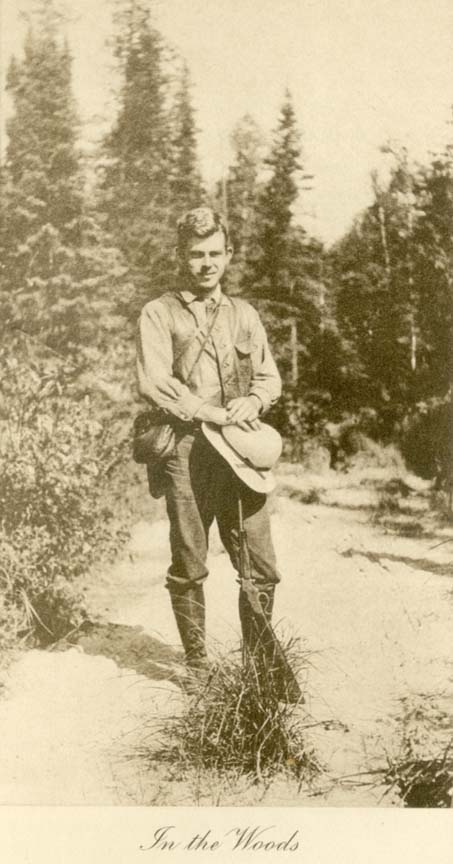
Mother often went with them to the Pontiac Game Club. I went only twice. Caspar did not consider me a success there. Father Powell was often invited to go to the woods with them, for he loved the wilderness as they did. When he was free to go with them he and Caspar saw much of each other and there formed a deep and lasting friendship. After Caspar's death Father Powell wrote of Caspar's love for the woods:
"In the years immediately preceding the War the place where Caspar most loved to be was the Canadian woods north of the Ottawa. In the woods thousands of questions, social, economical, ethical, present themselves in new and more engagingly simple aspects. Caspar hated the ponderous imbecilities and pomposities of life. He found that in the Laurentians difficulties vanish, conventions fade, clothes are reduced to their least common measure. Things in Cincinnati, Boston or New York regarded as essential and inevitable evaporate among the trees or simplify themselves with instructive ease.
"The Canadian woods north of Petawawa are a labyrinth of lakes, of low hills and mountains, covered once with big pines, now with spruce and hemlock and a second growth of other timber. The weeks spent there each year were full of fishing, canoeing, tramping the moss-grown trails and camping experiences. Each hour was perfect of its kind. In the early morning the outlines of the hills over the lake would be indescribably soft and tender; while the day progressed with a succession of harmonies akin to a symphony, and ending with a few low, gracious chords.
"Well, he has ridden his ride and made his mark in many a foray, and now he is where the heroes are. Could it be better After all, that is the way to die, better a thousand times to lay down your life for others than to drivel off into eternity betwixt awake and asleep in a fatuous old age. May God rest his gallant soul."
Alpha Delta Phi Club,
Sept. 26, 1907.. . . . . . . . . . I SAW everybody I know, and it certainly is good fun to be back again.
I signed on this morning in Comp. Lit. 1, French 6, Fine Arts 4, Philosophy A, History 16 and English 45. This is a good selection, I think. I went in to see Spence, and brought Father Tovey and him out to tea. I was glad to see them again. Spence is too thin. He looks poorly and not as impressive as he should.
I had been ordained late in May, and had at once begun my ministry at St. John's Church, Bowdoin Street, Boston. I wonder if he expected a deacon to be as portly and "impressive" as a bishop.
Hampden Hall, Cambridge,
Oct. 10, 1907.. . . . . . . . . . I MET the Bishop of London the other day. He is the most attractive man I think I have ever met. The next day I saw him out at Oakley playing golf. I would really like to know him better.
I am going to Nassau with the golf team tomorrow for a week and two days, during which time I am signed off at the office. I will send you my picture as an athlete when it appears. It does seem sort of a joke, doesn't it?
Monk says, "Do not strike that man, he is fighting for Old Harvard." I hope that I can make good, and I expect to.
Alpha Delta Phi Club,
Dec. 15, 1907.. . . . . . . . . . THE other evening Monk and I had dinner at the Mission House. He was deeply impressed, to say the least, and really wants to go again. I guess he kept me up until one o'clock talking about Spence and Father Powell. It is an eye-opener to him. Monk is living with us now. Mose is in Virginia --- "bad eyes."
Jan. 4, 1908.
. . . . . . . . . . I DINED out here and have just returned from a free lecture on digestion at the Harvard Medical School It was very interesting, but I am now afraid to eat or drink. Why we are able to live I don't see. This is the first of a very interesting series of lectures, which I shall not attend.
I shall go in to see Spence tomorrow afternoon or morning.
I have almost finished Dante's Inferno! It is like Shaler's(82) remark, "It goes in one ear, and, meeting with no particular obstruction, goes out the other." I shall have to go through it again on the "low speed." You certainly have to "keep your eye on the ball" to understand that gentleman.
What with the Inferno and the remains of three trunks scattered over our room, I fear for the worst in my dreams tonight ....
Jan. 8, 1908.
. . . . . . . . . . TEMP has got the grip, as well as a large hunk of meat gently torn from one of his feet. He is at Lexington suffering. I shall try to get out to see him today.
Before departing he depicted the beauties of the fair sex of the Queen City in such glowing terms to Mose that the aforesaid gentleman informs me that he is going to Cincinnati at Easter without fail. What is more he seems to be organizing an invading army totally unbeknown to me. It is at present composed of Huidekoper and Gaspar Bacon.(83) They contemplate incidentally going to Lexington where they expect to purchase the thoroughbred and partake of a coon-hunt with Fritz Belmont.(84) Isn't it nice to have your own party so carefully thought out?
CAP.
This arrangement has one advantage in that I may regret. Come soon.
"Come soon," underlined, is typical of Caspar's appeals to our parents to come to him. Probably they did so, even if he had left them at home, only a week before, at the end of his Christmas recess.
Lexington, Feb. 9, 1908.
I FINISHED Saturday, and I was jolly well glad to get through, I can tell you. I did well in my Fine Arts, but in my frenzy to avoid a disaster in this, I neglected my History 16 with the result that I was stung, I fear. They refused to ask me any of the things I knew about. I spent hours explaining why Napoleon did such and such a thing when I had to take a guess on whether he had done it or not. It was in the words of the papers a "trying ordeal." The chump who made out the exam refused to ask questions on the only book in the course which I knew anything about, that voluminous green book, which I carried about with me. I pinned my faith on that book alone, and I went down with it, I fear. I never did like the book anyway. I had such a miserable cold that I came out here with Temp, and Dr. Briggs has been having a grand time giving me pills, etc.
Temp is twenty-one today. Festivities are in order; relatives, gold watches, etc. Dr. Briggs may well be proud of him. Without being priggish in any way he is the cleanest fellow, both in body and mind, that I know anywhere.
His grandmother is here, and a wittier, more charming old lady I have never seen.
I have spent the afternoon reading "The Newcomes." It certainly is delightful! Of course I don't know, but it seems to me that I get more "education" from Thackeray than from miles of books like that fatal green book in History 16 (it isn't worthy to have a name).
I enclose the exam along with a picture of me "at work," by Tempy.
CAP.
I am "a very sick woman." I may come home if I can get signed off.
Alpha Delta Phi Club,
Mar. 13, 1908.. . . . . . . . . . I MET Spence at Dr. Goodale's this afternoon. We are both nearly O.K., so the Doctor says. Spence and I walked up Beacon Street to the Mission House where I had tea (and when I say tea, I mean tea, for it was Friday the 13th, in Lent, and I guess the cook knew it).
I am going to tutor a fellow, my own age, in Latin.(85)
As the slang expression goes, "What do you know about that?" I really think it will be good sport. He seems pretty thick, and I don't think he will ever learn enough Latin under my tutelage to find out the fact that I don't know any myself. I shall be very severe with him, for I thoroughly believe in the motto, "Spare the rod and spoil the child." He could lick me easily, but he "has got religion," and humble is no fit description of him. Moreover, if the worm should turn, he looks clumsy and I think I could beat him to the monastery, where, like the knight of old, I should of course be safe. I do not, however, look for any such uprising. What I do fear is that he may learn more rapidly than I expect and start asking questions. He almost stumped me today on, "What is a transitive verb?" If he gets too inquisitive I shall reply, "By advice of counsel, I refuse to answer."
March 20, 1908.
. . . . . . . . . . IN the evening I heard Spence preach at St. Augustine's. He was good and perfectly natural. The only thing he needs to be really fine is to feel a little more self-confident. In music when a good performer strikes a distinctly bum note, he shakes his locks and everybody thinks it was a wonderful minor note. Father Powell has the art down to a very fine point, but Spence is lamentably weak.
Tell Dad that he ought to be glad he was not there. He stuck the knife in and turned it around on me All Right, All Right.
I returned to Cambridge tired out by the strain of the day, and promptly got into a very small poker game where in one hour I lost the last of my patrimony, which same was $5.00. Monk got off what I consider one of the most original lines I have ever heard. He had a large stack of chips before him all evening. Then he started losing, and when he got almost to the end he looked up and said, "Well, it looks as though the seven lean years are coming."
Today Spence came out and we went to Soldiers' Field and watched "Harvard's Tempy" perform, very poorly, I thought, but, as he disagrees on this, maybe I am wrong.
April 3, 1908.
I HAD an amusing experience with "our dear Dean" the other day. I got a call and you should have seen Robinson's joy, as I have done nothing but tell him that he is "in serious danger of separation" ever since he has been put on probation. I was some worried myself, although I didn't see just what I had done. Imagine my relief when he told me that "As a representative of Harvard in intercollegiate athletics," he was going to ask me not to cut any more than possible, as the Committee were examining the records of all the members of teams. Never have I seen anything more intense than Robinson's disappointment.
Tuesday, May, 1908.
I WAS about to write you Sunday when the great Chelsea fire broke out. Of my wonderful experiences at this fire I will tell you when I see you. It was without doubt the most tragic and exciting day and night I have ever spent.
I had lunch at the Mission House, after which I went to Chelsea with Fr. Powell bearing much food and drink. I got so interested that I made a night of it and came in at seven this morning. This also was a fine experience which you shall hear about when I arrive.
Again he spent the summer in the woods. Father and Mother were there also, and part of the time they had as their guests Tempy and Pren Willetts. Caspar thoroughly enjoyed that combination of Harvard and the woods.
Hampden Hall, Cambridge,
Dec. 1, 1908.DEAR MON,
I AM sending you the card of a dinner we gave to Pres. Eliot at The Fly the other evening. It was really a wonder. Pres. Eliot made a very stiff "speech," but you should have heard the talks which Bishop Lawrence, Major Higginson, and particularly old Prof. Hill (Spence's friend) made us. He (Hill) got up and compared Eliot to the explorer who started out to find the centre of Africa with six fur coats on and shed them one by one as he neared the centre. Then he said, "Eliot started to do his life-work with six coats on; he has shed them all but one. But I, who was a classmate and 'brother' in this club with him, want to tell you what he is like with that one last overcoat off." Just why Eliot didn't slay him I don't know, but he really seemed pleased. The whole thing was a real treat in every way.
I went to for Thanksgiving and had a miserable time. In the evening we went to a reception at ------. His wife is healthy, wealthy and amiable (when given her chance to say anything). I had a miserable time; I ate so much that I had cramps when I got home. I couldn't get to sleep, neither could Temp, so we sat up and talked, he, sentimental bosh and I, financial difficulties, until the wee hours. When we saw each other in the morning we both roared without saying a word. He went down to Philadelphia in the evening with "Lamb," to pursue the "royal family" (Wiborgs I mean). I am still grouchy and have a bad cold, so has Temp, so we sit and scowl at each other by the day, which helps a lot.
Alpha Delta Phi Club,
Dec. 8, 1908.. . . . . . . . . . SUNDAY evening we had dinner in Boston with Charlie Short.(86) He is more amusing than ever. For some reason, unknown to me, he always has to have a long consultation with the head waiter before he can order mashed potatoes, and when it comes to wine he really becomes eloquent. I offered to bet him $10 that he couldn't tell the difference between American champagne at $2.00 per quart and French at $4.00, if he didn't see the labels on the bottles. He was greatly disgusted, but would not take the bet all the same.
I am rehearsing for the Christmas play at the Pudding,(87) in which I play the rôle of a "goody." I just noticed it myself that I am excruciatingly funny and in fact the whole show. I hope somebody will agree with me.
Jan. 27, 1909.
. . . . . . . . . . SUNDAY I wrote an entire thesis of twenty-eight pages and stayed up most of the night. I never put in a harder day's work, but to my surprise I picked rather an interesting subject.
Monday night we gave our show at the Pudding (with variations). It was of course more appreciated there than in town.
Yesterday evening I dined at the Wendell's with Bill and Gilbert Butler.(88) Barrett was "simply ripping"; I can't put it too strongly how nice he was. Afterwards we gave the last performance at Jordan Hall. The hall was jammed and very appreciative, I thought. Everybody was presented with huge bunches of flowers, etc. After the show our company and all other performers went to the Victoria for supper bearing great bunches of flowers. To say that the greeting given us on our appearance, by a crowd of friends who happened to be there, was cordial, is to put it mildly.
Mose is leaving at the Mid-years. My grief, as I told him, is considerably lessened by the fact that I shall then have (1) bedroom (1) all to myself. Talk about your oriental luxury!
I will send you a program of the show. Monk says it is my début into Boston high life. He refers to me as "that climber from somewhere in the Middle West."
Chestnut Hill, Feb. 12, 1909.
WELL, the exams are all over! ... I am out at Temp's with a little grip, which Dr. Briggs is killing in great shape, but I felt pretty rotten yesterday .... I am growing rather tired of Cambridge as a winter resort; I wish I had graduated in a way, for I am doing nothing but loaf and get sore at the beastly cold weather. I am getting anxious really to get to doing something.
This tragic outburst is not the work of a Byron, but of your son who has the grip, and feels like a vicious, snarling cur. In a way, however, it is a pleasure to be sick in a decent household where you get some sympathy. It is very different from being sick in the Club, I can tell you. In fact I am thoroughly enjoying a grouch in domestic surroundings.
I re-read "Soldiers Three" yesterday. It is better than ever. All this talk about Kipling having the wrong ideal of the Indian Empire gives me a pain. Of course he has the wrong ideal, but he has caught and turned into literature this very same aspect, wrong though it may be. Kipling isn't writing political essays on the best way to govern India, he simply pictures the spirit of the Government as he saw it, and makes delightful pictures too. I think I have the examination habit.
Cambridge, Mar. 1st, 1909.
WELL, the Wiborgs(89) have gone and "all is quiet along the Potomac." I really think they had a fine time and I know that I did. They got here at seven Friday morning; Mr. Wiborg came up with them as did Harriet Anderson.(90) Tempy, Lamb, Henry Wilder and I chartered a huge automobile and went in to meet them, after which we all had breakfast together at the Touraine. Then while they unpacked, etc., we went on a flower purchasing expedition. Then we came out to Cambridge where we wandered about awhile and then we went to Oakley, where we had luncheon. After sitting around awhile we went for a ride through Brookline and finally left them at the Touraine. We all had dinner at the Somerset Club as the guests of Mr. Burr, whom they knew well in Florence. Then we went to see Ethel Barrymore and then to the dance.
The dance was really a wonder. I spent about an hour or so introducing anxious friends. It really was ridiculous how anxious everybody was to meet them, and inside of half an hour they knew everybody, I think. Then I took poor worn-out Mr. Wiborg over here to the Club and put him in a comfortable chair, talked about all sorts of stupid things and tried to be decent. I missed in this way most of the dance, but by keeping him company I was able to stall off the girls' departure until six o'clock in the morning, for which they seemed very thankful.
Most of the day was spent in sleep, calls, etc., and Sunday we went with them as far as Providence. Since when I have done little but sleep ....
It was just like Caspar to have spent the evening introducing his friends to these girls, and then making it possible for them to dance all night by keeping their father entertained at a club.
March 31, 1909.
WE had a small dinner here Saturday night for Ned Bell,(91) who is going abroad.
Alpha Delta Phi Club,
April 26, 1909.. . . . . . . . . . SUNDAY we watched the Squadron take their annual parade down Fifth Avenue to Church, preceded by a large band. As everybody I knew in New York is in it, it was very amusing. George Wag says, "I may not be much on the drill, but under fire I am peerless." We (Jones, Monk, Suydam, Willetts and I) marched alongside of them, lined up with canes as another regiment. We got them laughing and all out of step.
[In this same letter Caspar writes of his hectic visit to Mrs. Wiborg in Washington. Editor.]
Henry and I went over to Washington Thursday and arrived about nine in the evening. We had the most hectic time of my career! Wow; but the pace was fast. One morning by gulping a cup of very hot coffee I read half of one column in a newspaper, but that was the only time we weren't on the jump "en masse." Dancing, theatre, riding, seeing Senate, etc., cards (poker for fun!), automobiling, breakfasting in the woods, wild games, baseball games, balloon ascensions, navy yards, private yachts, thousands of callers, white and yellow and Germans galore. Now every one of the things happened in three days and most of them happened two or three times each day. I feel like a ship that has lost its propeller.
The English language is incapable of describing such rapid action or the human brain of taking in any clear impression of it (mine was at least).
Towards the end of the tumult Nat Simpkins(92) called me up and said that a card was awaiting me at the Army and Navy Club where he, Mose, and Bob Bacon(93) were seated in "three comfortable chairs" in a quiet room, with three long cool drinks in front of them and that both a fourth chair and drink were awaiting me. Just as this vision was soothing my tired brain I was summoned to a Virginia Reel!!!
Lamb was all right, as he managed to wander off with Olga, but I was the butt of it all. I tried Lamb's trick with every girl there, but they all preferred the tumult to any such fate as that. I said to Henry one night just as he was about to drop asleep, "Henry, do you suppose that big wicker chair will be out on the porch in its old corner when we get back?" He sat up in bed and said, "Do you know that I thought of that on the picnic this afternoon, when a spider crawled up my back."
They are a lovely family, though, one and all, and they have a magnificent house. I really did have a fine time, I suppose, but they put about one month's entertainment into three days.
They had three butlers and other scavengers who drained me dry as a bone. I felt so tired that I could have read Wordsworth with pleasure.
May 11, 1909.
. . . . . . . . . . TEMP has been sick here at the Club and I have been staying with him, and have done the first work I have touched since Mid-years. I am getting really rather tired of loafing and anxious to get some real work, and doing some good. I have gotten about all that I am going to pull out of Cambridge. Although it is really pleasanter here than ever before.
June 5, 1909.
. . . . . . . . . . I HAVE just gone to my last recitation! It is hard in a way to give up the best time in my life, but I am really rather anxious to start in earning my living, which by the way I suppose I won't be able to do for several years. I am doing no good here now and spending much more than I ought to spend, but it will soon be over.
My allowance would help a lot!!!
DIRECTLY after graduation Caspar and our parents joined me in England. I had gone to Oxford a year before to become a novice of the Society of St. John the Evangelist at the mother house of our order, Cowley St. John's, Oxford. As soon as I saw Caspar there I asked him my usual question, "What are you going to do now?" There was a determined and affectionate look in his eyes as he answered, "The life you have chosen rather settles my life too, doesn't it? I must go home and take care of 'the Family.'"
He abhorred the idea of "settling down," of going into business, of being indoors at a desk, of doing the same thing every day, of seeing the same people every day --- in short, routine and discipline. As a small boy he had run away from them. That was prophetic.
At this time he gave one the impression of elegant and permanent leisure. He appreciated that himself, for he thoroughly enjoyed an inquiry of Father Waggett's,(1) "And how is dear old Caspar? And is his work still done?"
His work really was done, so far as business was concerned, before he began it. I often raised the subject that summer, during our weeks together in Oxford, Norfolk, the Isle of Wight and London, but Caspar never continued the conversation. Nevertheless he did go home as a matter of course and get a job. It was a misfit. Caspar was bored and did no work. Many people made a hasty decision that he was only a genial and witty loafer. He half agreed with them.
Then he first began to think and to speak of himself as a failure. Certainly he had been "a success" in College, but he found that friendliness, charm and generosity, divorced from industry and regularity, which had made him popular in Harvard, had no market value in the business world. It seems now a great pity that his first step in the work of life should have been in an uncongenial direction. Fortunately he did not go far on that path. He would never have felt at home in it.
In the spring he, the Countess Camilla Hoyos, who was visiting at our house, and Father were exposed to rabies. They went at once to the Pasteur Institute in New York. There Caspar met, through the Countess Camilla, Dr. Frank Wood, the eminent bacteriologist.
He interested Caspar immensely. By the end of the Pasteur treatment Caspar had decided to be a physician. It was as much of a surprise to him and to us all as when I had decided to be a priest. All of Caspar's enthusiasm, that had been in total eclipse during his "business career," flashed out. I wish I had kept the letter he wrote me about his decision. It was alive. He had already made up his mind to study chemistry that summer so that he could enter the Harvard Medical School in the autumn. He asked me to learn from Sir William Osler if he could study chemistry in Oxford that summer, for he wanted to be there with our parents and me.
His letter showed that he was in earnest about becoming a physician, and it also unintentionally revealed that he was happy to have any excuse to return to Harvard.
No letters written by him from June, 1909, to October, 1910, can be found. Probably he wrote almost none, for during that time he was with Father and Mother.
That summer of 1910 he spent in England, mostly in London, to work there in a chemist's laboratory.
Oct. 3, 1910.
DEAR MON,
. . . . . . . . . . I REGISTERED this morning. Attended my first lecture in Anatomy by Dr. Warren. It in no way resembled "The Lesson in Anatomy" of fame. The course is very large and of every possible type. There are about twenty men who are dressed and look like gentlemen. There were many more who did not so dress, who looked equally fine, and there was about half the class who looked cheap and grasping. Lunt(1) fell on my neck and called me "old fellow." I was equally effusive and bought him lunch. We shall be great friends, I fear ....
161 Bay State Road,
Oct. 7, 1910.WELL, I knew it would happen. I am coming here to live. And I am going to room with Laurie Lunt!! He has been here since the real opening of the School, and assures me it is very quiet, and if it is very quiet for him certainly will be for me. I am going to give it a good try at any rate. We have a beautiful house and we have a large room with a bay overlooking the Charles.
I have not yet moved in. Came over here last night to give it a trial, and am now seated clothed in pajamas, which I asked for, writing this epistle. Please send on my desk, desk chair, that wicker armchair and bed linen, not to speak of my fur coat. The work is fast and furious, hotter than anything I ever dreamed of, but it's a great pleasure to be treated as if you had a few brains and some ability. I have not the slightest feeling about skeletons, cadavers, or in fact any such thing any more than I have ever had for any dead animal. A large per cent turn pale and a few faint. I rejoice that I feel the way I do, but I don't think that it is a thing to treat with an air of bravado. It becomes horrible if that is done. It is all made easy by the fact that Professor Warren (you remember I dined with him in London) is such a complete gentleman.
I went into the Mission House the other evening and had dinner. Fr. Powell was more charming than ever.
Now, as near as I can see there is absolutely no reason why it wouldn't be a good plan for you to come on here at any time. As far as I am concerned it will help, in that I would enjoy it enormously, and if we should work things intelligently I think it would actually aid my work.
161 Bay State Road.
. . . . . . . . . . Now as to the next proposition. I have looked fairly well at this game here, and there is absolutely no reason why you should not come on here. I cannot conceive of any way in which it would not be of the greatest help to me. My reasons for wanting you to come on here are two-fold. The first set are purely selfish. I would love to have you in the first place; in the second place it would help me in my work in every way. Also I believe it would do you all kinds of good. You would make many friends here "who speak your language.". . . This I think would do you more good than anything in the world. I also think it would be a pleasure to see me doing something which is worth while and which you approved of. Think and talk this over very seriously. You see the work is so strenuous during the day that it is next to impossible to work all evening----for me at least. Ordinary evenings I work about an hour and a half; I only put on more steam on occasions. This is about up to my limit. This would give us quite a good deal of time together. . .
I AM hoping you are better. Do let me know. Everything goes on with great speed here. I like it better and better each day. And still everybody here tells me they look back on their first half year as on a horrible nightmare. Part of the work is deadly stupid, part is very interesting, and it is a great pleasure even to attempt to use your intellect while you are working. Everybody works; the competition is frightful, but good fun.
I am very glad I have moved here; I believe it's a fine thing to get out of the atmosphere of the School for a short time each day. L----- and I have agreed not to talk work while at meals, or on our way to and fro ....
. . . . . . . . . . WHEN I was sick L------ was pretty nearly as bad as Father is. He "meant as well" as he possibly could. I really believe he is as splendid a man as you would want to find; he is clean, manly, forgiving, but he has not one slightest atom of a sense of humor. He is the very highest type of Yale gentleman.
When we are working, and by the way he is the best person to work with I have ever struck, and when we are walking home or to the School together, it somehow or other seems to happen that I invariably think of the most amusing things to say which have ever entered my head. I have given it all up, it is too chilling. I write them on my cuff and save them for somebody else, and continue talking about politics or athletics.
I really like the work; it is more and more interesting.
I think less and less of my class-mates, particularly the prominent ones. I have discovered several very meek-looking individuals who will be very fine men some day. There is a man named ------- in my section. As we were walking along in the School he said to me, "Say, every time I look at these buildings they look sweller to muh." Needless to say he is as bright as chain-lightning in his work.
. . . . . . . . . . You ask me of the men here. They are all pleasant. Henry Wilder, Dan Sortwell,(2) John Simons (3) in my class, Don Nichols, '06,(4) Goodhue, '06,(5) Horace Gade, '03,(6) a Norwegian, and Austin Gill,(7) are very nice and the others are not aggressive. It is pleasant here, but I wish you were on. It would make me completely happy.
I never have seen such a change as there is at Harvard, as I see it through the eyes of The Fly. Under Lowell every one seems so much more active--- a new-born desire to have the Club stand for activity amongst the whole undergraduate body. Such unity of purpose was unheard of before. The old idea of "O, well, I shouldn't do that, but if you want to do it, it's none of my business," simply does not exist .... Tell Charlie he is an ass and I would love to see him.
. . . . . . . . . . THINGS go on much the same here. I have one bad bit of news; I am a wretched dissector. Of all the clumsy people I have ever seen I am the clumsiest. I am either timid, afraid to cut at all, or else I hack away with a boldness which no structure in the human body can withstand. However, it is like the reports from Franklin on my handwriting, "Poor, but improving." This has been a "hacking day," so I am through early; on my timid days I return of an evening. A funny part about the whole thing is that it is not the least bit grewsome. It ought to be like Poe, but it's more like the Scientific American, except the smell, which is terrible.
I was thinking last night of a terrible part of Swift's Gulliver's Travels (not the children's edition). Gulliver is in the land of the giants. At the Court he is a great curiosity. The great beauty of the Court picks him up and holds him near her face so that she can see him. He then sees that her face, which to her people appears soft and lily white, is really a mask of minute hairs, etc., etc. (à la Swift), invisible to their colossal eyes. It is one of the bitterest satires that even Swift ever wrote. It seems to me that the more charitable way to look on it is as a great Gothic Church; made up of a great mass of complications, none of them beautiful in themselves, but forming a magnificent whole.
Here is one on Lunt. I said, "O for the good old days when we called the whole region from our chest to our legs simply 'guts." He replied, "Then why do you want to study medicine if you feel that way about it?"
Most of these letters are undated, but they all were written before Christmas, 1910. By that time his repeated appeals to Father and Mother to come to Boston so that he might live with them had had the effect he desired.
Throughout his life he usually made his plans without respect to them; then, both by letters and telegrams, he besought them to join him. These affectionate S.O.S. calls were genuine, flattering and irresistible. From December, 1910, until his death Father and Mother were either with him or planning to go to him. For three winters they had houses in Boston to make a home for him; during the three years he was in the North they were constantly planning to go to him "when the ice breaks," and he had been "in the War" only a few months when his appeals drew them to England. There they remained until after the Armistice. They did not "run after him," as some people thought; they merely tried to keep up with his adventurous life in response to his loving appeals.
During the winter of 1910-11 they three had a small furnished house on Exeter Street. All Caspar's days were spent at the Medical School, but in the evening he and Mother shared with each other their Boston friends, old and new. The friends of each became the friends of both, and then Father's. Caspar once said to me, "Mother makes our friends and Dad keeps them for us."
In speaking that winter of a cousin, Mabel MacLeod Hammond, and her family (the Franklin T. Hammonds, of Cambridge), Caspar said, "There is a crying need for more relations like the Hammonds. When you go to see them they are glad to see you and you have a splendid time. When you stay away for months at a time they never get their feelings hurt."
During that winter Caspar and our parents had the joy in common of frequently going to the opera. Caspar was always fond of music. Although his "practising" as a child was comic and soon given up as hopeless, he had always heard good music at home, at concerts, and whenever grand opera was within his reach, in Cincinnati, New York and Paris.
Never before had he the opportunity to go to the opera several times each week. This was made possible for him at that time by Mrs. Wirt Dexter's standing invitation to Caspar to join her in her opera box. Caspar took her so literally at her word that, when he bought seats for some special performance, he told her she owed him the $10.00 he had paid for them. He not only enjoyed the opera with her, but during that winter they formed an intimate and lasting friendship.
Listening to great music was one of Caspar's chief joys also during the summer of that year, 1911. He went with Father and Mother to England to be near me in Oxford. Our intimate friend from Cincinnati, Mrs. Thomas, his devoted "Aunt Georgine," had the old Newman house at Iffly that summer. Caspar was constantly there with her, perched on the end of her piano bench, listening by the hour to her music. He usually asked for Beethoven, and when she turned to other composers he would ask for Beethoven again.
I remember them enjoying Beethoven together especially that summer at Goring-on-Thames. Father and Mother and the Countess Camilla Hoyos took a charming house there for the few weeks I could be with them. Everything there was peaceful, and suggested quiet grace and permanent beauty. It would have been impossible to believe that Caspar and Harry Byng,(8) who played golf together every morning, would soon be killed in a world war. Even then there were violent, although purely academic, discussions of international problems. Caspar often told Camilla afterwards that she had been the first person to explain to him why he instinctively detested Germans by her denunciations of what we have since learned to call Prussianism. Although an Austrian she loved most her mother's country, England. There Caspar first knew her, and even during and after the War kept up an intimate friendship with her.
She had visited us in Cincinnati in 1910. In the winter of 1911-12 she was one of the many interesting friends Mother had as guests at 386 Beacon Street. Caspar's intimate friend, Charles W. Short, Jr., was spending the winter at our house. Caspar was fond of them both as friends and apparently never noticed that they were in love with each other. That was a relationship that always surprised him. As his friends became engaged and married he was always at a loss to know how to account for it or what to say to them. He wrote to Charley, on hearing of his engagement to Camilla, "I don't know if you will be happy, but I am sure you will never be bored."
The following letter illustrates Caspar's amusing ignorance on the subject:
386 Beacon Street,
Feby. 14th, 1912.DEAR TEMP,
WHEN numerous friends have told me of their engagements I have always tried to say something suitable to a great dramatic moment. I have tried all methods of congratulation, from a speech in the Lunt manner to satirical quips; all have been dismal failures, I have always said the wrong thing. However, I shall try again.
I am glad (I am generally sorry). In the first place you are really cut out to make a good husband. You always were destined for a married life. You've pushed a few bells too in your day, but even that you did with a sort of domestic touch. You were the only person I felt perfectly sure would marry.
Now you have got the right girl for you, and, last but not least, for me. I don't often take a fancy to a girl on first sight, but I surely did to her. I said to Henry shortly afterwards that I thought you had gumption enough to try to get her, but you sort of had me guessing.
Of course I will usher for you. Why shouldn't I? You could only have avoided my ushering by not asking me, and I am not so sure that that would have been effective.
Maybe I could get out for a day during the Easter holidays. I saw Mose the other day. He looked fine.
Is Wilder to be an usher? Will he have the nerve to pose as a single man?
Don't mark this E, but consider it the earnest effort of a poor little boob to congratulate you on a happiness which he knows nothing whatever about.
Lovingly,
CAP.I will write to Ruth Card when I find out where she is.
During his first year in the Medical School and up until January of 1912 Caspar did brilliant work in spots. Some subjects interested him and he got A's in them. Some subjects bored him and he got E's in them. One wonders if he would ever have tackled his medical course seriously as a whole.
Early in January, 1912, he had to have an operation for an acute attack of appendicitis. He seemed to make a rapid recovery, but he was not well enough by the first of February to go over to New York with Father and Mother to meet me on my return to America. Shortly before, after five years in the noviciate of the Society of St. John the Evangelist, I had made my profession for life as a Religious. Caspar's cable to me on that occasion was characteristic. He understood and admired my motives for entering Holy Religion, but when it came time for me to "take the veil," as he merrily expressed it, he did not cable any bromidic message of "congratulations and love," but the one word "Enfin."
When he was supposed to be too ill to travel to New York to welcome me back to America you can imagine our surprise to have him board our train at Providence. He had to come part way to meet me, doctors or no doctors. In spite of a huge fur coat he caught cold that zero day that developed into tonsillitis. Germs migrated from his tonsils to a valve of his heart and there proceeded to settle down and raise a family. I cannot describe his case medically, but I know he was flat on his back until June. He was at the Beacon Street house and in several hospitals. Among the many things that were done to him his tonsils were taken out. Before the operation I remember I asked him if he wanted the Sacraments. He answered, "Heavens, No. This doesn't amount to anything. If it were serious I should want everything you or any priest could do for me." Then with a twinkle in his eyes he added, "I'm afraid you can't stage a proper Catholic deathbed this time, Spencey."
He did not seem critically ill at any time that winter or spring, but he and we all knew that his heart was seriously damaged. As he became ill before the Mid-year examinations he had lost a whole year's work at the Medical School.
To start in again with the second year's work, in the autumn of 1912, was discouraging. He was not really well. Also, he seemed to have lost interest.
Dr. John Mason Little, a friend of mine who had spent several years in the North with Dr. Grenfell, happened to be in Boston on a vacation at that time. Although Father, Mother and Caspar were settled for the winter at 7 Chestnut Street, Caspar decided, after several talks with Dr. Little, to offer himself to Dr. Grenfell for work in the North until the opening of the Medical School in the fall of 1913. His heart seemed to be up to the trip and the work, for it "had established compensation." He needed also a fresh enthusiasm to carry him through the long grind of preparing to be a physician. So in November of 1912 he set out for St. Anthony, Newfoundland. Father went with him as far as St. John's. From there on his own letters tell his story.