
| Three Months |
Fr 2,00 |
|
Fr. 2,75 |
| Six Months |
4,00 |
|
5,50 |
November 12, 1918.
Today, when France and her allies are magnificently rewarded for the sacrifices undergone during more than four years by the most complete victory in history, I express my heartfelt thanks to the personnel of the Reserve, officers and men, French and American, for the unceasing devotion of which they gave proof under every circumstance.
I am proud to command an organization in which every member has shown such a high regard for duty and for the importance of his task.
All will be happy to feel today that the effort furnished by the Reserve contributed its part towards the final victory. I wish particularly to express my gratitude to our comrades of the American Field Service, who came to offer their aid to France at a time when they were under no obligation to take part in the war, and who were, in a way, the link between the Armies of France which had been struggling since the beginning of hostilities and the great American Army without which the Victory of Right would not have been possible.
I pay a tribute to all members of the Reserve who have lost their lives during the campaign and particularly to our dear friend, First Lieutenant Edwards, who fell on the field of honor barely three weeks before the cessation of hostilities.
Our work is not finished. Our duty now is to make a last effort and to replace the means of communication destroyed by the enemy during his retreat. This effort will he hard, but the security of our armies of occupation, the provisioning of our soldiers and of the civil population must be assured before all.
I am confident that I can depend on all to accomplish this task to the end.
Word has been received that Chester Robinson Tutein, 2nd Lieutenant U. S. Aviation, was killed recently in an accident. Tutein joined the Field Service June 20th, 1917, being attached to T. M. U. 526 until November 19, 1917, when he was released to go into Aviation. He was 23 years of age, a student at Massachusetts Institute of Technology, and his home was in Winchester, Massachusetts.
We have just learned that Paul Warren Lindsley Cadet in U. S. Air Service was killed in an accident at an Instruction Center at the end of last October. Lindsley joined the Field Service May 26, 1917, being attached to T. M. U. 184. He was released November 20th, 1917 and went into the Italian Service of the A. R. C. Later he went into U. S. Aviation., Lindsley. was 21 years old, and his home was in Marietta, Ohio.-.
Sous le commandement du premier lieutenant américain Macpherson et du sous-lieutenant Huret, a fait preuve pendant les journées des 9, 10, 11 juin 1918, des plus belles qualités de froide résolution de sentiment élevé du devoir et du plus noble esprit de sacrifice. Après avoir perdu 8 voitures et 3 conducteurs dans le bombardement de C..., a continué à venir prendre en première ligne, sous le feu des mitrailleuses ennemies, les blessés à évacuer. Ne s'est retirée que sur l'ordre formel du médecin chef; a continué à assurer son service d'évacuation pendant trois jours dans les circonstances les plus périlleuses, se prodiguant sans compter jusqu'à l'extrême limite des forces de son personnel.
After being revised by Foch, "O. K. 'd" by Petain, approved by Pershing and overlooked by G. H. Q., the above "souvenir de guerre" arrived at the Section almost contemporaneously with the realization of that hitherto elusive, and willow-the-wispy "fin de la guerre". In these days of wild celebrations, and uncamouflaged windows, it would perhaps be amiss to recall the time when Old Man Mars stalked the Earth with his man-made-lightning and thunder, to say nothing of brancardiers, and ambrosial Pinard. Nevertheless, it behooves us to begin exercising our reminiscent mood now, in order that we might not be found wanting when we are called upon to tell little Johnnie what father did in the great War. So, let us reminisce.
The situation represented by the above citation will always be remembered as the Great Adventure of 637, altho the Section has seen harder and more dangerous work since. At midnight, June 8-9, the village of Deleted, in which the G. B. D. was situated, was subject to a violent, eight hour, artillery preparation anticipatory to the Boche Drive. There were eight ambulances and ten men on duty at the time. Next morning, seven men returned to the cantonment, boiling with rage that they, Knights of the Flying Flivver, should be forced to the humiliating extreme of covering some ten kilometers on foot. One is a prisoner. Two are still missing.
The tales of those that came back were wild and varied, according to the individual imagination, but all agreed that they had been treated to a practical demonstration of "Hell Breaking Loose". But a small thing like Hell could not prevent a real game of "craps" down in the cave. "Hap" Golden says that it was the explosion of at least a 210 that flipped his natural into an "eighter". And just as he rolled, the concussion of another big one blew the candle out. When it was relighted, eight was up. Everyone agreed that it took quite a little presence of mind to do that. Just then, the gamesters stopped to tell the guy that passed the cigarettes just what they thought of him. You see, no one could figure out any system of smoking in a gas mask. But when two or three marmites came into the house above the cave, the interest in the game began to wane. There was too much repenting to do for past sin.
At about 7:45, report was received that the Boches were on the outskirts of the village, and already had a machine gun mounted at the head of the main street. The Médecin-Chef immediately gave orders for the burning of the G. B. D. and the departure of the personnel.
The ambulanciers dodged, and ducked down the shrapnel-swept road, past the infantry drawn up in the ditches. The grim and determined soldiers were waiting, but the Knights of the Flivver tarried not. It did not seem advisable to attempt such tactics as made Don Quixote famous. A Red Cross brassard has as much chance against a pack of Boches as the well known pike against the likewise well known windmill. And so they came back ---seven of them.
In the meanwhile, the remaining cars at the cantonment had been called out, and were working full time. In the course of a short time other cars were secured from the park, and the section worked at full strength until the Boches were stopped.
The thrills and escapes will furnish material for many a fireside tale when "we get back". And June 9 will go down in the Diary of 637 as the day of the Great Adventure.
If you. want the truth, I was always a bit diffident about going into danger. I used to say that it was getting badly wounded that I was scared of, and not death. But as a matter of fact I didn't much fancy getting killed, either. That was what surprised me about getting popped off. It all happened so quickly. I was just stooping down to pick up a souvenir when all of a sudden --bim ! --- there I was, off on my way, ordre de movement and all, before I had a chance to think what had happened.
Pretty soon I got to wondering where I was going, and yet was afraid to look at my papers. The uncertainty was terrible, but then suppose it should say, --- Well, you can imagine how I felt. I waited a while, and turned the papers around and looked them all over on the outside. They appeared harmless enough. Then I turned up the corner to the line where it says "Destination" but not far enough to see what was written. I turned it up a little farther and there was a great big "H;" a little bit farther, and there was an "e". Oh, Lord, I began to break out in a cold sweat, and I couldn't look any farther. "I'll close my eyes and count ten," I thought, "and then I'll look." So I shut my eyes and opened the, paper. I counted ten; and then twenty and thirty, and after I'd been counting I don't know how long, I sort of absentmindedly opened my eyes and read it. I had to read it two or three times, before I was sure. But it certainly did say "Heaven" as plain as day. You, see, I was sort of expecting the other.
Of course after that I was feeling pretty good, and I went to sleep and dreamed of a six course dinner. When I woke up, somebody was calling, "Everybody out! Change cars!" and I found myself just waiting around.
I stopped a guard.
"What place is this?"
He mentioned some name I'd never heard before.
"How long do we have to wait here?"
"Where are you going? Let me see your papers."
Now it is against my principle to show my papers to any guard. They always find something wrong with them, and send you to a Provost Marshal.
"I'll take care of the papers," I said, "but I'm going to Heaven, if you want to know."
The guard winked.
"That's what they all say," he said. "Let's see ; this is 1918 --- the through train for Heaven will be along in 1920; but I guess you can get on any of these locals, all right.
And he went away chuckling, and I sat down, to wait. I've got to admit I was disgusted. The place was nothing but junction and there wasn't even a buvette in town. I don't know how long I waited, but certainly a crowd of people had come and gone before my patience was exhausted. Then I looked up the guard.
"Look here," I said. "Isn't there any way I can get to Heaven without waiting for that blamed express."
"You still here!" he exclaimed. "You don't mean to say you're really going to Heaven, do you?"
"Sure I am," I said, and showed him the paper, --- which is justifiable in case of emergency.
"Well, I'll be, " he said. "It's hard to know what to do about your case. There hasn't been anybody along for that destination since I came on the job. I was booked for there myself when I first came out but I got put on detached service here," he explained.
He scratched his head a couple of times.
"I'll tell you what," he said, "if you're really set on it, you can go on to the next junction, and wait in the station until one of the empties goes back to Heaven. I think they have a shortline there. That is, if you're sure you want to go there."
"Thanks," I said. "I believe I will."
"Just wait a second," he said, looking at me rather strangely almost pityingly I thought; and he went into his office and came out with a bar of chocolate and a sack of bull.
"Take these," he said. "Good bye and good luck. There's your train."
And I was off. Not long after we rolled into the next junction, and I found a guard.
"When does the next train leave for Heaven over the short line?" I asked.
"Tomorrow morning, as soon as it comes in. Expecting a friend?" he asked.
"No. Much obliged," I replied, for as I said before, I hate inquisitive guards.
I began to look about the junction, and I could see I was going to like the burg. Brightly lighted streets, lots of traffic, and if I could judge, cafés and theatres. There was a guard at the gate, but I watched my chance, doubled back up the switch-yard and over the fence into the city.
That night I had some time. I met a little black-eyed devil in a café and she and I had supper together and went to a show and well I'll never forget that night.
Next morning I had to argue with the conductor of the shortline to get on the train, and finally had to bribe him with my cake of chocolate and a swig of something I had bought the night before.
It was a swift ride and before I knew it I was in Heaven. Would you believe it, it was raining. There was a great big "Welcome" sign, done in gilt, with Christmas-tree hangings, bedraggled and dripping. There didn't seem to be anybody around, but pretty soon an old white-bearded man with a red armband came by. He stopped, surprised, when he saw me.
"Who are you?"
"Stormfield, sir. Private Stormfield."
"How did you get here?"
I had tried to figure out some kind of a story for this event, but I kind of lost courage. I thought it was. best to pull this bewildered stuff.
"Honestly, sir, I don't really know."
"Don't know, eh? Well, it affects lots of them that way. Let's see your papers."
I had to give them to him. I followed him into a musty office where there were a couple of other clerks. The old boy looked at my papers, vaguely, through his glasses. It was plain he couldn't read them. He stamped them five or six times and filed them away and gave me a pink check, "Good for One Eternity of Happiness." Then he turned to one of the clerks.
"Give this souljer a spiritual examination."
I went into the next room with the clerk. He sat at a desk and began checking off a lot of points without asking me anything, mumbling queries and responses automatically to himself,. "Religion-Christian. Record-Faithful, etc., etc."
"How are you morally? " he asked.
"Pretty well, thank you."
"Well, I guess that's all. Oh, let me see your soul."
I showed it to him ; and he looked at it rather curiously.
"Hmmm. Never saw one like that before. Don't you think it looks rather --- well rather ragged? How are your thoughts? "
"To tell you the truth, I haven't been thinking much lately."
"Oh, that's good," he said. "You're passed."
And he went back to the other room. The old boy turned to the other clerk.
The clerk got out a robe, a hymn-book a harp, a halo, a pair of sandals, and one pair regulation angel’s wings and put them on the counter.
"Give this souljer Equipment C. "
In another second I had them on, and a lot of dirty little cherubs came in and threw artificial flowers at me, and then asked for pennies and a cigarette Americaine,
The old boy said, "Now you are an Angel, 1st class, and you can go and have a good time forever."
Then I walked out into Heaven. There were some grand buildings and beautiful streets, but not much doing. I passed bunches of other Angels wandering about in badly fitting robes, and harps slung over their backs. I fixed mine that way.
Then I met a fellow with great big wings and a sash, who looked at me hard. I was going to pass on when he yelled at me.
"Say Buddy, what's your outfit? Don't you know enough to salute a Seraph when you, see one?"
I gave him a salute. There's no use arguing with that type.
But it seems it wasn't right.
"You do it like this," he said, kissing his hand and giving it kind of a flourish at the end.
I made a stab at it.
"That's better, only kneel at attention when you're talking to a Seraph after this."
A little farther on I came upon an Angel, actually scrubbing the golden paving stones.
"And what may you be doing, my friend?" I inquired.
"Oh me, " he said. " I'm on corvée. I tried to skip out of here the other day on a little trip, and got caught and they shoved me on this cobble-stone detail for A. W. O. L."
"Well, " I said, "if that's your idea of a heavenly time, take me home. What did you try to skip out for?"
"Got fed up. Nobody new ever comes in, and the kind we get don't make things any livelier. If I'd had my rights I'd have been a Seraph long ago, but they stuck in a lot of these Charley Boys who had recommendations from the churches. I put in my application for Martyr Corps, and got it turned down; and then I tried to transfer to Choir Celestial, and to Messenger Service, and never heard from either of them. I tell you I'm sick of this cloud out-post duty."
This sort of stuff wasn't encouraging and I walked off to a small cloud and sat down to kind of think it over. I hadn't been there long when I heard somebody hollering at me; I looked down and saw an Angel in spectacles, and with a triangle on his sleeve.
"Hey there," he called. "Cheerio! Don't look so gloomy. Have a good time!"
"Who are you?" I said. "I don't have to have a good time unless I want to."
"Oh yes you do," he said, facetiously. "This is Heaven. Come down and have a cup of chocolate."
"You go away," I said, edging around the cloud.
"And don't forget the Flying Trip tomorrow," he continued. "We start early ; bring your lunch. I'll show you all the famous places. And tonight we're going to have a dance if we can get any demoiselles."
"What, is there a scarcity of ladies?"
"No, but most of them are invited to the Seraph's Ball. Don't forget to come to the dance, though. We're going to have the nicest time. Cheerio! Goodby. Have a good time!"
And he was gone.
By this time, though I hate to admit it, I had pretty well made up my mind about Heaven. So I went back to the main office, and hunted up the clothing clerk.
"Say," I said. "About this halo. It sort of settles down and scratches my left ear. I wonder if I could get another."
"Sorry," he said. " They all complain of it. But it can't be helped. It's regulation."
"Do I have to wear it?"
"Of course," he said. "It's regulation."
I turned away, and went to the head clerk.
"Pardon me, sir," I said, saluting. "But are you sure this is Heaven?"
"It's absolutely official, " he replied. "Accredited by G. H. Q."
"Well, that being the case," I answered boldly, "I believe I'd like to get checked out."
"Checked out" he ejaculated. "Impossible! Why, where were you thinking of going?"
"I thought maybe, if you didn't mind, I'd like to go to---to that junction at the end of the short-line.
"That junction at the end of the short-line!" He shuddered, aghast. " You must never go there!"
"And why not?"
"What, don't you know?" he said "Why, my boy-- that's Hell."
L. W.
Haro1d Holden Sayre (S.S.U. 10) Flying Cadet U. S. Air Service, is reported missing.
Curtis R. Kellogg formerly of T. M. U. 184 has been commissioned 2nd Lieutenant, M. T. C. and assigned to duty with the M. T. O. Paris.
Lieut. Jefferson B. Fletcher, formerly a member of S.S.U. 4 and Com. Adj. of S.S.U. 29 now commanding officer of S.S.U. 517 U. S. A. A. S. has been awarded the Distinguished Service Cross.
Word has been received that Charles C. Jatho (S.S.U. 19) who was missing after the June drive, has been a prisoner at Camp Rastatt.
Moyer D. Thomas (S.S.U. 4) is now in the Chemical Warfare Service, and his address is Lincoln College, Oxford, England.
Laurence C. Ames (S.S.U. 68) 2nd Lieut. A. S. and Charles A. Atwell, Jr. (T.M.U. 526) U. S. A. S. have received orders to return to America.
Harold Willis (formerly S.S.U. 2) who escaped last month from a German prison camp where he had been a prisoner for fourteen months will sail for America on December 2nd.
Benj. F. Etter (S.S.U. 2) 2nd. Lieut. U. S. F. A. expects to be in Harrisburg, Penn. after December 15th.
George Leslie Herrick, recently commissioned second lieutenant, M. T. C. will be adjutant of the American Mission, Reserve Mallet as soon as he gets official assignment to duty.
Joseph R. Crockford formerly T. M. 37 has been in Camp Hospital No. . for several weeks as a result of an operation.
Thomas Paterson, formerly of headquarters American Mission Reserve Mallet, has been transferred to the new Motor Transport school at Decize where he is how sergeant major.
Charles Robertson and Benjamin Tower have been transferred from the Reserve Mallet to the new Motor Transport school t Decize.
Arthur Young, better know to former members of T. M. 155 as "Cy" was sent to a French hospital recently, suffering from appendicitis.
Robert Hyman, formerly T. M. U. 242, now an aspirant in French Artillery visited the Mallet Reserve this week while his battery was stationed in the vicinity.
Laurence C. Ames (S.S.U. 68) 2nd Lieut. A. S. ; William H. Bovey (S.S.U. 33) U. S. A. A. S. ; J. D. Hutchinson (S.S.U. 30) 504 Regt. de C. L. A., S. 334 ; Douglas M. Smith (T.M.U. 526) Ecole Militaire de l'Artillerie, Fontainebleau ; John M. Swasey (S.S.U. 71) U. S. A. A. S. ; Thomas H. Wagner, Jr. (S.S.U. 65) Ensign U. S. N. A. F. ; Paul W. Penland (T.M.U. 133) 2nd Lieut. Air Service, Orly, Seine ; Curtis R. Kellogg (T.M.U. 284) 2nd Lieut. M .T. C. ; Maurice L. Hanavan (T.M.U. 155) 2nd Lieut. M. T. C.; Charles C. Leonard (S.S.U. 71) U. S. A. A. S.; Benj. F. Etter (S.S.U. 2) 2nd Lieut. U. S. F. A. ; H. H. Powell (S.S.U. 2) Capt. U. S. A. S. ; H. J. Plass (S.S.U. 32) U. S. A. A. S.; Benjamin Henderson (S.S.U. 2) U. S. A. A. S. ; Malcolm Olson (T.M.U. 184) American Red Cross ; George L. Wilson (S.S.U. 13 and 69) 1st Lieut. U. S. A. A. S. ; Benjamin Jacobson (S.S.U. 2) U. S. A. A. S.; Kenneth T. White (S.S.U. 4) U. S. A. S. ; Albert Magnus, Jr. (S.S.U. 29) 2nd Lieut. M. T. C. ; Arthur B. Kinsolving (S.S.U. 4) 1st Lieut. U. S. A. A. S.; William J. Losh (S.S.U. 14 and 10) 1st Lieut. U. S. A. A. S. ; Ewen Maclntyre (S.S.U. 2) 1st Lieut. U. S. A. A. S. ; Elmer Naslund (S.S.U. 32) 2nd Lieut. M. T. C.; Leslie Gardner (S.S.U. 33) U. S. A. A. S.; Robert C. Davis (S.S.U. 33) U. S. A. A. S.; Walton D. Spreul (S.S.U. 71) U. S. A. A. S. ; De F. G. Folts (S.S.U. 65) U. S. A. A. S.; Fred P. Smith (S.S.U. 65) U. S. A. A. S.; John M. Grierson (S.S.U. 13) U. S. A. A. S.; Roger A. Burrell (S.S.U. 14) 1st Lieut. U. S. A. A. S. ; Travis P. Lane (T.M.U. 133) Aspirant 102 R. A. L. Bat. 21, S. P. 99; Cabot D. Kendall (T.M.U. 184) Sgt. 26th Motor Truck Co. M. P. O. 716; Myron C. Wick (S.S.U. 15) 1st Lieut. U. S. A. A. S. ; Russell H. Potter (S.S.U. 28) 1st Lieut. U. S. A. A. S.; Vernon Caughell (S.S.U. 14) Lieut. U. S. A. S. ; Charles A. Blackwell (S.S.U. 64) Aspirant French Artillery ; T. R. Tarrant (T.M.U. 526) Lieut. U. S. A. S. ; John S. McCampbell (S.S.U. 69) Aspirant French Artillerie R. R. Ball, Jr. (S.S.U. 69) Aspirant French Artillery; Howard S. Ramsdell (S.S.U. 9) U. S. A. A. S.; Richard E. Goss (S.S.U. 70) U. S. A. A. S. ; S. A. Searle (S.S.U. 33) U.S. A. A. S.
| Three Months |
Fr 2,00 |
|
Fr. 2,75 |
| Six Months |
4,00 |
|
5,50 |
The first section of the old Field Service to be attached to a French division was welcomed in the Vosges in April 1915 by Commandant de Montravel. Since that time on many occasions the Commandant has had opportunity to welcome other of our sections and to help them in their moments of difficulty. He is one of the best as well as one of the oldest friends of the old Field Service. This is the message he sends to the Service:
"Je ne puis oublier, moi, que dès le début de 1915 une splendide phalange de vos meilleurs jeunes hommes est venue nous apporter une aide aussi généreuse que spontanée.
"A moi qui ai été un des premiers à apprécier leur sublime enthousiasme, il appartient de vous dire aujourd'hui combien j'ai été fier d'accueillir ces vaillants précurseurs de toute votre Grande Patrie, et de vous exprimer toute la reconnaissance que nous leur avons vouée.
"Comme Chef de Service Automobile dans plusieurs armées, je les ai vus à l'oeuvre (et depuis bientôt quatre ans!) : toujours prêts, toujours dévoués et infatigables; des héros sublimes et modestes chaque fois que l'occasion s'en est présentée.
"Permettez-moi de leur rendre ici l'hommage qu'ils ont si vaillamment mérité. Tous ceux qu'ils ont secourus, tous ceux qui les ont connus, ne pourront jamais les oublier. "
Chef d'Escadron de Montravel,
D. S. A., 3e Armée,
18 Nov. 1918.
It has been learned that George M. Hollister was killed in action in October. Hollister joined the American Field Service in April 1916 being assigned to Section 3. He remained with that sections going with it to the Orient, until June 1917, when he returned to America, to enter an officers' training camp. He was commissioned in the Infantry and was sent to France nearly a year ago. Hollister was a graduate of Harvard University and his home was in Grand Rapids, Michigan.
Word has been received that Herbert Raymond Kendall was recently killed in Aviation. Kendall entered the American Field Service in May 1917 and was attached to T. M. U. 133 until November 1917, when he was released to go into Aviation. He was 22 years of age, a student at the University of California, and his home was in Santa Ana, California.
Thomas G. Cassady, formerly of S. S. U. 13, has been awarded the Distinguished Service Cross and also a Bronze Oak Leaf, with the following citations.
FIRST LIEUTENANT THOMAS G. CASSADY, Air Service, U. S. A. ----For extraordinary heroism in action near Fismes, May 29, 1918, and near Spieds, France, on June 5, 1918. On May 29, 1918, Lieutenant Cassady single-handed attacked an L. V. O. German plane which crashed near Fismes. On June 5, 1918, as patrol leader of five Spads, while being attacked by twelve German Fokkers, he brought down one of the enemy planes near Spieds, and by his dash and courage broke the enemy formation.
A Bronze Oak Leaf to be worn on the Distinguished Service Cross is awarded for the following act of extraordinary heroism in action: On August 16, 1918, near Saint-Maire, while acting as protection for a Samson he was attacked by seven Fokkers two of which he brought down and enabled the Samson to accomplish its mission and return safely.
For many of us who remember the old camion days, Soissons will always be home while we are in France. It was there that we became accustomed to France, there that we first did our bit, and there in its quaint streets that we picked up acquaintances with poilu friends and later with the friendly inhabitants of the historic city. For this reason while Paris will always represent to us all that is French, still when we think of those early days, Soissons will be most clearly envisaged, and will be most associated with our new life as conducteurs.
When we first came to Soissons of course it had already suffered from Boche hate! that was early in the Summer of 1917. The Germans were just beyond it up on the Chemin des Dames having been driven there in April, but all that summer, when there was a lack of something to strafe, they made the best of dropping a few shells on the cathedral, about the Pont Anglais, the Gare, or the Place de la Republic or its environs. So, the city had suffered much from the invaders even though it had not been occupied since the early days of 1914. Not so badly was it destroyed, of course, as Reims; in fact there were many houses where there had been a shell; there were many more that had been only hit two or three times, and, then some which had only a pile of ruins to show that they once existed as dwelling places. But aside from shattered glass and, a ruined transept on the north side and several broken arches, the cathedral which Rodin loved so well, was not greatly damaged, The abbaye St. Jean des Vignes, was hit several times but was still a historic monument of mediaevalism and enough of it was left to make it an attraction for sightseers and the janitor would take you to its tower for a franc. The Caserne Charpentier was practically intact, and the Hotel de Ville also, and the Place de Mail with its long avenue of overtopping elms while showing the trace of many a passing shell, and machine gun bullet, comparatively had little to complain of, and it served us excellently as a camp, the trenches that skirted it, making lines of demarkation for parking the remorques in which we lived at that time.
The streets of the city, too, were in good condition. There was the theatre on the Grand Place with scarcely a mark on it, and the baths adjoining it which most of us found such a luxury when they were opened up in September had only one side a bit shaken with a shell necessitating two or three props for a support. Then as you passed on down toward the place de la Republic by way of the Rue du Commerce you could see that the city had suffered from the war but it did not look as if it would take a lot of work to restore it to its former business footing. Opposite the little store where we bought our papers there were vacant spaces where houses were blown up early in the war. Progressing further down the street however you saw scarcely a break in the compact rows of adjoining stone houses. At the place de la Republic there were many scars from shrapnel about the façades of the building but the monument erected in the center by the citizens of the place to its heroes who fell in the war of 1870 was not marked.
The gare showed more traces of bombardment. All the glass was broken from the roofs overhanging the quais, and buildings for storage were shattered at one end, and there was a huge abri at the other end.
Then making a tour up the boulevard Jeanne d'Arc you could see the houses of the richer residents of the place safely ensconced behind their stone wall and iron fence, a few bricks knocked from a corner in a few places and perhaps one or two rather badly damaged. And the mouldy exterior of the abbaye St. Jean des Vignes showed white in places where a shell had torn away and defaced a part of the bas reliefs. About the Place St. Christophe everything looked natural except for the lonesomeness and lack of all signs of life except for the solders who were constantly passing through the town at that time to get ready for the big fight on the Chemin des Dames.
And down the vista to the north from the Place St. Christophe through the Boulevard Pasteur scarcely a trace of violence could be detected. Madame Macherez's house had two or three shell holes through the wall and other slight evidences of bombardment, but the house next it where Commandant Mallet, head of the Reserve in which we served, had his headquarters was untouched by hostile fire.
Such a place of interest as it became when after we had been there a couple of months the people began to come back! During those months we had, lived like savages developing the black paws that inevitably result from washing in gasoline and in that not too frequently, developing necks that nothing but a razor would blanchir and an attitude calloused towards things in general. It was like becoming civilized again when the people began to come back and have began to get acquainted with them.
What camioneer has not known the joys of the ancient vintage that was kept in the "Hole in the Wall" where many a simple soldat got K. P. the next day for lingering after his pass was up! Who did not flirt with Cecile the charming damozel who with her pa-pa and ma-ma conducted the public baths, and who did not ask Mademoiselle Fourneau, who lived just across the street to elope with him to America : Who has not stealthily drunk cognac in a coffee cup at the Café Tête Noir, there in the street round the corner from the Cathedral. Who didn't buy a flash light battery every time he went down town from the three pretty red-headed girls in the little shop there in the rue de Commerce, or pies from Novian, there at the end of the bridge Pont Anglais. Finally who was there among all that crowd who had not dined (and swore it better that Rectors) at the Croix d'Or, or the Lion Rouge, and cultivated an intimacy with Audrey or Suzette or Lucienne? if there be any such let him confess his insignificance now or forever hold his peace.
Who will ever forget the poker games and seven and half games that used to soften the hard moments of the summer months when there was nothing to do but lie about in camp, games that took place under the elms of the place de Mail. What gambler then and there did not cultivate the lamentable Field Service habit of asserting his independence and superiority and refuse to respond when a sergeant called him from the game to a potato peeling corvée, a habit however of which he soon broke himself after he joined the army. Who will forget the inspection days after we joined the army, when the whole camp lived in terror of the Altesse who lived not far away, known as the Major. It used to take all day to get presentable to appear before his hated but feared presence.
And the pinard parties that took place in the barracks at night. They of all things will never be consigned to the limbo of the forgotten. The red ink that went down with a gasp at most times flowed smoothly enough when drunk from a five litre gasoline bidon, which vessel was used to camouflage it in case the top should come into the barrack. And the mud, and the stonepile, and the barrack stove, and Louis Brocks' cooking, and Bull Thomas, well, most of us will not soon forget any of these things.
And now what is left of it all? Nothing but these happy memories as we found from a trip to Soissons a few days ago. Rain was dripping through the shattered roof of the magnificent cathedral, and of the tower that was a landmark, and the first thing seen by all corners to the city, there was nothing left but two corners still projecting raggedly into the heavens but looking as if about to fall in the street. And of the body of the cathedral there was nothing left but a shell. Piles of stone lay in nave and transept filling them with all kinds of débris. And the decrepit walls pierced by scores of shells show how one more noble work of art had been made a martyr to German hate. The streets, but one would scarcely call them streets now, rather they were paths between piles of stones, not a vestige left of the rue du Commerce or the rue St. Christophe and what houses did remain had their steel shutters pierced with machine gun bullets, the grim history of the terrific street fighting that had taken place behind the stone barricades that still stood in the streets. The Baths were not harmed much but a high explosive shell had destroyed the theatre just behind them, and the "hole in the wall" will see many a day before there is another party of revellers within its walls. And for some reason or other all those places with which we were most familiar seemed to have been designated for particular punishment. The Croix d'Or and the Lion Rouge are no more, nor half a dozen other places where you could drive dull care away. The station of course was a wreck, that was one of the first things the Boche took care of when they came through there so suddenly in the hectic days of last May. The Place de la Republic alone seemed to have been spared. There were scars on the facades of the buildings there where shrapnel had hit, but it was practically intact, even to the monument in the center of the place. Much more damage had been added to the fine residences of the Boulevard Jeanne d'Arc, and a little more of the spires of St. Jean des Vignes had been shot away. Here as most places it seemed the business places and the cathedral and the dwellings of the poor that suffered most.
After all this de débâcle of a fair city imagine the surprise of seeing the old barracks of our cantonment in the Place de Mail, looking as if we had just left them; although what scenes of carnage and bloodshed and hell had taken place above and around them since we left when the Boche began his drive in March. Not a splinter seemed out of place, not a door torn off, or any changes whatever to denote that they had been fought over and been in hostile hands. The company street with its four fronting kitchens were ready to move into if necessary, and the barracks themselves still had some of the rubbish we had left together with a lot we had not left lying about, and only a few machine gun bullet holes in the sides reminded its that we had not been occupying them continuously. The trees are cut in many places by bullets but not noticeably. It was all one of those strange hazards of the war.
Nevertheless standing in the camp there and turning about to look down along the panorama of the low houses beside the Aisne, and the spire of the St. Wasst cathedral over which we had to often watched the sun set in that summer of 1917, we knew it was not the same camp w had lived in eight months before, intact as it was.
For, Soissons lay in ruins before us and its soul was dead.
David DARRAH.
A recent number of the New-York Times publishes this letter from Paris.
In your issue of Aug. 25 you printed a letter written to me by a former resident of New-York City, where his mother still resides, James A. Gamman, telling how and why he joined, as a common soldier, the famous French Foreign Legion, the "shock corps" par excellence, where, as somebody has well said, the only French you need to know are the three words. "En avant, Légion!" The letter in question contained this sentence : "I leave for the front tomorrow, and then I am sure I will know better how to act my part." Yesterday I spent an hour at Private Gamman's bedside at my old hospital at Neuilly, near Paris, where he has been lying for over a month, and it may interest your readers to hear from his own lips the sequel to the gallant letter which you published.
"When I left for the front," he began, as he sat slightly propped up, " had been in the Legion three months, but had never been under fire. I arrived, at Soissons for the last German drive, where General Mangin, who, by the way, began his military career in the Legion, was in command, and who always has a warm spot in his heart of hearts for his old corps. Imagine, then, how he felt when he had to sacrifice us, for at the end of that drive, which lasted from July 9 to July 25, we were all battered to pieces and had to be sent to Amiens en repos. For instance, my own company, the second machine gun section, went into action ninety-six strong and came out twelve men, all the rest having been killed or wounded. Every officer fell, and only a Sergeant was left to command this remnant. At Amiens we followed on behind the French for a month, and though under fire were not in action. But on Aug. 25 we went back to Soissons and joined General Mangin again, when I was wounded on the night of the 30th while advancing with a machine gun on my shoulder. I was shot clean through the left breast just above the lung and fell unconscious. I suppose it was in falling that I broke my left arm. I reached Paris the night after I was wounded, which, by the way, speaks well for the rapidity in which our wounded are cared for, at least in my case.
"So I have seen it all, and it has been a most wonderful experience, which I would not have missed for anything. I was most lucky during my brief stay at the front, and I was lucky, too, in not being more seriously hurt. I may add that I was engaged in the oil business at Tulsa, Okla., when this war fever attacked me, at the age of 30. So I suppose some people may say that I was old enough to have known better, But I don't say so."
At this moment the X-ray attendants came to take a photograph of the shattered left shoulder, which, I understand, seems to he knitting together favorably, though there is still the danger that it may leave Mr. Gamman with a stiff arm for life. But think what it might have been," were the last words of this superb American soldier as I left him with my heart full of emotion.
THEODORE STANTON.
We may add that since the above was written, Mr. Gamman has made such progress that he is now able to leave the hospital and is often seen in Paris.
To the Editor of the Bulletin:
I am sorry to see a beginning, or at least an example, of defaitiste poetry in your number of November 23rd. Some months ago I read a particularly malodorous poem called "War", by David Darrah, describing the murder of two French people by a Frenchman. The writing of that poem afforded Mr. Darrah amusement, at least, when I objected to its subject and style, he gave that reason as his excuse. It did not seem to Mr. Darrah that the faithless wife and her lover were also merely amusing themselves, and that their license was no less poetic than his.
But Mr. Darrah is no longer amused at death. In his poem "To One I Slew" I can find only a sentimental regret that a German should have been "made void ". This is not a time for sentiment towards the Germans, and any regret would seem more suitable as coming from them. Instead of addressing explanatory stanzas "To One I Slew" --- I am glad he got at least one --- he might better write a few regretful verses "To the sixty-three millions I haven't yet slain ". For the war isn't over. Every one over here has seen the German as a bullying, fiendish brute in war, and no one is surprised to find him a rather squealing coward in peace. They are one and the same thing, the German is still Boche. Our armies know it, they have their hands on the German throat and their bayonets at the German stomach, ready to strangle him, starve him, annihilate him unless he can show very quickly what possible purpose in God's world --- not the devil's --- he serves.
I hope that Mr. Darrah is not preparing a Wagnerian poem of regret on his having been forced to uproot the Kaiser, like a poisonous flower, from his palace at Potsdam.
John W. CLARK.
(formerly S.S.U. 3).
To: Editor,
Paris.
To your " complete list" (Mallet Reserve) of issue 66, Oct. 12, 1918, and the shattering supplement of Lieut. Caesar, in issue 68, Oct. 26, 1918, may I add the names of 20 more 2nd Lieutenants M. T. C. who were not mentioned.
Peter J. Baader. Frederic G. Hartswick. Julian Barkelew. Leroy Kent. Albert V. Blessing. Franklin L. Kline. Theodore E. Bourland. James H. Latham. Kenneth Hankinson. Clark R. Pigott. Frederick M. Legler. John M. Poland. James E. Henschell. Richard H. Shainwald. Lee D. Ikard. Benjamin Strong, Jr. Charles R. Ireland. Warren E. Taylor. Robert E. James. Lawson M. Watts.
M. P. KAISER,
1er Lieut. M. T. C.
(formerly T. M. U. 526).
To the Editor:
Up to now we have had fairly decent weather. I say up to now, that is up to three or four days ago. Since then we have had one day of snow, and the rest of the time the most impenetrable fog you can imagine. Not merely a morning fog, or an evening fog, but a fog which lasts all day long. A fog so thick you cant see more than fifty meters in front of you at the most, so you are always alone, and the silence is maddening. A fog that would immediately turn to rain if you so much as said "Bang". A fog that leaves you soaking wet and which clouds my glasses so I cannot wear them. A fog, a fog, in fact an altogether damnable fog!
You know I am beginning to lose my supreme faith in that pet Gott of mine who always provides taxis, a place to sleep, and a solution for every embarrassing situation. I believe he must have gotten lost in the fog.
We are still here in Belgium and no prospect but that I will gradually melt away in the fog.
Your somewhat foggy,
Q. V.
Wilfred Dillon, formerly T. M. U. 184, now Pvt. Co. G. 310th Infantry, A. E. F. writes:
"A few words to thank you for the chocolate and cigarettes you sent me, which I received some time ago but we were on the go after "Jerry" and I could not very well write. But now, its over and I hope to find a chance to drop in and shake hands with some of the old timers at rue Raynouard. -
"If you are still sending out the Field Bulletin I would be very thankful for news of the old outfit."
Joseph Desloge, formerly T. M. U. 526, now Aspirant in French Artillery writes:
"Thank you very much for the cigarettes and chocolate. They certainly strike the right place. We are on repos now and diligently following the dictum : in times of repos prepare for more repos.
We have cleaned up everything in sight including the towns and are now brushing up our infantry drill. The Colonel probably has raison. For there is no telling. We might have to impersonate a military organization coming down the Champs and it behooves us to be able to hit the middle of the Arc the first shot. Anyway I suppose we must compose ourselves to receive the applause of delivered democracy and salvaged civilization.
Van D. Burton (S.S.U. 13 and 8), aspirant in French artillery, who was seriously wounded last month has been given two months convalescence leave in America.
J. M. White (S.S.U. 1), who has been promoted Captain Chemical Warfare Service, called at rue Raynouard on his way back to America.
Lieutenants John R. Fisher (S.S.U. 2 and 20), Herbert P. Townsend (S.S.U. 1), Ralph S. Richmond (S.S.U. 15 and 30) and George W. Roberts (S.S.U. 3 and 8) have been promoted Captains U. S. A. A. S. These officers have been in command of Parcs of the U. S. A. A. S. for some time.
Tom. O'Connor (S.S.U. 12) who has been convalescing at rue Raynouard, expects to sail for America on the 12th of December.
Norman S. Buck (T.M.U. 133) has been commissioned 2nd Lieut. Chemical Warfare Service.
Among the three divisions graduated from the Saumur Artillery School of the American Expeditionary Forces in France are the following American Field Service men : Wharton Allen, S. S. U. 12, Whitney Coombs, S. S. U. 68, William Parmenter Hunt, S. S. U. 1, Philip Henry Glorieux, S. S. U. 9, Ritter Holman, S. S. U. 70 and 18, John Hillman Woolverton, S. S. U. 72 and 27 and Barclay Robinson S. S. U. 67. Each graduate has received a certificate of proficiency stating that he is qualified to have a commission as 2nd. Lieutenant. In this instance "proficiency will be its own reward" as the conclusion of an armistice has resulted in orders that no further appointments be made.
The following former members of the American Field Service have been sent to the United States by the Motor Transport Corps as instructors:
|
|
Roy M. Hutchinson M. T. C. |
|
T. M. 184. |
|
|
James H. Latham M. T. C. |
|
T. M. 133. |
|
|
Franklin L. Kline M. T. C. |
|
T. M. 526. |
|
|
Lawson M. Watts M. T. C. |
|
T. M. 397. |
|
|
Richard H. Shainwald M. T. C. |
|
T. M. 397. |
|
|
Lee D. Ikard M. T. C. |
|
T. M. 184. |
|
|
Frederick Legler M. T. C. |
|
T. M. 397. |
|
|
Clark R. Pigott M. T. C. |
|
T. M. 184. " |
|
|
Warren E. Taylor M. T. C. |
|
T. M. 184. |
1st Lieut. Charles H. Bayly M. T. C., formerly T. M. 397 is stationed at La Havre.
1st Lieut. Walter C. Sisson M. T. C., formerly T. M. 526, is Motor Transport Officer of Nevers.
1st Lieut. Fred Daly, formerly T. M. 526 and 1st Lieut. John Wiggins, formerly T. M. 397 have recently completed the French C. R. A.. course of Instruction.
1st Lieut. Horton Kennedy M. T. C., formerly Chef section C, T. M. 526, is instructor at the Motor Transport School No. 1.
M. P. KAISER,
1st Lieut. M. T. C.
J. W. Clark (S.S.U. ) has been promoted S/Lieutenant French Artillery.
K. L. Austin (S.S.U. 4 and 8) has been commissioned 2nd Lieut. Field Artillery.
Thomas H. Wagner, Jr. (S.S.U. 65) Ensign U. S. N. A. F. has left for America.
All members of the Field Service who have the fortune to be in Paris on Christmas Eve, will, it is hoped, attend the special Christmas Dinner which will be served at 21 rue Raynouard on December 24th at 7 P. M.
Those who expect to be present should register their intentions at the earliest possible date. The price, tout compris, will be eight francs. On account of the limited facilities this dinner will be exclusively for old Field Service members.
This is our last Christmas in France, --- and we want to make the Christmas number of the Bulletin appropriately commemorative of that fact. Please send promptly contributions, in verse, prose or picture.
It is proposed to devote the New Year's number to accounts to be furnished by our readers, of the last day of the war, --- the momentous day when the armistice was signed. Every man whom we have seen has had some interesting experience to relate of how the great news was received and celebrated at the front, and we want to collect some of these stories before they are forgotten.
A prize of FIFTY FRANCS is therefore offered for the best poem or article descriptive of the last day of the greatest of all wars.
The following were among those present at the Thanksgiving Dinner at "21" on Thursday, November 28th.
Edwin B. Ackerman (S.S.U. 32), E. R. Andrew (S.S.U. 628), Bruce Allen (S.S.U. 628), Luther R. Bailey (S.S.U. 15), H. M. Bowman (S.S.U. 523), J. Boyer (Hdqs), S. M. Brumson (T.M.U. 184), Lieut. D. G. Babbitt (59th Infantry), J. I. Bliss (S.S.U. 71), Capt. W. De F. Bigelow (S.S.U. 1), William L. Cahill (T.M.U. 184), W. A. Castor (Sgt. U.S.A.A.S.), Thomas J. Cudire (S.S.U. 631), L. H. Davidson (T.M.U. 184), Robert A. Dole (T.M.U. 526), Joseph Devereux (S.S.U. 583), R. H. Fussell (T.M.U. 397), Frederick C. Greene (S.S.U. 30), J. H. Gray (T.M.U. 526), John Francis Gargan (S.S.U. 650), J. A. Gordon (T.M.U. 184), S. Garfield (French Artillery), J. D. Hutchinson (S.S.U. 67), H. T. Howard (T.M.U. 133), F. Arthur Howland (S.S.U. 66), Finley J. Henderson (S.S.U. 629), Frank W. Holmes (T.M.U. 526), R. T. Hanks (T.M.U. 133), Earl Taylor Johnstone (S.S.U. 10), F. C Jones (T.M.U. 526), Herbert A Knight (S.S.U. 650), John P. R. Kelly (S.S.U. 650), F. W. King (Hdqs. U. S.A.A.S.), Joseph B. Keyes (S.S.U. 16), E. W. Kane (S.S.U. 28), John B. Logie (T.M.U. 526), Charles Francis Kiernan (S.S.U. 650), Lieut. G. H. Lowe, Jr. (Hdqs. U.S.A.A.S.), Verner McClelland (S.S.U. 68), R. Keith Miller (13e Artillerie), A. Meyer (S.S.U. 14), Beverly R. Myles (A.R.C.), Albert Mayoh (T.M.U. 397), Edward Nickel (U.S.A.A.S.), M. E. Northrop (S.S.U. 4), Amos F. Paley 2nd. Lt. {S.S.U. 591), James W. Peters (2nd Lt. S.S.U. 585), W. A. Putnam (S.S.U. 647), Lieut. T. L. Preble (T.M.U 397). W. A. Rollins (T.M.U. 184), Ben. F. Roster (Y.M.C.A.), Tom. O'Connor (S.S.U. 12), Jerome Preston (S.S.U. 15), Howard H. Powel (Air Service), David J. Post, Jr. (S.S.U. 9), Ralph Odonell (S.S.U. 629), Malcolm Gratine Olson (T.M.U. 184), Leo. Vincent Smith (S.S.U. 65), Howard S. Ramsdell (S.S.U. 9), Edward S. Storer (S.S.U. 13), William E. Shirar (U.S.A.A.S.), F. R. Smith (S.S.U. 1), William R. Summers (S.S.IJ. 523), Emmett H. Shaw (S.S.U. 26), G. Starkenman (S.S.U. 515), Robert T. Rieser (S.S.U. 33), W. H. Renfrew (T.M.U. 526), C. O. Soles (S.S.U. 647), M. Emile Barrière (International News Service), Douglas M. Smith (T.M.U. 526), L. E. Timson (S.S.U. 13), J. H. Tedford (T.M.U. 13), Paul Tison (T.M.U. 526), Aubrey L. Thomas (S.S.U. 8 and 13), R. Temple (T.M.U. 526,) Arthur E. Thomson (A.R.C.), Robert S. Stinson (T.M.U. 133), Harry B. Van Sanden (M.S.T.U. 316), J. B. Whitton (T.M.U. 133), Thomas H. Wagner, Jr. (S.S.U. 65), Ensign U. S. N. A. F., Harry D. Wood (S.S.U. 69), Charles C. Young (S.S.U. 650).

| Three Months |
Fr 2,00 |
|
Fr. 2,75 |
| Six Months |
4,00 |
|
5,50 |
|
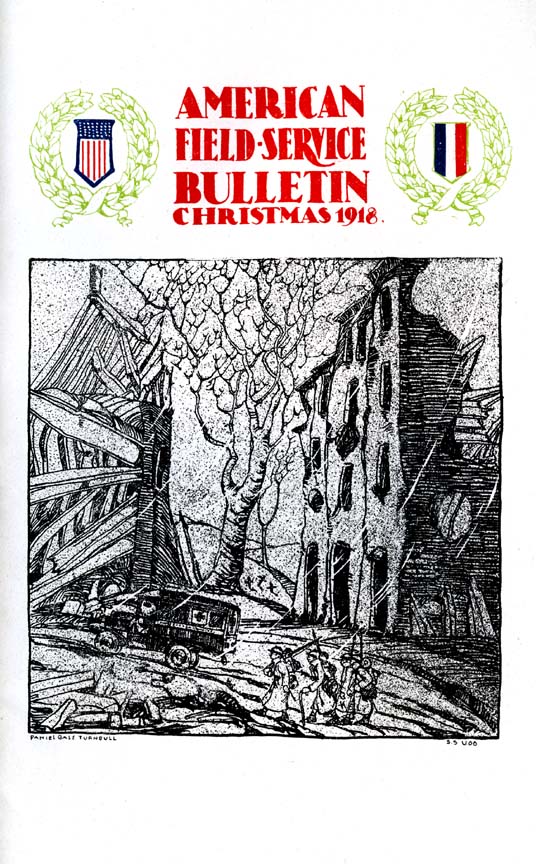
THE "BULLETIN" WOULD LIKE TO TAKE ADVANTAGE OF THE SEASON FOR GOOD WISHES TO EXPRESS ITS APPRECIATION TO THOSE WHO HAVE SO GENEROUSLY GIVEN OF THEIR TIME AND THOUGHT TO FILL ITS PAGES WITH WITTY CRITICISM AND KINDLY KNOCKS IN THE DEARTH OF FACTS WHICH WERE FROWNED UPON BY CENSORS. MAY THIS BE A HAPPY CHRISTMAS TO EACH ONE OF OUR READERS, AND TO MANY MORE WHO MAY SHARE IN YOUR CHRISTMAS SPIRIT, THE REAL JOYOUS SPIRIT OF GIVING NOT GETTING, AND MAY THE COMING DAYS AND YEARS BRING SUCCESS IN WHATEVER PATH YOU MAY CHOOSE TO FOLLOW. THERE IS NO LIMIT TO WHAT AN UNWAVERING WILL CAN ACCOMPLISH. MAY THIS BE TO EACH ONE A DAY COMMEMORATIVE OF VICTORY, THANKSGIVING AND CHRISTMAS!. |
Somewhere in France, little kiddies are smiling, for now they may have nourishing food, and perhaps a toy for Christmas. And they will have a chance to become strong and healthy, as is the Divine Right of Childhood.
War Orphans of France! What a vast deal of suffering childhood, and self-sacrificing motherhood are written in those words. Orphans whose fathers gave their lives on the field of battle that the little children of coming years should live, play and be happy, unhindered, and untroubled by the grim spectacle of war.
Who knows them better than the men of the Ambulance who have seen them behind the lines, and who have seen them fleeing in terror from their native villages, trudging along the roadsides, their brave mothers urging them onward.
We have seen men dead on the battlefield, men torn and rent by the engines of war, and we said, "C'est la guerre". We have seen the thin, drawn faces, the weary smile of the little war orphans of France, and we said, "Quelle guerre, quelle horreur ".
So when, last July, some one in S.S.U. 19 (637) suggested the adoption of a war orphan, the subscription went "over the top", and with the aid of Lieutenant MacPherson, and Lieutenant Huret enough was raised for the adoption of two children. A few days ago some one, being overcome by an advance installment of the Christmas Spirit made a similar suggestion. Again over six hundred francs were raised, and again with the aid of Lieutenant MacPherson, enough was secured for the adoption of two children, making a total of four orphans for the section. One hundred francs were also sent to the two previously adopted children.
So Somewhere in France, four little kiddies are smiling, and Elsewhere in France a group of ambulanciers are happy that they made them smile.
S. G., S.S.U. 19 (637).
Ernest Giroux, T. M. U. 526, who was killed in an air fight on May 22, 1918, has been awarded the Distinguished Service Cross.
Dr. Ernest H. Lines formerly with the Field Service has by recent decree been made a Chevalier de la Légion d'honneur.
The following citations of Field Service men have been received by S. S. U. 19 (637)
Soldat de 1re Class Carl W. Vail:
Excellent conducteur et technicien, a toujours fait preuve d'un sang-froid et d'un courage remarquables, notamment le Juin, à Saint-Maur, où il s'est rendu, dans une zone violemment bombardée, à la recherche d'un officier, grièvement blessé, qu'il a réussi à ramener. S'est distingué, pendant l'offensive du 18 au 24 juillet, en assurant des réparations de voitures aux postes les plus avancés.
Soldat de 1re Classe Edward P Shaw:
Engagé volontaire du début, a demandé à rester à l'avant. A eu sa voiture criblée d'éclats d'obus, le 21 mars, à Mesnil-les-Hurlus, et a continué à assurer son service, bien que légèrement intoxiqué. Pendant l'offensive du 18 au 24 juillet, a fait preuve d'un courage et d'un dévouement inlassables en évacuant les blessés des postes avancés sur les routes très exposées.
Soldat de 1re Classe Solomon Garden:
Excellent conducteur, dévoué, courageux et énergique. A fait preuve d'initiative et de sang-froid dans la matinée du juin, et a rejoint sa section après la destruction de sa voiture, malgré un bombardement intense par obus toxiques.
Soldat de 1re Classe Ralph E. Cousins:
Un des meilleurs et plus anciens conducteurs de la section s'est offert volontairement, dans la journée du juin, pour aller à une batterie exposée chercher des blessés qu'il a réussi à ramener. Toujours prêt pour les missions: demandant courage et sang-froid:
Soldat de 1re Classe Charles Jatho: - -
Engagé volontaire depuis le début de la campagne. Modèle de dévouement, d'abnégation et de conscience, exemple constant pour ses camarades dont il possédait toute la confiance et l'estime. Est disparu le 9 juin à un poste avancé.
We have just learned of the death of Merrill M. Benson which occurred on October 17th while en route for the United States where he was going. to have a surgical operation performed. Benson joined the Field Service in July 1917, being attached to T. M. U. 526 until November 13th when he enlisted in Mallet Reserve. He was 23 years of age, a student at Wisconsin University, and his home was in Sterling, Illinois.
Word has been received of the recent death from pneumonia of Osric Mills Watkins, Second Lieutenant in the U. S. Aviation, Lieut. Watkins was for many months a member of the American staff of the Field Service Headquarters, in Boston. About a year ago he entered American aviation, and went to Italy for his preliminary training. After the completion of his course at Issoudun, he reached the front as a scout pilot. He was twenty-one years of age, and a member of the Class of 1919, Harvard University. His home was in Indianapolis, Indiana.
When we all return to college the absence of many a fine man 's going to be regretted --- those who didn't come back. And I know in our own club at Harvard the loss of none will be more deeply felt than that of Osric Watkins. Dear old Oz, perhaps the best liked, and for that reason the most widely known, man in his class, has left with us a vivid memory of a clean living, honor loving man who stood and lived for all that was highest. His irresistible good humor and charming manner never failed to impress all who came in contact with him.
As the world might have profited by his life, we his friends have profited by both his life and death. Leaving us in the flower of his youth, he has taught us the lesson of supreme love, devotion and sacrifice for a wonderful cause.
We offer our deepest sympathy to his family and fiancée.
G. R. Y.
|
IN AFTER YEARS Upon a summer's day, a child is playing The child stoops down and picks a flower growing But now the sunshine and the meadow flowers Wm. Cary Sanger, Jr. 1st. Lieut. Inf. France, |
|
FATHERS SLAIN TO SONS UNBORN This is the only heritage we give you --- Our lives point out the bleeding path we came Paul M. FULCHER, |
So many questions have been asked and so many misunderstandings have arisen concerning our recent convoy, that I have felt it necessary to set forth an authentic history of what might otherwise become obscured by tradition.
Starting from the north of France southward, we progressed favorably for a time. I was attached to the camionette, a boat full of ambition and overflowing with reliability. It was in Meaux that the fun began. Evening and darkness had arrived when the convoy missed us going around a corner. At the next roll call there were besides myself. Capt. Pringle, Pop and Ed with the G. M. C. and shop, and Dr. Snowden. The last mentioned had a guy along with him whom I judged he must have picked up. A way-faring man, I thought I, but I asked no questions. None of us, himself included, had the slightest idea what to call him; but it didn't matter at the time, for he was asleep. The rest of us decided we must find our route at once. We selected Pringle to make inquiries, because of his proficiency in French. I well recall his earnestness in the matter, as I caught sight of him interviewing three sets of young ladies on a bridge. In the meantime Pop was aiding our cause by shinning all the sign poles as we circled around the town. We soon ran out of signs and had to decide on a good looking road. It was an ill-fated turn that we took, for rain set in at once. The first we knew, Capt. Pringle gave a signal of distress. He had discovered that his left hind wheel had ceased to revolve, while the hub cap was going so fast that sparks were flying from it. We were working on this when our way-faring friend awoke. For brevity I shall call him Mr. X. It seems he had lost his bearings, for turning to Snowden he demanded, "Who in hell are you?"
"Doggone it, I'm Pringle", declared Dr. Snowden, sparkling with humor. At this moment along came an English Major in his staff car. Doubtless on account of the darkness, Mr. X. mistook him for a French duke and greeted him with " Bon jour, mon duke ". But Pringle stepped forward and again mastered the situation, of which Mr. X. was by far the most difficult part.
After we got into motion once more, we hit a town where we encamped. I had borrowed a French blanket roll that night,, and soon found, it full of wash basins and gas masks. While trying to assert myself with these I perceived loud snoring on my left. My only recourse was Pringle's shoes and puttees. It took the final three shots to get the range, but the fourth had marvellous effects. The next I knew it was 4:00 in the morning and commotion was heard. It seems that Mr. X had found his identification papers and was making an announcement. He gave a very familiar name, so when we had gotten organized, we cast an eye la bas. His line was unexcelled and his gestures no one could approach (with safety) but when we noted his bearded features and mien we had to abandon our hopes. Mr. X went on to say that we hadn't elected officers so he would act as top sergeant. His first order was for us to start the convoy at once. Now this was far from practicable inasmuch as Pringle couldn't be roused and Snowden had lost off his lowspeed pedal which he feared he would need. I felt that I must act in this crisis so I convinced Mr. X that he should take a stroll before breakfast. We started off well but missed each other around a difficult corner. The first I knew I found myself by an M. P. I invited him to pursue with me a logical consideration of what my accompanying him would accrue. His reasoning was scant and illogical but I steered him around to our cantonment. As soon as he saw our outfit, he bowed himself away.
After calisthenics, taking in a pretty village wedding, and repairing Snowden's car, we set out. Nothing startling happened that afternoon except that we ran out of gasoline and had to travel on our reputation until we reached a town to get stocked up. That night we pulled up to a smooth looking place where we stopped and went to bed. Soon something whizzed by and we found we were parked in the middle of the National Epernay-Paris Route. A civilian suggested our moving up by a near-by church. This we did, and all went well, until the next morning which happened to be Sunday. The bell had tolled and the people arrived to attend early mass, but our shop and camionette were obstructing the entrance so that worshippers couldn't get in. The G. M. C. took a notion to start in an hour and a half and we were off to the delight of all.
Never before had our cars run so well as on that fine morning. I was just congratulating myself upon my good fortune in having the camionette when she began to slow down a trifle. I judged I was on three cylinders. Just then Dr. Snowden, who had been killing kilometers behind me, shot by calling cheerily to me that everything was all O. K. So I turned on more juice but my best efforts to catch Snowden were in vain. I tried my brake which worked splendidly: An inspection revealed no trouble except the loss of one rear wheel and a few adjoining parts, dropped off some distance back. The mechs. decided to remedy the trouble which they did during the next nine hours. The rest of us went hunting fire wood down somewhere around the Spanish border. We were started again by 7 on in the evening. Between 8 00 and 9 00 I fell into a comfortable sleep. My camionette kept the road fairly well until she came to an inviting turn which, however, was the wrong one. Of course the rest of the convoy followed me. In time we found where we were, except for those that weren't. It was not many hours before we had effected a junction which the French call Gare. Life is said to be an adjustment, and we certainly adjusted ourselves to that gare which was after all a very good "chambre à couché."
The next day was a memorable one, for we struck an American Quarter Master. We stocked up on everything from blackberry jam to corned beef hash. Whenever any one got hungry we'd stop at some nice French grandma's where there was a good old-fashioned fire place. She would heat up our food, make hot coffee, and furnish us with plenty of hospitality and good cheer. That night we found a fine, warm, cow barn where we had good lodging. In the morning Ed got us all up at 5 30 and the farmer's wife furnished us a sumptuous breakfast.
On this, the final day we hit up a pace calculated to bring us speedily to our destination. I couldn't resist taking' the lead, but soon along came a sort of a camouflaged ditch which attracted my camionette. When Doc. Snowden pulled up he indulged in laughter some fifteen minutes which seemed to demoralize his bus so that it took its place in the ditch behind me. Mr. X was full of optimism. He reported Pop Wiard as saying he found he had a million tow ropes whereas he had started out with but one, it developed that he had confused the words "tow ropes" with "totos". Our united efforts only got us in deeper until 'the kind gods sent us an enormous English truck which hauled us out at once. Our last stretch was not eventful except for the disintegration of the camionette. I finished the race without lights, horn, brakes or reverse. Ed and I had an argument as to whether I was running on three or four cylinders. He declared that it was four, but at any rate, I found one spark plug wire lost off.
In the end, we found the wandering part of 630, all except the staff car. They say that the staff car got away from its drivers, At all events the Lieutenant came back in an ambulance. Since those days our family has all kept together. I should add that we have adopted Mr. X who has marched to the head of the line, alphabetically speaking, at least.
R. J. B. --- S.S.U. 630.
Yesterday, when the dense, dark, massive clouds drove on, and the storm swept us with a speed exceeded only by the lightning of our massed artillery, I thought, to write in defence of the warlife; but this morning came forth our old time friend of the world of light, and its king. The whole plain dazzled and flashed with that freshness which is newly created with every sunrise. And could I, so long a lover of these scenes, attempt only to convince a disbelieving world? The sceptic is joined to his idols of peace and ease and decay; let him alone. And we, whose hearts are young and nerves strong, crave not reasons for our affection. We and the doubters have no quarrels, any more then we and our wily opponents out there across the plain. For all grudges and hate have left our hearts while we have gloried in the pursuit of our primitive game. Did we not on Christmas last; pause a few hours to visit their trenches, exchanging souvenirs with the respect and courtesy of the drawing room, while not a fortnight ago a Heidelberg prisoner Ph. D. heartily expressed a desire to visit us in the home parlor were not the war a barrier.
Let it not be imagined we selfishly delight in our life here, while those behind spend their days in sacrifice and anxiety. Have not the historians and philosophers agreed that our one year of war has achieved for our loved land a unity, a healthful simplicity of living, a moral uplift, that our last half century of peace could not approach? If we have true friendships and home ties, have they become weakened or severed? Has their love or ours failed with the juxtaposition of an ocean? Or has love proved to be time's fool? I suspect many of us have learned more about real affection than we ever knew before the tests came.
Not a score of months have passed since we too were seeking the glamors, the allurements, and the vanities of so-called civilized life. We were paying for the fashions and the tinsels and the bubbles often exchanging for them health of body and soul. Then we came here and discovered the realities. Little wonder that we now smile at those former follies, --- we who have each day our simple needs supplied, we who live close to Nature and face to face with death and eternity. For these present tasks we needed the company and inspiration of Nature. Days of struggles she presents, days charged with storms and dashing winds, when the forests bend and sway. Or it may be those ancient and untiring allies, wind and clouds, opposed to the sun. How often have I stood breathless on such a day against the fury of wind blasts, the charging of the cloud army, and the wavering of light shafts. Most pleasing to the it was, when the wind redoubled his energy, the sun his radiance, strength opposing fixity, neither outdone. But what are these to nights when all the elements break loose, joined by the thunder of the guns. Never before have mortal ears been visited with sounds on this magnitude, for never before has war approached such violence. But, man placed in the midst of these immense forces, has enlarged his contracted self, until he has learned to rejoice at hurling himself out there where all his powers are employed and augmented. He learns what resources lay slumbering in his being, until the inspiration and intensity of really great tasks roused them into action. The true warrior knows not how to trifle with work or life. Than this, there is nothing greater to be known.
Such a warrior --- four such --- I carried one night over a perilous road to the field hospital. We reached it after a long and hard trip. The blessés were tired and in pain. It was dark as I helped them to descend, but I think I could see the thanks glowing from their faces. I came to the fourth, one of those French heroes advanced in years. His foot was severed and in spite of all his efforts not to be a burden, I had to carry him. Like those spirited war horses who are heart-broken when disabled, so seemed this grand old defender of his country. Yet a hero's spirit bends but does not break, as I knew when through his tears came these words, "C'est pour la France". Tell me, if other than war has brought to earth these heavenly traits living in ten thousands of hearts.
Not only has war its pleasures of work but also of relaxation:. These are mostly like what we turned to in our few moments of natural living which even the rush of civilization grudgingly afforded, such as childhood and camping. But here they mean far more. I shall never forget a bit of space down in Champagne, enclosed by rough unpainted boards, and cheese-cloth in the window frames, for there during a few months grew up a life, associations, comradeship, which made those, "barracks" more to us than a palace. What congenial evenings we used to spend after we had washed the supper dishes and cut the wood for the evening fire! We read, talked, played games, sang until the retiring signal which meant ten minutes more of candlelight. Then we sought our hand made beds, and dreamily watched the firelight flickering on the rude walls, heard the crackling in the stove, enjoyed the wind or rain or guns, until all blended joined by memory's varied scenes to form the texture of dreams. What better atmosphere for the growing up of true friendships simple natural life, and a common, danger.
Danger, suffering, and death, we have come to at last. What is our answer? Have any the right to answer more than we? I submit the reply of that American soldier who stood guard in an abri when a grenade entered and rolled by his feet. Without an instant's delay he threw himself upon, it. That decision and sacrifice were simple and swift, but saved the lives of five comrades. Deeds like these are so numerous in war that many never reach the pages of history. But over such heroes' graves might well be inscribed an epitaph in the spirit of that one written by Simonides --- words inspired by and made immortal by the deeds of those Greeks who fell at Platea ---"If to die nobly be the chief part of excellence, to us of all men Fortune gave this lot: For hastening to set a crown of freedom on Hellas, we lie possessed of praise that grows not old."
R B.
Since November first, by a freak of circumstance, I have been almost continually out on duty and have spent only five different nights and three different days with the section. I moved up in front of Toul to the Champagne, in Gouraud's army, working through Ripont on to Rethel-Poix, Terrou-Bouizicourt, Mézières, where our division crossed the Meuse the last night of the war and took Charleville. It was a wonderful way to finish the war, in action, but I was scared to death before it was over. I had everything happen to me except stopping éclats --- engine trouble, running out of essence where essence just wasn't, and falling into a mine crater and breaking a front spring. But I kept going and was still going when we started to make the occupation, moving through Mouzon into Belgium south of Vresse, on to Carlsboro, Paliseul, Libin, St. Hubert to the beautiful Chateau Lavacherie. There I left on a trip to Sedan, was smashed into by a French aviator. Went on to Reims to get a new car, and got three, picking up four permissionnaires. Then I led a convois (on thirty litres of essence) from Reims up thru Belgium and was five days locating my division --- begging, borrowing and stealing essence to keep the three cars running about 700 kilometres. But I located the division at Trois Vierges, in Luxemberg.
Thanksgiving we spent in Saint Hubert, and cross my heart, honest to goodness, this is the menu:
It was a terrible battle, beginning at noon and lasting until 3 P. M.
Our reception in Northern France was overwhelming and I never will forget the parade of our division in Mézières the afternoon of the eleventh, when little children walked in front of the troops scattering flowers and men, women (and some doggone goodlooking girls) and children kissed the soldiers and hugged them and cried, all in the same time.
In Belgium we got the warmest kind of a reception, and were surprised to find the Belgians comparatively well off. They have not suffered at all as the French in northern France have suffered. They detest the Boche nevertheless, and call him invariably "sal Boche ", and he is sal too, and I never knew *hat real filth was until I began to move through the country on his heels.
I got a funny thrill in Belgium, coining into Paliseul. I was running ahead of the division and supposed some of our chasseurs de l'Afrique were ahead of me but hadn't seen any. All at once a German officer and ten soldiers, all armed, appeared, and thought I was sure a prisoner but there being nothing else to do I kept on into Paliseul, where I found some of our chasseurs. I told them about the Germans, but they knew about, them, as they were. gendarmes left behind to guard a lot of property being turned over to the French.
J.B.C.
The author of "Ambulance 464", formerly of S.S.U. 12 writes Nov. 19th.
Since my return to the United States I have lectured several hundred times for the 3rd and 4th Liberty Loan, and Chatauqua work all summer. I am now at the Central Officers' Training School, Camp Lee, Va. Kindly place my order for the A. A. F. S. History when it comes out and also for the "Bulletin " as long as it runs.
Julien H. BRYAN.
Dear Ed:
I have intended for some time to subscribe to the "Bulletin" for since leaving the old section (637) I have missed it greatly. Enclosed are "cinq francs", and I hope that by the time my subscription runs out I shall be back to the "ould sod".
If there are any copies of. the November 30th number still on hand, will you please send me three or four of them, for I was a member of 637's lucky seven which came unpleasantly close to spending a few months at Camp Rastatt or some other one of Bill's copyrighted replicas of Hell.
It is a pleasure to read the "Bulletin" with its gossipy notes on the doings of former members of the Service, bursts of poetry and satirical selections such as "Private Stormfield's Visit to Heaven".
Keep up the good work, Ed, and with many thanks for past favors believe me.
Very truly yours,
Herbert E. BIGELOW
Sgt. Parc " G ".
My dear Editor:
Many thanks for putting me on the Bulletin mailing list.. I had no idea how much I had enjoyed reading said publication until 1 arrived in a Section where it was unknown.
So enraptured, in fact, did I become while absorbing the last issue that I burst into song. The enclosed is what materialized. Should you consider it worthy of the Bulletin, here it is.
My very kindest regards and best wishes for a Merry Christmas.
G. Hinman BARRETT,
(formerly S.S.U. 32).
|
VICTORY! Hail to the new-born Peace on Earth! Great is the age we were born to serve! Voila ! Voila ! You may say adieu, G. Hinman BARRETT. Dec. 3, 1918. |
Lieutenant Yorke Stevenson has followed up his very successful book, "At the Front in a Flivver", with its sequel "From Poilu to Yank", both of which are published by the Houghton Mifflin Company at one dollar fifty each. The new volume brings the history of Section One down to January first of the, present year and contains many pleasant references to the old Service, to 21 rue Raynouard, to the Bulletin, and to the members at the front and to those who managed things at the rear. It will be remembered that Lieutenant Stevenson was the last Chef, and a most efficient one, of "famous old Section One", and his two books are valuable contributions to the American branch of the literature of this war.
In sending the products of one's literary efforts to the Bulletin nowadays, one wonders what storm or avalanche of criticism they will bring forth from J. W. C., H. K., D. D., K. P., or various other penwielding ambulanciers and camioneers. We should like to forestall said storm or avalanche in the beginning by frankly admitting that almost any criticism of our own meagre efforts would very likely be justifiable. But for the illumination of some of the more violent critics we might state, that it is our personal opinion that the literary ravings of our ambulanciers and their kindred of the rolling houseboats should not be judged according to the standards of Shakespeare, E. A. Poe, G. B. S., Marie Corelli, or Bob Chambers.
For instance, it is not unusual that one who has seen the war over a flivver wheel should sometimes confound a semicolon with a cotterpin, and effect his transitions with a clatter and a bang. Nor is it any wonder that his etymology should be somewhat confused when, in an ambulancier's vocabulary, water and essence seem to be one and the same word. Has not the word Ford been completely replaced by Damflivver to indicate that half-monster, half-machine, perpetrated by Henry Ford with the assistance of none other than His Satanic Majesty? And is a mixed metaphor any more atrocious than a mixture of red wine and champagne?
Our contention is that one's writings reflect, to some degree, the objective and subjective environment of the writer. A poet is imbued with the very soul of his subject. Now, when one's subjective and objective environment is sparkplugs and transmission bands, and when one is imbued with the soul of that paradoxical monstrosity called a flivver, do we not have a new style of composition equally paradoxical, and equally monstrous to its origin?
If there can be a Cubist style, why not a Flivverist style : In the same manner in which the flivver conforms to no laws or rules of mechanics, so the flivverist style should conform to no set rules of composition. Just as no self-respecting ambulancier ever stops to consider a few 77'S and mitrailleuses, so, no disciple of the literary flivverists should ever be phased by punctuation, mixed metaphor, rhyme, or reason.
Thus we have presented our "Apologia" in order that none of our future efforts might be considered as trying to conform to any standards of rhetoric. We hoist the red flag. We are a Literary Flivverist.
S. G., (S. S. U. 19 )
Lieut. J. M. Walker (S.S.U. 3) has been promoted Captain F. A.
Pvt. Robert C. Vance (S.S. U. 14) and Pvt. Lawrence J. Moran (S.S.U. 71) have been promoted to Sergeant.
Sergeant James W. Harle, Jr. (S.S.U. 2 and 10) has been promoted to Sergeant 1st. Class.
Captain Carrol U. Riggs was a welcome visitor at "21" this week. Captain Riggs now in Coast Artillery Corps was one of the 1915 volunteers of the A. A. F. S. connected with S. S. U. 2.
The following old A. F. S. men were in Training Schools and Camps on the Day of Armistice:
William R. Gentry, Jr. (T.M.U. 526) 2nd. Lieut. Infantry, S. A. T. C. Howard College, Birmingham, Ala.
Arthur Llewelyn Howell (S.S.U. 2) 1st. Lieut. 36th Regt. F. A. Toledo, Ohio.
Murdock Porter Johnson (T.M.U. 526) Sgt.-1st. Cl. Coast Artillery Corps, Battery B, 33rd. Artillery, Camp Eustis, Va.
Frederick Norris Spaulding (T.M.U. 184) Pvt. F. A. F. A. C. O T. S. Louisville, Kentucky.
Roland Williams Stebbins (S.S.U. 1) Pvt. F. A. T. S., Camp Zachary Taylor, Kentucky,
Luke C. Doyle (S.S.U. 3) Major Sanitary Corps; William P. Hunt (S.S.U. 13) U. S. A. A. S. ; Harry J. Williams (S.S.U. 19) U. S. A. A. S. ; Henry W. Patterson (T.M.U. 133) Aspirant French Artillery; Edward H. Pattison (T.M.U. 526) 2nd. Lieut. U. S. Artillery; Harry R. Perley (S.S.U. 14) U. S. A. A. S. ; Walter D. Carr (S.S.U. 66) Lieut. U. S. A. A. S. ; Paul Cadman (T.M.U. 133) Captain U. S. F. A.; John E. Boit (S.S.U. 2) 1st. Lieut. U. S. A. A. S.; Roger A. Burrell (S.S.U. 14) 1st. Lieut. U. S. A. A. S. J. W. D. Seymour (S.S.U. 17) 1st. Lieut. U. S. A: A. S. ; Richard B. Varnum (S.S.U. 3) 1st. Lieut. U. S. Aviation; J. Marquand Walker (S.S.U. 3) Captain F. A. ; Russell Willard (S.S.U. 10) Lieut. Anti-Aircraft; George R. Fearing, Jr. (S.S.U. 29) U. S. A. A. S. ; R. R. Speers (S.S.U. 9) 1st. Lieut. U. S. A. A. S. ; John M. Swasey (S.S.U. 29) U. S. A. A. S.; Samuel M. Keplinger, Jr. (S.S.U. 29) U. S. A. A. S. ; Walter J. Gores (S.S.U. 18) 1st. Lieut. U. S. A. A. S. Leslie Gardner (S.S.U. 33) U. S. A. A. S. ; Robert Calder Davis (S.S.U. 33) U. S. A. A. S.; J. Timothy Walker (S. S.U. 1) Aspirant, French Artillery; Frank Caldwell (S.S.U. 66) Aspirant, French Artillery; Bailey Van Ness Emery (A.R.C.) Aspirant French Artillery; Bertrand E. Tremblay (S.S.U. 66) 1st. Lieut. U. S. A. A. S. ; Richard E. Goss (S.S.U. 70) U. S. A. A. S.; David Garratt (S.S.U. 66) Aspirant French Artillery; Arthur J. Putnam (S.S.U. 18) 1st. Lieut. U. S. A. A. S. Harry L Williams (S.S.U. 26) A. R. C.; Wharton Allen (S.S.U. 12) Sgt. 310 F. A. Joseph B. Keyes (S.S.U. 16) 2nd. Lieut. M. T. C.; Ramon H. Guthrie (S.S.U. 3) 11th Aero Squad Richard Temple (T.M.U. 526) Elève Apirant, Fontainebleau; Henry M Hamilton (S S U 69) Elève Aspirant; Clarence E. Roe (T.M.U. 526) Elève Aspirant; Raymond T. Hanks (T.M.U. 133) Elève Aspirant; Francis C. Jones (T.M.U. 133) Elève Aspirant ; Neil G. Shaw (S.S.U. 622) U. S. A. A. S. ; Benjamin F. Butler (S.S.U. 13) U. S. A. A. S.; B. P. Eldred (S.S.U. 66) Elève Aspirant; Hugh Allwyn Innes-Brown (S.S.U. 2) Lieut. U. S. A. A. S.; Norman S. Buck (T.M.U. 133) Lieut. Chemical Warfare Service; Frank E. Barton (T.M.U. 397) Prov. Co. F. Reserve Mallet; Raymond Neynaber (S.S.U. 69) U. S. A. A. S.; Sidney O'Donoghue (S.S.U. 650) Pvt. 1st. cl. U. S. A. A. S. ; Travis P. Lane T.M.U. 133) Aspirant French Artillery; Robert C. Wigand (S.S.U. 4) and. Lieut. F. A.; Joseph Platt Cooke (T.M.U. 133) U. S. Air Service; Agnus M. Frantz (S.S.U. 18) 1st. Lieut. U. S. A. A. S.; Ritter Holman (S.S.U. 18) U. S. A. A. S.; Paul Tison (T.M.U. 526) Civilian Aviation; William H. Richards (S.S.U. 17) and. Lieut. M. T. C.; John Passmore Scott (T.M.U. 184) 1st. Lieut. M. T. C.
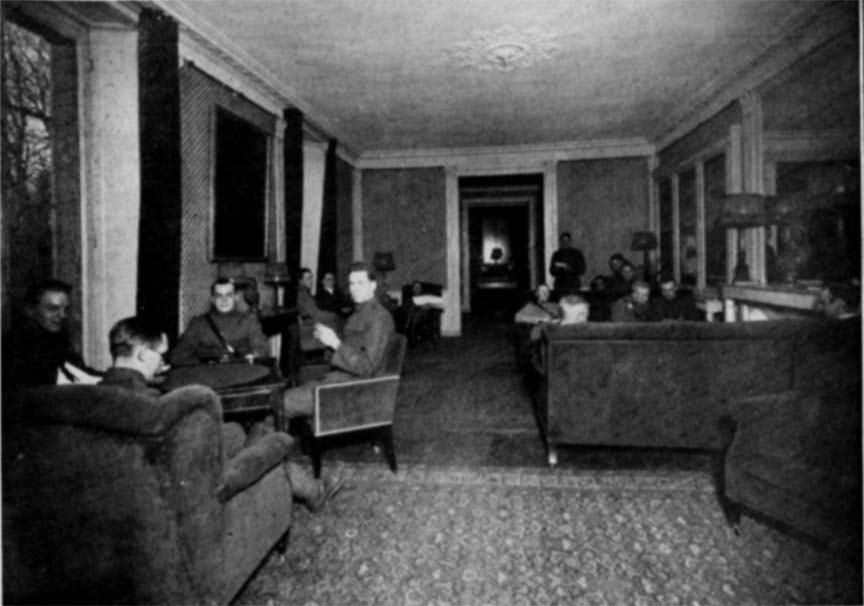 at 21, Rue Raynouard |
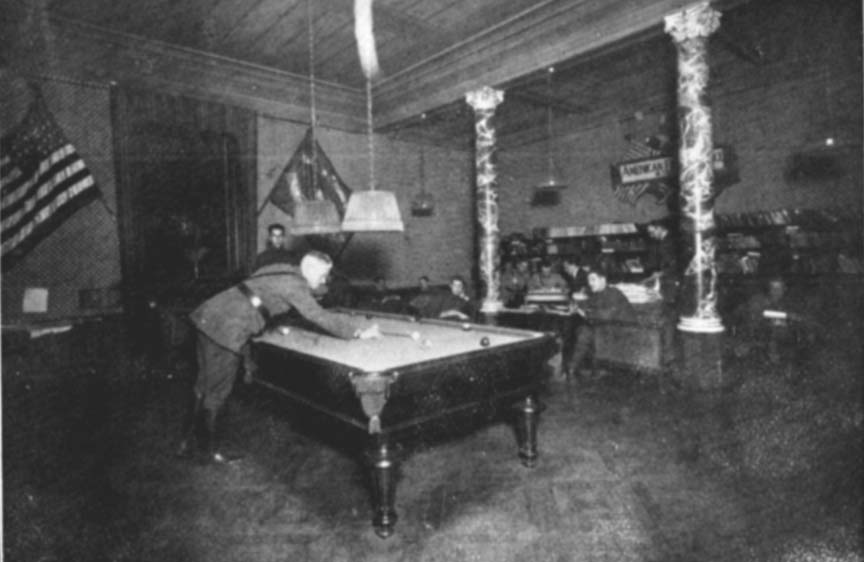 at 21, Rue Raynouard |