| Three Months |
Fr 2,00 |
|
Fr. 2,75 |
| Six Months |
4,00 |
|
5,50 |
I do not know yet if I was right or wrong. I shall never know. After these years that have passed I am wont to look on it as one of those mysteries of the war which not even the publication of official documents would reveal.
What intuition came into my subconsciousness to determine my action, I neither have been able to explain. Yet the fact stands. Rising somehow into my full consciousness there seemed to appear irrefutable evidence that night, however, that made me feel convinced of the absolute truth of my suspicions.
I have often wondered too it the perturbations of conscience that still agitate me in this incident. I remember that a moment after 1 had made the decision that night I was stung with the ruthlessness of my course of action. The quality of mercy is not strained, That adds to my present sense of guilt that with a war hardened sense d humanity, apathetic to suffering, and completely imbued with the psychology of militarism, that no sense of humaneness or of pardon can be countenanced when dealing with enemy espionage. But that is perhaps the mystery. From the voiceless lips of the dead there will come no enlightenment.
But to the story. was on duty that night with my company. We were in dugouts along a highway captured by us in our offensive against the Germans a few weeks before. Impassable to traffic it was, all shell swept and torn. Above us on one side o the road was a long abruptly rising hill and on the other side was a forested level between juts of other hills which too were covered with trees. Trees I should hardly call them now however, not even timber. There was nothing left but the trunks and they were charred and burned. Our 75’s were camouflaged in the yellowish brown dirt of the shell-ploughed, field on the slope above us.
It was all as desolate as the world on the fourth day of creation ere yet there had been any plants or living things created, and to add to the general gloom that night there was a light rain falling and it was dark. We were not firing but the men in the line eight hundred yards ahead of us were active with bombs and machine guns. There was mud underfoot and mist in the air.
We were not firing that night because we dared not. Our position was in full view of the German lines though so thoroughly camouflaged that their artillery had failed to find us. But there was something behind the uncanny foreknowledge of the Germans of our every move in this stretch of the front. One of our men even had the pass word given him by a German. Challenged by the guard as he was going down a section of the trench he forgot the word. When a German listening post not far out supplied him with it. They were insolent. The incident is absolutely true.
For this reason we were merely lurking with our guns up there on the hillside waiting for proper support from the positions farther back. We were holding it because of its strategic value.
I had just finished a tour of inspection that night and was about to turn in myself. Everything was quiet except for the pup-pup-pup of the machine guns at intervals up a little ahead of us. Most of the men were in their dugouts, many asleep, except for the few on watch that night. I was about to report when it occurred to me, to look in at the dugout occupied by there cuisine. I descended into it.
There were the two cooks and three or four men. And with them there were two strangers. They were dressed in sheep skin lined coats and kepis and khaki uniforms with the buttons of our own army. Both of them were not old, between 28 and 30, I should say. They had intelligent but ingenuous faces and tried to summon enough French for conversation with the cooks and men. The cooks were entertaining them.
The whole party stood at attention as I entered.
"Who are your friends?" I asked Philippe, the chef.
"Two drivers who have lost their way. They have a poste back a little ways and came up here to see the front. They are having dinner with us, sir ", replied he.
"What service are you connected with," I then asked one of the two strangers turning--- to him.
We are ambulance drivers with a section near here", one of the men answered readily enough.
The only thought that came into my mind then was the last instructions of the commandant at officers call the day before. Yet I had not the slightest logical basis for my deduction. My only explanation is that my mind was surcharged with that anxiety, that care. Some clue to the thing must be found and found soon, were the exact words of my commandant.
I turned again as I was about to leave.
"You say you have lost your way?" I asked.
Outside it was black and dark as Erebus.
"Yes sir, we have", the men replied.
"What town are you quartered in ?" I then asked.
He mentioned the name of a little village.
"Take the road just outside to the right and you will find it ", I said.
Then I left.
It was a road that led direct to a frontage of the German trenches, nestling with machine guns.
God pardon me for devotedness to duty if those two men were not German spies!
David DARRAH,
Reserve Mallet
|
NON-COM NONSENSE I am a Sergeant, P. A. RIE, sgt. 1re cl. S. S. U. 637 |
A member of Section 3 has compiled a list of the present activities of members of that section. Although some of the names have appeared in the list of present activities of former A. F. S. members, it is interesting to note the contribution to the varied Allied services which alone one of the oldest sections of the A. F. S. has contributed.
| L. Hill, | 2nd Lieut. F.A.U.S.R. |
| A. G. Carey, | 2nd Lieut. F.A.U.S.R. Hqrs. 2nd F. A. Brigade |
| P. Fenton, | 1st Lieut. A.S.S.U.S.R. Hqrs. Air Service A.E.F. |
| H. O. Hale, | 1st Lieut. A.S.S.U.S.U. 2nd Instruction Det. Air Service. |
| E. J. Curley, | Aspirant, French Artillery. |
| C. R. Codman, | 1st Lieut. A.S.S.U.S.R. |
| P. Lockwood, | 1st Lieut. F.A.U.S.R. attached 12th Regt. A.A. |
| A. I. Henderson, | 1st Lieut. F.A.U.S.R. 7th Regt. F.A. |
| T. Hamilton, | 1st Lieut. British Tank Service. |
| W. K. B. Emerson, | 2nd Lieut. F.A.U.S.R Air Observation. |
| J. Mellen, | 1st Lieut. A.S.S.U.S.R. |
| S. Galatti, | Capt. U.S.A.A.S. |
| J. M. Walker, | 1st Lieut. F.A.U.S.R. attached 12th Regt. F.A. |
| L. Doyle, | Capt. U.S. Sanitary Corps. |
| B. F. Dawson, | 1st Lieut. A.S.S.U.S.R. |
| J. W. Clark, | Aspirant, 36e d'Artillerie. |
| T. W. Potter, | 1st Lieut. U. S Air Service. |
| L. V. Hitt, | 1st. Lieut. U.S. Engineers, Camouflage Section. |
| E. T. Tinkham, | Cadet, Naval Aviation. |
| D. Sargent, | 1st Lieut. 5th Regt. FA. |
| C. T. Clark, | Aspirant, 28° d'Artillerie. |
| J. Munroe, | Aspirant, 89° d'Artillerie. |
| A. Blutenthal, | French Air Service. |
| C. Winant, | Aspirant, 236° d'Artillerie. |
| C. A. Watkins, | French. Artillery School Fontainebleau |
| C. H. Fiske, | 1st class pvt. O.T.C. Yaphank, L.I. |
| C. Baird, | 1st Lieut. F.A.U.S.R. 6th Regt. F.A. |
| F. L. Baylies, | French Air Service. |
| T. Buffum, | French Air Service. |
| G. Francklyn | Sergt. 6th Regt. FA. |
| R. B. Montgomery, | Cadet U.S. Air Service. |
| E. H. English, | U.S.A.A.S. |
| G. B. Logan, | Cadet U.S. Air Service. |
| C. Amsden, | Cadet U. .S. Air Service. |
| G. W Roberts | 1st Lieut. U.S.A.A.S. |
| R. B Varnum, | Flying Cadet Air Service |
| J. N. D'Este, | Corp. 101st Regt. FA. |
| W. H. Rainsford, | Capt. Inf. Yaphank, New-York. |
| H. Innes Brown, | 1st Lieut Sanitary Corps. |
| D. V. Rice, | 1st Lieut. 15th N. Y. Inf. |
| L. Hall, | 1st Lieut. FA. |
| W. Barber, | Fontainebleau, French Artillerie School. |
| K. D. Alexander, | American Red Cross, Italian Service. |
| C. Rodes, | American Red Cross, Italian Service. |
| G. Phillips, | |
| E. H. de Neveu, | Interpreter Office of the Engineers Officers T, of C. |
| C. Keogh, | Sous-Lieut. French Air Service, Armée d'Orient, Gd. Parc Aéronautique Français, Salonique. AFO. |
| W. T Harrison, | Cadet A.S.S.C. |
| A. N. Wilder, | Pvt. 17th Regt. FA. |
| W. H. Rubinkam, | Cadet Naval Aviation. |
| G. S. Sinclair, | Cadet A.S.S.C. |
| L. H. Tenney, | Pvt. 5th Regt FA. |
| J. F. Todd, | Pvt. 5th Regt FA. |
| H. J. Kelleher, | U.S.A.A.S. |
| Lawrence G. Fisher, | American Red Cross. Italian Ambulance. |
| Scott Russell, | American Red Cross. Italian Ambulance. |
| Ramon H. Guthrie, | Cadet in Air Service. |
| B. H. Tracy, | Cadet in Air Service. |
Frank L. Baylies (S. S. U. 3) brought down an enemy aeroplane on Monday, March 18th. (Exchange)
Dear Editor,
Without further preface I am submitting to you a five-reel poem, written in an abri with a smoky stove, hoping you may find use for it in the Bulletin sometime.
|
AFTER THE WAR Oh, this life has got its drawbacks, But in spite of all the dangers, For without our ambulances, Just recall the Verdun battle, So when Kaiser Bill gets his'n H. G. M. |
The Ambulance drivers of the United States Army Ambulance Corps continue to make excellent records in transporting the French wounded. Many have received the Croix de Guerre recently for their brave deeds.
The list includes:
Lieut. Joseph R. Greenwood of Section 633.
Private (1st class), Richard V. Buel, and Private George Ripley Cutler of Section 642.
All have had citations stating that they had shown unusual bravery and calm under fire and that their work has been highly appreciated.
New-York Herald, of March 15th.
If any men now in the ambulance who formerly were employed by Armour and Company, U. S. A.. will send their names, addresses and the names of their former office and department to A. S. Trude, Jr., S. S. 0. 632, it will he greatly appreciated as a complete list of Armour men in this service is being made.
Dear Ed
The four "American Song Books " have come and the en reposers have already had a session from cover to cover. It was last night. We thank your very much for the hooks and hope it was not too much bother. We also thank Miss Clifford of Denver.
Don't forget that the purchasing department of the AF.S. is ready to buy for you any article you need from Paris. Write directly to Manager Store, American Field Service, 21, rue Raynouard.
Robt. W. Wood, Jr. (S.S.U. 9 and 10) 5e Brigade Ecole d'Artillerie Fontainebleau ; John R. Edwards (S. S. U. 8) 1st Lieut. A.S.S.C.U.S.R. Air Service ; Horace F. Carbaugh (S.S.U. 13) U.S.A.A.S. ; Arlie C. Phillips (S S.U 13) U.S.A.A.S ; Gilbert N. Ross (S.S.U. 26) U.S.A.A.S. ; Tom O'Connor (S.S.U. 12) U.S. Naval Aviation ; Robert L. Buell (SSU. 15) Y.M.C.A.; B. G. Dawes (T.M.U. 184) Wagoner 17th Engineers; Lieut. Norman B. Curtice (T.M.U. 526) American Mission, M.T. Div. ; John Craig, Jr. (S.S.U. 2); Francis T. Henderson (T.M.U. 527) 5e Brigade Ecole d'Artillerie, Fontainebleau ; Howard T. Stackhonse, American Mission, M.T. Div. ; H. Bradley Ogden, American Mission, M.T. Div. ; Edward N. Seccombe (S.S.U. 2) U.S.A.A.S. Arthur K. Dearborn (T.M.U. 397) Civilian Engineer to Ordonnance Department ; George Dock, Jr. (S.S.U. 2) Aviation ; Alvan Cushman, (S.S. U. 4.) Naval Aviation.

| Three Months |
Fr 2,00 |
|
Fr. 2,75 |
| Six Months |
4,00 |
|
5,50 |
|
THEIR MEED Lament not, mother-land, over thy lost Youth. S. S. U. 631 (13). |
Editor of the Bulletin,
We hear our prescribed area is a fine place, but we never kicked on Paris or Nice.
One of our voitures received ninety-nine éclat holes the other day on one of those days reported so very quiet in our sector.
Since we lost our English General's uniforms the poilus are bolder in their demands for essence, in fact the Sammy outfit doesn't seem to impress the inhalers of pinard.
Have three new dogs and must report the death of our only thorough-bred, a Swedish police houndess. She went west when she saw our new cantonnement for the first time. This is great stuff, cleaning up after the French sections, and they call them Sanitary sections. The scarcity of essence is bringing on attacks of horse asthma and horse fever.
Does any one know a system to find out the American number of a section when you know the field service number? The poilus are all "het up'' about the diploma some of them may get. This volunteering is great, but I think the next war we will wait to he tapped.
S. S. U. 621/68
A surprise attack by the "enemy" in the form of a seventh-inning batting- rally that netted eight runs and demoralized the opposition, gave S.S.U. 635, formerly S.S.U. 17, a 14 to 4 victory over Battery L, sixth Reg., U.S. Artillery, in the ambulance boys' first game of the season, played Saturday afternoon, March 16th, at a U.S. Artillery training camp.
The game was arranged by First Lieutenant Neftel, section commander, and was attended by all the members of the section in camp, with Lulu, the section's German sheep dog, and Jean, a four-year-old citizen of France as mascots.
Owing to the brilliant work of the pitchers, neither side scored until the last half of the fourth inning, when an error attributable to the unevenness of the ground resulted in a run for Battery L. In the fifth inning, S.S.U. scored three runs and Battery L. one, and in the sixth each team added up another marker.
In the seventh frame, Garrett, pitcher for the ambulance boys and formerly a Harvard first-string twirler, got the range on his opponent's, Fisher's, fast one, and led off with a Texas leaguer. When the smoke finally cleared away, Farmer, formerly of the Missouri University varsity nine, Ogden, Seymour, Muldoon, Walton, Toll and Peck had hit safely, and the shortstop's error in fielding an attempted sacrifice by Fletcher resulted in Toll scoring on the fumble and Fletcher reaching the plate on Peck's long drive. To make assurance doubly sure, S.S.U. 635 took two more runs in the eighth, although the artillery men sent in a fresh pitcher in an effort to stop the onslaught. Battery L made their final score in the ninth.
Features of the game were homerun drives by Seymour and Walton, and the gilt-edged pitching of Garrett.
Fifteen hits were made by the ambulance boys, and eight by the artillerymen.
Second Lieutenant Jones of Battery L. umpired the game, and won praise from all for the accuracy of his decisions.
Lieutenant Neftel expects to arrange other games for his team this season.
The line-up Saturday was:
Peek, catcher.
Garrett, pitcher.
Walton and Richards, first base,
Ogden and Mustard , second base.
Toll and Maxfield, third base.
Farmer, shortstop.
Muldoon, left field.
Seymour, centre field.
Ward and Fletcher, right field.
J. P. FLETCHER
Bill and I came over on the boat together. We "ah oui-ed" and "comprends pas-ed" around Paris to our hearts' content trying to enjoy life for a few days before going out to be shelled and mitrailleused by the Boches. We had read "Ambulance No. 10 ", "At the Front iii a Flivver" and various other volumes trickling with blood and gore, and we had the idea that ambulanciers got up about 5 A. M. and drove down to get shot before breakfast. 1 think I would have been nervous had it not been for Bill. That husky brute only laughed when I brought forth some new terror awaiting us at the Front.
"They say you have to be in expert mechanic ‘out there’, so if your flivver breaks down on a shelled road you can fix her in a jiffy and clear out ," I remarked weakly one day.
"Oh, that's nothing," replied Bill in his off-hand cocksure manner. I read the Ford Manual coming over on the boat and I think I'll get along all right."
"Have you ever driven a Ford, Bill?"
"No, but I know I can."
And that was final.
Then came the day of driving, tests. Whitman got out his rattle trap and loaded four of us into it. Bill was one of those present. I noticed that the test car had a superfluous emergency brake on the right hand side. That was Whitman's "Life-Saver", as he afterwards explained. Now the instructor began his preliminary explanations.
"Carry your spark about here, your throttle about here for starting. Press the extreme left pedal --- you are in low. When you get a start, let the pedal up, at the same time easing up on the gas!"
I could see that Bill wasn't paying much attention to the instructor. Why should he, he had read the Ford Manual once! But as soon as Whitman paused Bill spoke up.
"Let me try her," he yelled in childish anticipation.
"All right, go to it," answered Whit.
Bill climbed to the wheel. He pushed in the pedal and we were off ; another moment and he let it into high. We were wavering gently down the street. In a few minutes Bill discovered that by pulling down the right hand lever on the steering column, one could get more speed. I saw him pull down the lever and grin with childish delight. We were now coming into a network of traffic, still going at high speed. Then Bill pulled the lever down another notch or so. The traffic was becoming denser, and we were racing down the, street at top speed, wobbling from side to side. I was becoming frightened Then I could see a touch of anxiety creeping into Bill's face. We could not go much further without an accident.
In another moment a mass of camions loomed up ahead going in both directions. We could not possibly get thru. Pill turned to Whitman with an innocent grin, raising his eyes completely from the street.
"How the hell do you stop the damn thing," he drawled calmly.
And the "Life-Saver" did its duty.
Solomon GARDEN, S.S.U. 19/637.
Raymond R. Bontz (T.M. 133) Naval Aviation; William L. Cahill (T.M. 184) American Red Cross ; Francis V.V Wethey (S.S.U. 13) U.S.A.A.S. Cyril B. Smith (S.S.U. 12) Hospital No. ; Julian B. Howe (S.S.U. 12) U.S.A.A.S. ; Raymond A. Neynaber (S. S. U. 26) U.S.A.A.S. ; Arthur J. Putnam (S.S.U. 18) Lieut. U. S. A. A. S. ; Howard S. Ramsdell (S.S.U. 9) U. S. A. A. S. ; John E. Boit (S. S. U. 2) U. S A. A. S. ; J. G. B. Campbell (S. S. U. 1) ; Noble W. Lee (S. S. U. 65) U.S.A.A.S. ; Frederic W. Lathrop (S.S.U. 65) U.S.A.A.S. ; H. W. MacNair (S. S. U. 65) U. S.A.A.S.; Frank G. Royce ( (S. S. U. 19) U. S. A. A. S. ; S. Garden (S. S. U. 19) U. S. A. A. S. ; John D. Loughlin (S. S. U. 19) U. S. A. A. S. ; Richard B. English (S.S.U. 29) Civil Aviation American ; F. L. Sexton (S. S. U. 14) U. S. A. A. S. ; G. Hinman Barrett (S. S. U. 32) U. S. A. A. S. ; Walter L. Clark (S.S.U. 12) Sgt. U. S. A. A. S. ; John Munroe (S. S. U. 3) Aspirant French Artillery ; O. R.. McMurry (S. S. U. 17) Lieut. Aviation Air Service; Charles Codman (S.S.U. 3) Lieut. A. S. S. U. S. R.
W. E. Penfield cited to the Ordre Service Santé 38e Div. October 30th, 1917.
|
MESSENGERS OF MERCY Oh, the Ambulance is a lazy life, Yes,
a carefree crew is the Ambulance Oh, half of the time we curse our lack Yes,
a carefree crew is the Ambulance, Oh, the ambulance man is a humane bird Yes,
a carefree crew is the Ambulance L.WARREN, S.S.U. 18 |
| Peter L. Kent, | Headquarters. | Inspector L. of C. Care of Chief Engineer L. of C. |
| A. Duncan McLeish | S.S.U.. 10 | Royal Flying Corps. |
| Chester L. Talmuage | S.S.U. 65 | 2nd Lieut. Royal Flying Corps. |
| D. E. Ashley | T.M.U. 133 | 2nd Lieut. Royal Flying Corps. |
| A. A. Dailey | S.S.U. 65 | Balloon Service, U. S. A. |
| Jerome F .McGee | T.M.U. 133 | Cadet in Air Service. |
| Frank B. Lamoine | T.M.U. 133 | Sergeant Aero Squadron 230, U. S. Air Service. |
| Morris K. Wallace | S.S.U. 66 | Private in Air Service. |
| Donald W. De Coster | T.M.U. 184 | Civilian in Air Service. |
| Raymond K. Bontz | T.M.U. 133 | Ensign U. S. N. R. F.-F. S. Class 4 |
| Russel Davis | T.M.U. 526 | American Red Cross---Italian Ambulance, Sect. 1. |
| George E. Dresser | T.M.U. 526 | American Red Cross---Italian Sect. 2. |
| Joseph H. Eastman | S.S. U. 14. | 1st Lieut. 94th Aero Squadron U. S. Air Service. |
| Ralph Aldom Frost | T.M.U. 133 | Cadet in Air Service. I |
| Lawrence G. Fisher | S.S.U. 3 and 65 | American Red Cross---Italian Ambulance |
| Guy C. Calden | T.M.U. 108 | 2nd Lieut. Q. M. Corps. |
| Lloyd H. Garner | S.S.U. 17 | 1st Lieut. Field Artillery. |
| Harlan H. Howard | T.M.U. 133 | American Red Cross---Italian Ambulance |
| Francis T. Henderson | T.M.U. 526 | Elève Aspirant French Artillery at Fontainebleau. |
| Howard Kahn | S.S.U. 72 | American Red Cross---Italian Ambulance, Sect. 1. |
| William W. Kennett | T.M.U. 133 | American Red Cross---Italian Ambulance |
| Arthur J. Masson | T.M.U. 526 | 1st Lieut. Field Artillery. |
| Nichols P. Makanua | S.S.U. 72 | Elève Aspirant French Artillery at Fontainebleau. |
| James R. Millikew | T.M.U. 184 | Cadet in Air Service. |
| Francis S. Morrison | T.M.U. 242 | Pvt Field Artillery. |
| Arthur I. Patridge | T.M.U. 526 | Elève Aspirant French Artillery at Fontainebleau. |
| Malcolm G. Olson | T.M.U. 184 | American Red Cross, Italian Ambulance . |
| Robert Rieser | S.S.U. 33 | American Red Cross, Italian Ambulance, Sect. 1. |
| William E. Resor | T.M.U. 133 | Pvt. American Red Cross. |
| Scott Russell | S.S.U. 3 | American Red Cross, Italian Ambulance. |
| Winship Roger | T.M.U. 184 | Cadet in Air Service. |
| Rowland A. Robbins | S.S.U. 365 | 2nd .Lieut. Air Service. |
| Paul Squibb | S.S.U. 30 | 2nd Lieut. Field Artillery. |
| Gerald S. Stone | T.M.U. 326 | Corp. Pilot Lafayette Flying Corps. |
| Rouse Simmons | T.M.U. 184 | American Red Cross, Italian Ambulance, Sect. 3. |
| Williams D. Swan | S.S.U. 10 | Corp. Field Artillery. |
| Brandreth Symond | S.S.U. 19 | 2nd Lieut. Field Artillery. |
| Richard D. Stevenson | S.S.U. 26 | 1st Class Pvt. 5th Field Artillery. |
| Harold H. Sayre | S.S.U. 10 | Flying Cadet in Air Service. |
| Edward I. Tinkham | S.S.U. 20 | Naval Aviation Landsman for Quartermaster. |
| Dudley F. Wolfe | T.M.U. 23 | American Red Cross, Italian Ambulance, Sect. 2. |
| Lloyd E. Walsh | S.S.U. 68 | Sergt. American Red Cross. |
| Charles H. Wooley | S.S.U. 9 | 1st Lieut. Air Service. |
| Raymond J. Whitney | S.S.U. 2 | Cadet in Air Service. |
| Gil R. Wilson | Vosges and S.S.U. 33 | Cadet Officer Air Service. |
| J. Marquand Walker | S.S.U. 3 | 1st Lieut. Field Artillery. |

| Three Months |
Fr 2,00 |
|
Fr. 2,75 |
| Six Months |
4,00 |
|
5,50 |
Starting on Wednesday, March 27th, The American Field Service in collaboration with the American Red Cross and the American Fund for French Wounded helped to care for the refugees arriving from the invaded districts, at the Gare du Nord. Inasmuch as the French Camion Service was very much occupied with other war work, our offer of trucks and ambulances was most gratefully accepted. The camions remained on service about twelve hours a day and the ambulances twenty four hours, and in the five days ending on Sunday at midnight, approximately eight hundred refugees with their belongings, were transferred from the Gare du Nord to other railroad stations in the day-time, and to places of refuge at night, by our cars driven by permissionnaires and other Field Service men in Paris at the time.
Our workers were deeply impressed by the attitude of the refugees and the gratitude with which they received any service, no matter how slight, this being particularly noticeable as many of them had been for two days on a journey which would in ordinary times take about two hours to cover.
In many instances it was the second or third time they had been forced to leave their homes and their cases were pitiful in the extreme; one old man who had been driven out for the third time had lost his mind and was weeping like a child. Civilian hospitals and institutions for the aged had been forced to evacuate, and the number of old people was appalling, many of them being paralytics who could not he moved, except on stretchers.
For the first two or three days they came in hordes and at times were crowded so closely in the basement of the Gare du Nord, where the Red Cross Canteen carried on its good work, that many of the women had to stand and hold their baggage in their arms as there was not a spare inch of space on the floor. This, however, was overcome after the first confusion of having so many unexpected arrivals, and with the many willing workers of the different organizations doing their best, every refugee arriving at the Gare du Nord -was given refreshments at the Canteen, before being transferred. The Canteen also gave out clothing and shoes in great quantities.
In addition to transportation, several members of the American Field Service helped with the distribution of refreshments and clothing in the Red Cross Canteen. The greater part of our work was done by men who were in Paris on permission and by former members of the American Field Service residing in Paris, and it was the opinion of all that they had never done a more worthy work. They have the greatest respect and admiration for a people who, in the face of se terrible a catastrophe, could still show so much gratitude and courage. This extended even to the children who showed no signs of whimpering or complaining,
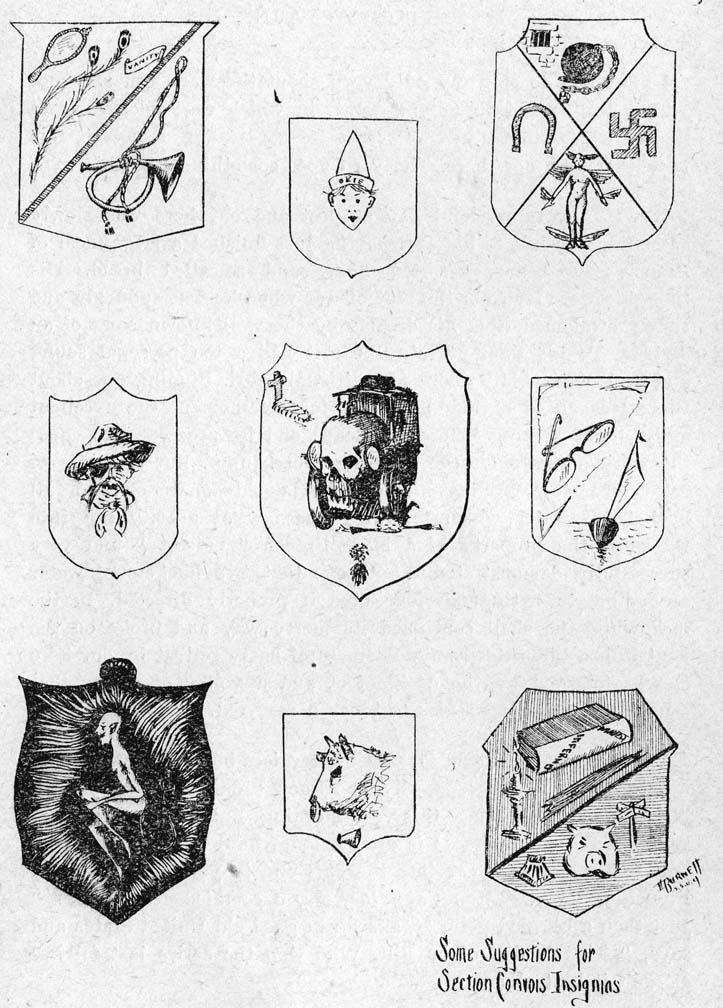
I am about to spin my only yarn about the war. You may not find it the sort of thing you want, in which case relegate it to the waste basket just as if I were a regular author. However, this is neither here nor there. The yarn goes something like this:
It is a very peaceful day at post and our hero was slowly ascending the hill to his abri having just finished a large meal of French issue beans, assorted horse and so-called bread. His thoughts were far from the seat of war when he was suddenly and rudely awakened from his dreams by the well known song of an arrivée. To his then untrained ear it had a too personal sound and he looked wildly about for a friendly abri. Finding one about two yards ahead of him he forgot for the moment the excellent story about looking before one leaps and he proceeded to equal the world's record for the standing broad jump. But the gods of mischance were guiding him and he landed square on two full buckets of water which following the law of gravity ran into the abri, the property of a large French "cuistôt" and very successfully demonstrated the theory that two buckets of water are ample to extinguish four fires if properly directed. In the meanwhile the shell continued its merry way and broke on the next hill, a kilometer away. Business of hasty retreat by our hero closely followed by the cook's foot and a volley of curses that caused three passing mules to blush a rosy red.
You may not find room for that masterpiece but it always amuses me greatly to tell it, especially as I know our "hero" very well, in fact I washed his face this very morning. But the most striking thing in the whole fracas is after a long, hard pull up to a post you roll out of your car into the abri and in your best A. F. S. French you say, "Mon Capitaine, il y a combien des blessés?" Just then a bearded poilu speaks up in good old United States and says, "There's five of us Bill. Who won the series last fall?" Doesn't it heat all?
S. A. SEARLE,
S. S. U. 645
|
A CAMION CONDUCTEUR Smoking in pipe in the Evening, Our Home's in a Tiny Village We're out of our Bed at Day-break We know the sound of the Arrivée, Just reach for the Old Tin Derby - The wind around us is howling The Shrapnel around us is Breaking, You push ahead in the Darkness With the sweat running out of your shirt sleeves Raymond H. FUSSELL, |
| Elbridge Adams | S.S.U. 26 | Williams R. O. T. C. |
| Dinsmore Ely | T.M.U. 537 | Corp. Lafayette Flying Corps. |
| Kenneth H. Casson | T.M.U. 184 | Ordnance Fort Slocum, N. Y. |
| Lewis B. Dougherty | S.S.U. 19 | 1 st Class Pvt. Ground Aviation School, Liberty, Mo. |
| Francis K. Douglass | T.M. U. 526 | Cadet Flyer Aviation, U. S. A. |
| Emmet T. Durkin | S.S.U. 26 | Cadet Military Aeronautics, U. S A. |
| Florimond J. Dusossoit | T.M.U. 526 | Cadet Military Aeronautics U. S. A. |
| Edmund A. Hastings | T.M.U. 526 | 1st Lieut. Aviation, U. S. A. S. |
| Henry Coe Laupher | T.M.U. 526 | Flying Cadet, Naval Aviation, U. S. A.. |
| Ovid L. Dally | S.S.U. 26 | Cadet, Flying Section, Aviation Corps, U.S.A. |
| Alden W. Foster | S.S.U. 64 | Cadet Cornell School of Aeronautics, Ithaca, N. Y. |
| George Carroll Buzby | T.M.U. 133 | Pvt. R. O. 'I'. C., Princeton, N. J. |
| Harrie Holland Dadmun | S.S.U. 30 | Chief Bowswain's Mate, Cadet at Ensign's School, Cambridge, Mass. U. S. N. R. |
| William Lowell Downes | T.M.U. 526 | Sergeant Signal Corps. |
| John L. Whitcomb | T.M.U. 526 | Cadet Royal Air Forces England. |
| Frank S. Fieldler | T.M.U. 537 | Pvt. 1st Army Artillery. |
| Vernon E. Caughell | S.S.U. 14-10 | U. S. Aviation. |
| Nicholas B. Clinch | S.S.U. 30 | Cadet U. S Army Aviation, U. S. A. |
| Gorham F. Freer | S.S.U. 2 | Cadet Royal Flying Corps Fort Worth, Texas. |
| Oswald Fowler | S.S.U. 4 | 2nd Lieut. Field Artillery America. |
| Peter F. Monahan | S.S.U. 16 | 94 Aero Squadron, 1st Pursuit Squadron. |
| Harry C. Roth | S.S.U. 14 | 2nd Lieut. U. S. F. A. |
| Andrew Alvord Baker | T.M.U. 526 | U S. Naval Aviation. |
| Frank H. Herrington | Vosges and S.S.U. 33 | French Artillery Aspirant. |
| Victor B. Geibel | S.S.U. 26 | Pvt. 1st Bat. F. A. Off. Train. School, Camp Upton, N. Y. |
| George H. Allison | S.S.U. 28 | Cadet, Naval Aviation, |
| James D. Beane | S.S.U. 9 | 1st Lieut. U. S, Air Service. |
| Christian Gross | S.S.U. 65 | Acting Major, 3rd.Off. Training Camp, Rockford, Ill. |
| Charles Mc. I. Kinsolving | S.S.U. 4 | 1st. Lieut. Air Pilot U.S. Army on detached service with French. |
| Robert C. Paradise | S.S.U. 15 | Cadet U. S. Air Service. |
| James L. Rothwell | T.M.U. 526 | L.Q.M. 3rd Class U. S. N. A. F. |
| Addison Fordyce | S.S.U. 64 | Cadet Flyer, U. S. Aviation in America. |
| J. Platt Cooke | T.M.U. 133 | U. S. Air Service. |
| James A. Devlin | S.S.U. 13 | 1st. Class Machinists' Mate U. S. N. R. F. |
| William H. Byers | S.S.U. 65 | Pvt. 76th Field Artillery Headquarters Camp Shelby. |
| Virgil W. Lewis | S.S.U. 4 | Cadet Signal Corps Aviation Balloon Observ. A S. S. E. R. C. Fort Omaha. |
| Theodore Frutiger | S.S.U.12 | Reserve Off. T. Camp, 5th Co. Chattanooga. |
Walter Ives, (S S. U. 32) has been commissioned 1st Lieut. in U.S.A A.S.
Julien H. Bryan (S.S.U. 12) now a student at Princeton, is the author of a book called "Ambulance No. 464 ".
On the night before Lt. Fletcher left Section 632 (old 14) to take charge of one of our repair echelons, he was tended a farewell banquet by the Section of which the "Bulletin" has received the following description.
"When I arrived at the Section in the late afternoon I was met by the French Lieutenant with the news that the French general of the division had that day cited Lieutenant Fletcher for his courageous and able leadership of the Section in active service and would the next day decorate him himself with the Croix de Guerre (ordre de la Division). We sit down to dinner in the usual half ruined house that our sections often occupy for quarters and Lieutenant Elliot Lee was also there as he had arrived the day before to replace Fletcher.
"We had a wonderful dinner at the end of which the French Lieutenant gave the news of Fletcher's citation to the section and proposed his health, wishing him "au revoir" and success in his new position. The reception the boys gave Fletcher will long live in my memory. No one there could doubt how those boys loved and respected him and appreciated the citation he had received. There was much hand clapping, cheering and speeches from the boys both to show their joy and their sorrow at losing him from the Section. Fletcher's speech of thanks was characteristically modest but it was apparent to all how deeply he was, moved by the whole event. After the dinner every member of the Section came up individually to shake his hand and to express what he felt. Fletcher was decorated by the General the next day at the General's Headquarters."
Section 14 a fortnight later had another big dinner to celebrate the end of its first year at the front.
To the Editor of the "Bulletin"
I am anxious to dad out the way to figure out the A. F. S. number from the U. S. A. A. S. section number and vice-versa. In other words, I want to know, whenever I see the U. S A. A. S. number designated on an ambulance how to find out what was the former Field Service number.
Old Philadelphia Lady.
Paris, December 24th, 1899
Sedley C. Peck (S.S.U. 10) Cadet in U.S. Air Service; Edwin H. Fairchild (T.M.U. 526) Escadrille N.. 159; Chas. V. McArdell (S.S.U. 65) U.S.A.A.S. ; William G. Rice (S.S.U. 66) Lieutenant U.S.A.A.S. ; Richard Buel (S.S.U. 30) U.S.A.A.S ; Alden B. Sherry (T.M U. 526) U . S Air Service ; Joseph H. Gray (T.M.U. 526) Naval Aviation; Richard Parmenter (T.M.U. 526) U.S. Air Service ; Fred G. Redman (S.S.U. 32) U.S.A.A.S. ; Alex. G. Standing (S.S.U. 32) U.S.A.A .S. ; Robert H. Scannell (S.S.U. 13) 2nd Lieut. Int. C. Gen. Staff G. H. Q. ; Enos W. Curtin (S.S.U. 2) 2nd Lieut Anti-Aircraft Artillery; Frank N. Cary (T.M.U. 526) U.S. Aviation; Charles Bayly (S.S.U. 26) 32° Artillerie Fontainebleau.
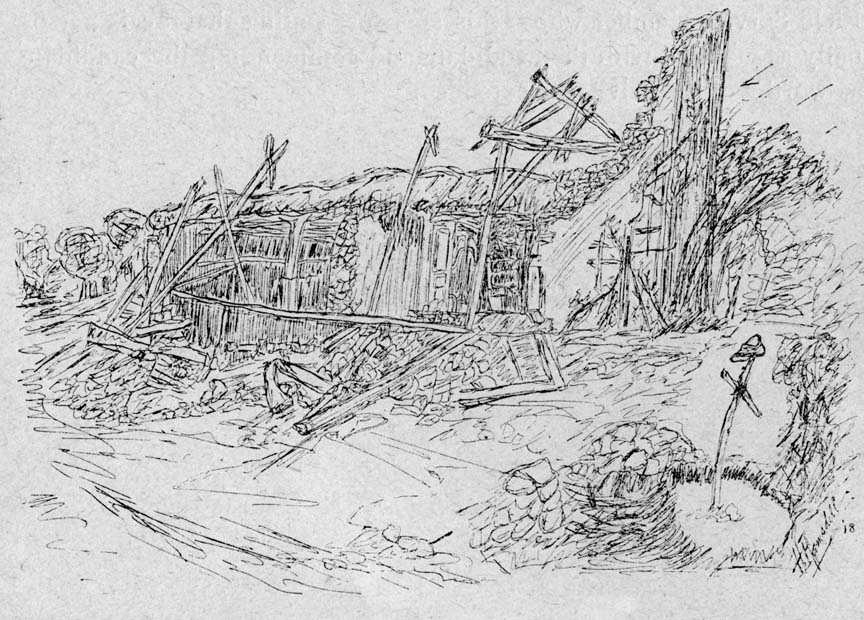
We regret to report that William J. Whyte who served as volunteer for several months in the Transport Branch of the American Field Service was killed in an aeroplane accident on March 20th 1918. Mr. Whyte was a member of T.M. 526 until August when he joined the U.S. Aviation Service in which he subsequently, obtained the rank of First Lieutenant. Before coming to France he was a student in the University of Chicago and his home was in Chicago, Ill.
Any Field Service man now a member of U. S. A. A. S. can extend the privileges of the Field Service Headquarters, including meals, lodging and the use of the living rooms for a period of two weeks to any member of U. S. A. A. S. whether or not he was ever connected with the Field Service. The guest so introduced has only to present a letter of introduction at the Headquarters, signed by the Field Service member who is his sponsor, stating that he is personally acquainted with the candidate and commending the candidate as worthy of the privileges extended.
| Three Months |
Fr 2,00 |
|
Fr. 2,75 |
| Six Months |
4,00 |
|
5,50 |
The prize of Twenty Francs has been awarded to the author of "Letters from the Rear " written by Paul M. Fulcher, S. S. U. 631 (né 13).
Many collections of letters from the front have been published and large profits reaped therefrom, but letters from the rear have thus far received little attention.
Now the rear is always interesting, and has several stages. It is the place you fall back to when you win a strategic victory--- that is the immediate rear and you never get letters from it. Then it is the place you go to on permission. That is the second rear, and from it you get letters saying that she is lonely without you and quite angry because she hasn't heard from you. Then there is the rear which means America, where we all came from and where we all hope to go, le plus vite possible. That is the rear from which we get letters sometimes.
Formerly letters from the front were interesting --- at least the rear thought them so--- and might be sold to magazines at the rate of five dollars for each thrill they contained. This happy temps jadis has passed, much to the advantage of truth and the sorrow of our thrill-hungry friends. Nowadays you can't tell about terrific bombardments, colossal gas attacks, and throngs of blessés hysterically grateful for a ride in your ambulance, when your lieutenant --- who may or may not have written the same kind of stuff in the golden age of the Field Service ---when your lieutenant will read every word with a weary, cynical smile, and knows that only one small thirty-seven shell came in that day and that it failed to explode ; that there had been no gas alerte for three months ; that the one blessé of the day was a teamster who hurt his knee by falling from a ravitaillement wagon. and mon Dieu-ed, bon Dieu-ed, doucement-ed and mon jambe-ed all the way in, finally calling you a Spanish cow as he hobbled into the hospital. You can't criticise the army, now, either. However, if you are a highbrow, you may make some such cryptic remark as the enlistment officer reminds me of the first line of Browning's "Childe Roland." I, of course, am not a highbrow. In this connection, you must bear in mind the fact that letter-writing is a privilege and not a right, and that in many previous wars the troops were --- unprivileged.
The reader must not infer that even the letter from the rear is an unalloyed delight. Often it bears evidence of many mistaken notions of the war. Perhaps much of this is due to "information" contained in letters from the front. But with all their faults, we love them still, and when Monday's mail brings a Ford radiator, Tuesday's, three inner tubes and a rear spring, Wednesday's, nothing at all, and Thursday's a complete outfit of overseas caps, we look forward to Friday rather expectantly.
The next war that I attend, I shall drop certain people from my address book.
First, there is the college chum who thinks that all his letters are censored. Some day I am going to inform him that I have received only one letter which had been even opened by censor. That was from my mathematics professor, and nothing was cut out of it, although the writer said that he had been making four-minute speeches --- an obvious falsehood, for the man never talked for less than fifty-five minutes in his life.
Then there is the girl who is so glad to get a "personal account of this great world movement." And the girl who thinks camp life must he so interesting. And her sister, who has sent me (so far) seven copies of the Emphasized Gospel of Saint John. And the girl who sends me banquet menus.
Next in order comes my Canadian aunt, who makes cutting remarks about the American army and especially about the ambulance corps, and inquires if we ever go near the front. And my cousin's sister-in-law's grandmother, who thinks we go up into the front line and carry the blessés down on stretchers. The rest of my relatives may continue to write. At least they mean well.
Then there is a whole phalanx of camp-fire girls who promised to send me packages, and writes weekly letters instead enclosing photographs of themselves which resemble Aloha the fair Indian maid, seven minutes before she bathed in the Fountain of Youth. One of the phalanx wants to know if I ever hear the guns.
A most offensive class comes next. Their letters urge me to seek out and slap jovially on the back their old friends, their very dear old friends, Captain Green, Major Brown, Lieutenant-Colonel Smith, and especially dear old Brigadier-General Jones.
The wife of the family doctor, who simply cannot understand why we are with the French, is a little annoying. So is the methodist minister, who still addresses me at 21 rue Raynouard. The young lady school-teacher who counts that day lost whose low-descending sun sees not some unique knitted garment done and speeded on its way to me is quite a trial, since often I can't discover on just which portion of the anatomy each garment should be hung, and since, after wearing for several weeks about my waist, as an abdominal protector, a strange creation which resembled an amoeba about to divide, I suddenly discovered that the thing was meant for a helmet.
But all these good friends can not compare to the correspondent whose case I have saved till the last. I mean the sweet old lady who sent me a package containing seven hundred and forty-nine post cards --- picture post roads and cards bearing "cheering messages and inspiring quotations" --- for me to distribute to the wounded I carried, and, if any were left, to the men in the trenches. I owe a certain period of unpopularity in my section to the fact that, instead of doing as she told me, I tacked up the cards to the walls of our cantonnement, putting up new ones when the old were torn down. The unpopularity was of course due to my using up the section's supply of tacks.
Paul M. FULCHER,
S. S. U. 631 (né 13).
| Julian Stanley Dexter | S.S.U. 64 | Cadet, Army Aviation, U.S.A |
| Herbert Raymond Kendall | T.M.U. 133 | Cadet Army Aviation in France. |
| Frederick B. Barlow | S.S.U. 64 | Cadet Royal Flying Corps. |
| Bennett Wells | T.M.U. 526 | 1st Ft. U. S. Air Service. |
| Edwin Miles Noyes | S.S.U. 28 | Sergt. 1st Class, Aviation Section, Signal Corps. |
| Herbert Walter Crowhurst | S.S.U. 12 | 2nd Lieut. Q M. C. N. A. |
| William Nelson Reagan | Calif. Office | 2nd Lieut. U. S. Air Service, A. E. F. |
| Norwood Paxton Johnston | S.S.U. 64 | Cadet U. S Air Service. |
| Thomas Lazear Orr | S.S.U. 12 | 1st Lieut. U 5. Air Service A.E.F |
| Alastair Ian Grant Valentine | S.S.U. 32 | Lieut. American Red Cross Italian Service, Sect. III. |
| Morris Henry Harnley | S. S. 29 | 1st Lieut. Aviation Section S. O. R. C. |
| Harry D. Wood | S.S.U. 69 | Private Red Cross. |
| Frederick Exston | S.S.U. 8 | Intelligence Section, American Headquarters. |
| H.G. Campbell | T.M.U. 184 | Motor Transport Service. |
| C. W. Alkire | T.M.U. 397 | Motor Transport Service. |
| G..E.. Amick | T.M.U. 184 | Motor Transport Service. |
| E. H. Drew | T.M.U. 397 | Motor Transport Service. |
| B. G. Kline | T.M.U. 133 | Motor Transport Service. |
| J. L. Nickel | T.M.U. 184 | Motor Transport Service. |
| F. T. Arthur | T.M.U. 537 | Motor Transport Service. |
| Cyrus Clark | T.M.U. 133 | Motor Transport Service. |
| Joseph Mellen | S.S.U. 3 | Lieut. Aviation. |
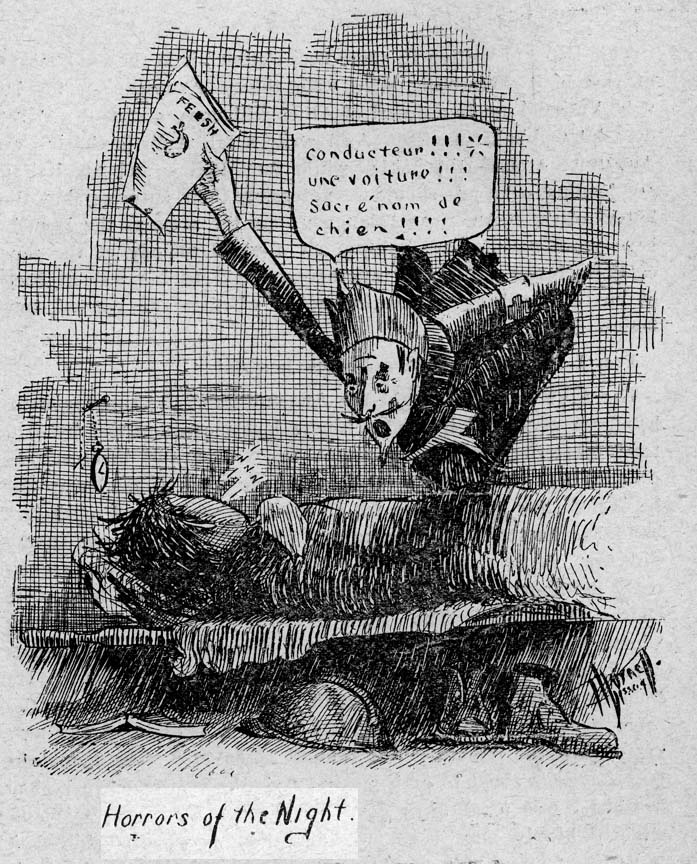
Dear Ed
This letter is written in sheer desperation; it is the only means of getting a connecting wire with things American --- for let it be known I am in a desert of Allies with nary a star or a stripe or a bit of khaki in view. As I write a tall Arab is chasing an Annamite around the table, while four Poilus and an Italian are leaning over my shoulder expressing their surprise that the letters of the "American" language are the same as the French. Five more malades are yelling out a weird melody at the tops of their lungs while still another confined to his bed in back of me is shrieking a question as to whether the general confusion distracts me.
Yes, I am sick and in a French hospital.
The Arab has now caught the Annamite and the running noise has been succeeded by Indo-Chinese howls accompanied by gutteral mutterings ordinarily swept by "Sahara" breezes. The French cook has entered and is showing his comradeship for les Américains by slapping me on the back while the French jazz band has burst into "Tipperary" with meaning glances in my direction. A Belgian from another ward comes running in excitedly his fingers placed on a certain word in a certain hook. He shows it to me. The word is cow-boy. I nod nonchalantly whereupon he works himself into a feverish state and makes sounds approximating "boom boom, wow wow and moo." He then darts out and reappears with a gentleman built along the same generous proportions as Jess Willard, explaining the new entry with the remark "Il connaît la boxe. " The herculean personnage is about to grab me and I shall continue when he has finished. Jess is all thru now and outside of a black eye and slightly bloody nose I am well. A Frenchman has shoved a "Vie Parisienne" in front of me and is pointing to the limb of the girl on the magazine cover. I’m sure I don't know what he expects me to do.
The treatment here is wonderful — I’m cured.
Yours truly,
Robert SCHOLLES,
S. S. U. 637.
|
SOUPIR Theres orders come tis whispered round So soon we gets official line We puts the old steel helmet on The Sergeant bleats his whistle Then we waits till night for cover Theres man and horse and motor truck Its black as old time hades You miss the truck in front an inch Hidden by hills from the Boches lines Right tip to Where they feeds ‘em steel It's days of use are over now A screaming and a Whistling We ducks with ninety frenchies Each minute comes a howling one They couldn't hold our boys near bye So when the whistle blows to leave They chased 'em sadly back to camp R. MORRISON YOUNG, |
A small volume dealing with the transport branch of the Field Service has recently been published in New-York under the title "Camion Letters from American College Men, Volunteer drivers of the American Field Service in France 1917 ". Most of the letters are from the Cornell men who formed the larger part of the first section assigned to transport work.
The volume is edited by Professor Martin W Sampson of Cornell, who worked so helpfully for the service in the Boston office during the summer of 1917. It is published by Henry Holt and Company, New-York. (One dollar net.)
Mr. and Mrs. Chester Guild of Newton announce the engagement of their daughter, Carolyn, to Lieutenant Maylon Philip Bryan, son of Mr. and Mrs. Mahlon Reading Bryan of Brookline. Lieutenant Bryan, recently received his commission in the Signal Reserve Corps, Aviation Section, and is expecting to sail immediately for active duty in France. Previously he took part in the American Ambulance Field Service in France, where he was a member of the renowned Section VIII.
Boston Evening Transcript
March 5, 1918.
The system of compiling the old Field Service number is very simple. Take S. S. U. 631 for instance: you subtract 600, then reverse the remaining numbers and you have S. S. U. 13.
TRYCOB.
The headquarters of the United States Army Ambulance Service continues to receive evidence in the way of citations of the good work of the American ambulance drivers who are transporting the French wounded. Corporal Elmer Naslund and Private Raymond Hunter, of Section 645, received divisional citations with Croix de Guerre on March 25. Section 629 has also been cited by the division for its exceptional work and Private (1st class) Perrin H. Long and Private (1st class) Ethelbert W. Love, of Section 638, also received divisional citations on March 24.
Reports from the front say that the United States Army Ambulance Service is doing excellent work in the big battle all along the line. Many sections are engaged and there have been few losses. There is a good reserve, so the organization is proving efficient in every way, and its work is being highly appreciated.
New-York Herald, April 3rd..
Capt. W. Def. Bigelow (S. S. U. 4) has received his second Citation. This time to the order of the Corps d'Armee.
VISITORS AT 21 RUE RAYNOUARD
Ripley Cutler (S .S .U. 30) U. S. A. A. S. ; Donald F. Bigelow (T. M. U. 133) 2nd Lt. Field Artillery; Robert A. Dole (T. M. U. 526) American Red Cross; James W. Harle (S. S. U. 2-10) Sgt. Headquarters U. S. A. A. S. ; Jack Nichols (S. S. U. 10) American Red Cross; Joseph Desloge (S. S. U. 10) American Red Cross; J. Dewitt Toll (S. S. U. 17) U. S. A. A. S. ; J. Milton Nazel (S. S. U. 17) U. S. A. A. S.; F. A. Webster (S. S. U. 2) 1st Lieut. S. C. N. A. ; H. G. Campbell (T. M. U. 184) M. T. S. Rec. Park, A. P. 0. 705; Randolph L. Knight (S. S. U. 16) U. S. A. A. S.; J. Frank Brown (S. S. U. 16) U. S. A. A. S. ; J. A. Scudder (T. M. U. 526) Corp. American Red Cross; Cecil Read (T. M. U. 133) 2nd Lieut. U. S. Artillery ; Joseph Mellen (S. S. U. 3) 1st Lieut. Aviation ; Charles Codman (S. S. U. 3) 1st Lieut. Aviation.
| Three Months |
Fr 2,00 |
|
Fr. 2,75 |
| Six Months |
4,00 |
|
5,50 |
|
OSTEL 1917 By day Everything changes with nightfall. Men work and talk ; eat and dig graves; By day Malcolm COWLEY, T. M, 526. |
|
EN REPOS There's no fit word of any tongue, It's a fearful kind of lassitude For a man with blood and willing His thoughts turn back to his homeland, When there's work he's well contented, A rumor starts him kicking, But send him out on the road again He's happy and he's well content To keep your men all happy. R. MORRISON YOUNG, T.M.U. 184. |
|
A SOLDIER'S HEAVEN A "Sammy" heard the bugle call William M. FARR, T. M. U., 184. |
FROM CENTIGRADE TO FAHRENHEIT
To the Editor of the "Bulletin"
I am anxious to find out the way to figure out the A. F. S. number from the U. S. A. A. S. section number and vice-versa. In other words, I want to know, whenever I see the U. S. A. A. S. number designated on an ambulance how to find out what was the former Field Service number.
Old Philadelphia Lady.
Paris, December 24th, 1899.
In response to Old Philadelphia Lady who wishes to know whenever she sees the U.S.A.A.S. No, upon an ambulance how to tell the corresponding number in the A.F.S.
Gee! She does not want much! I can tell what the answer is but I can't tell her how she can do it. My system is a bit complicated but it works, none too accurately, however. Before the Old Lady decides to tackle the job so she can satisfy her, curiosity whenever an ambulance goes by, I strongly advise a course in memory training. I have been at it six months and I can't tell off hand how they run.
She will have to dope out her own system as we all do. We men in the Post Office here at B.C.M. have handled thousands and thousands of letters that have to be transposed while assorting and we make mistakes because there is no connection between the numbers. As soon as I read this request from our "old friend", I saw it was a good chance to plead our case before the fellows who don't get their mail. It is no use trying to convince them that we are not always to blame and that the trouble might be elsewhere, so I will plead guilty and use this as an excuse. But the next time you get a letter addressed by the old A F.S. number just stop and think of what I have to go through with before I arrive at the conclusion necessary to get your letter in the proper bag. But I am to tell the Old Phila Lady my system.
S.S.U. 1 is now 625, this much you must start with. I always remember this because Gildersleeve, you--- all know Gildie, he will recite The Shooting of Dan Magrew at the drop of the hat. And any place you will drop the hat. He doesn't care.
I have seen him do it when they had all lost their hats. Well Gildie has an old Ingersoll he is trying to auction off. "I'm offered six dollars for this 22 jewel open face stem winder, Who will make it a quarter? Six and a quarter six and a quarter!" 625. Voilà1 A.F.S. 2 drew 626. Section 3 was out in the Orient when the Allentown contingent got over and as Section 3 did not show up for a Commission they gave 627 to A.F.S. 4. Field Service 8 drew 628 because it ended in 8. Field Service 9 drew 629 for the same reason. I am telling you how To remember it. Easy isnt it. Section 10 was left ill Albania. 11 was a Norton Harjes Unit I believe. So Section 12 got No 630 and so an to 19, --- 637. Then Meaux school has to butt in with S.S.U. 20 and spoil it all. Have you had enough?
By this sort of memorizing you can learn it. Old S.S.U. 62 is now 591, 63 is 585, 65 is 622. If you wish to memorize the dope sheet write me and I will send you the list and upon completion we will make you our memory expert. One thing sure unless I first visit Gildesleeve's auction 1 cannot put it over.
So my dear Old Lady you will not be able to tell when you see an Ambulance go by what old Field Service Section it was because it will be out of sight by the time your mental processes have worked sufficiently. Save your mind the work. And here is a secret. It may not be a Field Service Section. after all They are using our "style of buss". This is in the bosom of the family. Theirs fell apart just as ours did in the Spring of 1915. "Oh! we can improve on the Field Service body. " Can't be done over night. But this is beside the point.
After all Old Lady Friend think in U.S.A AS. numbers just as our boys think in French, even though you cannot think in Centigrade.
Headquarters may have a better way of telling. 1 hope so. At any rate I shall watch the Bulletin and see.
And above all things insist upon the correct address upon your letters.
James W. HARLE, Jr.
P.S. The Xmas rush is still on, a load of packages yesterday and one to day. Cheer up you will get that Xmas cake yet.
| Roswell Miller | T.M.U. .326 | Machinist Mate 2nd Class U.S. Naval Reserve Force |
| Robert T. Burr | S.S.U. 68 | Cadet Aviation, Camp Dick Dallas, Texas |
| Robert Howard Gamble | S.S.U. 1 | Ensign, Naval Flying Corps U.S.A. |
| Everett L. Stanley | S.S.U. 12 | Sgt Headquarters 26th Div. |
| George Dent Adamson | T.M.U. 184 | Pvt 5th Field Artillery |
| Charles Frank Hill Crathern | T.M.U. 526 | Pvt. 1st Vermont Infantry U.S.A. |
| Kirby Hartley | T.M.U. 397 | Cadet Aviation Section U.S. Signal Corps Berkeley, California |
| Oliver Lyons Clark | S.S.U. 64 | Cadet Pilot, Aviation, New Orleans, Louisiane |
| William Lawrence Clark | T.M.U. 184 | Railroad N and W U. S. Proving Ground Maryland |
| Leslie H. Buckler | T.M.U. 526 | 1st Lieut. A.S.S.C.U.S.R. |
| Raymond Victor Holtz | S.S.U. 69 | Headquarters Detachment161st F. A. Brigade, Camp Grant, Rockford, Illinois |
| Spencer Lee Trotter | S.S.U. 8 | Motor Truck Co. 2424 Camp Jos. E. Johnston, Jacksonville, Florida, |
| Paul Holton Ballou | S.S.U. 64 | Appointee to U.S. Military Academy |
| Samuel Gibson Frantz | S.S. U. 18 | Flying Cadet, Balloon Aviation. Princeton, New Jersey |
| Lloyd B. Seaver | S.S.U. 9 | Cadet, Aviation Section U.S. Signal Corps Reserve. Camp Dick, Dallas Texas. |
| George Edward Tonkin | T.M.U. 133 | Infantry U.S.A. |
| Philips Henry Glorieux | S.S.U. 9 | U.S.A.A.S. |
| Roswell Miller | T.M.U. 526 | U.S. Naval Reserve Force |
| John Rosslyn Boorde | S.S.U. 12 | U.S. School of Aerial Photography Rochester, N. Y. |
| Russell Story Perkins | T.M.U. 133 | Pvt U.S.A.A.S Provisional Casualty Co. No 7 |
| Richard Wainwright Thorington | S.S.U. 27 | R.O.T.C. Princeton University |
Announcement has been made of the citation of Lieutenant William E. Westbrook, commanding Section 621 (S.S.U. (68), which speaks of his bravery and, courage during a gas attack, when he evacuated a number of men who were suffering from the effects of gas.
All of the reports from the front recently have remarked on the excellent work of the Ambulance Service during the heavy fighting
Frank J. Taylor (S.S.U. 10) who has been editing the Field Service History has gone to the front as United Press Correspondent,
All communications and material for the book should he addressed simply American Field Service
Thayer Robb. S.S.U. 33, has been commissioned 1st. Lieut. Intelligence Department, A.E.F.
Reginald B. Vaughan who has recently had charge of the Parc at Billancourt, has received a commission in the English Army.
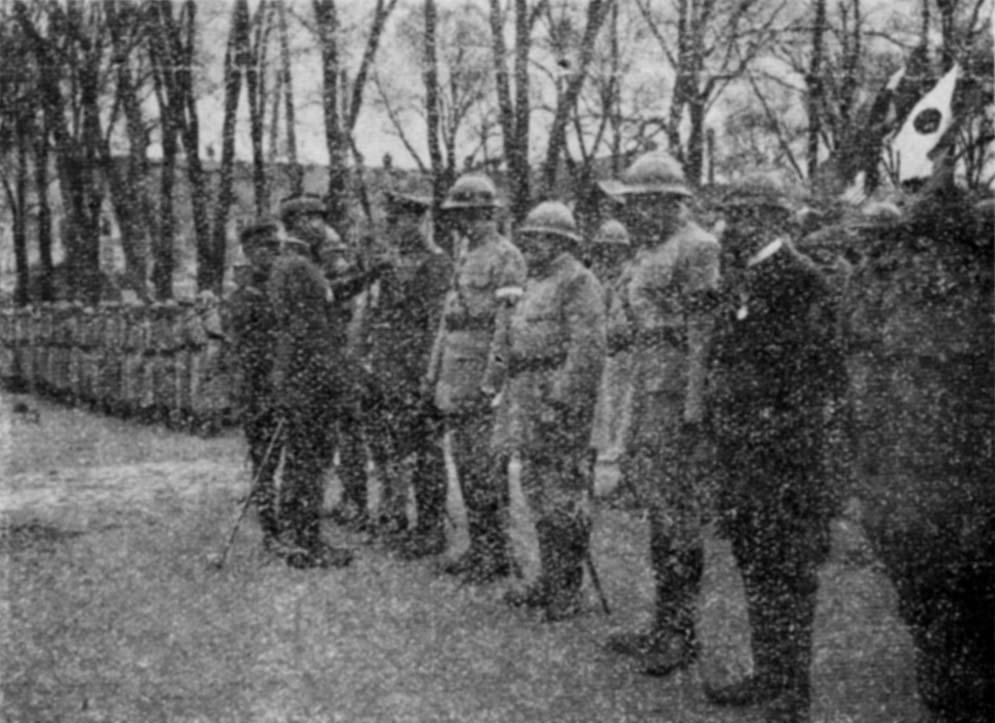
Captain William de Ford Bigelow so long a member and officer of Section 4, now in charge of one of the repair parks of the U.S.A.A.S., was recently decorated by general Gouraud with the Croix de Guerre and awarded in army corps citation for valiant service rendered during an air raid in the city where he is at present stationed. The citation follows:
April 2nd 1918.
The General Commanding the 4th Army cites to the order of the 4th Army Corps Captain Bigelow (Wm. de F.) commanding the S. S. U. 509. Has given evidence of most complete disregard of danger in organizing under the enemy fire rescue service particularly dangerous. Has communicated to all his personnel the remarkable ardour and zeal which animate him., Has been previously cited.
General commanding the 4th Army, GOURAUD
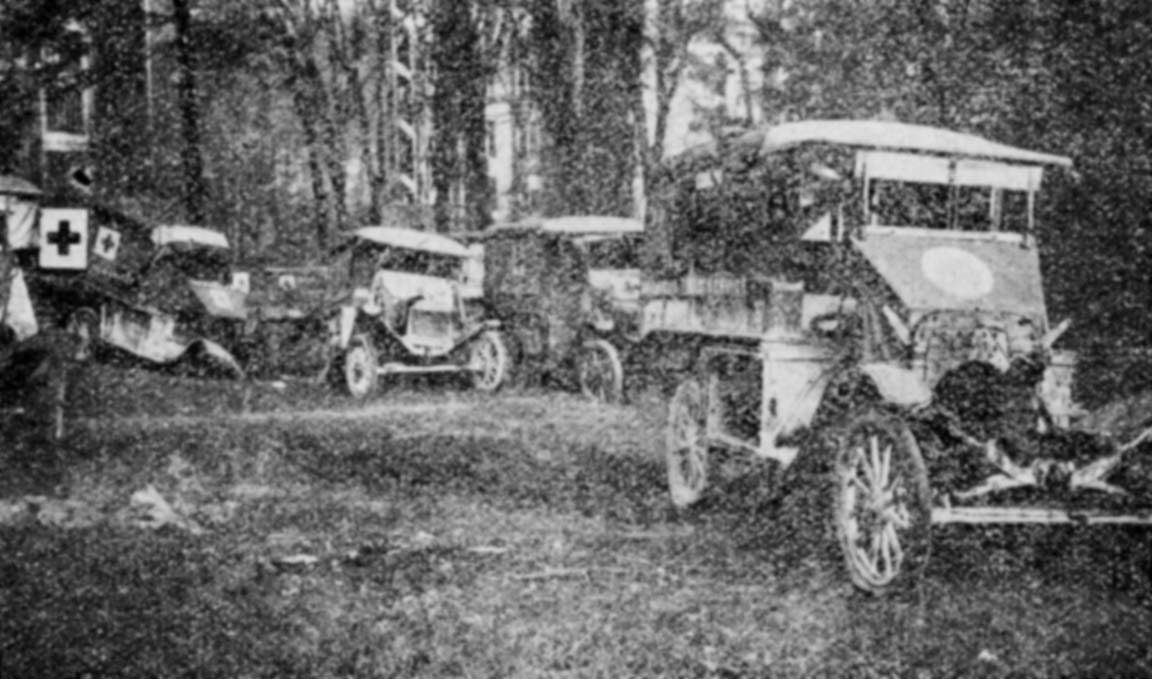
A corner of the park at 21, rue Raynouard showing cars destroyed in service, whose donors live in New-York, North Carolina, Illinois and California. These cars have performed good work in various ambulance sections. No 737 in the foreground was destroyed at Mornzeville while Section 29 was doing the run to Mort-Homme. The others in the background come from Sections 12, 13 and 19, their condition results of collision or wear and tear of a year's service at the front.
M. H. Roblee (T.M.U. 526), American Red Cross, Italian Ambulance ; N. H. Reynolds (T.M.U. 537) U.S.A.A.S.; T. M. Parmelee (S. S. S. 29), American Red Cross, Italy; Henry W. Patterson (S.S.U. 29), American Red Cross, Italy ;4 Robert C. Duff (S.S.U. 9); C. A. Elliott (S.S.U. 9), American Red Cross ; C. R. Kellogg (T.M.U. 184), American Mission, Reserve Mallet; Charles B. Fogle, Signal Corps, Photo Plant ; Theodore Stanton, Cornell University.
Some one tried to give a false impression saying : "Paris was sacked" when as a matter of fact Paris monuments were only being sand-bagged.
One of our men who had not been in for a long time went into a restaurant that he used to frequent and being thirsty hastily filled a tumbler from what he took to be a water bottle and only after he had drank a day's rations did he discover it was saccharine. Now that restaurant serves saccharine in the guise of sugar coated pills.
The French general commanding the section personally congratulated Baylies.
New-York Herald April 18.
Louis G. Mudge (T.M.U. 537), American Red Cross; E. Mack Gildea (T.M.U. 133) ; H. A. Innes Brown (S.S.U. 3), 1st Lt. S.C.; Cyril Smith (S.S.U. 12), U.S.A.A.S. ; Robert G. Eoff (S.S.U. 18), Lafayette Escadrille ; H. P. Kennedy (T.M.U. 526), 2nd Lt. Q.M. US.A.; Buford A. Clark (T.M.U. J84), 2nd Lt. Q.M.U.S.R.; Powel Fenton (S.S.U. 3), 1st Lt. Air Service.
|
THE WATCH AT NIGHT Oft' when the sun from the far distant west O'er distant hills slow the light fades away; The twinkling stars pierce the veil of the night, And sometimes when all is quiet and still E. A. Doepke Jr. |