| Three Months |
Fr 2,00 |
|
Fr. 2,75 |
| Six Months |
4,00 |
|
5,50 |
It will come as a considerable surprise to our readers to learn that since the competitions have been finished and the prizes awarded there has been a considerable slackening off of contributions to the « American Field Service Bulletin ».
It has taken the greatest amount of ingenuity and knowledge of human nature to come to the conclusion that among our brave ambulance and camion drivers there is still not lacking a certain commercial spirit.
Let me point out that the competitions were started with the idea of stimulating interest among all our sections and we fully expected that after one such generous offer on our part that we would from then on be deluged from all sides by eager contributors to our paper. It is with the deepest disappointment that we now admit that this has not been the result and by our philanthropy we have not killed that most insistent of all serpents, the «Chase of the Mighty Dollar.
We are therefore in the position of having « to come across again» or close up the editorial office. For this reason we offer.
TWENTY FRANCS for the best Essay sent in before November 12th,
TWENTY FRANCS for the best Poem sent in before November 19th,
TWENTY FRANCS for the best Drawing, in before November 26th.
TWENTY FRANCS for the best Section Notes sent in before December 3rd.
The advent of the American troops in France has brought back in our midst many familiar faces. During the last week or two men who have formerly served with the American Field Service have been dropping in to the rue Raynouard, little changed except for the Stetson hats and «Sam Brown» belts.
The following is a list of those who have paid their respects to their old service: C. Burr, Cdt. Adj. S. S. U. 9, now 2nd Lieut. U. S. Marines ; T. Potter, S. S. U. 3, E. Fowler, S. S. U. 4, A. Taber, S. S. U. 4 and K. Rotharmel, S. S. U. 4, are all now in the Lafayette Escadrille ; Lovering Hill, Cdt.Adj. S. S. U. 3. now Lieut. in U. S. Artillery ; A. G. Cary, S. S. U. 3 now 1st. Lieut. U. S. Artillery ; C. T. Clark, S. S. U. 3, now in French Artillery at Fontainebleau ; A. M. Hyde, Cdt. Adj. S. S. U. 26 ; Lt. Rodocanachi S. S. U. 2 and his cousin Lt. Rodocanachi, S. S. U. 13; Waldo Pierce, S. S. U. 3; W. K. Emerson, S. S. U. 3, Powell Fenton S. S. U. 3 now 1st. Lieut. in U. S. Aviation ; H. D. Hale S. S. U. 3, now 1st. Lieut. U. S. Aviation ; and J. M. Walker, S. S. U. 3, 1st. Lieut. U. S. Aviation.
|
EPIC YEARS The star shells flare ; the tortuous trenches wind Chemin des Dames (October 19, 1917), S. S. U. 70. |
The Franco-American Concert given under the auspices of the Army Y. M. C. A. at . . . . . . . by the men of the Field Service Sections T. M. 184 and T. M. 526 was a success in every sense of the word and plans are on foot to give similar programs each week with a mixture of local and imported talent.
The program called for a Mandolin ensemble as a curtain raiser and judging by the enthusiastic applause accorded them and the repeated demands for an encore, Chipman, Busby, Moreland, Fowler and Pelts were all there with the stuff. M. Donini a French wit attached to 526 kept the poilus who had packed the rear of the tent in a jolly mood throughout his dramatic monologue and in the following number Busby made his banjo talk a language limited neither by race, color or previous condition of servitude, when he ran through the banjo stunt that kept him constantly on the boards when a member of the Princeton Musical Club.
Baldridge (184) who draws for Leslie's was exceedingly clever and his rapid fire sketches ran all the way from French corvées and a petit Parisien to Marshall Joffre and President Wilson. A few surreptitious glances at Captain Mallet, who came over especially for the program, and a few rapid passes at the board was followed by a wave of applause at the successful sketching of a « subject » taken from the audience.
Moreland (Yale Mandolin Club) and Chipman (Dartmouth) at the piano in their dual number went the whole way on high gear and had almost succeeded in negotiating a safe return trip when a broken string put Moreland in the ditch, but Chipman got by safely and finished strong amid cheers from the crowd.
M. Jean Deschamps, a renowned Parisian sculptor and winner of the Prix de Rome gave some songs of good opera calibre and Lieutenant Goubeau was encored repeatedly in his rendition of popular airs.
The program closed with the singing of the Marseillaise and the Star Spangled Banner.
The following men sailed from New York via England on Oct. 9th. Mitchell and Whitney ; via France on October 14th, Allison, Culbertson, Ganz, Groesbeck, Hackett, Lippman, H. Navin, O. Nevin, O'Brien, Parker, Redman, Smith, Wade, and Williams via England on October 15th, Anderson, Andrews, Bailey, Carney, Cordner, Davenport, Frisbie, Green, Herrick, Hughes, Hummel, Lancaster, Miller, Munro, Pillow, Riley, Savage, Seywood, Shisimanian, E. Smith, R. Smith, Thomas, Trude, Wold, C. Wolfe and D. Wolf.
21 octobre 1917.
Le général commandant la 6° armée cite
«Soumis à un très violent bombardement an cours d'un transport de materiel, à proximité des premières lignes, a fait preuve, sous la direction du chef SCULLY, activement secondé par les conducteurs THOMPSON et MACY, de bravoure et d'un sentiment élevé du devoir, effectuant, à défaut de corvée spéciale, le déchargement du matériel, se multipliant pour secourir les blessés et ne se repliant, en ramenant toutes ses voitures, qu'après avoir mis les blessés à l'abri et avoir accompli intégralement sa mission.»
Conformément aux prescriptions de la note du général commandant en chief n° 24.709 du 30 septembre 1916, le général commandant la 6° armée décide que cette citation sera inscrite à l'Ordre du 11e Corps d'Armée. Au G. Q .A., le 18 octobre 1917.
VIIe CORPS D'ARMÉE
---------
DIRECTION
DU SERVICE DE SANTÉ
---------
Secteur postal n° 40
Par application des dispositions:
1° De la loi du 8 avril 1915, instituant la Croix de Guerre;
2° De l'instruction du 13 mai 1915 pour l'application du décret du 23 avril 1915, le Directeur du Service de Santé cite à l'Ordre des Formations Sanitaires du VIIe Corps d'Armée (Croix de Guerre):
BALLOU, P., de la Section Sanitaire Américaine n° 64:
« Volontaire Américain, conducteur d'une auto sanitaire. A fait preuve de courage et de mépris absolu du danger en évacuant les blessés de la Division dans des conditions très pénibles sur des routes fréquemment soumises à des bombardements violents. »
S. P. 40, le 2 octobre 1917.
VIle CORPS D'ARMÉE
DIRECTION
DU SERVICE DE SANTÉ
------
Secteur postal n° 40
Par application des dispositions:
1° De la loi du 8 avril 1915, instituant la Croix de Guerre;
2° De l'instruction du 13 mai 1915 pour l'application du décret du 23 avril 1915, le Directeur du Service de Santé cite à l'Ordre des Formations Sanitaires du VIIe Corps d'Armée (Croix de Guerre):
HARRISON, B. V., de la Section Sanitaire Américaine n° 64 :
«Volontaire Américain, conducteur d'une auto sanitaire. S'est signalé par son mépris du danger, sa bravoure et son sang-froid, en assurant avec un grand dévouement l'évacuation des blessés, sous des bombardements fréquents.»
S. P. 40, le 2 octobre 1917.
Dear Sir
I noticed in the last issue of the Bulletin a reproduction of the insignia of one of the other sections. This particular section was very proud of their combination of the Stars and Stripes, Tri-Color, a Red Cross, section number and an American buffalo. A picture of the Capitol building at Washington would complete this combination.
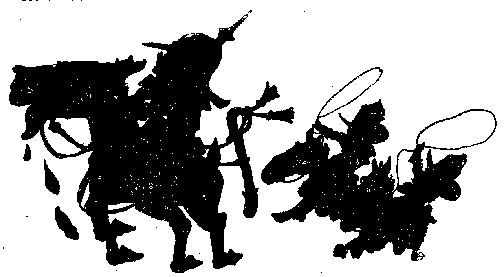
I would like to submit our insignia for reproduction in the Bulletin. Of course we will have to ask the pardon of "LIFE" for stealing it, but we don't think they will object.
The work of getting out the stencil, and also the enclosed copy, was done by Private Russell P. Mitchell, in civil life a young Pittsburg architect.
The section is just waiting for a period of repos, when we will have our emblems on the sides of all the cars.
Will. E. WESTBROOK,
S. S. U. 72.
Private Christian Gross has been released from the U. S. A. A. S. in answer to a summons to return to the United States to accept a captaincy in the Illinois National Guard.
Ten minutes of physical jerks after the "coffee an'" is serving to keep the men in fine condition in preparation for the coming cold weather.
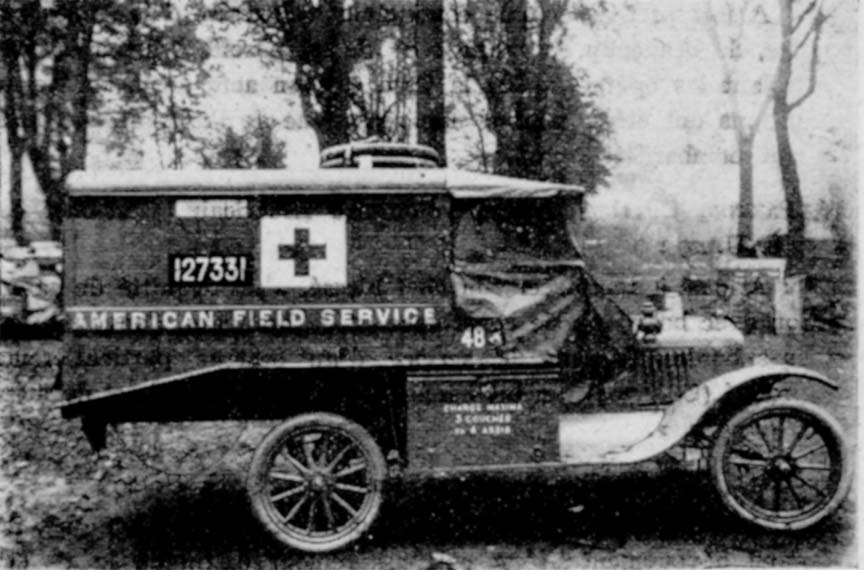
It is with deepest regret that we report the demise of Ford staff car N° 127032, destroyed by flames on time evening of october 12.
Isn't it about time to be getting out them heavies?
M. G. S.
A buvette is the country cousin of a Paris café And like most poor relations it seldom puts on airs. Sometimes it is a room all to itself, but it gets along amicably in the same quarters as the kitchen stove, or with the week's washing in the courtyard. Any place will do where you can store a cask of wine and a couple of glasses.
The primary purpose of buvettes is the sale and distribution of vin blanc, and in a land of foaming beer and cocktails it would certainly be a failure. But in the war zone such things are not known, and buvettes are frequented in great numbers by poilus and others who are thirsty. The poilu will fight without food or water (quite well without the latter) but he has got to have his pinard The proprietor of a buvette is generally a madame... not the chin-chucking, bar-maid variety, but a seasoned dame of forty years and up. The wine list is always varied ... varied twice. You can get either vin blanc or vin rouge, and both are very sour. In swell buvettes you can get lemon or strawberry syrup to put in it, which makes it even worse. Wine is served in litres or in «chaupines», but a chaupine is only half a bottle, so you may as well order a litre in the first place.
The prices range according to the nationality of the patron.
Buvettes are closed to the public between the hours of 1:30 and 5:30 according to a military regulation. During this time you must drink in the backroom ... the buvette proper being reserved for officers and gendarmes.
Buvettes act as a national forum more representative than the Chamber of Deputies. They are also utilized for vocal performances, to which etiquette demands the strictest attention. Many a man has been shot in the back for walking from a buvette while a poilu was singing. It is like leaving church before the collection ... very like.
Buvettes have several other uses. To the initiated and the wealthy they can produce anything from a full meal to a cob webbed bottle of champagne.
They serve as excellent parking places for staff cars and ambulances.
The briquet is an ingenious piece of war hardware devised by the soldiers to take the place of matches, a purpose it serves most competently, refusing to light with mechanical regularity. There
[MISSING]
Juillet 1917, en accomplissant comme aide-conducteur d'auto sanitaire, pendant 72 heures consécutives, le trajet entre deux postes violemment bombardés. »
MARTIN, Townsend, volontaire Américain S. S. U. 29:
«A fait preuve, comme conducteur volontaire d'un auto sanitaire, de beaucoup de courage et de sang-froid, particulièrement pendant les opérations de la Cote 304, en août 1914, où les évacuations ont été faites sur une route vue de l'ennemi et violemment bombardée ».
PATTEN, John L., volontaire Américain S S. U. 29:
«A fait preuve, comme conducteur volontaire d'une auto sanitaire, de beaucoup de courage et de sang-froid, particulièrement pendant les opérations de la Cote 304, en août 1917, où les évacuations ont été faites sur une route vue de l'ennemi et violemment bombardée.»

| Three Months |
Fr 2,00 |
|
Fr. 2,75 |
| Six Months |
4,00 |
|
5,50 |
The Second Sub-Editor, with a real interest in the "Bulletin" which has been mistaken by some unintelligent hangers-on as a desire to flirt with the Sub-Editor, has been detailed to write this week's editorial.
"Bulletin" editorials are always written on Sunday and their value depends entirely on where and with whom the Editor has lunched. Today the Editor has lunched "Where" but the "With Whom" was absent, therefore the subject is necessarily a serious one.
We are publishing a complete list of the enlisted ambulance sections up to date. We hope very soon to also give a complete list of enlisted Field Service men in the Quartermaster's Department, in the Aviation and Engineers' Corps.
Very shortly the Volunteer Automobile Service With the French Army will be a thing of the past. The record and history of the American Field Service will not be complete until the end of the war. Its members serving in all branches of the United States Expeditionary Forces received their first opportunity in this Service and they are certain to look back to their volunteer days in France with pride and with a sense of increased usefulness due to the part they have already played.
The role the "Bulletin" wishes to play is the binding of former associations with the future achievements of the members of the Service. Will you help us fulfil this role by sending in at least a word stating what service you are in, or much more preferably a contribution which might he published so as to make the "Bulletin" nearly as welcome a visitor to all our friends as a letter from home.
The following is a list of the personnel of the twenty-five ambulance sections which were completely militarized on the first of November, which constitutes the contribution of the American Field Service in personnel to the United States American Ambulance Service.
All unenlisted men in the ambulance branch, excepting members of sections three and ten of the Army of the Orient have been released.
|
------------ Stevenson, W Yorke. White, James M. Bissell, Percy R. Townsend, Edw. I). Alling, Harold M. |
------------ Bingham, Wm. .J. Boit John E. MacKenzie, Gordon. Carter, John S., Jr. |
|
------------ Iselin, Henry C. Kinsolving, Arthur D. Buckler, Leon H. Purves, Edmund R. Barker, Joseph S. |
------------ Miles, Appleton T. Owens, Martin S. Anderson, Wm. F. |
|
------------ Cogswell, George R. Machado, John Z. Carlisle, Averill D. Prentice, Samuel K. Davison, V. C. |
------------ Coan, Raymond C. Clark, Walter L. Jr. Kann, Norman King. Ash, W. O. |
|
------------ Kinsley, Alan D. Scannell, Robert H. Grierson, John M. Phillips, Arlie C Anderson, Rembert C. |
------------ Muhr, Allan H. Gordon, Edward. Burrell, Roger A. Bennett, Bartholomew |
|
------------ Greenwood, Jos. R. Wick, Myron C. Weeks, Francis D. Allen, Charles M. |
------------ McClure, Bruce H. Keys, Joseph B. Weeks, Francis D. Platt, John R. Shaw, Alpheus E. Aldriedge, Samuel M |
|
------------ Neftel, Basil K. Richards, W. H. Seymour, James W. D. Church, Wm. P. |
------------ Putnam, Arthur J. Gores, W. W. Irwin, J. M. Nash, E. G. Bailey, K. A. |
|
------------ MacPherson, Lynn A. Rie, Paul A. Shaw, Chas. A. Bigelow, Herbert E. Catuna, Percy J. |
------------ Butler, C Allen. Thompson, Leland S. Wilson, George L. Jr. Hicks, Edw. L. Beardlsley, G. E. |
|
------------ Westbrook, W. E. Belden, A. B. Crease, A. P. Smith, W. P. Jr. Abbott, F. K. |
------------ Gile, A. G. Shoup, Oliver H. Jr. Potter, Russell H. Jr. Wells, Newell W Jr. Colie, Fredk. R. |
|
------------ Speers, Roland R. Brown, James S. King, John Devine. Block, Maurice F. Battles, Joseph P. |
------------ Richmond, Ralph S. MacDougall, Albert -E. Beebe, Junius O. Buell, Richard Van W. |
|
------------ Battershell, Charles C. Woolley, Douglas F. Magnus, Albert, Jr. Bingham, M. L. |
------------ Vosburg, Keith. Barrett, Gurney H. Standing, Alec G. Baum, George L. |
|
------------ Ware, Gordon. Wallace, F. E. Lebon, George. Maslund, Miller. Barnum, Phelps. |
------------ Sponagle, James. Silver, Milton G. Hill, Ralph B. Donovan, W. J. |
|
------------ Rice, Will. G. Tremblay, Bertrand E. Boule, Leroy L. Brooks, Gaylord Jr. |
------------ Nourse, Robt Lee. Harding, Le Roy L. Nourse, Norman C. Bradford, Thomas C. Ash, Harold J. |
|
------------ Walker, Croom W. Smith, John M. Wood, Kenneth Axford. Stevens, Chas. P. Jr. Baker, Ingham C. |
------------ Fisher, John R. Butler, Benjamin F. Quirin, Louis M. Frantz, Augustus. Ives, Walter. Carr, Walter D. Rich, Vincent L. Van Alstyne, David, Jr, Potter, Lars . Gwynn, Wm. M. |
Did I hear any one asking what this Section was doing-? We are resting at present. Also getting our cars in shape for the next move. In three days our Section.
The following officers have been appointed: First, Sergeant Rie, Sergeant A. Shaw and Corporal Bigelow.
Owing ,to the, departure of our French cook for parts-remote, it looked as if the Section would have to begin Lent early, but George Smith and Hoskins rose to the emergency. Not only did they provide some tempting dishes but created a new dish: "Apple Duff Dix-Neuf ". If any. Section desires the recipe, a post card directed to the above cuisiniers will secure the same.
There were twenty American Field Service men on the "Finland" which was torpedoed and brought safely back to port.
D. Mills of' Section 13 and of "Antilles" fame was of course on the "Finland". He is now entering Aviation.
The Personnel of Section Three arrived from the Orient on November fourth under the command of Section Leader John N. D'Este. Section Ten should arrive shortly after the "Bulletin" goes to press.
States that for the present no Order de. Mouvement will be given for Marseille, Nice or Monte Carlo.
H. L. Houghton S. S. U. 2 had a slight accident on the 29th of October by falling ont of a camion he was driving as it left for the front. He is now at Dr. Blake's Hospital.
During the past week we have had the following visitors: Sidney Allan, S. S. U. 4, now in Lafayette Escadrille, W. E. Eoff of S. S. U. 18, now in Lafayette Escadrille R. T. Scully, Cdt. Adj. T. M. 133, now Construction Department American Aviation; P. Cadman, Cdt. Adj. T. M. 133, now Lieutenant U. S. Artillery; J. B. Mellen, S. S. U. 3, now First Lieutenant U. S. Aviation ; W. H. Cutler, S. S. U. 9, Chaplain Engineer Regt.; William D. Crane, S. S. U. 4, First Lieutenant U. S. Infantry; R. P.. Stone, T. M., now American Aviation; E. G. Guthrie, now returning home; C. B. Denny, S. S. U. 13, now American Red Cross ; C. E Adams, S. S. U. 28, now Y. M. C. A.
R. A. Donaldson has also just dropped in to the rue Raynouard and the Editor would like to take this opportunity to publicly thank him for his support to this paper. It is to him that the readers of the "Bulletin" are indebted for "En Repos ", "Henry on the Grande Route " and "Epic Years" as well as many interesting Section Seventy Notes.
The American Field Service Bulletin is glad to announce that although the American newspapers are doubling their prices of subscription, owing to the high cost of paper our subscription rates will remain the same thanks to the whole issue for the next twenty years having been bought by a Hundred Dollar subscription from Chicago, Illinois, U. S. A.
A hook has just appeared in the United States entitled "At The Front With A Flivver" by W. Yorke Stevenson, Cdt. Adj. Section 1. Houghton, Mifflin and Co., Boston, Publishers.
If any members of the T. M. Service have any drawings, photographs, poems or articles appropriate for the T. M. Book, they should be sent immediately to Mr. Andrew as the MSS. will be sent to the States within a fortnight.
We wish to thank S. S. U. 19 for 1 copy just received of their second Diary which is greatly to their credit.
The Post Office handled two hundred and forty sacks of mail in seventy two hours of last week, but that is nothing to the man who "didn't get his".
120e DIVISION
------
Etat-Major
------
1er Bureau
Q. G., le 18 octobre 1917.
Le Général Commandant la 120e Division d'Infanterie cite à l'Ordre de la Division:
HUGHES, William D. F., volontaire Américain S S. U. 29:
« A fait preuve, comme conducteur volontaire d'une auto sanitaire, de beaucoup de courage et de sang-froid, particulièrement pendant les opérations dc la Cote 304, en août 1917, où les évacuations ont été faites sur une route vue de l'ennemi, et violemment bombardée. »
PAXTON, Charles-Francis, volontaire Américain, sous-chef à la S. S. U. 29:
« Appelé à remplacer son chef blessé, s'est acquitté de sa mission avec beaucoup de conscience et de bravoure, donnant à tous ses subordonnés dans le service d'un secteur particulièrement éprouvé (Cote 304), un bel exemple d’esprit de devoir et de mépris du danger.»
HALL, Charles P., volontaire Américain S. S. U. 29:
« A fait preuve, au cours des opérations de la Cote 304, d'un grand dévouement ; s'est particulièrement distingue le 1er et le 2 août 1917, dans l'accomplissement de son service de conducteur d'auto sanitaire en évacuant de nombreux blessés sur une route vue de l'ennemi et incessamment bombardée. »
KENNEY, William H., volontaire Américain S S. U. 29:
« A donné un bel exemple de dévouement et de mépris du danger à ses camarades plus jeunes, particulièrement les 30 et 31
MILLER, Mortimer, conducteur à la S. S. U. 15:
«Engagé volontaire américain pour la durée de la guerre, conducteur d'un allant remarquable et d'un dévouement absolu. Toujours volontaire pour les évacuations périlleuses, s'est particulièrement fait remarquer le 18 septembre 1917, en transportant les blessés sur une route violemment bombardée du secteur du Mort-Homme. »
Mc DOUGAL, Robert-Davis, conducteur à la S. S. U. 15:
«Engagé volontaire américain pour la durée de la guerre, conducteur très énergique, s'est fait remarquer à diverses reprises par son dévouement et son courage, notamment le 15 septembre 1917, en évacuant des blessés sur une route violemment bombardée du secteur du Mort-Homme.»
Q. G., le 2 octobre 1917.

| Three Months |
Fr 2,00 |
|
Fr. 2,75 |
| Six Months |
4,00 |
|
5,50 |
Oh Men of the American Field Service! The Editor confesses that he is in a quandary! From the generosity of his noble heart did he two weeks ago offer up the munificent prize of a certain sack of monies on a certain date for the best essay. Lo the date has already arrived, and with the date the post, and with the post but one letter for said Editor containing one essay which you will find suivant.
Being but a committee of one and feeling himself incapable of judging such a fine point, will some kind reader please tell the Editor whether to award the prize to «The Pinard Gatherer» or whether to extend clemency in holding the prize over for another fortnight.
All answers, good, bad or indifferent will appear in these sheets.
It is possible for any poilu to become the Pinard Gatherer. No priest of habit is as popular or as much revered as this Priest of Bacchus. Without him there could be no fighting ; without him no victory.
The time comes each day when one of a group in the trenches is ordained to get the Pinard for the others. Lucky the man upon whom this choice falls. The bullets may sing around, the shells rumble and fall, but more apprehension is felt for the Pinard Gatherer than for all the other immediate dangers. Off he starts his casque on straight, canteens slung from his shoulder. He is thrice blessed, Priest of Bacchus, loyal subject of Le Roi Pinard and Comrade of Kirsch.
If aught should happen to him --- it is a sign of ill-omen. Another soldier is dispatched for the food. Perhaps he may never return. Hunger may visit these warriors of the line but no apprehension is felt for the man who went after the food. « C'est la guerre» they say. Perhaps one will let fall a tear but that is all. But let misfortune befall the Pinard Gatherer --- it were better far that all the hosts of a thunder storm were gathered together against them --- for fear has come into their hearth and melancholy to their minds. Such apprehension comes upon them as came to the people of Troy when the serpent strangled Laocoon and his priestly sons at the altar.
As a rule, however, the Pinard Gatherer returns --- in truth by devious ways, a zig zag journey --- but he returns.
No grape-vine wreath encircles his brow, but the casque rests uncertain on the back of his head. His shoulders bend beneath his precious load, his knees wobble, a swaying motion takes possession of his body. It is the dance of the Bacchantes. Praise comes to his lips ; he sings, he shouts. From time to time he stops, raises a canteen to his lips. A murmur like to rippling water sounds from his throat. What skill is his! Each canteen must have an equal amount of precious Pinard when he gets back. With fingers deft he finds the proper one. His thirst satisfied on he goes, to his waiting, anxious companions. He arrives, bringing cheer to all. Bacchus is still their friend.
C. JATHO, S. S. U. 19.
|
A FRENCH JOKE A voiture came in from "Po Tash"--- |
Dear Editor,
Herewith please find an effort to portray the mental actions and reactions of an ambulancier's mind. If you are willing to overlook the crimes committed in rhyme and rythm perhaps you will publish said effort in the "Bulletin".
|
VOITURE WARFARE First Verse (En Repos) This world wide war wouldn't be such a bore Second Verse (At the Front) Oh, could we have forseen what this war has been Third Verse (See First Verse) Fourth Verse (See Second Verse) |
Section 66 may not have the most original animals for mascots but it does lay claim to the distinction (?) of having the greatest number. A short time ago the total number of animals was to wit, namely, one large dog, three middle sized dogs, six (count 'em) puppies, and two cats. Since then Custodian Miner has disposed of four of the puppies by tossing a bag containing them and a 16-inch shell into the icy waters of the Aisne. According to latest reports the bag sank, so we are now worrying along with only eight mascots.
James W. Gill of Steubenville, Ohio, has rejoined the section. Fox, Lynch and Reilly, our first Allentown men, have joined the section.
First Sergeant Carr is at the officers' School at Meaux. First Class Private Demorest is at the Clerks' School at Sandricourt.
Occasionally we find scattered about our four-seated library on the hill, copies of your "Bulletin". It is a noticeable and an interesting fact that few T. M. U. notes are included, the space being filled by much S. S. U. literature on the subject of" repos". With this in mind and having a few moments leisure at an unloading park, we thought it not amiss to send in our bit of current news and otherwise.
T. M. U. 133 was but isn't ; the remains being scattered among 184 and 526. This groupement was composed of four sections, familiarly known as Dartmouth, California, Princeton ad Missouri. During its four months of service T. M. U. 133 has established an enviable record (see any Route Gardée Bureau) consisting mostly of excess sparks, collisions when on convoy, and of complaints and curses when on repos. However, in spite of all we could do some good work was accomplished. Princeton had two men badly wounded and other sections many badly scared. Besides service to France we have gained considerable acquaintance with many valuable phrases of the French language. Any one in the groupement is at least familiar with "Trop vite", "Doucement", "Défense de doubler", etc., and can reply fluently, "Comprend pas".
The trucks of the section are prizes having the appearance of a derelict wind-jammer and running with the smooth precision of a brokendown harvester. One of the most useful and hardest worked parts was the tow rope but you could depend upon it there were at least two things on each truck that wouldn't work, namely --- conductor and the governor.
As to mascots we limited ourselves to crows, cats, and those in the barracks. The latter were numerous but were putting up a losing fight when the groupement was taken over by the French drivers.
The scattered remnants of this famous groupement are now patiently awaiting release and slowly starving to death. Those who obtained dismissals from the service on account of color blindness, itchy feet, lop ears, excessive dandruff, and stiffening of the joints, are reported as slowly recuperating in Paris. However, in a few weeks all of our releases will be forthcoming and there will be a hegira to Paris that will make the German invasion of Belgium look like a Jewish picnic.
As a closing benediction to this theme, we are constrained to quote from one of the immortal poets of T. M. 184:
| It was roll call in the groupement and the chauffeurs
all were there Surrounded by the ozone of the fetid barrack air. In walked the hard-boiled Sergeant and his voice rang through their stalls. "Are youse guys here all present?" and the chaufiemirs answered. "Surely". This made our Captain angry and he said "You bunch of bums, You get no confiture for this you low down league of slums". Up speke a hardy chauffeur and his face was bold as brass, ''You can sheve your jim-jam jelly ---" And that's what came te pass! |
Sont cités à l'ordre de la Division:
DICK, C. Mathew, conducteur à la S. S. U. 15:
«Engagé volontaire américain pour la durée de la guerre, conducteur très énergique, s'est fait remarquer à diverses reprises par son dévouement et son courage, notamment le 15 septembre 1917, en évacuant des blessés sur une route violemment bombardée du secteur du Mort-Homme. »
And now, after all this, we might add that section 70, as a unit, has disbanded. Twenty five of the men have taken over old section 18, and the rest have gone into section 16. As far as section 70's official insignia goes, we officially and by vote, "famous artists" and all, hand it over as a present to section 26, or the former men of it. This will save them all further efforts and much BS in trying to claim it anyway. Now that you officially have it secure, old men of section 26, you are perfectly free to paint it on your cars --- as you never did before!
Section 70.
| Three Months |
Fr 2,00 |
|
Fr. 2,75 |
| Six Months |
4,00 |
|
5,50 |
Including the two poems published last week, thirteen poems have been received for the Competition. The prize has been awarded to Mr. Forrest B. Wing, T. M. U. 526, author of «Malmaison».
The following poems received Honorable Mention : "The Heroes" Philip Wood, T. M. U. 526 D ; "The Ghosts of Verdun" S. S. U. 13 ; "War's Absolution" Lansing Warren, S. S. U. 18 ; also "Song of the Casualty List" by Lansing Warren.
Mr. Huffer Controller of the American Field Service has just offered.
THIRTY FRANCS for the best joke or Short Amusing Story, and TWENTY FRANCS for the second best.
All competitors must send in their contribution,, before december 24th.
|
MALMAISON (october 23, 1917) Lovely and fair you were in days of old, Not long ago I climbed your hell-torn hill Ah, Malmaison, unhappy child of Fate! FORREST B. WING |
|
THE HEROES These were the things they dreamed upon But they are gone who strove the best --- What have they now? ---These things we see? Theirs is the peace, the cold caress Philip WOOD, T. M. U. 526 D. |
|
THE GHOSTS OF VERDUN I wonder, could the slain ghosts walk some night S. S. U. 13 |
|
WAR'S ABSOLUTION A monarch's hopes, a people duped to fight, LANSING WARREN, S. S. U. 18. |
|
THE SONG OF THE CASUALTY LIST If you think that the war is all cheering and song, The casualty list, the casualty list, The private who dreamed of all immortal fame The casualty list, the casualty list, There's no one too lowly, and no one too proud The casualty list, the casualty list, LANSING WARREN, S. S. U. 18. |
|
A LETTER FROM HOME Soldiers, sailors and ambulance drivers, R. M. SCHOLLE, S. S. U. 19 |
Nothing much doing in Section 9. Practically all new men. Among our members are ten of Section 72 and four Allentown men, only four "original". Nine men remaining of those in the service previous to Sept. 1.
We still are on repos, adding another village to the long list of rest cure stations but we hope for "action front" soon.
The personnel of Section 10 arrived on Monday, Nov. 19th, from the Orient, under the leadership of Carl A. Randau.
Lost --- Somewhere in France or elsewhere --- seven, strong, valiant Americans from Allentown. Will the finder kindly notify this Section. No questions asked.
It is still a matter of discussion in the Section as to whether we lost the men or they lost us. When last heard of they were at Chalons but disappeared from there leaving no trace.
Frank Royce is spending permission at Saint Raphael on the Mediterranean.
"Billy Sunday" Winslow, a former member of this Section had a narrow escape from drowning when the Finland was torpedoed.
Bridgman and Johnson --- original members of Section 19 -- have succeeded so well in aviation that they are flying alone.
Top Serg. Paul Rie is studying at Sandricourt.
Several members of the Section are acting as aids for the Humane society. One Member ran over a dog. Several others have killed chickens. The largest undertaking was made by Woolf who ran over a cow. We are given to understand that the Society is looking for the ''Goat'' of Section Eight.
Nov. 13, 1917.
Dear "Ed",
The shades of night were falling (they descend about 3 00 P. M. in this locality) as that disastrous game of show-down came to its close. As gracefully as our gray voiture slideth into a ditch, so my last blue chip slid into the stack across the table. As securely as said voiture renmaineth in said slough, so my fortune remained in yon pile. And then in that dark hour, lo ye Bulletin for November third arrived and its financial offer rose even as a star of hope in my commercial firmament ; for as the revised version of Hoyle has it, "Hope springs eternal in the poker player's purse."
But honest "Ed", I claim a worthier motive than the desperate hunch that poverty inspires in us reporters. I have in mind as I become the newly awakened mouthpiece for a section long silent that, after exposing and killing all anti-phonograph propaganda, we are hot foot after the necessary collateral for a victrola. (Philanthropic readers possessing old records please note!) Hence, because we are not ashamed to prate of ourselves and doings and because of our lively interest in and appreciation of the Bulletin and... and ... ("I did it with my little hatchet, Father ") because of that twenty; these personals.
"Fourteen " signed up with five exceptions, which exceptions have already exeunted: Roth and Karnaghan to American artillery, Myers and Johnson to aviation and Phelps to the States. Their places have been taken by five of the October fifteenth batch. E. H. Hughes of "Frisco" (Ohio Wesleyan) E. W. Smith, Poughkeepsie, N. Y. (Cornell) A. S. Trude and W. K. Varney from the defunct Chicago office of the A. F. S. and C. Wolfe of Omaha. Now that the section has subsided from the strain of having these youngsters lug in hand grenades and other un-sapped souvenirs and cooled their superfluous ardor by setting them to polishing name plates and hunting "howitzer pins", we present an entirely Samified and orderly appearance.
We have been comfortably busy up Reims way for seven weeks in a sector where the lines have remained the same for two years, consequently the coup-de-main has developed to a diabolical point of efficiency. Our cars serve three advance postes connected with a reserve poste and parking place by fair roads (as such roads go). There are also two cars on evacuation calls at the headquarters hospital. We are housed at present in a stable loft with 'lectric lights an' everything ; the only drawback being the horse below who munches on pebbles and icicles most of the night.
Unfortunately, we can't get into this section emblem controversy and sarcastically insist that somebody's yellow buffalo resembles a question mark as well as being the exact copy of ours, because in donating our cars the Society of the Friends of France of California wished their trade mark on each voiture. (It's much too complicated to copy or we'd enter it in the drawing contest.) Perhaps its just as well for we have so many artistic temperaments (self labelled) in the gang that the selection of a suitable design would lead to internal dissention. And speaking of artists, one of our favorite indoor sports is to have Freddy Sexton paint a portrait of one of the boys, whereupon the rest of the section has a great time guessing who it is and then laughing at the victim's denials.
Besides rattling the horse's teeth on the regimental piano (I neglected to mention our petite repository for the musical instruments, which for the purposes of this article may be called a social room) Chamberlain, who hails from Honolulu, collects artistic post cards. (you know the kind !) He peruses the collection once in evening when off duty and makes terse criticisms semi audibly, the latest gem being that, " A lady with her head shot off is a heluva symbol for Victory".
"Buddy" "Williams", the Georgia gambler, who after a month of hard effort has solved the meaning of the mysterious initials G. B D. and mastered two more invaluable French phrases, to wit, "mauvais route" and "oo-la-la", still marvels how the children in the neighborhood, though mere infants without schooling, can speak the darned language and what's more, understand what they're saying. "Eddie" Gordon, our top Sarg, still reads a novel a day besides taking care of his other jobs.
We wish to report a flunk in the athletic line. On November 9th, most of our French division gathered in gala array to see their team trim us at association football. They did ! Owing to the lack of an adding machine, the exact score will ever remain a secret. Finally when our players were about to classify as couchés, the ever ready rain leaked through and saved us further humiliation. In fact, when I cast about for some record to flaunt in the face of the other sections, (a thing which seems to be typical of all section notes) about all I can do is to push our cook forward and challenge any other section to beat him.
We will descend for just one wee slap and remark, casual-like, that we have read with interest some of the pure and unadulterated with which certain members of Section 8 have been fertilizing their home papers. This, in spite of the fact that our mechanic's brother recently drew a commission in that outfit. (That should get a rise, hey, "Ed"?)
We report friendly chats with our neighbors the members of Section 15 and the boys from 70 that have now taken over 18.
As a prime thriller, the old time arrival of the big mail pouch has given away to the monthly arrival of the pay-master and every-one's credit is good now-a-day. But enough of this rambling. We might mention Bob Vance's success at writing Alsatian pinard-hound stories for the United Press or boast of our highly satisfactory Section snap shot exchange, invented and kept running smoothly by patient Perley of Princeton or tell of Vic Martin, the inventor of picturesque profanity but we won't.
In the words of H. Togo, suffice it to say, we are having a dandy time in France and hope you are the same,
Editor of the Bulletin:
Section 70 read with interest section 26's communication done in the usual deadly manner of the junior staff of the Princeton Literary Nassau, by one who in the past has sent many little communications to the society column of the Denver Post.
In reply, and merely as a side issue, we would like to say that we appreciate section 26's good intentions in crediting us with (French cars!), but merely for the purpose of correcting misinformation, we would like to call the section's attention to the generally known fact that the Fiat is an Italian car. Otherwise the compliment was well turned.
Secondly, while the men of section 70 were still in school at home, or else had graduated and were out in the world, and while section 26 was over here as half-finished sophomores and juniors, with their compulsory Greek and Latin only half-baked, section 26 may have adopted the Buffalo as their official insignia. We don't know about that, except taking the word of the correspondent --- but more of that later. At any rate on July 1st most of us were out of college and in France.
Granted that the section adopted the Buffalo, what became of it? Section 70 has since had a chance to view the major part of Section 26's Ford cars, and there is no sign of said Buffalo, past or present, on them. We would think that between the 1st of July, when the correspondent says the insignia was adopted, and the 1st of November, when we viewed the cars, there would have been time to paint on the insignia. But perhaps the section wrecked their cars so fast between these times that all of the original machines were out of commission. Might we inquire, too following another hypothesis, whether the famous "artist" who designed the mythical Buffalo was a futurist? One is led to suspect it.
We were glad to learn that there "happens to be a war in France", and that section 26 has been somewhat occupied in taking care of their share in it. At last we have real assurance that the world will be made safe for democracy. Also we can readily believe (judging from the Buffalo less cars) that there were indeed reasons that "prevented a more efficient advertising of the fact" that the Buffalo had been so adopted.
In regard to "our young friends of section 70 " being guilty of "more or less public exposure if not presumption, at least plagarism ", we are willing to plead guilty of public exposure", and, when dealing with such a staid and dignified body as section 26 we might be, at a pinch, guilty of "presumption". But of "plagarism" even the most biased jury would have to return the verdict of not guilty. You can't plagarize what hasn't been created. So we say to section 26, like wellington, "Publish and be damned".
As far as the small Buffalos which section 26 claims it has been wearing on its caps for some time, we are led to suppose that, like the insignia on the cars, these may be all Bull too.
As for the bottle, which section 26 suggests, we must confess that we thought of it, but we gave the idea up because we thought 26 would undoubtedly try to claim this.
Section 26 also inquires whether the Buffalo was yellow. Buffalos, of course, are usually of this general hue, but for the unintelligent we will hereafter try to have the Bulletin printed in colors. For section 26's special edification we will also vouchsafe the information that the Red Cross of the insignia was colored red, and that strange as it may seem, the United States flag was done in red, white and blue.
As for the tail of the Buffalo, we will have to admit that it was not strictly in accord with this year's fashions, but section 26 missed the point. The tail was elongated and elevated in this special position so that section 26 could get a good view of the Buffalo --- from the rear.
We have heard that section 26 proper has been taken over by new men. We do not know what has become of the old men who were taking care of the war so well. but we would imagine, judging from their past performances, that they were recruited, one and all, into the Ananias Club.
[MISSING]
| Wilkinson, L. E. Williamson, A. D. Williams, R. H. Woodell, J. D. |
Woodend, R. A. Woodman, P. D. Young, R. M. |
| Banister, W. B. Barkelew, J. A. Brown, C. L. Champlin, W. B. Carothers, T. A. Colwell, R. C. Cowan, A. M. Dain, T. A. Dowley, K. C. Earl, A. H. Griesmer, E. P. Grandy, C. Hall, I. G. Hood, G. W. Kautz, J. I. Kent, LeRoy. King, L. B. Kohlepp, N. Latham, J. H. Legler, F. M. |
Lovering, R. W. MacKinley, J. B. Monteagle, K. Miller, D. K. Payne, A. C. Pigott, C. R. Prudden, E. D. Robson, A. C. Ralston, A. E. Shields, F. P. Shepard, C. Sharpe, A. F. Stearns, L. O. Westfall, P. C. Wood, L. B. Wright, W. B. Wilkinson, M. H. Wilkinson, J. H. Young, A. O. Jr. Young, E. A. |
| Bayly, C. H. Bown, W. E. Clark, B. A. Darling, M England, M. J. Holmes, A. F. Hutchinson, R. M. Ikard, L. D. Kaiser, M. P. Krusi, LeRoy, F. Lamade, G. R. |
Lansing, F. E. Meyer, C. F. Olmsted, W. B. Rhodes, M. C. Robinson, Frank Owen. Seymour, H. B. Storrs, J. W. Talmage, F. Wells, H. Whitman, R. \\ |
| Three Months |
Fr 2,00 |
|
Fr. 2,75 |
| Six Months |
4,00 |
|
5,50 |
The Winner of the Prize for the Best Drawing will be announced in the next number of the "Bulletin".
We are happy to offer to Mr. Charles C. Jatho the Prize for the Best Essay "The Pinard Gatherer" which appeared in "Bulletin" No. 20 on November 17th.
|
SOMEWHERE IN FRANCE "Somewhere in France" "Somewhere in France"; "Somewhere in France";
"Somewhere in France
", Alfred S. TRUDE, Jr. S. S. U. 14. |
|
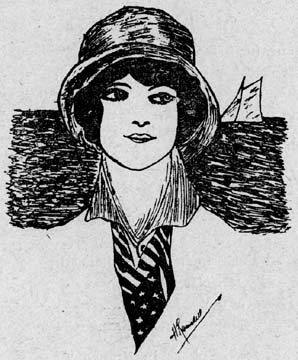
C'EST ÇA I've
been roosting over where When
everything you see You
tote a gun and pack, You
must live on rancid grub, If
you're like the cheerful French For
there is no more to tell Lansing WARREN, S. S. U. 18. |
|
"NO MAN'S LAND" A desolate stretch, seared and bare, Between the trenches, dark and grim, Yon heap of stones so faintly seen, Tangled wire snares, barbed and sharp, Where ghosts of men stalk at night H. C., S. S. U. 9. |
|
HIS LONG REPOS Pierre Leguet threw hand grenades. The mud, the hunger, biting rains Body and soul protested deep, No murmur leapt his tight-shut lips, For when the evening sun swung low, In southern France a quiet town His spirit leapt the dark war zone, Thus endless days dragged endless nights But lo! a sudden change was felt A greater calm alone revealed And while he dreamed of care's surcease And onward rushed with gathering speed They vanished leaving in their train S. S. U. 13. |
It has been quite a space of time since news of 17 has percolated through the Fedorian columns of the editorial sanctum. That isn't because there is none. We suffer from a certain unpardonable modesty.
We have a football team. We say it with simple pride To say that it is some football team is to state the obvious. "Scotty" Palmer, Captain select, plays the game with speed, either foot, and a Scotch accent. The Scotch accent is as necessary to good soccer as the nineteenth hole to sustaining golf. One glance at the team in action is enough to convince anyone that the future of muscle dancing in America after the war is a rosy one. At times it represents the third reel of a Chaplin comedy. The French Lieutenant, goal keeper, has been playing a fine game.
The first game was played to a hotly contested 0 -- 0 with a team from one of the divisions. The second game was played with a team composed of some of time best amateurs in the district. They beat us 3 - 0. As for the next game, we shall see what we shall see.
Couig has returned from the permission which he spent at Nice. He says that it compares very favorably.
Walton has been under the weather for some time but is now down in the south of France getting back the old jazz.
We have adopted a small refugee. The kid is about the proudest specimen in sight with his new clothes and treatment. He speaks English with a camion accent, slow but overwhelming.
17 is still decidedly on deck and ou the job. We hope to keep the dope up to date from now on, awarding ourselves the beautiful brown derby at proper intervals.
|
You can travel all along the line, at any poste you please,
It may be that the wood is wet, or that the flue can't function,
S. L. C |
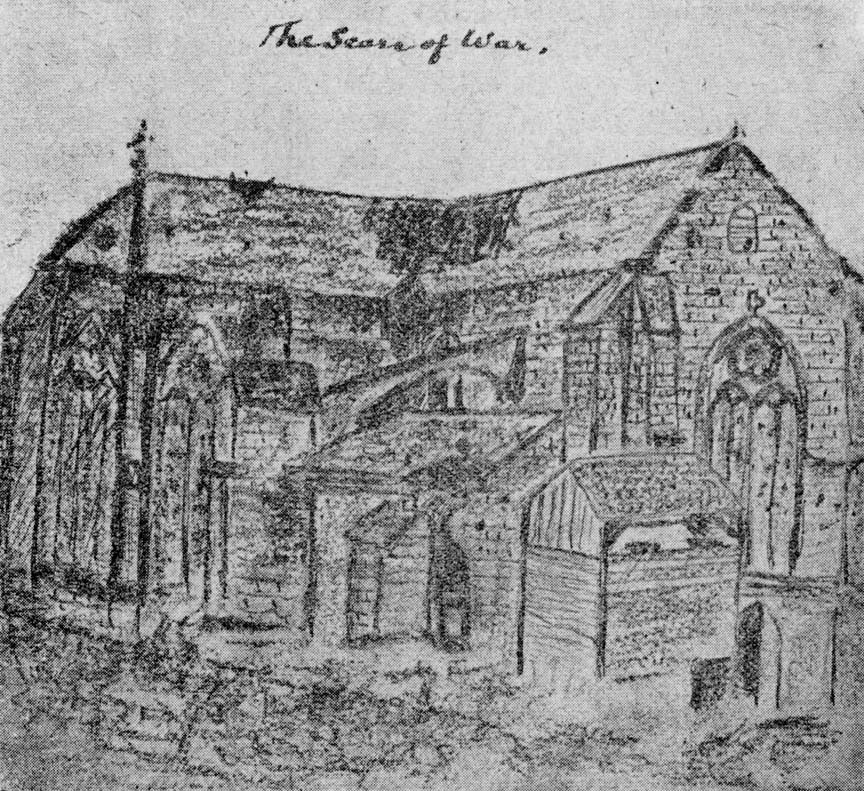
Using your French-English, English-French dictionary, you might think that a Poste de Secours was a medical first aid station, but that would just show that you only know book French, and not French as she is spoke on the battle front. It would probably be more correct to call a Poste de Secours an emergency station, for its shelter is indeed used for emergency... when the obus begin to arrive.
Used for the wounded, you say? Not at all. The wounded are the least of the worries around a Poste. It is used for the doctors and the ambulance drivers, the pharmaciens and the brancardiers but principally it is used by the ambulance drivers. If you have any doubt about its being used as an emergency station, you should see an ambulance dash up into the court about the time there is an unpleasant whistle overhead, and see what the ambulance driver does. No nickel ever hit the slot of a gum machine any faster than the ambulance driver hits the entrance to the Poste.
The Postes de Secours are usually situated near the front line, but not near enough so that the doctors have to worry about being made prisoners in a trench raid, and not so close that the ambulance men could, answer. "Yes" with only slight deviation from the truth, when their friends at home write and ask whether it is "really true that they drive their ambulances up into No Man's Land and rescue the wounded ".
Postes de Secours are usually located in ruined towns. The best looking house, that is, the one the least demolished, is usually picked out for the Poste. In this way the Germans are fooled. They naturally think it is the General's headquarters and shell it, while of course it is only a Poste, and the joke is on them. They waste a lot of good shells, and only get a few ambulance drivers and doctors, while the General, up the street six hundred yards under a completely demolished house with thirty feet of rock above him, goes scott free. This form of camouflage, or fooling the enemy, hasn't much popular appeal among the populace of the Service de Santé, but it is said that the more artistic eye of the General, always on the lookout for higher strategy, greatly appreciates the deception.
Time, along with the air, hangs heavy at the Postes de Secours. The brancardiers occasionally vary the monotony by going out four or five minutes after the arrival of an obus which threw dirt and tiles into the courtyard, and sweeping away the debris. About the same time the doctors and ambulance drivers do some varying of monotony on their own hook by testing out the wine cellar, twenty feet down below the abris. Aside from the usual commonplaces such as "Ah! beaucoup de jolies femmes en Paris " and "Trois ans il est trop. Nous sommes très fatigués", the principal topic of conversation is usually the strength of the roof above the abris. There is much speculation as to whether its four feet of rock would stand a shell. Most of those who occupy the Poste are agreed that a shot from a small trench mortar wouldn't pierce the roof, but on the other sizes there is much difference of opinion. Some think that a 77 would not come thru . Others think it would, but that it would not kill anyone. On the other hand it is generally agreed that a 155 would come thru all right, but argument waxes hot as to whether more brancardiers or more doctors would be killed. Examples aiming to sustain both sides are quoted from Switzerland to the sea. From those sizes up there is a good deal of contention as to what the shell would do when it came thru. Everyone, however, grants the point that a 480 or a 510 would not only come thru, but would kill everyone. After this point is settled, purely, of course, in an academic fashion and with no personal feeling in the matter, coffee and pinard are usually served, while some few even go so far as to take a little sustaining cognac. However a good time usually passes, sometimes almost a week, without an abris in the neighborhood being hit. Then it is that many get to thinking that even a 510 wouldn't hurt the Poste. But just about this time an ordinary 155 comes over, goes thru some abris nearby with about six feet more of rock on it than the Poste, and kills everyone inside. This brings a sudden reversal of opinion. The brancardiers bestir themselves and carry four more stones up and put them on the top of the abris. And so it goes until another arrivée smashes another abris, when three or four more stones are added to the roof. If, as our stern minded and well informed (?) patriotic papers at home, state, this war will continue three years more, by the end of the time a pretty good abris will have been constructed, and it will no longer be necessary for the doctors to seek refuge in time wine cellar.
Occasionally wounded are brought into the Poste. Here they receive first aid treatment by having a yellow tag put on them, and being told to sit down, if they can find a place, and wait until an ambulance is going back with a lieutenant who wishes to go to town, when they may, provided the officer has no companions, be allowed to go along. Blessés in the night are a great nuisance. They also cause the ambulance driver much worry. It is on these occasions that the true character of the doctor is exhibited. If lie is a real gentleman he turns over on the other side and tells the blessé that "it is necessary to rest ici until the morning". If he is a grouch and doesn't want the blessé around interfering with his sleep he usually has the brancardier wake the ambulance driver, and after making a whirling motion with his hand, says "Mettez marcher le moteur, vite, vite, vite ". Then he goes back to sleep and is bothered no more. Thus is human nature always in the crucible.
Somewhere it has been stated that there are no buvettes actually at the front. If the person who made the statement would visit the doctors' quarters at Poste he would change his opinion.
R. A. D.
Way Spaulding of S. S. U. 29, whose home is Hopedale, Massachusetts, was wounded on November 24th. Two pieces of éclat went through his chest, but he is now out of danger and will be shortly evacuated to Paris.
Henry C. Wolfe, George E. Dresser and Richard Temple formerly of T. M. U. 526 are going to leave next week and expect to drive ambulances for the American Red Cross "Somewhere in Italy."
Practically three hundred men o( the Transport Branch of the American Field Service have enlisted in the Motor Transport Division of the Quartermaster's Corps, and approximately six hundred members of the Field Service have enlisted in the United States Army Ambulance Service with the French Army.
We have not vet secured a complete list of the Field Service men who have enlisted in the United States Army in other branches such as Aviation, Artillery, Engineering, Infantry, Camouflage, and the Intelligence Department, but it is well within the truth to say that the American Field Service has contributed more than twelve hundred men to the United States Expeditionary Forces in France, not to mention those who have joined the Red Cross, the Y. M. C. A. and several Chaplains.
The following is a list of Members of the Transport Service,
| Alkire, A, D. Alkire, C. W. Amick, G. E. Andrews, F. S. F. Arthur, F. T. Ayers, C. H. A. Baird, E. W. Baldwin, J. C. Bangs, E. G. Barker, R. H. Barnett, K. S. Barton, F. E. Bell, J. T.. Benson, M. M. Berger, J. Jr. Black, W. W. Blessing, V. de V. Bond, R. L. Bothwell, M. T. Bourland, T. P. Bristol, W. Mc. Jr. Brown, J. H. Browning, R. A. Browne, A. S. Bruggemann, L. G. Butler, F. P. Bruce, M. L. Jr. Caesar, C. U. Calloway, C. H. Calden, G. C. Campbell, H. G. Carbaugh, H. F. Case, W. W. Clapp, J. S. Clark, Carolus. Clark, Robert D. Coe, R. H. Collins, B. C. Collins, DeWitt C. Collard, H. M. Conway, A. F. Cook, S. F. Corboy, L. W. Coulston, G. S. Cox, R. H. Craig, J. W. Creighton, G. W. Crockford, J. R. Crooks, J. B. Cunningham, A. Cunningham, E. P. Curtice, N. B. Curtiss, C. G. Dalrymple, H. E. Daly, F. J. Dann, A. P. Darrah, D. |
Davenport, K. C. Davey, A. T. Dawes, W. M. Day, K. H. Dean, L. S. Dolan, T. Doolin, P. R. Dougherty, T. H. Drew, E. H. Durgin, G. Durham, D. Durland, R. W. Edwards, G: L. Jr. Eisenhart, J. R. Ellinwood, R. E. English, S A. Estabrook, L. T. Evans, C. B. Fales, H. W. Farmer, J. C Ferguson, G. Field, D. P. Flanagan, H. E. Fletcher, J. P. Flickinger, B. P. Ford, N. W. France, R. Frizzell, W. Furbish, H. O. Gallaher, H. Ganz, F. M. Gibb, J. R. Gillies, G. C. Glann, J. E. Glazier, W. L. Jr. Gray, P. H. Griffin, A. H. Griffin, G. T. Guy, J. E. Hahn, J. P. Hanavan, M. L. Hankinson, K. Harper, H. Harper, W. P. Harris, F. M. Hartswick, F. S. Henderson, R. J. Henry, A. K. Henschel, J. E. Herndon, C. Herrick, L. G. Hess, M. Hinrichs, D. M. Holmes, F. W Howard, H. T. Hoyt, A. P. S. Kane, C. E. |
Kaufman, I. M. Keefe, P. D. Kellogg, C. R. Kendall, C. D. Kennedy, Horton. Kimber, F. H. Kirk, C. B. Kline, B. Kline, F. L. Kuech, J. F. Kuhn, J. S. Kurth, F. W. Lamade, R. M. Leidgen, N. C. Lentell, P. W. Lepper, R. H. LeTarte, A. C. Locke, H. A. Loring, S. M. Lowe, R. J. Lowry, E. K. McCall, C. H. McClintock, R. J. McCord, W. B. McGinty, F. C. McIntyre, F. R. Means, J. McG. Means, T. Mills, W. Morningstar, B. P. Morrison, J. K. Moss, J. S. Munro, G. R. Nickel, J. LeR. Jr. Nickerson, N. H. Niesley, P. Nye, D. D. Ogden, H. B. Orcutt, O. H. Ordway, D. Ordway, R. Paterson, T.W. Pattison, E. Pelletier, J. À. Peffers, H.W. Percy, D. B. Persons, H. Z. Pote, K. E. Potter, P. K. Preble, T. L. Prince, L. M. Pruyn, S. Quirk, L. W. Reed, D. A. Jr. Remington, D. C. Richardson, C. S. Robertson, C. D. |
Rogers, A. Sambrook, W. L. Samuel, E. M. Jr. Sauters, J. D. Jr. Sawyers, F. L. Scoles, D. Scott, J. P. Seymour, McN. V. Jr. Shaffer, C. N. Shainwald, R. H. Shinn, L. B. Shirley, T. E. Singer, L. F. Sisson, W. C. Sprague, A. C. Squire, R. W. Small, L. A. Stackhouse, H. G. Starr, C. B. Stevens, M. L. Stewart, D. W. Storer, E. S. Strong, B. Jr. Stude, L. S. Struby, G. B. Sturgis, E. K. Swigart, J. Jr. Tallant, G. P. Tapley, W. T. Taylor, R. G. Taylor, R. S. Taylor, W. E. Terry, A. Jr. Thayer, G. A. Thomas, G. E. Thompson, Nivelle V. Tilton, E. H. Tinkham, C. M. Toland, O. J. Torbenson, A. P. Townsend, W. S. Tubbs, S. T. Turrill, E. B. Travis, J. W. Tusler, H. S. Urban, R. S. Wakem, F. J. Wait, N. E. Watkins, C. R. Watts, L. M. Wethey, F. V. V. White, V. S. Wheeler, S. S. Whiting, J. L. Whiting, L. M. Wiggins, J. G. Wilcox, R. T. |