NAPOLEON once said: "One bad general is better than two good ones." And Machiavelli, an astute student of the science of war as well as of the art of politics, was fond of this maxim: "Let only one command in war, for several minds weaken an army."
It took the Allies nearly four years to achieve unity of command on the western front, which ran through Belgium and France, from the North Sea to the Alps. At one time, on this long line, the main theater of the Great War, there were as many as five separate armies, under five flags-armies speaking different languages each absolutely independent of the other, but all battling against one enemy.
The Belgians in Flanders, the British along the Somme, the French in Champagne, the Americans in the Vosges, and the Italians in the Alps-all were masters of their own destinies. But there was no master of the military destiny of the Allies as a whole. And for the long lack of such a master the war was unduly prolonged and the Allied cause repeatedly threatened with defeat.
When, in the spring of 1918, the higher command was finally created and the Allied armies faced the Germans as a single units the war was won. The end was only a matter of time. The armies of the kaiser had to surrender or be crumpled by the great hosts of democracy fighting as one great army.
It is required, now, to tell briefly why this necessary step of appointing one supreme commander for all the Allied armies was not, and could not be, taken earlier. The whole question of a higher command was not discussed by the Allies at the beginning of the war. Nor could it have been discussed. We must remember the instructions which the British minister of war, Lord Kitchener, gave to Field Marshal Sir John French, at the time he assumed command of the British forces in France. These instructions were:
"I should like you to know that your command is completely independent, and that in no case will you be placed under the orders of an Allied general."
One could not be clearer in the repudiation of the single command. Extremely regrettable consequences ensued.
After the first unfortunate battles in Belgium and northern France, Marshal French, availing himself of his independence, manifested his intention of temporarily abandoning the struggle in order to reconstitute his army in the rear. The intervention of the British government brought him to a more rightful conception of the requirements of the moment, and, as a matter of fact, he thereafter conformed to the plans of General Joffre.
The victory of the Marne effaced the bad recollections of the war's beginnings, but it did not provide for the direction of operations as a whole.
In October, 1914, immediately following the battle of the Marne, the struggle shifted to Flanders. Two English and four French army corps, as well as the Belgian army, fallen back from Antwerp, were engaged here. It would have been advisable to place them all under a single commander.
But in the same way as Lord Kitchener forbade Marshal French to put his forces under an Allied general, so the Belgian Constitution forbade the placing of Belgian troops under the orders of a foreign commander.
General Joffre, when commander-in-chief of the French armies, had delegated me to Flanders in order to promote coordination and cooperation. I had no title conferring on me rights to an interallied command. If it devolved upon me to play an important part in the battles of Yser and Ypres, I owe it solely to the confidence and good-will of the King of the Belgians and Marshal French, and to the authority they granted me in their councils.
The Belgian army, despite its enormous losses and profound exhaustion, was maintained on the Yser, and the British army, side by side with the French armies, successfully defended Ypres against fierce assaults. But the utmost efforts of the enemy for many months failed to break the implacable union of the French-Belgian-British forces. This illuminating experience did not, however, bring about a permanent higher command for the Allies. Nearly four years of painful experience were required to do that!
At the end of 1914, the Germans, compelled to cope with the Russian peril, decided to dig themselves in in northern France and Flanders to hold the front as in a vise, without attempting a general offensive. They sheltered themselves behind powerful defenses built along the whole front from the North Sea to Switzerland, hundreds of miles.
In 1915, the Allies vainly tried their strength against that German wall of men behind ramparts of earth, concrete and steel. The giant cuirass would not give way before the best weapons used in any war. It was necessary to construct new weapons, more numerous, more modern, and more formidable. This required several months.
In 1916, a new and redoubtable instrument for assault-the tank-was devised. And this year the Franco-British offensive on the Somme won notable successes that were not, however, decisive. These successes might have been increased to definite battle-victories with permanent results, had a unified command been at work to insure on all occasions a suitable rhythm and objective in the operations of the British and French armies.
For lack of a permanent general direction it was necessary to come to understandings during the heat of action with all grades of commanders. These understandings often took a long time to arrive at, when time was a vital factor in the success of the operation. A sporadic victory in an isolated battle, even with confusion and rout of the enemy in one sector of a 120-mile battle front, had no permanent result unless there was such coordination of the forces as to extend and consolidate the victory.
Anyone who studies the offensive on the Somme in 1916 must come to the conclusion that the Franco-British attacks obtained important results only when jointly conducted and always did when the operations were unified and directed on a broad front. On the other hand, whenever the attacks were isolated or executed without a plan that comprehended and included the whole battle front they resulted either in failure or small gains not worth the grave losses incurred.
The French general headquarters organized interallied conferences, and these were attended by the different commanders-in-chief or their representatives. But however useful these meetings may have been, they could not possibly replace the sole command, indispensable upon the actual battle-field for the conduct of a war.
Toward the end of 1916~ as the number of Allies increased and their battle equipment improved, a still greater need of a single command became manifest.
The idea of a higher command was making headway, but its application still seemed so difficult that its most convinced partisans hardly dared openly to urge it.
The honor of daring to do so belongs to Lloyd George. On coming into power in England as prime minister he shook off all prejudice and silenced all scruples. He believed in the value of the single command, and he dared to say so and to act. The trusted military and civil personal representatives whom he sent to France were imbued with his courage and expressed his conviction.
At a Franco-British conference called by Lloyd George in Calais on February 26 and 27, 1917, it was decided that for the operations in the spring of 1917 the British armies commanded by General Haig would be subject to the orders of General Nivelle, the new French commander-in-chief. That was the first step! It was taken at a great moment in the war. The United States had dismissed the German ambassador and was preparing to declare war upon the imperial German government. Germany was even then beginning to transfer troops from the Russian front to France to make a supreme effort to win the war on the western front before the Americans could enter it.
For the first time, after thirty months of indecisive warfare, the single command was officially instituted on the western front for two armies the British and French.
The experiment, unfortunately, did not succeed.
It is impossible for me to give the precise reasons for this failure, as the situation in which I then found myself does not permit me to express any certain opinion on this subject. There has been talk of disagreements between the military chiefs. I know nothing about them. Rather, I believe, that the failure of our attacks in 1917 was responsible for the abrupt ending of the tentative scheme. The failure made the general situation still more critical; the possibility of any military victory great enough to end the war still more doubtful.
In the summer of 1917 the defection of Russia was so easy to foresee that at a meeting of the heads of the Allied governments held in Paris on July 25 the French commander-in-chief, General Pétain, I, as chief of the general staff, and my British colleague General Robertson, all laid stress on the power which the German effort might develop in 1918 owing to Russia's abandonment of the war.
In order to cope with this coming danger, we, as the military commanders, proposed the creation of an interallied organization to prepare a plan for a more rapid movement and better coordination of troops on the western front. Our suggestion had little success. It was deemed to indicate pessimism. And somebody even stated that military men lacked imagination. The meeting finally broke up without anything having been decided.
Three months later, on October 24, 1917, the Germans and Austrians attacked in Italy. As early as the 26th French and British divisions, thanks to previous arrangements between general staffs, were transported beyond the Alps. On the 27th I myself left for Italian headquarters.
Because of the growing defeat, the heads of the French and British governments went to Italy and met the Italian government at Rapallo. On November 7 the three governments agreed to create a "higher council of war" composed of the French, British and Italian prime ministers, each assisted by a military representative.
The purpose of this higher council of war was the coordination of military action on the western European front and the supervision of the general conduct of the war. It was to hold meetings in Versailles.
Under pressure of events, another feeble step was thus taken.
Did it achieve any result? Not It did not fill the real requirement of the Allies' military organization. It had no power to act. The higher council of war was to supervise and coordinate. But it possessed no means of directing and still less of commanding.
Fortunately, the American, British, French and Italian generals composing the technical division of the higher council of war were all convinced of the absolute necessity for a single command, but their governments would not consent. Even Lloyd George had been persuaded, temporarily, to modify his previous view..
General Wilson, British representative, agitated for it with equal ingenuity and perseverance. General Cadorna, Italian representative, although more conservative in his actions, likewise undertook its defense.
General Weygand, French representative, evinced his ardent conviction for it under all circumstances.
As for General Bliss, the American representative. ever since his arrival in France during November, 1917, he had openly agitated for a single military command. So fully persuaded was he as to the reasonableness and correctness of his belief on this all-important question that at one time he believed the United States should insist upon the Allies designating a commander-in-chief as a primary condition of the immense effort which America was then pre paring to exert. He had so advised the American secretary of war and President Wilson.
The point of view of the military representatives at Versailles, however, was not shared by everyone. Marshal Haig, who had bad memories of his temporary subordination in 1917, maintained a prudent reserve. The imperial chief of staff, General Robertson, remained faithful to the principle of 191/1~a separate British army, responsible only to its own commander-in-chief. He contended that in no case could the British commander-in-chief be placed under the orders of an Allied general.
The military conferences at Versailles nevertheless continued. They met, they conferred, they often agreed, but they were without power to act. At the end of January, 1918, they proposed to the various government heads the creation of "an Interallied General Military Reserve"-that is,. a military force not under the exclusive control of any one of the Allies, but available in emergency to aid anyone hard pressed. If this proposal were adopted, it would be an important step toward the single command.
On February 2 the higher council of war accepted the military representatives' suggestion and definitely decided to form this reserve. An executive committee was appointed composed of the military representatives of the United States, France, Great Britain and Italy. This committee would determine the size and composition of the reserve, specify its location, arrange for its transportation and concentration-and finally, when the moment came, decide upon its use.
As president of the executive committee, I approached the various commanders-in-chief on February 6 regarding the constitution of the Interallied Reserve. I encountered no difficulties either at the French or Italian general headquarters. The British general headquarters, however, would not entertain the demands made upon them, and their refusal was so categorical that I was forced to renounce the idea of organizing the reserve.
What would the heads of the governments do when faced with this situation ? As incomprehensible as it may seem they abandoned their previous resolutions.
On March 14 and 15 a meeting of the higher council of war took place in London. The British prime minister, who had been informed of the threatened German attack on the British front, declared that he now approved Marshal Haig's unwillingness to forego any of his divisions to benefit the general reserve. The head of the British government not only brought the French premier over to his viewpoint, but also convinced him that it was equally impossible to detach any British unit from the French front to create such a reserve.
This was the final blow to the general reserve, the executive committee, and therefore to the single command of which the first two contained the germ.
The reason for the governments' sudden change of front was very simple It was wholly attributable to a mutual arrangement which the British and French commanders-in-chief, Marshal Haig and General Pétain, had just concluded. According to this arrangement, the two commanders promised each other reciprocal aid in case of attack.
If the attack developed on the British front the French army would send five divisions of infantry, four of cavalry and three regiments of artillery to the aid of the British.
Should the French front be attacked Marshal Haig would give General Pétain the support of six to eight of his divisions, with an equal number of artillery units. This aid, however, was subject to the British front itself not being involved in a big German offensive.
It was on the strength of this agreement that the heads of the Allied governments had abandoned the idea of the general reserve controlled by an executive military committee.
"The two commanders-in-chief are agreed. What more do you want ?" said one of them.
On close examination, however, the agreement was found to be too fragile and indefinite to be effective. Without considering the restriction with which the British side was burdened, one naturally feared that the agreement would immediately break down in the event of such an emergency as a sudden general attack, the result of which upon his own position and army neither general could confidently foresee.
In the presence of the brutal and unexpected reality of such a battle, would not each commander-in-chief necessarily be concerned far more with the fate of his own armies, for which he was responsible to his own government, than with the perils of his neighbor? His sense of duty would restrain him. An individual may bravely and nobly sacrifice his own life to save another, but no general commanding an army can either bravely or nobly sacrifice that army to save another.
What is required in battle at the moment of grave decisions is the authority and power of a single commander to use instantly any part of his force for the benefit of the whole-even to sacrifice a part of his force to gain the victory. And the decision made by him must be executed unfalteringly by every corps and division commander.
On March 15, at London, I immediately called the attention of the heads of the government to the uneasiness which their decision to abandon the general reserve caused me. And I pointed out the great gap existing in the organization of the command of the Allied armies at a moment when one of the most serious battles of the war was apparently to begin.
Experience permitted me to make this criticism. Since the beginning of the war, numerous battles had been fought in which the different Allied armies had taken part.
The French and British had fought together in 1914 on the Marne and at Arras.
The French, British and Belgians had fought side-by-side on the Yser and at Ypres during the same year.
And in 1917 on the Piave, the Italians, British and French had offered a united front to the Austro-German hosts. None of these cooperative campaigns could have been successful in the smaller arenas if there had not been coordination and centralization of authority, and I believed that the same result would ensue under like conditions in the larger arena.
In the spring of 1918, this medium would have been the command of the Interallied General Reserve, if the Reserve had been constituted.
When the Interallied General Reserve was abandoned the Allied governments incurred heavy responsibilities. They put their confidence in a mere personal agreement between two chiefs each to help the other-an agreement to be carried out in the stress of battle, under circumstances that could not be foreseen, by each commander-in-chief. It was a compromise agreement and in military, as in other affairs, compromises do not often work. Events now proved the lack of wisdom in this arrangement.
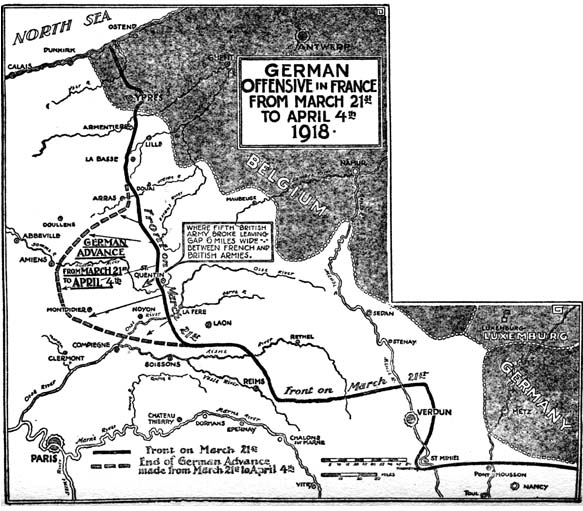
On March 21, 1918, at four o'clock in the morning, a deafening clash of thunder suddenly broke along the French front from Arras to Noyon. The German artillery was coming into action along a line sixty-five miles long.
The Central Powers were beginning the offensive that was to win the war. Because of the crumbling of the eastern front following the Russian Bolshevik revolution, Germany was able to concentrate all her forces in the west. With a great superiority of men, the German commanders were determined to destroy the Allied armies before the United States could throw enough men into France to give the Allies a numerical advantage.
For five hours the German artillery hammered our positions. It annihilated our defenses. It killed thousands of courageous defenders. It extended its deadly work for six miles behind the battle-line, poisoning the whole countryside with shells containing asphyxiating gases.
At nine o'clock, under cover of a dense fog, fifty divisions of the enemy, a half-million men, united in a concentrated ferocious attack upon the disordered Allied trenches.
The German soldiers were animated by the highest spirit and supreme confidence. The British and French armies were facing the most formidable onslaught of the whole war.
Before Arras, the Third British Army under General Byng stood firm. It did not flinch under the avalanche. But in the region of Saint-Quentin, south of Arras, the Fifth British Army under General Gough was completely routed. Retreating toward the Somme, it failed to reestablish itself on that river. Four days later this army found itself pushed back more than fifteen miles to the rear of its original lines.
Far graver than the loss of territory was the fact that General Gough's forces had lost all liaison with the French fighting on their right. There was an open gap of six miles between these two Allied armies. Through this opening the Germans could throw their army, permanently dividing the British and the French. The crisis was the most critical in the World War because if the Germans realized and took full advantage of the situation, they could defeat the northern section of the Allied armies, take the Channel ports, cut off reinforcements and win the war.
The French divisions, sent to the rescue, in compliance with an agreement made between the British and French commanders-in-chief, failed to reestablish the continuity of the front. Marshal Haig, commanding all the British forces, asked for further succor from General Pétain, generalissimo of the French armies.
Pétain was unable to grant General Haig's request. Champagne, the defense of which depended wholly upon the French, was also under terrific German attack, so that no troops could be diverted. In this area the soldiers of France guarded the road to Paris. Their numbers could not be reduced any further.
Here was a situation which the understanding between the two commanders-in-chief could not solve. The brutality and immensity of the recent developments had brought on a profound crisis-a crisis, which I must say was not unexpected by us of the general staff, but which, because of the lack of a higher command, we were unable to provide against.
Unless the breach was quickly filled, two separate battles would soon be fought-a French battle for the defense of Paris and central France, and a British battle for command of the Channel and control of the British bases. These battles would not be fought at the same time. Von Ludendorff would first engage one enemy and then the other. Against both he would possess an overwhelming superiority of means.
Such was the prospect before us. I was then chief of the general staff, and in that capacity a technical adviser of the French government and directly responsible to it.
Therefore, on the afternoon of March 24-it was Sunday and three days after the beginning of Germany's greatest offensive I called upon Monsieur Clemenceau, premier and minister of war. I requested him to constitute without delay a "Directing Medium of the War."
I impressed upon Monsieur Clemenceau the absolute urgency of some authority that would give the necessary directions for the conduct of the battle as a whole and that also would be able to assure the execution of its plan. If such an authority were not created, I told the premier, the battle would be insufficiently prepared, inadequately conducted and improperly executed. The consequences would be the most serious conceivable. In the language of diplomacy, these were strong terms.
A few hours later, General Haig made a similar appeal to the British government. During the night of March 24-25 he cabled to the imperial chief of staff to come to France immediately "in order that a higher command for the whole western front might be appointed as soon as possible."
In the hour of danger the loyal soldier, such as General Haig, puts aside all prejudice and devotes himself to a single end-the welfare of the cause he represents.
Following General Haig's appeal, General H. Wilson, the new chief of the imperial general staff, hastened to France. He was at Abbéville on the 25th. Here he was met by Haig, who explained the situation to him.
Amiens, the vital center of communication between the British and French armies, was dangerously threatened since the Germans made the critical breach in the Allied front. It must be saved at any cost. But how? The British had no more reserves. All had been exhausted. Help could come only from the French. General Pétain, however, still anxious about Champagne, would not consent to greatly reducing his forces.
Pétain was willing to dispatch to the Somme ten divisions more than he had promised. But their transport would be slow, at the rate of only two decisions daily.
General Haig considered this French aid as totally inadequate. He frankly stated that the only way of meeting the ever increasingly dangerous situation was to appoint a supreme chief to take such immediate, energetic and even daring measures as were necessary to reestablish the front.
While this conversation between General Haig and General Wilson was going on at Abbéville, I was present at an equally important conference at the French headquarters in Compiègne.
Here, besides myself, were gathered the President of the Republic, Monsieur Poincaré; Monsieur Clemenceau, General Pétain, and Lord Milner, who was a member of the British war cabinet and had been sent to France by the prime minister, Lloyd George, as a special observer.
During this conference General Pétain pointed out the profound disorganization of the Fifth British Army, and stated the measures taken by him to come to its aid. He had dispatched fifteen French divisions in its direction, five of which were already engaged. Later he hoped to send along others, but for the moment he could give no further aid. It was necessary for him always to be ready for a German attack on Paris by way of the valley of the Oise and Rheims.
I was questioned. I had nothing to say as to the policy of General Pétain and the French general headquarters. But it did seem to me that the danger of the German offensive having for its object the making of a breach between the British and French armies in the direction of Amiens was such that it was necessary, if need be, to run certain risks elsewhere.
I was in favor of sending to the north of the Oise the number of divisions required to reestablish the front. And I said that they should be sent rapidly, even if they must, therefore, be put into the battle in a not completely organized state.
My viewpoint seemed to secure the support of all those at the conference. In the absence of General Haig, however, it was difficult to make formal decisions. It was agreed thereupon that another meeting would be held the following day with the British generals.
Thus on the evening of March 25 the opinion prevailed in the British general staff, as I afterward learned, that the aid afforded the British by the French was insufficient, and that in order to increase it, as well as augment the speed with which it was given, a chief was required to take charge of the combined forces.
Who was the chief to be ? There was further hesitation. Witness the proposition made to me at this time by Major-General Wilson. He suggested entrusting the direction of operations to Monsieur Clemenceau, whom I would serve as chief of staff. I easily demonstrated to General Wilson that this would be a solution which, instead of disposing of difficulties, would only increase them. He agreed with good grace.
Such was the situation when we again met on the following day at Doullens, a small quiet town about thirty kilometers north of Amiens.
The colorful saying of America's first ambassador to France, Benjamin Franklin, when earlier he was advising the American revolutionists, "We must all hang together, or assuredly we shall all hang separately," epitomized the situation of the Allied armies on the west front before a commander-in-chief was appointed.
I have told how the lack of a unified control prolonged the war on the west front. The supreme effort of Germany to win the war before the legions of America could throw their full weight into the military balance was made only after the collapse of the Russian armies in their own revolution made it possible to concentrate nearly all the German strength in France. This compelled the governments of France, England, Italy and the United States to consent to put all their armies under a single commander-in-chief.
The circumstances leading up to this momentous decision I have already described.
The Germans had begun their great offensive on March 21 and the Fifth British Army under General Gough had broken, in the region of Saint-Quentin, leaving the open gap of six miles between the British and the French.
The situation was critical. Taking advantage of this breach, the Germans were likely to start two new and vital offensives-to drive through the French towards the south on to Paris and to turn on the British towards the north for command of the Channel and the British bases.
It was with all this in mind that the historic gathering at Doullens was held.
Representing the French at this important conference were Messieurs Poincaré, Clemenceau and Loucheur, General Pétain, myself and my chief of staff, General Weygand. The British were represented by Lord Milner, General Wilson, General Haig and his chief of staff, General Lawrence.
When we arrived at the Town Hall, Sir Douglas Haig was meeting with his army commanders in the large hall where the conference was to be held. While waiting for the British commander and his generals to finish their consultation, we walked about in the neighboring garden and conversed. Anxiety was written on every face and expressed in many remarks.
I remember breaking somewhat sharply into the conversation on hearing someone express the idea that it might be wise to evacuate Paris.
"Paris!" I said, "Paris has nothing to do with it! Paris is a long way off! It is where we now stand that the enemy will be stopped. We have only to say, 'He shall not pass!' and he will not pass. I guarantee you that. Believe me, success is three-quarters achieved when we are convinced that we cannot fall back farther and the order is sent forth to resist where we stand at this very moment."
Haig having finally dismissed his lieutenants, we seated ourselves around the conference table at about 12:30 P. M. Monsieur Poincaré presided.
General Haig was the first to speak. He stated that he would stand firm before Arras and on the north of the Somme, but that he could do nothing on the south side of the river. All his troops were engaged. He could hope for scarcely any reinforcements from England. The safety of Amiens depended entirely upon help from the French.
General Pétain, questioned in turn, stated the measures he had taken to protect Amiens. He had ordered additional French divisions to the Somme, so that the number now totaled twenty-four. Their transportation, however, necessitated rather long delays and their action could not be expected to make itself felt for some days.
After these exposes Lord Milner rose, and, taking Monsieur Clemenceau aside, suggested that the governments entrust the general conduct of operations to myself.
Monsieur Clemenceau was of the same opinion, and he and Lord Milner readily obtained the consent of Generals Haig and Pétain, both of whom were possessed by the same spirit of self-abnegation. A paper was immediately drawn up recording the agreement that had just been reached. By virtue of this agreement, known to history as the Agreement of Doullens, I was commissioned by the British and French governments "to coordinate the action of the Allied armies on the western front."
It was about half past two in the afternoon when the document, signed by Lord Milner and Monsieur Clemenceau, was handed to me. The higher command had been born.
After a quick lunch I immediately set to work. My plan had been formed for a long time. It was necessary to reestablish at once the liaison between the British and French armies, and to cover Amiens. Two things were required to do this:
First, the troops which were fighting must retreat no farther. Second, the French divisions arriving as reinforcements must be thrown without delay into the breach so as to fill it up.
These were the simple ideas that I conveyed to the different chiefs. By the evening of March 26, all those who were fighting the enemy knew what was expected of them-resistance, always more resistance, resistance to the utmost!
The next day, the 27th, I again visited the commanders, constantly reiterating that they must organize themselves on the spot and stand firm at all costs.
I made certain that my instructions were carried out, even visiting subordinate officers, when necessary. I did everything humanly possible to straighten out errors and mitigate shortcomings.
On the 28th I continued my rounds. Little by little I felt hope and confidence returning. Our resistance was growing stronger.
The enemy's attacks, however, continued violent. They had taken Montdidier.
It was at this point that there occurred a great symbolic gesture which conclusively demonstrated to the world the absolute solidarity of the Allies. ;
On the afternoon of March 28 I was in Clermont, a small town in the Department of Oise, then the headquarters of the Third French Army. Here General Pershing met me, and, with a generosity I shall never forget, said:
"At this critical moment, there is no question of any importance except that of fighting. Infantry, artillery, aviation-all we have is yours to do with as you please. I have come to tell you that the American people will be proud to participate in the greatest battle of history."
And General Bliss, who later represented America at Versailles, expressed like sentiments. He said:
"We are here to get killed ! What is keeping you from making use of us?"
Thus the United States, prevented by the urgency of circumstances from participating in the agreement of Doullens, indicated their full and entire approval. What a noble gesture ! What an admirable impulse !
I could not better respond to the wonderful «good fellowship of the Americans than by having the First American- division immediately take up its position before Montdidier-the very center of the German offensive.
Toward the end of March the German onslaughts against Amiens became less and less frequent and progressively decreased in intensity. The Allied front, now reconstituted, formed a firm barrier against the invading hosts. On April 4 the enemy was definitely stopped. The higher command had proved itself in the crucible of action.
The enemy now turned upon us in another sector. The next blow came in Flanders. The German plan was to destroy the left wing of the British armies, reach the Channel ports, and from there bombard the British coast with guns of unprecedented weight and length fabricated for that purpose.
On the 9th of April nine enemy divisions attacked along a solid front of about twelve miles between La Bassée and Armentières. These troops were soon reinforced by Eve new divisions, extending the battle t nearly to Ypres. The struggle continued furiously for twenty long days with only intermittent rest for the troops at night.
At first the Germans met with some success, but they were finally halted in their advance by the arrival of our reserves, nine French divisions and one cavalry corps, which I had hurriedly thrown into the crisis.
The battle had been so furious that when a pause came the weariness almost to exhaustion of the armies made, comparatively, a calm for several weeks. I had but little indication of the enemy's future intentions. We expected another attack. Lacking information, however, regarding the German preparations, we could only make hypotheses.
We were of the general belief that the German command would resume the maneuver in which it had almost succeeded and which seemed most advantageous from a strategic standpoint-an offensive between Amiens and Arras, the junction point of the Allied forces. If not this maneuver, we thought, then another offensive in Flanders.
We learned subsequently that Von Ludendorff reasoned differently. Behind the British troops in previous attacks he had found French units which halted his advance. He decided, therefore, to deal first with the French reserves, by a diverted attack on the French front, in order to fix them on this area. After obtaining this result he would suddenly resume his operations in full force against the British in the hope of breaking through at some point.
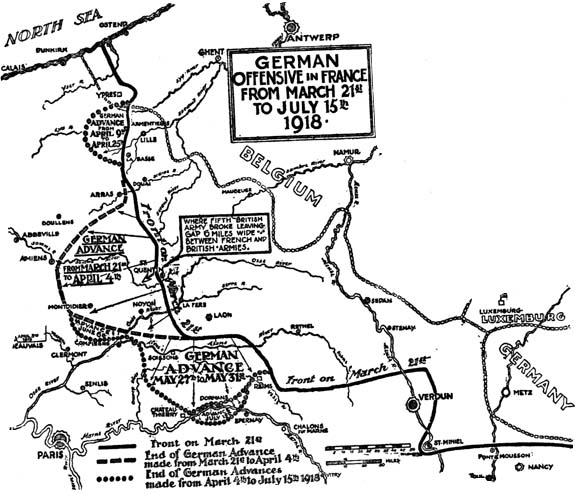
On May 27, in execution of this plan, thirty German divisions proceeded to attack the French positions between Soissons and Rheims. The maneuver was a complete surprise to us. The few French divisions holding the front were swept away, and after four days the enemy reached the Marne at Château-Thierry.
This was a considerable success and was in no way discounted by Von Ludendorff. It assured him the desired result of engaging the entire French reserve. Thirty-five French infantry divisions and six cavalry divisions were finally participating in the battle. We even called upon other Allied reserves. Five British divisions, two American divisions, and two Italian divisions were placed in line.
Thanks to these reinforcements, the third enemy attack was checked. It was almost immediately followed by a fourth between the river Oise and Montdidier. On the 9th of June thirteen German divisions were rushed forward in the direction of Compiègne to attack the salient that our lines formed in this region. This offensive, expected and prepared for, was stopped after four days of fighting. It had achieved only a slight withdrawal of our front to the north of Compiègne.
Von Ludendorff now planned a fifth offensive, which he termed "the offensive for peace." He chose the region between Château-Thierry and Verdun as the battle-field. He apparently calculated upon finding the front in this region but loosely held. And no doubt he expected at least to gain tactical success enough to enable him to resume the offensive in Flanders under ideal conditions.
But the valor and spirit of our armies were now at their zenith, the Americans wherever they had appeared imparted fresh, youthful vigor and eagerness to the attack, and the whole battle-line of hundreds of miles, from the frontier of Germany in Lorraine to the Channel ports, was now under the eye and will of a single commander-in-chief.
The air service, the wireless and the telephone kept him informed of any extraordinary preparations of the enemy. Knowing the exact method of the German attack, the details of its execution could be foreseen, and the commander-in-chief and his staff were able to provide, not only for the defense, but fox counter-attack.
Thus, on July 15, when the German divisions moved forward for the fifth time, they were stopped short in Champagne. The slight advance of their right in the direction of Epernay and to the south of the Marne only served to thrust the German forces farther into the vast pocket of Château-Thierry, thereby greatly heightening the danger to which they were exposed.
It was here that on July 18 the American, British, Italian and French forces were going to take the enemy by the throat and thereafter never relinquish their grasp.
It had now become necessary to transform my rôle of coordination into one of management. The decision to do this had been taken in a conference held on April 3, 1918, at Beauvais. Representatives of the American, British and French governments were present. It was not until May 2 that the Italian government gave their approval to the new agreement.
Thus I now had strategic direction of military operations on the western front, with the official title of Commander-in-Chief of the Allied Armies in France. I was invested with the necessary powers to make decisions regarding the strategic employment of all the Allied forces. I could divide among them the responsibilities for defense and offense. I could make the exchanges between the French and Italian fronts. Between April and July, I had been able to have all the Allied reserves participate in the various defensive battles.
At first the action of the chief command manifested itself in the conduct of operations. But its field of activity was not limited to this. It went a great deal further. It extended to the needs and even to the organization of the various armies.
Here is an example. The British armies, after the fierce German attacks of March and April, 1918, showed a loss of 300,000 men and 14,000 officers. Nine of their divisions had to be dissolved. This diminished the total of our reserves at the very time that the enemy's forces were increasing.
I intervened and insisted both to Marshal Haig and the government at London that the original number of British divisions be maintained. As a result it was decided that all except two of the dissolved units were to be reconstituted. But this could not be done until the middle of July. In the meantime we were obliged to make up the deficit. How?
There was only one way-an appeal to America!
Now, to what extent was America capable in the spring of 1918 of affording the Allies the immediate aid which they needed, especially in the way of infantry?
At this time, April, 1918, the American army in France had five fighting divisions, counting the units in course of transport or debarkation-seventy thousand American infantry to come to the aid of the cruelly battered British and French armies, whose losses had been most severe.
Faced with this critical situation, I arranged with Generals Bliss and Pershing that the troops sent to France during May and June should consist primarily of infantrymen and machine-gunners. The government at Washington approved our agreement, and the British government undertook to supply the necessary ships for transport.
During the month of May 240,000 men arrived from the United States. Two hundred and eighty thousand more arrived in June. By the first of July there were at least 450,000 American infantrymen and machine-gunners in the ranks of the Allies.
With the rapid arrival of these large forces, other problems presented themselves. There had not been sufficient time in the United States fully to train and organize the fresh American units now being hurried to the front. The task had to be completed in France. Training offered no difficulties. But supplying the necessary means of combat to a modern army was another matter. What oversights, errors and delays to avoid!
In order to execute efficiently this important and urgent task, we created a general staff section in Paris whose duty was to centralize, coordinate and solve all questions relating to the equipment of the American army. I understand that this arrangement was appreciated by the American command, who always had suffered previously because it never knew exactly where and to whom to apply for necessary things.
There were other and very varied activities which I was compelled to undertake during the whole campaign of 1918, besides directing the armies at the front.
We endeavored to establish complete mutual aid among the Allies, as it was indispensable to our success. We requested the French army to furnish 75 and 155 .m.m. guns to the Americans, motortrucks to the Belgians, asphyxiating projectiles to the Italians.
From the British we obtained tanks for the French, howitzers for the Americans, artillery and aircraft for the Belgians. We asked the American army to furnish aviator-pilots for French planes and we urged the United States to bring to France the steel required for the construction of tanks and the manufacture of shells.
It was also necessary to foresee the future and to provide munitions to conduct the war rigorously and incessantly for a long period ahead, no matter how protracted by the strong and still determined enemy.
Thus it was that in 1918, by arrangement with General Pershing, I requested the American government to send over eighty divisions by April, and one hundred divisions by June, 1919. We would then be certain of having an incontestable numerical superiority over the enemy during 1919 if the war should last that long.
The reply from Washington was: "You shall have the one hundred divisions requested and still more if necessary."
A commander of armies must be a student of psychology as well as of tactics. When I was teaching at the Superior War College in Paris, I often quoted to my students the aphorism of Joseph de Maistre: "A battle lost is a battle which one believes is lost, for battles are not lost materially." And to emphasize the truth of this I pointed out numerous great battles of history which had been lost or won morally.
There is nothing that destroys an army's morale like constant retreat. To win battles an army must take the offensive. A wise general retreats only to get in a better position to attack the enemy.
Thanks to the French reserves, the British and French fronts had been reunited before the Germans realized the opportunity for a decisive victory that was well within their grasp. Amiens was thus saved and the Franco-British armies' communications preserved. The positions we occupied, however, were too close to Amiens and the Paris-Amiens railroad. Both were still within range of the enemy's guns. Thus, on April 3, my authority as commander-in-chief having been increased by the Beauvais agreement, confiding to me the strategic direction of all operations, I immediately ordered Marshals Haig and Pétain to prepare an attack in force at that point.
This offensive was fixed for April 12. It never came off. We were forestalled by the Germans, who attacked in Flanders on April 9 so vigorously as to compel us to throw a large part of our reserves into this region to stop a new German advance at that point.
On May 20, when this attack was stalled, I sent further directions to the commanders-in-chief. I reminded them that only by an offensive could we stop the enemy; that by initiating an effective attack we would regain the moral ascendancy. I designated the places. First, there was to be a Franco-British offensive which was definitely to put Amiens outside of striking distance of the enemy. Then there was to be an offensive in the north to free the Bethune coal basin, which the Germans held under fire of their artillery.
But again a great and skilfully planned German offensive postponed the execution of our plans. On May 27 the enemy advanced on the Aisne. Our front here was but loosely held, so the German troops reached the Marne at Château-Thierry before we were able to check them. There the American Marines distinguished themselves in "The Battle of the Woods." The severe struggle had such unexpected results that we had to change our battle program and adopt a new one. Events offered us another and more advantageous field of action.
The Germans in their advance had rushed into a vast "pocket" between the Aisne and the Marne. the revictualing of the large number of troops in this area was effected by two or three railroads, all of which ran through Soissons. It was clear, therefore, that if we made ourselves masters of Soissons, or if we were able to keep it constantly under fire, we would prevent the provisioning of the troops in the "pocket" and render the Germans' position on the Marne untenable.
I directed General Pétain to prepare an offensive with the Tenth and Sixth French armies. This action was to put us in possession of the heights dominating Soissons, from where we should be able to bombard the converging point of the railroads.
As preparations for this offensive were under way we learned that the enemy was getting ready to attack in Champagne.
Were we again to postpone our plans?
No! Conditions had changed. We now had considerable reserves available. These had been entirely reorganized and reequipped. We also had a considerable and daily increasing reserve of war material-cannons, tanks, munitions and airplanes.
These means in men and material not only would enable us to halt the Germans in their new offensive, but would be sufficient to strike a severe counterblow. And our strength was augmenting rapidly as the effectives of the American army constantly increased. We could now plan all our offensives on a constantly growing scale.
How strikingly different the situation in the enemy's camp! After expending tremendous efforts without achieving decisive results, the Germans were having serious difficulty in renewing their fighting units. The numerical superiority would shortly pass to the Allies. All the predictions that the Americans would not be able to get into the war in force were being shattered.
On July 13 and 14 I decided in accord with General Pétain that the threatening German offensive in Champagne must be met at once by a counteroffensive. We were already prepared to advance at Soissons, and in a few days we extended our preparations of attack as far as Château-Thierry.
The German drive in Champagne started according to program on July 15. We immediately checked it. And on the 18th we began our counter-attack. All the world knows what followed. In fifteen days the enemy was forced back on the river Vesle. The Allies captured 30,000 prisoners, 600 cannon, 200 Minenwerfer and 3,000 machine-guns. Our front was shortened thirty miles. The Paris-Châlons railroad was again ours and put in operation. The threat against Paris was ended. And, most important of all, after four months of defensive action imposed by the numerical superiority of the enemy, the initiative of operation now belonged to us.
In this magnificent action seven American divisions participated-the First, Second, Third, Twenty-Sixth, Twenty-eighth, Forty-second and Seventy-seventh. The place of honor in the thrust toward Soissons on July 18 was shared by the First and Second American divisions and some chosen French divisions. The Americans acquitted themselves admirably and indicated what was to come later at Saint-Mihiel and in the Meuse-Argonne.
It was difficult to ascertain the moral effect produced upon the enemy by the profound change in the situation of the two belligerents. We could imagine it and feel it, but it was not yet revealed, not yet palpable. What we did know, and it was the essential thing, was that, since July 18, the control of events had passed into our hands. By guarding the initiative through energetic action we would prevent further attacks of the enemy. We were relieved of all anxiety in the north and, as a result, had much greater freedom to plan attacks elsewhere.
At my headquarters on the 24th of July I met the three commanders of the Allied armies-Haig, Pershing and Pétain. I said to them:
"The Allied armies have arrived at the turning of the road. In full battle they have just regained the initiative of operations. Their strength enables them to retain it! The principles of warfare command them to do so! The time has come to abandon the general defensive attitude hitherto imposed by our numerical inferiority. We must pass at once to the offensive and not give the enemy a chance to rest or reorganize his forces."
I told Marshal Haig I would put a French army under his command. This naturally increased his willingness to take the offensive. And I urged upon General Pershing the well-known fact that the American army, made up of spirited youths, was chafing to get fully into the struggle.
Finally we all heartily agreed. We parted with the understanding that the single command to all the Allied armies was henceforth to be "En avant!" (Forward !)
Our first offensive, executed on August 8 by British and French armies under the command of Marshal Haig, had for its objective the liberation of Amiens and the Paris-Amiens railroad that we had planned as long ago as April 12. It started from the Albert-Montdidier front and its success was complete. "A day of mourning for the German Army," wrote Von Ludendorff. "Our first great misfortune," added Von Hindenburg.
On August 10 our objective was not only attained but so far exceeded that I decided to take immediate advantage of what seemed to me the disorder of the enemy. I extended our field of action from Arras to Soissons.
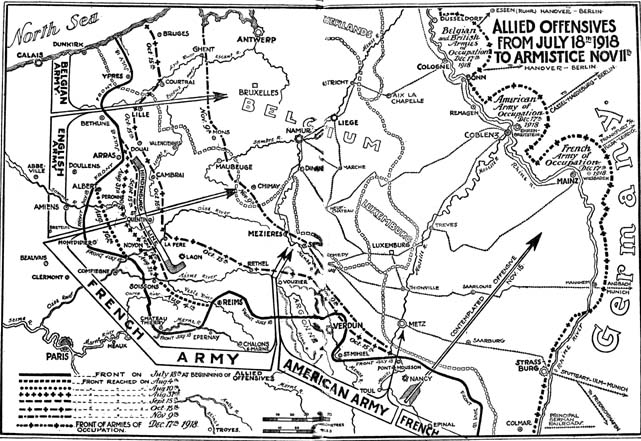
We continued the offensive on August 20 along a front of eighty-one miles. Three British and three French armies took part in the action. The battle was fierce; the enemy retreated over large areas. At the end of the month we reached the general line: Arras-Péronne-Noyon-Soissons. And by the middle of September, the Germans were forced back upon Von Hindenburg's famous position. It was from this very line they had set out six months before on their great offensive against Amiens-the offensive that was to win the war.
The success of the first part of our plan, which consisted of liberating Amiens, had surpassed our expectations. The second part, which called for an offensive to free the mining region of Bethune, was never undertaken, as the enemy evacuated all the positions he occupied on the river Lys. The object of the third part of our plan was the wiping out of the salient of Saint-Mihiel.
I was early aware of American sentiments regarding Saint-Mihiel. When the soldiers of the United States first arrived in France, they evinced surprise at two situations; first, that although the war had been in progress for three years, the single command had not been instituted; and second, that the great salient of Saint-Mihiel had not been straightened out in four years.
I have already told of America's help in achieving the single command. It was only just, I therefore felt, that the reducing of the famous "rupture" of Saint-Mihiel should be left in their hands.
The American preparations for the Saint-Mihiel offensive were undertaken with thoroughness. They were facing the most formidable defenses that the Germans could erect during a period of four years to hold this vital point.
The attack began on September 12 at 5 A. M. It was preceded by four hours of artillery fire. The advance of the Americans was irresistible. In less than two days all objectives set had been achieved. The famous "rupture" no longer existed. Over 15,000 prisoners and 450 cannon had been taken. For a first attempt of a "new" army it was a masterly achievement.
The moral effect of the victory of Saint-Mihiel was incalculable The American army under its own commander-in-chief had met the enemy in a great battle and had vanquished him. In the crucible of an independent action the American army had proved itself. This fact could not fail to impress the German general staff and bring discouragement to its army.
It was now necessary to broaden our offensive. The enemy must be given no rest, nor allowed to slip from our grasp. The greater the front upon which we attacked, the more difficult it would be for him to reinforce his hard-pressed troops at any point. Thus, after August 20, we considerably widened our attack. Bit by bit we were spreading the conflagration. The wiping out of the Saint-Mihiel salient had greatly facilitated our actions. We could now even contemplate a general offensive from the North Sea to the river Meuse.
I had discussed such an offensive with General Pétain as early as August 30. And on September 3, in view of the ever-increasing progress of our armies of the center, I directed General Pétain, while fully sustaining his present actions, to prepare a Franco-American offensive extending from the river Meuse to Rheims and progressing in the direction of Mézières.
I directed Marshal Haig at the same time to follow up and develop his attacks on Valenciennes, Saint-Quentin and Cambrai.
Lastly, I requested the King of the Belgians to take command of a group of armies composed of the Belgian divisions, a British army, and some French divisions. These forces were to capture the enemy's defenses around Ypres and then march toward Bruges and Courtrai.
Preparations for this new and enlarged offensive were rapidly pushed forward along the entire front. Everything was ready on September 26, and during the next two days the thunder of our cannon roared from the North Sea to the Meuse on a battle front extending more than two hundred miles.
The Allied armies attacked in converging directions, along a front of two hundred miles.
The shock of the attack was extremely violent. The enemy gave way all along the line. But the obstacles we had to overcome were many and difficult.
On the east, where the Americans were operating, there was the hilly and wooded region of the Argonne. Here the scarcity of means of communication and the rugged nature of the land made the effective handling of large forces particularly difficult. The Argonne was the pivot of the entire front. The Americans' attack was directed toward Mézières and Sedan, the German armies' most important centers of railroad communication. If the enemy fell back here, the avenue of supply for a great portion of his troops would be imperiled, and he would be forced to retreat along the whole eastern half of the front-a retreat that would be dangerously difficult to execute with the Americans in possession of the Argonne. It was the Achilles' heel of the German army.
In the center, where the Franco-British armies and several American divisions were engaged, there were the deep and formidable defenses of the Hindenburg line, which the Germans had established during the winter of 1916-17. They ran from Cambrai through Saint-Quentin to La Fère.
While on the north, where King Albert's group of armies was fighting, there were the low-lying marshes of Flanders. Here the advance of troops was extremely laborious, as the damp soil was made almost impassable for heavy guns by abandoned trenches and innumerable shell holes.
Thanks, however, to the will of the commanders, and the ardor and energy of the rank and file, every difficulty was surmounted, all Nature's obstacles were overcome and the resistance of the enemy conquered. On October 15 the Franco-British armies, having pushed beyond the Hindenburg line, were stretched out along the line Douai, Cambrai, Saint-Quentin, Laon, Rethel, Vouziers.
To their right, the First American Army, now under immediate command of Lieutenant-General Liggett, after tremendous effort and fierce fighting, was master of the Argonne. The Sedan-Mézières line, the very heart of Germany's railroad connections with the front, lay directly before the onrushing soldiers from the United States. This great offensive of the Meuse-Argonne is, I believe, by far the greatest battle in American military history. Certainly none is more glorious.
On the Franco-British left the Flanders group of armies had reached Courtrai and were approaching Bruges. The difficult country had now been passed. The area before us was relatively easy to get over. All that was necessary for complete victory was the continued advance of our entire forces.
It was on October 19 that I set the following objectives: For the group of armies in Flanders-Brussels; for the British and French armies-the river Meuse from Givet to Mézières; for the American army -Sedan.
It was toward these objectives that the Allied forces advanced victoriously at the end of October and during the early days of November.
The enemy fell back farther and farther before our fighting hosts. Their retreat was covered by units strongly equipped with artillery and machine-guns. And they left behind them dire destruction which the necessities of warfare did not always justify.
We pursued the retreating Germans as closely as possible. We were never sure that in spite of our close pursuit they would not stop and again face us along some strong position-the line of the Meuse, for instance.
It was necessary for us to anticipate such an event and to prevent it. This could best be done by still farther extending our offensive. I, therefore, on October 20, directed General Pétain to prepare to advance in Lorraine, east of the river Moselle. This new attack was to be in the direction of Metz and the valley of the Saar, and was to be executed by two French armies and the newly organized Second American Army, under the immediate command of Lieutenant-General Bullard. These were to be ready to go forward about November 15.
The preparations for this new push in no way slowed up the immense operations along the rest of the two-hundred-mile front. Everywhere, day and night, we were driving forward, and driving hard.
The Allied armies were now intent upon reaching and crossing the Rhine. The Germans would be at our mercy as soon as the great river barrier had been conquered
On to the Rhine ! This became our battle-cry. We were determined, if necessary, to continue throughout the winter the tremendous offensive begun on July 18. And we were preparing constantly to increase the effect of our attack by extending it to the river Moselle and even beyond the Vosges Mountains.
Developments now came very fast ! The complete debacle of the enemy seemed an absolute certainty after November 1. Revolution threatened Germany's leaders-the inevitable consequence of military defeat.
On November 5 the German army began a general retreat along a front of one hundred and thirty-two miles. Von Ludendorff resigned! The kaiser prepared to flee !
On the 6th of November, General Pershing reported:
"A division of our first corps has reached a point on the Meuse opposite Sedan, twenty-five miles from our line of departure. The strategical goal which was our highest hope has been gained. We have cut the enemy's main line of communications and nothing but surrender or an armistice can save his army from complete disaster."
November 8, the German plenipotentiaries came to solicit an armistice.
By the 9th of November, the Americans had reached Sedan, the French were at Mézières and pushing forward into Belgium toward Chimay, the British had occupied Maubeuge and Mons, and the Belgians, having retaken Ghent, solemnly entered their beloved city.
On that day I sent a fervent appeal to the commanders of the various armies:
"The enemy, disorganized by our repeated attacks, is giving way all along the front. It is important forcefully to maintain and also to speed up our actions. I appeal to the energy and initiative of the commanders-in-chief and to their armies to render decisive the results already obtained."
Sensing their flags being swept onward to victory, they all gallantly answered:
"Count on us! We will march forward till the end."
What a glorious spirit ! It more than compensated for the suffering of the past and the deep agony that all Allied commanders experienced at the beginning of 1918.
The Allied armies were now certain that the battle was won, and it was won. The truth of the famous aphorism of Joseph de Maistre had again been demonstrated.
Before the morning of November 11 dawned, Germany, incapable of stemming the victorious tide of our armies, submitted to all the conditions specified by the Entente for the stoppage of hostilities.
On December 1 our armies entered Germany; on the 9th they reached the Rhine, and on the 17th they installed themselves on the right bank of the river. From there they saw the conquered Germany. They permitted the Allied governments to dictate to the Central Empires the terms of peace.
Thanks to the unity of all, the Allied armies had accomplished their task. This unity had been constantly sustained during an uninterrupted battle lasting for eight months. In all history there is no military effort to be compared to this.
That the single command played an essential role in the Allies' victory every serious student of the war realizes. Although the expressions "single command,'' "higher command" and "united command" have won great popularity, I prefer the expression "higher management." The former are, no doubt, more impressive, but if taken literally they convey a less accurate idea of the real situation.
Do not imagine that the command, in the military sense of the word, can be exercised over very different armies by the relatively simple means that a general is accustomed to employ in handling his own army.
Compulsion-impossible to obtain except through constant appeals to the various governments-will not insure the carrying out of orders in armies of different nations. The orders will always be diversely understood, interpreted and executed.
The higher management, which the united command represents, must pursue one objective it must elevate the morale and increase the strength of each army while coordinating the efforts of all.
This objective can be achieved solely through the confidence which the governments, the commanders and their soldiers accord to the supreme commander. His past and, more important, his acts will decide whether or not he is to receive this confidence, which alone can enable him to lead the different armies to victory.
Then, too, there must be understanding at any price. Communications must be frank and clear! The demands which the different commanders-in-chief make of their governments must be supported and coordinated.
It is only right that the man who is to exercise the general military direction of a coalition be given the commission of commander. This will better affirm his authority in the eyes of all. But no matter what title he possesses, it will not protect him for long from criticism, resistance and differences of views. He must prove his abilities. His prestige and power will depend entirely upon his achievements.
The main thing is to make the coalition work. Confidence unites and strengthens the various groups. There must be constant conferring. There is danger in an inflexible command, as it is liable to check and divide forces which must work together if victory is to be won.
Victory! This is the end. Every means is good as long as it leads quickly to this. The whole problem is when and how to employ all the resources at one's disposal.
I avoided numerous or large conferences. They lead usually to long discussions, rarely to proper decisions. There were only two general conferences of all the commanders-in-chief during that last glorious offensive. One was on July 24, 1918, when I outlined our offensive program for the summer. The other was on October 25, when we decided together upon the military terms of the armistice.
On the other hand, I had frequent talks with my distinguished collaborators. There were about sixty meetings with General Pétain, still more with Marshal Haig or General Pershing. I met each one at least every four or five days.
Our conversations were generally preceded or followed by the dispatch of a letter, which served as a basis for the conversation or stated the conclusions arrived at. These conversations were always dominated by a spirit of cordiality and confidence, which greatly aided me in my task.
And now let me state in conclusion that I entertain the deepest feelings of gratitude toward all those whom I had the honor to command, whatever their rank or their flag.
During peace, as during the war, my thoughts are constantly with them. They were the true artisans of our common victory.
| Killed, missing or prisoners |
220,000 |
| Wounded |
450,000 |
| Total |
670,000 |
| Killed |
137,564 |
| Wounded, missing and prisoners |
715,297 |
| Total |
852,861 |
| Killed |
350,000 |
| Wounded |
825,000 |
| Prisoners |
195,000 |
| Total |
1,370,000 |
THE World War of 1914-18 was utterly unlike most former wars. For the German people, located in the very heart of Europe and exposed to attacks from all sides, it was a war for existence, a war of the people in the fullest sense, a war which devastated private and public life.
There was no possible doubt of the intentions of Germany's enemies. They meant to destroy Germany as a world power. In October, 1914, Delcassé, French foreign minister, wrote to Isvolski, Russian ambassador in Paris, that the main goal of the Entente was "the destruction of the economic and political power of the German Empire."
The inevitableness of the war, with all its subsequent ramifications, was not recognized by the Germans before the outbreak of hostilities when I vainly endeavored to compel full compulsory army service. Nor was the inherent nature of the struggle comprehended by the imperial German government during the first years of combat.
The Germans were politically immature. They did not realize the point of view of other peoples. Most of our diplomatists were bunglers.
This is the only possible explanation why Germany, conscious of her own natural powers, but unconscious of what others thought of her, failed to use all her resources in the conduct of the war.
Influenced by political parties, subject to secret and sinister interests more powerful than the organized government, Germany was also obsessed with the fear that her resources might soon be exhausted. This fear made her content with military half-victories.
The policy of over-caution runs counter to the lessons of history. It has been proved again and again that when peoples are fighting for their existence victory comes only to nations that cast out fear and fight with all their might.
At the end of August, 1916, when I assumed the management of the supreme command together with Field Marshal von Hindenburg, the war had been on for two full years. The Central Powers-Germany, Austria-Hungary, Turkey and Bulgaria-had not yet made any definite progress toward an honorable peace.
The enemies' "will to war" was unbroken. A stalemate existed. In all theaters of war-in France, in Russia, in Italy, in the Balkans, and in Asia-Minor -we had surrendered the initiative to our foes. Everywhere the enemy dictated the action.
Typical examples of the activities of our enemies at this time were in the western theater-the tremendous offensive conducted by the French and the British on the Somme; in the eastern theater, the masterly offensive of the Russians under General Brussilov, which profoundly shook the Austrian's eastern front; the Austrians had suffered a setback at the hands of the Italians; Rumania at that critical moment joined the Allies in spite of their Hohenzollern king.
On the seas, the German fleet had given a glorious account of itself in the battle of Skagerrack on May 3, 1916. But the continually growing pressure of the English blockade was increasingly effective, causing us terrible hardships at home.
Field Marshal von Hindenburg and I agreed in August, 1916, to scrap the whole system of "wise economy of available resources" that had dominated Germany's policy thus far.
The Central Powers and especially Germany were otherwise doomed to suffer slow but sure suffocation.
The German people had to be aroused to a thorough understanding that their country's fate was at stake, and that each and every one, no matter what the age or sex, must be prepared to sacrifice life itself for the threatened fatherland.
The Hindenburg program for war industries and the so-called "Auxiliary Service Act" were immediately inaugurated. The latter provided that all those who had not been drafted for the rank and file were to serve in the different branches of the war industries.
The success of these measures did not come up to expectations. The supreme command was not permitted to execute them as it designed them. It could merely make suggestions to the government.
If I had only known at the time that secret influences reaching beyond the boundary of Germany were more powerful than the government of any nation, I should have acted differently.
Our enemies then had a tremendous numerical superiority on both fronts, Russia being still in the war, requiring more than one hundred German divisions to combat her. We had to deal with our enemies each in turn. Rumania, our newest enemy, was at once attacked, and by the winter of 1916 she was eliminated.
Our occupation of Rumania opened economic sources of well nigh inestimable value. The petroleum and agricultural products of Rumania were of extreme importance to the Central Powers, which had been deprived of imports from neutral countries.
As far as the other theaters of war were concerned, all that we were able to do was to thwart the attacks of our foes in turn by employing a newly developed system of tactics. This new tactical system called for the use of all technical aids to a far greater extent than previously. Also, defensive battles were conducted in a more mobile manner. If our enemies' attacks had been coordinated by a single commander we could not have done this.
It was especially our aim to economize our manpower, to replace men by machines. I hoped eventually to succeed in balancing our manpower with that of the enemy so that we would ultimately assume the offensive.
The divergence between both the manpower and economic strength of the Central Powers and that of their surrounding enemies was so great that the change which I hoped for could only be brought about through jeopardizing England's economic life while we were still able to hold our line.
I considered England our most dangerous enemy, as Great Britain's economic resources seemed almost inexhaustible.
The only means of destroying Great Britain's economic power which offered itself was an unrestricted and an intensified submarine war in English waters. This program of submarine warfare had been weakly postponed time and again for political reasons, mainly having to do with the United States.
We expected an intensified submarine campaign to cut down England's import of war materials from the United States. In no other way could we turn the scales of war in our favor. We expected also to react on England's general economic life, in a manner analogous to England's hunger blockade upon Germany. In short, the intensified submarine war was primarily a weapon directed against the English home front. But that intensified submarine war was first modified, then temporarily almost abandoned for political reasons.
The German Naval Office expected the U-boats to sink so many enemy ships that England in particular would give up hope of destroying Germany, and would be willing to enter into peace negotiations. These, it was hoped, would culminate in honorable conditions acceptable to both parties. But our undersea war was arrested. The delay was fatal.
Politicians assumed that unrestricted submarine warfare would bring the United States into the war against Germany, and that Germany would then lose the war, as Ambassador von Bernstorff cabled. Unrestricted U-boat warfare would have been renounced altogether if it had been possible to obtain the guarantee that the United States would remain out of the war. But no such guarantee could be obtained. Our delay was fatal. If the submarine war had been pressed with all our energy and resources, America would not have had time to enter the war before it was won. President Wilson would undoubtedly have refused to enter the war when victory was crowning the Central Powers.
I do not know whether there are still serious-minded people in the United States who are inclined to deny the correctness of this opinion or in any way to doubt it now after the "Intimate Papers of Colonel House," as well as the letters of Ambassador Walter H. Page to Wilson, have been published.
President Wilson did not embark upon the war immediately after Germany again announced unrestricted U-boat warfare the following year. Victory was then within the very grasp of German arms. President Wilson only wrote warning or menacing letters.
When, on February 1, 1917, unrestricted submarine warfare was resumed, the first few months yielded astounding results. The amount of tonnage sunk reached tremendous proportions. The British prime minister in his private confidential dispatches foresaw defeat. Around the end of March, Admiral Jellicoe told the American Admiral Sims that England could hold out until November, but no longer.
England availed herself of all neutral bottoms wherever found by simply seizing them for use as munition ships and transports in defiance of international law. And the neutrals hardly raised any hue or cry.
Thus U-boat warfare did not hit England hard or quickly enough to force her to enter peace negotiations on a basis acceptable to Germany before the United States entered the war. But unrestricted submarine warfare did help successfully to balance the situation along the fronts until after the debacle of Russia. Then German arms entertained renewed hope of bringing about a decision against France and England before the Americans could get over to France and into the battle.
In the spring of 1917, in the western theater of war, we successfully stemmed the tide of the onrushing Entente troops along the Aisne, and in the Champagne and the Artois, in spite of the fact that these attacks were supported by tremendous war material. The losses of the enemy were so great that serious mutinies developed in the French army.
In the second half of 1917 we gradually assumed the offensive.
I first aimed at Russia, which was weakened by revolution. The Russian army collapsed under our victories at Tarnopol, Riga, Dagoe and Oesel. Toward the end of the year Russia, joined by Rumania, entered into armistice negotiations with the Central Powers.
Also, in the fall of 1917, Italy was badly defeated in the course of a short but valiant offensive from the Isonzo to the Piave. Unfortunately, because of the situation in the western theater of war, and especially on account of the battle of Flanders, which raged without a letup from June until November, I was in no position to dispatch sufficient German troops to the Italian front to bring about a definite war-deciding decision there.
But the year 1917, fraught with many crises, ended with much promise for Germans. After defeating Russia and Italy we had succeeded in gaining some freedom of action for our last and most difficult task-the destruction of the Allied armies on the western front.
When Field Marshal von Hindenburg and myself decided upon a big offensive the political, military and psychological situations all seemed to require quick and decisive action. We all realized that if American men and resources actually were thrown into the scale they would win the war.
Time, as was always the case during the entire war, was again at work against the Central Powers.
The sinking morale at home was then badly in need of some remedy against the trifold poison of an extended hunger blockade, an unscrupulous enemy propaganda, and a destructive revolutionary agitation.
Military victories alone would quickly defeat the last two sinister enemies at home and give the people the confidence and tenacity that make an army invincible.
Our weak allies, Austria-Hungary, Turkey and Bulgaria, were hardly able to carry on any longer. They had placed all hopes upon Germany, now facing a new antagonist in the United States, who, having at last declared war on us in the spring of 1917, was known to be making tremendous preparations for a new and greater offensive than ever before.
If America succeeded within a short span of time in drilling, equipping and shipping her troops to France, there to enter the front lines, the numerical superiority we had gained by defeating Russia would be more than offset.
The German army of 1918 was no longer the wonderful weapon of war we had put into the field four years before. It had not as keen an edge as in 1914, but it was by no means dull ! If the war should continue much longer, however, the quality of the troops was liable rapidly to decline. Replacing manpower had now become a serious problem and also providing adequate horses, guns, ammunition, etc.
One of the most important gifts of a leader in the field is his knowledge of the human heart. I hope I may say of myself, without undue conceit, that I was very sensitive to the heart-beat of the German soldier. I knew only too well all his worries and sorrows, all his desires and hopes.
For more than three years the German soldier in France and Belgium had been assigned to play the almost unendurable part of an anvil upon which the hammer of the enemy beat down uninterruptedly. Now, at last, the anvil craved the part of the hammer. The German army, drilled for attack, clamored for an offensive.
Our men in the trenches knew too well that only a military victory would bring about the peace which they longed for so fervently. And they also knew that chances for a victory would vanish soon unless we could take the initiative and force a decision.
Field Marshal von Hindenburg and myself believed that public sentiment in the enemy countries could be effectually influenced in favor of peace negotiations if we succeeded in winning decisive battles. The world always favors a winner.
We clearly saw that to gain our ends strategy and politics had to cooperate closely. Military aims had to coordinate minutely with sane and clear political ideas.
It was our intention, therefore, to synchronize the intended military offensive with a far-reaching political offensive directed against the English home front. Until America's entrance into the war could make itself felt in a military way the English home front had to be considered the foundation upon which the enemy's resistance was built.
In January, 1918, I submitted a memorandum to the chancellor of the empire, Count von Hertling. I asked for the organization of a dexterous, purposeful and consistent propaganda to support and further Lord Lansdowne's "patriotic peace movement" in England. This propaganda was to convince the English people that it was merely David Lloyd George's imperialistically ambitious "knockout" policy that prolonged the war; and that it was possible and wise to stop the measureless bloodshed and suffering and make a peace that would protect the honor and safety of England.
I wrote the imperial chancellor: "Today words may be looked upon as battles. Correct words are battles won. Incorrect words are battles lost. If we aim to enhance our chances for victory on the actual field of battle by victories behind the English front, our words must be chosen so as to make it possible for the English peace party to stand before their people and say: 'If you would only let us guide you, the way for peace negotiations will be open and the honor and safety of England will be guaranteed.' t7
Unfortunately, Germany's weak and clumsy political administration hardly accomplished anything toward putting into effect these clear and concise ideas concerning the coordination of political and military plans.
Later in the same year, around the beginning of June, 1918, to be exact, when the very pinnacle of military victory had been achieved by the German army, carrying the offensive beyond the Chemin-des-Dames as far as the Marne, I again appealed to the imperial chancellor to organize a political propaganda offensive against the English home front. I wrote that the English peace movement should be urgently pressed now, in the hour of our greatest triumph, when the British field marshal publicly confessed that he was fighting in despair with his "back to the wall."
All my insistence came to naught, as a result of the feeble and inept conduct of the political administration of the empire.
The supreme command did not delude itself as to the difficulty of the task the German army faced on the western front in the spring of 1918.
Our attack had to be carried forward through the enemy's lines and beyond his fortified positions into open country in northern France. It required all our skill and concentrated strength. But several blows, delivered at intervals and against different points of the front, would be necessary to maintain the mobile warfare and end the long stalemate that had been enduring for four years on the western front, since the first battle of the Marne in 1914.
By the middle of March, 1918, we withdrew forty divisions (400,000 men) from Russia and Rumania and eight (80,000 German troops) from Italy. Thus, at the beginning Of the spring offensive of 1918, the German forces on the western front reached 193 divisions and three brigades (1,936,000 men) .
The Allies' forces at this time fluctuated between 167 and 180 divisions. Accordingly, the German forces enjoyed for only a few weeks a slight numerical superiority as to divisions. According to intercepted wireless we received, the American flood of nearly 300,000 young, fresh fighting men a month had already begun to flow to France.
Our front in Greater Russia still necessitated sufficient garrisoning to prevent Russian bands from invading. Rumania had to be kept under our power, and we had to send all of twenty divisions (200,000 men) into the Ukraine.
The food problem of the Central Powers had become momentous both for the army and the home population. The last Rumanian harvest had been a complete failure. It was necessary to force the Ukraine peasants to work for us to produce food for our armies, and the Emperor Karl of Austria, who had succeeded the old warrior Emperor Franz Joseph, was a weakling, completely under the influence of his wife, Empress Zita, whose sympathies were all with our enemy.
In these last terrible months, with our allies falling away or weakly failing us, we had great difficulties in equipping our men. Horses for the artillery were lacking. Only actual attack (shock) divisions were fully equipped.
For political as well as military reasons, we selected the English front as the place to attempt the break through. We assumed that England would be more impressed and more eager for peace after her own divisions had suffered most.
We tried to find the English front's weakest point and selected England's southernmost trenches between Arras and La Fère, defended by the British Fifth Army, under General Sir Hubert Gough.
It was good high land and dry. We didn't have to wait for the interminable rains to stop. As the Americans were due soon, we could not afford to wait.
To drive a wedge between the English and the French was our strategical goal between Arras-La Fère. We meant to push the English toward the Channel coast by frontal attacks and defeat the enemy by sections.
Our attack began on March 21, 1918. As Marshal Foch himself describes it in his excellent account: "A deafening clash of thunder suddenly broke along the French front from Arras to Noyon. The German artillery was coming into action along a line sixty-five miles long. The Central Powers were beginning the offensive that was to win the war."
Rather, it was the German offensive for peace.
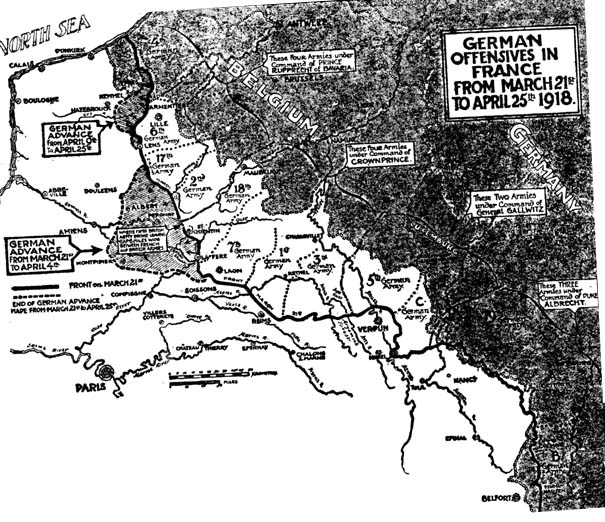
The brunt of the attack fell to the Seventeenth and Second German armies, part of the group of armies commanded by Crown Prince Rupprecht of Bavaria. They consisted of more than thirty-five divisions equipped with approximately 1,500 heavy guns and 2,200 field pieces.
The southern wing of our mobile front, made up of the group of armies commanded by the German Crown Prince, was ordered to protect our left flank against French attacks that were sure to be started to relieve the English. This group of armies counted twenty-four divisions, with 1,600 light and 1,000 heavy pieces of artillery.
From the very start, the battle developed differently from our expectations. The Seventeenth Army of General von Bülow and the right wing of General von Marwitz's Second Army were able to make but little progress, and that slowly, because of the stubborn opposition they encountered to the southwest of Cambrai. On the other hand, the left wing of the Second Army and the whole of General von Hutier's Eighteenth Army succeeded in taking extensive areas in the country west of Saint-Quentin. They soon reached the Somme near Péronne, and shortly after crossed the Crozat Canal.
I was now faced with the difficult problem of deciding whether I should stop the victorious progress of General von Hutier's Eighteenth Army, which had been entrusted to cover our left flank against the French. This would mean forcing a decision on our right wing north of the Somme. It would necessitate throwing more effectiveness into battle, so as to overcome unexpected stubborn opposition of the enemy at the other point. The alternative was the inauguration of an entirely new strategical plan.
When a commander is bent upon breaking through the enemy's positions it is not always possible to adhere closely to a preconceived plan, for the break does not always occur where it is most confidently expected. The strategist who sticks to his initial plan when things do not develop as he expected is in danger of losing his objective. To break through an enemy's line effectively, it is necessary to exploit any initial success at any weak point. The gap thus forced open must be widened as a flood widens a hole in a wall (levee). And all setbacks at other points of the line must be counterbalanced.
On March 26 our troops reached the line Albert-Noyon. General Gough's Fifth English Army was shattered to bits. In complete disorder, it drew back in a westerly direction toward Amiens. A wide gap had been opened between the English and the French fronts. It was Marshal Foch who, with marvelous rapidity, sent French reserve divisions to this breach, prevented a permanent break in the Allied front and saved the British army.
I was personally much interested in reading Marshal Foch's graphic description of the severe dangers which the Allied forces faced at this time. I noted with great satisfaction that the new plan of operations which I inaugurated on the evening of March 26 was based upon a correct analysis of conditions prevailing in the camp of my opponent. Those military critics who have severely criticized me for my decision of March 26 are thus proved to be wrong in their contentions.
My new plan was to concentrate our offensive toward our left wing, where we had been most successful. I expected completely to cut off the English from the French by having the Second and Eighteenth German armies advance around the left wing of the French near Noyon.
The leadership of Foch, now in supreme command of the Allied armies, was undoubtedly one, if not the chief, factor that thwarted my intentions. With tremendous energy, the marshal threw all available troops into the gap.
Until the enemy's broken front was restored to its former wall-like solidity, victory beckoned to the German troops if they continued to attack. But, unfortunately, the German Eighteenth Army commander, after reaching Montdidier on March 27, did not press forward, but waited for two days for his right wing, the Second German Army, to advance toward Amiens.
Both German armies thus lost that glorious momentum that carried them forward at the beginning of the offensive. On March 30 the situation was such the general staff had to be satisfied with a limited undecisive victory. My heart was heavy when I was compelled to arrest the offensive.
The attempt, after a few days of rest and after receipt of sufficient ammunition, to take the extremely strategically important rail-head of Amiens also failed. The attack ended on April 4.
After reading Marshal Foch's statement, I am certain that the German offensive of March 21, 1918, would not have failed of its objective if, in accordance with my suggestions, the advance had been constantly sustained, thus making it impossible for the enemy to reorganize or for Foch's reinforcements to have time to come up.
Forty British divisions had been severely beaten. Their fighting strength had been destroyed for a long time to come. Their losses in killed, injured, prisoners and captured war material put victory within our reach, but for two days' pause by us, fatal to us, enabling Foch to save them.
This German offensive in the spring of 191 our last great effort-that for two days split the British and French armies, was really an offensive for peace. We wanted to force our enemies to enter peace negotiations. We were at last convinced that America was able to put her tremendous forces into war.
On March 21 and again April 9 we executed two powerful attacks against the British-one along the Somme and the other in Flanders. Both had resulted in great gains of territory, but we had failed of our complete objective actually to separate the British forces from the French and to break through the British front far enough to bring the battle into open country. We were intent upon an open field warfare on the western front, for only through mobile warfare could a real military decision he reached. But Marshal Foch's promptitude and energy prevented the success of our plan.
After the abortive results of our first two blows we were faced with a most perplexing problem.
What, after all, proves the greatness of a leader in the field? It is his gift of one-sidedness, the stifling of all doubts, the utter disregard for any timidity which he may harbor in his heart of hearts, the unshakable tenacity with which he holds on to the great resolution in his soul.
Marshal Foch is absolutely correct in stating that the most important virtue of a leader consists in that strength of will which prevents him from wavering even in the most critical moments, and which will not permit him to doubt the ultimate victorious outcome of the battle in which he is engaged.
I still, therefore, held on to the idea of delivering a decisive blow against the British. This could best be done in Flanders, where the positions we had reached at the end of our last offensive offered better chances for the continuation of operations than on the Amiens front.
It was my conviction, however, that it was necessary to attract the enemy's attention to some other part of the front so as to induce him to divert his strong reserves now concentrated in Flanders.
An attack was ordered on the front held by the German Crown Prince along the Chemin-des-Dames. This offensive could not be executed immediately, but only after the troops had been rested and preparations made. The necessary delay here was to the advantage of the enemy, as the American forces were daily increasing. But there was no other solution.
Toward the end of May General von Boehn's Seventh Army and a part of General von Bülow's First Army began to advance along the Aisne front. This operation was a real surprise for the enemy. The part of the front against which our attack was directed was only thinly garrisoned and could draw on but few reserves.
Our initial goal had been none too ambitious, but the quick and clever exploitation of our first far-reaching successes won us a rich gain in area as well as enormous booty. The chances for a successful execution of an attack in Flanders against the English, planned as the principal issue of the whole undertaking, had been essentially enhanced
Marshal Foch agrees with me in this. According to his own statement, "the wisely and ambitiously conceived'' German offensive against the Aisne front interfered with the execution of a counter-attack in Flanders which he had already planned and ordered.
Foch now faced the necessity of withdrawing the greater part of his reserves from Flanders to reinforce the jeopardized Marne front. Eventually not less than thirty-five French divisions of infantry and six divisions of cavalry, about 400,000 men, were drawn into the battle between the Aisne and the Marne.
In addition, five English, two American and two Italian divisions were also used to reinforce this part of the front.
(The fighting strength of all divisions except the American toward the end of the war was around 10,000 men. The American was 20,000.)
It was on June 2 that David Lloyd George, together with Premier Clemenceau, of France, and Premier Orlando, of Italy, in agreement with Marshal Foch, appealed to the President of the United States, stating that there was grave danger of the Allies losing the war unless their numerical inferiority was quickly remedied by the arrival of American troops. This proves that the moral and material success of the third German offensive of 1918 was very great.
A second attack by the troops of the German Crown Prince was now planned for July. This attack was on both sides of Rheims, and was to ameliorate the tactical situation of General von Boehn's Seventh Army, whose flanks, resting on the Vesle, were dangerously exposed as his center had advanced to the Marne. The offensive was also to force more withdrawal of enemy forces from Flanders to save Rheims.
I did not delude myself at this time as to the imminence or the strength of the American forces then coming into action. The French troops in many sectors of the front were being replaced by Americans, and the quality of the new forces was already manifest to me.
The German general staff estimated for me that on July 1? 1918, there were a round million American troops on French soil, of which 600,000 were already fighting. Their divisions, which we estimated to number twenty-two, were twice as strong as our own in actual number of infantry. America was evidently throwing all of her almost inexhaustible resources into the great battle.
Wherever the American soldier had made his appearance on the front, he had proved himself not very well trained, but extremely eager and even too rash, with apparently inexhaustible nervous energy. It still remained to be seen, however, whether the new divisions which had not yet been in action would be equal to the regulars that turned the tide at Château-Thierry. It also remained to be seen whether American leadership, lacking tactical and technical experience in handling even single divisions, could handle great armies, especially in mobile warfare.
There was no chance any more for the German field army to obtain reinforcements. It was impossible to draw troops from other theaters of war. Reinforcements from home grew less and less. The few that came consisted of rehabilitated casualties and convalescents. Some were drawn from non-occupied units, old men employed behind the front and in occupied territories. The actual fighting strength of many battalions had fallen below five hundred men.
Also, the process of moral disintegration induced by enemy propaganda was not only undermining the home front, but also spreading in the rank and file of the field army.
But in spite of everything Field Marshal von Hindenburg and myself maintained stout hearts. We still confidently believed that the shock power of our troops would prove adequate to the task awaiting them.
To surround our own intentions and measures with impenetrable secrecy was indispensable. We had to surprise the enemy at some weak spot. If this could be done, a German victory on the Marne and in Champagne, even as late as July, 1918, would have changed the whole war situation in favor of the fatherland.
The Americans would have found themselves faced with the very difficult task of rushing up and down the front, supporting their sorely pressed allies first here and then there.
Unfortunately, the most important condition for the success of our new offensive proved lacking. The failure of the German attack on both sides of Rheims in the middle of July, 1918, was not due to insufficient preparation or mistakes of the various army command or lack of available fighting power or the demoralization of our troops, but purely and simply to the fact that the element of surprise was absent.
The Americans obtained from treacherous German prisoners what and where we were- preparing. In some cases perhaps the prisoners did not know the meaning of what they themselves revealed. But the American officers learned along which parts of the front attack would be staged. [Editor's note: The Allies possessed a remarkably fine service for the interrogation of prisoners, who in replying to what appeared as harmless questions often gave information of the greatest importance. It is hardly accurate to call this treachery.]
As the German attack at Rheims on July 15 did not succeed in its first onslaught, the offensive was stopped the next day so as to avoid the useless waste of strength. The troops of General von Boehn's Seventh Army, which had crossed the Marne, were withdrawn.
But in spite of the tactical disappointment in which these operations resulted, we had realized our main intention. We had actually succeeded in weakening the enemy's front in Flanders by forcing him to withdraw reserves from there. Our own troops in the neighborhood of Rheims thereupon were immediately transferred to Flanders. There they were to launch, as soon as seemed feasible, the long-prepared attack.
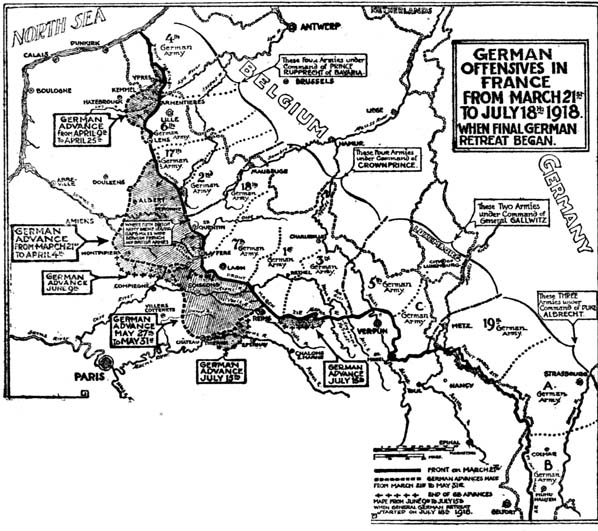
Marshal Foch's big offensive on July 18, in the direction of Soissons, interfered with these operations. On account of the pressure exerted by Marshal Foch, General von Boehn's Seventh Army had to be retired beyond the Vesle to the line Soissons-Rheims. This line was reached on the night of August 1. The whole Marne salient which had been taken in May was given up. This was the first great setback for Germany.
The successful execution of this most difficult retreat demonstrated the valor and ability of our troops. But the losses were great. Many divisions were used up. Fresh forces were required to rehabilitate the situation. With heavy heart, therefore, I had to give up the Flanders offensive. We lacked the necessary effectives and also the war material to carry it out.
There now developed the very situation which I had endeavored to prevent. The initiative passed to the enemy. Germany's position was extremely serious. It was no longer possible for us to win the war in a military sense. Politics must bring the war to a conclusion.
I have often been reproached for having assumed the actual superior management of politics as well as of the war. These reproaches are in no way borne out by facts !
If I mixed in politics, I simply did it out of a feeling of responsibility for so many thousand German lives. Ambition played no part in my activities. I merely felt it my duty to stop the weak, unfruitful policy of Chancellor von Bethmann-Hollweg, which, in my mind, was responsible for the development and outcome of the whole war. Field Marshal von Hindenburg felt as I did. No thought of self entered our minds. The national honor, the safety of the armies committed to our charge were not only uppermost; the)t were our only thought.
While the troops at the front fought with unequaled bravery against a world of enemies, at home the very soul of the German people was being shaken by anti-militaristic propaganda and by pacifistic and defeatist movements. Revolutionary agitation walked hand in hand with utter corruption. In every respect, the political leadership of the empire was vacillating when it should have been adamantine.
The supreme command was, therefore, frequently compelled to raise its voice in protest against the political mismanagement. Occasionally, it was even forced to interfere with political affairs so as to avoid utterly disastrous results.
The supreme command would have disregarded its duty if it had not insisted with all its authority that the political and military leaders must work together if victory was to be achieved.
Unfortunately, all my exertions were in vain. Von Bethmann-Hollweg resigned in July, 1917, but nothing in the conduct of affairs within Germany or in relation to Germany's allies was materially changed under the chancellorships of Michaelis and Count von Hertling.
The lack of unity of purpose in both thought and deed which prevailed between statesmen and military leaders in Germany all through the war is one of the principal reasons for the ultimate debacle.
Today, of course, I clearly see that conditions as they prevailed at home were merely the result of a policy already inaugurated before the outbreak of the war by interests beyond the control of any government-interests whose influence veritably overshadowed the power of the nation.
The political leadership of the empire, consciously or unconsciously, succumbed to the influence of these interests. Germany simply was not permitted to gain victory. If I had only known then what I know now, in spite of a natural disinclination for politics, I should have interfered more energetically and earlier to save the fatherland.
At a conference in Spa on August 13 and 14, the supreme command made it unequivocally clear to the political leadership of the Empire, that it was no longer possible to win the war militarily. All that was possible for military leadership was a strategical defense to hold the enemy and permit negotiations.
I realized that the only way of inducing the Allies to accept a renunciatory peace, not entailing unbearable conditions for the fatherland, was by paralyzing their fighting spirit as much as possible. Our troops had to offer the most stubborn resistance, showing unbroken fighting spirit. To the glory of the German troops up to the very end of the war they proved themselves worthy and capable. Thousands and thousands showed splendid heroism and many thousands died gloriously on that field of honor.
With more than a million fresh, young, ardent Americans pressing forward into the battle, the result was inevitable.
To its infinite credit the German field army remained securely in the hand of its leaders until the very end. Our retreat was conducted according to plan and in complete order.
The tremendous superabundance of pent-up, untapped nervous energy which America's troops brought into the fray more than balanced the weakness of their allies, who were utterly exhausted.
It was assuredly the Americans who bore the heaviest brunt of the fighting on the whole battle front during the last few months of the war. The German field army found them much more aggressive in attack than either the English or the French.
For instance, in the simultaneous attack launched at the end of September-six weeks before the war ended-by the French in Champagne and the Americans between the Argonne and the Meuse, General von Einem's Third German Army facing the French had no difficulty in holding firm the line against their frontal attacks for fully two weeks, while General von Gallwitz's Fifth German Army facing the Americans in the Argonne could not withstand the incessant force of intrepidity of the American attack.
In the October battles for the possession of the Meuse line, which we had held for four years and heavily fortified, the Americans must be credited with decisive victory. By frontal pressure against the troops opposing them, they forced us to abandon the Aisne position and retreat behind the Meuse. The French on numerous previous occasions had attacked us there in great force, suffered terrible loss themselves and gained no advantage.
Regarding the actual fighting of the Americans, their attacks were undoubtedly brave and often reckless. They lacked sufficient dexterity or experience in availing themselves of topographical cover or protection. They came right on in open field and attacked in units much too closely formed. Their lack of actual field experience accounts for some extraordinarily heavy losses.
After the collapse of all of Germany's allies and after the Americans had wiped out the Saint-Mihiel salient Field Marshal von Hindenburg and I decided to ask our government to ask President Wilson for a truce and peace. This was undoubtedly the hardest and most bitter resolution of our lives. After careful survey of the entire situation, without "nerves," but calmly and with a full understanding of our responsibility, we united in urging an immediate cable message asking an armistice.
Secretary of State for Foreign Affairs Admiral von Hintze, who had just arrived at Spa, came independently to the same conclusion.
The army and the political leaders of the country were for the first time then in full accord.