
TO CONTEMPLATE THE work which Miss Nightingale performed for the army produces a sensation of weariness. It is too much. No one person should have driven herself to accomplish all this. What must not these mountains of paper, these innumerable reports and memoranda, these countless letters, have cost in fatigue, in strain, in endless hours of application, in the sacrifice of every pleasure? And yet by 1859 work for the army was only a part of her labors. From military hospitals and military nursing she had passed to civilian hospitals and civilian nursing; from working for the army she had passed to working for the nation and the world.
She returned from the Crimea with the intention of devoting her life to the British Army. It was impossible. Her knowledge, her genius, and her experience were such that she could not be allowed to limit herself to military affairs.
In her evidence before the Royal Sanitary Commission of 1857 she was asked: "Have you devoted attention to the organisation of civil and military hospitals?" She replied: "Yes, for thirteen years I have visited all the hospitals in London, Dublin and Edinburgh, many county hospitals, some of the Naval and Military hospitals in England; all the hospitals in Paris and studied with the 'Sœurs de Charité'; the Institution of Protestant Deaconesses at Kaiserswerth on the Rhine, where I was twice in training as a nurse, the hospitals at Berlin and many others in Germany, at Lyons, Rome, Alexandria, Constantinople, Brussels; also the War Hospitals of the French and the Sardinians."
The Commissioners were startled. It was an experience such as no other person in Europe possessed; and it was impossible that its benefits should be restricted to the British Army.
In a letter to Dr. Farr, written during the autumn of 1859, Miss Nightingale described her feelings when she became aware of the deplorable state of civil hospitals. She came back from the Crimea, she said, suffering from a delusion. She knew military hospitals were in administrative confusion, but she imagined civil hospitals to be much better; and her state of mind when she discovered civil hospitals to be "just as bad or worse" was "indescribable."
During the long, losing fight over the construction of Netley Hospital she learned that abysmal ignorance of the first principles of hospital construction existed even among educated and liberal-minded people. She suffered a notable defeat because no single person concerned had had the faintest idea that any special importance ought to be attached to the way in which a hospital was designed. Steps must be taken to educate public opinion, and through Netley she entered the field of public health. In October, 1858 Lord Shaftesbury arranged that two papers written by her on Hospital Construction should be read at the annual meeting of the Social Science Congress. They were received "with enthusiasm," and she expanded them into a book which was published in 1859 under the title Notes on Hospitals.
It was her revolutionary thesis that the high rate of mortality, then invariable in large hospitals, was preventable and unnecessary.
It may seem a strange principle to enunciate as the very first requirement in a Hospital that it should do the sick no harm. It is quite necessary nevertheless to lay down such a principle, because the actual mortality in hospitals, especially those of large crowded cities, is very much higher than any calculation founded on the mortality of the same class of patient treated out of hospital would lead us to expect.
Notes on Hospitals draws an alarming picture of contemporary hospital conditions; walls streaming with damp and often covered with fungus, dirty floors, dirty beds, overcrowded wards, insufficient food, and inadequate nursing. The answer to hospital mortality was neither prayer nor self-sacrifice but better ventilation, better drainage, and a higher standard of cleanliness.
Notes on Hospitals was a success; it went into three editions, and after its publication she was constantly asked for advice on Hospital Construction.
The plans for the Birkenhead Hospital, the Edinburgh Infirmary, the Chorlton Infirmary, the Coventry Hospital, the Infirmary at Leeds, the Royal Hospital for Incurables at Putney, the Staffordshire Infirmary, and the Swansea Infirmary were submitted to her. The Government of India officially consulted her on the plans for the new General Hospital at Madras. The Crown Princess of Prussia and the Queen of Holland submitted hospital plans. The King of Portugal asked her to design a hospital in Lisbon. She did so, the plans were accepted, and she then learned that the hospital was intended not for adults, but for children; the King of Portugal waved aside her protests---it did not matter, the children would have all the more room.
She had to deal with an enormous mass of practical detail. The piping of water was novel, and each choice was in some degree an experiment. She wrote hundreds of letters to ironmongers, engineers, builders, and architects. Huge bundles of these survive, though notes attached to the bundles state "Many destroyed." She did not like the dark-green walls which were becoming popular in hospitals and wished to have "the palest possible pink." She forwarded one long report with the title "A treatise on sinks."
In 1859 each hospital followed its own method of naming and classifying diseases. Miss Nightingale drafted model hospital statistical forms which would, she wrote, "enable us to ascertain the relative mortality of different hospitals, as well as of different diseases and injuries at the same and at different ages, the relative frequency of different diseases and injuries among the classes which enter hospitals in different countries, and in different districts of the same countries." The model statistical forms were well received. St. Mary's Hospital, Paddington, St. Thomas's, St. Bartholomew's, and University College Hospital agreed to use them at once. A year later representatives of Guy's, St. Bartholomew's, the London Hospital, St. Thomas's, King's College Hospital, the Middlesex, and St. Mary's, Paddington, met and passed a resolution that they would adopt a uniform system of registration of patients and publish their statistics annually, "using as far as possible Miss Florence Nightingale's Model Forms."
She found statistics "more enlivening than a novel" and loved to "bite on a hard fact." Dr. Farr wrote in January, 1860: "I have a New Year's Gift for you. It is in the shape of Tables." "I am exceedingly anxious to see your charming Gift," she replied, "especially those returns showing the Deaths, Admissions, Diseases." Hilary Bonham Carter wrote that however exhausted Florence might be the sight of long columns of figures was "perfectly reviving" to her.
In the spring of 1859 St. Thomas's Hospital found itself in a dilemma. The South Eastern railway was about to build a line from London Bridge to Charing Cross, and St. Thomas's lay directly in the path proposed. The Governors of the Hospital were unable to agree on a policy. Some wished the railway company to acquire the whole site and move the hospital to a new district; others wished for only a part of the site to be sold so that the hospital could remain in its ancient place. A deadlock was reached, and in February, 1859 Mr. Whitfield, the Resident Medical Officer, called on Miss Nightingale and asked her to help. In his opinion the whole site should be sold and the hospital rebuilt in another district. Would she influence the Prince Consort, who was a Governor, to adopt this point of view?
She would not allow herself to be easily convinced. She went into the matter thoroughly, studied figures, interviewed railway and hospital officials, and came to the conclusion that Mr. Whitfield was correct. She then sent a memorandum to the Prince Consort. He read her memorandum and was converted.
However, the battle was not yet won, for a new point was raised. Financially it might be preferable to sell the whole site and rebuild elsewhere, but there was surely an ethical consideration. Ought the hospital to leave its ancient position among the people it had served for centuries? Again an appeal was made to Miss Nightingale. She collected statistics of patients treated in the hospital and was able to prove that the largest number of patients treated at the hospital did not come from the immediate neighborhood but from districts further away. A memorandum containing this evidence was drawn up by her and submitted to the Governors and the Prince Consort, and as a result it was agreed that the whole site should be sold and the hospital moved.
Yet another crisis followed. The Governors, becoming greedy decided to ask the railway company the then very large sum of £750,000. Miss Nightingale, called in once more, pointed out that if the demand was persisted in, the company would go to arbitration; and the sum awarded would almost certainly be smaller than the present offer. Her advice prevailed; the entire site in the Borough was sold by agreement, and the hospital moved to its present position in Lambeth.
These negotiations produced a close association. Mr. Whitfield became devoted to her, and Mrs. Wardroper the matron was already a close friend. She became identified with St. Thomas's and in time held a position in the hospital which was almost that of patron saint.
Her interest in nursing and nursing reform had never diminished, though her work for the army had pushed it into second place. She had the Nightingale Fund of £45,000 at her disposal to found a Training School for Nurses, but there had been great difficulty in finding suitable connections for the school. In 1859, when she became concerned with the affairs of St. Thomas's, she began work on a scheme to establish the school there.
While she worked on this scheme for training the professional nurse, she wrote a little book on nursing for the use of the ordinary woman, which became the most popular of her works. Notes on Nursing was intended to make the millions of women who had charge of the health of their children and their households "think how to nurse." "It was," she wrote, "by no means intended . . . as a manual to teach nurses to nurse." It is a book of great charm, sympathetic, sensible, intimate, full of witty and pungent sayings, and possessing a remarkable freshness. Neither its good sense nor its wit has dated, and Notes on Nursing can be read today with enjoyment.
When the book was published in December, 1859, it caused a mild sensation. Habits of hygiene now taken for granted were then startling innovations. Mothers of families were shocked when Miss Nightingale attacked the education of the mid-Victorian girl, to whom "the cox combries of education" were taught, while she was left in ignorance of the physical laws which governed her own body.
The book was not cheap-the price was 5s-----but 15,000 copies were sold within a month; and it was reprinted at 2s. and later at 7d. Thousands of copies were distributed in factories, villages, and schools, and it was translated into French, German, and Italian. "There is not one word in it written for the sake of writing but only forced out of me by much experience in human suffering," she wrote to Sir John McNeill on July 29.
It is impossible to doubt, after reading it, that Miss Nightingale was a gentle and sympathetic nurse. She understood that the sick suffer almost as much mental as bodily pain. "Apprehension, uncertainty, waiting, expectation, fear of surprise, do a patient more harm than any exertion. Remember he is face to face with his enemy all the time, internally wrestling with him, having long imaginary conversations with him." "Do not cheer the sick by making light of their danger." "Do not forget that patients are shy of asking." "It is commonly supposed a nurse is there to save physical exertion. She ought to be there to save (the patient) taking thought."
She spoke of the "acute suffering" caused a sick person by being so placed that it is impossible to see out of the window; of the "rapture" brought to an invalid by a bunch of brightly colored flowers; of the intense irritation caused to an invalid by a noise such as the constant rustling of a nurse's dress. She understood the relief afforded a sick person by being taken out of himself. "A small pet animal is an excellent companion for the sick. A pet bird in a cage is sometimes the only pleasure of an invalid confined to the same room for years." She loved babies and recommended visits from the very young. "No better society than babies and sick people for each other."
It will be recalled that when she was convalescing in Mr. Sabin's house at Scutari she had become fond of a certain Sergeant Brownlow's baby; and when the 7d. edition of Notes on Nursing was published she added a chapter on "Minding Baby" inspired by this child. "And now girls I have a word for you," the chapter opens. "You and I have all had a great deal to do with 'minding baby,' though 'Baby' was not our own baby. And we would all of us do a great deal for baby which we would not do for ourselves." Jowett of Balliol said that a world of morality was contained in the parenthesis "though 'baby' was not our own baby." She received letters telling her that this chapter was most fruitful in results. Unhappily, Sergeant Brownlow's baby died shortly after the return of the troops to England from the Crimea, owing, she said, to the insanitary condition of the barracks in which the father's regiment was quartered.
She attacked "invalid food." As a result of invalid diet thousands of patients are annually starved, she declared. "Give 100 spoonfuls of jelly and you have given one spoonful of gelatine which has no nutritive power whatever. Give a pint of beef tea and you have given barely a teaspoonful of nourishment. Bulk is not nourishment." Milk, in her opinion, was the best of all invalid foods, and she urged also that people who are ill should not be deprived of vegetables. Tea "admittedly has no nourishing qualities but there is nothing yet discovered which is a substitute to the English patient for his cup of tea." Invalid food must be carefully served: Do not give too much, do not leave any food by the patient's bed. "Take care nothing is spilt in the saucer."
In a series of pungent paragraphs she cut to pieces the current idea of a nurse. "No man, not even a doctor, ever gives any other definition of what a nurse should be than this---'devoted and obedient.' This definition would do just as well for a porter. It might even do for a horse. It would not do for a policeman." "It seems a commonly received idea among men, and even among women themselves, that it requires nothing but a disappointment in love, or incapacity in other things, to turn a woman into a good nurse."
Though she denounced the education of the Victorian girl, and advocated the training of women, Notes on Nursing ends with a vigorous attack on the 'Jargon about the rights of women." "Keep clear of both the jargons now current everywhere," she wrote; ". . . of the jargon, namely about the 'rights' of women, which urges women to do all that men do including the medical and other professions, merely because men do it, and without regard to whether this is the best that women can do; and of the jargon which urges women to do nothing men do, merely because they are women, and should be 're-called to a sense of their duty as women' and because 'this is women's work' and 'that is men's' and 'these are things which women should not do' which is all assertion and nothing more. . . . You do not want the effect of your good things to be 'How wonderful for a woman!'; nor would you be deterred from good things by hearing it said 'Yes, but she ought not to have done this, because it is not suitable for a woman.' But you want to do the thing that is good whether it is suitable for a woman or not." To praise women for doing what men did habitually and easily, she wrote, was to reduce them to the status of Dr. Howe's idiots whom, after two years of ceaseless labor, he succeeded in teaching to eat with a knife and fork.
Six months after the publication of Notes on Nursing, the scheme for establishing a Training School for Nurses, endowed with the proceeds of the Nightingale Fund, was at last carried through. For the past three years she had been "continuously deluged" with suggestions for spending it. In March, 1856, she had written: "The first fruits of a long series (as I expect) of the brick and mortar plans of needy or philanthropic adventurers who wish to get hold of the 'Nightingale Fund' have already come in upon me. . . . I take at random those which first present themselves. One is a magnificent elevation with my statue on the top to be called the 'Nightingale Hospital' . . . another is a Home for Nurses with no hospital at all. One advises me to admit none but gratuitous services. This includes a threat if the obnoxious word 'Sister' is allowed, and a terrible warning as to the 'cut of our aprons' which are to be 'Large and White,' and a caution as to 'Celibacy,' which I was not aware before came into the question. We are also solemnly assured that the 'Apostles received a salary' (How much was it?) and that the Nurses must lead an 'ordinary life.' I thought the object was they should not be ordinary nurses. One offers me a clergyman and his sons and insists upon a service every day in the week, probably a son for each day and the Father on Sunday. Another insists on no Clergyman at all and a strictly secular education, One desires to confine my operations to the Work Houses, another to the Hospitals and a third recommends the training of nurses for private families only. One wishes for an 'Order,' another for an 'Asylum for old age, and a third for high wages which will enable each to save for herself."
She saw before her a fresh succession of the religious intrigues which had so nearly wrecked the nursing in the Crimea, and she refused to move. "If I do anything at present I shall be smothered in the dust raised by these religious hoofs," she wrote.
In March, 1858 she wrote to Sidney Herbert asking to be released from the responsibility of conducting the Fund. He dissuaded her. The money was well invested and could accumulate; there was no need for immediate action. The subscribers expected that she personally would "animate the work"; and he did not see how she could with propriety dissociate herself from it.
She unwillingly agreed but continued to feel that the Nightingale Fund was a millstone round her neck. Moreover, she had been annoyed by an attempt by the Council of the Nightingale Fund to dictate to her what her activities should be. It was proposed that she should be asked for a pledge that she would work in civil hospitals and not in Military hospitals. "I might go to the Opera and Races," she wrote to Sidney Herbert on October 31, 1856, "no pledge against amusing myself existing, but I might not take Government employment being pledged to work for Civil Hospitals by the Fund. . . . I never can cease while I live, doing whatever falls in my way in the work I have mentioned above, viz. the Military Hospitals, which God and you have so singularly put into my hands."
By 1859, however, it was evident that some action must be taken. She was now an invalid; it was most unlikely that she would ever be sufficiently recovered to become the active superintendent of a large institution; and in any case her achievements were so great that as the superintendent of an institution she would be wasted. The scheme of founding a training school for nurses was revived. She was to be the patroness and organizer; and a sub-committee of the Nightingale Fund Council was appointed to hurry the scheme forward.
She hoped to work with Dr. Elizabeth Blackwell, but the plan failed. "During March and April in town," Miss Nightingale wrote to Sidney Herbert on May 24, 1859, "I saw and corresponded with pretty nearly all the hospital authorities and female superintendents in esse or in posse that could be applied to the Fund. I will not tell you in writing (tho' I could any day viva voce) all the pros and cons and the different plans I have successively tried to initiate. The most promising, that of the 'London' qua hospital and of Miss Blackwell qua superintendent, has fallen through. I have talked over the matter at great length with Sir John McNeill. For some months past I have also discussed it with some of the authorities at St. Thomas's Hospital. The Matron of that Hospital is the only one of any existing Hospital I would recommend to form a 'school of instruction' for Nurses. It is not the best conceivable way of beginning. But it seems to me to be the best possible. It will be beginning in a very humble way. But at all events it will not be beginning with a failure, i.e. the possibility of upsetting a large Hospital---for she is a tried Matron."
Mrs. Wardroper, matron of St. Thomas's Hospital, a gentlewoman by birth, had been left a widow with young children at the age of forty-two, and had taken up nursing. Training was unknown---she entered the wards of a hospital and learned what she could from experience. Miss Nightingale wrote, "Her force of character was extraordinary, and she seemed to learn from intuition." She was appointed matron of St. Thomas's in 1853, a remarkable achievement for a woman of her upbringing and class. Mrs. Wardroper held the post of superintendent of the Nightingale Training School for twenty-seven years, and a great part of the success of the school was due to her energy and determination.
The scheme for a training school for nurses was not universally welcomed. A strong party in the medical world thought that nurses did very well as they were, and that training would merely result in their trespassing on the province of the doctors. Both Mrs. Wardroper and Mr. Whitfield, the Resident Medical Officer at St. Thomas's, showed courage in committing their hospital to the scheme; and in May, 1860 Mrs. Wardroper wrote warning Miss Nightingale that they must be prepared for "rather harsh criticism."
Strong opposition came from within St. Thomas's itself, led by the Senior Consulting Surgeon, Mr. J. F. South. In 1857, when the scheme of a training school was first discussed, Mr. South published a little book, Facts relating to Hospital Nurses. Also Observations on Training Establishments for Hospitals. He was at the top of his profession, President of the College of Surgeons and Hunterian Orator, besides being senior consulting surgeon at St. Thomas's, and "not at all disposed to allow that the nursing establishments of our hospitals are inefficient or that they are likely to be improved by any special Institution for Training." He argued that the sisters learned by experience and could only learn by experience, that the nurses were subordinates "in the position of house-maids" and needed only the simplest instruction, such as how to make a poultice. He asserted that the nursing at St. Thomas's hospital was already on a very high level. "That this proposed hospital nurse training scheme has not met with the approbation or support of the medical profession is beyond doubt," wrote Mr. South. "The very small number of medical men whose names appear in the enormous list of subscribers to the (Nightingale) Fund cannot have passed unnoticed. Only three physicians and one surgeon from one London Hospital and one physician from a second are found among the supporters." The Nightingale Training School was launched in an atmosphere of criticism. Its way was not to be made easy, and the probationers would be watched by unfriendly eyes.
The object of the school was to produce nurses capable of training others. The Nightingale nurses were not to undertake private nursing; they were to take posts in hospitals and public institutions and establish a higher standard. They were to be missionaries, and as such they must be above suspicion. If scandal centered upon a Nightingale nurse, an active opposition was eagerly waiting to fasten on it. One piece of indiscretion, one false step, and hopes of reforming the nursing profession and elevating its status might be set back for years. The future of nursing depended on how these young women behaved themselves. As a result, candidates to become Nightingale probationers were subjected to minute examination, and there was great difficulty in finding young women of suitable character.
In May, 1860, advertisements appeared inviting applications for admission. The response was discouraging. However, fifteen candidates were chosen, and on June 24, 1860, the Nightingale School opened. No pupil was admitted without a certificate of good character, and the training was to last for one year-so long a period was hitherto unheard of. The Nightingale probationers lived in a nurses "Home"; this was a novel idea originated by Miss Nightingale, and it was received with disapproval by the opposition. An upper floor of a wing of St. Thomas's was fitted up so that each probationer had a bedroom to herself, there was a common sitting-room, and the sister in charge had a bedroom and sitting-room of her own. Books, maps, prints, and a supply of flowers from Embley were sent by Miss Nightingale, though Mrs. Wardroper feared that flowers came dangerously near overindulgence. The Nightingale probationers wore a brown uniform with a white apron and cap. Board, lodging, washing, and uniform were provided by the Fund. Each probationer was given 10 pounds sterling for her personal expenses during training. At the end of the year's course the nurses who had satisfied the examiners were placed on the hospital register as "Certificated Nurses." A first-class cash gratuity of 5 and a second-class cash gratuity of 3 pounds sterling were offered to nurses who were certified to have worked efficiently in a hospital for one year after completing their training.
It was a standard of life which nurses had never been offered before, and the opposition sneered at Miss Nightingale's "lady nurses." She did not believe nurses should be housemaids. "The Nurses," she wrote, "should not scour; it is waste of power." The Nightingale probationers worked hard, attending daily lectures from the medical staff and sisters of St. Thomas's Hospital and bi-weekly addresses from the chaplain. They were required to take notes, to be ready to submit their notebooks at any time for inspection and to pass examinations both written and oral; they acted as assistant nurses in the wards and received practical instruction from surgeons and sisters. What was required of them in work, however, was as nothing compared to what was required in behavior. Every month a report entitled "Personal Character and Acquirements" was filled in by Mrs. Wardroper, who exercised the closest possible supervision over every probationer. The details of the report, planned by Miss Nightingale, were minutely comprehensive. Two main heads, "Moral Record" and "Technical Record," were further subdivided; "Moral Record" had six subdivisions---punctuality, quietness, trustworthiness, personal neatness, cleanliness, ward management, and order. "Technical Record" had fourteen subdivisions which were again subdivided, in some cases a dozen times. Mrs. Wardroper wrote against each head "excellent ... .. good ... .. moderate," "imperfect," or "o." In addition she wrote confidential personal reports on each probationer.
Even this information was felt by Miss Nightingale to be insufficient. She was obsessed by the importance of these young women. The future of nursing hung on their behavior. Their natures, their thoughts, might wreck or make the work. If only she could get inside their minds. She originated a new scheme by which each probationer was required to keep a daily diary which was read by her at the end of the month. "I am sure," wrote Mrs. Wardroper, "that your approbation will stimulate them to increased perseverance." Miss Nightingale noticed that some of the probationers were weak in spelling and arranged for them to have spelling drill.
Flirtation was punished by instant dismissal---the girls selected and trained to redeem nursing must not allow themselves to be women; their mission was to prove that the woman can be sunk in the nurse. No Nightingale probationer was permitted to leave the Home alone; two must always go out together. "Of course we always parted as soon as we got to the corner," wrote one of the original probationers in a reminiscence.
The character and behavior of each probationer was discussed by Miss Nightingale and Mrs. Wardroper in anxious conferences and long letters. One set of letters considered in detail whether a certain young woman ought to be dismissed because she "made eyes." She was a competent nurse and her moral character was "said to be unexceptionable," but she seemed unable to refrain from "using her eyes unpleasantly." Before she was dismissed, however, ought they not to consider whether she might not grow out of this objectionable habit as she became older?
Strictness was necessary. The Nightingale nurse must establish her character in a profession proverbial for immorality. Neat, lady-like, vestal, above suspicion, she must be the incarnate denial that a hospital nurse need be drunken, ignorant, and promiscuous. It soon became evident that the school was succeeding. Within a few months a flood of applications was being received to bespeak the services of Nightingale probationers as soon as their period of training was completed.
A second experiment, financed out of the Nightingale Fund at the end of 1861, was the establishment of a Training School for Midwives. With the co-operation of the authorities of King's College a maternity ward was equipped, and the physician accoucheurs of the hospital agreed to assist in giving a six months' training; it was a scheme which Miss Nightingale had had at heart since her Harley Street days. On September 24, 1861, she wrote to Harriet Martineau: "In nearly every country but our own there is a Government School for Midwives. I trust that our school may lead the way towards supplying a long felt want in England."
The school trained midwives, not only to work in hospitals, but to deliver women in their own homes. During their training at the hospital the candidates paid for board and lodging but received instruction free. A promising beginning was made, and a number of owners of large estates sent women at their own expense to be trained as village midwives. Unfortunately, after more than two years of success, an outbreak of puerperal sepsis brought the scheme to an abrupt end, but Miss Nightingale's interest in rural problems of health continued, and she was constantly consulted on the selection and training of village nurses.
Through these years of unremitting toil her sole recreation was theological and metaphysical speculation, and in the summer of 1858 she turned again to the philosophical manuscript she had written in 1851 designed to provide a new religion for intelligent artisans. She sent it to Dr. Sutherland, who wrote on July 7 to Aunt Mai that he "disagreed entirely and vehemently" with her theory, but "I have preferred sending this to you because poor Florence is very unwell and in our own work we have enough of difference of opinion to make it desirable not to have more." In spite of this discouragement Miss Nightingale did a considerable amount of work on the manuscript during the following year and at the end of 1859 had it privately printed under the title Suggestions for Thought.
She had a strong affection for the book;--- she believed it to be an important work, and she determined to obtain unbiased opinions. She sent out a number of copies anonymously, with a letter asking if, in the opinion of the recipient, the book should be offered to the general public. A copy was sent to Richard Monckton Milnes, who identified the author and wrote to her on January 21, 1860: "I do not think the theory of omnipotent and implacable Law is any more satisfactory to the disturbed and distracted mind than that of a beneficent and benevolent Deity." As to its suitability for the "Artizans of England" he could not express an opinion as he had "a morbid horror of touching on these subjects with what people call the 'lower classes.' " The book, he added, should be revised. The letter ended on a wistful note: "My two little women are well and happy. I am as much of both as I believe is good for me.
From John Stuart Mill she obtained unqualified approval. Suggestions for Thought was not sent to him anonymously---a copy was brought to him by Edwin Chadwick, who first sent him a copy of Notes on Nursing. "I do not need it," wrote Mill, "to enable me to share the admiration which is felt towards Miss Nightingale more universally, I should imagine, than towards any other living person." He read Suggestions for Thought with care, annotating the copy in the margin; and he wrote on September 23, 1860, giving his verdict in favor of publication.
An anonymous copy was sent to Benjamin Jowett by Clough. Jowett, at this time a tutor of Balliol, was Clough's close friend. His verdict was unfavorable: he had "received the impress of a new mind," but the book must be rewritten. He thought that "here and there I traced some degree of irritation in the tone, the book appears to me full of antagonisms---perhaps these could be softened."
She also sent a copy to Sir John McNeill, and he, too, told her the book must be rewritten and replanned. She wrote that she had not time or energy to undertake it and regretfully laid the book aside, sending the manuscript to Richard Monckton Milnes for safe keeping. Yet she was not entirely convinced. More than ten years later she sent the manuscript to the historian, Froude. Once more the verdict was unfavorable, and this time she resigned herself. She wrote to him in July, 1873: "What you say about its 'want of focus,' want of 'form,' of its 'bleating propensities,' is of course felt by me more than anyone. I would re-write every word---if I could."
Suggestions for Thought was a failure, but it had brought her friendship with Benjamin Jowett. "I do so like Mr. Jowett," she scribbled on the margin of one of Jowett's first letters. In 1860 he was already a celebrated Oxford character. He was a fellow and tutor of Balliol and Regius Professor of Greek, and his personal appearance, wit, and eccentricities were University legends. In appearance he was short, cherubic, and strikingly handsome on a miniature scale; undergraduates nicknamed him the "downy owl." He spoke in a small piercing voice, "that small sweet voice once heard never to be forgotten."
Between Jowett and Miss Nightingale acquaintance quickly became intimacy. Like all the men who were fond of her, Jowett scolded her--she was not to exaggerate, not to fuss, not be so hard on people; she was to try to be more cheerful, to look back on what she had accomplished and be proud of herself. Affection became devotion, and it was known to their friends that Jowett was pressing her to marry him. She refused, but their friendship was unaltered. They corresponded constantly, and she leaned on his devotion and advice. "My darling Jowett," she called him.
She needed friendship, for as 1860 drew to its close the structure for which she had sacrificed everything in life crashed round her ears in ruin---Sidney Herbert's health finally collapsed.
IT WAS THE WORST POSSIBLE moment for him to break down. Everything depended on War Office reorganization, and War Office reorganization could be pushed through by Sidney Herbert alone. "One fight more, the last and the best," wrote Miss Nightingale; let him nerve himself to this final task and he should be released. He should be allowed to resign his office. He should go away where he would, abroad, or to Wilton, or to Ireland. He should shoot, fish, hunt, and never be worked on the treadmill again. But he must not fail now.
She had the habit of disregarding his complaints, and she shut her eyes to his physical condition. Indeed, his health varied. In November, 1859 he insisted on going down to Wilton, spent the week fox hunting and wrote: "I have been drenched to the skin every day and enjoyed myself very much." Surely if he could hunt five days a week, he could find enough strength to carry through War Office reform. She admitted his health had deteriorated, but so had her own. In February she wrote to Manning: "I am so much weaker that I do not sit up at all now."
Sidney Herbert's health was not to be the sole catastrophe; from the beginning of 1860 blow after blow rained on her as if Fate was determined to discover how much she could be made to bear.
In February Dr. Alexander suddenly died of a cerebral hemorrhage. Behind his death lay a history of obstruction and petty intrigue. The departmental machine had been strong enough to break him. Men he had trusted, who had been placed in their positions through his recommendation, had betrayed him. Disillusioned, snubbed, frustrated, he had labored through the immense amount of work entailed by the Sanitary Commission, and he was engaged in drafting the new Army Medical Regulations when he died. "His loss undoes a great part of the work I have done," Miss Nightingale wrote to Sir John McNeill in March, 1860. "I wish I had not lived to see it. . . ."
While she was still distracted by the loss of Alexander, another blow fell. Aunt Mai returned to her family. Since the previous autumn Aunt Mai's position had been intolerable. Uncle Sam refused to visit her when she was with Florence---he said he would be "de trop." Her second daughter was to be married that summer, and she implored her mother to come home. It was undeniable that Florence, who had been dying in 1857, was still alive. In the early summer of 1860 she decided it was her duty to return.
Her decision provoked intense bitterness. When Miss Nightingale realized that she was going to leave she refused to see her or speak to her. Aunt Mai wrote to Embley that she could not send her usual report on Florence's health because she had not seen her for over a week. Miss Nightingale did not forgive Aunt Mai for nearly twenty years; they never met, and the correspondence between them ceased.
It was impossible for her to be left alone; and in June, 1860 Hilary Bonham. Carter came to the Burlington to take Aunt Mai's place. Clough remained faithful, calling daily and devoting every moment he could snatch from his office to the work, but his health, too, was causing anxiety, and on December 7, 1860, Miss Nightingale wrote a depressed letter about him to Uncle Sam: "I have always felt that I have been a great drag on Arthur's health and spirits, a much greater one than I should have chosen to be, if I had not promised him to die sooner."
Alexander was dead, Sidney Herbert fatally handicapped by ill health, and the burden on her increased. It was out of the question for her to leave London, and in August she went to Hampstead once more. She was very feeble, lying all day in bed by an open window in her rooms in South Hill Park, finding solace in the society of her cats and of children. She had Clough's children to stay with her, and on September 1, 1860, she wrote to Clough's wife describing a visit from the baby. "'It' came in its flannel coat to see me. No one had ever prepared me for its Royalty. It sat quite upright, but would not say a word, good or bad. The cats jumped up upon it. It put out its hand with a kind of gracious dignity and caressed them, as if they were presenting Addresses, and they responded in a humble grateful way, quite cowed by infant majesty. Then it put out its little bare cold feet for me to warm, which when I did, it smiled. In about twenty minutes, it waved its hand to go away, still without speaking a word."
Sidney Herbert rode out to see her every day. Forced to stay in London for the second summer in succession, he was weary, feverish, and dispirited. He felt "a total inability to deal with business." "He shrank," Miss Nightingale wrote to Sir John McNeill in July, 1861, "from the Herculean task of cleansing the Augean stable."
Through July, August, and September he complained of biliousness, lassitude, and headaches. In September Liz asked Florence not to come back to the Burlington because the daily ride out to Hampstead did Sidney so much good; and she stayed in Hampstead with Hilary Bonham Carter through the autumn.
Sidney Herbert was enduring a martyrdom, while the two women closest to him shut their eyes and drove him on. More than a year before he had told his wife: "Every day I keep the War Office with the House of Commons is one day taken off my life." Since then, with Miss Nightingale urging him on one side and Liz on the other, he had forced himself to continue with both. Now he was nearly at the end of his powers. In October and November, 1860 his health suddenly grew worse. Perhaps, wrote Florence, it was the London air. She conferred with Liz. He was so much better out of London---perhaps the solution was not to stay in Belgrave Square but to take a house in Hampstead. Liz agreed, and Mrs. Sutherland was sent round the house agents. It was too late. No change of air could save Sidney Herbert now. Early in December he collapsed.
He was pronounced to be suffering from kidney disease, incurable and at an advanced stage: the amount of work he was doing must be cut down drastically and at once. It was practically a death warrant. On December 5 he rode out to Hampstead to see Miss Nightingale. "He was not low, but awe struck," she wrote to Uncle Sam on December 6; "I shall always respect the man for having seen him so."
He remained with her for several hours, his intention being to consider what his future course of action should be. In fact it had already been settled for him. Liz had been to see Florence earlier, before Sidney was well enough to ride out, and they had agreed between themselves what he was to be persuaded to do. Three courses were open to him. He could retire altogether; he could give up the War Office, and keep his seat in the House of Commons; he could go to the House of Lords, give up the House of Commons and keep the War Office. For his own sake the first was the best. The doctors had enjoined complete and absolute rest as his only chance.
But that choice neither Miss Nightingale nor his wife would allow him to contemplate, nor indeed did he contemplate it himself. Work was his fate. He recognized that and inclined toward the second course. He would give up the War Office and keep his seat in the House of Commons. He was a House of Commons man; he had sat in the House for twenty-eight years and had been brilliantly successful there. He could "do with the House what no one else could." He was an orator and a matchless negotiator. The work of the War Office he frankly detested. It did not suit him. His talents were wasted. He had never had, as Miss Nightingale frequently told him, any genius for administration. He could not, drive himself as he would, master the enormous mass of intricate detail which War Office reorganization involved. His mind recoiled from it.
But Miss Nightingale's task was to persuade him to keep the War Office. For the sake of the work, for the sake of War Office reorganization, he must be persuaded to resign his seat in the Commons, keep the War Office, and go to the House of Lords.
The interview was long, very long, but she succeeded. For the sake of the work the War Office should be kept. "A thousand thanks," wrote Liz, "for all you have said and done." She had forced him to sign his death warrant.
She still refused to admit how fatally ill he was. How else could she justify what she had done? The shock of the doctors' verdict had been great, but presently she began to minimize it: doctors were often wrong; people with so-called fatal diseases often lived for years. "I hope you will not judge too hardly of yourself from these doctors' opinions," she wrote on December 8, ". . . it is not true that you cannot (sometimes) absolutely mend a damaged organ, almost always keep it comfortably going for many years, by giving Nature fair play. . . . I am not going to bore you with a medical lecture. But I do hope you won't have any vain ideas that you can be spared out of the W.O. You said yourself that there was no one to take your place.---and you must know that as well as everybody else. It is quite absurd to think Lord de Grey can do it. . . . You cannot be the only person who does not know that you are necessary to the re-organising of the W.O. It is more important to originate good measures than to defend them in the H. of C. I don't believe there is anything in your constitution which makes it evident that disease is getting the upper hand. On the contrary."
He tried to follow her directions. He went down to Wilton and wrote cheerfully on the 12: "I went out hunting, had a lovely bright day and a good run, and I slept like a top for the first time for some days." Early in January he was created a baron with the title of Lord Herbert of Lea, and took his seat in the House of Lords.
Miss Nightingale showed him no softness, and it almost seemed as if she regarded bad health as her personal monopoly. "To him retaining office and giving up the H. of C. is like what it was to me giving up men and taking to regulations," she wrote to Harriet Martineau on January 1, 1861. Only once did she permit herself a quick horrified glance at the truth, when, on January 13, she wrote to Harriet Martineau: "I see death written in the man's face. And, when I think of the possibility of my surviving him, I am glad to feel myself declining so fast." She hid herself behind impatience, harshness; she blamed him. It was a relief to blame him and to close her eyes to the grim certainty advancing inexorably upon her.
Liz began to drag her husband on an anxious, melancholy round, consulting doctor after doctor, starting with eminent specialists, descending to fashionable quacks, trying treatment after treatment, each started in expectation of a miraculous cure, each only too soon discarded.
Throughout these months Miss Nightingale was plagued by domestic difficulties. She had now been at the Burlington for two years, and it was both uncomfortable and expensive. In April, 1861, Colonel Phipps, Private Secretary to the Prince Consort, wrote to W. E. N. offering Miss Nightingale, on behalf of the Queen, an apartment in Kensington Palace. On April 20 she wrote to W. E. N. sharply declining: "I have to see a great many people on a great variety of subjects and no residence would be any use to me which was not near enough the business centre of London to allow me to see these people at a moment's notice."
She was not easy to live with. In a letter to Uncle Sam on June 2, 1861, she described her mental state. "It is the morbid mind of a person who has no variety, no amusement, no gratification or change of any kind. . . . I am always thinking I might do more or I had better not have done what I did do."
When Hilary Bonham Carter finally joined her, a new difficulty arose. Hilary's family complained, first, that Hilary was being victimized, as Aunt Mai had been, and, secondly, that Florence was taking up all her time and preventing her from working at her drawing. Miss Nightingale blamed herself. Hilary must devote a certain number of hours each day to work, and to encourage her she agreed to sit for a statuette. It was an important concession, for she had a moral objection to having her likeness taken in any form. "I do not wish to be remembered when I am gone," she said.
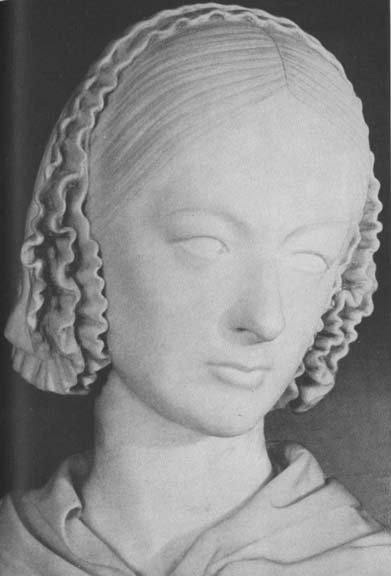
For the bust by Steell, now in the Royal United Service Institution, she gave only two sittings; and then only because it was to be paid for out of the proceeds of a fund raised by small subscriptions from the noncommissioned officers and men of the British Army. Hilary had been given a unique opportunity. She began the statuette and at first it progressed well. But she did not finish it. Months went by, Hilary stayed with one sister while her husband was away, nursed another sister's children through measles; but she did not complete the statuette.
"Hi! It is now the seventh month since you told me that little horrid thing would be done 'Next Monday'---since then 30 Mondays have elapsed," Miss Nightingale wrote to her in July, 1860. At the end of August Miss Nightingale refused to leave the Burlington for Hampstead until the statuette was done. Hilary was forced to finish it, but she was dissatisfied and began another. The second statuette was not satisfactory. Hilary took advice from everyone and was "almost ill of trying to alter and improve to meet everyone's views and strictures." The head of the first was united with the body of the second. The face was worked over again and again. Finally, she lost heart altogether.
The statuette was not finished until the spring of 1862. The sculptor Thomas Woolner was called in to give technical advice on the final version, and it was exhibited at the Royal Academy. Miss Nightingale's family did not like it. "I have seen our F," wrote Fanny to Parthe, "and am shocked at the poor little finnikin minnikin they call Florence." Nevertheless, and in spite of the fact that it is slight and amateurish, a sketch rather than a finished portrait, the statuette is one of the best likenesses of Miss Nightingale. In 1866 Mrs. Sutherland wrote: "There are photographs of the statuette which (though it seems odd to say so) are more characteristic than the actual portraits, none of which . . . give a real idea of what you were ten years ago."
Unwillingly Miss Nightingale realized that with all her talent, all her charm, all her intelligence, Hilary was frittering her life away. In March she went to do a cure at Malvern, and while she was there Miss Nightingale wrote telling her not to come back. "Dearest. I hope that you will have guessed that long before last year had ended, I had quite come to the conclusion that it would not be right for me any more to absorb your life in letter writing and house-keeping. For this I gave you my reasons in five big conversations. . . . If I could, if we were on that kind of terms together, I would go down on my knees and ask you to forgive me for having made such a use of your life. If you like to come back on the terms about the Atelier and the hours which we discussed by letter---as my guest and friend---oh my very best and dearest friend---but not as my letter-writer and housekeeper---let us now discuss what those hours shall be, you settling them before you come back. . . ."
But Hilary would settle nothing, and she was not allowed to return, though sending her away, Miss Nightingale told Clarkey, was like amputating her own limb. A month later a fresh blow fell. Clough's health gave way completely. He was told his only chance of survival was complete rest in a warm climate, and in April, 1861 he and his wife went abroad to Greece.
She was left entirely alone. In a year she had lost Alexander, Aunt Mai, Hilary, and Clough. She was in no condition to face the enormous burden of work involved in War Office reform combined with racking suspense over Sidney Herbert's health.
In January, 1861 the scheme for War Office reorganization was launched. There was to be a pitched battle between the forces of reform and the forces of bureaucracy. Sidney Herbert on the one hand, Benjamin Hawes on the other. Miss Nightingale was not confident. Sidney Herbert was the pivot; Sidney Herbert was the essential; Sidney Herbert alone could carry the scheme through---and she feared Sidney Herbert was weakening. "Our scheme of reorganisation is at last launched at the War Office," she wrote to Sir John McNeill on January 17, "but I fear Hawes may make it fail. There is no strong hand over him."
Again she hid fear behind impatience. She wrote to Douglas Galton in January that Sidney Herbert was the weak spot in the War Office reorganization scheme. "No one appreciates as I do Mr. H's great qualities. But no one feels more the defect in him of all administrative capacity in details." By March she was frantic, declaring that Sidney Herbert was inefficient. She warned Douglas Galton, "Though he says he will set about your committee as soon as ever you like, make haste, for he is like the son who said 'I go and goeth not.' " She railed at his delays; she complained of "the difficulty of bringing him up to scratch," the impossibility of getting a decision from him, his "total incapacity for attending to an administrative question for a single hour." She obstinately refused to recognize that he was a dying man. "He is a great deal better of that there is no doubt," she wrote to Liz in March, and added, "he is a bad patient." On May 14 she wrote: "I am sure the Cid thinks 'Oh she does not know how weak I feel and how much worse in general health' . . . but I do. I see it every time I see him and sorrowfully perceive that he is weaker and thinner---and yet I don't think him worse in general health, not materially worse." The opinion of the doctors was against her, but she dismissed their opinion. "Almost all London physicians are quacks."
She spared him nothing; she stood behind him insisting that his sick mind should flog itself on, his weary spirit brace itself for fresh struggle. No one intervened on his behalf; Liz seconded her demands, and he bore it all with "angelic temper." By the end of May it was useless for her to rail at him---what she demanded he no longer had the power to attempt. Disease was advancing with horrible swiftness. He spent the mornings on a sofa in Belgrave Square drinking gulps of brandy until he had the strength to crawl down to the War Office, where he arrived too exhausted to work. In fact, he was dying on his feet; an examination, made after his death two months later, showed disease so far advanced that it was a miracle he had been able to work at all for the past year.
The end came in June. In the first week in June he collapsed, and on June 7 he wrote to Miss Nightingale telling her he could struggle no longer. He must resign the War Office and retire. It was the letter of a beaten man. "As to organisation I am at my wits end. The real truth is that I do not understand it." He suggested that he should remain in office for a few weeks longer so that he could carry through, as a last gesture, certain points of internal organization and military hospital reform.
On June 8 she replied, bitterly, contemptuously, and cruelly. He had failed her. She refused to accept his health as an excuse. "I believe you have many years of usefulness before you. I have repeated so often my view of your case---and I never felt more sure of any physical fact in my life---that I will not trouble you with writing my letters all over again." She told him what his failure meant. Their work was ruined. War Office reorganization was a general wreck. The reform of military hospitals was a general wreck. The suggestion that he should stay on in office just long enough to carry through certain essential reforms she contemptuously rejected. "No reform had better be done by anyone about to leave office. . . . How perfectly ineffective is a reform unless the reformer remains long enough at the head TO MAKE IT WORK." For herself personally there was nothing he could do, but on Douglas Galton's behalf she asked him to establish and define Galton's position at the War Office, where his authority had been questioned. "I consider your letter as quite final about the reorganisation of the W.O. And I promise never to speak of it again. Many women will not trouble you by breaking their hearts about the organisation of an office---that's one comfort. . . . Hawes has won. If you will not think me profane I will say 'Hell hath gotten the victory.' "
She cut herself off from him. He was still at the War Office preparing to hand over to his successor. She would not see him or write to him. Uncle Sam remonstrated with her and was told, "There is no uneasiness between me and Lord H. I am sure he does not at all realise what I feel about his failure, but thinks I do not see him or write to him because of my own health." He did realize, and he could not bear it. Her anger he had always been able to bear, but he could not endure her unhappiness. "Poor Florence "---he used the phrase so often. She gave up so much, and she was doomed to fail. He had always seen that she must fail, that the sacrifice must be in vain; from the beginning he had known that the task she insisted on undertaking was too difficult. But she had almost made him believe that faith could move mountains. Poor Florence.
 |
 |
|
From the bust by Sir John Steell |
|
It was not in his nature to leave her to eat her heart out; he had always said, "It takes two to make a quarrel and I won't be one." Ill and harried as he was, he went to face her. She was in the old familiar rooms at the Burlington. Here, where so much had been endured, so much had been hoped, so much had been sacrificed, a terrible interview took place. In September, 1861, in a letter to Harriet Martineau she described what passed between them. She was a woman possessed; she was consumed with grief and rage; she would not see that she had before her a dying man. By failing to endure---and who could be asked to endure more than she had endured?---he was dooming the British Army. She felt no more pity for him than if he had in fact been an inanimate tool breaking at the crucial moment in her hand, and she lashed him with her tongue. "A Sidney Herbert beaten by a Ben Hawes is a greater humiliation than the disaster of Scutari," she told him implacably. "No man in my day has thrown away so noble a game with all the winning cards in his hands." She said that he bore it all. He did not justify himself. "And his angelic temper with me I shall never forget."
Did she break his heart, or had he already passed beyond her power to wound? The end had almost come. He had intended when he resigned to remain at the War Office clearing up his work for some weeks, but within a fortnight he had another and even more serious collapse. He was ordered to give up work at once and to go to Spa for a cure. On July 9 he came to the Burlington to say good-bye to her. They were not alone. He could no longer walk easily, and he was brought in a carriage and assisted up the stairs. She never saw him again.
He managed to reach Spa, but his condition was hopeless. He wished to be at Wilton, and on the 25 he came home. It was evident that he was dying. He reached Wilton, saw again the place where he loved every spot as if it were a living person, and early in the morning of August 2, 1861, he died. Liz kept notes of his last hours and his last words for Florence. His last coherent thought, she wrote, was of Douglas Galton's position in the War Office which Florence had asked him to establish, his last murmur "Poor Florence . . . poor Florence, our joint work unfinished." "And these words he repeated twice."
Miss Nightingale was in Hampstead when she heard the news. She was overwhelmed. Anguish, despair rushed in on her like the bursting of a dam. She hurried down to the Burlington where she collapsed, and was seriously ill for nearly four weeks. Uncle Sam took charge of her affairs, informing all correspondents by her orders that "a great and overwhelming affliction entirely precludes Miss Nightingale from attending to any business."
The structure of her existence had been destroyed at a single blow. "He takes my life with him," she told W. E. N. "My work, the object of my life, the means to do it, all in one depart with him. . . . Now not one man remains (that I can call a man) of all whom I began work with five years ago. And I alone of all men 'most deject and wretched' survive them all. I am sure I meant to have died." Successive frenzies of grief, of longing, of rebellion swept over her. She found it difficult not to blame God, who possessed, after all, absolute power, for letting Sidney Herbert die. Sidney Herbert's death involved the misfortune moral and physical of five hundred thousand men," and it would have been "but to set aside a few trifling physical laws to save him."
There was no doubt of her agony, and yet-it was not quite what might have been expected. She felt grief, longing, the hopeless regret which follows bereavement, but she did not feel remorse. She felt she was justified. She knew that Sidney Herbert had found the burden of life almost too heavy to bear, that he had been overworked, harried, and subjected to unjust criticism, and she regretted it had been necessary for her to add to his burdens. But the necessity had existed; it had been her duty to act as she did; and she had nothing with which to reproach herself. In the letter to Harriet Martineau of September 9 she wrote: "I too was hard on him." It was the only admission she ever made that she had anything to regret. In the same letter in which she told Harriet Martineau of the "angelic temper" with which he bore the hard things she said to him, she added implacably, "at the same time he knew that what I said was true."
He died with a broken heart, but she never admitted she had done anything toward breaking it. That had come about through a combination of the world's cruelty and his own weakness. She never felt she was to blame.
Yet now he was dead an extraordinary change took place in her. While Sidney Herbert was alive she had been the teacher, he the pupil; she had been the hand, he the instrument. Now he was dead she called him her "Master." It was the name by which she always referred to him. She who had criticized him never uttered now a word that was not praise, she who had lashed him with her tongue, now abased herself before him. She spoke of herself as his adoring disciple. "I loved and served him as no one else," she wrote to Sir John McNeill.
She developed an intense possessiveness about him. No other claim must equal hers; no knowledge of him could be compared with her knowledge. "I understood him as no one else," she wrote. It was the old story. What she felt, what she endured, must be unique. No illness was to be compared with her illness; no self-sacrifice was to be compared with her self-sacrifice; no grief could rival her grief. She would not even admit a wife could be more bereaved. "How happy widows are," she wrote to Uncle Sam on August 14, 1861, "because people don't write them harassing letters in the first week of their widowhood and yet I know of no widow more desolate than I."
Hand in hand with intense jealous emotion came resentment. The world did not understand; friends did not understand; they had wrong ideas, miserable misapprehensions.
In fact, the world was doing Sidney Herbert less than justice. His obituary notices were cold. The disasters in the Crimea were remembered, but it seemed that no one was aware of the benefits which had since been conferred on the British Army through him. His friends thought that something should be written which did justice to his achievements; and Miss Nightingale was approached by Gladstone to write a short memoir. On August 21, in a turmoil of grief, irritation, and misery, she wrote a vast letter to Sir John McNeill saying she knew nothing about what had appeared in newspapers. As far as she was concerned, she had stopped all newspapers from the day of Sidney Herbert's death because she could not bear to read one line about him. But "before he was cold in his grave his wife, Mr. Gladstone and the War Office have done nothing but harass me. . . . Twice in the first week after his death I was written to for materials for his life. Mr. Gladstone was one of these as you will guess. And he enclosed me a sketch written by her. There was not one word of truth in it from beginning to end!!! She represented him as having triumphed (and quoted words of his to this effect) in having effected the reorganisation of the War Office, which he died of regret for not having done. I told Mr. Gladstone a little of the real truth and wrote at his request a slight sketch of what he had done. (And the week was not out before she wrote to me for another.) . . . This is just what I most dreaded and least asked. In fact I really would hide myself in the East of London not to do it."
Grief, resentment, irritation, despair, discharged themselves in the floods of words, which were her safety valve. But when irritation and resentment were discharged, as in all the crises of her life, justice and generosity remained behind; and when fury at Liz's obtuseness had run its course, there emerged recognition of her qualities and rights, and Miss Nightingale became the support and consolation of Sidney Herbert's widow.
During the first fortnight after her husband's death, Liz wrote to her five times. "You will say the children ought to be a comfort to me," she wrote on August 14, 1861, "but I suppose I am not naturally fond of children---at any rate I have never been used to be much with them. He was my all. He is gone." "You know all I have to bear more than anyone else," she wrote in November, 1861.
She continued to include Miss Nightingale in her family life after Sidney Herbert's death. "I cannot help repeating that there is a great 'fond' of justice and magnanimity in her," Miss Nightingale wrote to W. E. N. in May, 1862. "I am always first with her because I was first with him. My claim to be consulted, to be informed is always recognised."
But she could not leave Sidney Herbert's reputation to the uninformed panegyrics of his wife or to the faint praises of men like General Sir John Burgoyne, who said at a memorial meeting: "Lord Herbert's hobby was to promote the health and comfort of the soldier and his pet was Miss Nightingale who followed the same pursuit." She reconsidered her decision and went to the Burlington, where she shut herself up for a fortnight, writing an account of Sidney Herbert's work for the army which she sent to Mr. Gladstone.
On August 21 she had told Sir John McNeill that she had asked Gladstone to assume Sidney Herbert's mantle. "I took advantage of my opportunity and told Mr. Gladstone a little of what he [Sidney Herbert] had not done, asking him whether I should tell him the rest, and asking him whether I should ask him to help in it for S. Herbert's sake. The reply was truly Gladstonian---cautious, cold, complimentary yet eloquent---but evidently intending to do nothing."
Her memoir was privately printed in 1861 and privately circulated under the title, Private and Confidential. Sidney Herbert---on his Services to the Army. In 1862 the memoir was enlarged, read as a paper at the London meeting of the Congrès de Bienfaisance in June, and subsequently published as a pamphlet under the title: Army Sanitary Administration and its Reform under the late Lord Herbert.
Sidney Herbert has left little impression. His term of office was a period of great and promising beginnings fated to come to almost nothing. Many years were to pass before the reforms for which he and Miss Nightingale labored became realities. Much of what he did was undone by his successors; many improvements have necessarily been superseded and forgotten.
It was his personal tragedy that fate called on him to expend his genius on a subject for which he was temperamentally unsuited. But he did not sacrifice himself in vain. The British Army was fortunate in finding such a champion. Without his influence, the prestige deriving from his high standing, and his altruism, the cause of the British soldier might well have languished for another half-century. He died before his work was done, and no outstanding reform is associated with his name, but he succeeded in making the health of the British soldier an issue of first-class importance, which no subsequent administration could ignore,, The Royal Sanitary Commission to inquire into the Health of the Army in 1857 may not have done all that was anticipated in the first flush of hope. But that it should have sat at all was a triumph and marked the dawn of a new age.
When Miss Nightingale had finished writing her memoir, she left the Burlington for ever. It was haunted; she could never bring herself to go back there. She could see Sidney Herbert in the street. "I could not bear to look down Burlington Street where I had seen him so often." And Sidney Herbert was not the only ghost. She could see Alexander; Clough, now desperately ill; Aunt Mai who had deserted her; Hilary, the limb she had been forced to cut off. "I have quite decided not to return to the Burlington where one by one my fellow workers whom I had so laboriously got together have been removed from me," she wrote to W. E. N. on September 9, 1861. She retired to Hampstead, where she isolated herself completely. She would see no one, fellow workers, family, or friends. To overwhelming grief was added blank despair as report after report reached her of Sidney Herbert's work being undone. During the first week after his death three important decisions he had taken were reversed by the Duke of Cambridge, the Commander-in-Chief, "who absolutely cringed to him when alive," she wrote to Sir John McNeill on August 21. "On one of these occasions Lord de Grey, who happened to be in G. Lewis' room (everything happens---is not done---at that miserable place) said, 'Sir, it is impossible; Ld Herbert decided it---and the House of Commons voted it' and walked out of the room. It was less wise than honest. But it had its effect for the time.
G. Lewis was awed and the C-in-Chief silenced. But only for the time." On September 24 she wrote to Harriet Martineau: "The Commander in Chief rides over the weak and learned Secretary of State (Sir G. Lewis) as if he were straw. Day rooms, Barrack Inspections, Hospitals, all the Sanitary Improvements, it is the same. Not one will they leave untouched." "As for me," she wrote to Sir John McNeill on August 21, "I feel like the Wandering Jew---as if I could not die."