
IT WAS THE OPENING of the catastrophe. The destruction of the British Army had begun. These were the first of the stream of men suffering from dysentery, from scurvy, from starvation and exposure who were to pour down on Scutari all through the terrible winter. Over in the Crimea on the heights above Sebastopol the army was marooned, as completely as if on a lighthouse. Thousands of men possessed only what they stood up in. After the landing at Calamita Bay and after the battle of the Alma, when the troops were riddled with cholera and the heat was intense, the men had, by their officers' orders, abandoned their packs.
Seven miles below the heights lay Balaclava, the British base. There had been one good road, the Woronzoff road, but the Russians had gained possession of it in the battle of Balaclava on October 25. There remained a rough track. The weather was still moderately good, but the track was not metaled and put into order before the winter. Men to carry out the work were non-existent. There was no native labor to be hired in this deserted spot. There were no tools. Above all, there was no transport. The army was still without wagons or pack animals.
Balaclava had become a nightmare of filth. Lord Raglan had been attracted by its extraordinary harbor, a land-locked lagoon, calm, clear, and almost tideless, so deep that a large vessel could anchor close inshore. But Balaclava was a fishing village of only 500 inhabitants, a single street of white vine-wreathed houses clinging to a precipitous ravine. No steps were taken to inspect Balaclava before it was occupied or to keep it in a sanitary condition. The army which marched in was stricken with cholera, and within a few days the narrow street had become a disgusting quagmire. Piles of arms and legs amputated after the battle of Balaclava, with the sleeves and trousers still on them, had been thrown into the harbor and could be seen dimly through the water.
Bodies of dead men rose suddenly and horribly out of the mud to the surface. Anchor chains and cables were fouled by limbs and trunks. The surface of the once translucent water was covered with brightly colored scum, and the whole village smelled of sulphuretted hydrogen.
On November 5 the Russians had attacked at Inkerman, on the heights above Sebastopol. In a grim battle fought in swirling fog the British were victorious. But victory was not reassuring. The British troops were exhausted; their commanders were shaken by the revelation of Russian strength. It was evident that Sebastopol would not fall until the spring.
And now an ominous incident occurred. A Mr. Cattley was attached to the British Army as chief interpreter. Mr. Cattley knew the Crimea well, and he sent in his resignation. He saw a great disaster ahead. The British Army was going to winter on the heights before Sebastopol, and the British Army was not only totally destitute of supplies but without the means of being able to transport supplies should they ultimately arrive. Moistened by the dews of autumn, and churned by the wheels of heavy guns, the rough track from Balaclava to the camp had become impassable. Mr. Cattley wrote to Lord Raglan warning him that winter was near, that the climate of the Crimea was subject to sudden and terrifying changes, and tendering his resignation. Lord Raglan made light of the warning and besought Mr. Cattley to withdraw his resignation. He did so and stayed to die in 1855.
The weather changed rapidly, icy winds blew---and the troops on the heights above Sebastopol had no fuel. Every bush, every stunted tree was consumed, and the men clawed roots out of the sodden earth to gain a little warmth. As it grew colder, they had to live without shelter, without clothing, drenched by incessant driving rain, to sleep in mud, to eat hard dried peas and raw salt meat. The percentage of sickness rose and rose, and the miserable victims began to pour down on Scutari. The authorities were overwhelmed. The first transports were not even expected. Through an oversight, notification that they had sailed was received only half an hour before the sick and wounded began to land. Utter confusion resulted, official barriers were swept away, and everyone was pressed into service. The Hon. and Rev. Sidney Godolphin Osborne, a personal friend of Sidney Herbert, had come out as a volunteer to act as chaplain to the troops in hospital, and had been cold-shouldered by the authorities; now he found himself assisting at operations. Mr. Augustus Stafford, M.P., who had come to Scutari to investigate the hospitals privately, and had had difficulty even in obtaining admission, had a saucepan thrust into his hand and was asked to go down to the wretched pier to pour some kind of warm stimulant down the throats of men writhing in agony. "Everyone helped," he told the Roebuck Committee, "the official people were assisting as much as possible but the number of official people was too small and the arrival was so great, a flood of sick came upon them, bursting in so suddenly that the means of the hospital were not able to meet it."
It was Miss Nightingale's opportunity---at last the doctors turned to her. Her nurses dropped their sorting of linen and began with desperate haste to seam up great bags and stuff them with straw. These were laid down not only in the wards but in the corridors, a line of stuffed sacks on each side with just room to pass between them.
Day after day the sick poured in until the enormous building was entirely filled. The wards were full; the corridors were lined with men lying on the bare boards because the supply of bags stuffed with straw had given out. Chaos reigned. The doctors were unable even to examine each man. Mr. Sabin, the head Chaplain, was told that men were a fortnight in the Barrack Hospital without seeing a surgeon. Yet the doctors, especially the older men, worked "like lions" and were frequently on their feet for twenty-four hours at a time. "We are lucky in our Medical Heads," Miss Nightingale wrote to Dr. Bowman on November 14. "Two of them are brutes and four are angels---for this is a work which makes angels or devils of men. . . . As for the Assistants, they are all cubs and will, while a man is breathing his last under the knife, lament the 'annoyance of being called up from their dinners by such a fresh influx of wounded.' But unlicked cubs grow up into good old Bears, tho' I don't know how, for certain it is the old Bears are good."
The filth became indescribable. The men in the corridors lay on unwashed rotten floors crawling with vermin. As the Rev. Sidney Godolphin Osborne knelt to take down dying messages, his paper became covered thickly with lice. There were no pillows, no blankets; the men lay, with their heads on their boots, wrapped in the blanket or greatcoat stiff with blood and filth which had been their sole covering perhaps for more than a week. There were no screens or operating tables. Amputations had to be performed in the wards in full sight of the patients. Mr. Osborne describes the amputation of a thigh "done upon boards put on two trestles. 1 assisted . . . during the latter part of the operation the man's position became such from want of a table he was supported by my arm underneath, a surgeon on the other side grasping my wrist." One of Miss Nightingale's first acts was to procure a screen from Constantinople so that men might be spared the sight of the suffering they themselves were doomed to undergo.
She estimated that in the hospital at this time there were more than 1000 men suffering from acute diarrhea and only twenty chamber pots. The privies in the towers of the Barrack Hospital had been allowed to become useless; the water pipes which flushed them had been stopped up when the Barracks were used for troops, and when the building was converted into a hospital they had never been unstopped. Mr. Augustus Stafford said there was liquid filth which floated over the floor an inch deep and came out of the privy itself into the ante-room. He told the Roebuck Committee: "The majority of the cases at the Barrack Hospital were suffering from diarrhea, they had no slippers and no shoes, and they had to go into this filth so that gradually they did not trouble to go into the lavatory chamber itself." Huge wooden tubs stood in the wards and corridors for the men to use. The orderlies disliked the unpleasant task of emptying these, and they were left unemptied for twenty-four hours on end. In this filth lay the men's food---Miss Nightingale saw the skinned carcase of a sheep lie in a ward all night. "We have Erysipelas, fever and gangrene," she wrote ". . . the dysentery cases have died at the rate of one in two . . . the mortality of the operations is frightful. . . . This is only the beginning of things." By the end of the second week in November the atmosphere in the Barrack Hospital was so frightful that it gave Mr. Stafford the prevailing disease of diarrhea in five minutes. The stench from the hospital could be smelled outside the walls.
A change came over the men, said Mr. Macdonald. The classification between wounded and sick was broken down. The wounded who had been well before began to catch fevers, "gradually all signs of cheerfulness disappeared, they drew their blankets over their heads and were buried in silence."
Fate had worse in store. On the night of November 14 it was noticed that the sea in the Bosphorus was running abnormally high, and there was a strange thrumming wind. Within a few days news came that the Crimea had been devastated by the worst hurricane within the memory of man. Tents were reduced to shreds, horses blown helplessly for miles, buildings destroyed, trees uprooted. The marquees which formed the regimental field hospitals vanished, and men were left half buried in mud without coverings of any kind. Most serious of all, every vessel in Balaclava harbor was destroyed, amongst them a large ship, the Prince, which had entered the harbor the previous day loaded with warm winter clothing and stores for the troops.
The hurricane rendered the situation of the army desperate. Such few stores and such little forage as it possessed were destroyed. Winter began in earnest with storms of sleet and winds that cut like a knife as they howled across the bleak plateau. Dysentery, diarrhea, rheumatic fever increased by leaps and bounds. More and more shiploads of sick inundated Scutari. The men came down starved and in rags. "They were without their shoes and their shirts had been thrown away in utter disgust at their filthiness or torn in shreds . . . they were swarming with vermin; their trousers were all torn; their coats ragged . . . sometimes they came down without any coats at all," said Mr. Macdonald in his evidence before the Roebuck Committee. The men told the nurses to keep away because they were so filthy. "My own mother could not touch me," said one man to Sister Margaret Goodman. By the end of November the administration of the hospital had collapsed.
"In the confusion at Scutari," Mr. Augustus Stafford told the Roebuck Committee, "I was never able to distinguish where one department began and the other ended. . . . Whenever I had anything to do with the authorities at Scutari, 1 never met with anything but personal courtesy and a wish to reform the evils . . . but through all the departments there was a kind of paralysis, a fear of incurring any responsibility, and a fear of going beyond their instructions."
For instance, Mr. Stafford determined to get the lavatories cleaned. He approached Dr. Menzies, who said it was none of his business. "If he had got in 12 or 13 men to clean out the lavatories he would immediately have been pounced on by another department and told that it belonged to that department." Mr. Stafford then went to Major Sillery, Military Commandant of the Hospital, who freely admitted the urgent necessity of the work, but asked where the money was to come from. He was "very nervous and anxious, very much distressed and perplexed." He had no instructions to execute the work, the money would have to be advanced, and he had no security for repayment. Mr. Stafford offered to pay himself. Major Sillery was horror-struck and refused. Mr. Stafford declared that if the lavatories were not cleaned he would write a letter and have it read aloud in the House of Commons. He then retired to bed with diarrhea.
In his evidence before the Roebuck Committee Mr. Stafford made it clear that he did not blame Major Sillery. "He was most anxious to do all he could for the improvement and amelioration of the hospitals, but he had no money. He did not consider, neither did I, that he was called on to risk the money which he, as a man deriving his support from his profession would have had to do, if he had advanced this money for the payment of 16 Turks to cleanse the lavatories."
And then in the misery, the confusion, a light began to break. Gradually it dawned on harassed doctors and overworked officials that there was one person in Scutari who could take action---who had money and the authority to spend it---Miss Nightingale.
She had a very large sum at her disposal derived from various sources and amounting to over £30,000, of which £7 000 had been collected by her personally; and Constantinople was one of the great markets of the world. During the first horrors of November, the gathering catastrophe of December, it became known that whatever was wanted, from a milk pudding to a water-bed, the thing to do was to "go to Miss Nightingale."
Each day she ascertained what comforts were lacking in the Purveyor's Store, what articles supply was short of, what requisitions had been made which had not been met. Mr. Macdonald then went into Constantinople and bought the goods, which were placed in her store and issued by her upon requisition in the official form by a medical officer. Nothing, with the exception of letter-paper and pencils, was ever given out without an official requisition duly signed. Gradually, Mr. Macdonald told the Roebuck Committee, the doctors ceased to be suspicious and their jealousy disappeared.
In one urgent work she met no opposition. Just as it was no one's business to clean the lavatories, so it was no one's business to clean the wards. The first commission Mr. Macdonald executed for Miss Nightingale was the purchase of 200 hard scrubbing-brushes and sacking for washing the floors. She insisted on the huge wooden tubs in the wards being emptied, standing quietly and obstinately by the side of each one, sometimes for an hour at a time, never scolding or raising her voice, until the orderlies gave way and the tub was emptied.
Her next step was to wash the men's clothes. Mr. Macdonald stated that for five weeks after he arrived at Scutari no washing was done at all. The Purveyor had been instructed to make a laundry contract and had done so with a Greek, who was quite unable to fulfill his obligations; he either failed to wash at all or washed in cold water, and shirts came back as filthy as they were sent, still crawling with lice. The men said they preferred their own lice to other people's and refused to part with their shirts, stuffing them, filthy and vermin-ridden, under their blankets. The total amount of washing satisfactorily accomplished for the vast hospital was seven shirts. Miss Nightingale made arrangements to rent a house outside the barracks and have the washing done by soldiers' wives. She consulted Dr. Menzies, telling him she wished to have boilers put in by the Engineers Corps. "Oh, but that is putting you to a great deal of trouble," said Dr. Menzies. "I should think the Purveyor would be able to make arrangements." The boilers were installed and the cost paid out of The Times fund.
Within the hospital her principal ally was Dr. McGrigor, 1st class Staff Surgeon, a young, energetic, man not, she said, wedded in everything to what had been done in the Peninsula. He accepted her nurses and made full use of them.
For a time she tried to work with Lady Stratford. On November 7, two days after her arrival, she wrote to Lord Stratford asking for sheets, shirts, and portable stoves for cooking "extras." He sent her Lady Stratford instead. Lady Stratford would not come across to Scutari (she had been in the Barrack Hospital once and the stench had made her sick), nor did she send linen and stoves, but she offered to get anything that was required in Constantinople. Miss Nightingale asked her to obtain twelve wagons to bring heavy goods up to the Barrack Hospital. Next day she looked out and saw drawn up before her quarters seven glass and gilt coaches and five other vehicles, which she had to pay off out of her own private funds. "This lark of the Ambassadress's," she wrote, "cost Miss Nightingale 500 piastres."
By the end of December Miss Nightingale was in fact purveying the hospital. During a period of two months she supplied, on requisition of Medical Officers, about 6000 shirts, 2000 socks, and 500 pairs of drawers. She supplied nightcaps, slippers, plates, tin cups, knives, forks, spoons "in proportion." She procured trays, tables, forms, clocks, operating tables, scrubbers, towels, soap, and screens. She caused an entire regiment which had only tropical clothing to be re-fitted with warm clothing purchased by Mr. Macdonald in the markets of Constantinople when Supply had declared such clothing unprocurable in the time---Supply was compelled to get all its goods from England. "I am a kind of General Dealer," she wrote to Sidney Herbert on January 4, 1855, "in socks, shirts, knives and forks, wooden spoons, tin baths, tables and forms, cabbages and carrots, operating tables, towels and soap, small tooth combs, precipitate for destroying lice, scissors, bed pans, and stump pillows."
Before Sebastopol conditions grew steadily worse. The stores lost in the hurricane were not replaced. Men, sick or well, lay in a foot of water in the mud covered only by a single blanket. Every root had been burned, and the men had to eat their food raw: meat stiff with salt and dried peas. Tea was withdrawn and green coffee, needing roasting and pounding, was issued instead, because good results had been obtained from the use of green coffee in the Caffre War. There was no bread. As the percentage of sick climbed and climbed, double turns of duty were thrown on the survivors. Men were in the trenches before Sebastopol for thirty-six hours at a stretch, never dry, never warmed, never fed. The sick were brought down to Balaclava strapped to mule-litters lent by the French---there was no British transport of any kind---naked, emaciated, and filthy. They were universally suffering from diarrhea, and strapped to the mules they could not relieve themselves. After waiting hours without food or shelter in the icy wind or driving sleet at Balaclava, they were piled on to the decks of the sick transports and brought down to Scutari. And the catastrophe had not yet reached its height.
At the beginning of December, when the Barrack Hospital was filled to overflowing, a letter from Lord Raglan announced the arrival of a further 500 sick and wounded. It was impossible to cram any additional cases into the existing wards and corridors, and Miss Nightingale, supported by Dr. McGrigor, pressed to have put in order the wing of the hospital which had been damaged by fire before the British occupation; it consisted of two wards and a corridor and would accommodate nearly 1000 extra cases. But the cost would be considerable, and no one in the hospital had the necessary authority to put the work in hand. She had been repeatedly assured by Sidney Herbert that Lord Stratford had carte blanche; now she applied to him, and Lady Stratford came across to Scutari escorted by a couple of attachés. Preferring not to come inside the hospital, she held conferences with the Purveyor and Major Sillery in the courtyard, and 125 Turkish workmen were engaged to repair the wards. After a few days a dispute about the rate of wages arose, and the Turkish workmen struck. Miss Nightingale wrote to Lord Stratford, who denied the slightest knowledge of the business; Lady Stratford withdrew; worried Major Sillery had neither money nor authority. On this Miss Nightingale took matters into her own hands. She engaged on her own responsibility not 125 but 200 workmen, and paid for them partly out of her own pocket and partly out of The Times fund. The wards were repaired and cleaned in time to receive the wounded.
Not only did she repair the wards; she equipped them. The Purveyor could provide nothing. "Orderlies were wanting, utensils were wanting, even water was wanting," she wrote to Sidney Herbert on December 12, 1854--- "I supplied all the utensils, including knives and forks, spoons, cans, towels, etc. . . . and was able to send on the instant arrowroot in huge milk pails (two bottles of port wine in each) for 500 men." The number of sick and wounded finally received was 800. One of the men described his sensations when he at last got off the filthy sick transport and was received by Miss Nightingale and her nurses with clean bedding and warm food---"we felt we were in heaven," he said.
The affair caused a sensation. Its fame reached the Crimea and was discussed in Colonel Sterling's mess. He was outraged. "Miss Nightingale coolly draws a cheque. Is this the way to manage the finances of a great nation? Vox populi? A divine afflatus. Priestess Miss N. Magnetic impetus drawing cash out of my pocket." It was the first important demonstration of what men at Scutari called the "Nightingale power." Respect for the "Nightingale power" was increased when it became known that her action had been officially approved by the War Department and the money she had spent refunded to her.
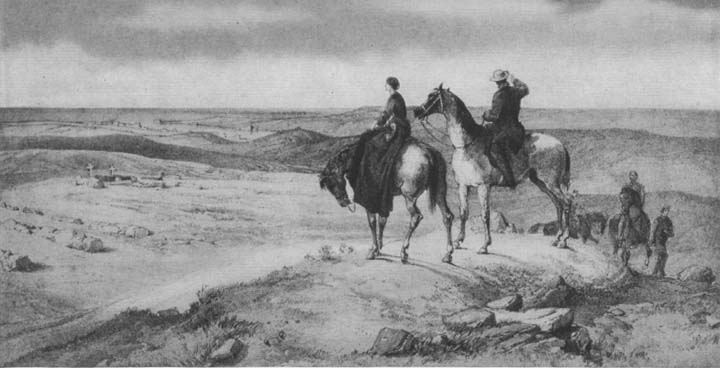 After a drawing by Parthenope Lady Verney |
 After a drawing by Parthenope Lady Verney |
But to Miss Nightingale these victories were only incidental; she never for a moment lost sight of the fact that the object of her mission was to prove the value of women as nurses. But, unhappily, no difficulties with doctors or purveyors were as wearing or as discouraging as her difficulties with her nurses.
"I came out, Ma'am, prepared to submit to everything, to be put on in every way. But there are some things, Ma'am, one can't submit to. There is the Caps, Ma'am, that suits one face and some that suits another. And if I'd known, Ma'am, about the caps, great as was my desire to come out to nurse at Scutari, I wouldn't have come, Ma'am." This, Miss Nightingale wrote to Dr. Bowman on November 14, 1854, was a specimen of the kind of question which had to be adjusted in the midst of appalling horror. "We are," she wrote, "steeped up to our necks in blood." Mrs. Roberts from St. Thomas's was worth her weight in gold, Mrs. Drake from St. John's House was a treasure, but most of the other hospital nurses were not fit to take care of themselves. Nurses had to be forbidden to enter any ward which contained men even moderately well, to be forbidden to be in the wards on any pretext after 8 P.m. To convince any of them, nurses or sisters, of the necessity for discipline was almost impossible. Why should a man who desperately needed stimulating food have to go without because the nurse who had the food could not give it to him until she had been authorized by a doctor? It was felt that Miss Nightingale was callous. It was said that she was determined to increase her own power and cared nothing for the sick.
These difficulties came to a head in December in the case of Sister Elizabeth Wheeler, one of the Sellonites. Sister Elizabeth, who was nursing wards of men suffering from diarrhea and dysentery, saw the men brought in emaciated and in agony from the fearful pangs of hunger superimposed on diarrhea, and her heart bled for them. She was a nurse of experience, and in her opinion the amount of food given to the men was inadequate: she was not allowed sufficient milk, eggs, or port wine. A passionate and emotional woman, she had on several occasions forced her way in to Miss Nightingale and made a scene, demanding larger quantities. Miss Nightingale refused to supply anything except what was ordered by the doctor and written and confirmed on the diet roll. Sister Elizabeth was furiously angry. She wrote letters home describing the fearful state of the wards and accusing the doctors of callousness and inhumanity. Unhappily one of her relatives passed on a letter to The Times. It was published on December 8, 1854, as a letter from a heroic Scutari nurse, and was made full use of in the campaign The Times was conducting against the Government. Miss Nightingale was horrified; nothing more unfortunate could have occurred. She was trying to convince the doctors of the complete loyalty of her nurses; here was a complete contradiction; she was trying to weld the nurses into a disciplined band by means of her authority, and here her authority was directly attacked. An investigation took place before the Hospitals Commission in December, 1854, Miss Nightingale and Sister Elizabeth both giving evidence. Sister Elizabeth's letter was not correct in its facts, for she had represented herself as nursing the wounded, but she had never nursed surgical cases. She had given a very high number of deaths and conveyed the impression that the deaths had occurred in a single ward when in reality they were the deaths for an entire division of the hospital. Her assertions were held to be inaccurate, and she was asked to resign.
Sister Elizabeth's attitude was common to a large number of Miss Nightingale's nurses. Reluctance to accept her authority and obey her instructions was constant from the beginning to the end of her mission, and many of her nurses heartily disliked her.
However, she had managed to establish herself, and now her nurses were fully occupied. She bad also acquired two new and loyal workers in Dr. and Lady Alicia Blackwood, who bad come out at their own expense after the battle of Inkerman. Dr. Blackwood obtained an appointment as Military Chaplain; Lady Alicia applied to Miss Nightingale to know where she could be most useful. After a few seconds of silence, and with a peculiar expression of countenance, Miss Nightingale said: "Do you mean what you say?" Lady Alicia was rather surprised. "Yes, certainly, why do you ask me that?" "Oh! because I have had several such applications before, and when I have suggested work, I found it could not be done, or some excuse was made; it was not exactly the sort of thing that was intended, it required special suitability, etc." "Well, I am in earnest," said Lady Alicia. On this Miss Nightingale asked her to be responsible for the wretched women who had been allowed to accompany the army and had been sent down from Varna. More than 260 women and infants were living in dark cellars beneath the Barrack Hospital; soldiers' wives, widows and prostitutes were crowded together, men from the Depot were forced to live with their wives in a room contained fifty or sixty other persons, a soil pipe drained into the corner of one cellar, drinking was incessant and the place was a pandemonium of drunkenness, cursing, and swearing. Lady Alicia removed the more respectable among the women, setting them to work in the laundry, and began a lying-in hospital. The children were separated from the adults, and a system of doling out food through Mr. Bracebridge was adopted which, Miss Nightingale said, became the curse of the hospital. Thirty-six women and thirty-six infants under the age of three months howled together daily outside Mr. Bracebridge's door---the Turks called them his thirty-six wives.
On December 14 she wrote Sidney Herbert a cheerful letter:
What we may be considered as having effected:
(1) The kitchen for extra diets now in full action.
(2) A great deal more cleaning of wards, mops, scrubbing brushes, brooms and combs given out by ourselves.
(3) 2000 shirts, cotton and flannel, given out and washing organised.
(4) Lying-in hospital begun.
(5) Widows and soldiers' wives relieved and attended to.
(6) A great amount of daily dressing and attention to compound fractures by the most competent of us.
(7) The supervision and stirring-up of the whole machinery generally with the concurrence of the chief medical authority.
(8) The repairing of wards for 800 wounded which would otherwise have been left uninhabitable. (And this I regard as the most important.)
She never wrote quite so cheerfully again. On December 14 she suddenly discovered, through being shown a letter written by Liz Herbert to Mrs. Bracebridge, that a party of nurses numbering no fewer than forty had left London under the leadership of Mary Stanley and were actually due to arrive at Scutari the next day.
She had not been consulted or informed, and the despatch of the party was in direct contravention of her agreement with Sidney Herbert, There was an even more serious aspect; at this critical moment, when she was struggling with difficulties caused by Sister Elizabeth and her authority was being questioned, the party was consigned not to her but to Dr. Cumming; she had been publicly passed over. The significance of this action was not lost on either her friends or her enemies at Scutari, and Sidney Godolphin Osborne wrote that he feared the Nightingale ministry seemed to be coming to an end. She was furiously angry, and on December 15 she wrote Sidney Herbert a scathing letter:
DEAR MR. HERBERT,
When I came out here as your Supt. it was with the distinct understanding (expressed both in your own hand writing and in the printed announcement which you put in the Morning Chronicle which is here in everyone's hands) that nurses were to be sent out at my requisition only, which was to be made only with the approbation of the Medical Officers here. You came to me in great distress and told me you were unable for the moment to find any other person for the office and that, if I failed you, the scheme would fail.
I sacrificed my own judgment and went out with forty females, well knowing that half that number would be more-efficient and less trouble, and that the difficulty of inducing forty untrained women, in so extraordinary a position as this (turned loose among 3000 men) to observe any order or even any of the directions of the medical men, would be Herculean.
Experience has justified my foreboding. But I have toiled my way into the confidence of the medical men. I have, by incessant vigilance, day and night, introduced something like order into the disorderly operations of these women. And the plan may be said to have succeeded in some measure, as it stands. . . .
At this point of affairs arrives at no one's requisition, a fresh batch of women, raising our number to eighty-four.
You have sacrificed the cause, so near my heart. You have sacrificed me---a matter of small importance now---you have sacrificed your own written word to a popular cry. . . .
The quartering them here is a physical impossibility, the employing them a moral impossibility.
You must feel I ought to resign, where conditions are imposed on me which render the object for which I am employed unattainable---and I only remain at my post until I have provided in some measure for these poor wanderers. You will have to consider where they are to be employed, at Malta, Therapia or elsewhere or whether they are to return to England---and you will appoint a Superintendent in my place until which time I will continue to discharge its duties as well as 1 can.
Believe me, dear Mr. Herbert, yours very truly,
FLORENCE NIGHTINGALE.
She had not done with him. She added a stinging postscript.
P.S. Had I had the enormous folly to write at the end of eleven days experience to require more women, would it not seem that you, as a Statesman, should have said "Wait until you can see your way better." But I made no such request. The proportion of Roman Catholics which is already making an outcry you have raised to 25 in 84. Dr. Menzies has declared that he will have two only in the General Hospital---and I cannot place them here in a greater proportion than I have done without exciting the suspicion of the Medical Men and others.
In order that Sidney Herbert should not imagine she had written hastily, she completed the letter by a statement at the foot: "Written. 15 December. Posted 18 December."
On Sidney Herbert's part there was honest misunderstanding. He was harried, in poor health, and almost worked to death. In the confused, unbalanced mind of Mary Stanley there was a mixture of religious fervor---she had secretly determined to become a Roman Catholic before she started for Scutari---and jealousy. The third person concerned, Liz Herbert, was prone to act emotionally and incalculably, to be easily swept into indiscretions; and she, like Mary Stanley, was blinded by religious fervor; though Liz Herbert did not become a Roman Catholic in her husband's lifetime, she was received into the Roman Church after his death.
Mr. Bracebridge spoke angrily of "Popish plots," and that, Miss Nightingale said, was ridiculous. Yet behind the unreliable fervors of Mary Stanley and the easily persuaded emotionalism of Mrs. Herbert was the formidable figure of Manning, who wished to focus on the nuns of his church the fame and the glory which surrounded the Scutari nurses. He had no animus against Miss Nightingale; they remained friends, and she said on several occasions that he had treated her fairly; but the arrival of Mary Stanley's party dealt her mission a blow from which it never completely recovered. Before the arrival of the newcomers on December 15, she was well on the way to complete success.
After it, though she achieved personal triumphs, her authority was not established until her mission was almost ended. Her orders were constantly disobeyed, her right to command questioned, and the original purpose of the undertaking became obscured by a fog of sectarian bickering.
The high percentage of Catholics and High Church Anglicans in her original party had already provoked an outcry. Before she arrived at Scutari, a letter published in the Daily News on October 28, signed "Anti-Puseyite," attacked her for recruiting her nurses from the Sellonites and a "Romanist establishment." He quoted Sidney Herbert's letter, which he declared to be animated by party spirit. (Parthe and Fanny had indiscreetly passed the letter round among their friends, and it had been copied.) Liz Herbert had written to the Daily News saying that Miss Nightingale was a member of the established Church of England, having been originally brought up a Unitarian. But the storm continued.
"Protestant Churchman" and "Bible Reader" wrote to the Standard to denounce her as an "Anglican Papist." Dark references were made to "Anglo-Catholic ladies at the War Office ... .. Jesuit conspiracies," and the activities of "the pervert Manning." One parson went so far as to caution his parishioners against sending any help to Scutari through a party composed of female ecclesiastics and Romish nuns instead of common-sense nurses.
If Mary Stanley had publicly announced her intention of joining the Roman Catholic Church, Sidney Herbert would not have allowed her to go to Scutari. But she kept it a secret and took with her Mother Frances Bridgeman of Kinsale, an Irish nun of ardent and rebellious temperament who openly avowed she intended to execute a spiritual as well as a medical mission.
It was Miss Nightingale's fate to be attacked by both sides, to have to endure what she called the "Protestant Howl" and the "Roman Catholic Storm." She belonged to a sect which, as the Dean of Elphin phrased it, is unfortunately a very rare one, the sect of the Good Samaritan.
Mary Stanley had been instrumental in collecting the first party and could not have organized the second in good faith. Its constitution was contrary to Miss Nightingale's rules. The fifteen Irish nuns considered they were under no obligation to obey anyone but their Superior, Mother Bridgeman, and Mother Bridgeman acknowledged only the authority of her Bishop. The fact that the party was consigned to Dr. Cumming proved a clear intention to evade Miss Nightingale's authority.
The party consisted of 9 ladies, 15 nuns, and 22 nurses, 46 in all. It had been hastily collected. Many of the "hired nurses" were ludicrously without experience, one old woman, Jane Evans, having spent her life looking after pigs and cows. Out of the whole 46 no fewer than 20 had come out with the intention not of nursing but of being "assistant ecclesiastics." Miss Stanley led the party, which was escorted by Dr. Meyer, a physician, and the Honorable Jocelyn Percy, M.P., who had conceived a passionate admiration for Miss Nightingale, and left a life of case and luxury with the object of becoming her fag and her footman. They traveled, like the first party, via Paris and Marseilles, but Mary Stanley had large ideas. A courier went ahead and took rooms for them in the dearest hotel in Paris, and Clarkey was asked to procure a dozen bottles of the best vinegar aromatique in case the nurses and ladies encountered bad smells.
The journey was discouraging. The "hire nurses" got drunk in the train and horrified the ladies by the vulgar peals of laughter which came from their carriage; one or two were drunk at dinner, several collapsed and revealed they suffered from delicate health, and one appeared in an array of rings and brooches. Mary Stanley's spirits sank. Writing a character of each of her party to Liz Herbert, Mary Stanley admitted that the women chosen were too old; perhaps a closer inquiry should have been made into their antecedents and characters. Among the few "quiet sensible" women was Miss Polidori, the aunt of Dante Gabriel Rossetti.
On December 15, between three and four in the afternoon, the Egypt anchored outside Constantinople. Mr. Bracebridge went on board and advised the party not to disembark. There literally was not a vacant corner in Scutari: Miss Nightingale's quarters were already accommodating forty in space adequate for three, and food, water, and fuel were seriously short; nurses required the strictest supervision, and Miss Nightingale could not deal with any more. Dr. Meyer and Mr. Percy were taken aback, and it was agreed that the nurses and ladies should remain on the boat while the gentlemen went to report the arrival of the party to Dr. Cumming. He rebuffed them, declining flatly to employ the nurses and ladies in the hospitals. He could not, even if he had been willing, find them any accommodations at Scutari, which was crammed to overflowing. Lord Stratford had agreed to lend them temporarily a house at Therapia belonging to the Embassy, and there they must go until arrangements could be made to send them home. Next, Dr. Meyer and Mr. Percy went to Miss Nightingale, who summoned Mr. Bracebridge as a witness. The interview was sadly different from anything the romantic Mr. Percy had anticipated. She was in a cold fury. She refused to take any responsibility for the party---she had never asked for them, they had come without her consent. Mr. Bracebridge took down notes of what passed and later called on the two gentlemen with a memorandum of the conversation which they were requested to sign.
One fact in particular was weighing very heavily on both gentlemen's minds. Owing to the style in which the party had traveled, they had spent the whole of the 1500 pounds sterling with which they had started and were penniless.
Off they hurried to see the new Military Commandant, Lord William Paulet---Major Sillery had been recalled that week. The Military Commandant of a hospital was all-powerful, and Lord William was implored to assist them. But he could no nothing. It was a physical impossibility to find accommodations for the party in Scutari, and he certainly could not force nurses on doctors who did not want them. There was nothing for it but to retire. Dr. Meyer and Mr. Percy remained behind in Constantinople trying to find employment and accommodations for the party. Mary Stanley and the other women went to the Embassy house at Therapia, where squabbles immediately broke out between the nurses and ladies.
By the end of December the need for money had become urgent. Dr. Meyer and Mr. Percy had failed to make any arrangements for the nurses in Constantinople, and Lord and Lady Stratford, though "kindness itself," did not advance any money. Dr. Cumming was applied to, but he refused to make any advance except from his own private funds. On the 21 the two gentlemen brought Mary Stanley to interview Miss Nightingale; Dr. Cumming and Mr. Bracebridge were present, and notes of the conversation were taken down. Mary Stanley explained her plan: ten of the Protestants were to be appropriated as assistants by the chaplains and ten of the nuns by the priests, "not as nurses but as female ecclesiastics." Miss Nightingale absolutely refused to countenance the scheme; it was directly contrary to the instructions she had received from the War Office. She denied any responsibility for the party; it had not been consigned to her, and its direction, maintenance and employment were not her affair.
She then offered to lend Mary Stanley 90 pounds sterling from her own private income for the immediate necessities of the party, and it was unwillingly accepted. Later she lent another 300. That evening Mary Stanley wrote to Liz Herbert that it needed "all her love for Flo" not to feel hurt at being treated so officially and being made to discuss all arrangements before witnesses. She added that she did not think the Herberts need be anxious about Florence; as far as looks and power went she had never seen her in greater force.
And before Sebastopol the catastrophe steadily grew, and more and still more sick poured down. Four thousand were received in seventeen days between December 17 and January 3, and the death-rate steadily rose. Mr. Bracebridge wrote to Sidney Herbert on December 14* "Flo has been working herself to death, never sits down to breakfast or dinner without interruption: often never dines . . . the attempt to do more will kill her today 200 sick landed looking worse than any others yet."
Yet, harassed and distracted as she was, when her first anger was over she saw that it would be disastrous to send the party back. Racial and religious issues were involved, and Lord Napier had gone so far as to say that in his opinion there would be almost a rebellion in Ireland if the Irish nuns under Mother Bridgeman were sent home. A scandal would do the cause she had at heart irreparable harm. She must swallow her grievance.
On December 24 she saw Mary Stanley, Mr. Percy, and Dr. Meyer again, and suggested a compromise. Some of the Irish nuns should be taken at once into Barrack Hospital, and to make room for them the white sisters from Norwood, who were not experienced in hospital nursing, should be sent home. She would write to Manning and make it clear that no blame attached to the Norwood nuns. This arrangement would not increase the number of Roman Catholic nuns in the hospital, which was something Dr. Cumming refused to contemplate. She would also endeavor to get some nurses accepted at the new Convalescent Hospitals which were to open in a few weeks. She refused absolutely to have anything to do with the scheme for religious visiting.
Miss Nightingale was, wrote Mary Stanley to Liz Herbert, "very low. She feels that to employ the women herself is impossible---to send them back to England is to incur universal odium and perhaps mar for ever her future powers of usefulness."
On Christmas Day she wrote to Sidney Herbert: "You have not stood by me but 1 have stood by you. . . . All that 1 said in my letter to you I say still more strongly. Please do read it. . . . My heart bleeds for you, that you the centre of the Parliamentary row should have to attend to these miseries, tho' you have betrayed me. . . . I believe it may be proved as a logical proposition that it is impossible for me to ride through all these difficulties. My caïque is upset . . . but I am sticking on the bottom still. But there will be a storm will brush me off."
The storm burst immediately. Fine weather was never to return. The sisters from Norwood, bathed in tears, bitterly resented being sent home, and Father Michael Cuffe, the Roman Catholic chaplain, told Miss Nightingale in an angry interview that she was like Herod driving the Blessed Virgin across the desert. "Pray confirm Father Michael Cuffe in his position here," she wrote to Sidney Herbert; "it is the only agreeable incident that I have had." Mother Bridgeman refused to allow her nuns to enter the Barrack Hospital without her---it would be "uncanonical." She declared they must have their own Jesuit chaplain and refused the ministrations of Father Michael Cuffe, who was the official Roman Catholic chaplain. Miss Nightingale was on her feet for twenty hours at a time and dressing wounds and sores for eight hours at a stretch; but instead of rest she had arguments with Mary Stanley and Mother Bridgeman. Loud-voiced, assertive, voluble, Mother Bridgeman, christened by Miss Nightingale "Rev. Brickbat," was determined to force an entry into the Barrack Hospital with all her fifteen nuns vi et armis. Between them, Miss Nightingale wrote to Sidney Herbert on December 27, they were leading her "the devil of a life."
If Roman Catholic anger was aroused, so was Protestant suspicion. "I grieve to say," wrote Mrs. Bracebridge to Liz Herbert on December she is acting a very double part and is in league with the Revd. Mother Bridgeman of Kinsale to force Flo, if she can, to give way and appoint them together to the General Hospital where they will work their proselytizing unmolested."
Next a Miss Tebbut at the General Hospital was accused by the Evangelicals of circulating improper books in the wards: she had lent a patient a copy of the Christian Year. Miss Nightingale herself was once more denounced by both sides. There had been Father Michael Cuffe's denunciation, and now a Protestant writer, getting information of her close friendship with Rev. Mother Bermondsey, gave the alarm of "Catholic Nuns transferring their allegiance from the Pope to a Protestant Lady." When the paper containing this article reached Scutari, Sister Mary Gonzaga, a Bermondsey nun and a most efficient nurse, laughingly called Miss Nightingale "Your Holiness" and she in turn called Sister Mary "My Cardinal." She was heard to say, "I do so want my Cardinal," and a Protestant scandal ran through the hospital.
Protestants and Catholics not only quarreled with each other but among themselves. Mother Bridgeman refused to meet the Bermondsey nuns, and her Jesuit Chaplain refused the sacrament to them. A Protestant chaplain wrote to the Secretary of State for War denouncing one of the Protestant nurses as a "Socinian"---a follower of Socinus, who denied the divinity of Christ---and demanded her instant removal. Dr. Blackwood, who had strong Evangelical views, was alleged to have preached against the nuns. One of the Irish nuns converted and rebaptized a soldier on his deathbed, and was promptly sent away by Miss Nightingale. "I do not intend to let our society become a hot bed of R.C. intriguettes," she wrote to Sidney Herbert.
Charges and counter-charges from clergymen, priests, private persons, doctors, and nurses flew backward and forward between Whitehall and Scutari. Documents were actually placed before the Secretary of State for War, and The Times, in an article published on January 9, 1855, commenting on the progress of Miss Nightingale's mission, stated: "The success of the experiment as a feature of the medical department of the army cannot be considered as decisively established until certain religious dissensions which have arisen are set at rest. . . . There is some danger of the whole undertaking coming to an abrupt conclusion."
The very practice she had stipulated in her interview with Sidney Herbert as one that must at all costs be avoided---the selection of nurses for sectarian reasons and not for their efficiency as nurses---was thrust on her by the composition of the second party. Presbyterians now wrote demanding that "some Presbyterian nurses" be sent out, and she felt she must acquiesce. When the nurses arrived, two immediately went out with a pair of orderlies and were brought back hopelessly intoxicated. She had to send them home, but she knew there would be a storm not because she was sending home two nurses but because she was returning two Presbyterians.
"Meanwhile," she wrote to Lady Canning, the second party of Nuns who came out now wander over the whole Hospital out of nursing hours, not confining themselves to their own wards, or even to patients but 'instructing' (it is their own word) groups of Orderlies and Convalescents in the corridors, doing the work each of ten chaplains."
However, by January 2 something had been arranged. Dr. Cumming had been persuaded to raise the number of nurses to fifty, "for which," wrote Miss Nightingale," we owe him eternal gratitude." Mother Bridgeman still refused to allow her nuns into the Barrack Hospital, but some of the best "hired" nurses had been sent for and some of the "ladies" had gone to the General Hospital, where one of them, Miss Tebbut, finally became Superintendent. Mr. Percy had "sneaked home like a commander who has set so many Robinson Crusoes on a desert island," and Dr. Meyer had obtained a post at a convalescent hospital in Smyrna.
"Enough of this subject, of which among these realities of life and death I am thoroughly sick," wrote Miss Nightingale to Sidney Herbert.
In the second week of January, 1855 she received his answer to her letter of December 18. He accepted full blame, confirmed her authority, implored her not to resign, left everything to her discretion, and, finally, authorized her, if she thought fit, to send the second party home at his personal expense. Liz wrote equally penitent. Miss Nightingale was moved; the letters were "most Generous and I deeply feet it. At the same time I do not regret what I said."
She then ceased recriminations and throughout the misfortunes caused by Mary Stanley's party never again reminded Sidney Herbert that he was responsible for their ever having arrived at all.
After two months of hospital life Mary Stanley found herself utterly disillusioned. She no longer wished to go to the Barrack Hospital---it was filthy, vermin-infested; she had found fleas on her dress; and Florence expected far too much in the way of discipline. Her consolations were the frequent visits she paid Lady Stratford at the Embassy and her intimacy with the Irish nuns and their private chaplain, Father Ronan who was preparing her for reception into the Roman Church; she was actually received some time during the spring. At the end of January it was suggested that the Turkish Cavalry Barracks at Koulali should be turned into a hospital, and Mary Stanley, encouraged by Lady Stratford, determined to take it over with her nuns, nurses, and ladies and run it in her own way. At the same rime Lord Raglan suggested that eleven nurses should be sent to the General Hospital at Balaclava. Miss Nightingale did not wish nurses to go, for the Hospitals Commission had reported adversely on the hospital there: it was filthy, inefficient, the orderlies were undisciplined, and Balaclava was even more crammed with troops than Scutari. However, certain nurses, led by an elderly Welsh woman, Elizabeth Davis, from Mary Stanley's party, were determined to escape Miss Nightingale's discipline, and she herself was unwilling to refuse Lord Raglan. She gave way, and eleven volunteers under the control of the Superior of the Sellonite sisters went to Balaclava. Mary Stanley herself, with Mother Bridgeman and ten of her nuns, went off to Koulali, refusing to ask Dr. Cumming's permission and declaring she would arrange the purveying of the hospital herself. Five or six "hired nurses," who were first class, preferred to stay at Scutari, and the remaining five of Mother Bridgeman's nuns were accepted by the General Hospital at Scutari, whence Miss Nightingale received constant complaints of their religious activities. Thus Mary Stanley's party was dissolved.
But Mary Stanley's own reign at Koulali was short. It was to be run on the "lady" plan. There were to be maids of all work to do the menial tasks. The ladies were not to wear uniform. Liz Herbert sent "white furred coats" and was asked for straw bonnets. Miss Nightingale was understandably annoyed. "I have," she wrote to Sidney Herbert on February 12, ". . . by strict subordination to the authorities and by avoiding all individual action, introduced a number of arrangements, within the regulations of the service, useful on a large scale but not interesting to individual ladies; e.g. four extra diet kitchens of which two, which I administer, feed above seven hundred of the worst cases, furniture and clothing, washing, bath-house, lock-up cupboards, etc. etc. This is not so amusing as pottering and messing about with little cookeries of individual beef teas for the poor sufferers personally, and my ladies do not like it. I acknowledge it, at the same time it is obvious that what I have done could not have been done had I not worked with the medical authorities and not in rivalry with them. . . . Cumming and I work hand in hand, and I have carried through him almost all that was possible under these awful difficulties. And he comes to me every evening. I protest emphatically now, before it is too late against the Koulali. plan, i.e. the lady plan. It ends in nothing but spiritual flirtation between the ladies and the soldiers. I saw enough of that here; it pets the particular man, it gets nothing done in the general. . . . The ladies all quarrel among themselves. The Medical men laugh at their helplessness, but like to have them about for the sake of a little female society, which is natural but not our object."
Koulali was not ready when Mary Stanley arrived. The second day two steamers suddenly anchored before the hospital, and 300 sick were carried in. There were no beds, no food. Sacks were hastily stuff stuffed with straw; ladies made lemonade. That night Mary Stanley went round the wards and discovered her health would not stand the strain. More sick poured in, and she became hysterical. "I cannot stay," she wrote to Liz Herbert. "I am not strong enough for the work. I have long been forced to give up special ward work." When she applied to Miss Nightingale for more ladies, the letter was referred to Dr. Cumming, who visited Koulali and was not pleased. He found that the ladies did little but stroll about with notebooks in their hands and refused to send any more. Confusion increased. Stores vanished. It was impossible to keep the hospital even decently clean. Mortality steadily rose until Koulali had the highest mortality rate of any, hospital, higher even than the Barrack Hospital. Mary Stanley's letters became desperate. "I feel anxious to come home before the strain has quite worn me out. For my mother's sake I dare not do more. . . . She even appealed to Miss Nightingale; in the name of their old affection, she must be allowed to explain. In her reply, just, implacable, chilling, Miss Nightingale ended their friendship. "I have nothing further to say. And for 'explanation,' I refer you to yourself. I have nothing to forgive, for I have never felt anger. I have never known you. There has been no 'difference' between us---except a slight one of opinion as to the distribution of Articles and the manner of doing so to Patients. The pain you have given has not been by differing nor by anything for which forgiveness can be asked, but by not being yourself, or at least what I thought yourself. You say truly how I have loved you. No one will ever love you more.---Florence Nightingale."
In March Lady Stratford sent for the Head Chaplain, Mr. Sabin, and attacked him on the subject of Mary Stanley's grievances. It was monstrous to accuse her of Romanist propaganda; the truth was Miss Nightingale was jealous of Miss Stanley. Mr. Sabin lost his temper and told Lady Stratford that she had been "grossly imposed on": the rumors of Roman Catholic propaganda at Koulali were true, and Mary Stanley was actively assisting Mother Bridgeman. He himself had received trustworthy information. from home that Miss Stanley had in fact been received into the Roman Church, and was only waiting to declare herself. Lady Stratford was horrified---her husband's Protestant views were well known. "Don't tell Lord Stratford!" she cried. Immediately afterward Mary Stanley went home.
Miss Nightingale had known the truth all along, but her sense of honor would not allow her to make use of it. "Now observe, dear Mr. Herbert," she wrote on March 5, 185 5, "this bother is none of my making. I have kept strict honour with Lady Stratford and also with Dr. Cumming about Mary Stanley's religious opinions. I could so easily have defeated her representations by 'telling of her' as the children say, and Mrs. Herbert will think that I have. . . . Koulali has excited suspicion without me, or in spite of me. Cumming asked the question one day in my room whether Miss Stanley were not an R.C. and I put it off in order that he might not say he heard it from me." It was a minor consolation that Lady Stratford sent in a bill for 8200 pounds sterling for purveying Koulali which the authorities had to pay.
At this difficult juncture Miss Nightingale's position was strengthened by Queen Victoria. On December 6 the Queen wrote to Sidney Herbert: "Would you tell Mrs. Herbert that I beg she would let me see frequently the accounts she receives from Miss Nightingale and Mrs. Bracebridge, as I hear no details of the wounded though I see so many from officers etc., about the battlefield and naturally the former must interest me more than anyone. Let Mrs. Herbert also know that I wish Miss Nightingale and the ladies would tell these poor noble wounded and sick men that no-one takes a warmer interest or feels more for their sufferings or admires their courage and heroism more than their Queen. Day and night she thinks of her beloved troops. So does the Prince. Beg Mrs. Herbert to communicate these my words to those ladies, as I know that our sympathy is valued by these noble fellows."
"The men were touched," wrote Miss Nightingale to Sidney Herbert on December 25. "'It is a very feeling letter' they said. 'She thinks of us' (said with tears). 'Queen Victoria is a Queen that is very fond of her soldiers."' The message was read aloud by the chaplains in the wards, posted up in the hospitals, and published in the newspapers. On December 14 the Queen had sent gifts to the men and a personal message, to Miss Nightingale, who was entrusted with the distribution of the gifts. The Queen wished her to "be made aware that your goodness and self devotion in giving yourself up to the soothing attendance upon these wounded and sick soldiers had been observed by the Queen with sentiments of the highest approval and admiration." Would she suggest something the Queen could do "to testify her sense of the courage and endurance so abundantly shown by her sick soldiers?"
Miss Nightingale was already pressing Sidney Herbert to change a regulation affecting the sick soldier's pay; 9d. a day was stopped from the pay of the sick soldier in hospital, even though his sickness was the direct result of active service, while the wounded man was stopped only 4 1/2d. a day. Now she wrote directly to the Queen asking her to have the stoppage made the same for sickness as for wounds provided the sickness was incurred as the result of duty before the enemy. She also asked that a Firman might be requested from the Sultan making over the military cemeteries at Scutari to the British. The Queen acted immediately on both suggestions. On February 1 it was announced that the men's pay would be rectified as from the battle of the Alma, and in the same month Lord Clarendon, the Foreign Secretary, successfully applied to the Sultan for a Firman transferring the ownership of the cemeteries to the British.
Officials engaged in opposing Miss Nightingale were thus reminded that her influence was very great. If the arrival and conduct of Mary Stanley and her party had shaken Miss Nightingale's prestige, Queen Victoria assisted materially to restore it. "It did very much having as our friends the great men," wrote Miss Nightingale to Mrs. Herbert in 1855 .
In January, 1855 the sufferings of the British Army before Sebastopol began to reach a fearful climax. William Howard Russell described the wounded arriving at Balaclava, strapped to the mules lent by the French:
"They formed one of the most ghastly processions that ever poet imagined. - . . With closed eyes, open mouths and ghastly attenuated faces, they were borne along two by two, the thin steam of breath visible in the frosty air alone showing that they were alive. One figure was a horror, a corpse, stone dead, strapped upright in its seat . . . no doubt the man had died on his way down to the harbour. . . . Another man I saw with raw flesh and skin hanging from his fingers, the raw bones of which protruded into the cold, undressed and uncovered."
Still no stores had reached the army. What had happened to them, the Roebuck Committee demanded later? Huge quantities of warm clothing, of preserved foods, of medical comforts and surgical supplies had been sent out---where did they all go? It was never discovered. The Roebuck Committee found it impossible not to suspect dishonesty, but Miss Nightingale reached a different conclusion. Large quantities unquestionably vanished in the Turkish Customs House, a "bottomless pit whence nothing ever issues of all that is thrown in," but she declared all the same that stores were available all the time the men were suffering, never reaching them through the "regulations of the service." She cites a number of instances in her Notes on Matters affecting the Health, Efficiency and Hospital Administration of the British Army. In January, 1855, when the army before Sebastopol was being ravaged by scurvy, a shipload of cabbages was thrown into the harbor at Balaclava on the ground that it was not consigned to anyone. This happened not once but several times. During November, December, and January 1854-55, when green coffee was being issued to the men, there were 173,000 rations of tea in store at Balaclava; 20,000 lb. of lime juice arrived for the troops on December 10, 1854, but none was issued until February. Why? Because no order existed for the inclusion of tea and lime juice in the daily ration.
Again, at the end of December there were blankets enough in store, says Miss Nightingale, to have given a third one to every man. But the men lay on the muddy ground with nothing under them and nothing over them since their blankets had been lost in battle or destroyed in the hurricane, because the regulations did not entitle them to replacement. At Scutari the Hospitals Commission recorded in January, 1855: "Goods have been refused although they were, to our personal knowledge, lying in abundance in the store of the Purveyor. This was done because they had not been examined by the Board of Survey." Miss Nightingale wrote to Sidney Herbert in March of that year. "The Eagle has now been arrived three weeks, and no use whatever has been made of her stores. Cumming says they have not yet been 'sat on.'" In February when the men were lying naked in the bitter cold Mr. Wreford, the Purveyor, admitted to the Hospitals Commission that he had received a large quantity of shirts a fortnight ago, but he had done nothing with them, did not even know the quantity as he had not yet had a 'board."' On February 15 Miss Nightingale wrote to Sidney Herbert: "I received a requisition from the Medical Officers at Balaclava for shirts. . . . I went to the Purveyor, as I always do, to give him a chance. The Purveyor answered 1st that he had no shirts. 'Yes,' I said, 'you have received 27,000 landed four days ago.' 2nd that he could not unpack them without a board---to which I answered that on every bale I had seen the number within marked, and he could send one or two bales making a memorandum for the Board---3rd that they were at the General Hospital and he could not get an order in time. It ended by his accepting my offer to send a bale of my shirts which he might replace to me afterwards."
On January 2, 1200 sick men arrived in one consignment at Scutari. Eighty-five per cent of these, wrote Miss Nightingale, were cases of acute scurvy. For want of lime juice and vegetables the men's teeth were dropping out; in some cases they were losing toes. On January 4 she wrote to Sidney Herbert enclosing copies of requisitions on the Purveyor, "properly signed by a 1st class staff surgeon, Dr. O'Flaherty," for supplies required for Barrack Hospital:
| Flannel shirts |
|
None in store |
| Socks |
|
None in store |
| Drawers |
|
None in store |
| N.B. There are some tea-pots and coffee-pots. | ||
| Required for Barrack Hospital | ||
| Plates | None in store | |
| Tin drinking cups | None in store | |
| Earthenware urine cups | Metal plenty | |
| Bedpans | Some | |
| Close stools | Plenty but frames missing | |
| Pails for tea | None at present | |
In January, 1855 there were 12,000 men in hospital and only 11,000 in the camp before Sebastopol; and still the shiploads came pouring down. It was, Miss Nightingale wrote, "calamity unparalleled in the history of calamity."
In this emergency she became supreme. She was the rock to which everyone clung, even the Purveyors. She described "Messrs. Wreford, Ward and Reade, veterans of the Spanish War, coming to me for a moment's solace, trembling under responsibility and afraid of informality." "Nursing," she wrote on January 4 to Sidney Herbert, "is the least of the functions into which I have been forced."
Her calmness, her resource, her power to take action raised her to the position of a goddess. The men adored her. "If she were at our head," they said, "we should be in Sebastopol next week." The doctors came to be absolutely dependent on her, and Colonel Sterling wrote home: "Miss Nightingale now queens it with absolute power."
Sidney Herbert had asked her to write to him privately in addition to her official reports, and during her time in Scutari and the Crimea she wrote him a series of over thirty letters of enormous length, crammed with detailed and practical suggestions for the reform of the present system. It is almost incredible that in addition to the unceasing labor she was performing, when she was living in the foul atmosphere of the Barrack Hospital incessantly harried by disputes, callers, complaints and overwhelmed with official correspondence which had to be written in her own hand, she should have found time and energy to write this long series of vast, carefully thought out letters, many as long as a pamphlet. She never lost sight of the main issue. At the time of the arrival of the Mary Stanley party she wrote: "There is a far greater question to be agitated before the country than that of these eighty-four miserable women---eighty-five including me. This is whether the system or no system which is found adequate in time of peace but wholly inadequate to meet the exigencies of a time of war is to be left as it is---or patched up temporarily, as you give a beggar half pence---or made equal to the wants not diminishing but increasing of a time of awful pressure."
On January 8, at the height of the calamity she wrote: "I have written a plan for the systematic organisation of these Hospitals upon a principle of centralisation under which the component parts might be worked in unison. But on consideration deeming so great a change impracticable during the present heavy pressure of calamities here, I refrain from forwarding it, and substitute a sketch of a plan, by which great improvement might be made from within without abandoning the forms under which the service is carried on. . . ." Page after page of practical detailed suggestions follow, dealing with the reorganization of the Purveyor's department, the establishment of a corps of medical orderlies, the rearrangement and improvement of the cooking and service of the men's food, the establishment of a medical school at Scutari, where at present there was "no operating room, no dissecting room; post-mortem examinations are seldom made, and then in the dead house (the ablest Staff surgeon here told me that he considered he had killed hundreds of men owing to the absence of these)." Finally, she made an urgent plea for medical statistics. "No statistics are kept as to between what ages most deaths occur, as to modes of treatment, appearances of the body after death, etc., etc., etc., . . . Our registration is so lamentably defective that often the only record kept is---a man died on such and such a day."
In another immense letter of January 28 she elaborated her scheme for reorganizing the interior administration of the hospitals. The Purveyor was to be abolished, the hospital to have its own storekeeper, the Commissariat to supply all the food under the direction of a "kind of Hotelkeeper" in the hospital. Each bed in the hospital was to have its own furniture and bedding supplied with it. The hospital was to be an entity in itself, not an appendage produced by the union of several departments.
She asked nothing for herself, nor did she use her influence to make life easier for herself by securing advancement for her friends. The only record of her having solicited promotion was on behalf of Dr. McGrigor. She asked Sidney Herbert to promote him a Deputy Inspector General two years before the proper time and thus do "a service to humanity at the expense of the Regulations of the Service." If Dr. McGrigor were not promoted, the work he was doing could be stopped by the simple process of the authorities bringing into the hospital someone senior to himself, in which case he would no longer be entitled to give orders. Dr. McGrigor was promoted.
Her facts and figures were freely used by Sidney Herbert and other members of the Cabinet, and important changes made in British Army organization during the course of the Crimean War were based on her suggestions. A Medical School was founded during the campaign, and the suggestions respecting the Purveyor, though not carried out immediately, formed the basis of reforms executed at a later date.
In spite of the improvements in the Barrack Hospital, something was horribly wrong. The wards were cleaner, the lavatories unstopped, the food adequate, but still the mortality climbed. The disaster was about to enter its second phase. At the end of December an epidemic broke out described variously as "Asiatic cholera" or "famine fever," similar to cholera brought over by starving Irish immigrants after the Irish potato famine, and by Miss Nightingale simply as "gaol fever." By the middle of January the epidemic was serious---four surgeons died in three weeks, and three nurses and poor old Ward, the Purveyor, and his wife died. The officers on their rounds began to be afraid to go into the wards; they could do nothing for the unfortunates perishing within; they knocked on the door and an orderly shouted "All right, sir" from inside.
The snow ceased, and faint warmth came to the bleak plateau before Sebastopol on which the British Army was encamped. The number of men sent down by sick transports stopped rising. The percentage of sick was still disastrously, tragically high, but it was stationary.
But in the Barrack Hospital the mortality figures continued to rise. Sister Margaret Goodman saw an araba, a rough Turkish tumbril, heaped with what she took to be the carcasses of beasts. They were the naked, emaciated bodies of dead British soldiers. A large square hole of no great depth was dug by Turks, the bodies were tossed into this until they came level with the top; then a layer of earth was shoveled over all, and the Turks stamped it down. They then drove off. The British were unable to bury their dead. A fatigue party could not be mustered whose strength was equal to the task of digging a pit.
In England fury succeeded fury. A great storm of rage, humiliation, and despair had been gathering through the terrible winter of 1854-55. For the first time in history, through reading the despatches of Russell, the public had realized "with what majesty the British soldier fights." And these heroes were dead. The men who had stormed the heights at Alma, charged with the Light Brigade at Balaclava, fought the grim battle against overwhelming odds in the fog at Inkerman had perished of hunger and neglect. Even the horses which had taken part in the Charge of the Light Brigade had starved to death.
On January 26 Mr. Roebuck, Radical member for Sheffield, brought forward a motion for the appointment of a committee "to inquire into the condition of the Army before Sebastopol and the conduct of those departments of the Government whose duty it has been to minister to the wants of that Army." It was a vote of censure on the Government, and it was carried in an uproar by a majority of 157. The Government fell, and Sidney Herbert went out of office, but Miss Nightingale's position was not weakened. The new Prime Minister was her old friend and supporter, Lord Palmerston. The two offices of Secretary for War and Secretary at War were combined and held by Lord Panmure, who was instructed to show consideration for her wishes and opinions. Her reports were regularly forwarded to the Queen and studied by her. Sidney Herbert wrote to assure her that he had no intention of giving up his work for the army because he was out of office. She was still to write to him, and he would see that her reports and suggestions were forwarded to the proper quarters. He would continue to be, she wrote, "our protector in this terrible great work."
At the end of February, Lord Panmure sent out a Sanitary Commission to investigate the sanitary state of the buildings used as hospitals and of the camps both at Scutari and in the Crimea. The Commission was formed at the suggestion of Lord Shaftesbury, Lady Palmerston's son-in-law and Miss Nightingale's old friend. Her name did not appear, but the urgency, the clarity, the forcefulness of the instructions are unmistakably hers. "The utmost expedition must be used in starting your journey. . . . On your arrival you will instantly put yourselves into communication with Lord William Paulet. . . . It is important that you be deeply impressed with the necessity of not resting content with an order but that you see instantly, by yourselves or your agents, to the commencement of the work and to its superintendence day by day until it is finished."
This Commission, said Miss Nightingale, "saved the British Army." It consisted of Dr. John Sutherland, an official of well-known ability and advanced views from the Board of Health, Mr., later Sir, Robert Rawlinson, a civil engineer of eminence, and Dr. Gavin. With the ill luck which seemed to dog all Crimean undertakings, Dr. Gavin was accidentally killed by his brother letting off a pistol shortly after his arrival, and his place was filled by Dr. Milroy. In addition the three Commissioners took with them the Borough Engineer and three sanitary inspectors from Liverpool, where a sanitary act had been in operation longer than anywhere else in the country, and shipped out a large quantity of building material.
They were followed by another Commission, the McNeill and Tulloch Commission of Inquiry into the Supplies for the British Army in the Crimea. This Commission of Inquiry went direct to the Crimea and did not call at Scutari. It consisted of Colonel Alexander Tulloch, R.E., and Sir John McNeill, who had had many years' experience first as a doctor and then as an administrator in India and Persia. He had been Poor Law Commissioner in Scotland, and thanks to his energy and initiative the Highland peasants, though almost as dependent as the Irish on potatoes, had escaped the worst consequences of the failure of the potato crop in 1846-47.
The Sanitary Commission landed at Constantinople at the beginning of March and began work instantly. Their discoveries were hair-raising. They described the sanitary defects of the Barrack Hospital as "murderous." Beneath the magnificent structure were sewers of the worst possible construction, mere cess-pools, choked, inefficient, and grossly over-loaded. The whole vast building stood in a sea of decaying filth. The very walls, constructed of porous plaster, were soaked in it. Every breeze, every puff of air, blew poisonous gas through the pipes of numerous open privies into the corridors and wards where the sick were lying. "It is impossible," Miss Nightingale told the Royal Commission of 1857, "to describe the state of the atmosphere of the Barrack Hospital at night. I have been well acquainted with the dwellings of the worst parts of most of the great cities of Europe, but have never been in any atmosphere which I could compare with it." Nurses had noticed that certain beds were fatal. Every man put in these beds quickly died. They proved to be near the doors of the privies, where the poisonous gases were worst. The water supply was contaminated and totally insufficient. The Commissioners had the channel opened through which the water flowed, and the water supply for the greater part of the hospital was found to be passing through the decaying carcass of a dead horse. The storage of water was in tanks in the courtyard, and these had been built next temporary privies, erected to cope with the needs of men suffering from the prevalent diarrhea. The privies were open and without any means of flushing or cleaning. The courtyard and precincts of the hospital were filthy. The Commissioners ordered them to be cleared, and during the first fortnight of this work 556 handcarts and large baskets fun of rubbish were removed and 24 dead animals and 2 dead horses buried. The Commission began to flush and cleanse the sewers, to limewash the walls and free them from vermin, to tear out the wooden shelves known as Turkish divans which ran round the wards and harbored the rats for which the Barrack Hospital was notorious. The effect was instant. At last the rate of mortality began to fall. In the Crimea spring came with a rush; the bleak plateau before Sebastopol was bathed in sunlight and carpeted with crocuses and hyacinths. The road to Balaclava became passable, the men's rations improved, and the survivors of the fearful winter lost their unnatural silence and began once more to curse and swear.
The emergency was passing, and as it passed opposition to Miss Nightingale awoke again.