
IN WRITING this biography I have been given the opportunity of presenting what I believe to be a complete picture of Miss Nightingale for the first time.
When Sir Edward Cook wrote his admirable official life immediately after Miss Nightingale's death, there was a large body of material which, for family and personal reasons, was either not available to him or he was asked not to use. He did not, for instance, see the Verney Nightingale papers; he saw only part of the collection I have described as the Herbert papers; and there was a great deal of other correspondence of which he was asked to make only a limited use. I have been fortunate enough to be given access to this material.
My thanks are due, first and foremost, to Sir Harry Verney, Bart., who most generously placed at my disposal the very important Verney Nightingale papers comprising the domestic correspondence and private papers of Miss Nightingale's mother, Frances, her sister Parthenope, Lady Verney, and the Nightingale family circle. I am deeply indebted to Lord Herbert for allowing me to use unpublished material from the Herbert papers, establishing, among other important points, the true nature of the relationship between Miss Nightingale and Lord and Lady Herbert of Lea. I should like to thank the late Mrs. Salmon, Sir Harry Verney's sister, for unpublished letters and private information, and I owe very much to the late Lady Stephen, not only for unpublished letters and reminiscences, but for her kindness, too, in procuring me access to family papers.
I am indebted to Sir Ralph Verney, Bart., for the correspondence of his father, Mr. Frederick Verney, with Miss Nightingale; to Sir Maurice Bonham-Carter for permission to make use of family papers; and to Mr. Leigh Smith for information of importance from the Leigh Smith papers. Sir Shane Leslie has allowed me to use two letters from his biography of Cardinal Manning, and Messrs. Hodder and Stoughton have kindly given me permission to quote extracts from letters published in Miss Elizabeth Haldane's Mrs. Gaskell and Her Friends. I should like also to thank Mr. James Pope-Hennessy and Mrs. Vaughan Nash. I owe, as every biographer of Miss Nightingale must owe, a debt to Sir Edward Cook, who in his official life performed the task of tracing a path through the mass of the Nightingale papers---the enormous collection of private and official letters and documents left by Miss Nightingale at her death and deposited at the British Museum in 1940. I should like to thank the Museum authorities, through whose cooperation I was enabled to examine the Nightingale papers at the National Library of Wales when, during the war, it was not possible to see manuscripts in London. Finally I should like to record my obligation to Mr. Michael Sadleir, without whose support, criticism, and constant assistance this book could not have been written.
CECIL WOODHAM-SMITH
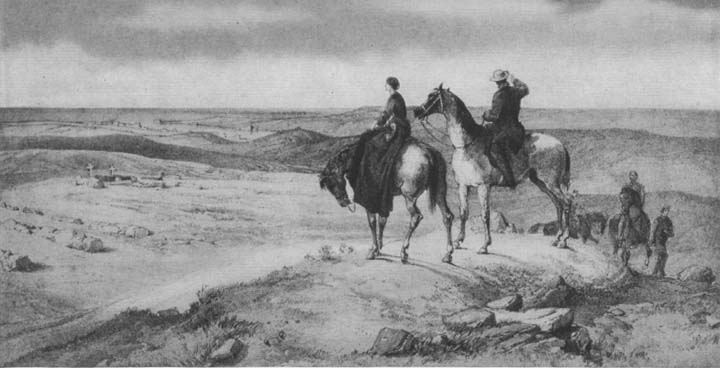 |
MISS NIGHTINGALE AND MR. BRACEBRIDGE SURVEYING
SEBASTOPOL FROM CATHCART'S HEIGHTS, MAY, 1855. After a drawing by Parthenope Lady Verney. |
 |
MISS NIGHTINGALE WITH HER TAME OWL ATHENA, circa
1850. After a drawing by Parthenope Lady Verney. |
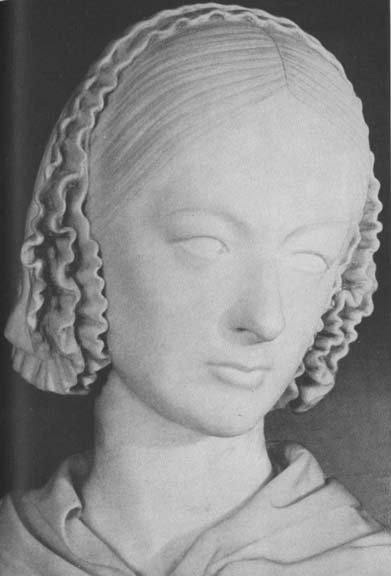 |
MISS NIGHTINGALE, 1859. From the bust by Sir John Steell. |
 |
SIR HARRY VERNEY, BART., AND MISS NIGHTINGALE ON THE LAWN OF CLAYDON HOUSE, 1899. |
The CLAYDON photograph and the pen and ink drawing reproduced on page 7 are included by kind permission of Sir Harry Verney, Bart.
IT WAS SOMETHING NEW to call a girl Florence. Within fifty years there would be thousands of girls all over the world christened Florence in honor of this baby, but in the summer of 20, when Fanny Nightingale fixed on the name for her daughter, it was new.
Novelty was the fashion in 1820. Europe was still rejoicing in the liberty which followed the end of the Napoleonic wars. Years of restriction had bred a longing for change, and now that freedom to travel had returned the roads and cities of Europe were thronged with travelers. Fanny and William Nightingale had been traveling in Europe since their marriage in 1818. They already had one daughter, born in Naples in 1819 and christened by the Greek name for her birthplace, Parthenope. For her second confinement Fanny chose Florence. She loved gaiety, and Florence had the reputation of being the gayest city in Europe. The Nightingales took a large furnished villa, the Villa Colombaia near the Porta Romana, where a second girl was born on May 12, 1820. Fanny decided she too should be named after her birthplace, and on July 4, 1820, she was christened Florence in the drawing-room of the villa.
It would have been better if Florence had been a boy. Though William Edward Nightingale, or as he was always called W. E. N., was rich, there were complications attached to his property. He had inherited from an uncle, and, under his uncle's will, if W. E. N. should have no son, the property passed on his death to his sister and next to her eldest son. However, the Nightingales felt no anxiety. Not all W. E. N.'s fortune was involved. He had inherited when a minor; a lead mine discovered on the property had greatly increased its value, and during his minority a large sum had been invested on his behalf which was absolutely his. The Nightingales had been married for two years, and Fanny had already had two healthy children. The next baby would be a boy.
Though they were both handsome, agreeable, and intelligent, they were not a well-matched couple. Only a few months before their engagement Fanny had been anxious to marry another man; and she was six years older than W. E. N. In 1820 she was thirty-two, extremely beautiful, generous, and extravagant. She had great vitality, was indefatigable in the pursuit of pleasure, never tired unless bored, always good natured unless thwarted, always kind unless her obstinacy were aroused. In the art of making people comfortable, in the arrangement of a house, the production of good dinners, she possessed genius. She intended, when she returned to England, to make herself a position as a hostess.
She came from a remarkable family. Her grandfather, Samuel Smith, had been a well-known character, celebrated for the riches he had amassed as a London merchant and for his humanitarian principles. He had come to the assistance of Flora Macdonald when she was a penniless prisoner in the Tower in spite of the fact that he was a strong Hanoverian. To show his sympathy with the struggle of the American colonists for freedom in the War of Independence he had relinquished his title to a large part of the city of Savannah. His son William Smith, Fanny's father, devoted his wealth to collecting pictures and fighting lost causes. For forty-six years he sat in the House of Commons fighting for the weak, the unpopular, and the oppressed. He was a leading Abolitionist; he championed the sweated factory workers; he did battle for the rights of Dissenters and Jews.
His children did not inherit his altruism. At Parndon Hall in Essex, in his London house in Park Street, his political and humanitarian activities were carried on against a background of ceaseless junketings. With tireless energy the young Smiths danced, went on pleasure parties and picnics, played parlor games, got up amateur theatricals. There were ten children, five sons and five daughters, all good looking, all with immense zest for living and amazing health. William Smith himself at eighty wrote that he had "no recollection whatever of any bodily pain or illness." None of his ten children died before the age of sixty-nine, six lived to be over eighty, and Fanny lived to be ninety-two. Looking back on her youth fifty years later, Fanny described family life as a "burly burly." "We Smiths never thought of anything all day long but our own ease and pleasure," she wrote.
Fanny was the beauty of the family; yet Fanny did not marry. Her sister, Anne, married an immensely rich Mr. Nicholson of Waverley Abbey near Farnham, the house which gave Scott the title for the Waverley novels; her sister, Joanna, married Mr. Bonham Carter, eldest son of a well-known Hampshire family, and settled near Winchester. Fanny remained at home with Patty and Julia who held "advanced" views and suffered from nerves. Association with her father's friends had left its mark on Fanny; she had acquired a passion for good conversation, "had a preference for clever elderly gentlemen, and was comparatively indifferent to gay young ones", and despised the junketings of Parndon. She had already "arrived at the age when the world acquits those parents who suffer their daughters to act for themselves," when, in 1816, she fell in love with the Honorable James Sinclair, a younger son of the Earl of Caithness. His character was allowed to be good and his intentions disinterested, but he possessed no income beyond the pay of a captain in the Ross-shire Militia, and no expectations. In immense letters, full of worldly wisdom, kindness, and unanswerable common sense, William Smith pointed out the absurdity of a woman of Fanny's habits contemplating life on an income of scarcely four hundred pounds sterling a year and declined, in justice to his other children, to assume the support of her future family. Fanny pleaded in vain that her affections were entirely given away and that losing James would quite break her down. By 1817 the affair was at an end.
Fanny was now nearly thirty, and William Edward Nightingale was nearly twenty-four. She had known him since he was a boy; he had been at school with her younger brother Octavius and had been coming to the house for years, an awkward lanky schoolboy, immensely tall, immensely thin, with a habit of always standing upright propped against mantelpieces and doors because he disliked folding himself into a chair. Originally his name had been Shore, but at twenty-one, when he came into the fortune left him by his uncle, he changed his name to Nightingale. He went up to Cambridge with an income of between seven and eight thousand pounds sterling a year, and Cambridge transformed him. He proved, though lazy, to be clever. He gained a reputation for wit. His looks improved; his height and a remote and gentle manner gave him distinction. He developed into a dilettante, rich, appreciative, indolent, charming.
It was an unexpected result. Wild blood ran in W. E. N.'s veins. The uncle, his mother's brother, from whom he inherited, had been an eccentric sporting squire, known throughout Derbyshire as mad Peter Nightingale. Peter Nightingale had been a dare-devil horseman, a rider in midnight steeplechases, a layer of wagers, given to hard drinking and low company.
In 1817 W. E. N. became engaged to Fanny. He was very much in love. Fanny's rich beauty warmed his reserved temperament, and for a short time he thawed. The period was brief. Normally, as Fanny wrote later, "Mr. Nightingale is seldom in the melting mood."
Fanny's family did not approve. They were fond of W. E. N., but they had no faith in his character. He was clever but he was indolent, hated making up his mind, hated taking action---he was not the husband for Fanny. Within six months they were married and had gone abroad.
Fanny believed she would be able to mold W. E. N. She intended him to become one of the prosperous, cultivated, and liberal-minded country gentlemen who played an important part in English public life. They would have a beautiful house, a fine library, maintain an interest in the arts, and entertain.
After nearly three years in Italy Fanny began to feel it was time they came home. W. E. N., she wrote, would have been content to idle in Italy for the rest of his life. As long as he had books and conversation he was indifferent to other pleasures. However, Fanny prevailed, and in 1821,when Florence was a year old, the Nightingales returned to England.
The first necessity was to house themselves. The Nightingales had no family place. Peter Nightingale had inhabited a tumbledown building, half manor, half farm, totally inadequate for the needs of Fanny, W. E. N., and two babies accompanied by maids, footmen, valet, coachman, and cook.
Before they left Italy, W. E. N. had decided to abandon the old house and had made a flying trip to England to have work started on a new house on higher ground. He was an amateur architect and himself produced the designs from which the plans were drawn. He gave his house mullions, a steep pitched roof, a vaguely Gothic air. The effect is not unpleasing, and the situation of the house is unrivalled. Lea Hurst stands high above a rolling country, terraced gardens fall steeply away on every side, and the view from the windows is immensely wide, so that the house, as Mrs. Gaskell wrote, seems to be floating in air.
But no sooner was Lea Hurst finished than Fanny realized she had made a mistake. As a family place Lea Hurst was inadequate; as a house in which to entertain it was impossible. The only attraction was a wonderful view. The situation was inaccessible, the house cold. The Nightingales attempted one winter there, and both children got bronchitis. Above all, Lea Hurst was much too small.
Fanny's standards of accommodation descended to her daughter. Twenty years later at a dinner-party Florence denied that Lea Hurst was anything but a small house. "Why," she said, "it has only fifteen bedrooms." except in
By 1823 Fanny had convinced W. E. N. that Lea Hurst, except in summer, was impossible. Certainly t hey would keep up a property where the Nightingales had been rooted for generations, but they must also have another house, a larger house, and in a warmer part of the country than Derbyshire.
In 1825 W. E. N. bought Embley Park, near Romsey, in Hampshire, on the borders of the New Forest. It was a good-sized plain square house of the late Georgian period, London was reasonably near, and Fanny's two married sisters, Mrs. Nicholson at Waverley Abbey near Farnham, and Mrs. Bonham Carter at Fair Oak near Winchester, were within easy reach. Above all, in contrast to the uncivilized remoteness of Lea Hurst, Embley was in the center of a "good neighborhood."
By the time Florence was five, the pattern of the Nightingales's life was fixed. The summer was passed at Lea Hurst, the remainder of the year at Embley Park, and twice a year during the spring and autumn seasons a visit was paid to London. Fanny would have liked a house in London, but W. E. N. refused.
He did, however, proceed to turn himself into an English country gentleman. He shot, he fished, he hunted, did a great deal for his tenants, supported a free school at great expense near Lea Hurst, and in Hampshire took an active part in local politics. Fanny looked forward to the day when he would stand for Parliament. W. E. N. was a Whig and in favor of Parliamentary Reform. "How I hate Tories, all Beer and Money," he wrote to Fanny in 1830.
Fanny's life ran smoothly. If she fretted after the son who failed to appear, she did not record it. The. only shadow was cast by Florence. Florence was not an easy child.
The two little girls were not called by their full names. Florence was shortened to Flo, Parthenope to Parthe or Pop. Flo was much the prettier. Neither of the girls inherited their mother's outstanding beauty, but Flo promised to grow up more than ordinarily good looking. She was lightly built, singularly graceful, with thick bright chestnut hair and a delicate complexion.
Both Fanny and W. E. N. loved children. All the closely related families of the Nightingale circle---Smiths, Shores, Nicholsons, Bonham Carters---delighted in children. A stream of cousins spent their holidays at Embley and Lea Hurst, and almost invariably Fanny had a couple of family babies in the house, enjoying a change of air and being fed up on country butter and eggs and cream. "Kiss all babies for me" is ---a frequent ending to the first letters Flo wrote home. Her childhood was filled with gardens to play in, ponies to ride, and a succession of dogs, cats, and birds to be looked after.
And yet Flo was not happy. If she had been an ordinary naughty child, Fanny would have understood her, but she was not naughty. She was strange, passionate, wrong-headed, obstinate, and miserable.
In an autobiographical note Miss Nightingale records that as a very young child she had an obsession that she was not like other people. She was a monster. That was her secret which might at any moment be found out. Strangers must be avoided, especially children. She worked herself into an agony at the prospect of seeing a new face, and to be looked at was torture. She doubted her capacity to behave like other people and refused to dine downstairs, convinced she would betray herself by doing something extraordinary with her knife and fork.
 Realization of the gulf which separated
her from everyone round her came hand in hand with the dawnings
of conscious thought. At first she was overwhelmed with terror
and guilt. Surely she ought to be like everyone else? What might
not people do to her if they found out the truth? But almost before
she had grown out of babyhood, guilt and terror were succeeded
by discontent. She wrote that as early as the age of six she was
aware that the rich smooth life of Embley and Lea Hurst was utterly
distasteful to her. She ceased to be terrified; she resisted,
disliked, and despised it.
Realization of the gulf which separated
her from everyone round her came hand in hand with the dawnings
of conscious thought. At first she was overwhelmed with terror
and guilt. Surely she ought to be like everyone else? What might
not people do to her if they found out the truth? But almost before
she had grown out of babyhood, guilt and terror were succeeded
by discontent. She wrote that as early as the age of six she was
aware that the rich smooth life of Embley and Lea Hurst was utterly
distasteful to her. She ceased to be terrified; she resisted,
disliked, and despised it.
She began, like many imaginative children, to escape into dreams. She told herself stories in which she played a heroine's part, and for hours at a time transferred herself completely to a dream world.
Though she shrank from meeting people, she was not self-sufficient. She was a child who craved for sympathy and attached herself with embarrassing vehemence to anyone whom she felt to be sympathetic. Her childhood was a series of passions---for her governess Miss Christie, for W. E. N.'s younger sister "Aunt Mai," for a beautiful older cousin. When Miss Christie left, when Aunt Mai married, when the beautiful cousin got tired of her devotion, the violence of her feelings made her physically ill.
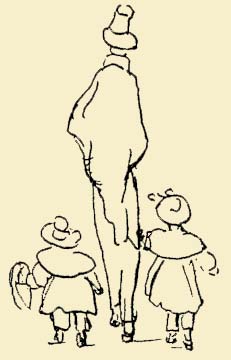
She did not attach herself to her mother. The companion of her childhood was W. E. N. Among the Verney Nightingale papers is preserved a sketch by Julia Smith, Fanny's unmarried younger sister, of W. E. N. and the two little girls. The trio have their backs to the artist. W. E. N., in frock-coat and top-hat, is in the middle, tall and thin as a hop pole; the two children, one on each side, wear pantalettes and broad brimmed hats. Parthe, as Aunt Julia points out in a note scribbled below the sketch, clings to her father's coat-tail while Flo "independently stumps along by herself."
W. E. N. was a man to enchant a child. He loved the curious and the odd, and he loved jokes; he had a mind stored with information and the leisure to impart it. He had great patience and he was never patronizing. Partly as a result of marrying Fanny, partly by temperament, he was a lonely man, and it was with intense pleasure he discovered intellectual companionship in his daughters. Both were quick; both were unusually responsive; both learned easily, but the more intelligent, just as she was the prettier, was Flo.
It was a difficult situation for Parthe. She was the elder, the plainer, the less intelligent, the less remarkable. Flo, strange, passionate, uncomfortable little thing, had something about her which struck people as exceptional. Flo dominated. Flo led, and Parthe followed, but Parthe followed resentfully. She was possessive toward Flo, she adored Flo, but she was bitterly envious of Flo. Fanny made a practice of sending the children to stay with their relatives separately. In 1830 Flo wrote to Parthe from Fair Oaks: "Pray dear Pop, let us love each other better than we have done. It is the will of God and Mamma particularly desires it."
W. E. N.'s plan for their education brought about the final division between the girls. To find a governess proved impossible. The world did not contain a woman who united the intellectual equipment required by W. E. N. with the standard of elegance and breeding demanded by Fanny. In 1832 he determined to teach the girls himself. A governess was engaged for music and drawing, and the girls learned Greek, Latin, German, French, Italian, history, and philosophy from their father. The time-table was formidable and W. E. N. exacting; the girls were required to work long hours, and Parthe rebelled. She left her sister struggling with Greek verbs and joined her mother or escaped into the garden.
Miss Nightingale and her father were deeply in sympathy. Both had the same regard for accuracy, the same cast of mind at once humorous and gloomy, the same passion for abstract speculation.
Parthe did not want to toil at Greek, but she resented the companionship between her father and sister, and in the summer of 1834 she wrote him a protest. He replied in a characteristic letter---involved, vague, and curiously reminiscent of a soliloquy in a poetic drama. "My dear Pop---not one word . . . among my waking dreams I sometimes fancy that you and I have not made half as much of each other's society as we might have done. . . . I have more subjects than one in hand, or in mind, which are likely enough to lend themselves to our future intercourse. In the meantime I feel that you are satiating yourself (perhaps usefully) with many matters which suit your infantine and merry days of 15---or is it 16? ---and, thro' a nervousness of interfering with them, I curtail my letter to a simple expression of my rejoicing at your merriments and your happiness.---W. E. N."
Change of subject did not produce power to concentrate in Parthe. She continued to be bored, resentful, and cross, and W. E. N. became angry with her. In 1853 Parthe wrote to him when he was in London. "Flo in bed, coughing, told me all. . . . I am properly punished, if you knew how very bitterly I feel your messages through her and your acknowledgment in your own letter, that you have ceased to care enough for my society, to be sorry I behave so ill."
To send messages of reproof to an elder sister through a younger did not make the elder less jealous, but it made the younger self-righteous. At fifteen Florence could be sanctimonious. "I hope our matutinal moments may not have been quite unprofitably spent, though we may not have improved our minds as we ought," she wrote to Fanny from the Isle of Wight in 1835. Her correspondence tended to be a record of her own good deeds. She had learned to eat sandwiches, which was an effort; she had practised curling her hair, as her mother desired; she had been devoting most of her spare time to looking after a baby cousin---"Dear little Robert I am sure I never love him the less for being ugly." By the time Florence was sixteen, the family had divided. She was W. E. N.'s companion in the library; Parthe was Fanny's companion in the drawing-room. Fanny was always busy; there were flowers to arrange, an increasing number of friends to be entertained, and innumerable letters to be written to the vast circle of the Nightingale family's connections.
On Florence's fourteenth birthday W. E. N. calculated she had already twenty-seven first cousins and nearly two dozen aunts and uncles by blood and marriage. In the center of this circle were the energetic handsome Smiths, who had the strongest possible family feelings. As each married, the circle was enlarged by the addition of a whole new family. Husbands of aunts, wives of uncles brought in their brothers and sisters and their wives and husbands; even the brothers and sisters of grandmothers with their train of children and grandchildren were corresponded with, visited, kept informed, consulted. With the single exception of Fanny's eldest brother, who maintained domestic arrangements which were described as decidedly improper, not one of the huge clan was anything but respectable and prosperous. Enormous numbers of letters were written. Not only major events, weddings, births, deaths, but the choice of a place for a holiday, the advisability of taking a holiday at all, the dismissal of a coachman or cook, the selection of a dress or a carpet provoked correspondence and consultations with aunts, uncles, cousins, and grandmothers.
To Miss Nightingale letters and consultations were an intolerable waste of time. "I craved," she wrote, "for some regular occupation, for something worth doing instead of frittering time away on useless trifles." Parthe had a large correspondence and numerous intimate friends among her cousins; but to Florence only three families were of importance---the Nicholsons of Waverley Abbey, the Bonham Carters of Fair Oak, and the family of Aunt Mai, now Mrs. Sam Smith of Combe Hurst, Surrey.
Aunt Mai was a person of importance to the Nightingales. She was W. E. N.'s sister; and, should he have no son, the property would pass to her. In 1827 she married Fanny's younger brother, Sam Smith. It was then seven years since the birth of Florence, Fanny was nearly forty, and there was no sign of another child. It was almost certain that, if Aunt Mai had a son, he would eventually inherit Embley and Lea Hurst, and the marriage which linked the two families more closely together was welcomed. In 1831 a son was born, and Fanny, in whom all hope of another child must now have died, behaved admirably. The situation was not easy for her. Not only was Aunt Mai mother of the heir Fanny had failed to produce, she was also the object of the extravagant devotion of Fanny's difficult little daughter Flo. Nevertheless, Fanny's affectionate relations with Aunt Mai were unclouded. Aunt Mai's son was accepted as the heir and given a privileged position in the Nightingale family. Florence was known to have a special gift with babies, and when he was a few days old he was laid in her arms: "My boy Shore," the eleven-year-old Flo proudly called him. Shore was recognized as being her special property, and devotion to Shore, pride in him, and Shore's devotion to her became one of the most important relationships in her life.
So Florence grew into girlhood in a life that seemed all smoothness and peace. At Embley and Lea Hurst there were comfort, security, and affection; there were intelligence and companionship. And yet beneath the surface there was no peace; Florence was brought up in a hot-house of emotion.
It was the result of a literary fashion. The wave of romanticism which had swept Europe had penetrated English domestic life, and ordinary wives and mothers were reproducing the behavior of the heroines of Byron and Chateaubriand. Since a rigid respectability governed their behavior, their emotions had to be expended on the commonplace events of everyday life. The naughtiness of a child, a misunderstanding between friends, the non-arrival of a letter necessitated smelling salts, a darkened room, a soothing draught. Women prided themselves on being martyrs to their excessive sensibility, and "delicacy" was universal. Fanny, Parthe, and Florence were all considered "delicate," though Fanny lived to be ninety-two, Florence ninety, and Parthe seventy-five.
Miss Nightingale grew up in this age and was indelibly impressed by it. Though her extraordinary mind owed its quality to uncompromising clarity and realism, her character contained the contradiction that she was also emotional, prone to exaggeration, and abnormally sensitive. The atmosphere in which she was brought up prevented her from achieving balance; throughout her life, when feelings were in question, she entered another world---violent, exaggerated, and unreasoning.
In the summer of 1834 she and Parthe were at Cowes with their governess, and W. E. N. wrote to tell them he had been invited to stand for Parliament as candidate for the Andover division. The girls' emotion approached hysteria. "What extraordinary news you have sent us," wrote the young Flo. "It quite convulsed our quiet little world. . . . Parthe, after a deep reading of the letter in which she neither saw nor heard anything which passed around, screamed out 'Papa is going to be M.P. for Andover!' Miss White and I stood aghast! . . .I could not sleep after it. I slept so lightly that I had the feeling on my mind that something very extraordinary, or dreadful, had happened and kept starting up to find out what it was."
W. E. N.'s candidature for Andover proved a turning-point in the Nightingales' lives. He was a fervent supporter of the Reform Bill of 1832, and had refused to enter political life until the Bill became law, when he believed a new age of political integrity would dawn. The election, in 1825, was the first to be held at Andover under the new franchise, and he entered the contest full of enthusiasm and hope. Fanny saw her plans maturing. They were to have a house in London.
He was not only defeated but profoundly disillusioned. The seat was lost because he refused to bribe the voters. A main object of the Reform Bill had been to end the purchase of votes, but the newly enfranchised electors of Andover took the view that the possession of a vote had always meant hard cash and that the extended franchise merely brought what had been the perquisite of a few within reach of the many. W. E. N.'s first contact with practical politics left him disgusted, and he resolved never to be persuaded to attempt an entry into political life again.
Fanny was defeated. W. E. N. ceased to adapt himself to the character she had planned. He gave up hunting and took long ambling rides in the New Forest; avoided political meetings and attended congresses of learned societies; spent more time teaching Florence and took to passing the greater part of each day in his library. An immensely tall desk was made for him, and he read standing up, he wrote standing up, he meditated standing up, contemplating for hours at a stretch such abstract subjects as, the nature of moral impulses, the relation of ethics to aesthetics, and the proofs of the existence of an immortal soul in mortal man.
He would have been content to pass his life in tranquility, allowing day after day to slide gently by. His natural home, he was fond of saying, was in "the quiet and the shadows." But life in the quiet and the shadows was unbearable to Fanny. She had been forced to give up her plans for W. E. N., but she did not resign herself. She transferred her plans and her ambitions to her daughters.
They were sixteen and seventeen. Next year, or the year after at latest, the girls must be launched in society. Since there was to be no house in London, everything must be done from Embley. The history of Lea Hurst repeated itself. The house was discovered to be entirely inadequate. Six more bedrooms must be added, new kitchens built, the exterior remodeled, the interior completely redecorated.
W. E. N. was tempted. He had made a certain reputation with Lea Hurst and contemplated with pleasure the task of getting out designs to convert the Georgian plainness of Embley to a fashionable Gothic outline. The expense was bound to be considerable, and Fanny proposed that, while the alterations were carried out, they should make an extended tour abroad. It would do the girls good to see something of the world. They could hear music, practise their languages, go to a few parties, buy clothes in Paris. Europe was so cheap that the tour would be an economy. W. E. N. agreed. He loved traveling, loved Europe, had many friends in Italy and France. He got out his own design for a traveling carriage, the alterations to Embley were started at once, and the Nightingales fixed a date to leave in September, 1837.
At this moment, in the midst of bustle, plans, discussions, Miss Nightingale received a call from God.
It is possible to know a very great deal about Miss Nightingale's inner life and feelings because she had the habit of writing what she called "private notes." She was unhappy in her environment, she had no one to confide in, and she poured herself out on paper. She hoarded paper (every odd scrap, every half sheet was preserved), and a very large number of her private notes exists. She wrote them on anything that came to her hand---on odd pieces of blotting-paper, on the backs of calendars, the margins of letters; sometimes she dated them, sometimes not. Sometimes they cover several foolscap pages, sometimes consist of one sentence. Occasionally she used a private note as the basis of a letter. Frequently she repeated a note several times at different dates with only a slight variation in wording. From time to time she also kept diaries; but it was in her private notes, written from girlhood to old age, that she recorded her true feelings, her secret experiences, and her uncensored opinions.
Her experience was similar to that which came to Joan of Arc. In a private note she wrote: "On February 7th, 1837, God spoke to me and called me to His service." It was not an inward revelation. She heard, as Joan of Arc heard, an objective voice, a voice outside herself, speaking to her in human words.
She was not quite seventeen, and she was already living largely in a dream world, which was often more actual to her than the real world. But the voices which spoke to her were not a phenomenon of adolescence. Nearly forty years later, in a private note of 1874, she wrote that during her life her "voices" had spoken to her four times. Once on February 7, 1837, the date of her call; once in 1853 before going to her first post at the Hospital for Poor Gentlewomen in Harley Street; once before the Crimea in 1854; and once after Sidney Herbert's death in 1861.
Her path was not made clear. The voices which spoke to Joan told her to take a definite course of action; Miss Nightingale was told nothing definite. God had called her to His service, but what form that service was to take she did not know. The idea of nursing did not enter her mind. She doctored her dolls; she nursed sick pets; she was especially fond of babies. Her protective instincts were strong, but they had not yet led her to the knowledge that God had called her to the service of the sick.
Meanwhile she knew herself to be God's, and she was at peace. Her call had filled her with confidence and faith. God had spoken to her once; presently He would speak to her again.
On September 8, 1837, the Nightingales crossed from Southampton to Le Havre. They took with them Fanny's maid, a courier, and the girls' devoted disapproving old nurse, Mrs. Gale. W. E. N. refused to take his valet.
THE TRAVELING CARRIAGE W. E. N. had designed was enormous. Five years later, when he lent it to Fanny's sister, it held Mrs. Bonham Carter and six of her daughters, besides a tutor and a maid. On the roof were seats for servants and for the family to enjoy the air and admire the scenery in fine weather. Six horses drew the carriage, ridden by postillions.
On the morning of September 9 the Nightingales left Le Havre to travel through France to Italy. The weather was brilliant; the girls sat on the roof; the postillions laughed, sang, and cracked their long whips as the carriage lumbered down the straight roads of France.
Florence was in transports of delight. She kept a diary of the tour and recorded that at Chartres she sat all night at her window enchanted by the beauty of moonlight on the cathedral. Her head was full of legends, and she turned romantic landscapes into the background for imaginary dramas. As they approached Narbonne, a lurid sunset flamed in the sky, and the city, half hidden by strangely shaped rocks, seemed sinister. She shuddered and imagined herself a traveler entering a city stricken by plague.
Yet for all her rhapsodies she remained precise. Each day she noted in her diary the exact hours of departure and arrival and the exact distance covered. Her letters to her favorite girl cousin, Hilary Bonham Carter, were not merely transports, for she was capable of mature observation. When they went over the castle at Blaye, she was struck by the fact that the custodian, a Napoleonic veteran, "seemed to have fought everyone but to feel rancune against none." At Bosuste, a village on the French-Spanish border which had had the misfortune to become a battleground in the Carlist war, she was impressed not by the horrors of war but by "the indifference which misery brings."
On December 15, 1837, the Nightingales drove into the gay and pretty town of Nice. There was a large English colony at Nice, balls, and concerts. With startling suddenness cathedrals, moonlight, and scenery vanished from Florence's diary and letters. She developed a passion for dancing and wrote to Hilary Bonham Carter that at the biggest ball of the season she danced every quadrille. Her letters took on a new tone; she began to attempt witticisms and to coin phrases.
When the time came to leave Nice, on January 8, 1838, she was heartbroken. As they climbed up the Corniche, she would not look at the famous view or admire the gold and silver lights over the sea. She sat inside the carriage shedding tears. "The worst of travelling is that you leave people as soon as you have become intimate with them, often never to see them again," she wrote in her diary.
Her tears dried themselves with remarkable speed. The Nightingales reached Genoa on January 13, 1838, and on the 17 Florence wrote to Hilary Bonham Carter that of all towns in the world Genoa was the one she liked best. It was "like an Arabian Nights dream come true." In 1838 Genoa was still one of the richest and most splendid cities in Europe. Its palaces and gardens, its opera and theatres, its fountains and statues, had earned it the name of "Genova la Superba."
Florence went to more balls, and at "the most splendid ball of the season" she had so many partners that she became confused. An officer came up and challenged her "in a rage" because, after refusing to dance with him, she sat out with someone else and there was an "embrouillement."
On February 14, after giving a large evening party, the Nightingales left Genoa for Florence. They halted at Nervi (described by Florence in one of her phrases as "a town of palaces inhabited by washerwomen"), and again at Pisa, where they went to a ball given by the Grand Duke of Tuscany and a morning entertainment which included luncheon and an inspection of the Grand Duke's camels. On February 27 they reached Florence.
In 1838, thanks to the liberal policy of the Grand Duke, Florence was the intellectual capital of Italy. Fashion and learning united. There were parties for Fanny, learned conversaziones for W. E. N., educational opportunities for the girls. The Nightingales settled in a handsome suite at the Albergo del Arno, near the Ponte Vecchio. They had a salon fifty feet long, a dining-room with a terrace overlooking the Arno, and bedrooms which were magnificently (Mrs. Gale, the girls' old nurse, said indecently) frescoed. Fanny wrote in March, 1838 to her sister Julia Smith that the Grand Duke was "exceedingly distinguishing and polite," the balls at the Grand Ducal Palace "exceedingly fine," cards had been sent by the Grand Duke not only for public functions but for private entertainments, and Florence had been "much noticed."
Florence became (as she told Hilary Bonham Carter) "music mad." The opera in Florence was one of the best in Europe. Grisi and Lablache, the two most famous singers of the day, performed there. Florence lived for opera, persuaded Fanny to take her three times a week, and declared she would like to go every night. But she did more than go into transports. With laborious patience she kept a book in which she made a detailed comparison, in the form of a table, of the score, libretto, and performance of every opera she heard. Instinctively she reached out for facts. Transports, ecstasies, were not enough. Her mind demanded something hard to bite on, and the romantic extravagance of her emotion crystallized surprisingly into figures.
Italy not only gave her music: in Florence she learned an enthusiasm for the cause of Italian freedom. Italy had been handed over to Austria, the military despot of Europe, by the Congress of Vienna and was being crushed into subjection. Like thousands of her contemporaries, Florence Nightingale was seized with a passion for Italy and Italian freedom as violent as falling in love. To her, as to the Brownings and to George Meredith, the cause of Italian freedom was more than a political conviction; it was a religion, a faith, the embodiment of the struggle of good against the powers of darkness. W. E. N. and Fanny had friends in England intimately connected with the inner circle of Italian patriots. Through these friends the Nightingales were brought into the heart of the movement to set Italy free.
Since childhood Fanny had known a remarkable family, the Allens of Cresselly, in Pembrokeshire. Fanny Allen was one of the intellectual women who were the advance guard of the feminist movement. Her niece Emma married Charles Darwin. Her sister Jessie married the Italian historian Sismondi. W. E. N. and Sismondi were introduced by the Allens. A friendship sprang up, and it was agreed that, after leaving Florence and making a tour of the Italian lakes in July and August, the Nightingales would visit Geneva, where, for reasons of prudence, Sismondi was living as an exile.
They reached Geneva in the first week of September, 1838 and found the city overflowing with political refugees. The Austrian Government was determined to crush independent thought in Italy; every man of talent felt himself in danger, and a horde of doctors, scientists, educationists, scholars, writers, and poets poured across the frontier to safety in Geneva.
The change was startling. The world which the Nightingales entered was a world of poverty, learning, and sacrifice. Florence instantly responded, and balls and palaces passed from her mind. She became the disciple of Sismondi. He was very short, almost a dwarf, and extremely ugly---so ugly that his wife had hesitated before marrying him---but his nature was charming and his conversation enchanting. He could not bear to see unhappiness or to cause pain to any living creature, fed the mice in his study while he worked, and in Italy had a crowd of 300 beggars permanently encamped outside his door. Through Sismondi she met well-known figures of the Italian movement: Ugoni and Madame Calandrini, who had been ruined and exiled for opening progressive schools; Ricciardi, a young nobleman whom the Austrians had shut up among lunatics with the object of destroying his mind; Confalioneri, who had been practically buried alive for fifteen years---"he still walks as if he had chains on his legs," wrote Florence.
W. E. N. would have stayed indefinitely in Geneva. He had found society which suited him among the professors of the University of Geneva and had struck up a friendship with de Candolles, the celebrated botanist. But, without warning, a crisis arose. Louis Napoleon Bonaparte, afterwards Napoleon III, after being expelled from Europe by the French, returned to Switzerland to see his dying mother. The French Government demanded his surrender. The Swiss, maintaining their right of asylum, refused. The French issued an ultimatum; the Swiss refused to give way, and French troops began to march on the Swiss. War seemed only a few days distant, and the Nightingales hastily prepared to leave for Paris. As they packed, every man and woman in Geneva was toiling at erecting barricades in the streets.
To leave Geneva was not easy. There were no horses. The vast carriage stood loaded, but every horse in Geneva had been requisitioned for artillery. W. E. N. scoured the town for horses while Fanny and the girls sat in the salon forbidden to go out, listening to the sound of barricades being erected in the street. Next day he managed to obtain inferior horses at an exorbitant price, and the Nightingales left. Sismondi saw them off, bursting into tears when he said farewell.
A few days later the crisis ended. The English Government mediated, Louis Napoleon voluntarily left Switzerland, and the French Government accepted the suggestion that he should be allowed to live in England. By the time the Nightingales reached Paris, the Genevese, hysterical with relief, were singing, dancing, and embracing each other in the streets. The experience made a deep impression on Florence. There were realities in Europe to which England, safely entrenched behind the Channel, was indifferent and blind. "At home in England changes and revolutions are like storms one only hears," she wrote to Hilary Bonham Carter in November, 1838.
W. E. N. proposed to spend four months in Paris and had taken an apartment in the Place Vendôme. It was, wrote Fanny, "extremely splendid." The rooms were vast and richly decorated; the dining-room had gilt mirrors, velvet draperies and carved chairs, the salon crimson satin and ebony cabinets. The windows framed a view of Napoleon's statue on the Vendôme column.
Fanny intended if possible to enter intellectual society and had an introduction, given her by her sister Patty, of which she had great hopes; it was to one of the most celebrated women in Paris--Miss Mary Clarke.
Without money, influence, or beauty, Mary Clarke had made herself a major figure in the political and literary world of Paris. In her hands the salon was revived, and every Friday night Cabinet Ministers, Dukes of France, English peers, bishops, scholars, and writers of international reputation crowded the drawing-room of her apartment in the former hotel of the Clermont-Tonnerre family, 120 rue du Bac.
Mary Clarke was not a Bohemian. She loved society, the great world, great houses, and great people. Her family connections were excellent. The Clarkes were an old Scottish Jacobite family, Lord Dalrymple was her cousin, and her sister married Mr. Frewen Turner, a Member of Parliament and owner of the famous Elizabethan mansion of Cold Overton in Leicestershire. Her personal appearance was odd. She was very small, with the figure and height of a child; her eyes were startlingly large and bright, and at a period when women brushed their hair smoothly she wore hers over her forehead in a tangle of curls. Guizot, who was devoted to her, said that she and his Yorkshire terrier patronized the same coiffeur. Yet though she had no ordinary feminine attractions, men were devoted to her, and many men wished to marry her. Ampere, son of the celebrated electrician and her intimate friend, wrote: "Her great charm lay in the absence of it. I never knew a woman so devoid of charm in the ordinary sense of the word and yet so fascinating. She was hardly a woman at all." Her effect on her friends was very great. No one, wrote Miss Nightingale, ever had so much influence in forming character, but her candor sometimes took her friends aback. "She had never a breath of posing or of 'edifying' in her presentation of herself," added Miss Nightingale, "even when it would have been almost desirable. . . . She was always undressed---naked in full view. A little clothing would have been decent."
Mary was launched on her career by Madame Récamier. About 1830, her mother, who suffered from bronchitis, was forbidden ever to go into fresh air again; the whole of Mrs. Clarke's life must be spent indoors, and Madame Récamier who admired her character and attainments invited her to come and live in her house, the Abbaye-aux-Bois. (Mrs. Clarke obeyed these instructions and lived to be ninety-two.) Madame Récamier was now fifty-four and her life had narrowed to a single object---the diversion of Chateaubriand, upon whom ennui had seized with the frightful effect of an incurable disease. Mary was invited to meet him. Her freshness amused him; she was invited again and conquered him completely. He declared he "delighted in her." "La jeune Anglaise is like no one else in the world. Boredom is impossible where she is."
Mary became Madame Récamier's close friend, visited her daily, was always present at her evenings; and when in 1838 the Clarkes moved to 120 rue du Bac, the intimacy continued.
She entered another distinguished circle through her close friendship with Claude Fauriel, the mediaeval scholar to whom the preservation of old French and Provençal literature is largely due. In 1837 Mary and Fauriel had been on terms of closest intimacy for more than fifteen years. They met daily; they traveled together; he dined with her almost every night, was invariably present at her parties, and behaved as master of the house; he had great respect for her mind, always read her his poems to criticize, and had left her his manuscripts in his will. Their intimacy was unconcealed and accepted; yet Mary's reputation was unblemished; she was the friend of bishops and deans, her salon was "serious," and she refused to receive George Sand on account of her irregular life.
There was in fact no cause for scandal. They were friends, not lovers. But friendship was Fauriel's choice, not Mary's. He was devoted to her, but he had never fallen in love with her. He could have married her, but he had never asked her to marry him. She was in love with him, and jealousy tormented her.
While Mary Clarke was in love with Fauriel, who had only devoted friendship to give her, Fauriel's great friend Julius Mohl was hopelessly in love with Mary, who felt only friendship for him. M. Mohl was as much at home in the rue du Bac as Fauriel and, like him, dined with Mary almost every night. The younger son of a well-known German aristocratic family, he had become a naturalized Frenchman because he loved Mary Clarke and wished to live near her in Paris. When Queen Victoria asked him why he had given up his native country for France, "Ma foi, madame, j'étais amoureux," he told her. He was an Oriental scholar of very great distinction. "M. Mohl," wrote Miss Nightingale, "was . . . consulted, though a staunch Protestant, by the Jesuit Missions Étrangères in Paris as an authority superior to their own." In addition to collecting material for a history of religion, he was engaged on a translation of the Persian epic Shah Nameh by Firdausi, for which he received a yearly grant from the French Academy. His character was charming, and he was a celebrated conversationalist. Nassau Senior, the American scholar, selected his conversation to record in one of Senior's Conversations. He spoke and wrote English perfectly and passionately admired English political principles.
The Nightingales were not the kind of connection which appealed to Mary Clarke. She did not care for young ladies; in fact, she did not care for women at all. "I don't like young ladies," she wrote to a friend who had asked permission to make an introduction to her, "I can't abide women. Why don't they talk about interesting things? Why don't they use their brains? My dear, they have no manners. I can't abide them in my drawing-room. What with their shyness and their inability to hold their tongues, they ain't fit for decent company. If your friend is a man, bring him without thinking twice about it, but if she is a woman---think well." She was, however, "absurdly fond" of children and regularly gave children's parties, and she acknowledged Fanny's letter of introduction by inviting the Nightingales to a "children's soiree."
One afternoon near Christmas they drove up to 120 rue du Bac. No servants were visible, but a clamor came from above. They walked up into a front drawing-room crowded with dancing, singing children; no one took any notice of them, and they went through to the back drawing-room, where two impressive and eminent-looking gentlemen were boiling a large black kettle over a log fire. One was Claude Fauriel, the other Julius Mohl.
In the midst of the children, dancing, singing, and clapping her hands, was a strange little figure no bigger than a child herself, whom Florence realized must be the celebrated Miss Mary Clarke. The children began to play blind man's bluff, and without further ado Florence picked up her skirts and joined in. It was the happiest possible introduction. She was never so unselfconsciously gay as with children---indeed, all the Nightingales were past-masters in the art of amusing the young.
Immediately after the children's soirée Mary Clarke invited the Nightingales to one of her celebrated Friday evenings. She had fallen in love with the whole family, most of all with Florence, but also with W. E. N.'s remote charm, Fanny's rich beauty and overflowing kindness, and Parthe's elegance. They christened her "Clarkey," and she turned their stay in Paris into a carnival. They met almost every day and, as Florence wrote to Hilary Bonham Carter, "tore about" together. Clarkey went everywhere and knew everyone. She took the girls to private parties, to studios, to galleries and concerts, to the opera, to the theatre, to receptions and balls. She introduced them to Madame Récamier. They were asked several times to the Abbaye-aux-Bois, met Chateaubriand, and were paid the very great compliment of being invited to hear Chateaubriand read his memoirs. And so when the famous readings from the Mémoires d'outre-tombe were given by Chateaubriand at the Abbaye-aux-Bois in January, 1839, Florence Nightingale was in the audience.
She was wildly happy. She had a "passion" for Clarkey, she was beginning an important friendship with Julius Mohl, and for the first time in her life she was breathing the air of freedom.
Fanny smiled on her infatuation. She wanted Clarkey to be the family's intimate friend. Clarkey was to be the source from which she intended to collect "notabilities" to add luster to her parties at Embley. Clarkey was unconventional, but Clarkey was accepted by the best society, and Fanny was satisfied. But the young Florence was receiving impressions of which Fanny never dreamed. One of the deepest was the impression made by Clarkey's friendship with Claude Fauriel. She observed that Clarkey and Fauriel met daily, that they were devoted and made no secret of their devotion, that Fauriel had the greatest possible respect for Clarkey's mental powers and treated her as an equal, above all, that this close intimacy was accepted without disapproval by everyone, even by so conventional a woman as her mother.
She acquired a belief in the possibility of a daily intimacy, a close friendship between a man and a woman on terms which did not include passion, and which did not provoke scandal. It was a belief she never lost and one which regulated her conduct throughout her life.
The Nightingales had now been abroad for eighteen months, and the alterations to Embley were due to be finished by June. Before they went down to the country, Fanny wished to spend part of the season in London and have the girls presented at Court.
In April, 1839 the family left for London. Fanny was well satisfied. The tour had shown her that in Florence she possessed a daughter who promised to be exceptional. She began to concentrate on Florence. Her pride in her was immense, her hopes for her brilliant.
They were doomed. Florence's conscience was awake, and the brief halcyon period was over. It was two years since God had spoken to her. Why had He not spoken again? The answer was evident---she was not worthy. She had forgotten God in the pleasure of balls and operas, in the vanity of being admired. She loved pleasure too much; she loved society too much; she must school herself to turn her back on it. In March, 1839, before she left Paris, she wrote in a private note that, to make herself worthy to be God's servant, the first temptation to be overcome was "the desire to shine in society."