
SOLDIERS' LETTERS FROM THE FRONT DURING THE SECOND YEAR OF THE WAR---HOW A SOLDIER FEELS IN BATTLE---SWAMPS OF THE CH1CKAHOMINY---A BABY ON THE BATTLE-FIELD---" OLD ROSY."
Letter from a Nurse on a Hospital Boat---After the Battle of Shiloh---Battle Scenes---"Marching all Day, and fighting all Night"---Fearful Condition of the Sick and Wounded---Intimidating Effect of the howling Shells---Burning commissary Stores---"It is all over! I am to be killed!"---Hard Lot of the Sick---Wading through the villanous Mud of Virginia---General Howard wounded---"Hereafter let's buy our Gloves together!"---Letters from Home---"A Means of Grace" Negro Friendliness---Splendid Foraging---Surprised at the good-looking Yankees---Life in a Rebel Prison---The Counterpart of Jeffreys and Haynau---Putrid Mule-Beef---Soup swarming with Bugs and Maggots---" A Baby on the Battle-Field "---The Army of the Cumberland "Old Rosy"---Nationalities represented in the Army---" Schpike dem new Guns! No, Sheneral, it vould schpoil dem!"
HOSPITAL BOAT CITY OF MEMPHIS,
PITTSBURG LANDING, TENN., June 6, 1862.
 HAVE not yet become familiar with
my new field of labor. It is one where all classes and creeds
are reduced to a common equality by the stern leveller, war. You
are well versed in the sad story of battle and death connected
with this locality. The heart's blood of our sons, fathers, and
brothers has been freely poured out on the plains of Shiloh. The
common private and the common enemy have been buried where they
fell. It. was not possible to do otherwise. But I have a kind
of heartbreak as I look at the rude and unsightly trenches in
which thousands of our soldiers are buried. In one grave within
a quarter of a mile of Shiloh church lie forty-seven Union men
with their captain. A few rods from them is a long trench in which
were buried two hundred and thirty-four secessionists. My post
of labor is on the hospital boat City of Memphis. She has taken
to the general hospitals at Mound City, Paducah, Cairo, and St.
Louis, over five thousand sick and wounded since the battle of
Pittsburg Landing. An old, gray-haired man is working with me.
He is a nephew of General Winfield Scott. He and three sons are
fighting to save the Union; he as a hospital nurse, and they as
Union soldiers.
HAVE not yet become familiar with
my new field of labor. It is one where all classes and creeds
are reduced to a common equality by the stern leveller, war. You
are well versed in the sad story of battle and death connected
with this locality. The heart's blood of our sons, fathers, and
brothers has been freely poured out on the plains of Shiloh. The
common private and the common enemy have been buried where they
fell. It. was not possible to do otherwise. But I have a kind
of heartbreak as I look at the rude and unsightly trenches in
which thousands of our soldiers are buried. In one grave within
a quarter of a mile of Shiloh church lie forty-seven Union men
with their captain. A few rods from them is a long trench in which
were buried two hundred and thirty-four secessionists. My post
of labor is on the hospital boat City of Memphis. She has taken
to the general hospitals at Mound City, Paducah, Cairo, and St.
Louis, over five thousand sick and wounded since the battle of
Pittsburg Landing. An old, gray-haired man is working with me.
He is a nephew of General Winfield Scott. He and three sons are
fighting to save the Union; he as a hospital nurse, and they as
Union soldiers.
Many incidents of daily occurrence show what strong ties of friendship bind officers and soldiers together. A lieutenant was wounded. We took him on board. When it was time to start, most of his command came to bid him "Good-bye." They took him by the hand, unable to speak a word, but wiped off manly tears from their bronzed cheeks with their coat-sleeves. At last, one who had better control of his feelings than the rest grasped the hand of the lieutenant, and said, "Good-bye, Bob! God bless you! Get well as quick as you can, and write to a fellow as soon you are able!"
Another, whose leg had been amputated, asked me to take the address of his young wife, and, as soon as I could, write her a letter; for he did not wish her to be kept in suspense until he was able to write himself. He seemed disposed to talk; but as he was very weak, and the surgeon insisted upon his being quiet, I sat down beside him, and soothed him by repeating to him fragments of hymns. Twice I went through the whole. of that beautiful hymn, "Nearer, my God, to Thee!"
"Oh," said he, "I have heard that sung hundreds of times, but never before did it sound to me so beautiful." He dropped asleep. I went to him two or three times to be sure that all was well with him, and was gratified that his slumbers were so calm. The last time my foot slipped. I brought a shaded night-tamp for examination, and found a large pool of blood coagulating under his cot. I turned the light full upon the young fellow's face. He was dead. The leg had not been well bandaged after amputation. The artery had slipped, and he had bled to death. I had a very different letter to write the young wife from what I had planned. How thankful I shall be when this stormy night of war is ended, and when the peace bells shall once more announce the beginning of a new day.
Yours as ever,
J. S.
CAMP NEAR HARRISON'S LANDING, VA., July 21, 1862.
Of course you have already heard a great deal about our famous retreat---or "change of front," as our commander-in-chief and our newspapers prefer to call it. The scenes through which I passed during that terrible week, seem more like a dream to me than a reality. For seven consecutive days, some part of the army was engaged with the enemy. The men were worn by hardship, and were suffering from the malign influences of an unhealthy climate. But they were obliged to manoeuvre before the enemy, or to fight him all day, and then to march all night carrying knapsacks, guns, and whatever else they needed. This, protracted through a whole week, has been almost unendurable. If ever men merited gratitude at the hand of their country, these poor fellows do.
We were ordered to strike our tents Saturday morning, the 28th of June. It was whispered that we were to fall back from Richmond. Our camp was situated in the timber, some two miles in front of the enemy's lines. We had hardly commenced the business of striking tents, when the enemy's shells began to scream through the air over our heads. Few things have so intimidating an effect upon men as these shells. They howl, shriek, whistle, and sometimes seem to groan, as they pass through the air. And though you cannot see them---so rapid is their flight--unless when they explode, you hear them so distinctly that you think you might see them if you took time and looked sharp. We did not get far from our camping-ground that day. At night, we bivouacked upon the ground.
The next morning I awoke early, not much rested, for my bed was in a swampy pasture, and it had rained. Our sick and wounded had been taken mostly to Savage Station, upon the railroad. A sadder sight I never beheld. I know not how many hundreds of sick and wounded were there, in a condition so unprotected and wretched that a heart of stone would have ached. The number was so large that there were only tents to shelter a few of them. The amount of suffering was so great that to me it seemed absolutely useless to try to do anything to make the poor fellows more comfortable. Their wounds were of every possible description. Some of the gaping wounds were actually flyblown, and covered with larvæ and maggots. Many were without shirts and drawers. Some were entirely nude, and tried to wrap themselves in a ragged blanket.
They were burning commissary stores in the neighborhood, which could not be taken away, and that might fall into the hands of the enemy. In the conflagration there was a constant explosion of shells, that, by accident or otherwise, were mixed with the general mass. The fragments of exploded shells were hurled over among these poor wounded fellows, lacerating and killing them, so that at last all attempts to remove them to a safer place were abandoned, as some of the assistants were themselves killed. All these wounded and sick fell into the hands of the enemy. But as they had more than enough sick and wounded of their own, they sent a flag of truce to General McClellan to come and remove them---and this was done. But in what a plight were they removed!
The day was occupied with marching and countermarching---none of us understanding what was aimed at, and content to blindly obey orders. Again it was night. But after darkness had set in, a battery that the enemy had been getting in position opened upon us. We endured the most fearful shelling, so all confess that heard it, that has been known in the progress of this war. It seemed as though all the fires in the infernal regions had been suddenly let loose upon us. We were in a narrow belt of timber, and the shells flew through like hail, crashing down boughs of trees, and ploughing up the earth where they struck. It was a fearful hour.
Early in the morning, the troops encamped near us, with ourselves, were again in motion. It was a retrograde movement, and we were put nearly at the head of the column. It was a confused, pell-mell march,---infantry, artillery, and cavalry straggling along the road together. Nature was fairly exhausted. Again the flanking guns were opened on us, and for a moment there was a little faltering. I think everybody felt as I did in the first moment, that we must escape from it. But directly the feeling toned me up, that I must go on, though all the batteries of the lower regions should open upon us. On we moved through the trees, balls and shells whistling and howling around us. The fire became so hot that we were ordered to lie down. I expected to be killed. I wondered whether I should be taken off by a minie-ball or a shell. The man next me was torn in a half score of pieces. I was spattered with his blood and rent flesh. Then the splinters of a tree that was struck by a shell covered me, as I lay on the ground. I am amazed now when I recall my mood of mind, for 1 absolutely grew cheerful and indifferent. "It is all over," I said; "I am to be killed. My body will be so mutilated that it will be buried on the battle-field!" And a great gush of joy stole through me as I remembered that my wife and daughter would not be sickened by the sight of my mangled remains.
There came a momentary lull in the firing, of which advantage was taken. There was a rapid deploying of our troops, a swift unlimbering of the big guns, a terrific cannonading from our side, a fierce charge on our adversaries; and soon by the cheering we knew our men were driving the enemy. I was so utterly exhausted that I remember it all as a dream in a nightmare. Louder and more general became the cheering; the whole muddy, weary, and exhausted army grew wild with delight, and rent the heavens with their cheers. The battle was sharp, but it ended in temporary victory. A few moments' rest was given the men, and then the weary retrograde march was resumed.
Before the head of the column reached Harrison's Landing, it set in to rain, and poured down without stint. In a very few hours, this broad' and beautiful plantation, memorable for being the birthplace of General Harrison, was one sea of mud. The sacred soil of Virginia became such a villanous paste that it was all a strong man could do to wade through it. I shall never, throughout eternity, it seems to me, forget the terrible scenes that passed before my eyes on that day. The whole army was worn out, two-thirds suffering from scurvy and malarial diseases, and yet it was obliged to bivouac in this horrible mud, and to be pelted with a drenching rain. The wounded were brought in ambulances by hundreds. The noble mansion of the estate was not a hundredth part large enough to receive them. It was a blessed thing that the river was at hand, and that there were transports upon it to receive these poor fellows, and to bear them to places where they could have better attention.
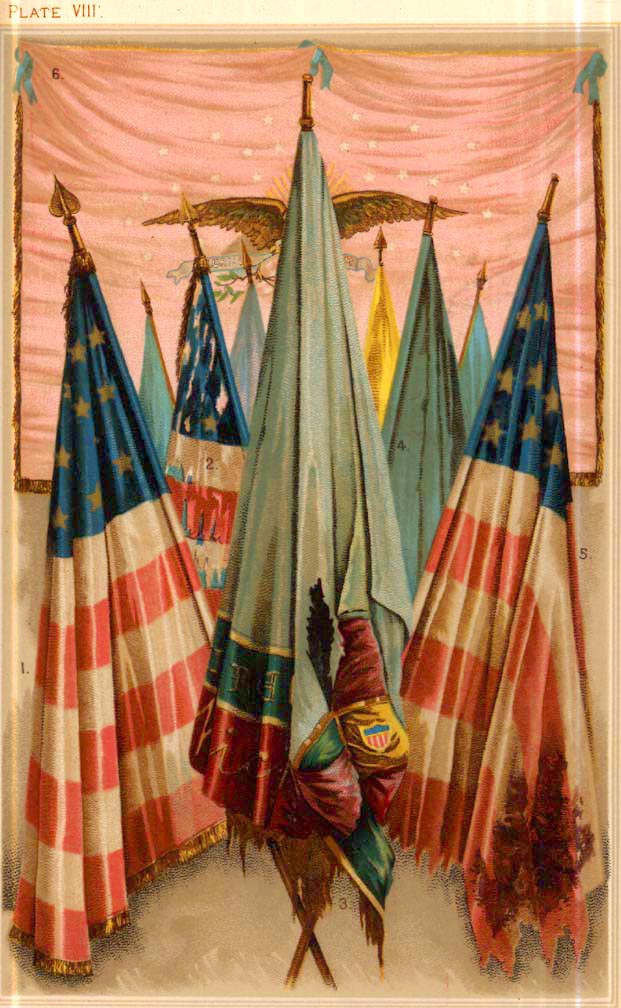 |
||
| 1. Seventy eighth Ohio Reg't. | 2. Seventy-eighth Penn. Reg't. | 3. Thirty second Ind. Reg't. |
| 4. Ninth Ky. Reg't. | 5. One hundred twenty ninth Ills. Reg't. | 6. Eighteenth N.Y. Cavalry |
 Descriptions Descriptions |
||
It fared the worst with the sick. No appeal of theirs was attended to. They lay in thousands around the premises, upon the wet ground, covered only with a bit of gum cloth or a blanket. It was a sight to make a man forever hate the name of war, to see these little mounds of human wretchedness. They gave no signs of life, save a stifled groan, or the motion given to the bit of cloth by the act of breathing. All day and all night they remained in this exposed situation, many of them hurried out of the world by this neglect. I suppose the surgeons, for the most part, did what they could; but I have a feeling that there is a great fault somewhere. Everybody declares that the Medical Department, as now organized, is a disgraceful failure.
At the battle of Fair Oaks, General Howard's right arm was shattered by a ball, so that it had to be amputated above the elbow. Waving the mutilated arm aloft, he cheered on his men, and was borne from the field. While being carried on a litter, he passed General Kearney, who had lost his left arm in Mexico. Rising partly on the litter, he called out gayly, "I want to make a bargain with you, General. Hereafter let's buy our gloves together!"
The estate upon which the army was encamped is called Berkeley on the map. It is a noble plantation, lying in a bend of the James River. Every sign of vegetation is trampled out, and its broad acres are as bare and hard beaten as a travelled road. The house is an ancient brick edifice, quite large, and flanked by two smaller ones. At a distance are the negro quarters, more comfortable than I have usually found them. The owner was in Richmond when the army advanced, and had directed the overseer to burn everything that the Yankees could appropriate. But the order was not carried out. Most of the elegant furniture was left in the house. The rich carpets remained upon the floor. In three hours' time they were completely covered with mud and soaked with human gore. The genius of destruction is let loose in war. Soldiers acquire a passion for destruction. It made my heart ache to see them break mahogany chairs for the fire, and split up a rosewood piano for kindling. But any protest is immediately received by the soldiers with cursing of the rebels and all who sympathize with them.
Yours truly,
Z. H. H.
MEMPHIS, TENN., Dec. 20, 1862.
We entered Memphis yesterday afternoon, after a march of eighteen days, when we accomplished one hundred and fifty miles. We were overjoyed to get back, and were no more than comfortably settled when our quartermaster came into camp with one hundred and forty letters for the boys. I was one of the unfortunate ones who received no mail; but I enjoyed the happiness of the rest. A Chicago Tribune of Dec. 8 was read from tent to tent, to a tentful at a time. The first notice in the local column was the opening of the new skating park, which seemed incredible to us, as we perspire in our shirt-sleeves, without any fire, as if it were midsummer.
I had gotten over my disappointment when one of the lieutenants came into camp, followed by the captain, the arms of both heaped with letters and papers. They had brought three hundred and ten more letters, and an immense armful of papers. Now, I had fourteen letters and five papers. I read and re-read them, and succeeded in digesting them all by morning. You cannot imagine what a change came over the camp after the men had read their letters.
Sometimes our expeditions and reconnoissances take us away from camp for a month at a time, so that we neither receive nor send any letters until our return. The men always become rough and somewhat demoralized on these occasions. They become profane and boisterous, some of them obscene and quarrelsome, and there will be bad. blood among them, with the prospect of several fights, as soon as they can manage them. By and by we get back to camp, and a big mail awaits us. All the men will have letters and papers from mothers, wives, sisters, and friends; and there is a change immediately. A great quietness falls on the men; they become subdued. and gentle in manner; there is a cessation of vulgarity and profanity, and an indescribable softening and tenderness is felt, rather than perceived, among them. Those who were ready to shoot one another a few hours before are seen talking with one another, and walking together, sometimes with their arms around one another. It is the letters from home that have changed the atmosphere of the camp. If the people at home only knew what "a means of grace" their letters are to the men, they would write frequently.
The climate is delightful, and as yet we have had but little weather that could be called chilly. The December weather has been like that of September and October in Chicago. Trees are budding, birds are singing, and the flies are a torment. As we go farther south I presume the weather will be even warmer. Almost all the inhabitants left in the country are old men and women and negroes. There is any number of the latter. We could have collected a small army of contrabands if the Emancipation Proclamation had been in effect. Most of the work in the army is done by negroes. Some regiments have sixty or a hundred of them. They cook, take care of the horses, wash, make roads, build bridges, and do almost all the heavy work. It surprises them to see white men work. "Why," they say, "you can harness a horse as well as any nigger. Our massas could no more harness a horse than they could fly." They constantly ask me why we will not let them fight. Most of them say they will stay with us through thick and thin, if we will only bury them when they are killed. Some of them are very importunate to drill and get ready against they are needed.
You would be surprised to see the amount of provisions the white people have stored away. When our men go to their houses and help themselves to sugar, molasses, meal, or anything, they will beg most pitifully: "Oh, don't take that, it is all I've got! I shall starve!" But an investigation of cellars, sheds, and smoke-houses, reveals immense quantities of supplies. Not a man in ten even pretends to be in favor of the Union; and they say all they dare in favor of the South. They declare that the North has always abused them; and that the time has come for them to rebel. They openly express their surprise to see such good looking men among the Yankees. Our orderly took dinner with a wealthy planter one day, and, while at the table, the lady of the house asked her little daughter, "if that man looked like a Yankee?" pointing to the orderly, who is a very fine looking fellow. "Why, no!" said the young lady; "I don't believe he is." When the orderly asked the reason of her doubt, she answered very frankly, "Why, Yankees are hideous looking creatures!"
Truly yours,
G. T.
WASHINGTON, D. C., Jan. 5, 1863.
It is so long since I have been able to write you, that I feel like saying, in the words of the old Scotch song,--
"Oh, years have flown since we have met,
And sorrow has been mine."
I have been learning, with a very ill grace, I fear, a lesson of patience and resignation in the prisons of Dixie. When I enlisted I had no expectation of being covered with glory or crowned with bay leaves; but I confess that I have seen considerably more than I bargained for. I fell into the tender embraces of the "Butternuts" on the 1st of last June, with a score of my comrades of the Ninth Michigan, and we have just been released from their loving hands.
I was taken in a skirmish at Chattanooga, Tenn. My captors conveyed me into the presence of General Kirby Smith. He questioned me very closely as to the number of men we had across the river, if our officers intended to attack the town, etc.,---questions which he had no right to ask, and which I had no idea of answering. After evading them for some few minutes, I replied to the august Kirby, as he demanded that I should tell him the truth, that he could easily solve all his own problems by crossing the Tennessee River, and reconnoitring for himself.
"Don't you dare give me any of your Yankee impudence!" was his amiable reply, and then I was dismissed to the camp of the Forty-third Georgia, where I was detained a couple of weeks. With other prisoners, I was marched to Atlanta, Ga., from thence to Macon, and turned in with about thirteen hundred Yankee prisoners, taken at various times and places. The camp consisted of about four acres, and was enclosed by a broad stockade, twenty feet high. I think the location was healthy, and we were well supplied with water; but we lacked almost everything else. The months of my detention there seemed to me like years, life was so desolate.
The infamous Rylander, the "secesh" major in charge of us at Macon, has a counterpart in the bloody-handed Jeffreys of English history, or in the inhuman Haynau of the Hungarian war. He instructed his guards to shoot "the first Yankee that came within ten steps of the guard line." I confess that there were days when the wish within me was so strong to murder this tyrant, that it was all I could do to prevent myself rushing upon him, foolhardy as the deed would have been; for I should have fallen before I had reached him. He could have brought a little sunshine into our dreary lives---he could have soothed the dying hours of many of our poor fellows-but he seemed to take a fiendish delight in seeing the men droop and die. Nearly three hundred of our men died in this prison during the four months that I was a prisoner there. Every state in the Union was represented.
Many of the boys were young and not inured to hardships, and they went under rapidly. Fragments of that sad poem, "The Prisoner of Chillon," would cross my memory as I saw pale-faced striplings die before my eyes, without the power to help. As true as there is a God in Heaven, many were starved to death, and perished for lack of the bare necessities of life. Some who grew insane with their sufferings, rushed beyond the dead line, and were shot immediately. That was merciful compared to the treatment others received.
Our rations were a half pint of flour and a small piece of bacon per man. Some of the time the bacon was so bad that we had to throw it away. When we did not have bacon, we were sometimes furnished with what we believed was mule beef. At times this was so putrid that it was impossible to eat it. We had no salt, unless we bought it at the rate of two dollars and a half per pound. If we asked for flour, we could have it by paying a dollar for three pints. Sometimes we received beef; but we were never allowed but eighteen pounds of beef, bone included, for one hundred men. Sometimes soup was made with this beef, and with black beans. River water was used in the making of the soup. Part of the time it was without salt; but it always contained plenty of bugs and maggots. Our rubber blankets, canteens, and haversacks were taken from us. Some of us received tents. Some had to lie outdoors; but none of us had anything with which to cover our bodies.
About the middle of September, rumors of a general parole of prisoners reached us, and by the last of October, with as thankful hearts as must have filled the bosoms of those released from the Bastile, we left the hated place. Death on the battle-field, death in the hospital, or death under any circumstances, is preferable to the brutality and starvation of a rebel prison. We were crowded into cattle cars and started for Richmond. At Columbia, S. C., we were stared at like wild animals; and the people appeared surprised and disappointed that we did not have horns, and hoofs. The cultivated and refined ladies amused themselves with walking backwards and forwards, making faces at us, spitting at us, and uttering gibes.
At Charlotte, N. C., we remained four days, awaiting transportation to Raleigh, with only a little rice, bread, and more putrid meat, which lasted us to Raleigh. Here we received crackers that must have been ancient when the war began, to judge from their stoniness, and some raw bacon, which we ate uncooked, for lack of fire. From Raleigh we were sent to Petersburg, and thence to Richmond, where we were paroled.
Ah! you should have seen us when we trod the deck of "Uncle Sam's" transports, if you want to know how men prize liberty. Despite the weak and emaciated condition of the boys, they were wild with enthusiasm. They kissed the flag, hugged the stanchions of the boat, patted its side, and said, "This belongs to Uncle Sam!" I was starving for coffee, and spent most of the first night drinking coffee, until there began to be danger of my becoming water-logged. As we steamed down James River to Fortress Monroe, up Chesapeake Bay, and the Potomac River, to the national capital, I think, despite our worn, ragged, and dirty condition, the sun never shone on a happier set of fellows.
I have some new ideas concerning the Southern soldiers. Hatred of the Northerners seems to be the one absorbing passion of their lives. They have any quantity of brute force, for they have been reared to be hardy physically. But the illiteracy of the Southern army is amazing. Not one in ten can read or write. How the South will get through the winter is a mystery to me, for the corn crop of Georgia and North and South Carolina is exceedingly scanty, and there is a great scarcity of meat. Shoes are worth nineteen dollars a pair. Everything is scarce and expensive. The only means of subduing this rebellion, in camp and in council, is with powder, ball, and bayonet. But will you think me lacking in patriotism when I confess that just now I feel like endorsing Horace Greeley's proposition to "let the wayward sisters depart in peace"---or in pieces, as they prefer?
Ever yours,
J. B. R.
BOLIVAR, TENN., Jan. 10, 1863.
Let me relate a touching little incident that is very affecting. At the battle of 'Hatchie, when the conflict was raging fiercest, midway between the contending forces we found a little blue-eyed baby lying on the cold. earth. A tear was on its cheek, which it had wept at finding itself alone, but it was unalarmed amid the awful confusion of the battle. With the missiles of death flying thickly about it, and crowding close upon its life, it lay there in miraculous safety, and by its smiles, and helplessness, and innocence, appealed to us for protection.
Now would you suppose that in the midst of that wild, fierce battle, with the field strewn with the dead, the shrieks of the wounded rending the air with agony, a great army would pause to save a helpless baby? Yet that is just what the Fourteenth Illinois did; and an officer of the regiment ordered the baby carried to headquarters, and tenderly cared for. The next day after the battle, the baby was brought before the Fourteenth and unanimously adopted as "the child of the regiment."
But three or four days later a heart-stricken, poverty-pinched mother came searching the battlefield and the camp in quest of her child. Wild exclamations of thanksgiving burst from her when she learned that her child had been rescued, and cared for with a mother's tenderness. I saw her receive the child, heard her brief prayer for the soldiers who saved it, and, with the blessing of a thousand men following her, she carried away our little laughing, blue-eyed baby.
Always yours,
O.
IN CAMP NEAR MURFREESBORO, TENN., Jan. 22, 1863.
After so long a silence, I seat myself to write you concerning the Army of the Cumberland. Since the battle of Stone River many changes have taken place with us. Our poor wounded comrades have all been sent North. Not, alas, as they came to us; for then they could carry whatsoever they needed, and now they return unable to carry themselves. But such is the fortune of war.
A large convalescent camp has been established near the fortifications, where the boys are taken as soon as they begin to recover and approach the time when they are fit for duty. This is a noble institution, and reflects credit on our worthy general. Near the camp is a large field or kitchen garden, cultivated by convalescents and details from the army, where will be raised more garden sauce, or " truck," than could possibly be consumed by the entire convalescent corps. This is necessary on account of scurvy.
We are indebted to "Old Rosy" (General Rosecrans) for the great improvement in our bill of fare and general condition. We in the Army of the Cumberland think him almost as big a man as "Old United States" (General Grant) or "Tecumseh" (General Sherman). We have drawn pickles, good ones too; something we have not seen before since we enlisted. They have sharpened our appetites, which, to tell the truth, were keen enough before. We have also received pepper, which you should be deprived of for a time if you wish to know how to appreciate it. We have also received a lot of real "Irish Murphys" (potatoes). These favors cause us to mention the name of "Old Rosy" very gratefully. I think it has never been our good fortune since we went into the service to be situated where there was such general good feeling. We think we have the right man in the right place, and we hope the authorities at Washington will agree with us. We could not lose Rosecrans from this army without serious injury.
A few days ago, one of the boys, in a fit of great wrath, occasioned by a letter he received from his family, who were suffering from want, wrote the following letter to General Rosecrans:--
GENERAL,---I have been in the service eighteen months, and have never received a cent of pay. I desire a furlough for fifteen days that I may go home and remove my family to the poorhouse.
"Old Rosy" gave him his furlough.
In my last I complained about the German officers, did I not? Well, I guess I must take that back.
They are splendid fighters; in fact, all the foreigners are who are with us. I wonder if you know how many nationalities are represented in this army. Sigel is a German, Turchin is a Russian, Stahl a Hungarian, Maggi a Sardinian, De Monteine is a Frenchman, De Courcey an Englishman, Ericsson a Swede, Corcoran and Meagher are Irishmen, and Fidella is an Italian.
There is a German officer in camp concerning whom they tell this story; they say at the battle of Shiloh he rode up to an aide and inquired for Grant. "That's him with the field glass," said the aide, wheeling his horse about. Our Dutchman rode furiously up to the General, and, touching his cap, thus addressed him: :--
"Sheneral, I vants to make von report. Schwartz's Battery is took."
"Ah," said the General, "how is that?"
"Yell, you see, Sheneral, de sheshessionists came up to de front of us; de-----sheshessionists flanked us; and de sheshessionists came to de rear of us; and Schwartz's Battery vas took."
"Well, sir," said the General, "you, of course, spiked the guns?"
"Vat! " exclaimed the Dutchman, in great astonishment, "Schpike dem guns! Schpike dem new guns! No, Sheneral, it vould schpoil dem."
"Well," said the General, sharply, "what did you do?"
"Do, Sheneral? Vy, ve took dem back again from de sheshessionists!"
These Germans will fight, and they care as much for this country as we Yankees do. And so, if I have complained of them, forget it.
For several days past, sentence of death has been daily executed upon spies, murderers, and deserters. Spies and murderers are hanged, but deserters are shot. It is a fearful thing for soldiers to shoot their companions in arms, and yet to maintain discipline it has to be done. Two were executed to-day. Thousands flocked to witness the spectacle, but I went as far as possible from the sight of the tragedy. During the last two years I have seen men enough making their unceremonious exit from this vale of tears and "hardtack" not to feel eager to witness any one's deliberate departure.
Cedar rails make excellent firewood, and that is probably the reason why there are no fences in this vicinity. Rail fences disappear like dew before the sun the moment an army camps in their vicinity. Our camp is in close proximity to the battle-ground, and the stench arising from the carcasses of dead horses and mules, which have not been buried, makes our camp anything but agreeable. We are waiting patiently for the fate of Vicksburg to be decided, and then we shall take up a forward march.
Yours truly,
S.I.S
.
SOLDIERS' LETTERS FROM THE FRONT DURING THE THIRD YEAR OF THE WAR---HOUSEKEEPING IN CAMP---RIDING "CRITTER-BACK"---DARING DEEDS---REBEL PICKETS.
Battle of Chickamauga---Remarkable Presentiment---Housekeeping in Camp---Ignorance of the Enemy---The walking Regiments"---" Cannon Soldiers"---Wept over his lifeless Body---Ignorance of secesh Soldiers---Yet they fight bravely---Have plenty of Hay, but no Impunity---Greater Loss by Sickness than on Fields of Battle---Evidence that the Enemy are near---" Riding Critter-back"---After the Battle of the Wilderness---"Any Commander but Grant would have retreated"---Recklessness of the Cavalry---Daring of the Soldiers--"Divide is the word, or you are a dead Johnny!"---Ten thousand Men sing "Rally round the Flag, Boys!"---One vast, exultant Roar! "---Talking with rebel Pickets.
HEADQUARTERS, FIRST BRIGADE, SECOND DIVISION,
CHATTANOOGA, TEEN., Oct. 29, 1863.
 HE sounds of booming cannon and
retreating musketry have scarcely died away, nor are the effects
of the great battle of Chickamauga yet removed from our sight.
I see this moment a throng of ambulances wending their way to
the pontoon bridge, loaded with our comrades, who, a short time
since, were joyous and strong, now carried away minus a leg, without
an arm, scarred, gashed, and with a weight of Confederate lead
in their bodies.
HE sounds of booming cannon and
retreating musketry have scarcely died away, nor are the effects
of the great battle of Chickamauga yet removed from our sight.
I see this moment a throng of ambulances wending their way to
the pontoon bridge, loaded with our comrades, who, a short time
since, were joyous and strong, now carried away minus a leg, without
an arm, scarred, gashed, and with a weight of Confederate lead
in their bodies.
I shall not undertake to give you any description of the battle. Every prominent paper has its special correspondent down here, and when they write their letters from information obtained by themselves at headquarters---and not from cowardly stragglers it can be, in the main, depended upon. You at home are probably better acquainted with the details of the battle than we here. My knowledge is properly confined to the part taken by my own brigade. We were not engaged on Saturday at all; but on Sunday, the 20th, we were formed in line of battle, in a strong position. Had we been left there, our loss would not have been what it is, and the loss of the Confederates in their desperate charge upon General Thomas would have been double; for we were in position to attack them with our artillery and infantry, on their left flank.
I think we could not only have checked, but utterly annihilated their massed columns. But no sooner had the troops on our left commenced to give way, than we were moved on the double quick to form a line in the face of a terrible charge, with our troops falling back and breaking through our line, while one section of our battery was unlimbered. Our much-beloved general, William H. Lytle, fell at the head of our column, twice wounded. We could not remove his remains from the field. Our brigade numbered fourteen hundred men, of whom we lost five hundred in killed and wounded. My Company, H, lost eighteen men out of twenty-eight, and two of our officers were killed; but we are in good spirits---have not been whipped, and do not believe while "old Rosy" commands us we can be. We have another idol. It is "little Phil" (General Sheridan). This place is now in such a condition that it is lost to the rebels. They might as well charge up into the heavens to obtain the sun as to waste their time on. this place.
I have never come out from any fight with such a sense of loss as from this. Seven of my company are lying side by side in one grave, within four rods of where they fell. My dear messmate, comrade, friend, and bedfellow, Alvin Bunker, from whom I have not been separated one night since we entered the service together, was killed in the act of taking aim. On the night before the battle we lay down together, near where we formed the line in the morning. That was the third night we had been engaged, and so we were obliged to lie down with neither fire nor coffee, although it was very cold and rainy. Alvin and I spread our blankets and lay down together, having on our belts and arms. Holding each other by the hand, we talked for a long night about the possibility of that being the last time we should sleep together. We promised each other that if either fell the other would take charge of his lifeless remains and write home all the particulars. And then I don't mind telling you of it---we repeated together the little prayer, "Now I lay me down to sleep," and, with more solemnity and tenderness than we ever before expressed, we bade each other "Good night."
In the morning, Alvin took out his watch, purse, some photographs, and little keepsakes, directed me what to do with them in case he was killed, and then said, "S-----, you will have to go home without me. It is all up with me. I shall be killed in the first hour of the fight." I remonstrated, even with tears, for you know how I loved Alvin; but I could not shake him in the least. Before nine o'clock, as he was standing by me, taking aim, a cannon-ball spattered me with his blood and brains.
All who were alive and not wounded soon retreated, leaving our wounded for the rebels to rob, and our dead for them to mutilate. But I could not leave my brother, my comrade, and my friend, and I bore his mangled and bleeding body with me a little out of the ranks of the army and wept over it. He was decently buried. If my letter is blue, have I not occasion?
Yours sorrowfully,
S.I.S.
LITTLE ROCK, ARK., Nov. 20, 1863.
We boys have learned pretty well how to take care of ourselves, and, about as soon as we get into camp, we set up house-keeping, as though we expected to spend our lives in camp. Cosey cabins are fitted up. One will have a fireplace and a chimney, which he plasters with the red earth. Another has "jerked" a crane from some "secesh" house, and swings thereon his three-legged dinner-pot. Tables, stools, and benches are tumbled together in the quickest way possible, and by the roughest of carpenters. Most of us have a bit of looking-glass that hangs on the wall, revealing to us our bronzed faces. Some of the boys have "jerked" a banjo from some quarter, which is strung up on a hook; and before many days the whole camp will have a real homelike air. The spaceways between the tents are cleared and kept smooth, or "policed," as the camp language has it. And in front of the tents there will be always little seats shaded by boughs of trees, where we can take our ease when off parade or duty.
But suddenly there comes some morning an order for striking tents, and then this canvas city vanishes more rapidly than it grew. The regiments march out, the bugles blow, the bands play, the roll of the drum is heard. Then the army wagons stretch along behind, and, at last, where, but a few nights before, all was life and animation, there are only desolation and the various impedimenta that a camp always leaves behind.
A more heathenish set of human beings do not exist outside the Orient than the country people of Arkansas; and the soldiers know little more than the civilians. In the parlance of this state, the Arkansas Infantry are "The Walking Regiments"; the artillery are "Cannon Soldiers "; an officer on horseback is "riding critter-back."
We always call our antagonists "Johnny Rebs," and they hail us as "Yanks" and "You-uns." We sometimes have very amusing conversations with the ignorant fellows, which not unfrequently end in practical jokes. Ignorant as they are, they are pretty good fighters, and lead us a lively dance sometimes.
Don't imagine that ignorance is confined wholly to the "secesh." We have a little display of it in our own quarters once in a while. One of the field officers dashed up to headquarters a few weeks ago, his horse reeking with foam from hard riding, dismounted, and threw the reins to his servant, who is, like myself, a Jerseyman.
"Feed him! " said the officer.
"Isn't he too warm to feed now?" inquired' the servant.
"No, not at all. You can feed him hay with impunity."
"Impunity?" queried old stupid. "We hain't got none. The quartermaster has furnished us hay, but nary a pound of impunity."
We have lost more men by sickness than we have by skirmishes or battles. I imagine that statement is true of the whole army.
Yours very cordially,
H. C. L.
HEADQUARTERS TWENTIETH INDIANA,
SECOND CORPS, BIRNEY'S DIVISION, June 8, 1864.
We have been resting for two days now, and, after thirty-five days of incessant marching and labor generally, and thirty days of battle, we appreciate it, I assure you. By "rest" I do not mean that we have left the front, and are out of sight and hearing of rebels; for our lines are only five hundred yards apart, and the occasional whirr of a rifle-ball, or the explosion of a shell, is assurance that they still live, full of murderous intent. We commenced the campaign on the 2d of May, and on the 5th were fighting. Every day until the 5th of June our regiment has been under fire, and not a day has passed but that we have lost one or more men before its close. In the charge of the 12th, the flag of the Twentieth Indiana was the first placed upon the rebel works, and its bearer, who had carried it since Gettysburg, was immediately shot down, and fell over among the enemy---dead. He was a noble fellow, and had only planted the flag when he fell.
Again at the crossing of the North Anna we were first, and alone charged the works, protecting the crossing of the others. But I do not like to think or to tell of these honorable deeds; for they always cost us the lives of our comrades, and the spilling of the blood of noble hearts, and their remembrance is painful.
General Grant's tactics are novel, and to us peculiar. Any other commander would have retreated after the battle in the Wilderness, but he does not know how to retreat. He continued the onward movement by flanking General Lee, causing him to seek a new position in haste. This flanking movement has continued until now; and rebel papers say, "Grant is enamoured of his left flank." I hope he will remain so. Confidence is unbounded in him. There is much in the letters of correspondents that is not true in regard to the great general. He never gets in a rage; never goes about cursing and swearing. He is never loud nor swaggering; and as to the stories of his inebriety, they are utterly baseless. He is always cool, self-governed, modest, reticent., quiet, and low-spoken. We are angry in the army, when we read the abominable yarns written concerning the unpretentious Lieutenant-General.
Nor have the stories of his disgusting style of dress a word of truth in them. I have never seen more style at the headquarters of the army than now, and General Grant himself, when I last saw him, was in splendid attire, but almost alone. He is the finest looking man on horseback lever saw. The "inevitable cigar" is true of him, for he smokes continually. He is so taciturn that when any one comes to us with an account of a talk that he has had, or heard of any one having with General Grant, he is chaffed unmercifully. Not a word that he says is believed.
This is a flue portion of Virginia through which we have passed. War has not, heretofore, laid waste many of these old plantations, and a certain kind of luxury continues here. The people generally have fled at our approach, and, of course, we have appropriated the good things they left behind them,---ice, chickens, pigs, corn meal, etc.,---they were luxuries to us. Our mess was so fortunate as to be able to supply itself with lots of corn meal and a cow, so that mush and milk, the best food in the world, has taken the place of the army delicacies,---hardtack and coffee.
A few days ago I met a cavalry man on the road. I was thirsty, and asked him if he had water in his canteen. He replied, "No, not water, but milk." I took the canteen, and laughed at what I supposed was the fellow's joke; for I supposed that the milk had come through the commissary's faucet. But it was indeed milk, not cold.
"Have you found a spring?" said I, laughing.
"Oh, no," replied he, nonchalantly; "there are about forty cows round here, and we just milk them." And so they did. The cavalry men are reckless fellows, under less discipline than the infantry, and have "just everlastingly lived," in army phrase.
When I went ashore at White House, I had not been there an hour before I saw some one coming, leading a cow triumphantly. I followed the man into a farmyard, and there I saw signs of the herd that he told me of,---not forty, but certainly more than twenty.
The daring of our men is to me amazing, as much as I have seen of it. It is reckless foolhardiness at times. But it is not surpassed by that of our enemies. One biting cold morning last winter, when the armies of Meade and Lee were drawn up on opposite sides of a little rivulet, all strung to so high a tension that moments seemed hours, and hours days, the deadly strife was so near at hand, a solitary sheep walked leisurely along the bank of the stream, on the rebel side. A rebel vedette fired and killed the sheep, and, dropping his gun, he rushed forward to secure his prize. In an instant he was covered by a gun in the hands of a Union vedette, who said, in a tone that carried conviction with it, "Divide is the word, or you are a dead Johnny!" "Johnny Reb" assented to the proposition, and there, between the two skirmish lines, the rebel soldier skinned the sheep, took half of it, moved back to his post, and resumed his musket. His challenger in turn dropped his gun, crossed the rivulet, lifted to his shoulder the other half of the sheep, waded back to his line, resumed his gun and the duties of his position amid the hearty cheers of his comrades, who expected to help him eat it.
During one of the eventful nights through which we have been passing, when we lay in line of battle behind our temporary fortifications, and the continuous crack of the sharpshooter's rifle rolled along the front, a solitary, ringing tenor voice struck up the stirring song, "Rally round the flag, boys!" Almost instantly, thousands of men, who seemed' to have been waiting for that or something else to dissipate the gloom engendered by the carnage of the day, joined in the melody. The volume of voice with which they rendered the chorus shook the very forests about us: :--
"The Union forever, hurrah, boys, hurrah!
Down with the traitor, and up with the star!"
The chorus was repeated, the whole line joining in it, until the refrain swelled into one vast exultant roar, which flung defiance to the enemy, who sent showers of bullets in the direction of the music, but the missiles whizzed harmlessly by. Our men were immensely inspired by the music, and it was very evident that the Johnny Rebs were equally irritated by it.
I have been having a talk with rebel pickets in front. They will trade anything for coffee and sugar, will take greenbacks for tobacco, but decline rebel money, which our boys have taken from their dead. They ask why we do not send back to the South the five thousand Confederate soldiers who have remained in the hospitals in and about Gettysburg, and who are now convalescent. I asked them how they knew this. Their answer was, "We learned by grapevine telegraph." The truth is, these rebels have asked not to be sent South, as they will again be forced into the ranks. The pickets express great admiration for General McClellan. They say, "If the South could vote, they would make McClellan President."
Yours sincerely,
E. G.
SOLDIERS' LETTERS FROM THE FRONT DURING THE LAST YEAR OF THE WAR---LIFE IN REBEL PRISONS---DREADFUL SCENES---HORRORS OF ANDERSONVILLE---LAST DAYS OF THE GREAT REBELLION---PEACE.
A Hospital Picnic---"The Stump Squad"---Strawberries for the Army---"Virginia a vast Blackberry Field"---"Old Hundred" in Camp---Hunting Bloodhounds---Letter from a Hospital Nurse in Annapolis---Thirty thousand Prisoners cooped up at Andersonville, in ten Acres---Their Hands and Feet rot off---Swarming with Vermin---Bones protrude through the Flesh---The Men become Idiots and Lunatics---Different Treatment of Southern Prisoners by the North---"The Yankees take good Care of us"---Last Days of Sherman's "March to the Sea"---The Army reaches the Atlantic Coast---Columbia, S. C., is burned---Destitution of the South---"At the Mercy of a General more powerful than Grant or Sherman, General Starvation."
HOSPITAL CAMP NEAR WASHINGTON, D. C., July 26, 1864.
HAVE been wondering if I could
find, interesting matter with which to fill a letter to you. I
confess the motive is a selfish one, for I hope to bring to myself
a speedy reply---one of your long spicy letters, full of r news
and gossip, and pleasant things about my negligent friends of
the West Side. I have just witnessed a hospital picnic. It is
a new thing for maimed and sick men to participate in out-door
festivities; but is there any form of kindness, or any manifestation
of tenderness, in which the men and women of the Sanitary Commission
fail to express themselves? If this war has developed some of
the most brutal, bestial and devilish qualities lurking in the
human race, it has also shown us how much of the angel there is
in the best men and women---has reconvinced me that man, with
the propensities of the lower creation still lingering in him,
is yet divine, and ordained ultimately to a noble destiny.
The convalescent portion of this large community was out to-day in full force. It was an odd-looking company, I can assure you. For they came to the picnic provided for them with arms in slings, and sometimes with but one arm---sometimes both were lacking. Some on one leg, and others, with scarcely healed, wounds, by the aid of friendly hands and crutches, were helped to the place of meeting. But there was a group the like of which, I venture to say, was never before seen at a festive gathering. It was composed of men whose limbs had been recently amputated. "We are the Stump Squad!" said one of the brave fellows facetiously, "and we are determined to see the fun." These were carried in their beds, by nurses and friends, out into the grove, and placed where the shade was densest, and where the breath of heaven could freely kiss their wan faces. New light came into the eyes of these maimed heroes as they looked round on the festive scene. Their stronger comrades made good use of the summer day. Some were engaged in games upon the thick greensward; others were swinging in the great box swings, or trying to amuse themselves in the bowling alleys. They were treated to excellent music, by the fine band of the Fourteenth New Hampshire, who came from their camp to help make the occasion pleasant. Every delicate viand which it was safe for the poor fellows to eat was furnished them, even to strawberries and ice-cream. And those were fed who were unable to help themselves, amid incessant jokes, witty badinage, and gay repartee.
I suppose you have learned of the efforts of the ladies to furnish all the sick and wounded men in the Washington hospitals with strawberries. They distributed this fruit to nearly ten thousand. They expected to do better than this; but they had difficulty in obtaining strawberries from the Washington and Baltimore markets, and could not use the money given them for that purpose. Having a large sum still unexpended, the ladies determined to use their own judgment in its expenditure for the men. It is a great stride from strawberries to tobacco. They had observed that most of the soldiers desired tobacco, but had not the means for its purchase and they consequently distributed tobacco, chewing or smoking, with pipes, to eleven thousand and sixty-eight men. The ladies learned very quickly, by inquiry, that there was nothing, outside of government rations, which the patients in the hospitals more earnestly desired than this filthy weed.
There is no limit to the thoughtfulness of the people for the comfort and happiness of the army. Last Christmas holidays, over five thousand roasted turkeys, with all the etceteras, were sent to the soldiers of the Army of the Potomac, through Adams' Express and other sources. Blackberries are the great luxury of the soldier at present. Virginia is one vast blackberry field. The army was never in better sanitary condition than now-and it is due, so the surgeons say, to the free use of blackberries as a diet. One of the surgeons told me that these Virginia blackberries would save the government a million dollars in medical and hospital stores.
While I am writing a letter about good times, let me give you another incident. A few nights ago, when the air was perfectly still, and an unusual quiet reigned on the earth and in the heavens, we listened to the singing of "Old Hundred," in which some ten thousand men joined. The air was vocal with the grand old strains. One mail had started it, a dozen took it up, and directly the whole camp was singing it. That was the beginning. They went from that to "Sweet Home," "Auld Lang Syne," "America," "The Red, White and Blue," and finally wound up by singing "Coronation." Before they had finished their concert, the blue canopy of evening was studded thickly with stars. I have no doubt the men were not only happier but better for this improvised concert.
One item more, and I am done. One regiment, the Fifty-Second Indiana, has recently been hunting bloodhounds. They have killed between twenty and thirty, valued at a hundred dollars each. They were kept to hunt runaway negroes, and were set upon the track of some of our men; and hence the slaughter. Let me hear from you as soon as you can get leisure to write, and tell me all the news. Not war news, but home news-and all that relates to the old days of peace. Will they ever come again?
Your friend,
E. G.
ST. JOHN'S COLLEGE HOSPITAL, ANNAPOLIS, Md., Dec. 10, 1864.
I had thought that by being detailed to a hospital near where my husband was doing duty, if he were sick or wounded I could be with him in his hour of need. But it was ordered otherwise. I had requested Miss Dix to detail me to these Annapolis hospitals, feeling sure that I should be within reach of him if he should be wounded or should be stricken down with sickness. Not even one of his company or regiment was with him. He was sent to the hospital on the 20th of June, and died the next day among entire strangers, as thousands of our soldiers do. He sleeps among the silent dead, at City Point, Va., on the banks of the James River, where he yielded up his life, a willing sacrifice to the cause of his country and liberty.
I trust some kind woman stood by him to minister to him when dying, as I am daily doing for brave men similarly situated. I believe that the angels of God came down, strengthening him as he passed through the dark valley, and conducted his emancipated spirit to his Father and his God. I am comforted to remember this, and to think of the welcome that he must have received from the near and the dear who had preceded him. I have never so thanked God for the glorious faith of an immortal life beyond the grave as since I have been in these hospitals, witnessing the daily departure of grand and good men to the better world.
Several thousand of our returned prisoners have arrived at Annapolis from Andersonville, Ga., during the last two or three weeks; and more are coming. Over thirty thousand of our men have been held there as prisoners, cooped up like cattle within the space of ten acres, without shelter from the sun, without water, without proper food, and receiving all the while the most brutal treatment. Twelve thousand have been starved into idiocy, lunacy, and death, in that hell of horrors. As the boats containing the poor fellows approach the Landing, a band of music attached to the military post strikes up "The Star-Spangled Banner," or some other national air, which the returning captives who are conscious, welcome with inexpressible delight. The wharf is densely packed with anxious friends, gazing upon the motley group who throng the vessel's deck, most of whom are bareheaded, without shoes, and thinly clad. They are equally anxious, after a captivity, in many cases, of more than two years, to recognize the features of some familiar face from home. Their tears fall in abundance as the poor fellows stand once more upon what they call "God's ground."
Last Monday, the flag of truce boat landed four hundred more men, brought from the prisons of Richmond and Belle Isle. Many were living skeletons, with just the breath of life left in them. The hands and feet of others were dropping off from dry rot. All are completely swarming with vermin, many are insane, and others have been made idiots from the treatment they have received at the South. Over one hundred were carried upon stretchers to the hospitals, only a few rods from the Landing. Oh, to have been treated as they have been! My blood curdles with indignation, and I can hardly endure it. Scores have already passed out of life since last Monday. They died under the stars and stripes, and the flag was laid over their coffins. There has not been a day since their arrival that we have not had eight or ten coffins standing in the chapel, side by side, awaiting funeral services and burial. Sad sights like these must touch the feelings of even the South; for I know there must be humane men and women among them.
The appearance of many of these poor creatures is very peculiar. Their hair looks dead, sunburned, and faded. Their skins, from long exposure and contact with the pitch-pine smoke of their camp-fires, and a long dearth of soap and water, are like those of the American Indian. Their emaciated forms, with the bones protruding through the skin in many instances, and the idiotic expression of their protruding eyes, tell of unparalleled cruelty and savage barbarity. The strongest land first, and are examined by the surgeon. Those that are able are sent to Camp Parole, a beautiful and well regulated camp, two miles from the hospitals, on the railroad leading to Washington and Baltimore. Then the weaker and more sickly follow, supported by strong men to keep them from falling. Then the stretchers bring after them the sad, large remnant of helpless sufferers, and they are taken to the Naval School Hospitals or to St. John's College Hospital.
Last, and saddest of all, come the martyred dead, who have died on their journey from the prison-pens to this point. There were thirty-eight on one boat, the Baltic, and the same number died after the boat had reached her moorings, before the noon of the next day. The day after the arrival of a recent boat filled with our released men, there was a funeral of forty-three from the Naval School Hospital, who had died on the return voyage. They were buried at one time, with sad and imposing solemnities as such long-tortured martyrs for right and truth should be. As they lay in their coffins, one was struck with the similarity of their appearance, which was that of extreme emaciation, with other indications of death from starvation, exposure, and neglect.
How different this treatment received by our men at the South from that which was given Southern prisoners in the hospitals and camps of the North! A copy of the Christian Index, a Baptist paper, published at Macon, Ga., lies before me. Let me give you an extract from a letter published in its columns, written by Captain W. B. Haygood, of Georgia, who was taken prisoner by the Union forces at Gettysburg, in July, 1863. His letter is dated, Hospital at Chester, Pa., Sept. 25, 1863. He says,--
"This is a first-class hospital. Our beds are good, with warm blankets, and all have clean sheets once a week. We have plenty to eat, and it is neatly served. We receive good light bread, beef, pork, ham, mutton, tea, coffee, rice, butter, syrup, and vegetables in abundance. All the prisoners are supplied with good warm clothing. I have a good suit of clothing, and a large woollen shawl. We are all right on the clothing question. We have plenty of reading matter, and I spend a good portion of my time in reading. I am in fine spirits, although I long to be in Dixie. Whatever reports may be in circulation in the South, or if you hear anything that conflicts with what I tell you, don't believe it! The Yankees are taking as good care of us 'rebel prisoners,' as they call us, as of their own men. I confess that my prejudice against the Yankees has died out under their treatment."
It is a significant fact, and a full answer to the charge of cruel treatment of rebel prisoners at the North, that of five hundred who were selected for exchange at Camp. Chase, Ohio, two hundred and sixty voted to remain in prison. And of three thousand two hundred and twenty-three in Camp Douglas, at Chicago at one time, seven hundred and fifteen refused to be exchanged.
Not even are the men in Southern prisons allowed to write letters to their relatives in the North, a privilege which is freely accorded to Southern prisoners in our hands. Union prisoners at Libby Prison are compelled to limit their letters to six lines. One of our women nurses, whose husband is detained there in captivity, has just received the following letter from her husband, which has been three months on the way.
DEAR WIFE:-Yours received---In hopes of exchange---Send corn starch---Want socks---No money---Rheumatism in left shoulder---Pickles very good---Send sausages---God bless you--Kiss the baby---Hail Columbia!
Your devoted husband.
Our return soldiers who are able, receive a new set of clothing, two months' back pay, and are sent home on a furlough of thirty days. Please excuse this imperfectly written letter, written by jerks at odd moments. My duties as nurse, leave me no leisure.
Yours truly,
M. M. C.
The horrors of southern prisons were well known throughout the North, and desperate chances were often taken by prisoners to escape, and were frequently successful. The following account of a Union prisoner's escape while on his way to Andersonville is taken from a letter written to the Hon. Samuel P. Bates, LL.D., by a member of a Pennsylvania Bucktail" regiment. He says:--
About twenty-five members of the "Bucktails" were captured with me, and we laid a plan for escaping from the cars while on the way to Andersonville. We were to overcome the guard, bind and gag them at a concerted signal, and leap from the car. I had stationed myself near the door, just beside one of the guards, with courage screwed up and nerves strung, ready to do my part. Just after dark it was announced to me that the enterprise had been abandoned.
I then made up my mind to escape alone. The weather was warm, and the guard permitted the door of the car to stand open. His gun rested across it. I stood for more than an hour by his side, just on the point of springing out, but still held back by the dread of what might be the result. I cannot describe my feelings at that time. I knew that in a moment I might be a mangled corpse, or I might be alive and free ; or, what was more likely, I might be disabled from travelling, recaptured, and subjected to the punishment that I knew would follow. I took out my watch, which, through some unaccountable oversight on the part of the rebels, had not been taken from me, and in the darkness felt the hands, and found that it was eleven o'clock. So, waiting for a favorable moment, I suddenly caught hold of the guard's gun, thrust it to one side, and leaped out into the darkness. The next moment I felt myself tumbling and rolling down an embankment. I heard the cry of the guard, trying to raise an alarm, as with a rush and a roar the train swept out of hearing, and I was left alone and free, but far in the heart of the Confederacy. I got upon my feet and felt to see if I was all right. I found that I was slightly bruised, somewhat scratched, and that I was terribly scared ; but, with the exception of breaking open the wound I had received in the Wilderness, I was not much hurt.
Alone, unarmed, I was in the midst of the enemy's country. Above me, to the north, I could see the pole star, which was to be the beacon to guide my footsteps by night. To attempt to go by the seaboard, I knew, would be to invite certain capture. Hence I shaped my course to the north, intending to travel till I had crossed the East Tennessee Railroad, and then strike west till I reached New River, which I meant to follow down to the Kanawha. My first purpose was to get something to eat, for which I felt ready to make any desperate attempt. I travelled through woods and fields for three hours before I came to a house. By that time I was nearly famished, having had nothing to eat for fourteen hours, and then only a small piece of corn-bread. At last I came upon a large Virginia mansion, and, having thought of a plausible story to tell, walked boldly up and knocked at the door. Two large dogs answered my summons by rushing out and barking at me furiously, but I stood my ground; and soon an upper window was thrown open, from which a man asked, Who's there?" Without answering his question, I said, "Quiet these dogs or I will shoot them." This he did, and then I told him to come to the door, that I was a friend, had command of a scouting party of Confederate soldiers, that we were out of rations and wanted something to eat. He at once came down and proceeded to get what I wanted, all the time talking to me and asking the news. I invented some stories which made him think that the war would soon be over, and that Southern Independence was an accomplished fact. He gave me a large piece of cornbread and about a pound of boiled pork. Thanking him, I bade him good-night and hurried away. Seeing him follow me, I got into the woods as quickly as I could, and in a tone of command I called out,
All right, boys! Fall in! Forward! march!" and, being afraid that my little ruse would be discovered, I was not long in putting a considerable distance between me and that house, after which I sat down and ate a hearty meal, and then, securing a comfortable bed among some dense undergrowth, I lay down and slept till daylight, which was not more than two hours.
During the next five days and nights I travelled as fast as I could in the direction I had determined to pursue, meeting with several very narrow escapes, from capture, and getting my food as best I could, mostly from the negroes, whom I could trust at all times and under every circumstance. On the morning of the sixth day, I heard from a woman, at whose house I had stopped to get something to eat, that the Yankees were at Buckhannon, twenty-five miles across the Blue Ridge. I determined to reach their lines, so I pushed ahead, keeping in the woods as much as possible. During the day I passed over the Great Otter Mountain (Big Peak), and in the evening, about an hour before sundown, I arrived in the valley, and then I knew there was nothing between me and the Union forces but the Blue Ridge, which I determined to cross, if possible, during the night. I cautiously approached a log cabin, knocked at the door, and asked the woman who opened it if I could get something to eat. Being told that I could, I entered and sat down to wait till it was ready. Of course, I had to give an account of myself at every place I stopped, and I was always prepared with some plausible story. Sometimes I was a rebel soldier, going home on furlough; at others I was a scout on important business pertaining to the rebel government. It was only to the negroes that I revealed my true character. To this woman I concluded to tell the truth, so I said I was an escaped prisoner trying to make my way North. While talking and waiting, I was startled to see coming round the corner of the house, with musket in hand, a genuine rebel guerilla. There was no escape. He walked straight up to the door, cocked his musket, and said, "You surrender!" I cannot describe my feelings on hearing that word as he repeated it, "You surrender!" Instead of the bright vision, which had almost come to be a reality, of reaching the Union lines, I saw before me the prospect of probable death by hanging, or, upon the least provocation or pretext, by the hand of my captor; and if I escaped immediate death, then starvation at Andersonville. A heavy weight seemed resting upon my heart. I could feel my lips quiver. I could not control my voice, and for a moment my feelings were those of complete despair. But in another moment I was myself again, and my eyes took in the situation exactly. It did not take me many seconds to make up my mind that, at all hazards, I would escape from my captor or lose my life in the attempt. I determined to take advantage of any chance that should present itself. He directed me to pass out of the door and take the path up the mountain-side leading to the highway. I started, but was stopped by the woman, who said, "Wait till I get you something to eat," and she brought out two pieces of corn-bread, one of which she handed me, which I put in my haversack, and the other to my captor, who was standing with his gun lying across his left arm. Just as he turned his eyes from me, and reached out his right hand, I sprang upon him, seized him by the throat, threw him over upon his back, and with both hands caught hold of his gun, knowing that if I once had possession of it, the tables would be turned. The woman now lent assistance to the rebel, and the only thing for me to do was to beat a retreat and take the chances of a shot.
I slipped my hand down the barrel, cocked the piece, and pulled the trigger, thinking I could fire it off and get out of sight before my escort could reload; but it missed fire. So, making a desperate effort, I tore myself from my antagonists and fled. The rebel followed some distance, calling upon me to halt or he would shoot me, and when I was within a few rods of the woods I heard the cap snap; but again the gun missed fire, and in another moment I was over the fence, into the woods, and out of sight. I travelled all night, and in the morning, about daylight, came upon Union pickets, and was soon in camp safe at last.
Yours very truly,
C. B. L.
HEADQUARTERS SECOND BRIGADE,
SECOND DIVISION, FIFTEENTH ARMY CORPS,
CAMDEN, NEAR GOLDSBORO, N. C, March 30, 1865.
I received with great gratitude the package of papers and magazines which you forwarded to me. They were not stale to me, but new and fresh, as I had been out of reading matter for nearly three months. It enlivens the dull monotony of camp life, and makes my tent seem a hundred-fold more like home, with a pile of papers and magazines lying in one corner, waiting perusal.
I believe we were at Beaufort, S. C., when I last wrote you. I dreaded to start out on the road through South Carolina, knowing the settled hate of the soldiers towards the state, and their determination to destroy all they could, as they marched through it. Whether they are right or wrong, they look upon South Carolina as the hot-bed of secession and treason, the prime mover in this cruel war, which has cost so much blood, treasure, and suffering. As I anticipated, fire and smoke and complete destruction marked our pathway.
We arrived at Columbia, the state capital, on the 16th February, with but little fighting and small loss. Our march to the sea had not been hotly contested. Columbia was taken, and the Fifteenth Corps entered the city on the 17th. It was not the intention of our commanding officers that Columbia should be sacked and burned, and stringent orders were given to prevent this. But the saloons and cellars of the city were full of intoxicating drinks. The boys found them, got drunk, and broke from all restraint. A few were shot for disobedience to orders, and many more were arrested; but nothing could stay them. They rushed on in their work of ruin, like the very genius of destruction.
It was a windy night. The city was fired in many places, and as the flames leaped from building to building, all the efforts of officers and sober men were necessary to save families and drunken soldiers from the wrath of the devouring element. In spite of all efforts, some were burned to death. The roaring of the flames, the clouds of black pitchy smoke, the screams of women and children as they fled from burning homes, with the yells of the inebriated and infuriated soldiers, inflamed with whiskey, combined to make that a night of horrors, such as I never before witnessed, and such as I pray God I may never see again. On Saturday morning, the city of Columbia was in ashes. I doubt if a city was ever more completely wiped out in one night.
Camden, the place made memorable in the history of the Revolution by the defeat of General Greene by the British, shared nearly the same fate as Columbia, and from nearly the same cause. The citizens of Camden had taken measures to conceal their liquors in the woods, a mile and a half from town, where they had buried them. But the soldiers found them, got drunk, straggled into Camden, and the night was again lighted up by the fires of burning buildings, which spread their lurid glare over the country for miles.
Cheraw, on the Great Pedee, was the next place of importance we reached. That was pretty well scorched and singed, as was also Fayetteville, on the Cape Fear River. At Columbia much danger attended the burning of the arsenal and the railroad depots, from the bursting of shells. One shell in bursting killed seven men and wounded thirty. Two of the men were never found. The hat of one was found in a tree; all other traces of them were lost.
The country through which we have passed is generally a pine timber, quite level, with light sandy soil, poorly adapted for raising produce, and abounding in swamps and quicksands. In many places where the ground appears to the eye to be dry and firm, a team of mules will break through the crust and go down to their bellies, and the wagon-wheels will sink to the axle-tree or box. We have often found ourselves in such a fix. It has therefore been necessary to corduroy the roads, in some places for miles on a stretch. This has made our march slow, difficult, and laborious.
But the great evil of all is the destitution in which we leave the poorer classes of these people. I have often seen them sitting with rueful countenances as we passed, sometimes weeping. Not a thing has been left to eat in many cases; not a horse, or an ox, or a mule to work with. One of our men who has been out foraging saw a man ploughing with two little boys harnessed into the plough for a team; and a woman told me, with her cheeks wet with tears, that she drew the plough herself while her husband, old and quite decrepit, held it, to prepare the soil for all the corn they raised last year---and now that was gone. It was not the intention of the commanding officers that poor people should be thus mercilessly stripped. But unprincipled stragglers ramble out of the lines, and out of the way of officers, and show no mercy or heart. They are the "bummers" of the army. Those who could, fell into our ranks as refugees, and came through to a point where they could get transportation, fleeing from a general more powerful than General Sherman or Grant---general starvation. They were looking for a place where they and their wives and children could live, but did not know where to go.
We passed over the battle-field of the old Revolution, near Camden, and a citizen showed us where General Greene had his headquarters, on a little hill capped by a sugar-loaf-shaped rock. But what were the military operations of that day and age in comparison with the present? I suppose General Greene's whole army would not compare in numbers or efficiency with one of the divisions of our corps.
It is not necessary for me to give accounts of our battles. You receive those by the papers sooner and more complete and correct than I can give them. Suffice it to say, in closing, that men are constantly coming in from the enemy's lines and surrendering. A few came in yesterday, who reported themselves all that were left of one whole division of their army after the battle of the 19th and 20th. They also reported the woods around full of men waiting an opportunity to come into our lines or to return to their homes.
The war is evidently nearing the end. I shall not be surprised any day to learn that Richmond is taken, and that Lee has surrendered. It does not seem to me possible that hostilities can be protracted another three months. The Union forces have overrun the whole South, the country is stripped and peeled, and the rebel soldiers are thoroughly demoralized. The armies of the enemy are melting away like snow in a June sun. Please God, let the day of peace soon dawn! Let war, which is the concentration of everything infernal, end in our republic forever!
Yours for the right,
R. L. T.
Richmond was evacuated, Lee surrendered, and peace declared in two weeks after this letter was written, and a month, nearly, before it reached me. With heartfelt earnestness I repeat the ejaculation of my friend: "In our republic may there be no more war forever! " Slavery, the iniquitous cause of war, is dead, never again to know a resurrection. The nation is entering on a grander work---that of healing, conciliation, and union. A century hence, when these shall have wrought their perfect work, our children's children will justify the fearful expenditure of life and treasure which was the cost of the excision of the hideous serfdom which had become an integral part of the republic. While it remained, there could have been no permanent peace and no certain prosperity. The bravery and sacrifice of the South, worthy of a better cause, could not preserve it. It was already doomed by the advancing civilization of the age, before the North and the South fought across the continent---one for its destruction, the other for its continuance. While we hope that it may know no resurrection here, may we not hope that it will everywhere cease among the nations of the earth?