| I return to France---The suffering among the French prisoners---The Clothing Society---I engage in relief work---Hostes dum vulnerati fratres---The fellow-feeling produced by suffering shared in common---The end of the war---A National Assembly ---The humiliating peace---The Emperor arrives in England---The Sedan of the Government of the National Defense---Mrs. Evans and I visit the Emperor and Empress at Camden Place---The admirable resignation of the Emperor---His interest in the education of the Prince Imperial---Mrs. Evans and I return to Paris---The aspect of the city |
 EEING that, for the moment, I could
not be directly of any service to her Majesty, and at the same
time recognizing that the war, in all probability, would continue
for several months at least, I decided to return to France in
order to go on with the Ambulance work, which I had been compelled
to leave so unexpectedly and suddenly.
EEING that, for the moment, I could
not be directly of any service to her Majesty, and at the same
time recognizing that the war, in all probability, would continue
for several months at least, I decided to return to France in
order to go on with the Ambulance work, which I had been compelled
to leave so unexpectedly and suddenly.
Knowing that there would be a want of medical stores and surgical instruments and apparatus in the French hospitals and camps, I bought in London a supply of the things I thought most necessary, and made preparations to take them with me to Metz.
To return to Paris, as I should have preferred to do, was out of the question. It was not likely that I would be permitted to pass through the German lines then investing the city; and besides, were I allowed to enter it, my usefulness might be greatly hampered on account of the assistance which I had rendered to the Empress; for, during the period immediately following upon the fall of the Empire, party feeling was strong, and the hatred of the Republicans against all persons who had proved to be friends of the Napoleonic family was implacable. Moreover, I knew that under Dr. Crane's supervision the American Ambulance was in good hands. I came to the conclusion, therefore, to look after the armies which were still in the field, and it seemed to me that I could be more useful in Metz than anywhere else.
In order to have no difficulty in passing through the lines of the German troops, I provided myself with letters of introduction and credentials from the highest German civil and military authorities; and although, in a few instances, obstacles were met with, I reached the French outposts safely.
On arriving at Metz, I asked permission to enter the city, stating the purpose, and addressing my request in the regular way to the head-quarters; but, to my great disappointment, my request was not granted.
Nevertheless this rebuff did not discourage me. I found in the neighborhood of Metz, and afterward at Sedan, several hospitals where my medical stores were greatly needed and highly appreciated. But the frightful scenes I witnessed during this my second visit to the Continent moved me greatly, and I decided, until I should be able to return to my home in Paris, to devote all my efforts to ameliorating the condition of those Frenchmen who were prisoners in the enemy's country; some of whom were suffering from their wounds or from diseases, and others from want, resulting from causes I had scarcely thought of, and most of whom were without sufficient clothing of a kind adapted for winter use.
I therefore at once returned to London, and addressed myself to several influential persons, to whom I related my experiences and whose cooperation I solicited. I told them how much I had been struck by the misery and distress I had seen everywhere among the prisoners who were not upon the sick lists, which resulted from the want of nearly everything, and especially from the need of warm clothing; and I expressed my opinion that, as the weather was already extremely severe, should the winter prove a hard one, thousands of them would succumb to their fate, unless effective measures of relief were promptly taken.
To my great delight, my words found willing ears, and I was enabled to create, with the help of Messrs. Michael Biddulph, Thomas Hankey, W. K. Gladstone, and Leopold de Rothschild, the so-called "Clothing Society," which, as has been acknowledged by the French Government, and also by the German authorities, rendered a great deal of assistance to the prisoners of war in the camps established in 1870-71 near Cologne, Mayence, Coblenz, and other German cities.
During nearly the whole winter I was occupied visiting these camps, and I crossed the English Channel several times to take to Germany or to Switzerland the gifts in kind or in money which had been collected in England by our society, distributing them either personally among the prisoners, or delivering them to trustworthy persons who had offered me their assistance.
My first trip to the Continent for this purpose was made in January, 1871. I left London on the 18th of that month, and arriving on the 20th at Lille, called upon the Count de Meulan, the president of a local Relief Society. This society was in direct relations with another society, that of the Chevaliers de Malte, which was under the presidency of Baron Schönlein, at Cologne, and which had received permission to forward goods coming from England, through France, free of duty and at small expense of carriage, and through Belgium at about half the ordinary charge. M. Longhaye, vice-president of the Lille Society, promised me all the aid in his power, and subsequently rendered me considerable assistance.
I proceeded to Brussels on the 21st, in order to arrange for the transportation of supplies through Belgium. The King himself, when I saw him during my previous trip, and told him of my plans regarding the prisoners, had graciously offered me all the assistance which he should be able to render me in my undertaking; and, inasmuch as there existed also in the Belgian capital an International Society which was doing work for the relief of the prisoners of war, it seemed to me advisable to work in cooperation with it.
Finding that, by this arrangement, an additional number of camps could be looked after, and that many of the old prisoners were being removed to other camps, I decided to dispose of the clothing I had brought with me in favor of the large number of new prisoners who were daily arriving at Cologne, Coblenz, and Mayence, and to supply them also with such sums of money as were most urgently required to meet their immediate wants.
The Belgian society having agreed to supply a quantity of wooden shoes to these new prisoners, my attention, on going to Cologne, was first devoted to the distribution among them of warm underclothing. I accordingly gave away there, in the name of our London Society, both personally and through the kind offices of the Chevaliers de Malte, a large quantity of drawers, stockings, slippers, and flannel belts, together with one thousand woolen shirts, costing one thaler (three shillings) each. I gave, moreover, to Colonel du Paty de Clam, of the Second Dragoons, who was indicated to me, both by his fellow-officers and the German military authorities, as possessing their entire confidence, the sum of two thousand francs, for the relief of the most necessitous and impecunious of the non-commissioned officers; and I promised him a further sum to be divided among them, should he think it necessary.
I also found at Cologne a ladies' society which had been organized by officers' wives, and which worked in a very praiseworthy manner. I therefore handed to the president, Madame Masson, the sum of one thousand francs, in order to assist her society in the purchase of woolen socks, drawers, and flannel belts for the convalescent prisoners from the hospitals.
Another sum of money was handed over for distribution to Baron Edward Oppenheim, who at his own expense, and with the aid of subscriptions, was trying to relieve the wants of the prisoners.
Before leaving Cologne, the Abbé Strumpf, a gentleman who spent all his time visiting the camps for the purpose of ascertaining the requirements of the prisoners, informed me that at Torgau, Saxony, the camp was extremely unhealthy, owing to the swampy character of the ground, and that wooden sabots were urgently needed there. I accordingly gave him money sufficient to purchase two thousand pairs.
On arriving at Coblenz, on January 25th, I presented my letters of introduction to General von Wedel, including one from the commanding officer at Cologne. He received me with much kindness, which I was told was characteristic of him; for he was so beloved by the French soldiers who knew him that they called him le père des prisonniers. He at once accorded me permission to visit the two camps established in the neighborhood of the city; and Major Lainstow, the officer in charge of Camp No. 2, also a man of kindly and benevolent impulses, whose humanity toward the prisoners had won for him their confidence and regard, afforded me every facility for carrying out the object of my visit. I myself distributed about two thousand pairs of woolen stockings to the prisoners in the two camps. For the relief of the soldiers and officers interned in the city of Coblenz itself, I left with Mr. and Mrs. Archer Burton, English residents of that city---to whose active exertions these prisoners owed the alleviation of much of their suffering---twelve large boxes of second-hand clothing which I had brought with me from London.
In a similar manner I occupied my time for nearly a month, distributing money and articles of clothing in the prison camps and hospitals at Mayence, Wiesbaden, Rastadt, Frankfort, Stuttgart, Carlsruhe, in fact all over Germany, to aid and comfort the poor French soldiers who had been taken captive during the war.
None except those who saw with their own eyes these men in the camps and lazarettos of Germany can have any adequate idea of the hardships and sufferings they endured, to the very end of that terrible winter of 1870-71. And all the while their ranks were literally decimated by disease; for it has been estimated that more than 20,000 of the inmates of these establishments perished by diseases brought on, principally, by exposure to the inclemency of the weather. The great want of suitable clothing among them was caused by the fact that they were hastily called into the field in July, were captured a few weeks later, in midsummer, and that six months or more had passed with no chance to obtain winter overcoats and blankets, or to renew in a regular way any of their supplies of clothing. But whatever the cause, or however unavoidable under the circumstances, it made no less sad and no less pitiable the condition of these barefooted, bareheaded, and ragged remnants of the military power of the Empire. To their physical suffering was also added the demoralization which came from defeat. They, neither knew the extent of their own misfortunes, nor how great were those which had befallen their country. They were unable even to communicate with their families at home, for they had no money with which to pay the postage on a letter.
A German gentleman, who was greatly interested in the unhappy lot of these prisoners, wrote to me from Dresden, saying: "Out of three hundred French prisoners in our camps, two hundred have not a penny. They can not pay the postage on their letters, so that even the letters which they receive have very often to be sent back"; and he begged me to "come to the relief of these poor people."
"If," said he, "we could only give them, on entering into the hospital, a sixpence apiece! Please authorize Mr. Irish (the American Consul at Dresden) to put a thousand francs in our hands."
I may add that this same gentleman wrote to me to say: "Our dear, highly beloved Crown-Princess [afterward the Empress Frederick] told me that she was very sorry not to have seen you when you called, and was much pleased to hear of the two thousand francs which you gave to us to be disbursed for the purchase of necessary clothing for the sick and wounded French prisoners now in the hospitals at Dresden."
That many ladies---French ladies---should have come to the assistance of the multitude of French soldiers, sick, destitute, and prisoners of war, is not remarkable. A number of them worked nobly and were unremitting in their efforts to relieve and comfort their unfortunate and unhappy compatriots. Among them I wish particularly to mention Madame MacMahon, the wife of Marshal MacMahon, whom I met at Mayence, and Madame Canrobert, the wife of Marshal Canrobert, whom I saw at Stuttgart, and who was as energetic as she was philanthropic. Madame Canrobert undertook to purchase for me, and to distribute personally among the convalescents leaving the Stuttgart hospitals, several thousand francs' worth of clothing and other articles. The Countess de Gramont at Munich was also indefatigable in her efforts to aid and assist the convalescents coming from the hospitals.
But many German ladies were no less considerate and charitably disposed towards the poor French soldiers who lay wounded and sick in the hospitals. Hostes dum vulnerati fratres was a motto which expressed not only the sentiment that guided the conduct of the Crown-Princess of Germany in her efforts to aid and succor these unhappy victims of war, but that of the Empress Augusta as well, who, when Queen of Prussia, established in all parts of the kingdom International Red Cross societies, to which, during the Franco-German War, she continued to give the most generous support. The Grand-Duchess of Baden took a special interest in the military hospital at Carlsruhe; and, on my making certain suggestions by way of improving the situation of a number of prisoners, she promised me that the matter should be promptly attended to. In fact, the French officers interned in Carlsruhe were well cared for, and were most hospitably treated by the citizens.
I should regret to have conveyed the impression, in these reminiscences of my experience among the prison camps in Germany during the winter of 1870-71, that the German Government failed to do all it could reasonably be expected to do in behalf of the French prisoners. When it is remembered that the transport service and supply departments of Germany had to provide for more than 400,000 captives---a larger number than were ever before taken by a victorious army---it should cause no surprise to hear that the Germans were for a time unequal to the task of properly taking care of the hordes of prisoners on their hands. The prisoners were generally fairly well housed; the rations furnished were both good in quality and sufficient in quantity; and the soldiers, and especially the officers, enjoyed a large amount of liberty. In every respect they were considerately treated by the officers in charge of the camps; and I was particularly touched on observing that even a larger share of military honors was accorded by the German authorities to the deceased French privates than would have been rendered them in their own country.
The causes for the suffering which prevailed in these prison camps I have already stated; but I should also state that, after a few weeks, the general condition of the prisoners was greatly improved by the distribution among them of immense quantities of clothing and supplies of all kinds which were furnished by a great number of relief societies that came into existence, immediately they were needed, all over Europe, and the United States also.
During my tours through Germany, while engaged in this relief work, I saw many things which were well worth noticing, and were of more than a passing interest, as they threw light upon human character in general, and taught lessons that may seem singular to those who have not themselves personally observed and studied the conditions and the consequences resulting from actual warfare.
One might expect that the life of a soldier and the continual sight of suffering would make his heart cold and indifferent, and brutalize his feeling; and most people naturally believe---when death threatens every one---when a man is surrounded on all sides by danger, that he becomes supremely selfish and cares very little even for his friends.
This, however, is not so always. On the contrary, I could mention many cases in which the soldiers whom I met in the hospitals or prisons showed the greatest kindness and sympathy for their companions.
I was often told by one of those men, when I offered him assistance, that he was not so much in want as one of his comrades; and more than once, some of the French prisoners refused to accept a shirt or a pair of shoes, even when they were suffering for the want of them, and pointed out to me others among their number who needed these articles far more than they did. The feeling that prompted these generous acts was something quite different from the amiable spirit of camaraderie which is developed by association alone. It seemed rather to be the result of a moral evolution, determined by the environment, that ended in the transformation of an original racial instinct into a fine sentiment of humanity---into that caritas generis humani which has redeemed the world and glorified it.
In peace, the inequality of conditions among men, and the great difference in the fortunes allotted to individuals, create, on the one side, envy, and, on the other side, disdain and a sense of superiority. Many of those who are in the enjoyment of all the comforts and luxuries of life cannot imagine that they can ever be placed in a condition similar to that of their less favored neighbors; for in times of peace sudden changes seldom occur, and the rich rarely have a chance to learn the lessons which misfortune teaches. Many of them therefore persuade themselves that those who are not as well-conditioned as they are, owe it to the simple reason that they are not worthy of a better fortune, and they learn on this account to ignore and despise them.
On the other hand, the poor, or those who are in a dependent position, imagine that they have been disinherited by fate; they know only their own sorrows and sufferings, and never can believe that the rich and the educated, and those who stand in high places and hold great offices, have also their troubles and hours of wretchedness. Deceived by the glittering outside of a life unknown to them and which they cannot understand, their hearts often become filled with envy and hatred.
In times of war the order and relative importance of things changes. Conditions are equalized; and the same hopes, and fears, and joys, and sorrows are felt and entertained by all. Every one knows that what has happened to his companion to-day may happen to himself to-morrow, and he treats his neighbor as he himself would like to be treated under the same circumstances.
It is when confronted by common dangers and suffering that men are most inclined to remember and to practise the golden rule. War is terrible; war is a prodigious leveler; but in its destructive course it sweeps aside the vanities of life, and very often among the ruins some of the fairest and sweetest flowers that grow in the garden of the Lord spring up and bloom.
While I was engaged as above described, the spring arrived, and with it the Franco-German War came to a close. The French armies had been defeated everywhere in the open field and, although Paris for a time still held out, le Gouvernement de la Défense Nationale saw that it would be in vain to resist the besiegers any longer.
After M. Jules Favre 's unsuccessful attempt to treat with Count Bismarck at Ferrières, which our readers will remember, and after the equally unsuccessful endeavors to induce foreign Powers to intervene in behalf of France, of which we have also spoken, Trochu and Favre, and their associates, announced that the Government would rely upon itself for salvation; and all the bombastic proclamations subsequently issued by them only reechoed their resolve to die or to conquer, and not to grant to the enemy a single stone of the fortresses or a single inch of French soil---" pas une pierre de nos forteresses; pas un pouce de notre territoire." The more events progressed, however, the more evident it became to every one that this mock-heroic decision would have to be modified. The flaming spirit---"the furious fool," according to M. Thiers---of the Republican Government was Léon Gambetta, who, on October 6, 1870, left Paris in a balloon, and descended at Tours, where he established a branch of the Government, and soon assumed the functions, if not the title, of a Dictator. However patriotic the intentions of this gentleman may have been, his efforts proved fruitless, notwithstanding his great ability and his prodigious activity. Armies were improvised---six hundred thousand men were under arms in less than four months---but, composed for the most part of raw and undisciplined levies, poorly equipped and badly officered, they were unable to come to the relief of the besieged capital. "If," said Bismarck to Jules Favre, "to arm a citizen were all it was necessary to do to make a soldier of him, it would be an imposition to devote a large part of the public wealth to the maintenance of standing armies. It is these that give the superiority in war---and you were beaten because you did not know it." Moreover, no intelligent or intelligible plan of military cooperation would ever seem to have been agreed upon between the Government in Paris and the Government at Tours; and their effective action, whether for war or peace, was still further paralyzed by personal jealousies and political divergencies. That the Government of the 4th of September should have permitted itself to be shut up in Paris, only shows how absolutely incompetent it was to take the first sensible step towards safety. In committing this folly, it threw away the only chance it had of communicating with the world, deliberately cut itself loose from France, and put in imminent peril its own existence; for, in the meantime, the example set by the members of the Government, on September 4th, was imitated by the Radicals and Socialists of the French capital.
On October 31, 1870, the inhabitants of those quarters of Paris where chiefly the working class lives, tried, under the leadership of Deleseluze, Blanqui, Pyat, and Flourens, to establish a government of the Commune. This attempt, however, proved unsuccessful.
But another attempt of a similar kind was made on January 22, 1871, and the Government did not prove, this time, powerful enough to crush the insurrection entirely, and the spirit of dissension and revolt among the inhabitants of Paris grew more and more violent and dangerous.
On the 28th of January an armistice was obtained from the Germans, in order to enable the French people to elect delegates for a National Assembly, whose sole mission it was to decide whether the war should be continued, or on what terms peace should be made.(62)
On February 13th the seven hundred and fifty representatives of the people elected to the National Assembly of France met for the first time in Bordeaux, and chose for their President M. Grévy. Whereupon the members of the Government of the National Defense resigned their offices, and on February 17, 1871, M. Thiers, who had been elected by twenty Departments as their representative in the National Assembly, was unanimously chosen by the members of this Assembly as "Chief of the Executive Power" in France, and a new ministry was formed.
On February 26th the preliminaries of peace were concluded at Versailles between Prince Bismarck and M. Thiers, and the day for the ratification of the preliminaries was fixed for March 1st.
And the terms of this peace! Is it necessary to recall them? to state that they were not the terms that had been offered to the Emperor---the cession of Strasbourg and a moderate war indemnity---but that they included the transfer to the German Empire of two great French provinces, the payment to the German Government within five years of $1,000,000,000, and the entry into Paris on March 1st of a German Army Corps, which was to remain there until these preliminary conditions had been ratified by the Assembly?
On the 1st of March, 1871, thirty thousand German troops marched into Paris, and Bismarck came to the Place de l'Étoile to hear the bands play the "Wacht am Rhein" under the "Arc de Triomphe." And squadrons of German cavalry were picketed along the Champs Élysées and in the Place de la Concorde- where the faces of the statues of the great cities of France---Lyons, and Strasbourg, and Marseilles, and Bordeaux, and the rest, were hidden behind dense folds of crape, to indicate the sense of the national humiliation. And it was on this same day, at Bordeaux, that the Assembly, chosen purely and simply to pronounce on the conditions of peace, formed itself into a Constitutional Convention---M. Thiers having declared that in any case it was sovereign---and purged itself of all responsibility for the war, and for the disastrous and shameful terms of peace it had accepted with indecent haste, by reaffirming the overthrow of Napoleon III. and his dynasty, and declaring him responsible for the ruin, the invasion, and the dismemberment of France.(63)
The humiliating terms on which peace had been obtained, and the unsettled political situation in France, grieved the Emperor bitterly. The war, however, was now over, and he was no longer a prisoner. He accordingly began to make his arrangements to leave Wilhelmshöhe, for the purpose of joining the Empress at Camden Place. But it was his destiny, before leaving his palatial prison, to hear of yet another disaster that had befallen his country. On March 18th news reached him of the outbreak of the Commune in Paris.
The day of his landing in England, March 20, 1871, was unusually fine, and thousands of people had assembled on the pier at Dover to witness the arrival of the illustrious exile. The Empress, with the Prince Imperial and a limited suite, had gone to Dover by special train from Chislehurst. They at once proceeded to the Lord Warden Hotel, where they stayed until the steamer from Ostend arrived. The Prince Imperial, with Prince Napoleon, Prince Murat, Baron Dupret, Prince Louis Lucien Bonaparte, and several distinguished English gentlemen, had accompanied the Empress from Chislehurst to meet the Emperor on his landing.
As soon as the boat was made fast, the Emperor, who stood on deck with Baron Hehren, General Fleury, and one of the Princes Murat, was immediately recognized. Repeated cries of "Vive l'Empereur!" from the assembled multitude greeted his Majesty, who acknowledged them with smiles and salutes. As he stepped on shore, the crowd pressed so closely about him that it was difficult for the Emperor to advance. The policemen, however, soon cleared a way before him, and in another moment the Empress Eugénie was in his arms. He pressed her to his heart; and the Empress, who kissed him several times with deep emotion, and her eyes full of tears, then walked away with him, clasping his arm with both hands. The Prince Imperial, who had taken hold of his father's hand and saluted him with a kiss on both cheeks, walked by his side. The curiosity of the people led them to gather around the exiles, who could not proceed until the gentlemen who accompanied them, together with some policemen, formed a cordon, and the Imperial family were thus enabled to walk slowly towards the Lord Warden Hotel.
Upon approaching the hotel, loud shouts of "Vive l'Empereur!" "Vive l'impératrice!" were uttered by the people who had gathered about the entrance, and by others who were waving hats and handkerchiefs from the windows. The Empress seemed half dismayed and half pleased at this homage; but the Emperor smiled good-naturedly, and bowed, lifting his hat to the multitude. The Imperial refugees stayed but a short time at Dover; and as a special train was in readiness at the railway station, they were able to leave at two o'clock. When the train steamed out of the station, two or three hundred ladies and gentlemen, who had come to witness the departure of the illustrious exiles, greeted them with loud acclamations; and while the cars were slowly moving off, the sympathetic cheering of the English people still for a long while reached the ears of the deposed French monarch, who an hour or two later arrived at his new home in Camden Place.
When the Emperor left Wilhelmshöhe I was in Switzerland, where I had gone to look into the condition of the French soldiers---the remnant of Bourbaki 's army---that had been forced to take refuge on Swiss territory, and whose sufferings from want of food, exposure, frost, and fatigue had been almost beyond belief. Thousands of their companions had perished or disappeared in the snow about Besançon and Pontarlier; and the condition of the survivors, frost-bitten, and in rags, resembled and was no less pitiable than the one which is said to have been presented by the shattered columns of the "Grand Army" that escaped from Moscow. The disaster was even greater, for the morale of the troops had vanished, and an army of over one hundred thousand men had been destroyed. Le Gouvernement de la Défense Nationale had found its Sedan among the defiles of the Jura. It was the fit ending of a campaign begun on September 4th in which the prestige of a century was dissipated, and the record of which is the darkest and most inglorious in the military history of France.(64)
And here it was, among these last victims of the war of 1870-71, that my relief work ended.
A few days after the Emperor arrived at Camden Place, I with my wife went to Chislehurst to present our respects to his Majesty, and our congratulations to the Imperial family, who, after having experienced so many vicissitudes of fortune, were now again reunited.
The Emperor received us in the most kindly manner, and with the same ease I had so often observed, just as if nothing unusual had occurred since I saw him at the Palace of Saint Cloud.
I noticed that he seemed to have grown a little older, that his complexion was somewhat paler than it had formerly been, and that his face bore traces of fatigue and suffering, He was now without a throne, or a country, or a home that was his own. Even the house we were in I myself had hired for him. He appeared, however, to be by no means depressed, but most happy to be once more with his wife and son, and pleased to see himself still surrounded by loyal and most devoted friends.
He at once began to ask us many of those personal questions which, of little importance in themselves, are always prompted by sympathies that tend to make the world akin, and talked freely himself in reply to our inquiries. The Empress soon after joined in the conversation, which ran on for a long time in the same amiable personal vein. Most of the things said were of interest only to ourselves. But the attempt of the Empress to extenuate the conduct of some of her enemies---to whom I casually referred---I was scarcely prepared for. What made her magnanimity---and formally expressed willingness to pardon them if they would only save France from destruction---all the more unexpected, was the fact that, in referring to the conduct of these persons, I had only used the words I had heard her Majesty herself use when speaking of them. Time had softened the bitterness of feeling which at first it was impossible for her to repress; and she was by nature too generous and too patriotic to permit me, a foreigner, to say any unpleasant thing of persons whose motives might be misjudged, and whom she still fondly regarded as her own people. Her Majesty's ability to forgive, if not to forget, is as remarkable as was that of Napoleon III.(65)
Before we left, the Emperor thanked me for having found for the Empress and himself a quiet and charming English home; and, referring to my visit to him at Wilhelmshöhe, spoke of the kindness of the Empress Augusta during his residence there, as also of the consideration shown him by Emperor William and the Crown Prince Frederick, at the Château of Bellevue, when he surrendered himself a prisoner.
This visit was a most agreeable one to us; and we were especially delighted to find that the Emperor had been able to accept the immense change in his personal situation and surroundings with so much philosophy, and seemed to be in such excellent humor.
The Commune and reign of anarchy having been set up in Paris, I was compelled to remain in London for several weeks, waiting for the restoration of order in the French capital. During this time I was a frequent visitor to Chislehurst. I found the Emperor usually cheerful and always most amiable. But he was troubled by the state of affairs in France---evidently much more so than by his own personal misfortunes. The outbreak in Paris disturbed him greatly; and he did not conceal his sense of humiliation caused by this most deplorable exhibition of social discord and political violence, made by Frenchmen in the presence of the German army of occupation, and while half of the city of Paris was still invested by Prussian troops.
Although he did not decline to speak about this fresh disaster that had befallen his country, the subject was painful to him, and he preferred to talk of other matters, of those in which his own responsibility was directly engaged, or of persons who had secured his confidence and esteem. And his conversation often became most interesting, as remarkable for its clearness of insight into the causes and consequences of events, as for its freedom from all asperity when it related to persons.
During one of my visits he spoke to me of the men then most prominent in French politics, and I was surprised at the kindly way in which he even excused some of those who had failed to justify the confidence he had placed in them. Of several of his political enemies he spoke in terms of praise. Among them was M. Dufaure, who, he said, had always been "an honest opponent." He had tried to get him to serve in his Government, but had failed, Dufaure having his own views with respect to his political duties. He then named several persons whom he had not succeeded in drawing to his support, and others who had deserted their parties and their principles without persuasion, most of whom had consulted only their own personal interests or those of their families. "In fact," he said, "the men whose acts have been most injurious to myself and most disadvantageous to my Government have been those who, while false to their origins and their dynasties, or their political affiliations, accepted high offices and responsible positions in the Imperial Government without any equivalent sense of loyalty to the Government they were serving." The name of M. Thiers having been mentioned, the Emperor said: "He is a most remarkable man. He has been an active opponent of mine, but I will forgive him, for he has recently been devoting his life to the service of his country. His influence in France is very great, and I hope he may continue to use it for his country's good."
The strongest and most lasting impression left on my mind by these interviews was the extreme ease and the admirable resignation with which the Emperor seemed to accept his simple surroundings and the new conditions in which his destiny had placed him.
Doubtless one of the secret causes of his extraordinary capacity to suffer in silence, or to overlook the evidences about him on every side of his fall from power, is to be found in the fact that he was constantly occupied. Forgetful of himself---unlike the majority of men in similar circumstances---he wasted no time in vain regrets. He was always at work on some question or matter of public concern. His interest in these subjects never ceased. While a prisoner at Wilhelmshöhe, the light in his bedroom was rarely extinguished until an early hour in the morning. At Camden Place he passed much of his time in a small room adjoining his bedchamber, and most plainly furnished, where, surrounded with books and papers and various documents, he appeared to be as much at home as when seated at his desk in his cabinet de travail at the Palace of the Tuileries, where I had so often seen him. Here, after the manner, as Bacon says, Monachi alicujus in cellulâ lucubrantis, he engaged upon his favorite studies---the settlement of international disputes by arbitration, questions of finance, and matters relating to public and even household economy.
The Emperor was also greatly interested in the education of the. Prince Imperial, who was now in his sixteenth year, affectionate, intelligent, and, with all the curiosity of youth, eager to learn. He was proud of his son, and delighted to talk with him about the studies he was then pursuing, under private tutors and at King's College, London, and to instruct him in the objects of government, the rights of the people, and the responsibilities of rulers. He wished him to study the history of France, in order that he might comprehend the spirit and the purpose of the founder of his dynasty; and he was most anxious that his son should clearly understand the principles by which his own political life had been directed. He desired to have the young Prince fix firmly in his mind the importance of adhering to right and justice, in dealing with all public as well as private concerns. The fundamental principles which he sought to inculcate in his son's mind were that without morality and justice society could not exist; and that morality and justice could only exist in a country where every one was treated according to his works; that liberty, except under law and order, was impossible; that the source of authority was the nation; and that whether the government exercising this authority was called an empire or a republic, mattered nothing so long as it expressed the will of the people freely consulted.
His affection for his son increased with his own diminished power and declining prospects. It was now through him be hoped that his ideas, his principles, and his name would be perpetuated. He in consequence had no secrets that he wished to conceal from him; a proof of which he gave one day when M. R-----, a distinguished ex-Minister who was conversing with him, stopped speaking on the Prince entering the room. "Oh, you can go right on," said the Emperor, "the Prince will be interested to hear what you have to say."
They were excellent comrades, this father and son, and were often seen walking side by side, in earnest conversation, up and down the long hallway of Camden Place or in the grounds near by.
Immediately after the collapse of the Commune Mrs. Evans and I returned to Paris. My home I found uninjured; but great was my astonishment when I drove through the streets of the capital and saw the extent to which the work of destruction had been carried.
The appearance of Paris was startling; and the devastation had not been the work of the Germans, but of the French themselves---of the Communists, by whom many beautiful edifices had been wantonly burned down, and of the Versailles troops, by whom the city was bombarded in the attempt to recapture it from the insurgents. The quarter of the city in which I live had been the principal battle-ground.
The Porte Maillot had suffered frightfully. The tunnel through which the railway passes under the Avenue de la Grande Armée had been crushed in throughout its entire length; the roadway, traversed by an enormous ditch, was half filled with twisted iron beams and broken bricks, and the chasm was spanned by a little wooden bridge. The railway station at this gate had absolutely disappeared; not a trace even of its walls remained; it had been blown entirely away. Every house in the neighborhood was windowless, with a hundred holes in the walls, and the ground was thrown up as if by an earthquake. To look at the Porte Maillot alone, one would suppose that the power of destruction had done its worst here. But this was not the case; the Porte d'Auteuil and the Point-du-Jour were quite as badly injured; and at Neuilly the buildings were in a still worse condition, for the walls of most of them were so shattered as to threaten to fall at any moment.
From the Porte Maillot to the Porte de l'Impératrice the houses were all more or less wrecked, but none had been entirely demolished; while those standing back from the streets, and having gardens in front, generally had only the windows injured. The old Porte Dauphine, then called the Porte de l'Impératrice, was almost intact. The drawbridge had scarcely a mark upon it, and the railway station and houses adjoining had, to my surprise, nearly all escaped injury. At La Muette, both the park and château were entirely untouched; the trees stood as fresh and whole as though shells had not been falling all around them, and fire and sword had not made desolate a large part of the beautiful city in the near vicinity. The entire estate had been converted into a fortress, by throwing up high earthworks around it, inside the moat and railings; but I could neither see nor learn that it had suffered in any other way. Passy had suffered but little, excepting on the Boulevard Beauséjour, which runs along the railway from the Grande Rue to the Rue de I 'Assomption. The houses there were directly in front of the fire from Mont Valérien and Montretout, and some of them were badly damaged. From this point toward Auteuil the destruction was more and more complete. The high, wooden bridges that crossed the railway at several points had been reduced to splinters; the trees and lamp-posts were eut up and thrown yards away; holes six feet deep were gaping everywhere; house-fronts were smashed in; iron railings were cut through and twisted at a thousand points; the telegraph-wires hung in strings; the road was choked with débris of every kind; and, in fact, it would be impossible to recount all the terrible effects caused by the shells in this section of the city.
In Auteuil, however, even this aspect of ruin was surpassed. Here the spectacle was really sickening. What the power of war can do, was manifest in all its destructive force; what could be done by relentless, ruthless battering, here was shown. The railway station, and the high walls which supported it, were a heap of rubbish, on the top of which was stretched the iron roof, broken and twisted and torn, until it was no longer distinguishable by its shape. Some of the houses were leveled to the ground---only a mass of stone and plaster, or looking like huge bundles of split firewood. From Auteuil to the Point-du-Jour the railway viaduct was terribly knocked about. At the Point-du-Jour itself every building was in ruins. The famous bridge across the Seine---a copy of the Roman Pont-du-Gard--only slightly injured by the German bombardment, was nearly destroyed during the Commune. Almost every roof in the neighborhood of Auteuil had been damaged more or less, and many of the villas had not only suffered from the long-continued shell-fire, but had also been pillaged by marauders as soon as they were deserted by the inhabitants. No quarter of Paris suffered so severely as this.
Proceeding up the Avenue de l'Impératrice, as I approached the Arc de Triomphe, I could scarcely believe it possible that this was indeed the splendid monument that was erected to commemorate the triumphs of the "Grand Army." The face fronting the Bois de Boulogne was almost entirely destroyed. It had been struck by hundreds of shells, and by thousands of the fragments of these missiles. it had apparently been a target against which certain batteries had been directed. Passing on, I entered the Champs Élysées. Here I scarcely recognized the Paris of old. Hardly a person was to be seen; and as for carriages, of all the thousands that used to line the gay avenue, there were none; they seemed to have vanished like figures in a dream. An unwonted silence reigned on every side. I arrived at the Place de la Concorde. The great mass of green leaves in the Garden of the Tuileries, though thin in comparison with what it once was, was still dense enough to shut out the view of the palace, and only through a break here and there in the wall of trees could I distinguish the blackened chimneys of the great building, standing grim and gaunt above its ruins. As for the Place itself, the pavements were torn up; the statues of the cities of France were all chipped, shattered, and scarred by bullet-marks; heaps of stones were piled here and there; the fountains were silent, one of them being literally shattered into fragments, and the other badly deformed. An enormous earthwork closed the entrance to the Rue de Rivoli. The walls above the terrace of the Garden of the Tuileries were parapeted with sand-bags pierced with loop-holes; and loopholes also were visible in the façades of the public offices fronting on the Place de la Concorde. Turning into the Rue Royale, from which I saw smoke rising and impregnating the air with the odor of charred wood, I found a number of people all staring up at the ruins; they seemed to be conjecturing as to the number of dead bodies that were to be found among them; for many lives were lost when the flames lighted by the pétroleurs and the pétroleuses swept through these shops and dwelling-houses.
As I passed along, I observed that the fluted pillars of the portico of the Madeleine were scarred by innumerable bullet-marks. The new Opera-House strangely enough, escaped all injury; and Carpeau 's statuary, which has furnished so many texts for sermons on the demoralization of the Imperial era, was left untouched. It was only after the reaction---the monarchical, clerical movement which set in almost immediately after the Commune---that the ink was thrown which for so many years stained the 'white fleshly limbs of the principal figure of "The Dance." By an odd fatality, this Opera-House facilitated the suppression of the Commune. The barricades of the Rue Halévy and of the Rue de la Chaussée d'Antin had almost stopped the advance of the Versailles troops, when this building, still unfinished, was secretly entered by them, and the soldiers were able from the windows of the upper stories to fire upon the insurgents, and thus render their position untenable. This was surely an unexpected opening performance, a tragic substitute for the long-deferred inauguration of the "Imperial Opera."
I looked in vain for the Column in the Place Vendôme; only a flat block of masonry occupied the spot where it had stood. I no longer recognized the Rue de la Paix, which I had entered for so many years nearly every morning and left every evening, going to and from my office. I almost doubted if I stood at my own door in this busy thoroughfare. True, the exterior evidences of serious damage in the central part of the city were few, and after driving about a while, the spectacle of walls indented, cornices chipped, and window-sills knocked down no longer made an impression upon me. The principal change which affected me, and which I could not soon get accustomed to, was the quietness of the streets. Taking the whole range of the boulevards, from the Madeleine to the Rue Montmartre, not a house had been injured; but when I passed along and saw how many shops were closed, and how apparently dead that whole quarter of the city was, I could scarcely realize that I was in Paris, and that this was the city which I had left less than a year before.
Dismayed and sick at heart, I returned home. It seemed to me that Paris would never recover from the ravages of two such fearful sieges. Soon, however, I saw that I was mistaken. Hardly six months had passed before most of the traces of this destruction had disappeared, and light-hearted Paris already, ere a year had elapsed, forgot almost entirely the bitter consequences of war and revolution.
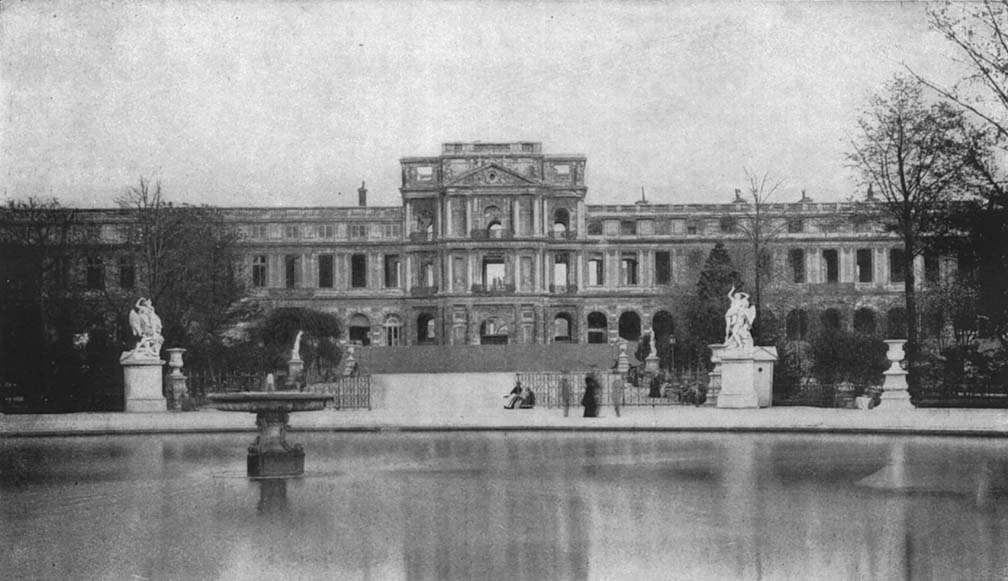
And yet, for many long years one huge pile of blackened walls, the remains of what was once the Palace of the Tuileries, loomed up in the very center of the city, solemn, grand, and mysterious, like a funereal monument, to remind the world of the uncertain life of governments---in France. It was only in 1883 that, becoming apparently ashamed of this startling exhibition of the savagery of the mob, of this vestige of the reign of the Commune in the Ville Lumière, the Government ordered the demolition of these ruins, and covered with fresh turf and with flowers the ground on which had stood the home of the most famous kings of France. Every trace of the palace has been removed, effaced, or carefully covered up. And here it is, in this new and formal garden, that to-day the children with their nurses gather together in hushed silence, and the idlers stop to watch Pol, the bird-charmer, as he stands on the grass by the laurel bushes while the pigeons hop about his feet picking up the crumbs he lets fall, or alight on his head or his shoulders, and the sparrows fluttering in the air peck at the bit of bread he holds in his outstretched hand. The place that has been the scene of so many great events in French history no longer even suggests continuity with the past to the Parisian or to the stranger.
| The visitors to Camden Place---November 15, 1871---The Emperor's health---His last photograph---Surgical advice is sought---A consultation is held---A statement contradicted---The operation---The death of the Emperor---The impression it produced in Paris and in London---Messages of condolence--- The immediate cause of the Emperor's death---His funeral---"Vive Napoléon IV!" |
OON after the Emperor arrived at
Chislehurst the Queen paid him a friendly visit; and the Prince
of Wales, and all the members of the English royal family, took
frequent occasion to express to the unfortunate monarch their
benevolent and sympathetic interest.
Equally gratifying and consoling to him may have been the warm welcome and the respectful homage he everywhere received from the English people when he went among them. To them, although uncrowned, and now living like an English country gentleman, he was always "the Emperor."
It was not long, however, before Camden Place became a center of more than ordinary interest to all those who admire and sympathize with men who bravely bear their unmerited misfortunes. Visitors from all countries came to see the exiled sovereign; to pay homage to the hero of misfortune; to thank him for his friendship to them in his days of power; to assure him of their continued esteem, and to place their wealth at his disposition. The Emperor was deeply touched by these manifestations of generous and kindly feeling, which at times assumed almost a semipublic character.
But there were other visitors, who came to renew their pledges of loyalty to his dynasty.
The unsettled state of things in France, the irreconcilable elements in the Assembly at Versailles, and the apparent impossibility of uniting them to form a definitive Government, began to suggest the possibility of a restoration of the Empire, vaguely at first, more openly afterward. Before the end of the year the regrets of the Imperial family were mingled with hopes; they began to look forward, and not backward, and at times Camden Place was invested with an air of animation even. The days of exile were also brightened occasionally by the visits of old and dear friends, and the messages and souvenirs that were sent to Chislehurst now and again, to remind their Majesties that they still held a place in the affectionate remembrance of their countrymen.
One of these days was November 15, 1871. It was the anniversary of the Empress' name-day, and quite a large party had assembled to honor the occasion. At dinner, some twenty persons sat down at the Imperial table, which was beautifully dressed with flowers sent from France; and in their smiling faces one saw an assurance that for this one day, at least, all were determined to be happy.
On this occasion an incident took place that Madame Carette has reported at length, but which illustrates so well the character of the Emperor that it is worth repeating in substance.
A lady having remarked the recent rapid change in the manners, and the language even, of people in good society, went on to say that gentlemen did not hesitate when characterizing their political adversaries, to employ expressions so violent that they would have been considered under the Empire as insulting. "Discussion is angry, and old friends are divided."
"Yes," said some one, "you cannot get five persons together without finding that they have five different opinions."
"Quite so," said the Emperor; "that is the French character. Even here at this table we have all sorts of opinions."
This observation brought out a general protest.
The Emperor, his countenance brightening, and with a mischievous twinkle in his eyes, turning towards the Empress at his side, said: "Why, you---you were always a Legitimist. You are a perfect fanatic for the Count de Chambord; you admire his character, and I think you admire also the proclamations he addresses to the French people. And here is Madame Lebreton; she is an Orleanist; she has retained, I am sure, a strong attachment for the Orleans princes.(66)
"And as for you, Conneau "---addressing his old friend, who was the meekest, gentlest, and most pacific of men--- "you are an out-and-out Communist; you have always entertained the most subversive ideas; you are an enemy of society. You have been seen at the work, when you were in Florence, affiliated to secret societies. You are a Carbonero."
The Doctor nodded approvingly to each of these charges; and every one laughed, greatly amused by the humor of his Majesty's bantering. Then, suddenly becoming serious, the Emperor explained how it was that he himself had been accused, and very mistakenly, of haying been a conspirator and a Carbonero.
And when he had finished, the Prince Imperial spoke up: "But, papa, I see here mamma, who is a Legitimist, and Madame Lebreton, who is an Orleanist, and Dr. Conneau, who is a Republican; where, then, are the Imperialists? " Then the Emperor, putting his arm around the waist of his son and drawing him tenderly to his bosom, said: "The Imperialists! You are the Imperialist, my dear child."
But while his Majesty was devoting his time and thought to questions of public interest or to the education of his son, who in October, 1871, entered the English Military Academy at Woolwich, his health began to be a subject of concern to himself and a source of anxiety to his friends. Visits to Torquay and to the Isle of Wight, although followed by temporary improvement, brought no permanent relief. Nor, from the character of his malady, did any such relief appear probable, unless the cause of the troublesome and painful symptoms could be definitely ascertained and removed.
The first indications of the disease that finally resulted in his death made their appearance in 1863, in the form of an attack of hæmaturia, following a carriage accident. After a few weeks a recovery appeared to have been effected. But later, the symptoms of vesical irritation recurred, together with other disabilities which, in two or three instances, required surgical intervention. At length, so unsatisfactory were the results of treatment---so serious even had the Emperor's condition become---that, in the spring of 1870, it was decided to have a consultation of surgeons. The consultation, in fact, took place on the 1st of July, 1870; the surgeons present being Nélaton, Ricord, Fauvel, Germain Sée, and Corvisart. Dr. Conneau was also present. There is said to have been some difference of opinion among these gentlemen with respect to the diagnosis, and, more particularly, concerning the urgency of a surgical examination. But this difference does not appear in the report drawn up by Professor Sée which is a model of its kind, alike comprehensive and clear.
The conclusion was that the Emperor was suffering from a purulent cystitis---caused by a stone in the bladder; and that the sound should be used to make sure of the existence and character of this foreign body. A copy of this report is said to have been among the papers found at the Tuileries by the Government of the National Defense. As published, it is dated---Paris, July 3, 1870, and is signed by "Professor G. Sée," alone. It has been the subject of much discussion---Why it was not signed by all of the consulting surgeons? Why it was not heard of until the war was over?---and of much curious speculation also; whether, had it been known, there would have been a war---or the war would have been begun and ended as it did, and so forth; the absurdity of which will appear in the light of a fact quaintly stated by an old English writer, namely: "There is no action of man in this life which is not the beginning of so long a chain of consequences as that no human providence is high enough to give us a prospect to the end." But its chief interest, in this connection, is that it establishes very clearly the nature of the local disabilities from which the Emperor had been suffering for many years, as also his physical unfitness, in July, 1870, to endure the fatigues and excitements of a military campaign.
In the autumn of 1872 he requested me to come to Chislehurst, as he wished to see me professionally. He received me in his usual cordial way, with the old-time smile and warm grasp of the hand. I noticed that there was a slight puffiness and lack of color in his face, and a slowness of movement that seemed to indicate advancing years and failing strength.
Not long before, the Emperor, with his cousin, Charles Bonaparte, had gone to London to have his photograph taken. On arriving at the photographer's, he said to his cousin, "How shall I be taken? " But when the camera was placed in front of him, he said, "I have it---I must remember that I am only an exile." This was the last photograph he ever had taken. The portrait facing page 228 is a reproduction of this photograph. It reveals traces of the sorrow and suffering that misfortune had written indelibly upon his features. The expression is sad, but the likeness is excellent, and shows the man as he appeared at the time of my visit.
He made to me no special complaint on this occasion, although he seemed perhaps a little depressed. He asked some questions about mutual acquaintances, and spoke of the difficulties M. Thiers was meeting with in the Assembly. Having told him that I intended to remain in England a short time, on my leaving he expressed the hope that I would call upon him before returning to Paris. This I promised to do; and accordingly, about a week later, I visited Camden Place again. It was then that he spoke to me of his physical disabilities, and said that he had concluded to consult some of the medical or surgical authorities in London. I immediately suggested to him Sir James Paget, who not only stood high as a surgeon, but was a man of the purest character, in whom all confidence could be placed. The Emperor seemed much pleased with this suggestion, and asked me to go and see Sir James, and make an appointment with him to come to Chislehurst at his own convenience, remarking: "I shall ask you the favor to arrange with him respecting his fees, since I am no longer able to incur expenses as I formerly did, although I like to be liberal to professional men." I assured him that he need have no concern about this, for I felt quite certain that Sir James would do almost anything to be agreeable to me, and would feel it to be an honor to have his Majesty's confidence.
On returning to London, I called upon Sir James Paget, and reported to him the conversation I had had with the Emperor. Whereupon he most kindly consented to go with me to Chislehurst the next day (October 31st). Here he met Sir William Gull, and also Baron Corvisart, and Dr. Conneau, the physicians attached to the Emperor's household, who had followed their sovereign into exile; and the case of the distinguished patient was fully set forth and carefully considered. That the disabilities and distress experienced were occasioned by the presence of a stone was a matter about which there was and could be very little doubt. But---and I think I may say this without violating any confidence---Sir James seemed to hesitate with regard to the expediency of an operation of any kind. At least, he expressed the opinion that, with a proper regimen and with quiet, the Emperor might live for many years to come without an operation. "Of course," he said to me, "the Emperor must expect to suffer more or less; still he can live with his enemy by taking care of him."
But during the weeks that followed, his Majesty's physical condition, far from improving, grew worse. He was at last compelled to give up all exercise, even walking, rarely leaving the house, and with results that began to affect his general health. In these circumstances the relief from pain and the improvement in health and strength that would follow a successful operation were matters too important and too desirable to be ignored. And the Emperor having expressed a wish to have another surgeon called in consultation, Sir Henry Thompson, an eminent specialist, who had already visited his Majesty a few weeks before, was mentioned as perhaps the highest authority and the most skilful operator in similar cases. Sir James Paget at once assented to this proposal, and said that the opinion of Sir Henry would have great weight with him and be most useful. Sir Henry Thompson was accordingly summoned to Camden Place, where, on December 24th, he met in consultation Sir William Gull and Sir James Paget, together with the ordinary physicians of his Majesty.
These gentlemen were unanimous in their opinion that a thorough examination ought to be made, under chloroform, in order that all doubt as to the diagnosis might be removed. It was furthermore arranged that the exploratory operation should be performed on January 2d following. And it was then that the sound unmistakably revealed the presence of a stone. Whatever complications might exist, this alone was believed to be a sufficient cause for the general symptoms of disability observed, and more particularly for the excruciating pains experienced.
Sir Henry took an optimistic view of the case, and proposed lithotrity (crushing), which is not supposed to be attended with much danger in most cases, since it involves no cutting, and the treatment, which usually requires several operations, can be suspended the in any unfavorable symptoms make their appearance.
After having carefully ascertained his Majesty's physical condition, it was the unanimous opinion of these distinguished professional men that, in view of all the facts in the case, the operation of lithotrity should be attempted. This conclusion having been reported to the Emperor, he expressed his willingness to submit to whatever surgical procedure might be thought necessary, and requested that the treatment proposed should begin at once. On this same day, therefore, January 2, 1873, at three o'clock P.M., the first operation was performed by Sir Henry Thompson, in the presence of the attending physicians and surgeons.
And here I wish to contradict a statement that has been made, and is frequently repeated, namely, that this consultation was held, and surgery resorted to, having in view a political purpose; that, in fact, it wag the first step in the execution of a carefully prepared design to repeat the attempt of 1840. A descent, so it is said, was to be made on the French coast, to be followed by a march on Paris, and the Emperor, on horseback, was to enter the city at the head of his army. The success of the scheme was supposed to depend entirely upon the Emperor's ability to ride into Paris on horseback; and as his disability was of such a nature as to make this impossible, it became necessary either to find some means of removing it or to abandon the idea of a restoration of the Empire.
This story, which has been told in slightly different forms, was either deliberately fabricated for a political purpose, or was the product of an active but ignorant imagination. The resort at this time to surgical treatment was advised, and consented to, in the Emperor's case, on exactly the same grounds and for the same reasons that would have made such treatment seem expedient in the case of any private individual; the suffering was great, the disease was progressing, and the general health was becoming rapidly affected; if no remedy could be found, it might soon be too late.
There was but one fact that gave color to this otherwise perfectly transparent invention. During the latter part of the year (1872) the unsettled state of affairs in France--the apparent impossibility of organizing there a stable government of any sort---was causing a manifest reaction in favor of the Empire; and the probability of its restoration at no distant day led the supporters of the Imperial dynasty to make frequent visits to Chislehurst and to speak of the future with hope and confidence. Those persons, however, who imagine that the Emperor was at this time conspiring to overthrow the French Republic, and intriguing to recover his throne, are greatly mistaken. He understood perfectly well that it was impossible for him, in the existing situation of affairs, to return to France except, to use his own words, "through the open door of universal suffrage." It was absolutely essential to his conception of the source of authority in civil affairs, and to his traditional sense of the Imperial dignity, that the dynasty should be restored only in response to the will of the French people, freely expressed. Had he not said again and again, both in private and coram populo, that public opinion was the foundation of all his power, and that without the confidence of the people his Government could not exist a single day? While the Republic, or the Orleanist and Legitimist monarchies, repudiating all responsibility for the consequences of the late war, might be able to take possession of the Government of France, dismembered and still occupied by the German army, without regard to the wishes of the majority, it must be evident to every one that the Emperor neither would nor could do this, and that he could not hope to retain the sovereign power, even were he to grasp it, unless the 'French people themselves had called him to the throne. This was the condition of an Imperial restoration, sine quâ non.
The operation of lithotrity being a tedious and painful one, the Emperor had been placed under the influence of chloroform, which he supported well and recovered from without unpleasant consequences. The first attempt to crush the stone was, in fact, as successful as could have been hoped; several fragments were broken off and removed, and at the same time the size as well as the specific character of the foreign body was ascertained; but the gravity of the case was made apparent, and the suffering to which the Emperor had been subjected during his long malady was recognized to have been very great; so great that Sir Henry Thompson exclaimed: "What extraordinary heroism the Emperor must have possessed, to sit in his saddle for five hours, holding on with both hands, during the battle of Sedan! The agony must have been constant. I cannot understand how he could have borne it."
The next day the patient had no fever, and although there was some local irritation, everything seemed promising. The greatest danger appeared to be over, and every one in the house was happy. Accordingly, a second operation was fixed for the 6th of January.
This operation was also performed successfully, but was not supported as well as the first had been. It was followed by a little fever, and the Emperor's condition during the next two days caused some anxiety to the physicians attending him; but an improvement being perceived on the evening of the 8th, it was decided to have a third operation the following day, at noon.
On the morning of the 9th, when the Empress visited her husband as usual, she found that he had slept well during the night, and appeared to be much better than the day before; so much so, indeed, that she had given orders to have her carriage and horses ready for the purpose of herself driving to Woolwich to give the Prince Imperial the good news of the Emperor's improved and promising condition.
A little before ten o'clock his Majesty was still lying easily, and his good pulse and regular breathing seemed to indicate that all would end well. Not long after, however, and before the commencement of the proposed operation, Baron Corvisart observed that the pulse of the illustrious patient was suddenly and rapidly failing---that he seemed to be losing consciousness; and his colleagues, whose attention he had directed to these alarming symptoms, saw the imminent danger, and immediately realized that Napoleon III. might have but a few minutes more to live.
The Empress was at once sent for, and Count Clary hurried to Woolwich to fetch the Prince Imperial.
When her Majesty entered the room of her husband she found him scarcely breathing. "But he is dying!" she exclaimed. Stimulants were administered, and various efforts were made to revive him, but in vain; and then Monsignor Goddard, who bad been sent for, administered the last sacraments of the Church. As the Empress leaned over him, the dying Emperor's eyes were fixed for a moment upon her. Recognizing his devoted companion, his lips moved as if he wished to speak; and then, a smile resting for a moment on his face, he sighed twice, and all was over. It was a quarter past eleven o'clock, and scarcely twenty minutes after the syncopal seizure.
When the Empress saw everybody kneeling, the terrible truth dawned upon her, and, with a loud cry, she sank down near the couch of her beloved consort. There she remained in tears, and immovable, until she heard that the Prince Imperial had arrived.
At the door of the vestibule of Camden Place the Prince was received by Count Daviller. Count Clary had already informed the young man of the grave apprehensions among those who were in attendance upon the Emperor when he left Chislehurst; and, although Count Daviller did not announce to the Prince that the Emperor was dead, his pale face indicated that the worst might be feared.
"What has happened? Tell me-tell me," said the Prince. But not waiting for an answer, he ran up-stairs and towards the room where his father had just commenced his last sleep.
At the door his mother met him, and falling upon his neck she said, weeping bitterly, "Je n'ai plus que toi, Louis! " Pale as death, the Prince entered the room, and, kneeling down before the couch of the Emperor, uttered aloud a short prayer. He then arose and kissed his dead father. His silence, his struggle with his emotion, the expression in his eyes, and his movements were most painful to all who witnessed the scene, and his friends hastened to tear him away from the body to which he feverishly clung. As they led him to his own apartment, he gave way to his grief, and found relief in tears and sobs.
I had been informed of the proposed consultation with Sir Henry Thompson, and the conclusion that surgical treatment was necessary had been communicated to me; and although I could not fail to remember the words of my wise and prudent friend, Sir James Paget, the success of the first operation was reported to me in such glowing terms as to dissipate any apprehensions concerning its final success that I might have previously entertained.
Such, indeed, was my confidence as to all danger being now over, that I think I have never been more surprised and shocked than I was on the afternoon of January 9th, when, about four o'clock, I received a despatch announcing the death of the Emperor. I simply could not believe it. If it were true, M. Rouher must have heard of it. Instantly I left my office and hastened to the modest mansion in the Rue de l'Élysée where the former Minister of his Majesty then resided. Before I entered I saw that there could be no question as to the truth of the announcement of the Emperor's death. The doors of the house stood wide open. Visitors could be seen moving through the corridors, ascending and descending the stairs without interruption; and although the servants at first made efforts to prevent the people from crowding into the building, they had quickly to renounce this attempt; for soon an unending concourse, that had gathered in the street and in front of the house, began to pass through the apartments, thinking of nothing but the fearful disaster that had befallen France. In the little drawing-room to the right of the entrance, where the Emperor's intimate friends were accustomed to gather, Madame and Mademoiselle Rouher were receiving the most distinguished visitors, when, toward five o'clock, M. Rouher himself arrived from the Chamber of Deputies, where he had just announced the sad news to the national representatives. In the course of an hour nearly all the prominent Bonapartista were to be seen in this little room, among them M. Henri Chevreau, M. Béhic, the Duke de Gramont, MM. Abbatucci, Galloni d'Istria, Forcade de la Roquette, the Duke and Duchess de Montmorency, the Princess Louisa Poniatowski, Baron and Baroness Farincourt, M. Benedetti, the Marquis Cossé-Brissac, the Count d'Ayguesvives, the Baron de Bourgoing, Colonel Stoffel, MM. Granier, and Paul de Cassagnac, the Commander Duperré, and, in fact, nearly all the ministers, senators, deputies, and generals of the late Empire. In a retired corner of the room, reclining upon a divan, Prince Charles Bonaparte was weeping bitterly, and scarcely able to suppress his sobs; while outside in the corridor there moved a somber crowd of men of all conditions of life---gentlemen in evening-dress, officials in uniform, working men in their blouses, old soldiers with gray mustaches and stern faces, tears running down the pallid features upon which, perhaps for the first time, such signs of sorrow were to be seen.
In London, the announcement of the death of the Emperor made a deep impression. The Times of the 10th said: "Indeed, since the death of the Prince Consort, no event of the kind has produced anything like so profound a feeling of sorrow in the city of London"; and in the issue of the next day the leading article ended as follows: "Louis Napoleon stood throughout our fast friend to the very bounds of discretion. He saw and felt that our place was to stand together; such were our natural affinities, such our social interests, such our position. He had made two long sojourns with us and had learned our ways. He had become one of us. He did not disguise his Anglican leanings. Like his immediate predecessor on the throne, Napoleon III will lie in an English grave---more secure there than at Saint Denis, more secure, probably, than at the Invalides. Received on these shores with the sympathy due to misfortune, and followed everywhere with the respect due to a dignified bearing and an affectionate nature, the ex-Emperor acquires a new claim to consideration in the agonies of his death-bed, the manly patience with which they have been borne, and the deep affection of those he leaves behind him."
Perhaps still more significant of the profound respect for the memory of Napoleon III entertained by the world, beyond the borders of the Empire he ruled, were the letters of condolence sent to the Empress by the municipalities of the principal Italian cities. The municipal council of Pavia, "in remembrance of the glorious days of Magenta and Solférino, sends to the widow of the great man, now no more, expressions of ardent and sincere grief." From Florence the Syndic Peruzzi wrote: "To her Majesty the Empress of the French: This Communal Council, assembled to-day for the purpose of being the interpreter of public sentiment, sends to your Majesty, and the Imperial Prince, the most respectful and heartfelt condolence, in the name of the Italian population, on the occasion of the loss you have experienced in the person of the man who was the stanch and liberal friend of Italy, and who helped her so vigorously to redeem her freedom. His name shall be engraved upon our hearts forever." And from Venice, and Milan, and Leghorn, and Naples, and scores of Italian cities, came similar testimonials of appreciation and grateful remembrance.
On January 10th a post-mortem examination was held over the body of the Emperor Napoleon III. The stone---a phosphatic concretion---was found nearly or quite half destroyed by the crushing to which it had been subjected. The part remaining was one and one-fourth inches in breadth, and one and five-sixteenths inches in length; its weight was about three-quarters of an ounce. The mucous membrane of the bladder showed signs of much irritation, both old and recent; the ureters were distended and the kidneys diseased, but all the other organs of the body were sound. The immediate cause of death was attributed, and probably rightly, to uremic syncope.
The next day the body was embalmed and placed in a coffin, dressed in a blue tunic and red trousers, with a gold sash around the waist---the undress uniform of a French General of Division. The dead Emperor wore the broad red cordon of the Legion of Honor, and a row of medals and decorations was attached to the left breast. By his side was a sword, and between the hands, that were crossed upon the lower part of his chest, lay a pair of white gloves. Two plain gold rings---one his wedding-ring---were on the third and fourth fingers of the left hand, and a small crucifix was placed upon his breast.
On Monday his body was removed from the small room where he died to the hall of Camden Place, where, placed on an inclined plane, under the skylight darkened and draped with the flags of the army he once commanded, the face in full view, a military cloak across the feet, in a Chapelle Ardente formed of dark hangings and lighted by candles in silver candelabra, it lay in state until the funeral.
The Empress and the Prince Imperial were visited by the Prince of Wales and other members of the royal family, and the Empress received a most affectionate message of condolence from Queen Victoria. On the following day (Tuesday) the thousands who had assembled to pass before the coffin were permitted to enter the house in groups of two hundred. It is estimated that on this day nearly twenty thousand people visited Camden Place, wearing mourning costume, many of whom were unable to pay their last respects to the dead Emperor simply because the hours passed and the night came before this multitude could be admitted to the hall where his body lay.
On January 13th I went to England for the purpose of expressing in person to the Empress and the Prince Imperial my sympathy in their bereavement and, as a member of the official household of the late Emperor, to attend his funeral, which was to take place on the 15th.
This funeral will be remembered by every one who saw it as a very simple but remarkably impressive spectacle. All the arrangements were made by M. Piétri, Count Clary, and Count Daviller. Between two thousand and three thousand of the most prominent Frenchmen in all walks of life were present in the procession, and upward of fifty thousand English people congregated to witness the passing of the cortège along the half-mile of road from Camden Place to St. Mary's Church.
The people began to assemble in the vicinity of Camden Place at an early hour, though none but those who were in possession of special invitations were admitted into the grounds or near the dwelling.
At twenty minutes past ten the hearse, drawn by eight black horses, drew up before the hall-door. A number of French workmen in white blouses, the dress of mechanics, now defiled along the front of the right wing of the house. At their head was a man who held aloft a French flag, while another carried a large wreath of immortelles, bearing the inscription, " Paris. Souvenir et regrets des ouvriers de Paris à sa Majesté l'Empereur Napoléon." Flowers in profusion were hung upon the sides or piled upon the top of the hearse, and most of them were fresh violets---the symbolic flower of the Bonaparte family-wrought in various devices.
At the foot of a fine tall cedar in front of the north wing of the mansion, some six or seven hundred noblemen and gentlemen of France were prepared to fall into their place in the procession; while the spectators in the grounds, to the number of a thousand or more, were congregated on the lawn and near the borders of the carriageway. Outside of the tall rustic fence separating the grounds from the Common was an innumerable multitude, many hundreds of whom were stationed in carriages commanding a view of the proceedings in front of the hall.
Punctually at the appointed time (eleven o'clock) the body of the Emperor, enclosed in three coffins, was brought from the house and placed in the hearse. The outer coffin was covered with purple velvet. There were three shields on this coffin, on one of which was the Imperial Crown, on another a Latin cross, and the third bore the following inscription:
A few minutes later the procession left Camden Place and emerged upon the Common, the French workmen in advance, the tricolored flag in front, attached not to a staff but to the freshly broken branch of a tree. After these men there followed an abbé having a golden cross on his breast; next came a number of priests one of whom read portions of the service for the dead. Then came the hearse, which was drawn by eight horses, with plumes on their heads and immortelles on their housings; and on each side of the hearse went the mutes, carrying wreaths of immortelles on their arms. The hearse was covered over with a pall of black velvet, on which were wrought the Imperial arms of France. Immediately behind the hearse, and so close to it that he was scarcely visible, walked the Prince Imperial, in simple mourning-dress, but wearing the Grand Cordon of the Legion of Honor, bareheaded, his clear blue eyes fastened upon the sad object before him. He seemed deeply moved, but his step was firm. Behind him was the line of princes of the House of Bonaparte, in their order of precedence, conspicuous among whom were Prince Napoleon, Prince Lucien Bonaparte, Prince Charles Bonaparte, and Prince Joachim Murat. Next came a host of the personal and military friends and political adherents of the late Emperor. The ex-Ministers of the Empire wore the Grand Cordon of the Legion of Honor; but, with two exceptions, the French officers did not appear in uniform; they were in evening-dress, and walked bareheaded, as did all in the procession. Coming immediately after the more prominent of the French officers and Imperial statesmen was the deputation of Italian Generals, sent by the King of Italy to Camden Place to represent him on this occasion. They wore their respective green and gold uniforms, and had upon their breasts numerous decorations and medals, and were followed by the main body of the procession, which consisted principally of Frenchmen---deputies, councilors of state, prefects, and others, among whom were a few French women. The procession moved very slowly along the winding road, the spectators remaining uncovered while it passed, and exhibiting marks of respect and sympathy. It was indeed a gathering of the friends of the dead Emperor; and there was no occasion for the services of the eight hundred constables that had been sent down from London to preserve order.
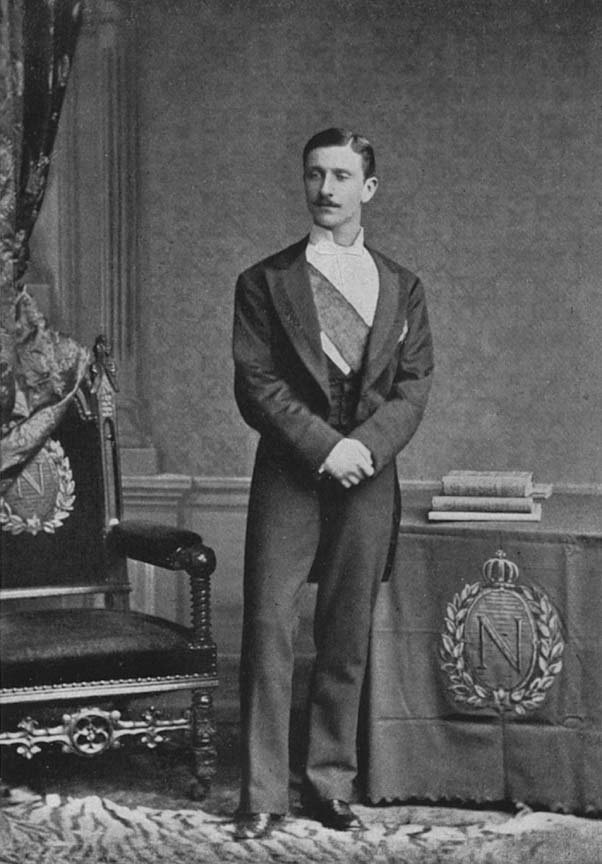
When the doors of the church were reached it was half-past eleven o'clock. The coffin was then carried in, and following immediately behind it were the Prince Imperial, the Bonaparte princes, and a few persons closely attached to the family. On account of the very limited capacity of the church, nearly all of those who walked in the procession were obliged to remain outside the doors during the religious ceremony, only one hundred and eight-four seats having been reserved for the persons who formerly belonged to the Maison de l’Empereur, and for the chief dignitaries of the Empire. Many of these seats were occupied some time before the arrival of the funeral cortège by the ladies of the Empress' household, and others, among whom were the Duchess de Malakoff, Madame de St. Arnaud, Madame Rouher, the Duchess de Mouchy, and Madame Canrobert. At 10:30 the Princess Clotilde and the Princess Mathilde had already taken their places in a small side chapel, where seats had been reserved for them. The ladies were all in deep mourning, and many of them were weeping.
As a member of the Imperial household, I took the place reserved for me in the body of the building. Looking about me, I saw, among the number of persons whom I have not already mentioned, Madame Lebreton, Viscountess Aguado, Madame de Saulcy, Madame Carette, Mademoiselle de Larminat, the Duchess de Montmorency, the Countess Clary, the Duchess de Tarente, Countess Walewska, Countess Aguado, Countess Pourtalès, Princess de la Moskowa, Princess Poniatowski. And among the gentlemen, the Duke de Parente, Generals Castelnau, Le Brun, and Frossard, Viscount Aguado, Marshals Canrobert and Lebœuf, General le Marquis de Fortou, Viscount Henri Bertrand, General de Juniac, the Duke de Gramont, M. Benedetti, Baron Haussmann, Baron Schneider, Admirals Rigault de Genouilly and de la Gravière, M. de Forcade de la Roquette, Duke de Montmorency, Duke de Feltre, Colonel Stoffel, M. Maurice Richard, Marquis de Chasseloup Laubat, as also two or three old soldiers, pensioners of the Emperor, several of the Imperial domestics, and a number of working men representing the delegations that had come to England to be present on this occasion.
Within the little church, the coffin was placed upon a catafalque in the central space immediately west of the chancel. The Prince Imperial took his place near the catafalque, on the north side, and the princes of the Imperial family stood near him. In the nave of the church the windows were draped with black cloth, which was festooned to let in the light. The windows on the west side were not draped, but the daylight, except such as penetrated through the eastern windows of the nave, was wholly excluded from the chancel, which was hung quite around with black cloth, and illuminated solely by six tall candles at the altar, and smaller lights on the ledges below. In the center of the east wall a large cross made of white satin, not less than six feet in length, was hung immediately above the burning candles; and the black drapery on the north and south sides was relieved by the Imperial arms, blazoned in crimson and gold.
The Right Rev. Dr. Danell, titular Bishop of Southwark, assisted by the Rev. Mr. Searle, the former deacon of Tunbridge Wells, officiated in the ceremony.
The 129th Psalm was read by the Bishop at the foot of the altar, and the mass commenced with the Dies Irœ. The Bishop sang the preface, which was followed by the Sanctus, the Consecration, and the Elevation. Then came the singing of the Benedictus, the Paternoster, and the Agnus Dei. The Bishop then received the communion, and the coffin was sprinkled and the absolution pronounced. After the absolution, the immortelles and other floral devices were laid aside, and the coffin was carried by eight bearers to the sacristy, the choir singing the In Paradisum, followed by the Benedictus and the Canticle. A few moments afterward it was placed in the vault that had been prepared to receive it; and the Prince Imperial, passing along into the sacristy, laid upon it two wreaths; others of the family mourners followed, with floral offerings in their hands, till the coffin was heaped high and hung round with these funereal tributes; and then the little gate of iron latticework was closed; and while the Imperial family and the mourners were leaving, and the organ was playing the De Profundis, one by one, to the number of fifteen hundred or more, most of those who had followed the dead Emperor to the chapel, passed by and sprinkled holy water upon his coffin through the grating. The service lasted scarcely an hour.
Thus ended the funeral ceremony, which was as sad as it was solemn and impressive, the voices of the officiators being mingled with the sobs of the women and the tears of the men.
And could it well be otherwise, when we remember the career of him to whom these obsequies and this last homage were rendered---that almost every one of the witnesses of this simple, sad service, in a humble little church in a foreign land, had also been a witness of the magnificent ceremonial which, in the very same month of January just twenty-one years before, in the ancient basilica of Notre Dame de Paris, opened with splendor and with such promise the history of the Second French Empire?
The Empress, worn out with fatigue and watching, having sat by the side of the deceased Emperor during the whole morning, was not present at the service in the church, but remained in her own room at Camden Place, where a few of her friends kept her company.
The body of the Emperor was not long afterward deposited in a sarcophagus, the gift of Queen Victoria, above which was placed the banner which at Windsor floated over his Majesty's stall as Knight of the Garter.
At the end of the funeral ceremony the Prince Imperial and the members of the Bonaparte family and household returned to Camden Place, where, in the principal drawing-room, the son of Napoleon III. received in person the condolences of the distinguished men who had attended his father's funeral. And then, observing the great concourse of people, mostly Frenchmen, who had gathered together on the lawn in front of Camden Place, the Prince, accompanied by the Duke de Cambacérès, Prince Napoleon, and others, went out upon the steps of the house to acknowledge this homage of respect for the memory of his father. Here, with uncovered heads, he was received; many tears were shed, and hands were warmly grasped and words of sympathy or pledges of loyalty given. As he was about to reenter the hall-door, a workman stepped forward and addressed him, closing a short speech with the words, "Vive Napoléon IV!" Instantly the cry was repeated by the whole assembly, and a rush was made toward the Prince, who was nearly swept off his feet by the impulsive and prodigious manifestations that followed of loyalty to the Imperial dynasty. At the very first viva the Prince raised his hand to stop the demonstration, but the sight of his uplifted hand only seemed to increase its force; and after he had been hurried into the house by his suite, the cries of "Vive Napoléon IV!" " Vive l'Empereur!" continued to be repeated with an enthusiasm indescribable, and that appeared to be inexhaustible.
Not long after this impressive scene, M. Thiers, then Chef du Pouvoir of the French Republic---that form of government which he cleverly affirmed "divides Frenchmen least"---was heard to say, " Yes, let me assure you the Republic will last for a long time in France; but, "added the author of the "History of the Consulate and the Empire," "were 1 to let you know all I think about it, I should tell you that, were the Republic to disappear, the Empire would be the only government the country could possibly accept. If the people should revive a dynasty, this dynasty would be the one they would choose. The Napoleons are Democrats, and their name can never be forgotten."