| The efforts of the Emperor to increase the strength of the army---His proposals are denounced by the Opposition---Favre---Thiers---Magnin---Jules Simon---State of the army when war was declared---On arriving at Metz the Emperor finds nothing ready---Misled by incorrect reports---A fair example---The situation becomes more and more difficult---A change of commanders---Sedan---A vivid account of the battle written by the Emperor---Further resistance impossible---The flag of truce---The letter of the Emperor to the King of Prussia---De Wimpfen meets Von Moltke and Bismarck at Donchéry---Interview between the Emperor and Bismarck described by Bismarck in a letter to the King of Prussia---Two letters---"Conneau" |
 APOLEON III, during the years immediately
preceding the war of 1870, had earnestly advised reorganizing
the army, so that France might be strong enough to preserve peace,
or to protect itself against any of the neighboring countries
in case of invasion; but the nation did not listen to him.
APOLEON III, during the years immediately
preceding the war of 1870, had earnestly advised reorganizing
the army, so that France might be strong enough to preserve peace,
or to protect itself against any of the neighboring countries
in case of invasion; but the nation did not listen to him.
On the 12th of December, 1866, at his suggestion, a proposition was laid before the Legislative Assembly asking that the numerical strength of the army might be raised, when on a war footing, to 1,200,000 men---the number at the disposal of the King of Prussia. This was to be brought about with a very slight increase in the charge on the Treasury, by changing the system of recruitment and by means of a reorganization of the military service that would place about 500,000 men of the National Guard at the disposal of the Government, to be called into any field of military operations in the event of war. The proposition was denounced and strongly fought against by the leaders of the Opposition in the Legislative Assembly. It furnished a splendid subject for the phrase-makers. "What," said Jules Favre, "after reigning fifteen years, after the public debt has been increased by 8,000,000,000 francs, after we have been forced into the wars that you know about---it is to be decreed that the whole population is to be delivered over to the drill-sergeant, and that France, instead of being a workshop, shall henceforth be only a barrack!" And M. Garnier Pagès, while arguing to show that liberty had more to gain by defeats than by victories, declared that the boundaries of States were no longer fixed by mountains, or rivers, or by armies, and loftily proclaimed that "la vraie frontière c'est le patriotism."
M. Thiers spoke as follows:
"Gentlemen, you forget one thing. It may be said that there is only the National Guard to defend the country, and that, unless you create the Garde Mobile, France is open to the enemy. I must, however, ask you of what benefit to us is our admirable active army, which costs from 400,000,000 to 500,000,000 francs annually? Or, do you suppose that it will submit to the first shock, and that France will be immediately without defense? Some days ago it was mentioned in this place that several Powers could oppose to you 1,200,000, 1,300,000, and even 1,500,000 men under arms. I do not say that these figures have influenced your votes; but, after all, these figures, when quoted, made upon you a very vivid impression. Well, then, these figures are altogether chimerical. According to the statement of the Honorable Minister, Prussia is able to oppose to us 1,300,000 men. But I must ask him, When has any one seen these formidable numbers? How many men did Prussia send into Bohemia in 1866? About 300,000. . . Therefore, gentlemen, we must not give the least credit to these fanciful figures. They are fabulous, and have never had any existence in fact. Let us, then, be assured our army will be sufficient to stop the enemy. Behind it, the country will have time to breathe quietly and to organize its reserves. Will you not have always two or three months---that is to say, more time than you need---for the organization of the Garde Mobile and for the utilization of the popular zeal? Besides, there will be volunteers in abundance. You have far too little confidence in your country."(26)
These were the words of M. Thiers when this proposition to increase the army and its efficiency was brought before the Legislative Assembly; and the speeches of his colleagues of the Opposition were to the same effect; and as they met with considerable support on the side of the majority the consequence was that the Emperor's plan for reorganizing the army could not be carried out.(27)
Nearly two years later, during the session of 1868, this measure was resubmitted to the Chamber of Deputies, but only after it had been modified. The Emperor now proposed that France should have at least 750,000 men under arms, including the reserves; but even this moderate demand met with the most violent opposition.
M. Magnin (afterward one of the members of the Government of the 4th of September, and one of those Deputies who voted for the war) said in the Chamber:
"You remember what an outburst of discontent was heard all over France at the announcement of the former project for increasing the army. Nobody would or could accept it. It was submitted to the State Council, which examined it in the Session of March; and, later, it was placed again before us, with an introduction explaining its motives, and with its most obnoxious points modified.
"In fact, the project in its new form reduced the time of service. There were still, however, 160,000 men required. In the active army the service was to be of five years' and in the reserve of seven years' duration. Those who did not serve in the active army were to serve four years in the Garde Mobile . . . . This still created a very violent and very ardent opposition, which was shared partially by your Commission, and I offer you my congratulations thereupon.
"The public did not look more favorably upon the new project than upon the preceding one; and the Emperor now announces to you that other modifications will be made. ‘It is,' he says, ' not a question of militarizing the country, but of modifying certain parts of the law of 1832.' "
M. Jules Simon (a member of the Government of the 4th of September, and who also voted for the war) said:
"Gentlemen, the chief aim of the project first presented was to ask for an army of 1,200,000 men. . . . I insist, before going farther, upon drawing your attention to the enormous figure---1,200,000!
"After considerable changes which are due to public opinion, to the zeal of the members of the Commission, and the concessions made by the Government, we have finally come to the present project. But it is plainly to be seen that you still wish to have an army of 800,000 men, and, in order to obtain this, you wish to create the Garde Mobile. The law which proposes this is not only a hard law, but an unmerciful one; one that weighs heavily upon those who are called to serve, and at the same time upon the whole population; because quartering the Gardes Mobiles in the houses of the inhabitants will be adding a new tax to those which already oppress us. In the end, the political consequences of the new system will be still more disastrous than the material consequences; and the law proposed is especially bad, because it will increase the almightiness of the Emperor. . . . .
"The important point is not the number of soldiers, but the cause they have to defend. If the Austrians were beaten at Sadowa, it was because they did not wish to fight for the House of Hapsburg against the German fatherland. Yes, gentlemen, there is only one cause which makes an army invincible, and that is liberty."
Strangely enough, many of the very men who were systematically opposing any increase of the army were most violent in their denunciations of the pacific policy of the Imperial Government with respect to Germany. "The soldier is a white slave," said M. Émile de Girardin one day; and the next day he claimed the Rhine as the rightful frontier of France, and, working himself into a frenzy over his theme, finally shrieked out: "If, to obtain it, it is necessary to give Europe a shower-bath of blood, let the shower-bath be given to Europe."
The proposed law in its modified form was at last adopted in 1868. By this enactment the regular army was increased to a total strength of 744,568 men, including the reserves (329,318) ; and provision was made for the mobilization of 500,000 National Guards for the defence of the fortresses. But the Opposition voted against it; and among those who opposed it were Messrs. Bethmont, Magnin, Glais-Bizoin, Dorian, Jules Favre, Carnot, Thiers, Jules Simon, Ernest Picard, Garnier-Pagès, and Pelletan. Had the will of these gentlemen been accomplished, the army would have been much smaller than it was when the war began.
But while the army was thus officially increased in number, its effective strength was, at the same time, actually reduced by the extension given to a pernicious system of furloughs subservient to certain political interests, and by virtue of which large numbers of soldiers were permitted to be absent from the ranks. On the 20th of March, 1868, Marshal Niel reported to the Senate that of the regular, troops in the second year of their service, twenty-five per cent, were absent on a six-months' leave; that of those in the third year of their service, a third were absent; that of the fourth year's men, two-fifths were absent; and that of the troops in the last year of their service, one-half were absent on a six-months' furlough.
When war was declared in July, 1870, more than a third of the French regular army was absent on leave. And, more extraordinary still, it was discovered that the cavalry horses had been "furloughed" to the farmers in about the same proportion. And these furloughs had been granted notwithstanding the repeated warnings the Emperor had given of the consequences that might follow.
If, therefore, France had too small an army at the beginning of the war of 1870 (415,000 men, not counting the reserves), and the rapid mobilization of this scattered army was impossible, it was certainly not the fault of the Emperor. On the contrary, the responsibility belongs to those politicians who prevented him from doing what he earnestly wished to do.
Nor does the responsibility rest entirely or even principally upon the political opponents of the Government. The Deputies at this time were nearly all Imperialists, nominally at least; and if the Emperor's proposition to reorganize and strengthen the army failed to obtain the support of the majority in the Legislative Chamber, it was because some of these Deputies honestly believed it to be unnecessary and inexpedient, and others were more anxious about their own personal popularity with their taxpaying constituents than mindful of the interests of the Government and of the nation.(28)
The time now had suddenly come when many patriots recognized the serious mistakes that had been made, and deeply regretted that the number of French soldiers was not greater. But the nation desired war; and the Emperor considered that he had no right, even had he the power, to refuse to submit to the national will. His only desire, as the representative of this will, was to do the best that could be done under the circumstances. These made a rapid movement forward imperative, if the campaign was to succeed. His plan was to attack the German troops on German soil, to cross the Rhine at Maxau, and to separate North Germany from South Germany. But the passage of the Rhine had to be effected before the enemy could concentrate near that river, otherwise the execution of his plan would be impossible without risking great losses. All, therefore, depended upon the precision and quickness of the mobilization of the French army, and upon its readiness for action.
How fearful, then, must have been the disappointment of his Majesty, when, on his arrival at Metz, he found that nothing was in readiness, and that the reports which he had received at different times from his chief military officers were incorrect and misleading.
In the year 1868 Marshal Niel sent a report to the Emperor, in which he said that all the orders had been prepared for a very speedy calling out of the soldiers of the reserve, and that, thanks to the measures taken, the several corps which were to form the active army could be made up ready for service, in case of an emergency, within a space of nine, or, at the most, of fourteen days. On the 9th of April, 1869, Marshal Niel, speaking in the Senate on the state of the army, made use of words still more assuring. He then said: "Our situation is such at the present time that, if we will maintain it, we can never be surprised." And two or three days later, in the same place, he declared: "To-day, whether we are in peace or at war is not of the slightest consequence to the Minister of War; he is always ready." Marshal Lebœuf, who was the successor of Marshal Niel as Minister of War, confirmed these statements, and also insisted that the armies would be ready to act within a fortnight, should they be called out.
On the 6th of July, 1870, Marshal Lebœuf submitted to the Emperor a schedule of the military forces at the disposition of the Government. According to this statement there should have been 350,000 regular troops on the frontier within fourteen days after the calling out of the reserves, and 100,000 Gardes Mobiles besides. This was the force to begin with; but before a month should have elapsed, 400,000 troops were also to be ready for action. To this force, the Marshal said, Prussia would only be able to oppose 390,000 men, and that, counting the soldiers of the Southern States, the German army would have a strength of only 420,000 men. (In fact, the three German armies of invasion numbered at first but 338,000 men.) Relying upon the correctness of these reports, the Emperor might have had good reason to hope for success, especially as his plan was to attack the Prussians before the armies of the Southern German States could be united with them. When, however, he arrived at his head-quarters three weeks later, he found, to his great dismay, that the eight French army corps sent to the frontier numbered only 220,000 men.
This state of things was very serious; but the most alarming discovery made was the fact that important instructions which the Emperor had given with regard to the distribution of military stores of every sort, even to the baggage train, had not been obeyed, although Marshal Niel had reported to the contrary. As the result of this neglect, the mobilization was paralyzed at the most critical moment.
The letters sent by the Emperor to the Empress at this time were most discouraging. " He was," she said, "navré. Nothing was ready; the confusion indescribable; the plan of the campaign must be abandoned on account of the inevitable delay."
The details of military organization are not very interesting to the general reader, but I think I may count upon his indulgence, if I give the facts in a single case that is a fair example of many others, and which will show plainly what reason the Emperor had for believing his army ready for action in July, 1870; as also that the non-execution of his orders was among the causes of the defeat of the French.
In the year 1868 the Emperor inquired at his War Department how long it would take to have in readiness the Government wagons that were stored at Vernon. The answer was that this operation would take several months. Surprised to hear such a reply, he immediately gave orders to have the wagons distributed over different parts of the country; and the Minister of War reported shortly afterward, in the following words, that these orders were in the way of execution.
"The concentration of all the baggage wagons at Vernon is dangerous in case of a war, as the length of time necessary for making ready so much matériel (6,700 wagons, 10,000 sets of harness, etc.) might interfere very much with a quick mobilization of the army. To remedy this difficulty, the following measures have been adopted:
"Barracks are to be erected in the Pare de Châteauroux for about 1,200 wagons, so that the squadron of the baggage train, which is quartered there, will find its wagons handy, without being obliged to send to Vernon for them.
"Use is to be made of the circumstance that a detachment of artillery and engineers is quartered at Satory, by placing there all those wagons which have to be furnished to the staffs and to the different corps of these troops.
"Sheds are to be constructed at the camp of Châlons for about 600 wagons, which are to serve for the baggage train accompanying the first divisions.
"The regimental wagons which are to serve the First Corps are to be distributed in the military posts of the East.
"According to this plan, the First Army will be able to find, between the camp at Châlons and the frontier, all the wagons that it will need for the march.
"The Army of Lyons will have its means right at hand; transportation for the Army of Paris will be at Satory, and, at the same time, the parks of Châteauroux and Vernon will furnish the wagons necessary for the Second and Third Armies.
"At this moment the small depots of the East are being constructed; the wagons for one division are at Metz; at Strasbourg there are wagons for one brigade, and at Besançon for one regiment. The depot of Toul will be opened in a few days.
"The constructions to be made at Châlons, according to the above plan, will probably be finished within one month.
"Lyons has the wagons necessary for one division of infantry and one division of cavalry; it will receive within a short time the wagons for another division of infantry---when the matériel which has come back from Civita Vecehia has been repaired.
The barracks which are at present being erected at Satory will hold all the regimental wagons.
"It is to be hoped that the distribution of the matériel will be accomplished before spring, with the exception of that to be sent to the Parc de Châteauroux, as the works there cannot yet be commenced on account of the condition of the ground."
From this report it will be seen that the Emperor had a right to believe that no considerable delay would occur with respect to the distribution of the army wagons. When the war of 1870 began, almost two years had elapsed since the arrangements indicated above were, according to the official report, to be immediately completed. What, then, will the reader say when I inform him that these wagons were still stored up at Vernon and Satory on the outbreak of hostilities in the year 1870, and that it was a long while before the greater part of them could be sent to the different corps, thus hampering the mobilization enormously?
There is a point in the preceding statement which should not be allowed to pass unobserved, namely, the wagons were apparently sufficient in number to meet the requirements of the service. In fact, the rigid parliamentary inquiry instituted by the Government of the Republic, after the war, has made it perfectly clear that the French War Department in 1870 was well supplied with nearly all the matériel necessary for a campaign, with the troops then at the disposal of the Government. The fatal error---the unpardonable blunder---of Marshal Lebœuf, and of his predecessor, Marshal Niel, consisted not so much in overestimating the number of "gaiter buttons" or other military stores en magazin, as in underestimating the time necessary to deliver these supplies where they were needed, and to provide for their regular distribution.(29) The want of something somewhere put a stop to every effective. movement everywhere. As we have seen, it was the opinion of both these war ministers that a fortnight would be time enough in which to equip and place the whole French army upon a war footing. Not only was it found to be impossible to do this, but it was not done at the end of a month. Nor would it have been possible in a much longer time, even under the conditions of peace, to have effectively mobilized the French army, and got its whole rather complicated machinery into good working order.
But, strange as it may seem, perhaps in no particular was the French army less prepared to enter upon a campaign than on account of the general ignorance of the geography of the country to be invaded and the absence of maps even of France itself. Detachments and whole Divisions of the army wandered about, not knowing exactly where they were or where they were going. The ignorance of the French general staff with respect to the topographical features of the ground upon which the battles of the war were to be fought would have been incredible, had not the greatest disasters been directly precipitated by the lack of such specific information and knowledge. There were generals who believed Wissembourg was in Bavaria; who did not know that the Meuse and the Moselle were two separate rivers, or that Sedan was a fortified place. And why should they be expected to know more than their superiors, if the story be true that is related of one of the marshals who was as conspicuous during this war as he was unfortunate in his leadership? Having occasion to send a letter to Sydney, New South Wales, the Marshal, so it is reported, asked a member of his staff if he could tell him where Sydney was. "In England," was the answer. "No," replied another member of the staff, "you are mistaken; it is in the United States." Perplexed by this contradictory information, the Marshal cried out, "Send for de H-----" to whom, when he entered the room, the Marshal said, "Tell me, de H----, in what country is this place, Sydney?" "In New South Wales," was the reply. " But where is New South Wales?" "In Australia, your Excellency." "And in what country is Australia?" "In the Indian Ocean," promptly replied M. de H-----.
"Sapristi! " exclaimed the Marshal; "ce diable de H----- il connaît tout! ''(he knows everything).
The discovery of this state of unreadiness, that it was no longer possible to execute his plan of campaign, must have given a severe shock to the monarch, who foresaw what evil consequences would inevitably arise from it; and it is reported that on the day of his arrival at Metz, when he recognized the situation of the army and in what manner his orders had been executed, the perspiration came out upon his forehead in great drops, and that he exclaimed, We are lost! "
And, as if the disorder and absence of preparation visible on all sides were not sufficiently discouraging, the Emperor found lying on his desk at the Prefecture some thirty anonymous letters denouncing the incapacity of his generals, and demanding that they should be superseded or discharged. Certainly one of the most extraordinary things that ever happened to a sovereign on the eve of battle!
That the delay required to prepare the army for active service was the proximate cause of the French reverses in the first battles of the war has since been universally acknowledged.
Napoleon III. therefore stated the case with absolute accuracy when he wrote, on the, 29th of October, from Wilhelmshöhe, to a distinguished English general: "Our disasters have arisen from the fact that the Prussians were ready before we were, and that we were taken, so to say, en flagrant délit de formation."
As one might have expected from the manner in which the campaign was opened, so it went on. The Germans gained one victory after another, and the situation of the French troops grew from day to day more difficult.
When the news of the first defeats became known in Paris, it created general consternation. Public opinion recognized the incapacity of Marshal Lebœuf, and the Parisians began also to mistrust the capacity of his Majesty as Commander-in-Chief of the Army of the Rhine. The Emperor therefore considered it wise not only to accept the resignation of the Marshal, but also to lay down his own military command. There now remained for him nothing but to choose an able successor.
In a council of the chiefs of the Army Corps, stationed at that time near Metz, it was finally decided that Marshal Bazaine should be appointed Commander of the Army of the Rhine, assisted by Marshal MacMahon, who was to take command of his own army corps, as well as of the corps of Generals de Failly and Félix Douay, and of the new columns which were being formed at Châlons.
On the 16th of August his Majesty made another concession to public opinion. At the suggestion of some of his generals, and at the urgent request of Prince Napoleon, he appointed General Trochu Governor of Paris---an appointment which, as will be seen in the following chapters, had very serious consequences.
Napoleon III. unselfishly yielded to the wishes of his people, by entrusting the most responsible posts to men whom the military experts and public opinion had declared to be the most capable;(30) but the concessions which his Majesty made proved fatal, for they led swiftly to the disaster of Sedan.
The events which took place during those last fateful days of his reign, are vividly described in a paper written by the Emperor shortly before his death. The following pages contain a translation of a part of this narrative:
"On the 30th of August, at four o'clock in the afternoon, the Emperor and the Duke of Magenta were on the heights of Mouzon, where the Twelfth Corps was in position. Both had alighted from their horses. The artillery of General de Failly was heard in the distance, and General Pajol, who had made a reconnaissance in order to judge how matters stood, had brought back the news that the Fifth Corps was retiring upon Mouzon. The Marshal then told the Emperor that the whole army would soon have passed to the right bank of the Meuse; that he himself did not wish to leave Mouzon before the operation was completed, but that all was going well. He advised the Emperor to repair to Carignan, where the First Corps must already have arrived, and where the head-quarters were to be established.
"Napoleon III. therefore departed full of confidence as to the result of the day. But scarcely an hour after his arrival at Carignan, General Ducrot came to him with the most alarming news: the Fifth Corps had been thrown back in disorder on Mouzon, along with the brigade that was sent to its aid; and the Marshal begged the Emperor to go as quickly as possible to Sedan, to which place the army would retire. The Emperor could not believe that the scene had so completely changed within a few hours; he therefore wished to remain with the First Corps, but at the solicitation of General Ducrot he decided to take the train, and arrived at eleven o'clock in the night at Sedan. Here he was urged to continue his route as far as Mézières while the railway was still free. He could there rally the corps of General Vinoy, and establish a new center of resistance in one of the strongholds of the North; but he thought that, in this case, he would be accused of seeking his own personal safety, and he therefore preferred to share the fate of the army, whatever it might be. The equipages and escort having been left behind at Carignan, the Emperor, alone and on foot, followed by his aides-de-camp, in the silence of the night entered the city of Sedan, which was about to be the theater of such terrible events.
"Sedan, classed among the fortified places, is situated upon the right bank of the Meuse; only the suburbs of Torcy lie upon the left bank. They are covered by advanced works which form a vast tête de pont. Formerly the city, owing to the feeble range of the cannon then in use, was protected by the hills which surround it. At the present time it is exposed to the artillery of the enemy when placed upon the heights which rise upon both sides of the Meuse. Moreover, in the year 1870 it was incompletely armed, badly provisioned, and possessed no outworks. On the right bank of the river are two tributaries, which form right angles with it---the Floing below and the Givonne above the city. One of these little streams runs out from the village of Illy to that of Floing, and the other from the village of Givonne to that of Bezailles; they surround the territory where the battle was about to take place. The prominent points of the battle-field are the Calvary of Illy, near the village of the same name, and the forest of La Garenne, situated west of the village of Givonne. The only route upon which a free communication with Mézières was possible was the highroad passing through the villages of Floing, Saint Albert, Vrigne-aux-Bois, and Tumécourt.
"In order to secure a retreat upon Mézières, the narrow defile which extends from Floing, in the direction of Vrigne-aux-Bois, should have been strongly occupied, the place itself should have been abandoned, and the left wing ought to have rested upon the heights of Illy and of the Givonne.
"General Ducrot, it must be recognized, had correctly estimated the position. It was at the Calvary of llly that he wished to establish the center of resistance. On the 31st of August, however, the troops were placed in position around, the town; they were distributed in a semicircle, from which Sedan as a center was distant some 3,000 meters, the extremities touching the villages of Bazeilles and Floing.
"From this semicircular position it was inevitable that the line of retreat must be toward the center; and that if the troops were repulsed, they would, by a natural instinct, precipitate themselves toward the city, which thus became an entonnoir (a funnel) to engulf them. To the north of Sedan are the remains of an abandoned entrenchment called the Old Camp, which overlooks the surrounding ravines; and all the ground which extends to the south of this camp is covered, as General Ducrot says, 'with stone walls, with gardens and hedges, and with a certain number of houses, which, joining those at the lower end of Givonne, made of this spot a veritable labyrinth. Defended by a few solid troops, it would have been very difficult to dislodge them; but, on the contrary, if a large body of soldiers, repulsed and in disorder, should retire here for shelter, it would be impossible to rally and reform them.'
"It was upon this uneven ground which we have just described that on the 1st of September, in the morning, the battle began. The enemy attacked simultaneously our two wings, evidently intending to surround us and cut off our retreat.
"The Marshal, Duke of Magenta, at once repaired to the outposts, and the Emperor, to whom he had sent news of this movement, mounted his horse and followed him, accompanied by his staff and a troop of guides.
"It is easy to understand his state of mind. No longer exercising the functions of General-in-Chief, he was not sustained by the feeling of responsibility which inspires the soul of him who commands; nor did he feel the uplifting excitement of those who are acting under orders, and who know that their devotion may lead to victory. The powerless witness of a foregone defeat, convinced that on this fatal day his life, as well as his death, was useless for the common safety, he advanced to the field of battle with that stolid resignation which faces danger without weakness, but also without enthusiasm.
"On departing from the Sub-Prefecture, the Emperor met Marshal MacMahon, who was being brought back wounded in an ambulance wagon. After having exchanged a few words with him, he proceeded in the direction of the village of Bazeilles, where the division of marines was hotly engaged. At Balan, General de Vassoigne gave him an account of the position of the troops. As every group of officers immediately attracted the fire of the enemy, the Emperor left his escort and most of his aides-de-camp, with a battalion of chasseurs that was screened by a wall, and went forward, followed only by four persons, towards an open height from which a view of the greater portion of the field of battle could be obtained.
"At this moment General Ducrot, to whom Marshal MacMahon had transferred the command, was executing a retreat, which under the existing circumstances was the best course to take. The Emperor sent to him one of his orderly officers, Captain d'Hendicourt, to ascertain the direction he wished to give to the troops. This promising young officer never reappeared; he was probably killed by a shell. The entire ground upon which the party stood was plowed by the enemy's projectiles, that were bursting around them on every side.
"After remaining several hours between La Moncelle and Givonne, the Emperor wished to go over to the lines of infantry which could be seen to the left, on the heights, but were separated from him by an impassable ravine. In order to reach them, he had to make a circuit, which brought him upon the ground cut across by hollows, hedges, and garden walls, that formed the labyrinth mentioned above. In the ravine, called the 'Bottom of Givonne,' the roads were crowded with the wounded, who were being carried to the ambulances; and a park of artillery blocked the avenues, through which Goze's division could proceed only with the greatest difficulty. When the Imperial party arrived near the old entrenched camp, a farther advance became impossible, as they met the infantry that occupied this place in the act of retiring in good order towards the town. It was now evident that every line of retreat was cut off by the enemy, who occupied the circumference; for the projectiles directed toward the center struck the troops both in front and in the rear. Many of the soldiers, alleging that they were without cartridges, were hurrying towards the only gate of the town which remained open.
"After having been during nearly five hours the witness of a struggle the end of which could be foreseen, the Emperor, despairing of being able to reach the heights of Illy from the place where he was, decided to go back to the town to confer with the wounded Marshal, and in the hope of leaving it again through the gate that opens on the departmental road to Mézières. Three officers of his staff had been wounded at his side and carried away by the soldiers; these were the circumstances under which he returned to the Sub-Prefecture, several shells bursting in front of his horse, but without harming him.(31)
"The road by which he wished to pass out, he ordered to be reconnoitered at once; but he was informed that the Mézières gate was barricaded, that it was impossible to get through it, and that the streets through which he had just come were already blocked by a confused mass of men, horses, and wagons. It was necessary, therefore, to remain in the town and await events. Toward three o'clock an aide-de-camp of General de Wimpfen, who, as senior officer, had taken the command-in-chief, succeeded with great difficulty in making his way to the Sub-Prefecture. He came to propose to the Emperor to place himself at the head of such troops as could be rallied, and to make an attempt to cut through the enemy's lines in the direction of Carignan. The first impulse of Napoleon III. was to accept the proposal; but he soon saw that, not to speak of the difficulty of getting through the crowded streets on horseback, it would be unbecoming for him to sacrifice, in order to save himself, the lives of a great many soldiers, and to escape with the Commander-in-Chief, abandoning the rest of the army, and leaving it without a head, exposed to certain loss. He refused, therefore, to accept General de Wimpfen 's offer.
"During this time the situation had assumed a more and more serious character. The heroic charges of the cavalry had not been able to arrest the advances of the enemy. The brave General Margueritte, mortally wounded, had just been brought at his request beside the Emperor. At this moment the surrounding hills on both sides of the Meuse were lined with several hundred pieces of artillery, which by a converging fire threw their projectiles into the city. Houses were on fire, roofs were crushed in, and death made many victims in the crowded streets, in the barracks which were transformed into hospitals, and in the courtyards, where soldiers from every branch of the service had taken refuge.
"In the meantime the commanders of the three army corps, Generals Lebrun, Douay, and Ducrot, came one after the other to declare to the Emperor that further resistance had become impossible; that the soldiers, after having fought for twelve hours without rest or food, were discouraged; that all those who had not been able to get into the town were huddled together in the trenches and against the walls; and that it was necessary to come to some decision.(32)
"From the day of leaving Châlons up to this time the Emperor had considered it to be his duty not to interfere in any way whatsoever with the arrangements and decisions of the Commander-in-Chief; but at this supreme moment, when, by an unheard-of fatality, 80,000 men appeared to be exposed to certain death without being able to make any resistance, he remembered that he was the sovereign; that he had charge of souls; and that he ought not to let men be massacred before his eyes who on some future occasion might be able to serve their country.
"Napoleon III. accordingly sent one of his aides-de-camp up to the citadel in order to assure himself of the state of things. The officer with very great difficulty succeeded in passing through the streets and in reaching the citadel, which itself was filled with soldiers who had taken refuge there. The report which this aide-de-camp brought back confirmed the words of the corps commanders. The Emperor, in consequence, sent General Lebrun to General de Wimpfen with the advice that he should ask for a suspension of hostilities, which would give time, if it were accorded, to collect the wounded and to consider what it was best to do. General Lebrun not returning, and the number of victims increasing every moment, the Emperor took it upon himself to order that a flag of truce be hoisted. Napoleon III. fully understood the responsibility he thereby incurred, and he foresaw the accusations which would be brought against him. The situation appeared to him in all its gravity; and the remembrance of a glorious past, in its contrast with the present, increased the bitterness of the moment. Who would ever admit that the army of Sebastopol and Solférino could be forced to lay down its arms? How would it ever be possible to make the world understand that, when confined within narrow limits, the more numerous the troops the greater must be the confusion, and the less the possibility of reestablishing the order indispensable for fighting?
"The prestige which the French army so justly enjoyed was about to vanish in a moment; and, in the presence of a calamity without precedent, the Emperor, although having had no hand in the military movements that led to it, was to remain alone responsible in the eyes of the world for this great disaster, and for all the misfortunes which the war might bring in its train! And, as if at this last hour nothing should be lacking to increase the gravity of the situation, General de Wimpfen sent his resignation to the Emperor; thus leaving the overwhelmed and disbanded army without a chief, and without guidance, at a time when the greatest energy was necessary to establish a little order, and to treat with the enemy with a better chance of success. The resignation was not accepted; and the General-in-Chief was made to understand that, having commanded during the battle, his duty obliged him not to desert his post in these very critical circumstances.
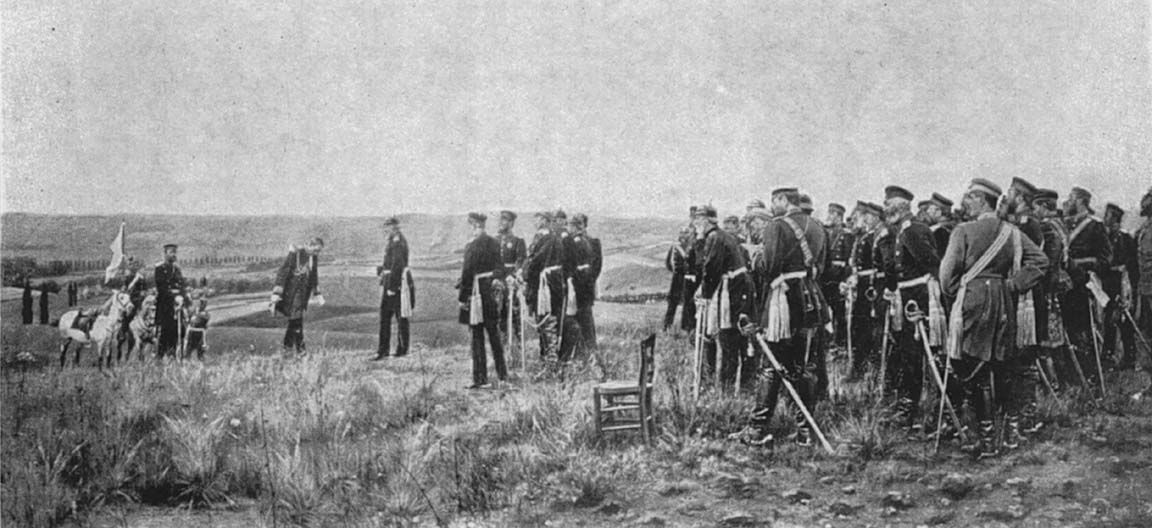
"While the white flag was being hoisted, a Prussian officer asked permission to enter head-quarters.
"Through him it was learned that the King of Prussia was at the gates of the town, but that he was ignorant of the presence of Napoleon III. in Sedan.
"Under these circumstances, the Emperor believed that the only thing which remained for him to do was to address himself directly to the ruler of Northern Germany.
"It had so often been repeated in the journals that the King of Prussia was not making war against France, but against the Emperor only, that the latter was persuaded he might, by disappearing from the scene and putting himself into the hands of the victor, obtain the least disadvantageous conditions for the army, and might give, at the same time, an opportunity to the Regent to conclude a peace in Paris. He therefore sent by General Reille, one of his aides-de-camp, a letter to the King of Prussia, in which he announced that he would surrender to him his sword.
"The King, surrounded by his staff, received General Reille, and taking in his hand the letter which he brought, opened it and read the following words:
"'MONSIEUR MON FRÈRE:
"'N'ayant pas pu mourir au milieu de mes troupes, il ne me reste plus qu'à remettre mon épée entre les mains de votre Majesté.
"' Je suis de votre Majesté le bon frère,
"'NAPOLEON.'
(" 'My BROTHER:
'Having been unable to die among my troops, the only thing I can now do is to place my sword in the hands of your Majesty.
"' I am, your Majesty's good brother,
"'NAPOLEON.')
"At first King William seemed astonished that the letter did not announce the capitulation of the town and army; but having been informed that General de Wimpfen was the French Commander-in-Chief, he requested the presence of this General at the Prussian head-quarters that evening."(33)
GENERAL REILLE PRESENTING TO KING WILLIAM
THE LETTER OF NAPOLEON III.
From a photograph of the painting by A. von Werner.
The meeting took place late in the evening, in the village of Donchéry, the persons present being, on the one side, General von Moltke, Count Bismarck, General von Blumenthal, and a number of officers; and, on the other side, General de Wimpfen, General Castelnau, and General Faure. General de Wimpfen opened the conference by asking what conditions the King of Prussia wished to impose upon the French army were it to surrender. " They are very simple," replied General von Moltke; "the whole army are to be considered as prisoners, with their arms and baggage. We will allow the officers to retain their arms, as a testimonial of our esteem for their courage; but they will be held as prisoners of war, like the troops."
General de Wimpfen at first tried to obtain concessions by appealing to the generosity of the German commander. When he, however, saw that the latter remained immovable, he broke out as follows:
"Well, if you cannot offer us better conditions, I will appeal to my army---to its honor; and I will succeed in breaking through your lines, or I will defend myself in Sedan."
Whereupon the Prussian General, who was perfectly informed as to the situation of both armies, explained so clearly the actual state of things to the French commander, that General de Wimpfen, seeing that from a strategic point of view his threat was without weight, turned to the political side of the question, and said:
"You are going to conclude peace, and doubtless you wish to do this at once. The French nation is more generous and chivalrous than any other nation, and consequently it knows how to appreciate the generosity which is shown to it, and is grateful for the consideration that is bestowed upon it. If you accord to us terms which are flattering to the amour propre of our army, the nation will be equally flattered; and then the bitterness of the defeat will be diminished in the hearts of the people, and a peace that is concluded on such conditions will have a chance of being durable.
"If you, on the contrary, insist upon rigorous measures against us, you surely will excite anger and hatred in the heart of every soldier, and the pride of the whole nation will be grievously wounded; for it considers itself in fellowship with the army and shares its emotions.
"You, therefore, will awaken all the dangerous instincts that are slumbering under the cover of an advanced civilization, and you may kindle the flames of an interminable war between France and Germany."
Moltke remained silent, but Count Bismarck answering, said:
"At the first glance, General, your argument seems serious; but, in fact, it is only specious and cannot stand discussion. One ought to count, in general, very little upon gratitude, and never upon the gratitude of a nation. There are times when the gratitude of a sovereign may be expected; in some cases, also, that of his family; in some exceptional cases, entire confidence even may be placed in the gratitude of these. But I repeat it, one must expect nothing from the gratitude of a nation. If the French nation were like any other nation; if it had solid institutions; if, like our own, it lived in the reverence and respect of these institutions; if there sat upon its throne a sovereign firmly established, then we could take into account the gratitude of the Emperor and his son. But in France, the Governments, during the last eighty years, have been so little durable, so multitudinous, they have changed with such extraordinary rapidity, and so entirely against all expectation, that one cannot count upon anything in your country. If a neighboring nation were to found hopes upon the friendship of a French sovereign, it would commit an act of craziness---it would be like building in the air.
"Moreover, it would be folly to imagine that France could pardon our success. You are an irritable people, envious, jealous, and proud to excess. Within the last two hundred years, France has declared war thirty times against Prussia, [correcting himself], against Germany; and this time you have declared war against us, as always, through jealousy, because you are not able to pardon us our victory of Sadowa. And yet Sadowa cost you nothing, and could diminish in no way your glory; but it has seemed to you that victory was a possession uniquely reserved for yourselves, that military glory was a monopoly of yours. You could not support by the side of you a nation as strong as you are; you have never been able to pardon us for Sadowa, where neither your interests nor your glory were at stake. And you never would pardon us the disaster of Sedan! Never! If we were to make peace now---in five years---in ten years---as soon as you could, you would begin the war over again. This is all the recognition we could expect from the French people! But we, we Prussians, just the opposite of you, are an honest and peaceable people; we are never disturbed by the desire of making conquests; and would like nothing better than to live in peace, if you were not constantly exciting us by your quarrelsome and domineering disposition."
It was not difficult to see, from these words of the German diplomatist, that, notwithstanding his remarks, he might have been willing to treat with the Emperor, and that only the fear of a change of Government decided him to insist upon those severe terms which would guarantee peace of themselves, even in case of such a change.
Had General de Wimpfen, therefore, tried to remove this fear and to defend the loyalty of the nation, or had Count Bismarck been convinced of the loyalty of the General himself, then the Count might have been induced to qualify his statements and to moderate his demands. But the French General made no adequate reply; and when the German statesman, who evidently had desired to sound the opinion of General de Wimpfen, saw that the French plenipotentiary did not think for a moment of protesting against the idea of a possible insurrection in Paris and of an eventual dethronement of the Emperor, he continued his attacks upon the unreliable character of the French people.
"France has not changed. It is she that has desired war . . . . We know very well that the reasonable and healthy part of France was not inclined towards this war; nevertheless, it also finally accepted the idea of it willingly. We know, too, that it was not the army which was most hostile to us. The party in France which forcibly desired war was the one which creates and destroys governments. In your country, this is the populace; it is also the journalists [and he put a stress upon this word] ; it is these we wish to punish; we must therefore go to Paris. Who knows what will happen? Perhaps there will be formed in your country one of those governments that respect nothing, that make laws for their own pleasure; that will not recognize the capitulation you will have signed for the army; a government which perhaps may force the officers to violate the promises they have given us; for, of course, they will say that they have to defend themselves at any price."(34)
These words characterize plainly enough the reasons which made the German authorities distrust the expediency of concessions they otherwise might have granted, and led them to insist upon a surrender on the severe conditions which they had at first demanded. General de Wimpfen, as will be seen, was finally compelled to accept them.
"On the morning of the 2d of September, Napoleon III, attended by the Prince de la Moskowa, stepped into a 'droschke' drawn by two horses, and drove to the Prussian lines. General Reille preceded him, on horseback, in order to inform Count Bismarck of his coming. The Emperor, counting upon returning to the town, did not take leave of the troops of the line, nor of the battalion of Grenadiers; nor of the Cent Gardes, who were his habitual body-guard. When the drawbridge of the southern gate of Sedan was lowered, the Zouaves, who were on duty there, saluted him again with the cry of 'Vive l'Empereur!' It was the last adieu he was ever to hear.
"Having arrived within a quarter of a league of Donchéry, and not wishing to go to the Prussian head-quarters, the Emperor stopped at a little house on the side of the road, and waited there for the Chancellor of the Confederation of the North. The Chancellor, informed by General Reille, arrived soon after." (35)
Count Bismarck, in a report which he sent to the Prussian King, has described what then took place. The following is an almost literal translation of his words from a French text:
DONCHÉRY, 2d September.
"Having gone, last evening, by order of your Majesty, to this place, to take part in the negotiations for the surrender, these were suspended until about one o'clock at night, in compliance with a request on the part of General de Wimpfen. Already General von Moltke had declared in the most categorical manner that no other condition would be admitted than that of laying down arms; and that the bombardment would recommence at nine o'clock in the morning, if at that hour the surrender had not been made.
"About six o'clock this morning the arrival of General Reille was announced. He informed me that the Emperor wished to see me, and that he was already on his way hither from Sedan. The General immediately returned to announce to his Majesty that I was following him; and shortly after, about half-way between here and Sedan, near Frenois, I found myself in the presence of the Emperor. His Majesty, with three superior officers, was in an open carriage, and by the side of the carriage there were three other officers on horseback, among whom were Generals Castelnau, Reille, Vaubert, and Moskowa (the last appearing to be wounded in the foot), who were personally known to me.
"When I came to the carriage I dismounted, and going up to his Majesty and putting my foot on the step of the carriage, I asked him what were his commands. The Emperor immediately expressed a wish to see your Majesty, being under the impression that your Majesty was in Donchéry. After I had replied that your Majesty was at that moment in the head-quarters at Vendresse, two hours' distant, the Emperor asked if your Majesty had appointed a place to which he should proceed, and, if you had not, what was my opinion on the subject. I replied that I had come here late at night, in the dark, and that the locality was unknown to me. I offered for his accommodation the house I myself occupied at Donchéry, which I was ready to leave at once. The Emperor accepted the offer, and the carriage proceeded at a walk toward Donchéry.
"About a hundred yards, however, from the bridge over the Meuse, at the entrance to the town, he stopped before the house of an artisan, lonely in its situation, and asked me if he could descend there from his carriage. I requested Count Bismarck-Bohlen, Counselor of Legation, who had in the meantime overtaken me, to examine the house; and, although he informed me that it was small and poorly furnished, the Emperor got down from the carriage and requested me to follow him. There, in a small room which contained but one table and two chairs, I had about an hour's conversation with him.
"His Majesty insisted particularly upon obtaining favorable terms of capitulation for the army. I declined from the outset to discuss this matter with him, because the purely military questions were to be settled between Generals von Moltke and de Wimpfen. On the other hand, I asked his Majesty if he was inclined to enter into negotiations for peace. The Emperor replied that, as a prisoner, he was not now in a position to do so. And when I further asked who, in his opinion, actually represented authority in France, his Majesty referred me to the Government then existing in Paris.
"After this point had been cleared up---about which one could not form a definite opinion from the letter sent yesterday by the Emperor to your Majesty---I recognized, and I did not conceal the fact from the Emperor, that the situation to-day, as yesterday, presented no practical side but the military one; and I dwelt upon the paramount necessity, in consequence, of having in our hands, through the surrender of Sedan first of all, a material guarantee that would assure to us the military advantages that we had now gained.
"I had on the previous evening, with General von Moltke, discussed and examined every side of the question whether it would be possible, without injury to the interests of Germany, to concede to the military honor of an army that had fought bravely, conditions more favorable than those already demanded. After due deliberation, we were both compelled to persist in our negative opinion. If, therefore, General von Moltke, who meantime had joined us, returned to your Majesty to lay before you the wishes of the Emperor, it was not, as your Majesty knows, to speak in their favor.
"The Emperor then went into the open air, and invited me to sit beside him before the door of the house. His Majesty asked me if it was not possible to let the French army cross the Belgian frontier, so that it might be there disarmed and interned. I had discussed this contingency also with General von Moltke on the previous evening, and, for the reasons already alluded to, I declined to consider the suggestion.
"The political situation I, on my part, did not broach, nor did the Emperor either, only in so far as he deplored the misfortunes of the war. He declared that he himself had not wished for war, but that he had been compelled to make it by the pressure of French public opinion.
"In the meantime, after inquiries in the town, and in particular through reconnoiterings by the officers of the general staff, it was decided that the Château of Bellevue, near Frenois, which was not occupied by the wounded, was a suitable place for the reception of the Emperor. I announced it to his Majesty, saying that I would propose Frenois to your Majesty as the place of meeting; and I asked the Emperor if he would not prefer to go there immediately, since a longer stay at this small house was not becoming to him, and as he perhaps was in want of some repose.
"His Majesty readily accepted the suggestion, and I conducted him, preceded by a guard of honor chosen from your Majesty's regiment of body-guards, to the Château of Bellevue where the staff and the carriages of the Emperor, coming directly from Sedan had already arrived.
"I found there also General de Wimpfen; and, while waiting for the return of General von Moltke, General Podbielski resumed with him the negotiations concerning the capitulation that had been broken off yesterday, in the presence of Lieutenant-Colonel von Verdy and the chief of General de Wimpfen's staff, the last two drawing up the official report.
"I took no part in these negotiations except, at the beginning, by reciting the political and legal aspects of the situation, in conformity with what the Emperor himself had said to me. But at this instant I received by Rittmeister Count von Noslitz a notice from General von Moltke that your Majesty did not wish to see the Emperor until after the capitulation had been signed. This announcement extinguished on both sides the hope that any other conditions than those already stipulated would be agreed to.
"I went after this to Chehéry to see your Majesty in order that I might announce to you the position of affairs; and on the way I met General von Moltke, with the text of the capitulation as approved by your Majesty; which, after we came together at Frenois, was, without discussion, accepted and signed.
"The conduct of General de Wimpfen, like that of the other French generals on the preceding night, was very dignified. This brave officer, however, could not refrain from expressing to me his profound distress at being called upon, forty-eight hours after his arrival from Africa, and six hours after his receiving the command, to sign his name to a capitulation so cruel to the French arms. But the want of provisions and ammunition, and the absolute impossibility of any further defense, had, he said, laid upon him, as a General, the duty of sinking his personal feeling, since more bloodshed could not make any change for the better in the situation.
"Our agreement to let the officers depart with their arms on parole was received with lively gratitude, as an indication of the intention of your Majesty---exceeding even the demands of our military and political interests---to spare the feelings of an army that had fought so bravely. To this sentiment General de Wimpfen has given emphatic expression in a letter in which he has returned his thanks to General von Moltke for the considerate and courteous manner in which the negotiations on his side were conducted."
After the capitulation had been signed, General de Wimpfen submitted the document to the Emperor, who was in a room on the floor above. Soon after, the King of Prussia and the Prince Royal came up to the château on horseback, accompanied by a small escort.
The meeting between the sovereigns was most painful. Both the King and the Prince Royal expressed for the Emperor the deepest sympathy, and assured him of their readiness to do everything in their power to ameliorate the sadness of his situation. The King then assigned to him the Palace at Wilhelmshöhe as a residence, and permitted him to send in cipher a despatch to the Empress. In this despatch the Emperor announced briefly the disaster at Sedan, and advised the Empress to endeavor to negotiate a peace.

How profoundly the Emperor was affected by the disastrous end of the campaign is made painfully evident in the two letters which he wrote to the Empress immediately after the capitulation of the army. They are as follows:
TRANSLATION "QUARTIER IMPÉRIAL, 2d September, 1870.
MY DEAR EUGÉNIE:
It is impossible for me to express to you what I have suffered and what I suffer. We have made a march contrary to all principles and to common sense. This could not fail to bring on a catastrophe. In fact, it has done so. I should have preferred death to the pain of witnessing so disastrous a capitulation; nevertheless, it was, under the circumstances, the sole means of avoiding the slaughter of 80,000 persons.
Would that all my torments were centered here! But I think of you, of our son, of our unhappy country. May God protect it! What will become of Paris?
I have just seen the King. He spoke to me with tears in his eyes of the distress I must feel. He has put at my disposal one of his châteaux near Cassel. But what does it matter where I go! . . . I am in despair. Adieu. I kiss you tenderly.
NAPOLEON."
TRANSLATION "BOUILLON, September 3, 1870.
"MY DEAR EUGÉNIE:
After the irreparable misfortunes that I have witnessed, I think of the dangers you run, and I am awaiting news from Paris with intense anxiety.
The present catastrophe is what might have been expected. Our advance was the height of imprudence, and, moreover, very badly managed. But I could never have believed that the catastrophe would prove so frightful. Imagine an army surrounding a fortified town and itself surrounded by far superior forces. At the end of several hours our troops made an entrance into the town. Then the town was filled with a compact crowd, and upon this dense mass of human heads the bombs were falling from all sides, killing the people who were in the streets, bursting through roofs and setting houses on fire.
In this extremity the generals came to tell me that all resistance was impossible. There were neither regular troops, nor ammunition, nor provisions remaining. A charge was attempted, but was unsuccessful.
"I remained four hours upon the field of battle.
"The march to-day in the midst of the Prussian troops was veritable torture. Adieu. I kiss you tenderly.
"NAPOLEON."
The Emperor had yet two years to live; but at Sedan he was struck with death. Humiliated and overwhelmed with grief on that day, his heart was broken by the outrageous accusations that continued to pursue him without respite. He harbored little bitterness of feeling toward his accusers. He even made excuses for some of those who, forgetting his entire past, believed the charges preferred against him; but they caused him no less suffering. His responsibility he accepted, but it was never out of his mind. Often a broken phrase escaping his lips, as if in spite of himself, betrayed to those about him the persistence of that fixed idea which haunted him to the tomb. "Conneau," said he, in a weak and barely intelligible voice, the instant before he expired, " Conneau, were you at Sedan?"
These words, the last that he uttered, plainly revealed the ever-open wound.
| Effects in Paris of the news of the first reverses---"Nous sommes trahis"---The resignation of the Ministry---General de Palikao ---A new Ministry is formed---General Trochu is appointed Military Governor---An unsuccessful mission---The announcement of the disaster of Sedan---A Cabinet Council is convoked---General Trochu is requested to come to the Palace---The night of September 3d at the Tuileries---The morning of September 4th---The council of Ministers---A deputation is sent to the Empress---Her Majesty is advised to resign---Her reply---The proposition of M. Thiers---The Palais-Bourbon is invaded by the mob---The conduct of General Trochu---The Emperor pronounces it "flagrant treason"---The simple facts---A pandemonium---The last session of the Senate---"I yield to force " |
 e have now to return to the French
capital, where we saw the population so hopeful and exultant at
the outbreak of the war.
e have now to return to the French
capital, where we saw the population so hopeful and exultant at
the outbreak of the war.
How changed is everything here! The first bad news had effected a revulsion in the popular feeling; and the general intoxication was followed by a sudden and complete reaction, as soon as the defeats of the French arms at Wissembourg, Froeschwiller, and Forbach became known.
If the misfortunes of their country had merely sobered the minds of the people, and produced among them a clear understanding of the actual state of things, and the consciousness of having been themselves the cause of the disasters, the result might have been highly beneficial, and all the mistakes might perhaps still have been repaired. As it was, the first reverses only prepared the way for new ones; for in the panic that followed, the people, instead of strengthening the hands of the Government, madly strove in every way to weaken its hold on the country and to paralyze its efforts to meet the requirements of the situation.
On the 8th of August, the Empress issued a proclamation.
"Frenchmen," said she, "the beginning of the war is unfavorable to us; we have met with a check. Be firm in the presence of this reverse, and let us make haste to repair it. Let there be among us but one party---that of France; but one standard---that of the national honor. I am here in the midst of you; and, faithful to my mission and to my duty, you will see me the first in the place of danger to defend the flag of France."
But she appealed in vain to the patriotism and the chivalry of the nation.
Before the beginning of the war the opposition of the people to the will of the sovereign had prevented him from making the necessary preparations; and as a consequence the army had been defeated; but those who had violently opposed every proposal to increase the efficiency of the army, far from blaming themselves, now accused the Government of negligence, and held it responsible for the loss of the first battles.
To abolish the existing Ministry, therefore, became the chief desire of the demoralized and discontented people. There was a great discordance of opinion, however, with regard to the persons by whom it should be replaced. All were clamoring that something should be done, but no one seemed to know what ought to be done. Some believed it would be sufficient, in order to obtain the immediate triumph of the French arms, simply to write the word "Republic " upon the flag; others proclaimed that the presence of the Count de Chambord upon the throne would have that effect---by securing for France alliances; but on one point all the enemies of the Empire agreed, viz., that the Deputies should be called together, and that the Ollivier Cabinet should be overthrown.
The people, dazed or stung to madness by defeat, forgot their own interests and the welfare of their country; while an unscrupulous Press, instead of trying to aid the Government in its difficult task, by urging the population to keep calm, and by informing them that the safety of the State, that even the integrity of France, depended on the union of its citizens in the defense of their fatherland, took special pains to incite their readers to a revolution, by appealing to their political animosities and prejudices, and, finally, by telling them that they had been betrayed.
Among a people essentially democratic, the national vanity is a force that is apt to dominate the public intelligence and to silence conscience. The people can do no wrong; they are always wise and blameless. If they meet with disasters and defeat, it is never through any fault of theirs, but is attributed to the ignorance and folly, or treachery even, of their official representatives.
To the foreigner knowing something of the organization of the French army sent into the field in 1870, and of the causes which had determined that organization, nothing could sound more pitiful or contemptible than the cries of "nous sommes trahis" with which wounded vanity filled the air of the capital, while courage and self-abnegation, and all that was noblest in France, were yielding up their lives in a desperate struggle with overwhelming numbers to defend the honor of the country and protect and preserve the patrimony of the people.
Betrayed! Yes. The French were betrayed; but not by Napoleon III., nor by the generals, whose misfortune it was to lead the armies of France to defeat; but by the men who persistently refused to give to the Emperor the military organization which he had called for, and who, with an ignorant incomprehension of the political aims of the Prussian Government, and stupidly refusing to recognize the military power of Germany after it had been clearly revealed to the world, were incessantly clamoring for war and a compensation for Sadowa, and boasting of the invincibility of the French army.
If the French people were betrayed in 1870, it was by political demagogues in the Chamber of Deputies or speaking through the press, who on the one hand magnified the burden of the war budget, talked of vast and needless expenditures, and denounced the army as a menace to liberty; while on the other hand they flattered the people with phrases until they actually believed they were unconquerable.
The French people were rudely awakened from this illusive dream by the German guns at Woerth and Forbach. But it was their own fault if they began to pay the penalty then, which they never since have ceased to pay, in armies surrendered, provinces lost, the horrors of the Commune, immense indemnities, the public debt doubled, taxes enormously increased, a remorseless conscription law that forces every able-bodied Frenchman to serve in the army for three years, and, most humiliating of all---for as Renan has said, "La France souffre tout excepté d'être médiocre" ---in being compelled to witness and to acknowledge the fall of their country from its ancient position of leadership among the great Powers of Europe. And all this through the failure to make, for the contingency of a war that was imminent, such provision as common sense should have recognized as necessary for the national security.
What a warning of the danger of being caught unprepared for war! The Franco-German War of 1870 exhibited once more to the world the irreparable consequences of a nation losing its instinctive consciousness of its military needs---of permitting itself to be enticed away from all thought or concern for the public welfare by the demands of individual and private interest, the accumulation of wealth, the love of luxury, and. the display of personal possessions.
For it must be admitted that not the least among the indirect causes of the disasters that overwhelmed the French armies, as well as of the final collapse of the Imperial régime, was the extraordinary commercial prosperity of the country from 1852 to 1870. This was the period of the greatest industrial activity that France had ever before known. Vast fortunes were rapidly made and as rapidly dissipated, and Frenchmen amused themselves. It is in such times, when "tout bourgeois veut bâtir comme les grands seigneurs," that the solidarity of society is lost sight of, and the State is exposed to the dangers that follow in the train of a sordid and incoherent individualism.
Since the Emperor, before leaving for the field, had unfortunately promised that the National Assembly should be convoked in case the nation desired it, the Empress Regent had to give way to the general clamor, and the session of the Legislative Body was accordingly fixed for the 9th of August.
At the very first meeting of the Deputies, the Ministers recognized that they would have to resign. Her Majesty could not help accepting their resignation; and she consequently was compelled to choose a new Cabinet. The wishes of the Radicals were thus fulfilled, and a ministerial crisis was added to the perils of the situation.
The Empress, after a short deliberation with her Counselors, sent a message to Count de Palikao, summoning him to come without delay to the capital.
The Count arrived in Paris on the morning of the 10th, and immediately hastened to the palace. Notwithstanding the fact that he had been somewhat neglected at the beginning of the war, and that younger officers had obtained important positions and commands in the army in the field, while he was obliged to remain at Lyons, he was anxious to do all in his power to aid the Regent and to defend his country.
When his arrival was announced, the Empress, who at the time was with her ministers, rose, and, stepping forward to meet him, said: "General, I have sent for you because I have a great act of devotion to ask of you." Count de Palikao answered: "I am ready to show all my devotion to the Empress and to my country. Will your Majesty please indicate what you desire of me?"
"I ask of you to be our Minister of War," the Empress replied.
That was not exactly an enviable position. Nevertheless, after having hesitated for some moments, and after having stated that he had little experience in political affairs, that he was a soldier, and not accustomed to speak in public, Count de Palikao accepted. His patriotism was, however, to undergo a still more serious test.
"General," said the Empress, "since you have submitted, you must sacrifice yourself entirely. You must form a new Ministry."(36)
Such a mission was exceedingly difficult for a man who had spent nearly all his life in camp, and the responsibilities connected with it might have deterred many men. As, however, the Empress and her Counselors insisted, and maintained that there was no other man who could form a Cabinet that would have any chance of permanency, he finally agreed also to this proposition.
Count de Palikao was one of those old soldiers who never discuss a point when there is a duty in question, but who go right to work without phrases. After some hours of labor, thanks to his patriotism, he was able to present to her Majesty and the Chamber the list of persons whom he proposed for the new Cabinet. It was constituted as follows: Count de Palikao himself had the portfolio of War; Henri Chevreau became Minister of the Interior; Magne was named Minister of Finance; Granperret, Minister of Justice; Clément Duvernois, Minister of Commerce; Admiral Rigault de Genouilly kept his place as Minister of the Navy; Baron Jérôme David was appointed Minister of Public Works; the Prince de la Tour d'Auvergne became Minister for Foreign Affairs; Brame, Minister of Public Instruction; and Busson-Billault was appointed President of the State Council.
It now devolved upon this new Ministry to satisfy the popular feeling with regard to the command of the army. How this was accomplished we have seen. The Cabinet granted the wish of the Opposition, and the result was that General Lebœuf resigned, and the Emperor laid down his military command.
This change in the general administration proved disastrous; for, however unfit General Lebœuf may have been, it was he who had made all the preparations for the campaign; and to depose him, and entrust his position to any one else, however capable, necessarily brought about confusion; since it was impossible for his successor to efficiently discharge the duties of his most important office without becoming acquainted not only with the general state of things, but with a great multitude of essential details as well. And for such studies there was no time, in the midst of the serious events which were then following each other in quick succession.
Other circumstances, moreover, aggravated the situation. General Trochu, who, as already mentioned, had been appointed by the Emperor Military Governor of Paris, entered the city at the head of an enormous army of Gardes Mobiles, and soon assumed there a position which was altogether exceptional.
When he presented himself before the Empress Regent, in order to announce to her his nomination, her Majesty was at first very much startled. She accepted, however, the appointment, and finally became reconciled to it, because a number of persons about her seemed to have confidence in the new Governor.
The events which followed proved that in selecting the Governor a great mistake had been made; and to the Emperor, as well as to the Regent, who had been induced to believe in the loyalty of the man, it was soon to be revealed with startling effect that the sympathies of General Trochu were not what they should have been, but that at heart he was with the enemies of the Imperial dynasty.
During the evening of the 2d of September there were rumors of a disaster at Sedan, and M. Jérôme David, a member of the Cabinet, received a private despatch announcing that the Emperor had been taken prisoner. But in the absence of official news, Paris at the time was full of the wildest rumors. Nevertheless, the Empress was greatly moved by these reports, and they produced upon the public in general a state of excitement or consternation that was paralyzing and fatal to any well-conceived intelligent effort to assist the sovereign to meet the impending crisis. One of the first thoughts that occurred to some of the friends of her Majesty was, that M. Thiers might perhaps be induced to come to her assistance, or, at least, to consent to aid her with his counsel. And, curiously enough, a precedent for this idea was found in the course taken by Marie Antoinette, who, in circumstances in some respects similar, had appealed to Mirabeau and had obtained from him the reply, "Madame, la monarchie est sauvée." And then, again, had not M. Thiers sent word to the Emperor, only a few weeks before, that the time might come when he could be of service to the Imperial Government? And so it was that M. Prosper Mérimée, a friend of the Empress from her childhood, was requested to see M. Thiers and ascertain if he would consent to give to her Majesty the benefit of his counsel. And, M. Mérimée, failing to obtain a satisfactory reply, immediately afterward, on the same day, M. Ayguesvives was entrusted with the same mission, but equally without success; for M. Thiers, whatever may have been the quality of his patriotism, was altogether too astute to embark his political fortunes in a sinking ship.
The Empress herself had no knowledge of this proceeding. Nor is the incident of any special consequence, except as it throws a vivid light upon the disarray and demoralization existing at the time about the Court and in official circles.
It was about half past four o'clock on the 3d of September, when M. de Vougy, the Director of the Telegraphic Service, brought to the Tuileries the despatch in which the Emperor announced to his consort the disaster of Sedan. M. Chevreau, when he had read the communication, pale with terror and struck dumb by the calamity, hastened to the Empress and handed to her the ominous paper that contained only two lines, but two lines of the most terrible significance:
"L'armée est défaite et captive; n'ayant pu me faire tuer au milieu de mes soldats, j'ai dû me constituer prisonnier pour sauver l'armée.---Napoléon."
(The army has been defeated and captured. Having been unable to get killed in the midst of my soldiers, I have been obliged to give myself up as a prisoner in order to save the army.)
With a cry of anguish, the Empress, who had risen to meet her Minister, sank back into her seat. The weakness of the woman succumbed to this fearful blow of fate, and the hot tears came rushing into her eyes. For a few painful moments she remained silent; her distress was too acute for speech or thought. She then arose and retired to her private cabinet. But after a little while she revived, and becoming conscious of her responsibilities as Regent, and stimulated by the hope that even yet all was not lost, began to think what it was her duty to do, in view of the new situation that had been created, and what measures should be taken to limit, or prevent, if possible, some of its most appalling and disastrous consequences. A Cabinet Council was called by her, and half an hour later the Ministers met together for the purpose of considering what should be done to check the advance of the Prussians and safeguard the interests of France. The sitting lasted until nearly nine o'clock.
A new coup-d'État might have saved the dynasty; but the Regent, as well as the majority of her Ministers, was decidedly against such a measure. When the question arose whether the Tuileries and other public buildings should be defended by an armed force, in case of necessity, the Regent, while she consented that the Chamber of Deputies should be protected by troops, positively refused to have the Tuileries protected except by the usual guard. She expressly insisted that orders should be given to the soldiers not to fire upon the people, whatever might happen, and she declared it to be her wish that not a drop of French blood should be shed for the preservation of her life.(37)
The only means which now remained for saving the Government was to try to obtain the spontaneous assistance of all its forces; and it was recognized that General Trochu alone, on account of his position and his popularity, would be able to exercise the desired influence upon the troops in Paris. Should he show himself resolute to defend the Government, then it was certain he would carry along with him the National Guards and defeat the hopes of the Republican agitators. Her Majesty therefore sought to obtain the assistance of the Governor of Paris, whose special mission it was to defend the Government and provide for the security of the capital, and upon whose loyalty and support she confidently counted. For this purpose she requested Admiral Jurien de la Gravière to inform General Trochu that she wished very much to see him. General Trochu sent back word that he had just returned from a visit to the forts, that he was very tired, and had not yet dined. The Empress expressed her surprise on being told the reason given by General Trochu for not immediately complying with her request. "He has not had his dinner!" she exclaimed; "neither have I had mine. Is it becoming, at an hour like this, to think first of our dinners?" And then she sent M. Chevreau, the Minister of the Interior, to him, to announce the contents of the telegram which she had received from the Emperor, and to request him to come at once to the palace, in order to deliberate with her in regard to the necessary preparations for an emergency.
M. Chevreau hastened to the Louvre and delivered this message to General Trochu. He described to him the anguish and despair of the Regent. "She has received the most cruel blow," he said, "as a sovereign, as a wife, and as a mother; there is no portion of her heart that does not bleed. She needs to have near her devotion and friendship. Go to her; your presence will do her good."
The General answered that he had just dismounted from his horse; that he was tired; that he had not yet dined, but that he would come in the evening, after his dinner, to see her Majesty.(38)
M. Chevreau left General Trochu very much astonished at his trivial excuses, but in the persuasion that the Governor would, nevertheless, go to the Tuileries. In fact, how could any one believe that a soldier would refuse to meet his sovereign, who had appealed to him for counsel, were it only as a mark of sympathy for a woman in misfortune, especially when he had taken upon himself the duty of aiding and defending her? General Trochu, however, did not go to the palace that evening. Again and again he was sent for, but could not be found.
Until late in the evening of Saturday, the 3d, the entourage of the Empress had not lost their confidence in the ability of the Imperial Government to maintain itself. It was reported that, the Radicals having approached General Trochu, he had replied: "Don't count on me. I shall remain faithful to the duty I have accepted"; and that, on the other hand, General de Palikao had said openly that he would not hesitate a moment to send the Governor of Paris to Vincennes, if he suspected him to be a traitor. But with the declining day the occupants of the Tuileries began to grow anxious. The reports received became more and more alarming. All night long the Empress was occupied in opening despatches that came in from every side, some communicating the poignant details of the recent battles; others reporting the openly hostile manifestations that were taking place in the streets of Paris; that a plot, even, had been laid to seize her as a hostage; but not one word of good news, not one word of encouragement, came from without to brighten the sinister story of misfortune that was breaking her heart, or to lighten the burden of official duties that was overwhelming her. That night there was a sitting of the Chamber of Deputies. But not a Minister, not a person, came to inform her Majesty what resolutions had been taken, or to report to her the proceedings at this important meeting. Bravely she strove to support, without faltering, the cruel blows that were falling upon her, and with admirable fortitude devoted every energy of her being to the defense of the nation. After a night passed without a moment's rest, at seven o'clock the Empress retired to the little chapel attached to her apartment, there to fall upon her knees and invoke the Divine compassion and assistance. Half an hour later, as a Sister of Charity, she visited the hospital that had been established at the Tuileries, in the great Salle des Spectacles, near the Pavillon de Marsan, and which was filled with the wounded who had been brought back to Paris.
Amid all these occupations and distractions, she found time to send a despatch to her mother, the Countess de Montijo, who was in Madrid, announcing the disaster at Sedan, and closing with words that revealed a spirit undaunted, and her indomitable resolve to do her duty, let come what might:
"Keep up your courage, dear mother. If France wishes to defend herself, she is able to.I shall do my duty. Your unhappy daughter, EUGÉNIE."
At half past eight o'clock the Council was to meet. Just before this meeting it was suggested to the Empress, by one of her friends, that General Trochu could not be trusted. But her Majesty would not listen to what was said; had not the Governor given his orders that cavalry be posted at the Palais-Bourbon, and the Tuileries guarded? and had not General Trochu also sent word that he would be present at the meeting of the Council?
When the hour fixed for the meeting had already passed, and General Trochu had not yet arrived, M. Chevreau asked the Empress to let the Ministers wait for the Governor, contrary to all usage, so necessary was his presence at this Council. At last the General made his appearance, and saluted the Empress with the vague bombastic phrase: "Madame, voilà l'heure des grands périls! Nous ferons tout ce que nous devons." (Madame, behold the hour of great perils has come! We shall do everything that we ought to do.) (39)
After this the General had some private conversation with her Majesty, which, whatever may have been his protestations of devotion and his promises to protect her person, could scarcely have reassured the Empress with respect to his purpose to use the influence and means at his disposition to uphold and maintain the Government; for when she reentered the Council-room, and when M. Chevreau, anxious to know how matters stood, approached her with the words, '' Eh bien, madame? " her Majesty made no reply except by an appealing look and gesture, which indicated that there was little hope.*
The Council of Ministers then examined the situation on all sides, and deliberated upon the means which might possibly prevent the danger that seemed to be rapidly approaching. For, the night before, Jules Favre had already proposed to the Deputies that Napoleon III. be deposed, and his dynasty overthrown; while, judging by the reports which arrived from the Prefecture of Police, it could not be doubted that an insurrection might take place that very day.
Some of the persons present gave expression to the opinion that it would perhaps be wise to transfer the seat of the Government from Paris to one of the cities in the provinces. But it was remarked that were this done the capital would be at the mercy of the mob; that the Parisians would undoubtedly set up a new Government, and that, through interior disorder and dissension which must necessarily follow, the city would be delivered into the hands of the enemy. In consequence of considerations of this nature, the idea of changing the seat of Government was rejected by most of the members of the Cabinet Council, and also by her Majesty herself, who concluded her remarks on the subject with the words: "Il faut tomber sans encombrer la résistance."(40) (Let me fall without being an encumbrance to the defense).
It was finally agreed that a proclamation should be published informing the people of the military situation and appealing to their patriotism, and that the Government should be strengthened by the participation of the two Chambers. But opinions differed as to the manner in which this cooperation ought to be obtained.
One of the Deputies, M. Buffet, had advised the Ministers to persuade the Regent to place all her powers in the hands of the Legislative Assembly, in order to put this body in a position to elect a new Executive power; but this advice was rejected because it was alleged that, in case the Regency should declare itself void of power, the Legislative Assembly would also, at the same time, lose its legal authority.
The Ministers finally proposed to present to the Assembly a law by which a Council, consisting of five members elected by the Deputies, should receive the power to assist the Regent, and by which Count de Palikao should be appointed Lieutenant General, and President of this Council.
This proposition was submitted to the Deputies at the sitting which was opened a few hours later---at 1 P.M.---but did not meet with the approval of the majority; it was rejected, with many others, and the project of M. Buffet was declared to be the only acceptable one. This gentleman, therefore, accompanied by MM. Daru, Kolb-Bernard, Genton, d'Ayguesvives, Baron de Pierres, and M. Dupuy-de-Lôme, was sent to the Tuileries, in order to request her Majesty to renounce her power and to hand it over to the Legislative body.
The Empress received the Deputation graciously, yet with great dignity, and without apparent agitation. The interview took place in the Salon Bleu, adjoining her Majesty's private cabinet. M. Buffet spoke first, explaining the project in the name of his colleagues. This he did at considerable length, setting forth its purpose with clearness and force, and exhibiting deep feeling. He was followed by M. Daru, who spoke strongly in favor of the measure.
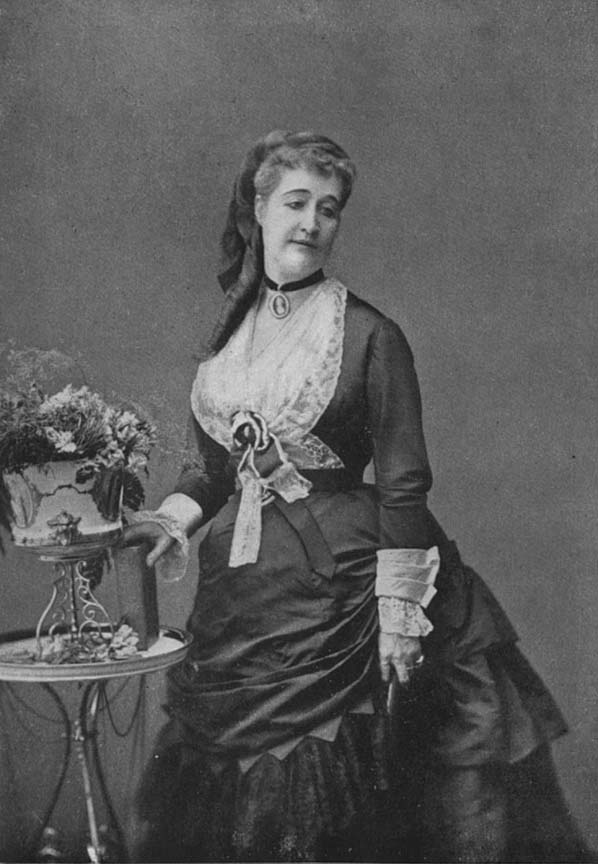
The Empress listened calmly to the speeches of the Deputies, and then, as if under the influence of a sort of inspiration, she replied:
"Gentlemen, you say the future can be insured on condition that I now, and at an hour of the greatest peril, abandon the post that has been confided to me. I must not, I cannot, consent to that. The future occupies me to-day the least of all things---I mean, not, of course, the future of France, but the future of our dynasty. Believe me, gentlemen, the trials through which I have passed have been so painful, so horrible, that, at the present moment, the thought of preserving the crown to the Emperor, and to my son, gives me very little anxiety. My only care, my only ambition, is to fulfil to the utmost the duties which have been imposed upon me. If you believe, if the Legislative Body believes, that I am an encumbrance, that the name of the Emperor is an obstacle, and not a source of strength in the attempt to master the situation and organize the defense, then you ought to pronounce the dethronement; and if you do, I will not complain, for then I shall be able to leave my place with honor. I should not, in that case, have deserted it. My honor, my duty, and, above all, the interests of the country in the presence of a triumphant enemy, require that the integrity of the Government should be maintained. I shall remain till the very last moment where I have been placed, faithful to my office. Were I to do otherwise, like a soldier who deserts his post in the hour of peril, I should betray the trust the Emperor has confided to me. I am persuaded that the only sensible and patriotic course the Representatives of the country can take, will be to gather around me and around my Government, to leave aside, for the moment, all questions of party, and to unite their efforts strictly with mine in order to meet the invasion."
After these words, the Empress recalled to the Deputies the noble behavior of the Cortes of Spain in Cadiz, who remained true to their captive King, and who were rewarded for their unchangeable devotion and their energetic perseverance by the final triumph of their cause.
"As for myself," she continued, '' I am ready to meet all dangers, and to follow the Legislative Body to any place where it may decide to organize the defense; and even should a defense be found impossible, I believe I might still be useful in obtaining the most favorable terms of peace.
"Yesterday the Representative of a great Power proposed to me to secure the mediation of the neutral countries upon these two grounds: 'Integrity of the French territory, and the maintenance of the Imperial dynasty.' I answered that I was disposed to accept a mediation upon the first basis, but I energetically refused it upon the second. The preservation of the dynasty is a subject which regards France alone, and I will never permit foreign Powers to interfere with our interior affairs."
Although these words of her Majesty made a great impression upon the persons present, M. Daru insisted that the Empress should leave her post, and he undertook to prove that, if her Majesty did not willingly resign her place, sooner or later she would be forced to do so; while by her spontaneous resignation, he argued, strength would be given to the Legislative Body as well as to the new Government, and thus the country might be saved.
The objection of the Empress to the plan proposed was that she could not accept it without seeming to desert her post at the moment of danger. "In case it is considered that the retention of the Executive power in my hands is an obstacle to the union of the French people, and prejudicial to the defense, do you think, gentlemen, that it would be a great pretension, on the part of a woman who should voluntarily give up a throne, to ask of the Chamber permission to remain in Paris---in any place that might be assigned to her, provided she might be permitted to share the dangers, the anxieties, and the suffering of the besieged capital?
"Do you believe then,'' she continued, "that it is agreeable to me to hold on to the powers of the Government?" and, hesitating for a moment, she added, in a voice expressing deep feeling, "Yes, you have seen me the crowned sovereign of your holidays. Nothing hereafter can soften the bitter memory of this hour. All the mourning of France I shall carry forever in my soul."
Pressed on all sides, yielding rather than persuaded, her Majesty finally declared that if the Council of the Regency and her Minister of War approved of the act, she would resign.
"You desire it, gentlemen," she said; " it is not the way I have regarded it; but I leave aside all personal considerations; only I wish to act in a regular manner. I wish that my Cabinet should be consulted. If my Ministers agree with you with respect to the course you propose that I should take, I shall make no opposition.
"Speak to M. de Palikao, gentlemen. If he agrees to my resignation, and if he thinks it necessary, I will tender it."
"Then you do permit us," said M. Buffet, "to announce this decision to the Assembly, and to M. de Palikao?
Yes," answered the Empress, "you may go and do so."
The Delegates now rose to retire, each one of them bowing low before her, who was still their sovereign, and who took leave of them, extending her hand to each, which they kissed with emotion. "My eyes were filled with tears," said M. Buffet, "as I came away after having witnessed such magnanimity and disinterestedness."(41)
The perfect calmness and self-possession maintained by the Empress from the beginning to the end of this interview greatly impressed all the members of the Deputation; and especially when, in the midst of the interview, a young man came into the salon without having been previously announced, and cried in a loud voice, "They are there in the Place de la Concorde!" The members of the Deputation were startled by this sudden, sharp cry of alarm; but her Majesty remained unmoved.
When the Deputation reentered the Palais-Bourbon, the sitting had just been suspended, and the committees had retired to their bureaus in order to deliberate upon three different propositions: one made by General de Palikao, another by M. Thiers, and the third by M. Jules Favre. It was therefore too late for the President to submit a new proposal to the Chamber, and the Delegates, in consequence, had to report separately, in their respective committee-rooms, the result of their conference with the Empress.
When the decision of the Empress became known to the members sitting in committee, the last cause for hesitation was removed, and the proposition of M. Thiers was, with a small amendment, adopted by the majority. This proposition, after its modification, read as follows:
"In view of the circumstances, the Chamber will proceed to choose a Government Commission for the National Defense. It shall consist of five members, to be elected by the Legislative Body. This Commission will appoint the Ministry. As soon as the circumstances shall permit, the nation will be called upon to elect a Constituent Assembly, the duty of which shall be to decide upon the form: of Government."
A little after two o'clock the Deputies reentered the Audience Chamber, but, to their astonishment, they found it occupied by the mob. The galleries of the Chamber had, ever since noon, been crowded with agitators from the faubourgs; and when, at 1.30 P.M., the Deputies retired for deliberation, these individuals went out upon the peristyle of the building, in order to put themselves in communication with the throng that filled the streets around the Legislative Palace, and had gathered on the Bridge and on the Place de la Concorde.
About twenty minutes later, a band of rioters, led by "Pipe-en-Bois," a burlesque celebrity of the time, forced its way into the building; and, in spite of the firmness of M. Schneider, the President, who kept his seat -and tried to maintain order, the Audience Chamber was soon filled with insurgents, some armed and in uniform, and some in blouses, a motley mob of men and boys, screaming" Vive la République! " " Déchéance! '' and rending the air with their clamor. They even pushed in among the benches of the Deputies, so that when the latter returned they found most of their seats occupied.
The tumult increased from moment to moment. Notwithstanding the efforts of M. Schneider, and the appeals of Gambetta and other leaders of the Opposition, the order necessary for the transaction of business could not be restored; the voices of the speakers were drowned by the hooting of the mob, and the president, putting on his hat, was compelled to suspend the sitting.
The reader naturally will be astonished to learn that no military force was used to protect the Legislative Body; that no guard had been kept there as a precautionary measure, and that when, the mob having assembled, the Governor of Paris was sent for, he did not appear. In fact, General Trochu did not make the least effort to interfere with the invasion of the Palais-Bourbon; nor with that of the Tuileries, which, as will be seen, was the object of a formidable demonstration shortly afterward.
It is not necessary that I should give my opinion with respect to the conduct of General Trochu on this occasion. Napoleon III. described it as "flagrant treason."
In a pamphlet published shortly before his death, entitled "Les Principes par un Ancien Diplomate," the Emperor speaks of General Trochu as follows:
"There we have a military man who has sworn allegiance to the Emperor, and who receives from him at a moment of supreme importance the greatest mark of confidence. He is appointed Commander-in-Chief of all the forces assembled in the capital. His duty is to watch over the life of the Empress. And this man, who on the morning of the 4th of September declares to the Regent that any one attempting to approach her will have to pass first over his body, permits the Palais-Bourbon and the Tuileries to be invaded; and, but a few hours after his solemn protestation, usurps the power, and declares himself President of the Government of the National Defense.
"Never has there been a treason committed more black, more flagrant, more unpardonable; for it was committed against a woman, and at the time of a foreign invasion. And this man, who must be called a traitor---for this name he deserves--seems nevertheless to enjoy general esteem. He is elected in several departments to the National Assembly by ignorant voters, and people do not blush to shake his hand; they even make him President of the Commission that has to decide upon points of honor.
"Does not this fact plainly demonstrate that we have lost our moral sense? What a contrast between this and an event which happened in the sixteenth century!
"When the Constable of Bourbon, who had conspired against Francis I, went to Spain, Charles V. obliged one of the gentlemen of his Court, the Marquis of Villena, to lodge the Constable. The Marquis obeyed. But when his guest had departed, he burned down his house, declaring that he had no wish to preserve a house which had given shelter to a traitor."
These are the words of the Emperor. And in order that the reader may decide whether they contain a just judgment, I will give an account of the proceedings of General Trochu on the 4th of September, basing my narrative upon official documents.
In the Cabinet Council that was held on the morning of the 4th, and which I have mentioned above, General Trochu had been warned by the Empress that an insurrectional movement would in all probability take place. At half past one o'clock he was informed by M. Vallette, the Secretary-General to the President of the Legislative Assembly, that M. Schneider feared there might be an outbreak. Toward two o'clock, General Lebreton, Questor of the Assembly, feeling very great anxiety on account of the attitude of the Gardes Nationaux and the indications of unusual popular excitement, went personally to the Governor of Paris in order to inform him of the gravity of the situation. When he arrived at the Louvre he was at first told that the Governor could not receive him, as he was very busy. M. Lebreton, however, insisted, and was finally admitted into his presence. He stated to General Trochu that the mob were surrounding the Palais-Bourbon, and that some of the leaders had already entered the building. He implored him to go at once to this place of danger, as his presence was necessary, and for the reason that he alone, by his immense popularity, would be able to keep order and protect the national Representatives. General Trochu answered that it would be impossible for him to do so, alleging that for several days his popularity had been decreasing, and that General de Palikao, the Minister of War, had succeeded in annihilating him completely.
"At present it is too late," he said; "I cannot do anything." To which M. Lebreton replied, "No, it is not too late; but there is not a moment to be lost"; for he was perfectly persuaded that the presence of the Governor would be sufficient to prevent all trouble.(42)
At last General Trochu agreed to go; and when the Questor saw him off, he had no doubt that he would go to the Palais-Bourbon to deliver the Assembly from the threatening danger.
In fact, General Trochu, accompanied by two officers, started on the way towards the building where the Representatives were sitting. He passed through the Court of the Tuileries, went to the Place du Carrousel, from there to the Quay, which he followed until he arrived at the Pont de Solférino, and then stopped and waited; because, as he said, "the crowd was too dense at this point for anybody to pass." M. Lebreton, who had left the Louvre at the same time, passed through this crowd without difficulty, and reentered the Palais-Bourbon. M. Jules Favre and several other Deputies were, at about the same time, also able to push through the crowd, and succeeded in making their way from the Palais-Bourbon to the Louvre.
Soon after the mob had broken into the Audience Chamber of the Legislative Assembly, Jules Favre, Jules Ferry, Kératry, and several other members bitterly hostile to the Imperial Government, decided to go to the Hôtel de Ville, there to proclaim the Republic and seize on the supreme power; and M. de Kératry remarked to M. Jules Favre "that he was certain he would meet on the way to the Hôtel de Ville, General Trochu, whose assistance would be necessary."(43) How M. de Kératry was sure that he would meet the General, we do not know, but the fact is that he and his associates did find the General waiting. "We met him," says M. de Kératry, on the Quay of the Tuileries, in front of the Conseil d'Etat, on horseback, surrounded by his staff. It was evident that he was waiting there for the development of events."
M. Jules Favre, accosting him, said: "General, there is no longer a Legislative body. We are going to the Hôtel de Ville. Be so good as to go back to the Louvre. We will communicate with you there."
Upon this the Governor quietly returned to the Louvre. On his way he, of course, had to pass the Tuileries, where the sovereign was to whom he had sworn in the morning that no one should approach her except over his dead body. Half an hour later the Tuileries were threatened by the rioters; and no one being there to defend the Empress, her Majesty, as will be stated in a subsequent chapter, was obliged to leave her palace as best she could.
About four o'clock in the afternoon MM. Steenackers and Glais-Bizoin came to the head-quarters of the Military Governor to beg General Trochu to go to the Hôtel de Ville. The Governor took off his uniform, put on citizen's dress---as if he could lay aside his allegiance with his coat, as if duty were merely a question of clothes---and went.
When General Trochu arrived at the Hôtel de Ville, M. Jules Favre and his associates had already usurped the sovereign power and declared themselves to be the Government. On being informed of this, the General put the following question to the usurpers: "Will you protect these three principles: God, the Family, and Property?"
This question was answered affirmatively by M. Jules Favre and his colleagues.
"Upon this condition," General Trochu then added, "I am yours, provided you make me President of your Government. It is indispensable that I should occupy this post."
The new Government, knowing well that General Trochu would be necessary for the triumph of their cause, acceded to his wish without hesitation. And so General Trochu, who in the morning had been the Imperial Governor of the city of Paris, was in the evening President of the Insurrectional Government.
These are the simple facts regarding General Trochu's conduct on the 4th of September, 1870; and from these facts alone the reader can decide for himself whether or not the judgment which Napoleon III pronounced against the Governor of Paris is just.(44)
The condition of things that obtained in the Legislative Chamber after the close of the sitting and the departure of the Deputies and the members of the Cabinet, baffles description. National guards, workmen, vagabonds, thieves, and half-grown boys---the mob---in a compact mass crowded into every part of the Palais-Bourbon, shouting and howling and gesticulating in a wild tumult of disorder. Two young ruffians made a rush for the Presidential chair, and seated themselves in it at the same moment, one of them seizing the President's bell, which he rang with violence and for a long time. Others, standing on the desks of the Deputies, were haranguing the citizens," and urging them not to leave the building until the Republic had been reestablished as well as "proclaimed." The uproar increasing, an effort was made to clear the floor of the Chamber, but with small result; and the galleries remained full of people, centers of commotion and of noise; a hundred persons were speaking, but only occasionally could a word be heard---a word of rage or of insult---"à bas "---"conspuez Bonaparte-et sa femme." Soon cigars, pipes, and cigarettes were lighted, and a dense cloud of tobacco-smoke obscured the atmosphere. This pandemonium was kept up until it was too dark to see, when, the rioters having slipped away one by one, silence reigned instead in every room of the vast, somber, and deserted Legislative Palace, until, a few weeks later, it was filled with the wounded and the dying brought in from the battle-fields around Paris.
It was about four o'clock when the Prince de la Tour d'Auvergne returned to the Foreign Office from the Palais-Bourbon, which he had vainly endeavored to protect, and meeting there M. Clément Duvernois, said to him "What has taken place is terrible for the dynasty, but it is still more terrible for the country; because this morning we had the support of conservative Europe to enable us to conclude an honorable peace, and this afternoon we have lost it."(45)
We have seen how the Palais-Bourbon was invaded on the 4th of September. Let us now see what took place on this memorable day at the Luxembourg.
Here, at half past twelve o'clock, the session of the Senate is opened under the Presidency of M. Rouher.
A Senator, M. Chabrier, immediately mounts the Tribune, and says that he desires to send his "last good wishes and last homage to the Emperor." He ends his speech with a phrase which has often been heard in France, " Vive l'Empereur!"
The Prince Poniatowski: " Vive l'Empereur!"
M. de Ségur d 'Aguesseau: "Vive l'Impératrice!"
M. de Flamarens, believing that the Deputies have already proclaimed the fall of the Empire, protests against this act, and declares it to be unconstitutional, and concludes with the exclamation, "Vive le Prince Impérial! Vive la Dynastie!
M. de Chabrier: "That is understood! "
Numerous voices: "Vive l'Empereur!"
M. Nisard: "Vanquished and a prisoner, he is sacred! " (Marks of approbation.)
After this the whole Senate cries together: "Vive l'Empereur! Vive l'impératrice! Vive le Prince Impérial! Vive la Dynastie!"
M. Rouher, in a voice trembling with emotion, makes a patriotic speech, which he closes with these words: "In presence of the gravity of these events, we shall know how to show the firmness of our purpose and a resolute and indomitable courage." (Applause.)
M. Quentin-Bauchart: "And a sense of our honor!"
M. Rouher: "I propose to the Senate to declare its sittings permanent!" ("Yes! yes!") "The sitting will be suspended, but will be opened again as soon as I have news from the Legislative Assembly. I ask the members of the Senate not to leave the building."
After this the Senators gather about the desk of the President, who is surrounded on all sides, and every one congratulates him on having so well expressed the heroic sentiments by which the Senate is animated. On the conclusion of this demonstration the members retire, full of patriotic feeling and with resolution in their faces.
When the news of the invasion of the Chamber of Deputies arrives, M. Rouher instructs the ushers to call the Senators together again; and it is as late as half past two o'clock when these ushers are seen, still rushing through the corridors, crying, "En séance, messieurs! en séance!
And now the President announces in a faltering voice that the mob has entered the Palais-Bourbon. Then he adds," Does the Senate wish to remain in session, although it is probable that no bill will be presented to us, for the Legislative Assembly cannot deliver it?
A good many of the Senators think that it would be just as well to retire; but MM. de Mentque and Ségur d 'Aguesseau declare that the Senate must remain in permanent session. M. Laradit agrees with them, and adds that it is necessary "to protest against the violence which prevents the Representatives of the people from deliberating calmly and freely"; and M. Emile de Girardin calls out that he is here in virtue of the Plebiscitum, a representative of 7,500,000 votes, and that he will not go out except by force. The sitting is again suspended.
After a pause of half an hour the sitting is resumed, and M. Rouher announces that he has just been informed that the mob has already taken entire possession of the Palais-Bourbon, and that deliberations there are for the moment impossible; and he adds: " I do not know what action the Senate will take, but, whatever it may be, it is my duty to protest against the invasion by force that has paralyzed the exercise of one of our great public powers." ("Hear! Hear!") "Now I am at the orders of the Senate to know whether you will remain in session, or whether you wish to adjourn, to meet again as soon as it is necessary. It is your right to make the decision, and I call for it."
Whatever the Senate may have wished, M. de Mentque persists in demanding that the Senators remain in their places. This time his proposition is received not with general approbation, but by what is called in French "des mouvements divers."
M. Rouher then says: "Were the mob at our doors, it would be our imperative duty to face it; but we are not menaced, nor can we deliberate. It is simply a question of dignity, which I shall not discuss; but I am ready to execute the will of the Senate."
M. Baroche agrees with M. Rouher; and while protesting against the assault on the independence of the Chamber of Deputies, and regretting that he cannot even die in the Senate Chamber, as he would like to do, says: "And now, what can we do? We can do nothing here. Perhaps we can render service to the country and to the dynasty outside, for I wish to speak loudly for the dynasty. (Applause.) Besides, by separating, we yield to force and not to fear, and our purpose is to defend, by our personal influence, order, and the Imperial dynasty to the very last moment."
M. de Mentque still tries to keep his colleagues together, and proposes to wait at least until 5 P.M. The proposition, put to a vote, is rejected. A night session is then proposed. With reference to this proposal, M. Rouher remarks that he will do what he can to call the Senate together, but that the convocation of the Senate in the night might not be accomplished without difficulty.
Several other propositions are made, and, while a confused debate is going on between the Senators Gressier, Dupin, and Haussmann, M. Rouher takes the occasion to leave the Senate Chamber. In his absence the Vice-President, M. Boudet, ascends the Tribune and closes the session with the words, "I request the Senate to come together to-morrow at the usual hour---two o'clock-unless the President should call us together sooner." A resolution to that effect is at once adopted, and the Senators adjourn at 3.30 P.M.
During the whole time this sitting lasted no mob had come to invade the Luxembourg. The Senators seemed to have been entirely forgotten by the people. The cause was the limited and entirely local character of the insurrection, as will be soon shown.
Late in the evening an anonymous communication was sent to the new Government, stating that there would be a night session of the Senate, in the Luxembourg Palace. Upon receiving this, M. Eugéne Pelletan, the only member of the new Government at that time present in the Hôtel de Ville, ordered M. Floquet, a representative of the Municipal administration, to seal up the doors of the Senate Chamber. In conformity with this order, M. Floquet, accompanied by two friends, went to the Palace of the Luxembourg, where he arrived toward ten o'clock. He was announced, and the Grand Referendary, M. Ferdinand Barrot, and General de Montfort, the Governor of the Palace, descended into the court to meet him. M. Floquet handed to the Grand Referendary, who was surrounded by two squadrons of gendarmes, the order of the insurrectionary Government. On receiving it, this gentleman replied, "I yield to force."
After having submitted to force, M. Barrot asked if he might remain in the palace, and if the Senators would be permitted to enter their committee-rooms to remove the articles belonging to them. M. Floquet answered in the affirmative, and while the Grand Referendary was retiring, began quietly to seal up the doors, and thus put an end to the existence of the Senate of the Second Empire.(46)