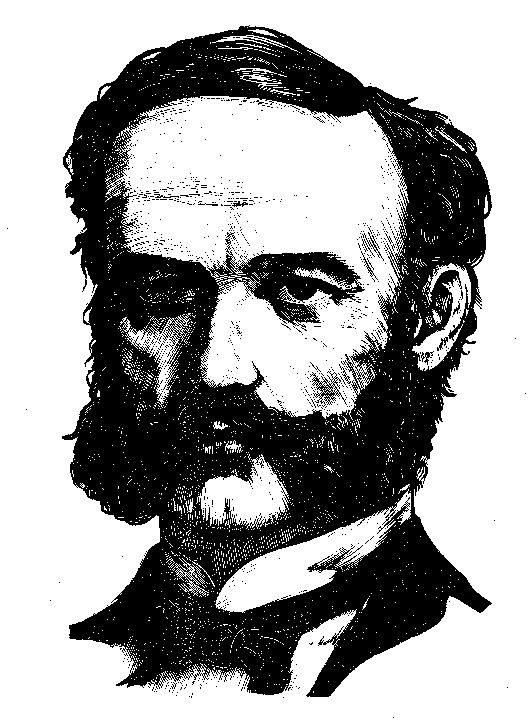
A Memory of Solferino was written and published in the year 1862. Its effect was astonishing. In an incredibly short period of time it was being read and discussed from one end of Europe to the other. Readers were shocked by Dunant's vivid and graphic descriptions of the violence and brutality of armed conflict. They were touched also by his account of the plight of the wounded and of the noble but pitifully inadequate efforts that he and his little band of helpers had made to aid the suffering. His proposals for ameliorating the condition of the wounded in future wars so impressed his audience that when national societies of the kind he envisioned would be organized they would not lack for volunteers. Efforts to get agreement among governments to give humane care and attention to the wounded, furthermore, would have many supporters in high places.
There were two reasons why Dunant's proposals met with such overwhelmingly favorable response. One was idealistic, the other practical. A wave of new humanitarianism had earlier swept across Europe. Great political and social changes were in progress. The cold callousness and indifference to human suffering of an earlier day had long since been replaced by a genuine concern on the part of many people for the well-being of mankind. People were more willing than before to give of their time and energies, as well as their substance, to help the unfortunate. Dunant's proposal that volunteers help attend and care for men wounded in battle was doubly appealing because it was patriotic as well as humane.
Many government and military leaders responded for a more practical reason. They needed no reminder from Dunant of the effect of new and modern weapons on the conduct of war, for they were quite aware that the steadily increasing destructiveness of armaments was sure to result in greater numbers of casualties in future wars. At Solferino, where nearly forty thousand men were killed or wounded in just fifteen hours of fighting, that fact had been made crystal clear. Dunant's proposals, it would seem, provided at least a partial solution to that problem. A reserve of trained volunteers, skilled in attending and caring for the wounded, that could be drawn upon when needed would be a valuable asset to any military establishment. Furthermore, there was little reason to believe that proclaiming voluntary auxiliaries neutral, and therefore not subject to violence or seizure, could be anything but advantageous.
So many persons became convinced of the merit of Dunant's proposals in so short a time that he did not have to wait long for the help and support that were needed to translate his concepts into reality.
Organization Begins
The first practical move was made in February 1863, when the Public Welfare Society of Geneva, a local philanthropic and charitable organization, appointed a temporary Committee of Five to take whatever steps it deemed necessary to begin the task of organizing societies of the kind Dunant had in mind. The names of the members are worthy of remembrance: The chairman of the committee was Gen. Guillaume Dufour, the highly regarded commander of the Swiss army. Two, L. P. Amidée Appia and Theodore Maunoir, were doctors. The fourth member was Gustave Moynier, a prominent lawyer of Geneva. The fifth was Dunant, who acted as secretary to the committee. Before their first meeting ended, they had decided that an international conference should be held to formulate a plan for organizing national relief societies. So filled with a sense of destiny were the members of the temporary committee that they decided then and there to constitute themselves as a "Permanent International Committee."
The first of two historic Red Cross conferences opened at Geneva on October 26, 1863. In the months preceding, Dunant had toured the capitals of Europe, seeking support for the conference and extending invitations to attend. The other members of the committee meanwhile worked on preparations. Thirty-six delegates from fourteen European states were on hand when the conference began. In just four days they succeeded in drafting a series of resolutions and recommendations that would be used later in organizing national relief societies for the care of the wounded in wartime. Before the year ended, the first society was organized---in the little kingdom of Wurttemberg, later destined to become a part of the German Empire. One after another society was formed in swift succession, and by 1875 there was one in almost every state in Europe.
It was evident even before this first conference that it could be only preliminary. A more important meeting would inevitably have to be held---a diplomatic conference to draft the terms of an international agreement that would provide for the protection and care of the wounded and recognize as neutral all those who attend and care for them. The Permanent International Committee had no authority to call such a conference. They could, however, and did, approach the Swiss Federal Government, which convened the conference and extended invitations to other governments to send representatives.
Diplomats of fifteen European states(33) were present on August 8, 1864, when the second historic conference opened at Geneva. After two weeks of discussion and work the conferees succeeded in drafting a convention or treaty that, when ratified and acceded to by governments, would bind its adherents to accord humane treatment to all sick and wounded of armies in time of war and to protect all those who attend and care for them. First to ratify the convention was France, on September 22, 1864. Others followed, and by 1870 every major power and most of the smaller states of Europe had joined the pact. Because of extensions that were made in later years, this treaty has become known in the Red Cross movement as the First Geneva Convention.
The Emblem and Name of the Red Cross
At the time of the conference of 1863 the delegates were fully aware that the volunteers might be in danger of their lives in battle zones unless they could be readily identified as noncombatants. Accordingly they decided that volunteers should wear a white armband emblazoned with a red cross. It is not clear who first suggested this unusual and striking device. What suggested it, however, appears to have been the Swiss flag, a white cross with arms of equal length in a field of red. By reversing the colors, the delegates not only created one of the best known symbols in the world today but also honored the Swiss, upon whose soil the conference was held.
It was inevitable that the symbol chosen would become quickly associated in the public mind with the organizations employing it and that the title "Society for the Relief of Wounded Combatants" would be replaced by the more easily remembered name "Red Cross Society." First to adopt and use the title officially was the Netherlands society in 1867. Other societies followed suit, but it was not until 1875 that the Geneva committee began to call itself the International Committee of the Red Cross.
Although the shape of the symbol identifying the Red Cross movement is that of a Greek cross, it has no particular religious significance. Some Moslem countries, however, to avoid misunderstanding among their people were early authorized to use a red crescent as the symbol of their societies. For similar reasons Iran (formerly Persia) uses a red lion and sun.
One of the recommendations made at the 1863 conference was that the delegates urge their governments to adopt a uniform, distinctive symbol for personnel of the medical corps of the army and a uniform flag for ambulances and hospitals. The arguments the delegates used must have been very persuasive, for Article 7 of the First Geneva Convention provides that "a distinctive and uniform flag shall be adopted for hospitals, ambulances, and evacuation parties [and that] an armlet may be worn by personnel enjoying neutrality but its issue shall be left to the military authorities [and that] both flag and armlet shall bear a red cross on a white ground."
Except in certain Moslem countries and Iran, as previously noted, the medical services of the armed forces of the governments bound by the Geneva Conventions use the red cross in a white field as an identifying and protective symbol for official medical personnel and chaplains; vehicles used for the transportation of the wounded; hospital ships, trains, and planes; dressing stations and field and base hospitals; and neutralized buildings or zones. The title "Red Cross" ("Red Crescent" or "Red Lion and Sun") in practice, however, is restricted to the societies themselves.
Because of the great significance of the symbol---whether Red Cross, Red Crescent, or Red Lion and Sun---and because of the respect widely accorded it as an identification and protection, many governments and all Red Cross, Red Crescent, and Red Lion and Sun societies zealously guard their symbols and make every effort to restrict their use to their armed forces medical services and to their national societies.
A full century has elapsed since the battle was fought at Solferino. It is almost a hundred years since the two historic conferences at Geneva. Within that period the Red Cross has become a world-wide voluntary organization noted for its work of compassion in behalf of the victims of war and disaster and for its peacetime health and welfare efforts in behalf of humanity. Within the century, too, the First Geneva Convention has been amended, extended, and more clearly defined until it now constitutes more than one-half of the body of international law pertaining to warfare. Practically every government in the world has now acceded to part or all of the Geneva Conventions. The Red Cross organization and the Geneva Conventions have been developed along similar lines and are closely interrelated. This is as it should be since both stem from the same source and are, to a considerable degree, interdependent.
The Red Cross organization in the year 1959 is composed of the following:
The International Committee of the Red Cross
The International Committee of the Red Cross is the direct successor of the Permanent International Committee, which was responsible for initiating organization of the movement in 1863. Members of the Committee are all citizens of Switzerland and may number as many as twenty-five. Although wholly Swiss in composition, its mission is world wide. As it has been from its beginning the Committee is nonpolitical, nonideological, and nonreligious in character, for its mandate is to carry on its operations with strict neutrality and without discrimination.
The International Committee acts as the guardian of the fundamental principles of the Red Cross and announces the recognition of new Red Cross societies. In time of war, including civil war or other internal disturbance, the Committee acts as a neutral intermediary between the opposing parties to aid victims of the conflict. It may act also as the neutral body through which communications and relief supplies of all kinds may be channeled to prisoners of war and other victims of war, civilian and military. From time to time, the Committee is called upon also to perform its services of communication and distribution of relief to victims of great disasters.
Traditionally, the International Committee of the Red Cross exercises the right to intervene in behalf of war sufferers. Furthermore, it works for the faithful observance of the Geneva Convention and takes cognizance of alleged violations of that part of international humanitarian law embraced by the Conventions. The Committee also concerns itself with the improvement and better understanding of the Geneva Conventions and prepares for their possible extension.
An important function of the Committee is to maintain in times of war and peace central information files on prisoners of war and on persons missing as a result of armed strife. Under an agreement with the governments and organizations that established the International Tracing Service, since 1955 the Committee has directed the Service and the performance of its important functions. Among them are locating and reuniting members of families who, as a result of war, confinement in concentration camps, and other events have lost touch with one another ; and issuance of certificates of death and of captivity or forced residence. These services of information and tracing are administered from the Committee's headquarters in Geneva.
The League of Red Cross Societies
The League of Red Cross Societies was founded in May 1919. Henry P. Davison, chairman of the War Council of the American Red Cross that, in effect, directed the society in World War I, was in large measure responsible for its formation. It was his idea to weld national Red Cross societies into a federation that would enable them to maintain close contact, to exchange with one another information about their experiences; and to bring about better coordination of effort, particularly in matters involving "the general welfare of humanity." When first organized, the League had twenty-six member societies. It now includes in its membership all the recognized Red Cross, Red Crescent, and Red Lion and Sun societies in the world.
The Board of Governors of the League, made up of representatives of member societies, prescribes in general the line of activities of the League and oversees its program. Prorated contributions by the member societies finance the League. Its affairs and activities are administered and directed by a secretary general appointed by the Board of Governors. Early in World War II, headquarters of the federation was moved from Paris to Geneva.
Representatives of the League and of the International Committee of the Red Cross meet frequently to keep each organization informed of developments in their respective fields of interest to the other. The League cooperates with its member societies in all phases of their activities, particularly those devoted to improvement of health, prevention of disease, and the mitigation of human suffering. Another function of the League is to channel equipment, supplies, and funds donated by member societies for disaster relief purposes. On several occasions in recent years, the League, at the request of the United Nations and of governments, has administered relief programs for victims of great disasters and for political refugees.
Composed of societies that embrace every race and religion and a wide divergence of political opinion, the League is a neutral body, free of all ties and prejudices.
National Red Cross, Red Crescent, and Red Lion and Sun Societies
In the year 1959 eighty-four states or nations throughout the world have recognized national Red Cross, Red Crescent, or Red Lion and Sun Societies, with an aggregate membership of 128,000,000. The societies, speaking generally, are composed of volunteer members and are voluntarily supported, and their fundamental purpose remains the same as it was when the movement began. To the extent that each is able, the societies recruit and train voluntary medical and paramedical personnel to serve, as required, in time of war as auxiliaries to the military medical services. They also produce, as needed, matériel essential to the care and comfort of the sick and wounded. At the request of their governments, some societies also organize, train, equip, and maintain ambulance and field and base-hospital units to help care for the sick and wounded in time of war.
At the very beginning of the Red Cross movement Henri Dunant noted the similarity of conditions resulting from great natural disaster to those produced by war. He foresaw that, in its Red Cross society, each nation would have an organization in being and trained manpower that could as readily help care for the victims of disaster as victims of war. First to use its manpower and resources extensively for a peacetime purpose was the American Red Cross in a series of disasters of considerable magnitude that occurred shortly after the American society was organized in 1881. Under the leadership of Clara Barton, its first president, the American society demonstrated the facility with which the resources of the Red Cross can be swiftly mobilized and effectively used to relieve suffering not associated with war. Today many Red Cross societies carry on programs of disaster preparedness and relief.
In times of peace Red Cross, Red Crescent, and Red Lion and Sun societies pursue a bewildering variety of activities devoted to the health, safety, and well-being of the people of the world. Some programs are preventive, some alleviate. Predominant, however, are educational and training programs that fit participants to take better care of themselves or to care for others. Training in first aid and in care of the sick and injured, for example, are two programs that serve a double purpose. People who take Red Cross training of this type not only are prepared to help care for the sick and wounded in time of war and disaster, but they may also use the knowledge and skill thus acquired to care for sick persons and victims of accidents in time of peace.
The International Red Cross
The International Red Cross is composed of the International Committee of the Red Cross, the League of Red Cross Societies, and the national Red Cross, Red Crescent, and Red Lion and Sun societies of all nations or states that accept the Geneva Conventions.
The International Red Cross Conference
The International Red Cross Conference is the highest deliberative body of the International Red Cross. Normally, it is convened every four years. The conferees are representatives of (1) governments that have signed the Geneva Conventions, (2) recognized national Red Cross, Red Crescent, and Red Lion and Sun societies, (3) the International Committee of the Red Cross, and (4) the League of Red Cross Societies. In effect the conference is at once an assembly and a forum to exchange and reconcile views, thus insuring unity of effort among all governments and Red Cross organizations in matters of common interest and world-wide significance.
The Standing Commission of the International Red Cross
The Standing Commission of the International Red Cross is composed of members elected by the International Conference and of representatives of the International Committee and the League of Red Cross Societies. Between Conferences the Standing Commission works for coordination and harmony of effort between the organizations of the International Red Cross. It also determines the agenda for each International Conference and collaborates with the society acting as host in preparation for the meetings.
The Geneva Conventions
The original treaty adopted in 1864---frequently referred to as the First Geneva Convention---was concerned primarily with land warfare. Another convention promulgated in 1899 extended to the sick, wounded, and shipwrecked victims of naval warfare and to those attending and caring for them the protection guaranteed to land forces by the first treaty. As a result of experience gained largely in World War I, there was presented in 1929, a convention to protect prisoners of war and to insure their proper treatment while in captivity. Finally, in 1949, the earlier versions of these humanitarian conventions were brought up to date and elaborated, and there was added a fourth convention for the protection of civilians detained in an enemy country, or in territory occupied by an enemy in time of international or civil war, and to give them certain rights.
As the Geneva Conventions stand today, their intent and purpose are to prevent wherever and whenever possible the inhumanities and injustices that are so often associated with armed conflict. They are designed not only to protect, but also to assure the humane treatment and uphold the dignity of persons who in time of war came under the control of a hostile power. In part also they attempt to prevent wanton and senseless seizure and destruction of property. Governments that accept the Geneva Conventions in effect bind themselves voluntarily to adhere to an international humanitarian code setting forth the high moral standards expected of the governments of civilized peoples who tragically find themselves at war.
In part, the great strength of the Red Cross movement is derived from its universality and from the readiness and willingness with which societies come to the aid of one another. This practice was established in principle by Article 5 of the resolutions adopted at the conference held in October 1863, as follows: "They [societies of belligerent nations] may call for assistance upon the committee of neutral countries."
Times without number in the nearly one hundred years that Red Cross has existed, whenever a society has been confronted with needs to which its own resources have been inadequate, its sister societies have given help to sustain efforts on behalf of those in distress. In times of war and of great disaster, societies have contributed to one another both money and matériel and, when necessary, have also provided technical advisors and additional manpower.
Because of the relationship and understanding existing between many governments and their national societies, governments also frequently choose to channel assistance given from their resources to stricken people in other countries through their Red Cross, Red Crescent, or Red Lion and Sun society. On occasion government facilities, especially means of transportation, have been made available to expedite badly needed supplies and personnel to the scene of a disturbance or disaster where a Red Cross (Red Crescent or Red Lion and Sun) relief operation has been in progress.
In the nearly one hundred years since the First Geneva Convention was offered the nations of the world, there have been many violations of the Conventions by powers at war. If there should be future wars, undoubtedly there will be many more infringements. In most cases, however, they have been due to the imperfections of man rather than to inadequacies of the law. There can be no doubt that, in the hundred years since Solferino, millions of persons have been spared much needless misery, degradation, and suffering in wartime, and that uncounted numbers of lives have been saved because of the existence of the Geneva Conventions.
The world-wide organization of the Red Cross, the Geneva Conventions, and the way in which governments and the Red Cross can and do cooperate for the benefit of suffering humanity attest to the greatness of the idea and the ideal conceived by Henri Dunant a century ago. Few men in history have a nobler or more enduring monument by which to be remembered.
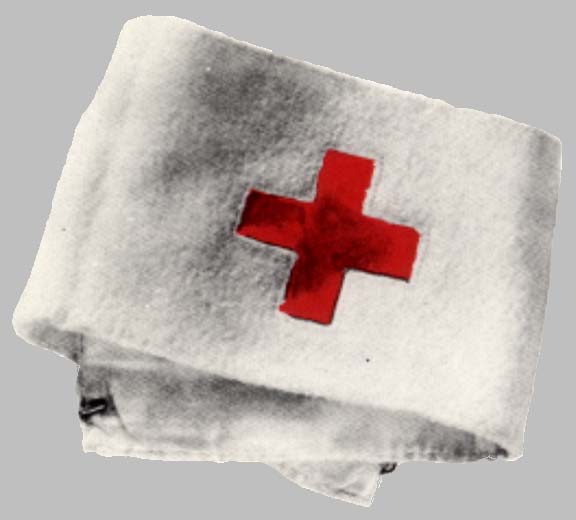
The Genevese physician and surgeon Dr. L. P. Amidée Appia wore the Red Cross armlet pictured here in 1861, in the war between Prussia and Denmark. It was the first time the emblem of the Red Cross ever appeared officially on a. battlefield. Only five years had passed since Dunant had seen the wounded at Solferino die by the score for lack of attention. At the preliminary international conference called by the Committee of Five, the idea of the Red Cross had been expounded to representatives of various lands, and a common, distinctive sign for ambulance services proposed: a reel cross on a white field. Upon the outbreak of the first war after the date of the conference, Dr. Appia went out to test the value of the new symbol. A representative was also on the Danish side. The emblem passed the test. It gained a hearing for Dr. Appia with both the military and civilian authorities. The armlet is in the possession of the International Committee of the Red Cross.